
Air Fryer Conversion Calculator: Oven to Air Fryer Time and Temp
Set your oven temperature and time, pick what you are cooking, and get the air fryer setting for your machine. The short rule: lower the temperature by 25°F (15°C) and cut the time by 20 percent. The calculator fine tunes that for your food and your air fryer.
 By Sujata ThapaEvery setting tested in our own kitchen · Free, no signup
Convert your recipe
Enter the temperature and time your recipe calls for. Pick what you are cooking and the machine on your counter, and the setting updates as you go.
First time? Check at 20 min. Trust a thermometer over the clock.
Why these numbers
The toast test
Air fry one slice of white bread at 350F for 3 minutes. No oil, no flipping, nothing else in the basket. Then look at what came out and pick the closest match.
Saved in your browser, so the calculator stays calibrated to your machine every time you come back.
It adjusts for what you are cooking and the model on your counter, not just the flat "subtract 25 degrees" rule. Conventional and fan ovens, Fahrenheit, Celsius and gas marks, and it converts back the other way too.
Settings already tested in our own recipes:
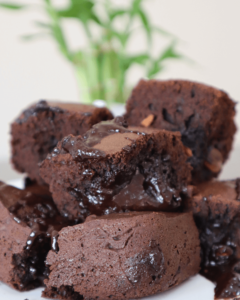
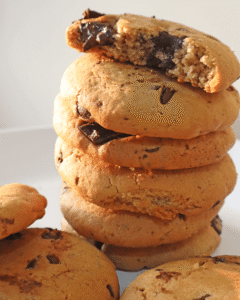
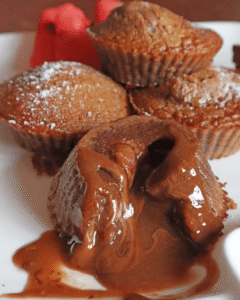
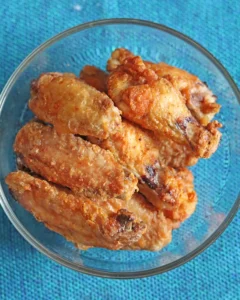
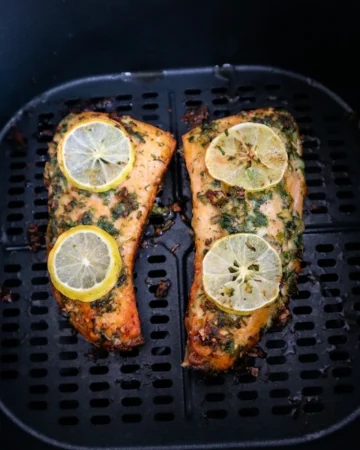
Real recipes we tested these settings on. See all
How to convert an oven recipe to an air fryer
Quick answer: lower the oven temperature by 25F (about 15C) and cut the time by 20 percent. A recipe that says 400F for 30 minutes becomes roughly 375F for 24 min in a basket air fryer. Cakes and cookies need a slightly deeper temperature cut, frozen foods need a smaller time cut, and the calculator above tunes both for your food and your machine.
That rule is a decent average and it is where the calculator starts. But an air fryer is really a small, aggressive convection oven. The fan strips away the thin layer of cooler air that normally sits against your food, so the outside browns much faster than the middle cooks through. How much faster depends on what you are cooking and which machine you own, which is why one flat rule leaves so many bakes raw in the center or scorched on top. If convection is new to you, what an air fryer actually is explains the fan in plain English.
Oven to air fryer conversion, step by step
Drop the temperature
Take 25F off the oven temperature for most foods. For cakes, cookies, brownies and pastry, take off 30F instead. The extra five degrees buys the crumb enough time to set before the top does.
Cut the time
Multiply the oven time by 0.8. Thirty minutes becomes 24. For frozen foods multiply by 0.92 instead, because the times printed on the bag already assume some fan assistance.
Adjust for your machine
Compact baskets cook fastest. Oven style and toaster oven air fryers have a larger cavity, so cut the time by 12 to 15 percent rather than 20. High wattage baskets like the Cosori TurboBlaze and Ninja MAX run hot, so trim a few extra degrees.
Check early, every time
Open the basket at about 85 percent of the converted time and look. Air fryers brown the outside fast enough that color alone will fool you, so confirm doneness with a probe thermometer on anything with meat in it.
Give the food room
Hot air has to circulate. A crowded basket steams instead of crisping, and no conversion math fixes that. Cook two batches rather than one crowded one. It is the first of the five rules in our beginner guide to using an air fryer.
Three adjustments the flat 25F rule ignores
What you are cooking
Cakes and cookies need a deeper temperature cut, closer to 30F, so the top does not set before the crumb does. We learned this over more than a few domed, cracked bakes. Dense casseroles behave the opposite way and need slightly longer at the standard cut. Frozen foods need the smallest time reduction of anything on the list.
Basket or oven style
Compact baskets concentrate heat in a small space and move air fast. Oven style units like the Breville Smart Oven Air have a bigger cavity and lower air velocity, so we cut the time by only 12 to 15 percent instead of 20. Paddle machines stir the food for you, which evens out cooking without you shaking anything. Still choosing a machine? The size guide covers capacity for 2, 4 or 6 people.
Your specific model
Higher wattage baskets like the Cosori TurboBlaze and Ninja MAX run hot, so the calculator trims a few extra degrees when you pick them. Dual zone Ninjas behave like a standard basket per drawer, so use match cook to get both drawers finishing together.
Wattage itself is a rough guide rather than a rule. A 1,700 or 1,800 watt basket recovers heat faster after you open the drawer and preheats quicker than a 1,300 watt one, but two units with the same number on the label can still land 20F apart in real output, because the thermostat and sensor placement matter more than raw power. That is exactly why the calibration test below beats reading the spec sheet. If your panel is covered in preset icons, our settings and symbols guide explains what each one sets, and why a manual setting from this calculator beats them.
Why air fryers vary, and how to calibrate yours
Air fryers are not calibrated instruments. The dial sets a target and a thermostat cycles the element around it, so the real average temperature inside depends on the sensor position, the fan speed and how well the drawer seals. Two units of the same model can land in noticeably different places, which is why a recipe with hundreds of good reviews still comes out scorched in somebody's kitchen.
Rather than guess where yours sits, measure it. One slice of white bread at 350F for 3 minutes, no oil, no flipping.
Tell the calculator which one you got and it offsets every conversion from then on, and remembers it next time you visit.
Oven to air fryer conversion chart
Bookmark or print this for the most common oven temperatures. Times assume a basket style air fryer. For oven style units, cut the oven time by 15 percent instead of 20.
| Oven F | Oven C | Gas | Air fryer F | Air fryer C | Time |
|---|---|---|---|---|---|
| 300F | 150C | 2 | 275F | 135C | cut 20% |
| 325F | 165C | 3 | 300F | 150C | cut 20% |
| 350F | 175C | 4 | 325F | 160C | cut 20% |
| 375F | 190C | 5 | 350F | 175C | cut 20% |
| 400F | 200C | 6 | 375F | 190C | cut 20% |
| 425F | 220C | 7 | 400F | 205C | cut 20% |
| 450F | 230C | 8 | 400F* | 205C* | cut 15% |
| 475F | 245C | 9 | 400F* | 205C* | cut 10% |
*Most air fryers top out between 400F and 450F. When the converted temperature is above your unit's maximum, use the maximum and add 1 to 2 minutes for every 20F you could not reach.
Converting from a fan oven or convection oven
This is where most conversion tools get it wrong, because nearly all of them assume an American conventional oven. A fan oven already circulates air, so at the same dial setting it runs about 25F hotter in effect than a conventional oven. The gap to an air fryer is therefore much smaller.
Keep the temperature roughly the same as your fan setting and trim the time by about 10 percent. Do not take another 25F off, or you will underbake. Switch the calculator to fan oven mode and it applies the correct math automatically. Cooking from an old recipe card in gas marks? Select gas marks directly and the calculator handles both steps.
Converting from a toaster oven or a deep fryer
Toaster oven recipes convert exactly like conventional oven recipes: drop 25F and cut the time by 20 percent, because a toaster oven is just a small still-air oven. One check first: if yours has a convection or air fry button and the recipe was written for that mode, use the fan oven setting in the calculator instead, since the air is already moving. For which jobs each machine wins outright, see our air fryer vs toaster oven head to head.
Deep fryer recipes are the one direction where the time changes more than the temperature. Keep the frying temperature, usually 350F to 375F, and expect roughly double the time, because hot oil moves heat into food far faster than hot air ever can. Wings that deep fry in 10 minutes take about 20 in a basket. The trade is worth it for most people: no quart of oil, a fraction of the fat, and nothing to strain and store afterward. The spread between foods is wider than in any other conversion, so treat the number as a starting point and check early. Battered wet coatings do not survive the switch, but breaded and floured coatings crisp well with a light spray of oil, and the right high smoke point oil matters more here than anywhere else on the site. How much to use, food by food, is in do you need oil in an air fryer.
Air fryer to oven conversion
Flip the rule around. Add 25F (15C) to the air fryer temperature and add about 25 percent to the time. An air fryer recipe at 375F for 20 minutes becomes roughly 400F for 25 min in the oven. Bake on a preheated tray, or set a wire rack inside a sheet pan, to get back some of the crispness the basket gave you. The calculator has an air fryer to oven mode for exact numbers.
Tested air fryer settings from our recipes
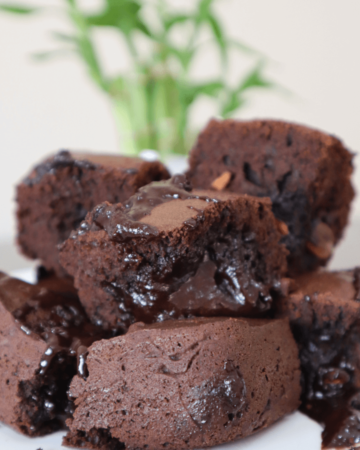
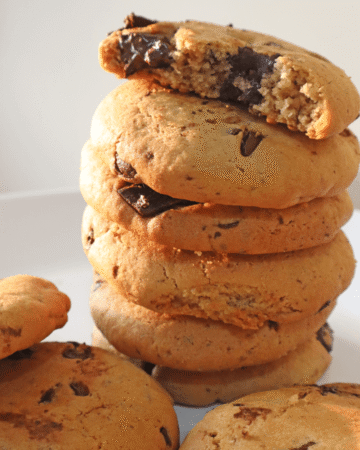
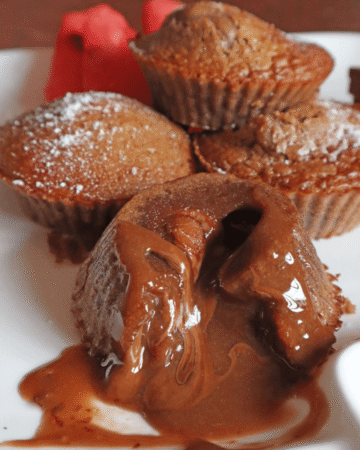
For the recipes below, skip the math. We baked and cooked each one in our own basket, so the temperature and time are the exact numbers on the recipe card.

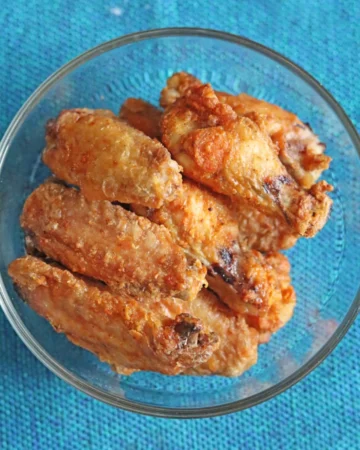
Air fryer cooking times for popular foods
Ready made settings for the foods people convert most often, with the USDA safe internal temperature where it applies. Flip or shake at the halfway mark unless the table says otherwise.
| Food | Temp | Time | Done when |
|---|---|---|---|
| Chicken breast, boneless | 375F / 190C | 16 to 20 min | 165F internal |
| Frozen chicken wings | 400F / 205C | 22 to 25 min | 165F internal |
| Frozen salmon fillet | 375F / 190C | 12 to 15 min | 145F internal |
| Pork chops, 1 inch | 380F / 195C | 12 to 14 min | 145F plus rest |
| Burgers, fresh half pound | 375F / 190C | 10 to 12 min | 160F internal |
| Frozen sweet potato fries | 400F / 205C | 12 to 16 min | Deep golden, shake twice |
| Potato chips, homemade | 360F / 180C | 15 to 18 min | Crisp, shake often |
| Broccoli or cauliflower | 375F / 190C | 8 to 10 min | Charred edges, tender |
| Chocolate chip cookies | 325F / 160C | 5 to 8 min | Set edges, soft middle |
| Brownies | 330F / 165C | 15 to 18 min | Moist crumbs on a pick |
| Carrot cake | 320F / 160C | 30 min | Clean skewer |
| Chocolate lava cake | 375F / 190C | 7 min | Set edges, molten center |
| Frozen french fries | 400F / 205C | 12 to 16 min | Golden, shake twice |
| Reheating leftovers | 350F / 175C | 3 to 6 min | 165F in the center |
| Bacon | 350F / 175C | 8 to 10 min | Crisp, drain the fat |
Baking something not listed? The full baking times and temperatures chart covers every bake on the site, and what you can and cannot bake will save you a couple of messy experiments. Cooking from the freezer aisle? Our frozen food chart covers 20 staples.
Air fryer baking, the conversion nobody gets right
Baking is the hardest thing to convert and the reason this site exists. Three rules on top of the standard math. Drop the temperature about 30F below the oven setting rather than 25F, so the top does not set before the middle. Keep the drawer closed for the first two thirds of the bake, because opening it early collapses anything with a delicate rise. Tent wet batters loosely with foil for the first half, then uncover to brown.
Two things the calculator cannot adjust for, because you decide them before any heat is involved. The first is the tin. A recipe written for a 9 by 13 will not fit a basket, and moving to a smaller pan makes the batter deeper, which needs longer at a lower temperature on top of the conversion. Our pan size calculator works out what actually fits. The second is quantity: once the pan is smaller you need less batter, and the recipe scaler gives you the amounts, including the awkward business of halving an egg.
If a bake comes out dry or scorched, our guides on avoiding dry bakes and preventing burning cover the usual causes.
Air fryer internal temperatures
Temperature and time both change when a recipe moves between appliances. The internal temperature at which a thing is actually cooked does not, because it is a property of the food rather than the oven. Egg protein sets where egg protein sets. So if you convert the dial and then finish on a thermometer rather than a clock, the conversion no longer has to be exactly right.
This is the step every other conversion calculator leaves out, and it is the one that stops a near miss becoming a ruined dinner.
| What you are cooking | Pull it at | Celsius | Why there |
|---|---|---|---|
| Cakes, cupcakes, muffins | 200 to 205F | 93 to 96C | Starch set, egg coagulated |
| Dense cakes, pound cake | 205F | 96C | Higher, or the base stays gummy |
| Quick breads, banana bread | 200 to 205F | 93 to 96C | Same as cake, just deeper |
| Fudgy brownies | 165 to 175F | 74 to 79C | Deliberately under a cake |
| Cookies | 185F chewy, 200F crisp | 85C / 93C | Fiddly, but calibrates your eye |
| Cheesecake | 150F in the center | 66C | Past 160 it weeps and cracks |
| Enriched bread, brioche, rolls | 190F | 88C | Soft crumb, still moist |
| Lean crusty bread | 200 to 210F | 93 to 99C | Needs to go higher to dry out |
| Fruit pie filling | 200F, or bubbling in the middle | 93C | Where cornstarch finishes setting |
| Chicken and poultry | 165F | 74C | USDA safe minimum |
| Ground meat | 160F | 71C | USDA safe minimum |
| Whole cuts of pork and lamb | 145F plus a 3 min rest | 63C | USDA safe minimum |
| Fish and seafood | 145F | 63C | USDA safe minimum |
The four meat rows are USDA safe minimums and are not negotiable. The baking rows are quality targets: a few degrees either side changes texture rather than safety. An instant-read thermometer costs about the same as two coffees and it is the single accessory that makes converting recipes reliable.
How these conversion numbers were built
Every temperature and time on this page came out of a real basket. We bake and cook each recipe in our own kitchen, record the setting that actually worked, and publish that number on the recipe card rather than a calculated estimate. The calculator's food type multipliers come from those results, cross checked against the manufacturer guidance published by Ninja, Cosori, Philips and Instant. Internal temperature targets follow USDA minimums, not eyeballed doneness.
Where we are uncertain, we say so. The model adjustments are the least precise part of the tool, because unit to unit variation within a single model is larger than the variation between models. That is exactly why the calibration test exists.
Air fryer conversion FAQs
How do I convert an oven recipe to an air fryer?
Drop the oven temperature by 25F (about 15C) and cut the time by 20 percent. So 400F for 30 minutes becomes roughly 375F for 24 minutes. Then refine for what you are cooking: bakes want a slightly bigger temperature cut, frozen foods a smaller time cut. The calculator at the top of this page applies those refinements for you.
What is 400F in an air fryer?
A 400F oven recipe works out to about 375F (190C) in a basket air fryer, with the time cut by roughly 20 percent. If your dial only shows Celsius, set 190C.
What is 350F in an air fryer?
A 350F oven recipe converts to about 325F (160C) in a basket air fryer, with the time cut by 20 percent. For cakes and cookies, go a little lower, around 320F, so the top does not set before the crumb.
What is 180C in an air fryer?
180C in a conventional oven is about 160C (325F) in an air fryer, with the time cut by 20 percent. If your recipe is written for a fan oven at 180C, keep the air fryer at 180C and cut the time by 10 percent instead.
What is 375F in an air fryer?
A 375F oven recipe converts to about 350F (175C) in a basket air fryer, with the time cut by 20 percent. For cakes and cookies drop a little further, to about 345F, so the top does not set before the middle does.
What is 425F in an air fryer?
A 425F oven recipe converts to about 400F (205C) in a basket air fryer, with the time cut by 20 percent. That is also the ceiling on most machines, so if yours tops out lower, use its maximum and add 1 to 2 minutes for every 20F you could not reach.
What is 450F in an air fryer?
A 450F oven recipe works out to 425F by the standard rule, but most air fryers top out at 400F. Set 400F (205C), cut the oven time by about 15 percent instead of 20, and check early. If your machine goes to 450F, use 425F with the normal 20 percent cut.
What is 325F in an air fryer?
A 325F oven recipe converts to about 300F (150C) in a basket air fryer, with the time cut by 20 percent. It is a common setting for cheesecakes and quick breads, where low, steady heat keeps the top from cracking before the middle sets.
What is 160C in an air fryer?
160C in a conventional oven is about 145C (295F) in an air fryer, with the time cut by 20 percent. If the recipe was written for a fan oven at 160C, keep the air fryer at 160C and trim the time by about 10 percent instead.
What is 200C in an air fryer?
200C is 390F, so a 200C oven recipe converts to about 185C (365F) in a basket air fryer, with the time cut by 20 percent. If the 200C recipe came from a fan oven, stay at 200C and cut the time by about 10 percent instead.
How do I convert a fan oven recipe to an air fryer?
Fan ovens already run about 25F hotter in effect than conventional ovens at the same dial number, so the gap to an air fryer is smaller. Keep the temperature roughly the same as the fan setting and trim the time by about 10 percent. The fan oven mode in the calculator does the exact math.
What gas mark is an air fryer?
Air fryers use degrees rather than gas marks, so you convert the gas mark to a temperature first and then apply the air fryer reduction. Gas 4 is 350F (175C) in an oven, which becomes about 325F (160C) in a basket. Gas 6 is 400F, which becomes about 375F. Select gas marks directly in the calculator and it handles both steps.
Can I bake cakes and cookies in an air fryer?
Yes, and it is the whole reason this site exists. Most cakes, cookies, brownies and quick breads bake well in a basket. Drop the temperature about 30F below the oven setting so the top does not set before the middle, and keep the drawer closed for the first two thirds of the bake. Wet batters need a loose foil tent for the first half. Our guide on how to bake in an air fryer walks through all of it.
Do different air fryer models really need different settings?
They do. Compact baskets cook fastest. Oven style and toaster oven air fryers need only a 10 to 15 percent time cut because of the larger cavity. High wattage models like the Cosori TurboBlaze run a touch hot. Pick your model in the calculator and the adjustment is built in.
Why does the same recipe work differently in my air fryer?
Because unit to unit variation is real. An air fryer dial sets a target and the thermostat cycles around it, so the real average temperature depends on sensor position, fan speed and how well the drawer seals. Two units of the same model can land in different places. Run the toast test described above, tell the calculator the result, and it will offset every conversion for your specific machine.
Do I need to preheat the air fryer?
Preheat 2 to 3 minutes for anything you want crisp: fries, wings, pastry. For cakes and delicate bakes, starting cold is fine and can help prevent over browning. If you skip preheating on crispy foods, add a minute or two. Our preheating guide covers when it matters for bakes.
How do I convert deep fryer recipes to an air fryer?
Keep the frying temperature, usually 350F to 375F, and roughly double the time, because hot oil transfers heat far faster than hot air. Wings that deep fry in 10 minutes take about 20 in a basket. Breaded coatings crisp well with a light spray of oil, wet batters do not survive the switch, and the spread between foods is wide, so check early. The deep fryer mode in the calculator applies this math for you.
How do I convert air fryer settings back to a regular oven?
Add 25F (15C) and add about 25 percent to the time. Switch the calculator to air fryer to oven mode for exact numbers, and bake on a preheated tray to get back some crispness.
What internal temperature should air fried food reach?
Poultry 165F (74C). Ground meats 160F (71C). Whole cuts of pork, lamb and fish 145F (63C) with a short rest. Air fryers brown the outside fast, so color alone will fool you. A cheap probe thermometer is the best air fryer accessory we own, and our accessories guide for bakers lists the rest.
Is this air fryer calculator free?
Yes. No signup, no email gate, and no limit on how many conversions you run.
Air fryer guides that pair with this calculator
The calculator gives you the number. These guides cover everything around it, from your first week with the machine to getting leftovers crisp again.
More free air fryer tools
Sujata Thapa
Sujata shares healthy, easy air fryer recipes learned through years of hands on cooking. Every guide and recipe here is tested in her own kitchen, so the temperatures and timings in this calculator work in a standard basket. Internal temperature targets follow USDA minimums.
Settings are a strong starting point, not a promise. Check a few minutes early and confirm doneness with a thermometer. USDA safe internal temps: poultry 165F, ground meat 160F, whole cuts 145F.