

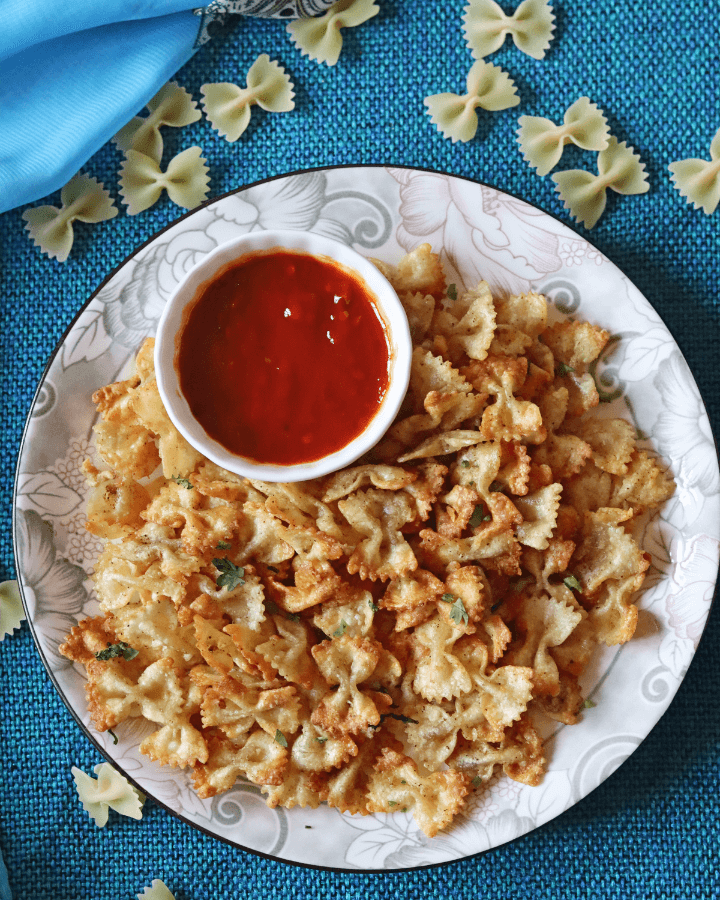
My first batch of these came out like little ceramic bow ties. Genuinely unpleasant to bite into. I followed a popular recipe exactly, and what I got was not a chip, it was a dried noodle with seasoning on it.
The second batch, from the same bag of pasta and the same bottle of oil, came out light and blistered and snapped when I bit down. The only things I changed were how long I boiled the pasta and how hot I ran the machine. That is the whole recipe really, and it is the part nobody explains.
Quick answer: Boil short farfalle two minutes less than the package says for al dente. Drain, dry it properly, toss with oil and seasoning, then air fry at 400°F (200°C) for 10 to 12 minutes, shaking at 4 and 8 minutes. Add most of the cheese in the last 2 minutes, not at the start. Eat them within the half hour, because that is how long they stay crisp.
A chip and a dried noodle are the same thing going two different ways
Cooked pasta is roughly two thirds water held inside a soft mesh of gelatinized starch. To turn that into a chip you have to get most of that water out. What decides whether you end up with a chip or a tooth-cracker is how fast it leaves.
- Slowly, at a low temperature or in a crowded basket where the pasta is really just steaming itself, and the starch mesh collapses inward as the water goes. Everything packs down tight and sets hard. You get something dense, glassy and genuinely difficult to eat. That is a dried noodle.
- Quickly, at a high temperature with real air gaps, and the water turns to steam faster than it can seep out. The steam pushes the starch open on its way out and leaves the holes behind. You get blisters, bubbles and a light porous structure that shatters. That is a chip.
Once you see it that way, every common complaint about this recipe sorts itself out. Too hard means the water left too slowly. Chewy means too much of it never left at all. Burnt on some pieces and soft on others means the pieces were not the same thickness, which brings us to the pasta itself.
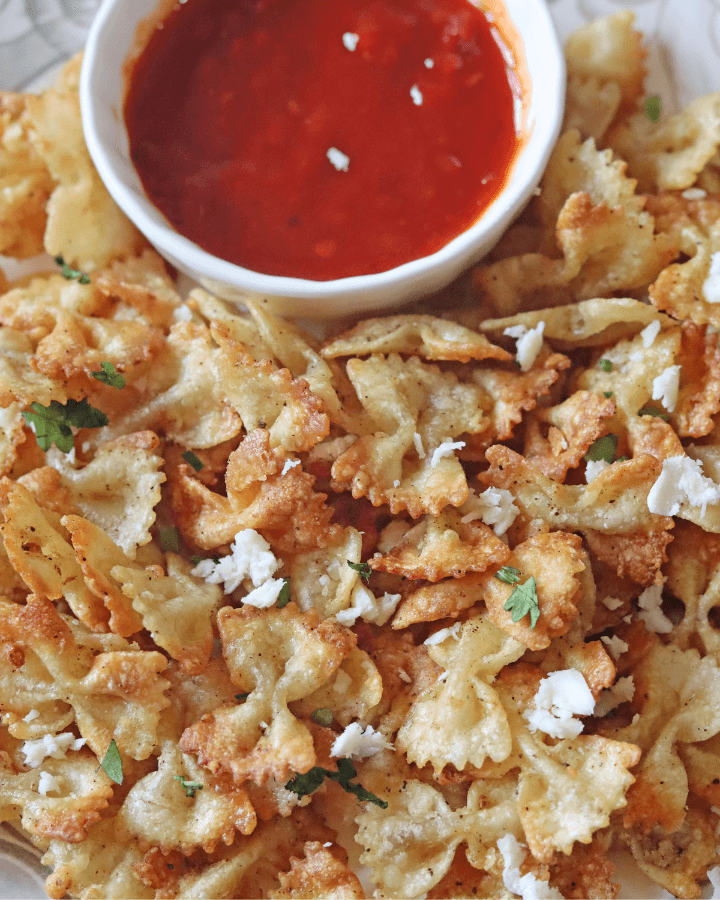
This is the same principle behind every crisp thing an air fryer makes well, and our guide on making bakes crispy in an air fryer works through why surface water is the enemy of every one of them.
Which pasta shape, and the problem with bow ties
Farfalle is the shape everyone uses, including in the photographs on this page, and it makes a good-looking chip. It also has a flaw that nobody mentions, and once you know about it you will notice it in every batch you have ever made.
The pinch in the middle of a bow tie is about three times as thick as the wings. That is not a small difference. By the time the wings are crisp and golden the knot is still holding water, so you get a chip with a chewy lump in the center. Push the batch further to fix the middle and the wings go from golden to bitter. This is the single most common reason people describe pasta chips as "some burnt, some chewy" in the same handful.
You can work with it, and I still use farfalle because I like the shape. Just know that bow ties want a couple of extra minutes and a lower finish, and that the center will always be a bit denser than the wings. If that bothers you, pick something with an even wall thickness instead.
| Shape | 400°F takes | What you get |
|---|---|---|
| Farfalle (bow tie) | 11 to 13 min | The prettiest chip. Crisp wings, denser center knot. Best for dipping flat. |
| Penne | 10 to 12 min | Even walls, very consistent. Hollow tube scoops dip well. |
| Rigatoni | 12 to 14 min | Thickest walls, sturdiest scoop, needs the longest. Stays a little chewy inside the tube. |
| Shells | 9 to 11 min | Crisp fast and hold sauce, but they nest inside each other and steam if you crowd them. |
| Fusilli | 10 to 12 min | Lots of surface area so plenty of crunch, though the spiral traps seasoning unevenly. |
Skip long shapes entirely. Spaghetti and linguine dry into brittle splinters rather than chips, and they are unpleasant to eat and awkward to dip. Skip fresh pasta too, since it has too much moisture and not enough structure. Plain dried semolina pasta is what this needs.
Boil it less than you think
Every recipe I found for this says to cook the pasta al dente. I would push back on that, and it is the change that made the biggest difference for me.
Al dente means fully cooked. But this pasta is about to be cooked a second time for twelve minutes. Boiling to al dente means the starch is already fully gelatinized and the pasta has taken on as much water as it is going to, and now you have to drive all of that back out again in a machine that is not especially good at it. The result is a piece that spends a long time slowly drying, which is the exact path to the hard dense version.
Boil two minutes short of the al dente time on the package. The pasta should still have a definite chalky bite when you drain it, the kind you would send back if it arrived on a plate. Less water went in, so less has to come out, and the chip crisps faster and finishes lighter.
Salt the water properly while you are at it. This is the only chance the inside of the chip gets to be seasoned, since everything you add later sits on the surface.
Ingredients
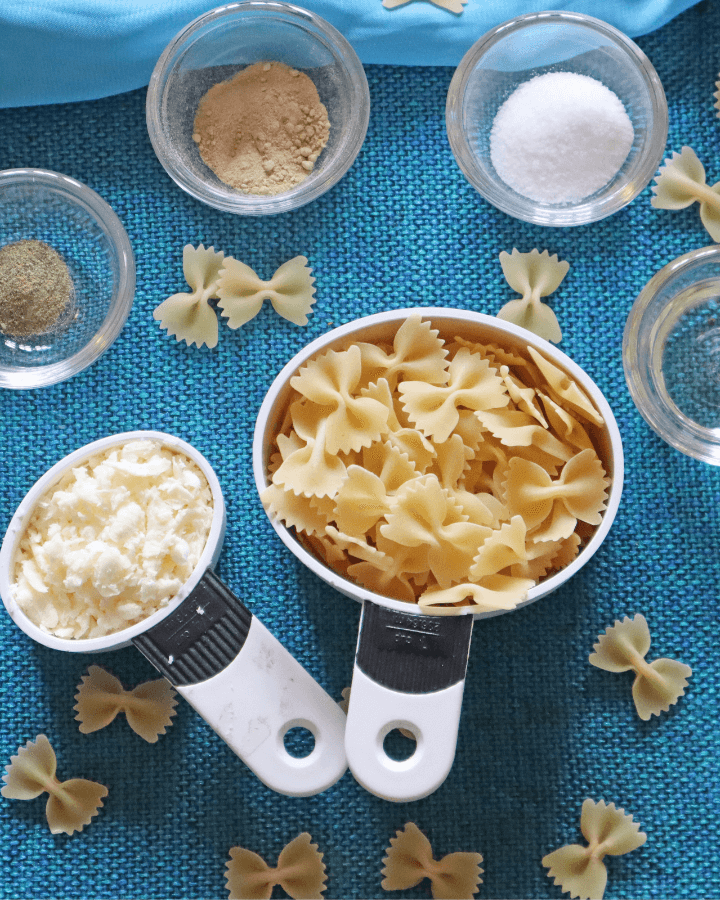
For the chips
- 1 cup short pasta (farfalle, penne or rigatoni)
- 2 tablespoons olive or avocado oil
- ¼ cup grated Parmesan
- 1 teaspoon garlic powder
- Salt, to taste
- Black pepper, to taste
On the oil: two tablespoons for one cup of dry pasta sounds like a lot and it is not. Oil does two jobs here. It carries heat into the surface faster than air alone can, and it is what actually makes the surface crisp rather than merely dry. Cut it in half and you get pale, leathery chips. If you want them lighter, use a spray oil and coat evenly rather than reducing the amount and coating patchily.
On the cheese: grate it yourself if you can. Pre-grated Parmesan is coated in cellulose or potato starch to stop it clumping in the bag, and those coatings do not melt. You get a chalky dusting instead of a browned crust. More on when to add it further down, because the timing matters more than the brand.
How to make air fryer pasta chips
- Boil the pasta two minutes short of al dente in well-salted water. It should still have a firm chalky bite.
- Drain and spread it on a clean towel in one layer. Pat the top dry too. Give it five minutes to steam off while you get everything else ready.
- Toss with the oil first, on its own, until every piece is glossy. Oil needs to reach the pasta surface, and it cannot do that through a layer of dry seasoning.
- Now add the garlic powder, salt, pepper and about a third of the cheese. Hold the rest of the cheese back.
- Preheat the air fryer to 400°F for 3 minutes. Putting pasta into a cold basket gives it several minutes of gentle warming, which is exactly the slow drying you are trying to avoid.
- Tip the pasta in and spread it out as evenly as you can. One layer if it fits, and cook in two batches if you want the best result.
- Air fry at 400°F for 10 to 12 minutes, shaking hard at 4 minutes and again at 8. Shake properly, do not just nudge the drawer. Pieces stick to each other and to the basket, and the ones underneath are steaming until you move them.
- Add the rest of the cheese for the final 2 minutes. It browns and clings without having time to turn bitter.
- Tip them straight onto a plate or rack, not into a bowl. A bowl traps the steam still coming off them and softens the batch you just made.
- Season again while hot and eat them. They are at their best for about half an hour.
Step five is the one people skip. Preheating matters more for this recipe than for most, and it is worth knowing which foods care and which do not, which our guide on preheating an air fryer sets out.
Getting the water off, and why patting matters
Water sitting on the outside of the pasta cannot get hotter than 212°F, and neither can the surface underneath it, because all the energy going in is being spent turning that water into steam rather than raising the temperature. Nothing browns and nothing crisps until it is gone.
So every bit of surface water you carry into the basket is time on the clock spent boiling rather than crisping, and that time is being paid for by the pasta slowly drying out from the inside. Which is, again, the hard dense outcome.
Patting dry is not fussiness, it is buying yourself two or three minutes of real crisping. Spread the drained pasta on a towel in one layer rather than piling it up, pat the top, and let it sit for five minutes. Warm pasta gives off a surprising amount of steam on its own if you let it.
Following an oven version of this recipe? Most of them run at 425°F for around 20 minutes on a sheet pan. Put those numbers through our air fryer calculator and you will get something close to the 400°F and 10 to 12 minutes here, which is a decent sanity check if your machine runs hot or cool. One adjustment the calculator cannot make for you: a sheet pan holds the pasta in a genuine single layer and your basket almost certainly will not, so add a couple of minutes and an extra shake to make up for it.
What actually fits, and what a real basket looks like
Every recipe for this tells you to use a single layer. Here is what a cup of dry pasta actually looks like once it is cooked and tipped into a standard basket.
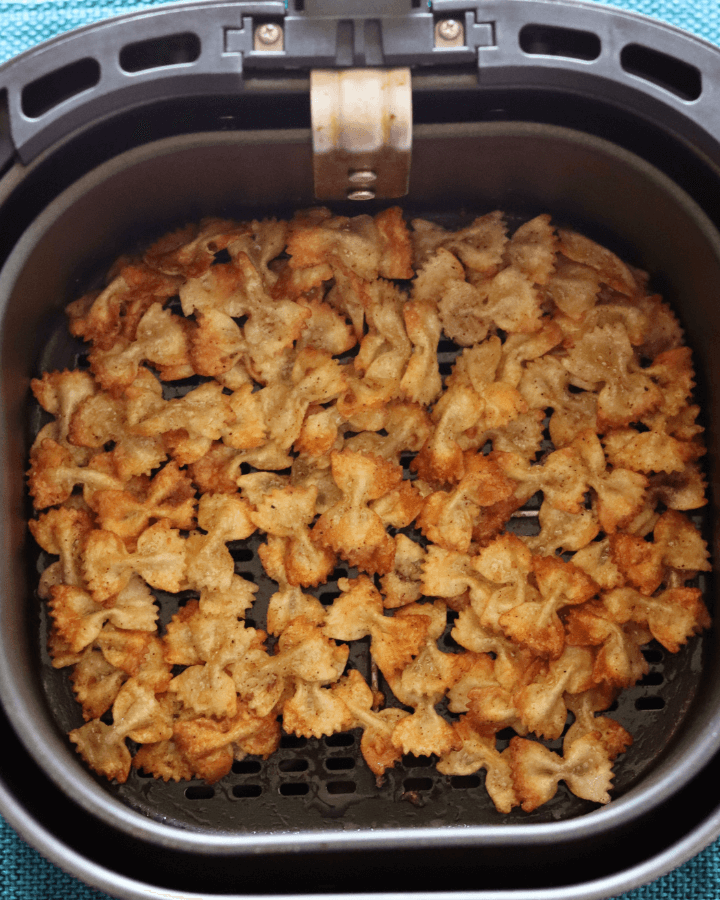
One cup of dry pasta comes out to roughly two cups cooked, which is about double what a 5 to 6 quart basket can hold in a true single layer. You have three honest options and they all involve a trade:
| Approach | Total time | Result |
|---|---|---|
| One full basket | 12 to 14 min | Fastest. Uneven, some pale pieces, needs more shaking. Perfectly good for a snack. |
| Two half batches | About 22 min | Genuinely even and crisp. What I do when people are coming over. |
| Oven-style, two racks | 12 to 14 min | One batch, single layer, even. Rotate the racks once. |
Pasta chips are about as single-layer as a food gets, which makes them a fair test of what your machine is shaped to do. A basket gives you depth you cannot use and a fan aimed at a heap. An oven-style unit gives you two flat racks and roughly triple the usable area, and for this specific recipe that is the difference between one batch and three. Our comparison of basket vs oven-style air fryers for baking goes through where each format wins, and flat spread-out food is the clearest case in the oven-style column.
Never overbake again
Get our one-page times & temps cheat sheet, plus a new tested recipe each week.
No spam · unsubscribe anytime
When to add the cheese
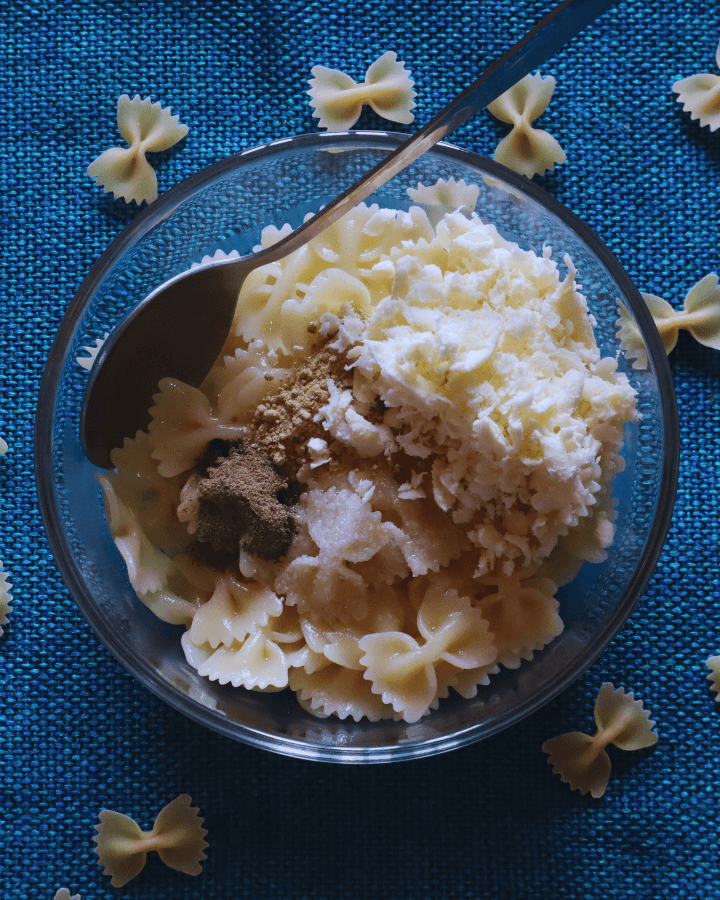
Almost every version of this recipe, including the one these photographs were shot for, puts all the cheese on before the pasta goes in. It works, and the chips are good. But you lose more of it than you think, in two ways.
- It falls off. Loose grated cheese on a smooth oiled surface does not stay put through two hard shakes. A good amount of it ends up on the basket floor, where it browns onto the mesh and gives you something to scrub later.
- Twelve minutes at 400°F is a long time for Parmesan. It is a dry, high-protein cheese and it browns quickly. Past a certain point the browning stops being nutty and turns sharp and slightly acrid, and it takes the whole batch with it.
Splitting it solves both. Put about a third in with the oil and seasoning, which is enough to season the pasta itself and to give you some cheese fused into the surface. Add the other two thirds for the last two minutes, where it melts and browns and clings, and then a little more over the top while they are still hot enough to catch it. You end up with visibly more cheese on the chip and none of the bitterness.
How long they actually stay crisp
Not as long as you would like, and this is worth being straight about because the storage advice attached to this recipe around the internet is optimistic. Five days in an airtight container is a number people copy from potato chip recipes. A pasta chip is not a potato chip.
Two things are working against you. Starch is hygroscopic, so it pulls moisture back out of the air, and unlike a fried chip there is no sealed fat layer to slow that down. On top of that, the inside of a pasta chip is never quite as dry as the outside, and over a few hours that leftover water migrates outward and softens the surface from behind.
- First 30 minutes: peak. Properly crisp, blistered, snaps cleanly.
- Two to three hours: still good, slightly less shattery.
- Next day: noticeably soft and a bit leathery, in an airtight container.
- Beyond that: not worth it, and they go stale-tasting as the oil oxidizes.
They re-crisp well though, which mostly solves it. Three to four minutes at 350°F brings a day-old batch almost all the way back, because you are only driving off reabsorbed surface moisture rather than starting over. Let them cool for two minutes afterwards, since they crisp as they cool rather than in the basket. Do not microwave them, which steams them soft and does not reverse.
Make them when you want to eat them. This is a twenty-five minute recipe and it is much better fresh than stored, so there is not much reason to make them ahead.
Fixing what goes wrong
They are rock hard and hurt to bite
The water came out too slowly. Usually that means the temperature was too low, the basket was too full so the pasta was steaming rather than crisping, or the pasta was boiled all the way to al dente or past it. Run 400°F, boil two minutes short, and cook in two batches.
They are chewy rather than crisp
Water still inside. Either not enough time, or too much moisture went in with them. Dry the boiled pasta properly on a towel before oiling, and give them another 2 to 3 minutes. Remember they firm up as they cool, so judge a chip that has sat for a minute rather than one straight out of the basket.
Some are dark and some are pale
An overlapping layer, which is what the basket photo above shows. Shake harder and more often, or split into two batches. Uneven browning is the honest cost of a full basket and shaking is the only thing that offsets it.
The middle of the bow tie is still soft
That is the pinched knot, and it is three times the thickness of the wings. Add 2 minutes and drop to 375°F for that stretch so the wings do not overtake it, or use penne, which has an even wall.
They taste bitter
Burnt cheese or burnt garlic powder. Both go bitter well before the pasta is done. Hold most of the cheese back until the last 2 minutes. If garlic is the problem, use granulated garlic rather than fine powder, since the finer it is ground the faster it scorches. Our guide on preventing burning in an air fryer covers the rest.
The seasoning all fell off
Dry seasoning went on before the oil, so it had nothing to stick to. Oil first, on its own, until everything is glossy. Then season.
They went soft within an hour
They were tipped into a bowl or a sealed container while still warm and steamed themselves. Cool them in a single layer on a rack or a plate and only bag them once they are completely cold.
Seasonings and dips
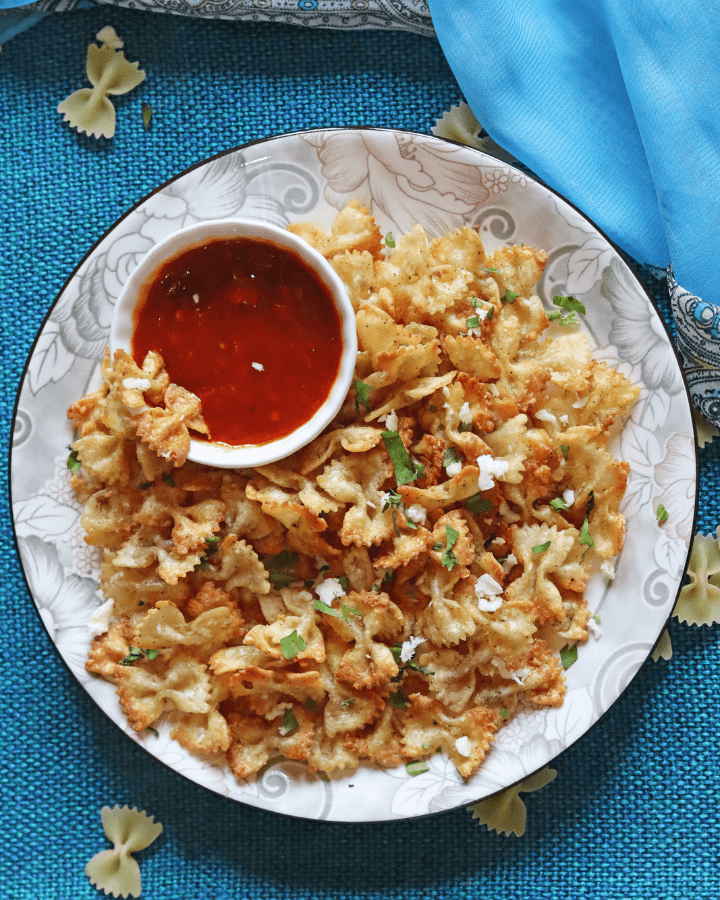
The base recipe is deliberately plain, since the seasoning is the easiest thing to change. A rule that holds for all of these: hardy dry spices can go in before the bake, but anything containing sugar, dairy or fresh herbs goes on afterwards while the chips are still hot and oily enough to hold it.
- Everything bagel: 1 tablespoon of seasoning tossed on after. The sesame and poppy seeds scorch if they go in early.
- Ranch: half a packet of dry ranch mix, added after. It has buttermilk solids in it that burn.
- Chili and lime: chili powder and cumin before, lime zest and a squeeze of juice after.
- Cacio e pepe: heavy on the black pepper before, all the Parmesan in the last 2 minutes.
- Cinnamon sugar: plain oil only going in, then toss in cinnamon sugar the moment they come out. Sugar added before the bake will burn onto the basket.
For dipping, marinara is the classic and it works because the acidity cuts the oil. Garlic aioli, ranch, whipped feta and a spicy tomato chutney all work. Warm the marinara, since a cold dip on a hot chip is a slightly sad combination.
If you like this sort of thing, our air fryer tortilla chips and crispy air fryer potato chips run on the same principle, and air fryer croutons are the closest relative of all, since they are also about driving water out of something soft until it snaps. For something sweeter in the same five-minute-snack category, air fried Oreos are the other recipe here that came off social media and turned out to be worth keeping. The full air fryer baking chart has times and temperatures for everything on the site in one place.
Frequently asked questions
QWhat temperature do you cook pasta chips in an air fryer?
400°F (200°C) for 10 to 12 minutes, shaking at 4 and 8 minutes. Higher is better here than the 350 to 375°F some recipes use, because a pasta chip crisps by losing its water fast. Slow water loss lets the starch collapse in on itself and sets hard, which is what makes pasta chips come out dense and tooth-cracking.
QWhy are my pasta chips hard instead of crispy?
The water left too slowly. A crisp chip forms when steam escapes fast enough to push the starch open and leave air pockets behind. When it leaves slowly the starch mesh collapses and packs down into something dense and glassy. The three causes are a temperature that is too low, a basket that is too full so the pasta steams rather than crisps, and pasta that was boiled fully to al dente or beyond. Run 400°F, boil two minutes short, and cook in two batches.
QShould I cook the pasta al dente for pasta chips?
No, boil it about two minutes short of the al dente time on the package. It should still have a firm chalky bite when you drain it. The pasta gets cooked a second time in the air fryer for twelve minutes, and pasta boiled to full al dente has already absorbed all the water it can hold, so you spend the whole bake driving that water back out. Less water in means less to remove and a lighter, crisper chip.
QWhat is the best pasta shape for pasta chips?
Penne is the most consistent, because its walls are the same thickness all the way round. Farfalle looks the best and is the classic choice, but the pinched center is about three times as thick as the wings, so the middle stays chewy while the wings brown. Rigatoni is the sturdiest scoop and needs the longest. Avoid long shapes like spaghetti, which dry into brittle splinters, and avoid fresh pasta, which holds too much moisture.
QWhy is the middle of my bow tie pasta chip still soft?
Because the pinch in the center of a farfalle is roughly triple the thickness of the wings, so it holds water long after the thin parts are crisp. Add about 2 minutes and drop the temperature to 375°F for that stretch so the wings do not scorch while the center catches up. If it bothers you every time, switch to penne, which has an even wall thickness.
QHow do you keep pasta chips crispy?
Eat them within about half an hour, honestly. Starch pulls moisture back out of the air and there is no sealed fat layer to slow it down, plus leftover water inside the chip migrates outward over a few hours and softens it from behind. To get the longest window, cool them in a single layer on a rack rather than in a bowl, and only put them in a container once they are completely cold. A day-old batch re-crisps well at 350°F for 3 to 4 minutes.
QHow long do pasta chips last?
They are at their peak for the first 30 minutes, still good for two or three hours, and noticeably soft and leathery by the next day even in an airtight container. Recipes claiming five days are borrowing that number from potato chips, which have a fat seal that pasta chips do not. Re-crisping at 350°F for 3 to 4 minutes brings a day-old batch most of the way back, but past a couple of days the oil starts to taste stale.
QCan you make pasta chips without oil?
You can, but they come out pale and leathery rather than crisp. Oil carries heat into the surface far faster than hot air alone and it is what actually crisps the outside rather than just drying it. If you want to cut down, use a spray oil and coat every piece evenly rather than using less oil and coating patchily, since patchy coverage gives you burnt spots next to soft ones.
QDo I need to preheat the air fryer for pasta chips?
Yes, 3 minutes at 400°F. Pasta going into a cold basket spends the first several minutes warming up gently, which is exactly the slow drying that produces hard dense chips rather than blistered crisp ones. This is the opposite of frozen food, which benefits from a cold start.
QHow many pasta chips fit in an air fryer at once?
One cup of dry pasta becomes about two cups cooked, which is roughly double what a 5 to 6 quart basket holds in a true single layer. You can cook the whole cup in one go if you shake hard at 4 and 8 minutes and accept some uneven browning, or split it into two batches for a genuinely even result. An oven-style air fryer with two racks does the full amount in one batch in a real single layer.
QWhy did my pasta chips taste bitter?
Burnt cheese or burnt garlic powder, both of which scorch long before the pasta is finished. Twelve minutes at 400°F is a long time for Parmesan, which is dry and high in protein and browns fast, and past a point that browning turns sharp and acrid. Add only about a third of the cheese at the start and the rest in the final 2 minutes. Granulated garlic scorches more slowly than fine garlic powder.
QCan I use leftover cooked pasta for pasta chips?
Yes, and cold leftover pasta actually works quite well, because refrigerated pasta undergoes starch retrogradation, which firms it up and drives a little water out. Rinse off any sauce, dry it thoroughly, and cook it a minute or two less than you would fresh pasta, since it starts drier. Do not use pasta that has been sitting in a cream or oil-based sauce, since the coating burns before the chip crisps.
Made these? Rate the recipe