

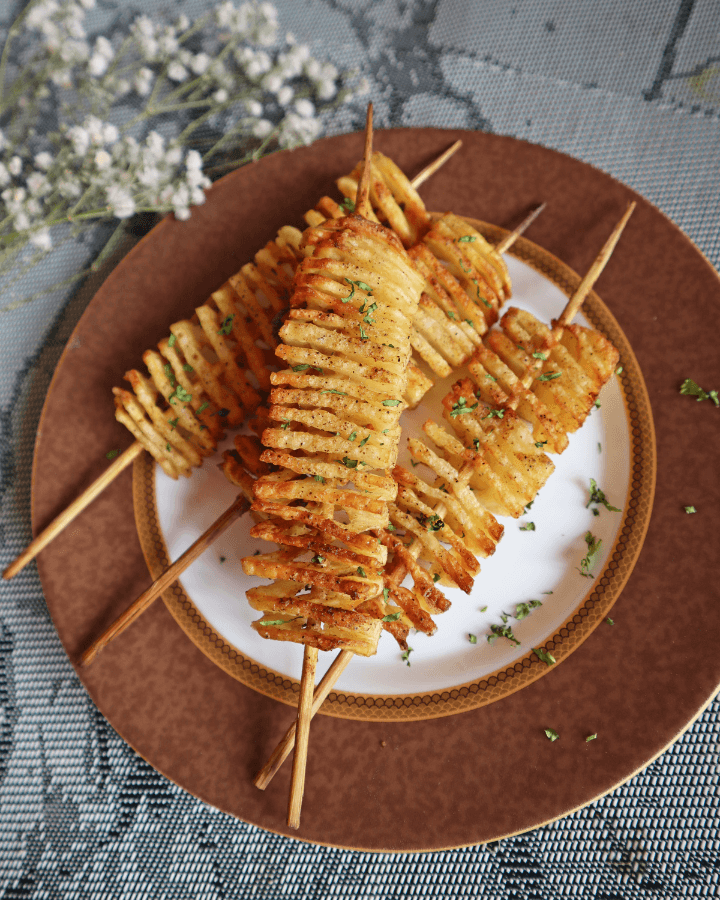
I made these three times before they were any good. The first two batches looked right on the plate and were disappointing to eat: crisp on the outer ridges, soft and slightly wet everywhere the folds touched. I had spent twenty minutes with a knife to produce, effectively, a steamed potato with crunchy edges.
What I had missed is that the cutting is only half the job, and it is the easier half.
Quick answer: Square the potato off and cut it into ½ inch slabs. Straight cuts down one face against chopstick guides, then flip and cut diagonally on the other face. Soak 20 minutes, dry hard, thread onto a skewer and stretch the folds open. Air fry at 360°F for 8 minutes, then 390°F for 7 to 9 minutes. The two temperatures and the stretch are what make these work.
What the accordion is actually for
A whole potato has one skin and not much else. Cut it into an accordion and you have created something like five or six times as much exposed surface, all of it raw starch waiting to brown. That is the entire point. It is the same reason we cut potatoes into fries rather than roasting them whole, taken to an extreme.
The catch is that surface area only counts if hot air can reach it. Two cut faces pressed against each other are not surface, they are an enclosed pocket. Water leaves the potato there, has nowhere to go, and the space between the folds sits at 212°F steaming gently while the outer ridges brown. You end up with the worst of both: burnt peaks and soggy valleys.
So the whole recipe reduces to two jobs, and most published versions only really cover the first:
- Make the surface. The cutting technique, which is fiddly but well documented everywhere.
- Keep it open. The skewer, the soak, the drying and the spacing. This is where batches actually fail and where almost nobody spends any words.
If you have made these before and found them underwhelming, it will have been the second job. Our guide on making things crispy in an air fryer covers why trapped moisture pins a surface at boiling point and stops it browning, which is exactly what is happening between the folds.
The cut, and why straight on one side and diagonal on the other
Everyone tells you to cut straight lines on one face and diagonal lines on the other. Almost nobody says why, and knowing why is what stops you cutting a potato into a pile of loose discs.
Put two chopsticks either side of the potato. They are a depth stop, not a holder. When the knife reaches them it cannot go further, so every cut stops short of the far face by the thickness of a chopstick and leaves an uncut strip of potato behind.
Now the important part. Cut straight down from the top and every uncut strip is at the bottom. Flip the potato and cut from what is now the top, and every one of those uncut strips is at the opposite face from the first set. The uncut material alternates from one face to the other, and that is what a hinge is. A row of alternating hinges is an accordion. Pull the ends apart and it opens.
The angle is doing a separate job. If the second set of cuts ran parallel to the first, each hinge would be a short square bridge and the whole thing would open a little and then jam. Cutting the second set on the diagonal makes each hinge a long thin wedge instead, which flexes much further before it tears. That is the difference between an accordion that stretches to four inches and one that opens half an inch and snaps.
Two mistakes account for nearly every failed accordion. Cutting both faces at the same angle, which gives you stiff hinges that break as soon as you stretch. And cutting too far apart, which gives you thick slices that never really crisp. Aim for slices about ⅛ inch wide. Closer is better than wider, right up to the point where the hinges get too thin to hold.
Slabs or whole potatoes
Worth settling before you pick up a knife, because it changes the recipe more than any seasoning will.
| ½ inch slabs | Whole potato | |
|---|---|---|
| Cook time | 15 to 17 min | 22 to 28 min |
| Even cooking | Very. No thick core anywhere. | Poor. Center around the skewer stays dense. |
| Crisp ratio | High. Almost all of it is surface. | Lower. A lot of interior potato. |
| Looks | Neat, uniform, several per plate | Dramatic, one big showpiece |
| Difficulty | Easier. A flat slab sits still. | Harder. A round potato rolls under the knife. |
The photographs on this page are slabs, and that is what this recipe is written around. Square the potato off into a rough rectangle first, then cut it crosswise into half inch slabs and accordion each one. You lose the trimmings, which is a small price for a potato that is actually cooked through by the time the outside is crisp. You do not have to waste the peelings though: they make crispy air fryer potato peels in about eight minutes while these are soaking.
The whole-potato version is the one that went viral and it does look spectacular. If you want it, use a medium potato of about 6 to 7 ounces and no larger, drop to 350°F, and give it 22 to 28 minutes. The thick column of potato the skewer runs through is what sets the time, and a big baking potato will still be raw in the middle when the edges are black.
Ingredients
For the potatoes
- 2 to 3 medium potatoes (6 to 7 oz each)
- 2 tablespoons olive oil or melted garlic butter
- ½ teaspoon garlic powder
- ½ teaspoon paprika (optional)
- Salt, to taste
- Black pepper, to taste
- Fresh parsley or chives, to garnish
Equipment you actually need
- 2 chopsticks, as depth stops
- Wooden or bamboo skewers
- A properly sharp knife
The knife matters more than the ingredients. A dull blade crushes the hinges as it goes through rather than slicing them, and crushed hinges tear when you stretch. If you have one knife you keep sharp, this is the recipe to use it on.
Garlic butter over olive oil if you are choosing. It browns better because of the milk solids, and it clings to vertical cut faces where thin oil runs off.
How to make air fryer accordion potatoes
- Peel the potatoes and square them off into a rough rectangle, trimming the curved sides. Then cut crosswise into ½ inch slabs.
- Lay a slab between two chopsticks and cut straight down across it in slices about ⅛ inch apart. The chopsticks stop the knife before it goes through.
- Flip the slab over and cut again on the diagonal, same spacing, still against the chopsticks. It should now bend and open.
- Soak the cut slabs in cold water for 20 minutes. Not optional here, for reasons in the next section.
- Drain and dry them hard. Pat between towels, get into the folds, and let them air dry another five minutes. Wet folds are the whole problem.
- Thread each slab onto a skewer and push the folds apart along it until they are evenly spaced with visible gaps. This is the step that decides how these turn out.
- Brush with oil and season on all sides, working it into the open folds rather than just over the top.
- Preheat to 360°F for 3 minutes, then air fry at 360°F for 8 minutes in a single layer, not touching.
- Raise to 390°F and cook another 7 to 9 minutes, until the ridges are deep golden and a skewer slides through the thickest part with no resistance.
- Season again straight out of the basket and scatter over the herbs. Salt sticks to a hot oiled surface and slides off a cool one.
Preheating is worth the three minutes here. A cold basket lets the stretched folds sit and soften before any heat arrives, and soft folds sag back together. Our guide on preheating an air fryer covers which foods care and which do not.
Keeping the folds apart
Three things work against you here, and they compound.
The skewer is a spacer, not a handle
Most recipes mention the skewer as optional, or as something to make the potatoes easier to pick up. It is neither. It is the only thing holding the accordion stretched while it cooks. Cut a slab, leave it loose in the basket, and it relaxes shut within a minute of the heat hitting it, because potato softens as it warms. Everything you cut is now sealed against itself.
Thread it on and physically push the folds apart until you can see daylight between them. They will stay where you put them.
The soak is doing something specific
Soaking potatoes is usually presented as a general tip for crispier fries. Here it is load-bearing, and the reason is the geometry. An accordion has something like five times the cut surface of a wedge, which means five times the free starch sitting on those faces. Wet starch on two facing surfaces is glue. It tacks the folds to each other and holds them shut against everything you have done with the skewer.
Twenty minutes in cold water washes most of it off. Change the water once if it goes cloudy fast.
Then you have to dry them properly
Which is the part people skip, having just spent twenty minutes deliberately soaking them. Water sitting in the folds cannot get hotter than 212°F and nothing above it can either, so every drop is buying time at steaming temperature instead of browning temperature. Pat them between towels, get into the gaps, and give them another five minutes in the air. It is worth the wait.

Why two temperatures instead of one
This recipe used to run at a flat 375°F for 15 to 20 minutes, which is what most versions online still do. Splitting it into two stages is a genuine improvement and it comes down to the shape.
An accordion is thin ridges attached to a slightly thicker spine. Those are two different cooking problems in one object. The ridges are a couple of millimeters thick and will brown in about eight minutes at high heat. The spine takes longer. Run the whole thing hot from the start and the ridges are done and heading toward burnt while the spine is still firm.
- 360°F for the first 8 minutes cooks the potato through without pushing the exposed edges past golden. This stage is about getting it soft, not colored.
- 390°F for the last 7 to 9 minutes drives off the surface moisture that has come out during stage one and crisps everything hard, fast, while the inside is already done.
Doing it the other way round does not work, incidentally. Crisp first and you set a hard shell that slows heat getting to the middle.
Adapting from an oven recipe? Oven accordion potatoes usually run around 425°F for 35 to 40 minutes. Put those numbers through our air fryer calculator and you will land close to the finishing stage here, which is a good check if your machine runs hot or cool. One thing to add on top of whatever it gives you: an oven cooks a tray of these lying flat, while you are cooking them stretched on a skewer with air moving through the gaps. That is much more efficient, so start checking earlier than the converted time suggests rather than trusting it to the minute.
Which potato, and the trade nobody mentions
Recipes tend to say russet or Yukon Gold as though they are interchangeable. For this cut they behave quite differently, and it is a real choice.
| Potato | Crisping | Holding the accordion |
|---|---|---|
| Russet (high starch) | Best. Dry and floury, browns hard. | Worst. Mealy texture, hinges snap when stretched. |
| Yukon Gold (medium) | Good. | Good. The sensible default. |
| Red or waxy | Fair. Holds more water, browns less. | Best. Very flexible, almost never tears. |
Yukon Gold is where I have landed. Russets do crisp better and if you have a steady hand and cut generous hinges they are worth it, but you will break more of them and it is annoying after all that knife work. If you are making these with kids, use a waxy potato and accept slightly less crunch in exchange for accordions that survive being handled.
Never overbake again
Get our one-page times & temps cheat sheet, plus a new tested recipe each week.
No spam · unsubscribe anytime
Fixing what goes wrong
Crisp on the outside, soft and damp between the folds
The folds closed up. Either there was no skewer holding them open, or they were not pushed apart along it, or they went in wet and the starch glued them shut. Skewer, spread, soak, dry. That is the whole fix and it is worth doing all four.
The potato fell apart into loose slices
A cut went all the way through. The chopsticks either shifted or the knife rode up over them near the ends, which is where it usually happens. Keep the chopsticks pressed firmly against the potato and slow down at the last inch of each side.
The hinges snapped when I stretched it
Cut too deep, cut both faces at the same angle, or a floury russet. Make sure the second set of cuts is on the diagonal, use a thicker chopstick so more potato is left behind, and switch to Yukon Gold or a waxy potato.
The ridges burned before the middle was done
Too hot too early, or slabs cut thicker than half an inch. Use the two-stage temperature and check your slab thickness. Our guide on preventing burning in an air fryer covers the other usual causes.
The middle is still hard
Almost always the whole-potato version with a potato that was too big. Stay at 6 to 7 ounces, or switch to slabs. A skewer should slide through the thickest part with no resistance at all.
The seasoning is all on the outside
Oil and season after stretching, not before, and work it down into the open folds with a brush or your fingers. Season again the moment they come out, while the surface is hot and oily enough to hold salt.
They went limp within ten minutes
Stacked on a plate while still steaming. Rest them on a rack in a single layer so the underside is not sitting in its own moisture.
Seasonings and dips
- Garlic parmesan: toss in grated parmesan for the last 2 minutes and again out of the basket, with plenty of garlic.
- Smoky: smoked paprika and a pinch of cayenne in the oil before cooking. Both stand up to the heat.
- Cajun or peri peri: a teaspoon in the oil. Watch these, since spice blends with sugar in them scorch at 390°F.
- Salt and vinegar: a spritz of malt vinegar the second they come out, then flaky salt. The heat drives the vinegar in.
- Herb butter: brush melted butter with chopped rosemary over the finished skewers. Fresh herbs added before cooking just burn.
For dipping, garlic aioli, chipotle mayo, sour cream and chive, or a sharp tomato chutney all work. These are rich, so acidity helps more than another creamy sauce does.
If you like these, our crispy air fryer potato chips, air fryer potato peels and air fryer hash browns run on the same soak-and-dry principle, air fryer tater tots and Alexia sweet potato fries are the no-knife-work versions for a weeknight, and air fryer pasta chips are the other recipe here that came off social media and turned out to be worth the effort.
Storage
- Eat them fresh. Like most crisp potato things these are best in the first fifteen minutes and there is no way of storing them that improves on that.
- Refrigerated: up to 3 days in an airtight container, once completely cool. They soften considerably.
- Reheating: 5 to 7 minutes at 350°F, still on the skewer if you can, so the folds stay open. This works well.
- Never microwave them. You will get a soft, damp potato with the texture of nothing in particular.
- Prep ahead: cut them, leave them in cold water in the fridge for up to a day, then dry and cook. The soak is doing its job the whole time.
That last one is the useful one if you are cooking for people. All the knife work happens earlier in the day and the cooking is sixteen minutes. The full air fryer baking chart has times and temperatures for everything else on the site.
Frequently asked questions
QWhat temperature do you cook accordion potatoes in an air fryer?
Use two stages: 360°F (180°C) for 8 minutes, then 390°F (200°C) for 7 to 9 minutes. The lower stage cooks the potato through without pushing the thin exposed ridges past golden, and the higher stage drives off surface moisture and crisps everything fast while the inside is already done. A single flat temperature leaves you choosing between burnt ridges and a firm center.
QHow do you cut accordion potatoes?
Lay the potato between two chopsticks, which act as depth stops so the knife cannot cut all the way through. Cut straight down across it in slices about an eighth of an inch apart. Then flip it over and cut again on the diagonal at the same spacing. Because each set of cuts stops short of the opposite face, the uncut material alternates from one side to the other, and that row of alternating hinges is what lets it stretch open like an accordion.
QWhy do I need to cut one side diagonally?
The alternating cuts are what create the hinges, but the angle decides how far they flex. If both sets of cuts run parallel, each hinge is a short square bridge that opens a little and then jams or snaps. Cutting the second set on the diagonal makes each hinge a long thin wedge, which bends much further before it tears. That is the difference between an accordion that stretches several inches and one that barely opens.
QWhy are my accordion potatoes soggy in the middle?
The folds closed up during cooking, so the cut faces steamed against each other instead of crisping. Potato softens as it warms and a loose accordion relaxes shut within a minute of going in. Thread each one onto a skewer and physically push the folds apart until you can see gaps, soak them first to wash off the starch that glues faces together, and dry them thoroughly, since water trapped in the folds cannot get above 212°F and nothing browns until it is gone.
QDo I need to soak accordion potatoes?
Yes, and it matters more here than for regular fries. An accordion has roughly five times the cut surface of a wedge, which means five times as much free starch sitting on those faces, and wet starch on two facing surfaces acts as glue that holds the folds shut. Twenty minutes in cold water washes it off. Change the water if it clouds quickly, then dry the potatoes hard before oiling them.
QDo I need skewers for accordion potatoes?
Yes, and not for serving. The skewer is the only thing holding the accordion stretched open while it cooks. Without one the folds relax shut in the heat and every cut face you made is sealed against its neighbor, which turns the whole thing into a steamed potato with crunchy outer ridges. Thread each piece on and push the folds apart along it until there are visible gaps.
QWhat is the best potato for accordion potatoes?
Yukon Gold is the best all-rounder. Russets crisp better because they are drier and higher in starch, but their mealy texture makes the hinges brittle and more of them snap when you stretch them. Waxy red potatoes are the most flexible and almost never tear, at the cost of some crispness because they hold more water. Choose based on whether you mind losing a few to breakage.
QShould I use whole potatoes or cut them into slabs?
Slabs about half an inch thick are more reliable and cook in 15 to 17 minutes with no dense core anywhere. Square the potato off, cut it crosswise, and accordion each slab. The whole-potato version is the one that went viral and looks far more impressive, but the column of potato the skewer runs through takes 22 to 28 minutes at a lower 350°F, and a large baking potato will still be raw in the center when the outside is dark.
QWhy did my accordion potato fall apart into slices?
A cut went all the way through, which usually happens near the ends where the knife rides up over the chopsticks rather than in the middle. Keep the chopsticks pressed firmly against the sides of the potato and slow right down for the last inch at each end. Using slightly thicker chopsticks leaves more uncut potato behind and gives you more margin.
QHow long do accordion potatoes take in an air fryer?
15 to 17 minutes total for half inch slabs, split as 8 minutes at 360°F and 7 to 9 minutes at 390°F. Whole potatoes take 22 to 28 minutes at 350°F and should be no bigger than 6 to 7 ounces each. They are done when the ridges are deep golden and a skewer passes through the thickest part with no resistance.
QCan I make accordion potatoes ahead of time?
Cut them ahead, yes. Leave the cut potatoes submerged in cold water in the fridge for up to a day, which stops them browning and continues washing off surface starch the whole time. Dry them thoroughly before oiling and cooking. Do not cook them ahead, since they soften within about fifteen minutes and reheating gets you most but not all of the crispness back.
QHow many accordion potatoes fit in an air fryer?
Three or four skewered slabs in a standard 5 to 6 quart basket, in a single layer and not touching. They take up more room than you expect because the whole point is that they are stretched open. Crowding them defeats the recipe entirely, since skewers pressed against each other close the folds just as effectively as no skewer at all. Cook in two batches rather than packing them in.
Made these? Rate the recipe