

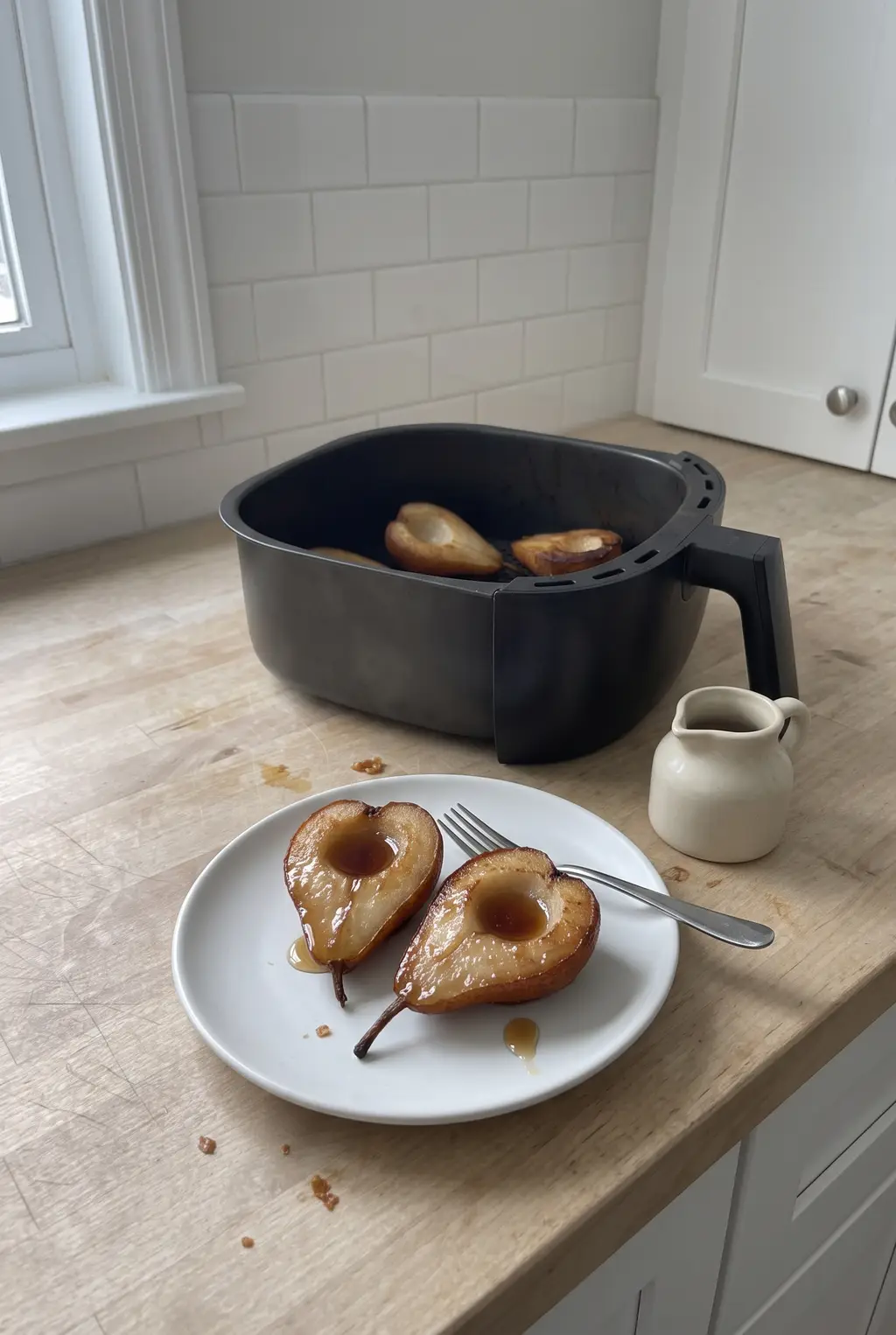
Pears run a scam on grocery shoppers. They are sold rock hard, ripen at home on their own unknowable schedule, hit perfect for about a day, and then quietly go mealy while you were saving them for the right moment. Everyone who buys pears knows the arc. Which is what makes baked pears such a satisfying answer: the recipe does not want the perfect pear. It wants the hard one, the one you cannot eat tonight anyway, and it converts it into dessert before the news is over.
This page is the pear sibling of the site's baked apples, and the comparison is worth one honest sentence: pears are softer-fleshed and wetter than apples, so they bake faster, want gentler handling, and land lighter on the plate, closer to a warm fruit course than a pastry stand-in. Same machine, same idea, different animal.
Quick answer: Halve and core 3 firm pears, skin on. Brush the faces with butter, lemon and maple, dust with cinnamon, and bake face down at 330°F for 6 minutes, then flip, fill the hollows with a walnut-oat crumble or leave them plain, and bake 6 to 9 minutes more until a paring knife slides into the thickest shoulder with no resistance. Rock hard pears: add about 5 minutes. Fully ripe: 8 to 10 minutes face up only.
Ripeness is the whole clock
Recipes that say "ripe but firm" are describing a pear that exists for one afternoon and assuming you own it. The useful version of that advice is a schedule that meets the pear where it actually is, and it looks like this:
| Your pears | The tell | Face down | Face up |
|---|---|---|---|
| Rock hard (store-fresh) | No give anywhere, even at the neck | 10-11 min | 8-9 min |
| Firm-ripe (the ideal) | Slight give at the neck, firm body | 6 min | 6-9 min |
| Fully ripe | Yields at the neck and shoulder | Skip it | 8-10 min |
| Overripe | Soft all over, bruising | Do not bake. Simmer into sauce; heat cannot un-ripen fruit | |
Check ripeness at the neck, just below the stem, because pears ripen from the inside out and the neck reports first. A pear that feels ripe at the fat end is already past it in the middle.
Why they start face down
The cut face against the hot basket floor is where the caramel happens: direct contact browns the sugars in a way circulating air alone never quite manages, the same contact logic that gives a seared anything its crust. Six minutes down builds that bronzed face; the flip then turns the caramelized side up to glaze while the skin side, which needs no browning, shields the flesh for the rest of the bake. Face-up-only recipes skip the sear and make up for it with higher heat, which is exactly how the 380°F versions end up with scorched maple edges over firm centers.
No parchment underneath: the faces need the bare floor to brown against, and the little maple that escapes wipes off a warm basket easily. If your machine's floor runs sticky, a weighted parchment round is legal per the liner rules, at the cost of a paler face.
Which pears, honestly
- Bosc is the baking pear. Dense, russet-skinned, holds its architecture through heat like it was designed for this. Give it the long end of every range.
- Anjou is the dependable second, either color. Softer than Bosc, sturdier than Bartlett, no surprises.
- Bartlett bakes sweet and fast and slides toward soft; start the knife test 2 minutes early.
- Comice is nearly dessert raw; it belongs on the fully-ripe lane if you bake it at all.
- Asian pears are the honest no. They are built like apples and stay crisp no matter the clock; bake them and you get hot crunchy pear, which nobody ordered.
The light lane and the crumble lane
Plain, these are one of the lightest desserts this site makes: butter, maple and cinnamon split six ways over fruit, about 110 calories a half, at home beside the rest of the lighter bakes. That is the version that moonlights as breakfast under cold yogurt.
The hollow the melon baller leaves is also an invitation. A spoonful of oats, chopped walnuts, brown sugar and soft butter pressed into each one after the flip bakes into a tiny crisp riding inside the fruit, and suddenly the light dessert is a plated one, halfway to the full pear crisp. The same toasted-nut logic as the candied walnuts, just done in place. Both lanes share every other step, so the household that cannot agree gets three halves each way.
Ingredients
Makes 6 halves
- 3 pears, firm to hard, Bosc or Anjou first
- 1 tablespoon (14g) butter, melted, or coconut oil
- 1 tablespoon maple syrup, plus more to serve
- 1/2 teaspoon cinnamon, small pinch of salt
- 1 teaspoon lemon juice
- Crumble lane: 3 tbsp oats, 2 tbsp walnuts, 1 tbsp brown sugar, 1 tbsp soft butter, cinnamon
Honey works in place of maple and browns a shade faster. Cardamom instead of cinnamon is the elegant version. Pecans for walnuts, obviously fine. The lemon is not garnish: it keeps the faces from browning gray while you work and sharpens fruit that heat has sweetened.
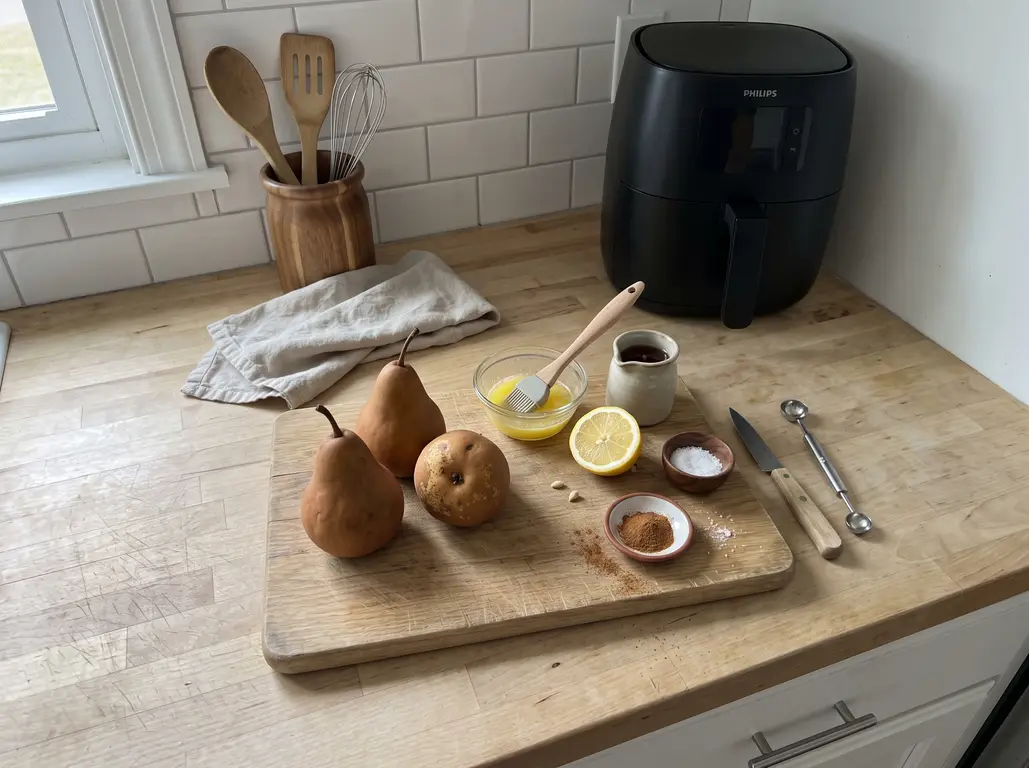
How to make them
- Halve lengthwise, skin on, and scoop the core with a melon baller or teaspoon, taking the fibrous stem line with it. The skin is structure; peeled halves slump.
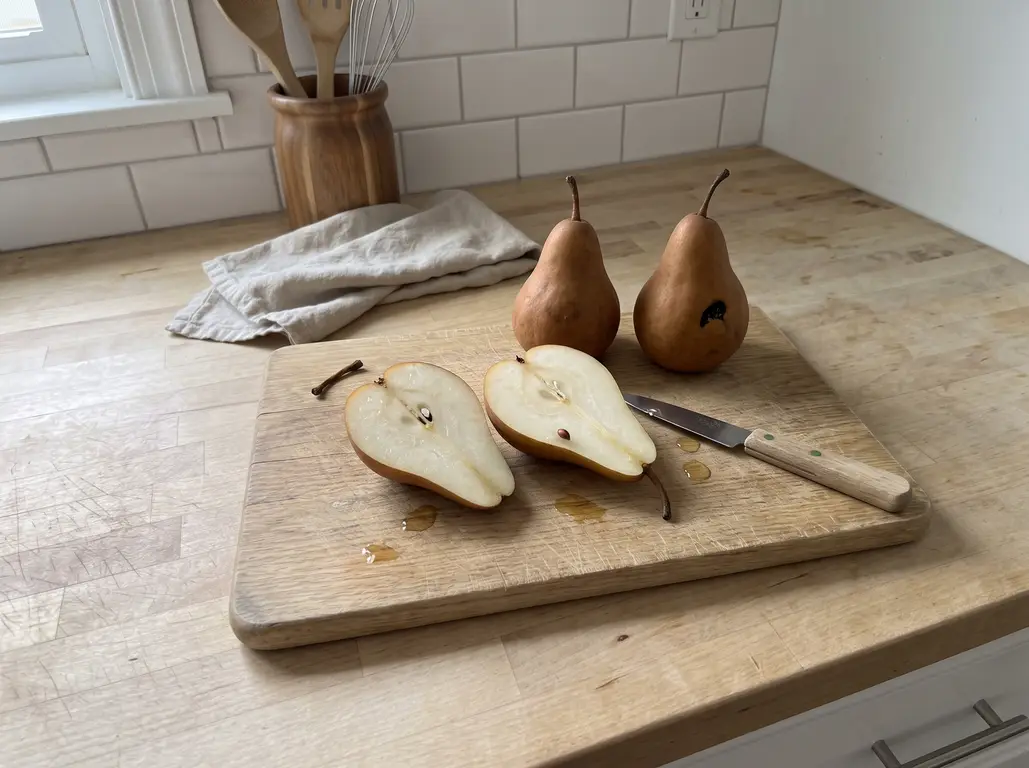
Halved lengthwise with the skin left on, so the halves hold their shape through the bake. 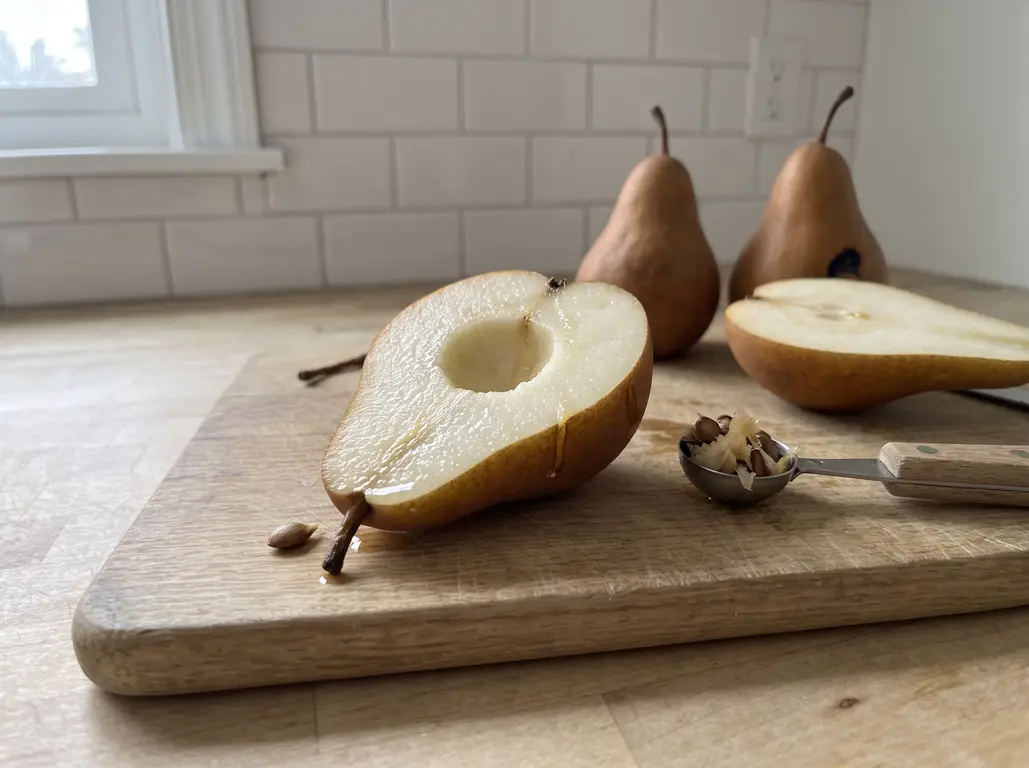
The melon baller takes the core and the fibrous stem line in one scoop, leaving a hollow for the glaze. - Brush the faces with the butter, lemon and maple, then the cinnamon and salt.
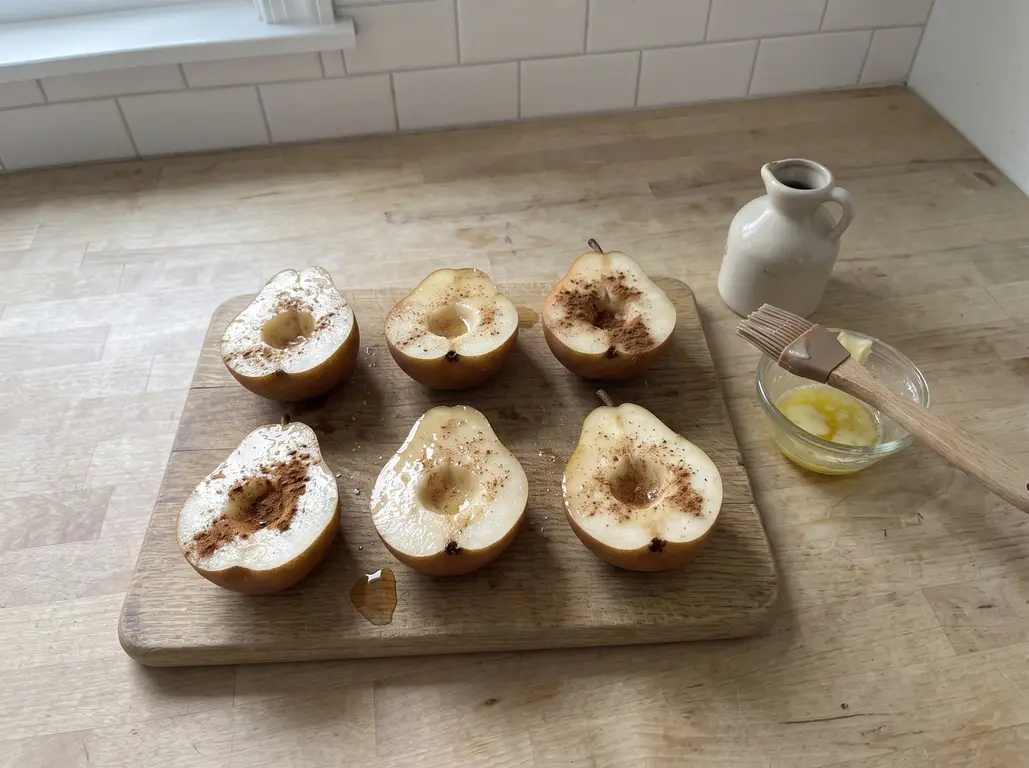
Faces brushed with the butter, lemon and maple, then dusted with cinnamon and a pinch of salt. - Face down at 330°F for 6 minutes, no preheat. The faces caramelize against the floor; the cold-start ruling lives in the preheat guide. 4 to 6 halves fit a basket with air between them.
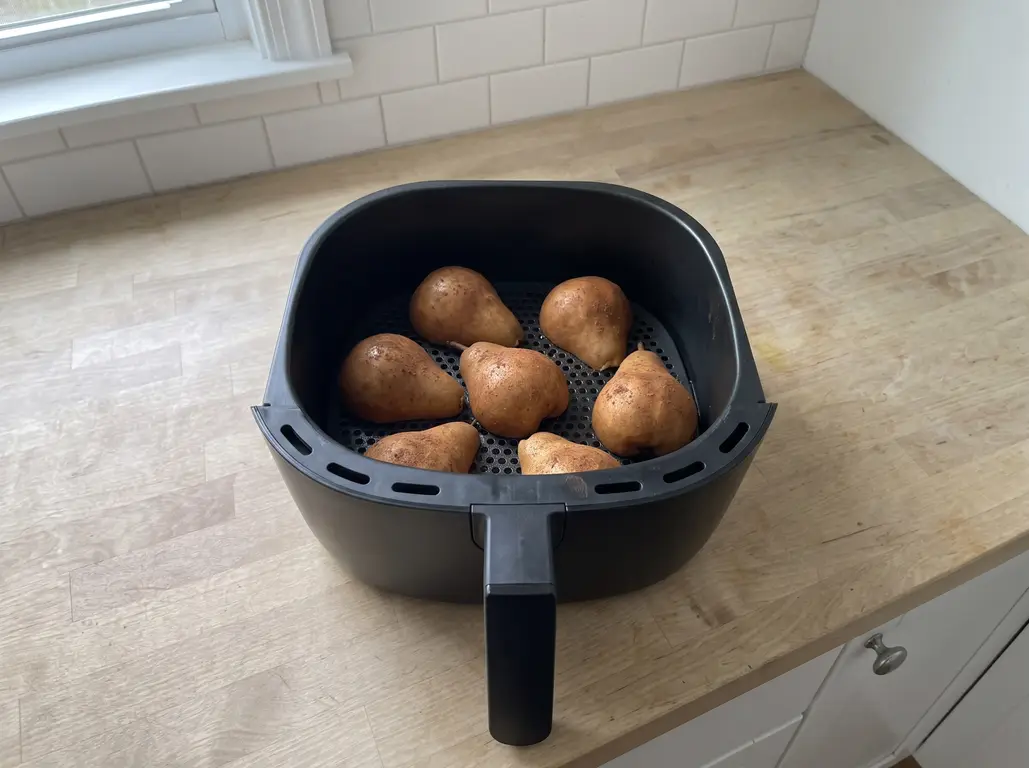
Cut side down on the bare floor at 330°F. The direct contact is what caramelizes the faces. - Flip, then choose the lane: plain, or a spoonful of crumble pressed into each hollow. Pressed, not sprinkled; the fan owns anything loose.
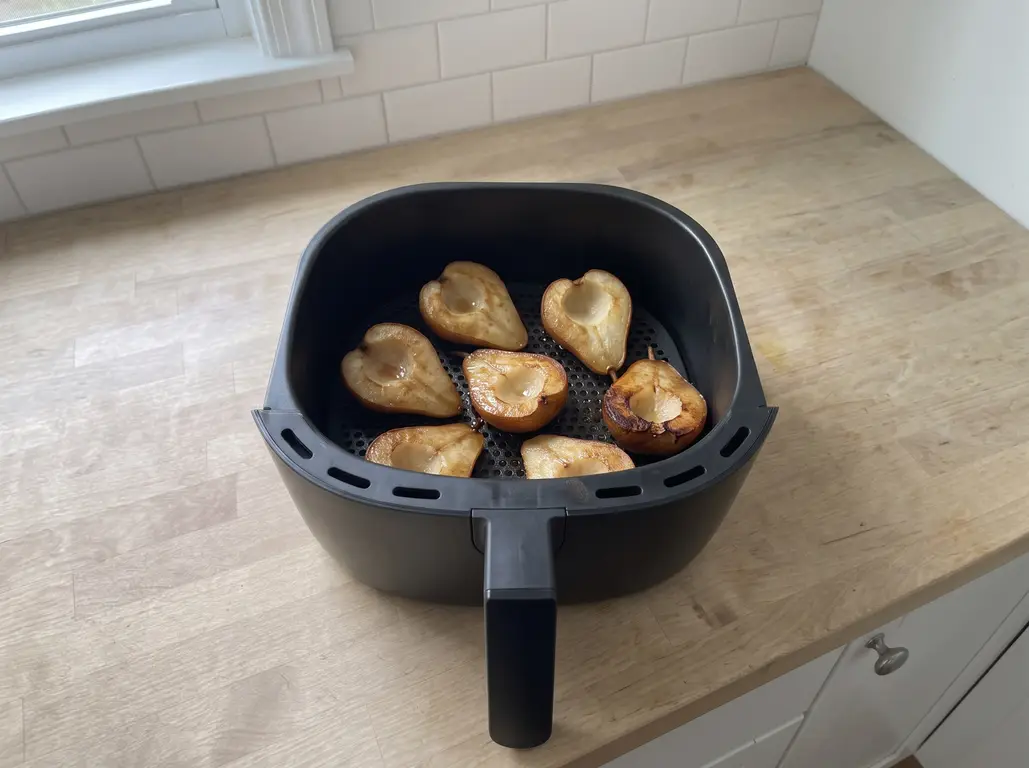
After the flip: the faces are bronzed and glossy, now turned up to glaze for the rest of the bake. - Face up 6 to 9 minutes more, until the knife says so, below.
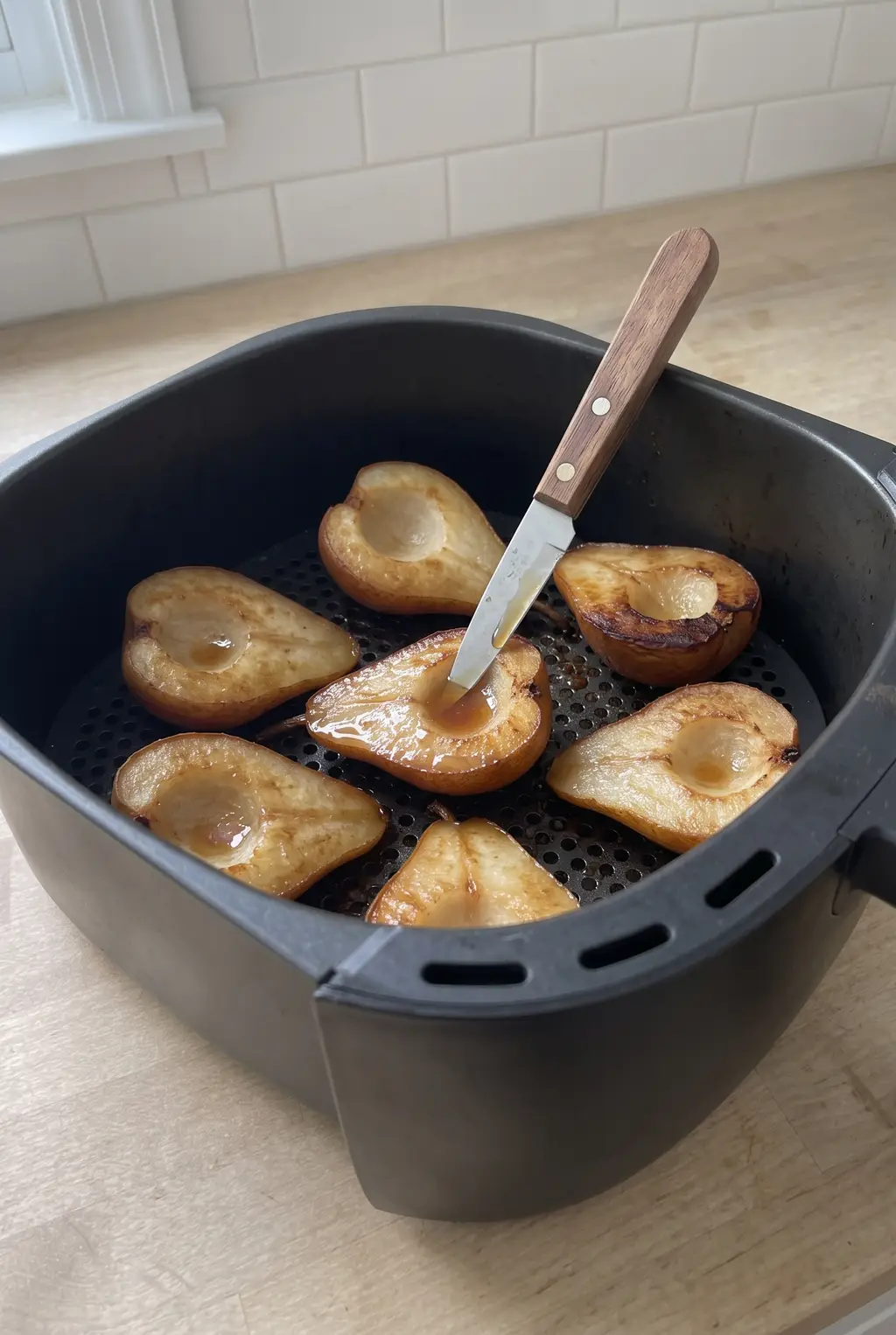
The knife test at the fat shoulder: it slides in with no resistance when the pears are done. - Ripeness adjustments from the table: hard pears take the long face-down; ripe ones skip it entirely.
- Rest 5 minutes. The flesh finishes on stored heat, plain carryover, and the juices thicken to a glaze.
- Scaling for company: halves bake by their size, not the batch, so more pears just means rounds; the recipe scaler resizes the crumble math when you triple it.
Converting an oven baked-pear recipe? Its 375°F for 30 minutes runs through the air fryer calculator to about 350°F, and this page bakes cooler still because maple sits inches from the element here, the standing sugar correction behind half the numbers on the baking chart.
Doneness
| The signal | What it means |
|---|---|
| Knife meets resistance at the shoulder | Not yet. 2 more minutes and test again; the clock serves the knife here |
| Knife slides into the thickest shoulder with no resistance, faces deep bronze | Done. Rest 5 minutes and serve warm |
| Halves slumping, skin wrinkling hard | Past it. Still delicious over yogurt, and next batch starts riper-aware |
Test the biggest half, at the fat shoulder, not the thin neck, which softens first and lies about the rest. There is no useful internal temperature for fruit this small; the knife is the instrument.
Troubleshooting
| What you got | Why | Fix |
|---|---|---|
| Firm centers, done-looking faces | Hard pears on the firm-ripe schedule. | The rock-hard row: 10 to 11 minutes face down before the flip |
| Mush | Ripe pears got the firm schedule. | Ripe lane: no face-down phase, 8 to 10 gentle minutes face up |
| Scorched maple edges | Baked at 350°F-plus with syrup aboard. | 330°F, and syrup brushed thin; repeat scorchers live in the burning guide |
| Pale faces, no caramel | Baked face up the whole time, or on parchment. | The 6 minutes face down on the bare floor is where the bronze comes from |
| Crumble blew around the basket | Sprinkled loose. | Pressed into the hollows after the flip, firmly |
| Halves rocking and tipping | Round skin side, uneven floor. | Shave a thin slice off the skin side of wobblers so they sit flat |
| Dried, leathery edges | Peeled pears, or small halves overbaked. | Skin stays on, and the knife test starts at minute 6 of face-up |
| One side browner | A machine hot spot. | Rotate the halves' positions at the flip |
Cross-recipe mysteries belong to the troubleshooting guide, and the machine's ground rules live at how to bake in an air fryer.
Serving them
- Warm, extra maple, something cold on top: ice cream when it is dessert, Greek yogurt when it is pretending not to be.
- Stone fruit, same trick: the baked peaches caramelize cut side down on the same bare floor, and they share a basket with the pears for a late-summer platter.
- The cheese move: a wedge of blue cheese or a shaving of parmesan beside a warm half is the fastest route this site knows to a dinner-party dessert that took 15 minutes.
- Next to their cousin: when the table wants cinnamon-stuffed and substantial instead of light and glazed, that is the baked apples, and the two recipes share a basket happily for a mixed platter.
Storage and reheating
- Fridge: 4 days covered, and they genuinely improve on day one in the cold, the juices setting into syrup around them.
- Reheat: 300°F for 3 to 4 minutes in the basket brings back the warm-glaze state; the microwave works and softens the bronzed face.
- Cold career: sliced over yogurt, oatmeal or pancakes, one baked pear half outranks any jam.
- Do not freeze them. Pears are mostly water; the freezer returns pulp. Bake three fresh ones instead, it is 15 minutes.
Frequently asked questions
QHow long do baked pears take in an air fryer?
About 12 to 15 minutes at 330°F for firm-ripe halves: 6 minutes cut side down so the faces caramelize, then 6 to 9 minutes cut side up until a paring knife slides into the thickest part with no resistance. Rock-hard pears take closer to 20 minutes and fully ripe ones as little as 8, which is why the knife, not the clock, makes the final call.
QCan you bake unripe, hard pears in an air fryer?
Yes, and this is the recipe's best trick: heat does in 20 minutes what the fruit bowl does in five days. Hard pears hold their shape beautifully, they just need the long end of the schedule, about 11 minutes face down and 8 to 9 face up. The only pears that genuinely will not work are overripe ones, which arrive at mush before the caramel arrives at them.
QWhat temperature do you bake pears in an air fryer?
330°F. Published versions run anywhere from 330 to 380°F, and the hot end shows why the scatter matters: maple and pear sugars scorch quickly that close to the element, so 380°F gives you blackened edges on flesh that never fully softened. 330°F caramelizes the cut face against the basket floor while the inside cooks through on the same clock.
QWhat kind of pears are best for baking?
Bosc first: the dense, russet-skinned ones hold their shape through heat better than anything else and take an extra minute or two. Anjou is the reliable all-rounder. Bartlett bakes soft and fast, so start checking early. Comice is dessert-tender already and belongs on the ripe lane. Asian pears are the exception that disappoints: they stay crisp like an apple no matter how long they bake.
QDo you peel pears before baking?
No. The skin is structural: it holds the half together as the flesh softens, it protects the rounded side from drying against the hot air, and it turns pleasantly soft by the time the fruit is done. Peeled halves slump and dry at the edges. If skin genuinely bothers someone at your table, it slips off easily after baking, which costs nothing.
QWhy did my baked pears turn out mushy?
The pears were already fully ripe and they got the firm-pear schedule anyway. Ripeness is the whole clock with pears: a fruit that yields at the neck is nearly dessert already and needs just 8 to 10 gentle minutes face up, no face-down phase. If the batch is past that, soft with bruising, bake nothing; simmer them into sauce instead, because no schedule un-ripens fruit.
QCan you stuff baked pears with a crumble topping?
Yes, the scooped core leaves a hollow that holds about a spoonful, and a quick mix of oats, chopped walnuts, brown sugar and soft butter turns each half into a tiny crisp. Press it in after the flip so it toasts for the face-up minutes without riding the fan. It adds about 60 calories a half and moves the dish from the light column to the dessert column, which is sometimes the assignment.
QAre baked pears healthy?
The plain version is about as gentle as dessert gets: around 110 calories a half, with 3 grams of fiber, one tablespoon of butter and one of maple split across six halves. Cold from the fridge with Greek yogurt they are a legitimate breakfast, not a rationalized one. The crumble version is richer and still modest by dessert standards. The ice cream you add is between you and the scoop.
QHow do you store and reheat baked pears?
Covered in the fridge for 4 days, where they somehow improve, the juices thickening into syrup around them. Reheat at 300°F for 3 to 4 minutes in the basket, which revives the caramelized face the microwave would soften. They are also good cold, sliced over yogurt or oatmeal, which is how the second half of every batch disappears in this house.
Never overbake again
Get our one-page times & temps cheat sheet, plus a new tested recipe each week.
No spam · unsubscribe anytime