

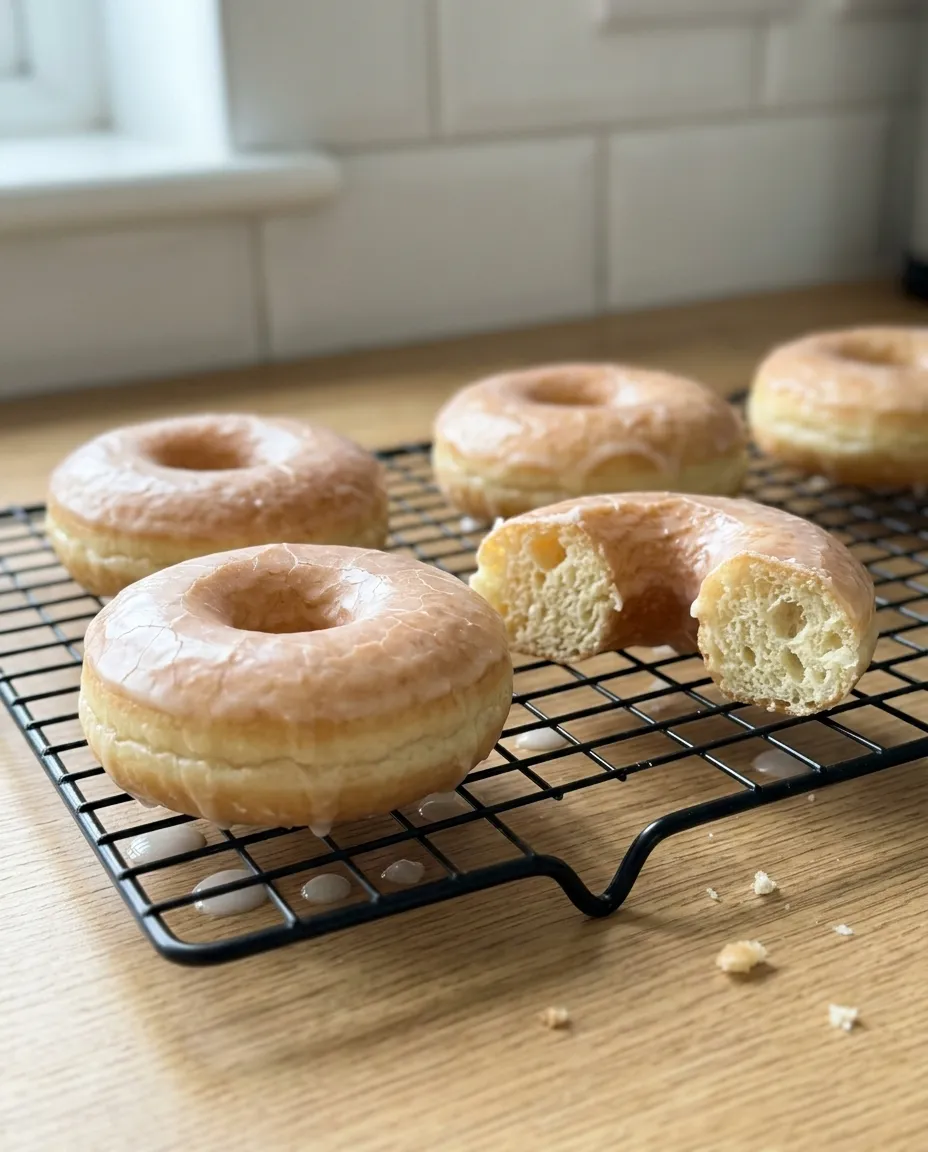
There is a specific pleasure in handing someone a warm glazed donut you made and watching them recalibrate. Store donuts have trained everyone to expect a certain heaviness, and a fresh yeast donut has none of it: it weighs almost nothing, gives like a pillow, and the glaze shatters faintly before the crumb takes over. The famous chain built an empire on serving them warm, and the empire's actual secret is that warmth, not any ingredient.
The air fryer earns its place here honestly. A donut is enriched yeast dough, the same family as the cinnamon rolls, and it needs no oil to become itself, only heat and restraint. What the machine cannot forgive is rough handling of the risen rings and impatience with the glaze, which is why those two get their own sections and their own rules.
Quick answer: Make a soft enriched dough, rise it twice, and proof each cut ring on its own parchment square so no hand ever dents it. Bake at 340°F for 5 to 6 minutes, one flip, stopping at pale blonde and 195°F, the lightest finish of any bake on this site. Then dip while warm, 5 to 10 minutes out of the basket, in a glaze of powdered sugar, milk, vanilla and a tablespoon of corn syrup, which is what makes it dry glassy instead of matte. Rack, 10 minutes, gone.
Rings here, holes next door
Housekeeping first, because this site now has a small shelf of donuts, each with a different job. The 10 minute route is biscuit donuts from a can, the orchard cake version is apple cider donuts, and the vegan donuts skip the yeast entirely. The donut holes are the bite-sized, cinnamon-sugar, shake-the-basket crowd-feeders, spheres with their own geometry problems. This page is the full-size ring wearing the glassy glaze, the donut-shop centerpiece. The shapes even follow different laws in the basket: spheres get shaken because they have no faces, and rings get one respectful flip because they have two plain ones, the same flip rule the frozen biscuits run on. Conveniently, this recipe feeds that page: the cut-out centers of your rings are donut holes by birth, and they bake at that page's 330°F while the rings cool, checked from minute 3, because a punched center is far smaller than the 20g balls that page is timed for.
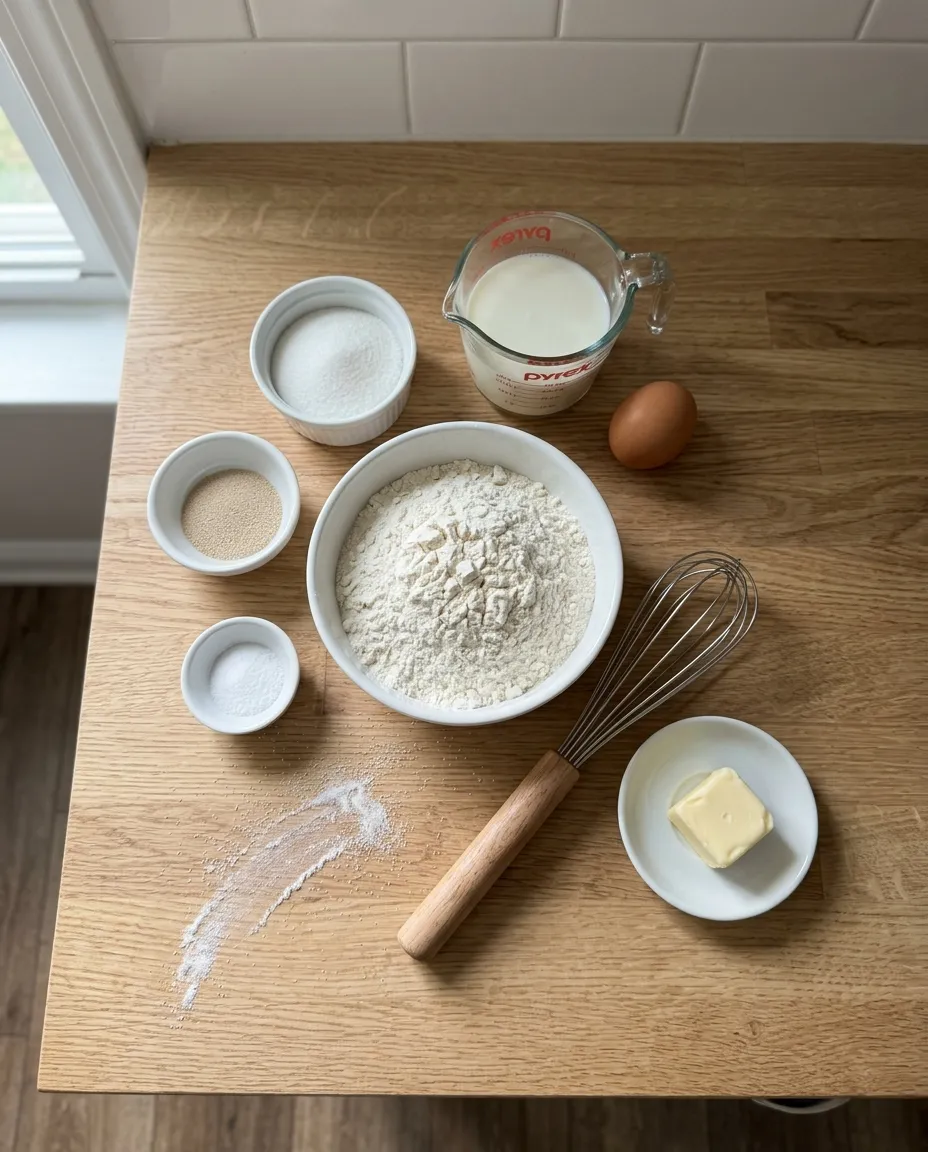
The dough: soft, rich, twice-risen
- This is the dinner-roll family in party clothes: milk, egg, butter and a little extra sugar in a soft, slightly tacky dough. If you have kneaded the dinner rolls, your hands know this one already, and the kolaches are the same soft enriched dough filled instead of glazed.
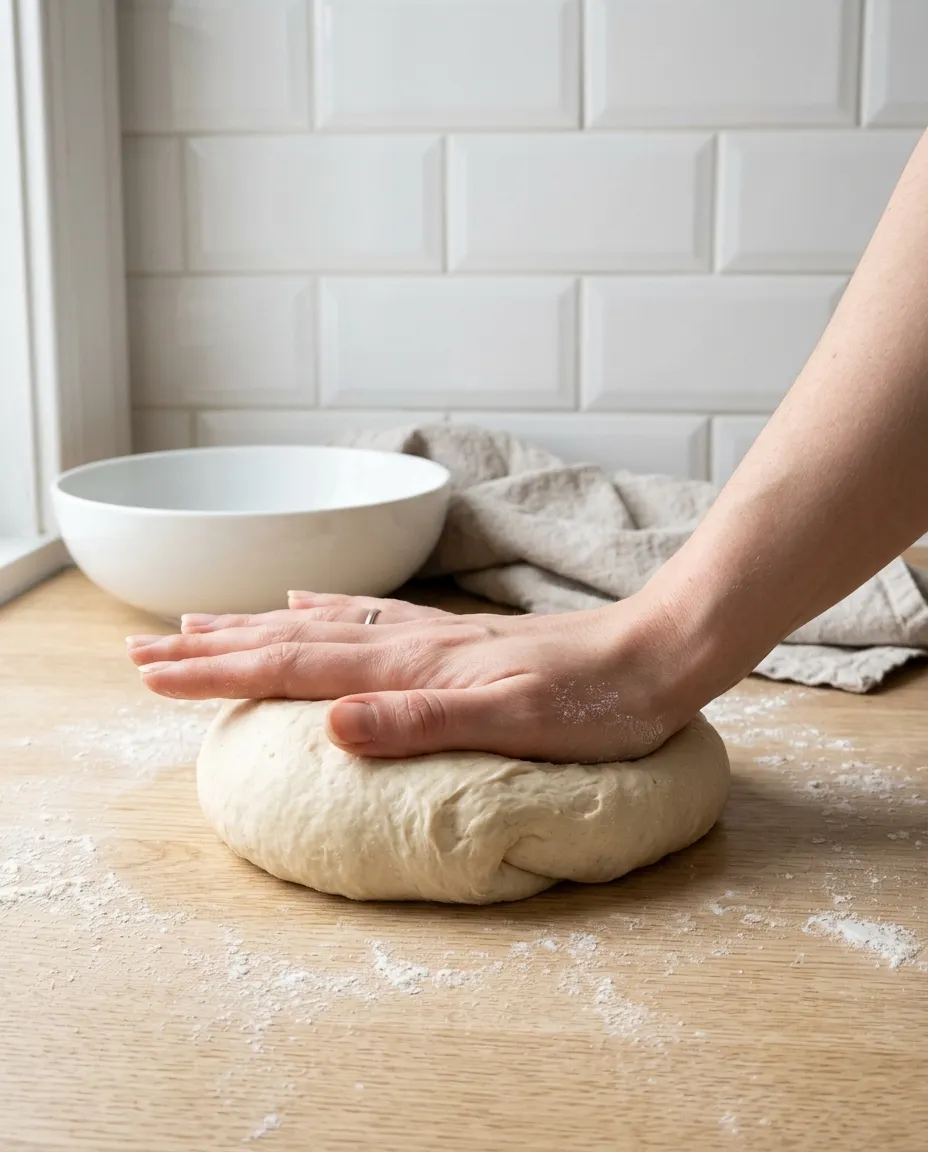
- Knead a full 8 to 10 minutes. A donut's lightness is a gluten net stretched thin around a million gas bubbles, and the net gets built now or never.
- Two rises, both real. The bowl rise doubles the dough; the ring proof, 30 minutes after cutting, is where the donuts earn their airiness. Shortchange the second one and the rings bake into bagels with ambitions.
- The proof box applies: the switched-off machine with a mug of just-boiled water beside the bowl cuts the first rise toward 40 minutes, the standing trick of every yeast page here.
Cutting rings, and what the scraps become
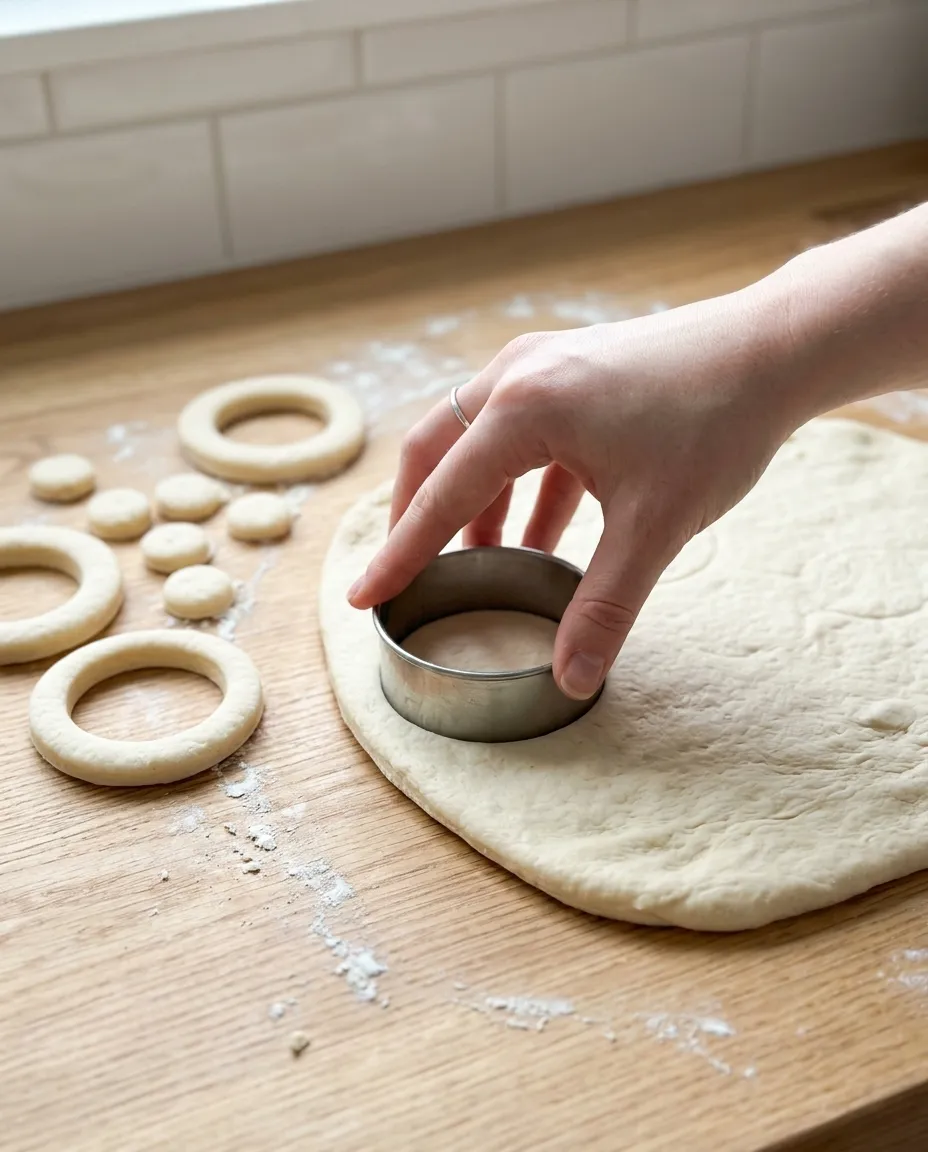
- Roll the dough a half inch thick, and cut with a 3 inch round cutter, then punch centers with a 1 inch cutter or a clean bottle cap. A dedicated donut cutter does both strokes at once and is worth its five dollars if donuts become a habit.
- Press straight down, no twisting, the scone cutter's law repeated verbatim: a twisted cut seals the dough's edge and stunts the rise.
- Scraps get exactly one second chance. Press them gently together, rest 10 minutes under the towel so the gluten relaxes, and cut again. Generation two is nearly as good; generation three is a tough little donut nobody deserves, so roll any final scraps into balls for the holes batch instead.
- The punched centers are not scraps at all: they are ready-made donut holes, and they proof and bake alongside their rings.
The parchment square rule
Here is the step that separates donuts that look homemade from donuts that look bought: after cutting, each ring moves onto its own small parchment square and never touches a hand again. A fully proofed ring is mostly air held together by hope, and fingers dent it permanently; the dents deflate, and deflated patches fry up flat and dense. The square is the stretcher crew:
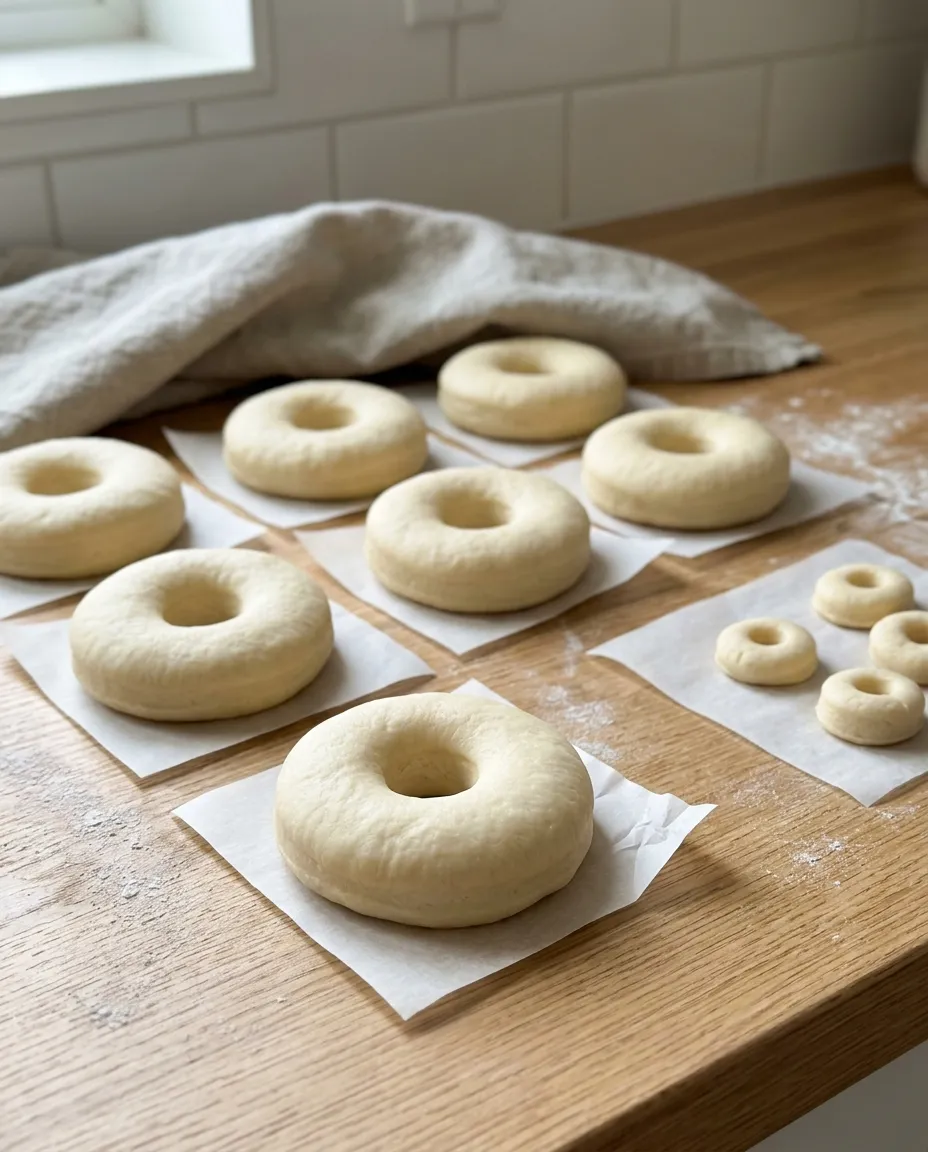
Proof on the square
Rings rise their final 30 minutes already sitting on their squares, under the towel, so nothing needs lifting later.
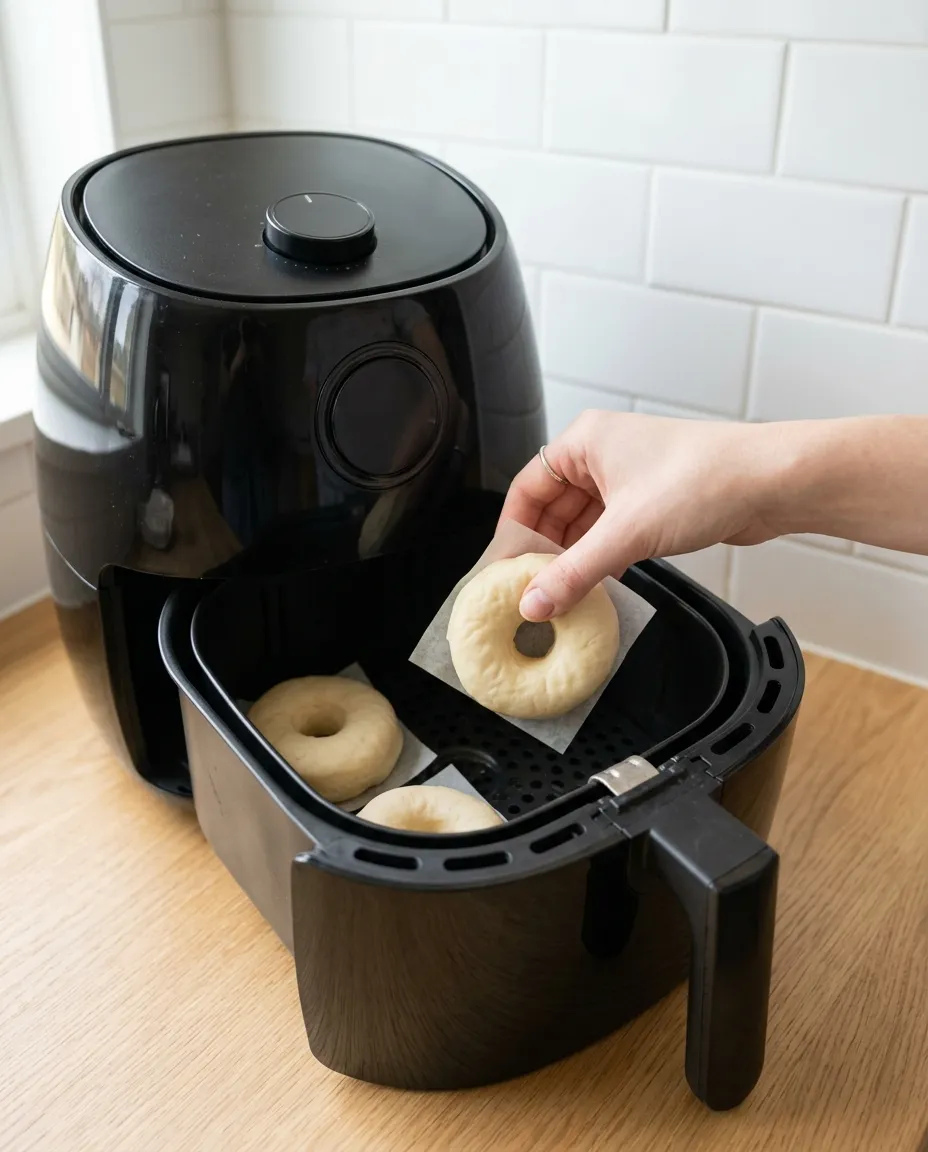
Travel by the square
Lower each ring into the basket holding the parchment's corners. The donut never feels a finger.
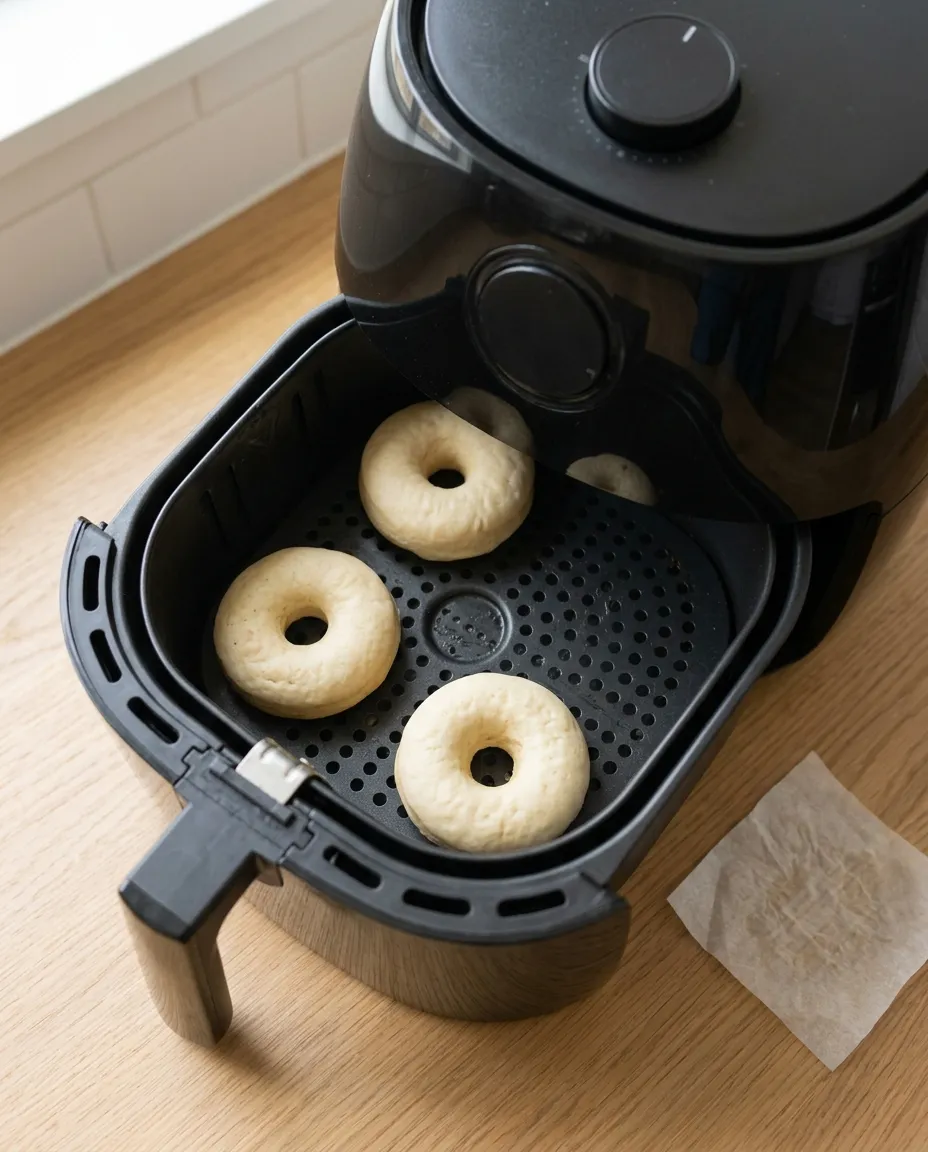
Retire the square at the flip
By minute 4 the underside has set; flip the donut off its square with a spatula, slide the paper out, and let the second face meet bare basket. The full liner law lives in the foil and parchment guide.
Bake to blonde, not brown
Every other bread on this site chases color, and this page is the exception that proves the doctrine: a glazed yeast donut is done at pale blonde, barely past cream, with just a whisper of gold at the edges. The chain's donuts are this color for a reason: browning is flavor development, and a donut's flavor plan is delicate crumb plus glaze, so a deeply browned donut tastes toasty in a way that fights its own glaze and eats dry besides.
That makes doneness harder to see, which is what the number is for: 195°F on an instant-read thermometer, the enriched-dough standard, reached here in only 5 to 6 minutes at 340°F because a ring is thin and has a hole for the heat to work through. The geometry that doomed the donut hole to gentleness makes the ring the fastest yeast bake on the site. If you are converting a family oven donut recipe, the air fryer calculator handles it honestly; a deep-fry donut recipe cannot be converted by arithmetic, for the oil-versus-air reasons the churros page owns. All the settings live in the air fryer baking chart.
The glaze: corn syrup and the warm window
Two decisions make the difference between a homemade-looking white coat and the thin, glassy, faintly crackled sheath of the donut shop:
- The tablespoon of corn syrup is not optional. Powdered sugar glazes dry by crystallizing, and plain ones crystallize matte and slightly grainy. Corn syrup is an invert sugar that interrupts the crystals, so the glaze dries smooth, glossy and faintly elastic, which is the shine and the delicate crackle in one ingredient. It is the same chemistry that keeps commercial glazes gleaming, available at every grocery store.
- Dip in the warm window: 5 to 10 minutes out of the basket. This page and the lemon bread look like they disagree, and they do not; they want different coats. The lemon loaf wants a thick opaque shell, so it demands a cold surface. A glazed donut wants a coat so thin you can see the blonde through it, and only a warm surface thins the glaze that far, letting the excess run off and leaving a translucent sheath. Too hot, the glaze runs off entirely; too cold, it sits thick and white. Warm is the window, and it is short.
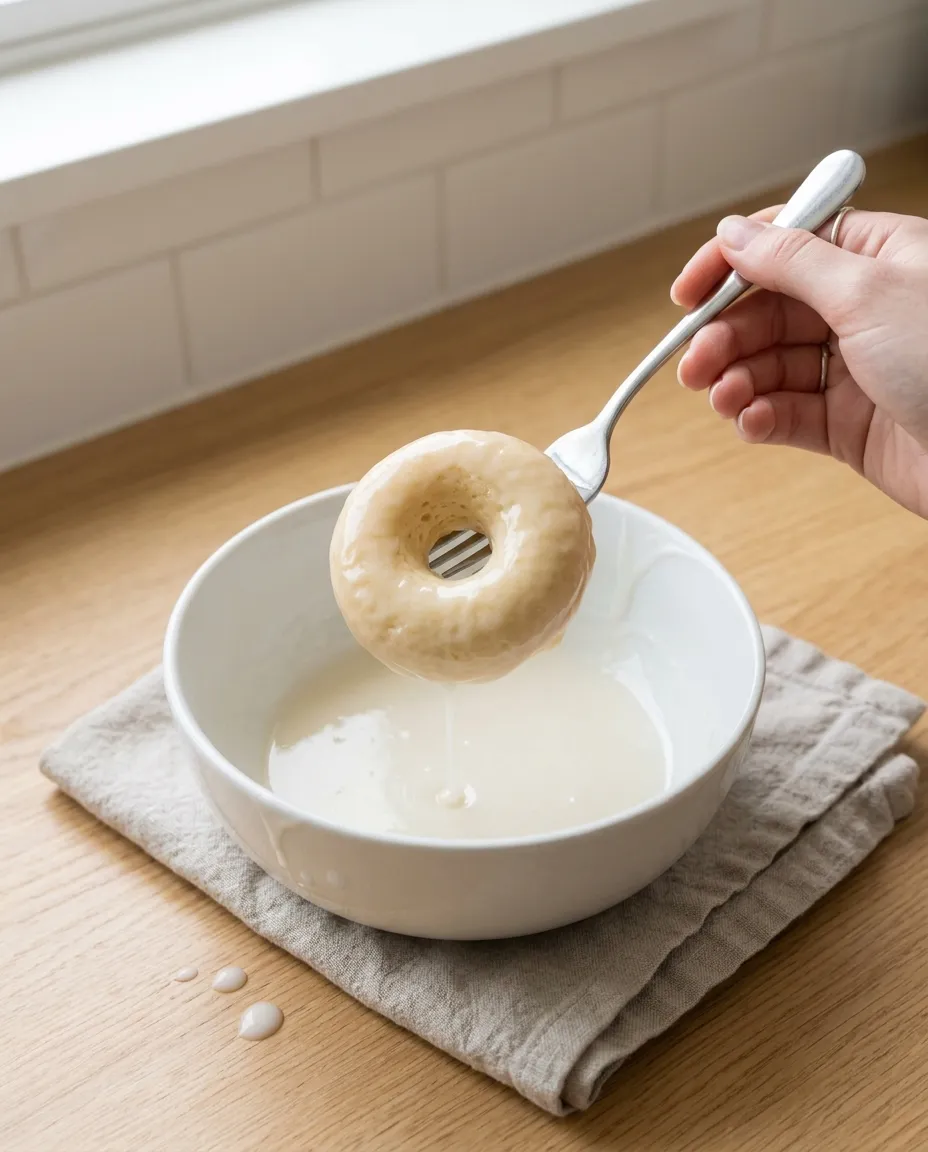
- Full dunk, then rack. Drop the donut in top-down, flip it with a fork, lift it out on the fork's tines and let it drip a beat before the rack. Ten minutes sets the glaze to a dry touch, and pouring the drip-tray glaze back into the bowl is legal and encouraged.
How to make them
- Make the dough: stir 2.5 cups flour, 2 teaspoons instant yeast, 1/4 cup sugar and 1/2 teaspoon salt. Add 3/4 cup warm milk, 1 egg and 3 tablespoons soft butter, and knead 8 to 10 minutes to smooth, soft and slightly tacky.
- First rise: 1 hour covered until doubled, or about 40 minutes in the proof box.
- Roll a half inch thick on a lightly floured counter and cut about ten 3 inch rings with 1 inch centers, pressing straight down. Re-roll scraps once, after a 10 minute rest.
- Set every ring on its own parchment square, centers on a shared square, and proof 30 minutes under the towel until puffy and fragile-looking.
- Bake at 340°F, 3 or 4 rings at a time, 4 minutes, lowered in by their squares, no preheat.
- Flip, retire the squares, and bake 1 to 2 minutes more to pale blonde and 195°F.
- Whisk the glaze while the first batch bakes: 2 cups powdered sugar, 1/4 cup milk, 1 tablespoon corn syrup, 1 teaspoon vanilla, pinch of salt, until pourable-smooth.
- Dunk each donut in its warm window, 5 to 10 minutes out, flip in the glaze, lift, drip, rack. Ten minutes to set, then serve while anything is still faintly warm, which is the entire chain-store secret performed at home.
- Bake the centers as donut holes per that page, and the pan is officially licked.
Troubleshooting
| What you got | Why | Fix |
|---|---|---|
| Dense, bready donuts | Shorted second proof, or over-floured dough. | The full 30 minute ring proof, and a dough that stays slightly tacky; extra flour is the lightness tax. |
| Flat spots and dents | Fingers touched proofed rings. | The parchment square rule, followed like law. |
| Brown, dry-edged donuts | Baked to bread color out of habit. | Blonde is done. 195°F confirms what the pale color cannot. |
| Glaze slid off entirely | Dipped straight from the basket, too hot. | Wait for the warm window's opening, about minute 5. |
| Thick, white, opaque glaze | Dipped cold, or the glaze was too stiff. | Dip warm, and thin the bowl with milk a teaspoon at a time to a slow pour. |
| Matte, grainy glaze | No corn syrup; the sugar crystallized its own way. | The tablespoon of corn syrup, which is the shine. |
| Rings sealed shut, small holes | Twisted cutter, or holes cut too small. | Straight-down cuts and a full 1 inch center; the hole shrinks as it proofs. |
| Tough second-batch donuts | Scraps re-rolled twice or more. | One re-roll after a 10 minute rest; after that, the scraps become holes. The troubleshooting guide handles the recurring mysteries. |
Uneven blonde across the basket is the usual hot spot tell; rotate positions at the flip. No preheat here, per the preheat guide, and machines that scorch pale bakes have a file in the burning guide.
Variations
- Chocolate glazed: whisk 3 tablespoons cocoa into the glaze with an extra tablespoon of milk. Dip the same warm way.
- Maple: swap the corn syrup and 2 tablespoons of the milk for real maple syrup. Autumn's donut.
- Cinnamon sugar instead of glaze: butter first, sugar second, per the law that page and the churros share. The same rings take either coat.
- Sprinkles: they go on in the glaze's first wet minute or they bounce off forever. Children know this instinctively and will supervise.
- Filled donuts: skip the hole punch, bake the solid rounds a minute longer, and inject jam or pastry cream from the side once cooled slightly, exactly as the donut holes page teaches at bite scale.
- Scaling up for a weekend crowd: the recipe scaler resizes the dough; the bottleneck is basket rounds of 3 to 4, so start the glaze bowl early and run a dip-as-they-land assembly line.
Storage and the overnight schedule
- Glazed donuts peak warm and hold for a day in a loosely covered container; airtight makes the glaze weep. They are honest for 24 hours and nostalgic after that.
- Revive at 320°F for 90 seconds, which re-melts the glaze just to gleaming and re-softens the crumb. Watch closely; the glaze goes from gleam to slick fast.
- The overnight schedule is the donut-shop move: make the dough after dinner, first rise in the fridge overnight, then cut, proof 45 minutes (cold dough proofs slower), bake and glaze. Warm donuts land on the table about an hour after you wake, and the cold dough cuts the cleanest rings of all.
- Freeze the baked, unglazed rings 2 months; refresh from frozen at 320°F for 3 to 4 minutes and glaze in the resulting warm window as if new. Glazed donuts do not freeze; the coat returns as syrup.
Frequently asked questions
QHow long do yeast donuts take in an air fryer?
5 to 6 minutes at 340°F, flipped at minute 4, the fastest yeast bake on this site because a thin ring with a center hole gives heat two fronts to work from. Pull at pale blonde and 195°F inside. The full project runs about 2.5 hours, nearly all of it the two rises, or split it with an overnight fridge rise and bake warm donuts an hour after waking.
QDo air fryer donuts taste like Krispy Kreme?
Warm from the glaze rack, startlingly close: the same weightless crumb, the same thin crackly glaze, courtesy of the corn syrup trick the chain's glaze relies on. What is missing is the faint fried richness of the oil, a real but small gap that the enriched dough mostly covers. The chain's true advantage was always serving them warm, and at home you control the warm.
QWhy do you put corn syrup in donut glaze?
Because plain powdered sugar glazes dry by crystallizing, and unmanaged crystals dry matte and faintly grainy. Corn syrup is an invert sugar that interrupts crystal formation, so the glaze sets smooth, glossy and slightly elastic instead: the shine and the delicate crackle of a shop donut in one tablespoon. Without it the donuts taste the same but look homemade; with it they look bought, in the good way.
QWhen should you glaze donuts, hot or cold?
Warm, in the window 5 to 10 minutes out of the basket. A hot donut melts glaze straight off; a cold one wears it thick, white and opaque. A warm surface thins the glaze so the excess runs off and a translucent, glassy sheath remains, which is the donut-shop look. This is the opposite of an iced lemon loaf, which wants a cold surface and a thick shell; the target coat decides the temperature, not habit.
QHow do you cut donuts without a donut cutter?
Two round objects: a 3 inch biscuit cutter, glass or jar rim for the ring, and a 1 inch cutter or clean bottle cap for the center. Press straight down without twisting, because a twisted cut seals the dough's edge and stunts the proof. Cut the center a full inch wide; it shrinks as the ring proofs. And the punched-out centers are donut holes, not waste, so nothing needs re-rolling but the true scraps.
QWhy are my donuts dense instead of light?
Usually the second proof was shorted; the 30 minutes after cutting is where the airiness is built, and rings baked too soon become bagels with ambitions. The other culprits are extra flour kneaded in because the dough felt tacky, tacky is correct, and dented rings from handling after the proof, which is what the parchment-square transfer system exists to prevent.
QDo you flip donuts in the air fryer?
Once, at minute 4. Before glazing, a donut ring has two plain flat faces, so it flips legally under this site's flip rule, and the flip is also when the parchment square it traveled on gets slid out so the second face bakes on bare basket. After the flip it needs only 1 to 2 more minutes. Its sphere-shaped cousins next door get a basket shake instead; shape decides the move.
QCan I make donut dough the night before?
Yes, and it is the best schedule this recipe has. Mix and knead after dinner, then let the first rise happen overnight in the fridge. In the morning, roll and cut the cold dough, which cuts cleaner than room-temperature dough, proof the rings about 45 minutes since cold dough moves slower, and bake. Warm glazed donuts land about an hour after you put the kettle on.
QHow do you store glazed donuts?
Loosely covered at room temperature for a day; a sealed container traps moisture and turns the glaze weepy. Revive day-old donuts at 320°F for 90 seconds, just until the glaze re-gleams. For longer, freeze baked unglazed rings up to 2 months and refresh from frozen at 320°F for 3 to 4 minutes, then glaze in the warm window as if new. Glazed donuts themselves do not freeze; the coat thaws as syrup.
Never overbake again
Get our one-page times & temps cheat sheet, plus a new tested recipe each week.
No spam · unsubscribe anytime