
Air Fryer Cheese Danish: Bakery Style, No Proofing
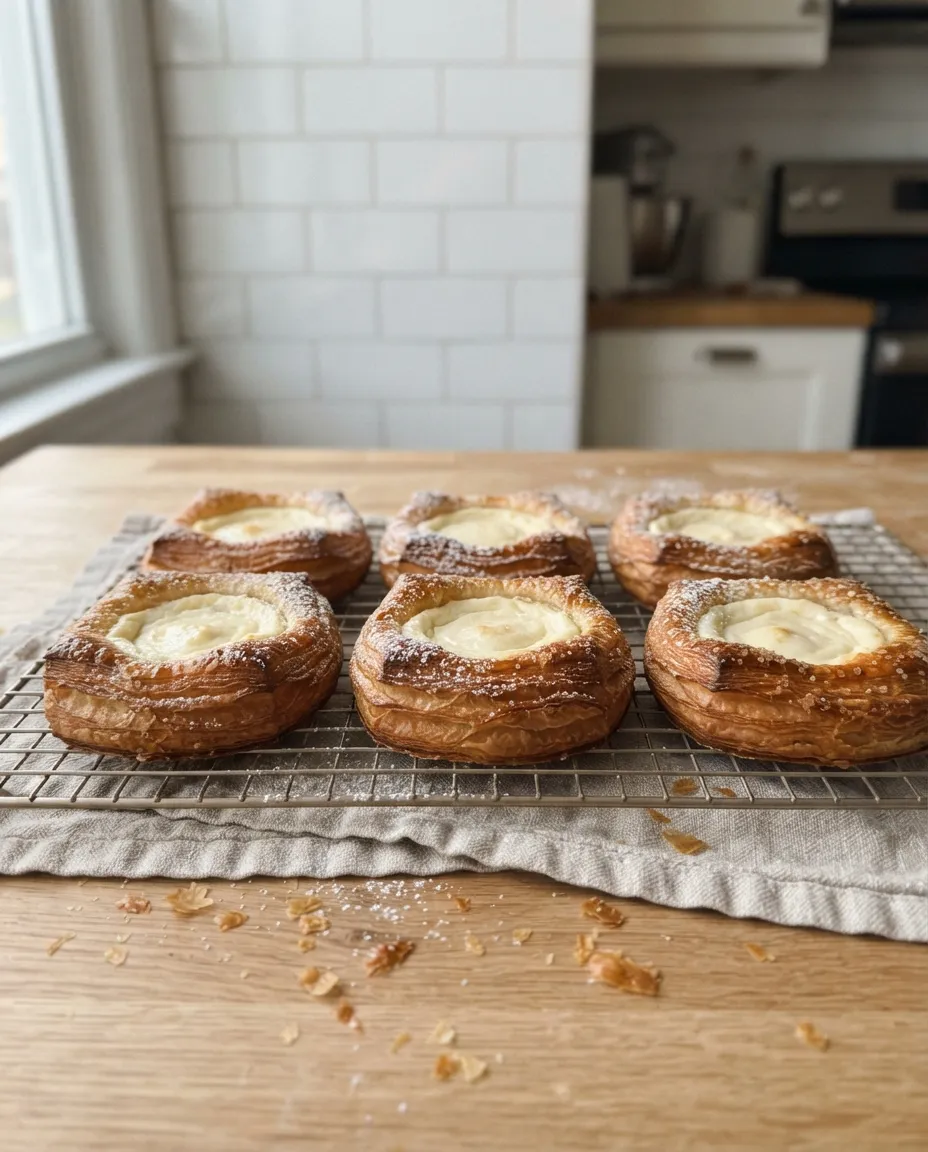
The recipes ranking for cheese danish are quietly at war with their own ovens. One runs 380°F and then drops to 320 partway through; another starts at 375 and retreats to 350; a third hides at 320 and pulls out at minute 4. All that thermostat gymnastics is treating one symptom: cheese filling browns faster than pastry bakes, and nobody has fixed the actual problem, which is structural. A danish needs a frame. Score a border into cold puff pastry, dock the middle, and the edges rise into flaky walls while the center stays flat and holds its filling like it was hired to. One temperature, 350°F, ten to twelve minutes, six danishes from one sheet, and a filling built on an egg yolk so it sets creamy instead of souffleing and slumping.
What’s on this page
What no proofing buys you
Full honesty at the door: a true bakery danish is laminated yeast dough, proofed for hours until the layers are both flaky and tender, and no shortcut reproduces that exactly. What a sheet of frozen puff pastry reproduces is the part your mouth actually remembers: shattering layers, a buttery frame, warm sweetened cheese in the middle. It gets you ninety percent of the bakery case for four percent of the work, and the missing ten percent is a subtle yeasty tenderness that most people cannot name with their eyes closed. That is the trade, it is a spectacular one, and this page takes it without apology. If you want the yeasted route with a sweet cheese center anyway, the soft enriched buns in our kolaches carry the same filling idea.
What the shortcut does not excuse is sloppiness with the parts that still matter: cold pastry, a filling engineered not to slide, and a shape that gives the cheese somewhere to sit. Those three are where the ranking recipes wobble, and they are the whole distance between a pastry that looks assembled and one that looks bought.
Puff pastry or crescent dough
Both work, and they make two different breakfasts. Puff pastry is the bakery-style answer in the title: it bakes into crisp, glassy layers with real shatter, and it is what this page's recipe card uses. Crescent dough makes a softer, breadier danish, closer to a sweet roll wearing a danish costume; it is the right call when the eaters are small or the softness is the point, and its home base on this site is the crescent rolls page. Run the crescent version at 330°F for 8 to 10 minutes, the crescent dough temperature this site uses everywhere, with the same filling and the same frame idea, pinching two triangles into a rectangle first and sealing the diagonal seam well.
Thaw puff pastry overnight in the refrigerator, never on the counter. The lift in those layers is cold butter flashing to steam, and butter that warmed up on a counter soaks into the dough and takes the flake with it. Cold sheet, sharp knife, and back into the refrigerator any time the dough turns soft and drapey instead of stiff and cooperative. The full handling rules for store puff pastry, thawing through baking, live in the puff pastry guide.
A filling that stays put
Danish filling has two classic failures: it slides off the pastry as it heats, or it puffs up proudly at minute 8 and collapses into a cracked crater at minute 12. Both are recipe problems, not oven problems. The slide comes from a loose filling on a puffing base, and the crater comes from whipping a whole egg into the cheese, which turns the filling into a little cheesecake souffle that cannot hold its rise.
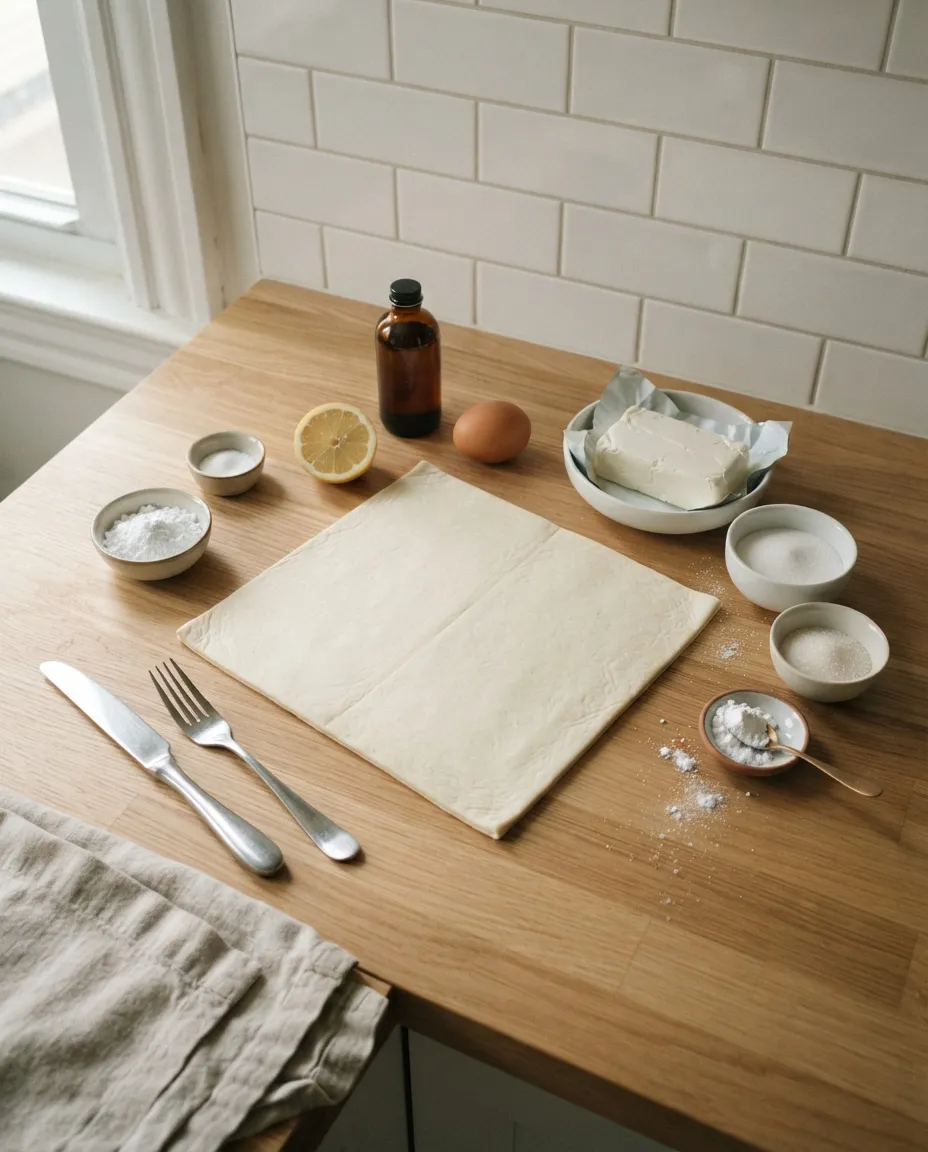
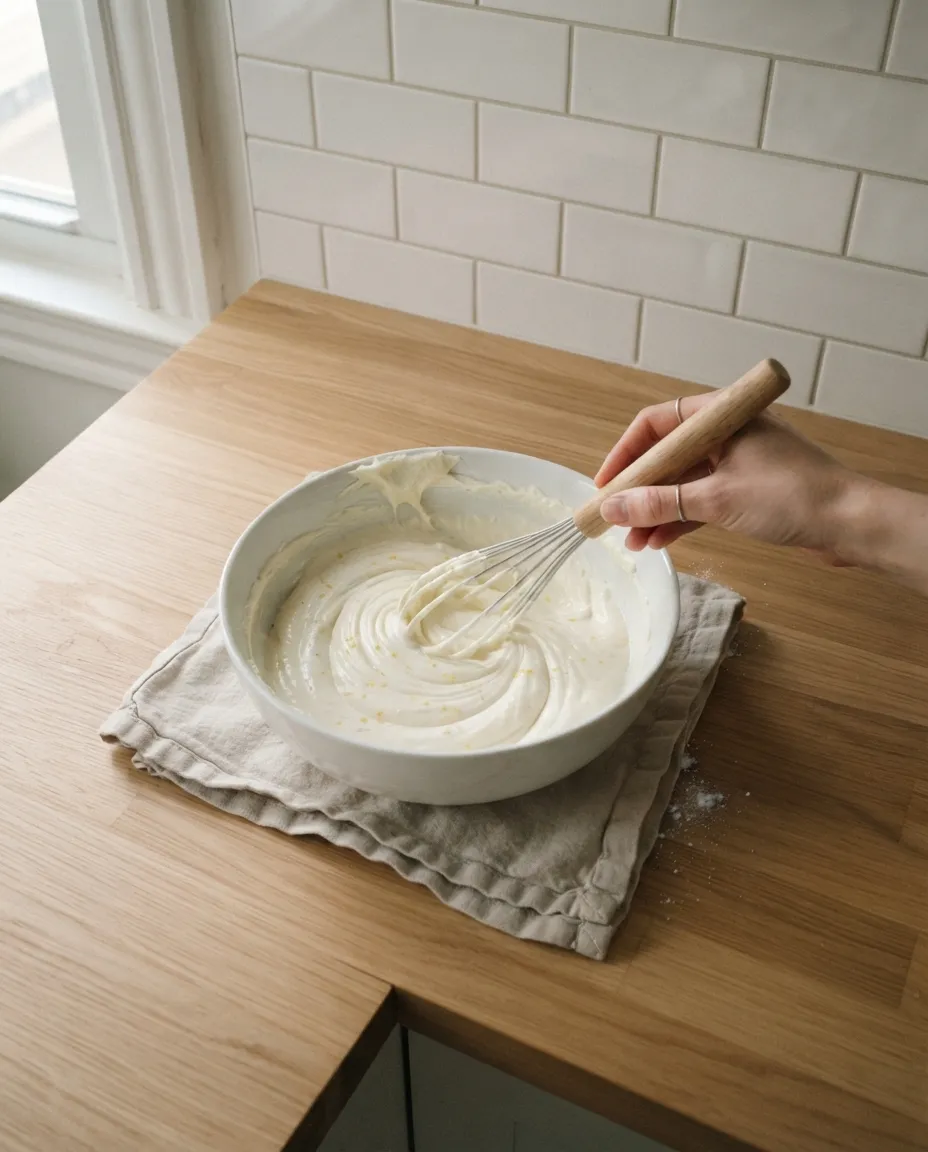
The fix is a stiff, yolk-only filling: cream cheese with sugar, a spoon of cornstarch, an egg yolk for richness and set, vanilla, lemon, salt. The yolk sets the filling creamy and dense with no ambition to rise; the cornstarch holds the moisture so nothing weeps onto the pastry; the lemon keeps it tasting like a danish instead of sweet spackle. Beat it smooth, then refrigerate it while you cut the pastry, because a cold, stiff filling stays exactly where the spoon left it. And the egg white is not garbage: it is the wash. Yolk in the filling, white on the frames, one egg, nothing wasted, which is how a bakery would do it.
The scored frame
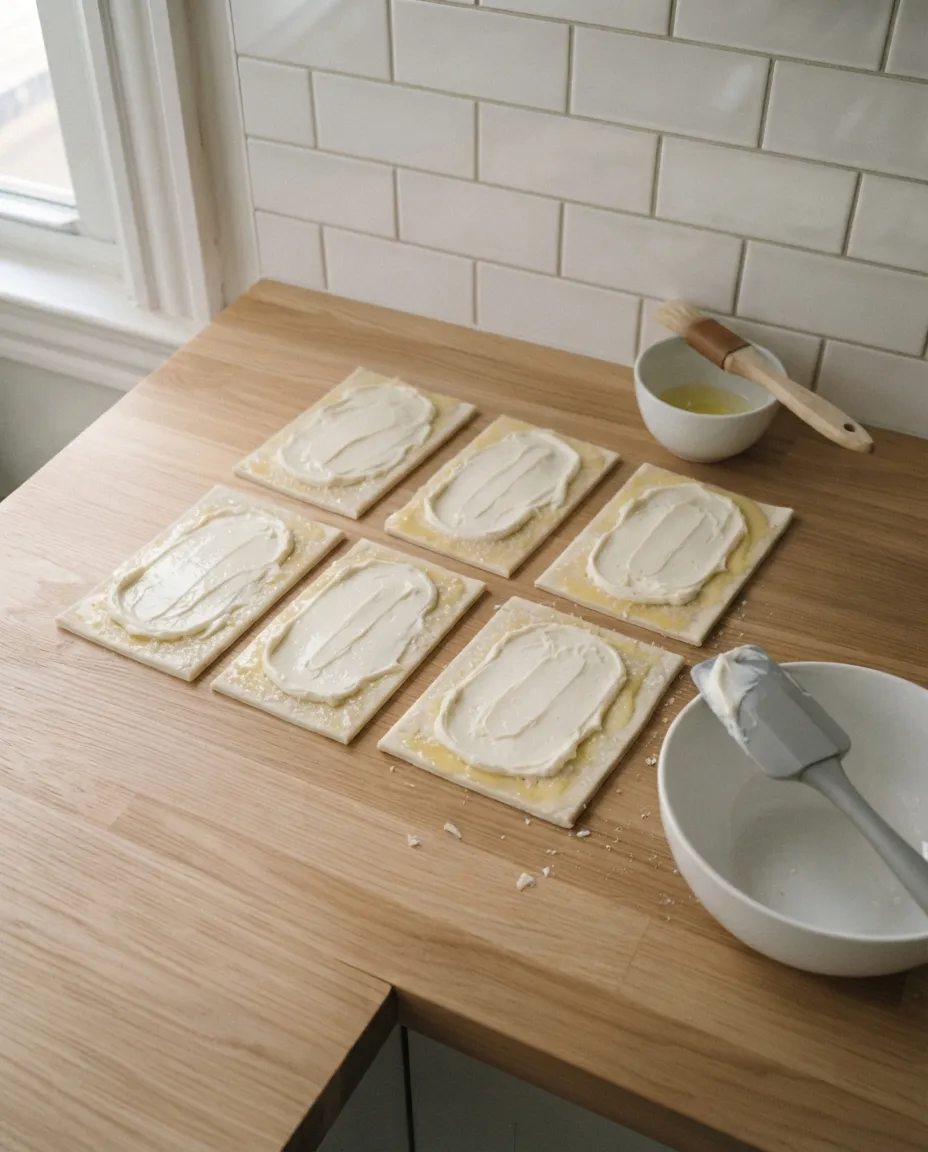
Here is the move that separates this page from every recipe it competes with. Cut the sheet into 6 rectangles, then take a knife and score a half-inch border around each one, cutting about halfway through the dough, never all the way. Inside that border, prick the center all over with a fork. That is 20 seconds of work per danish, and it redesigns the bake: the un-pricked border inflates into a tall flaky frame, while the docked center cannot inflate and stays flat, a little tray that holds the filling level through the entire bake.
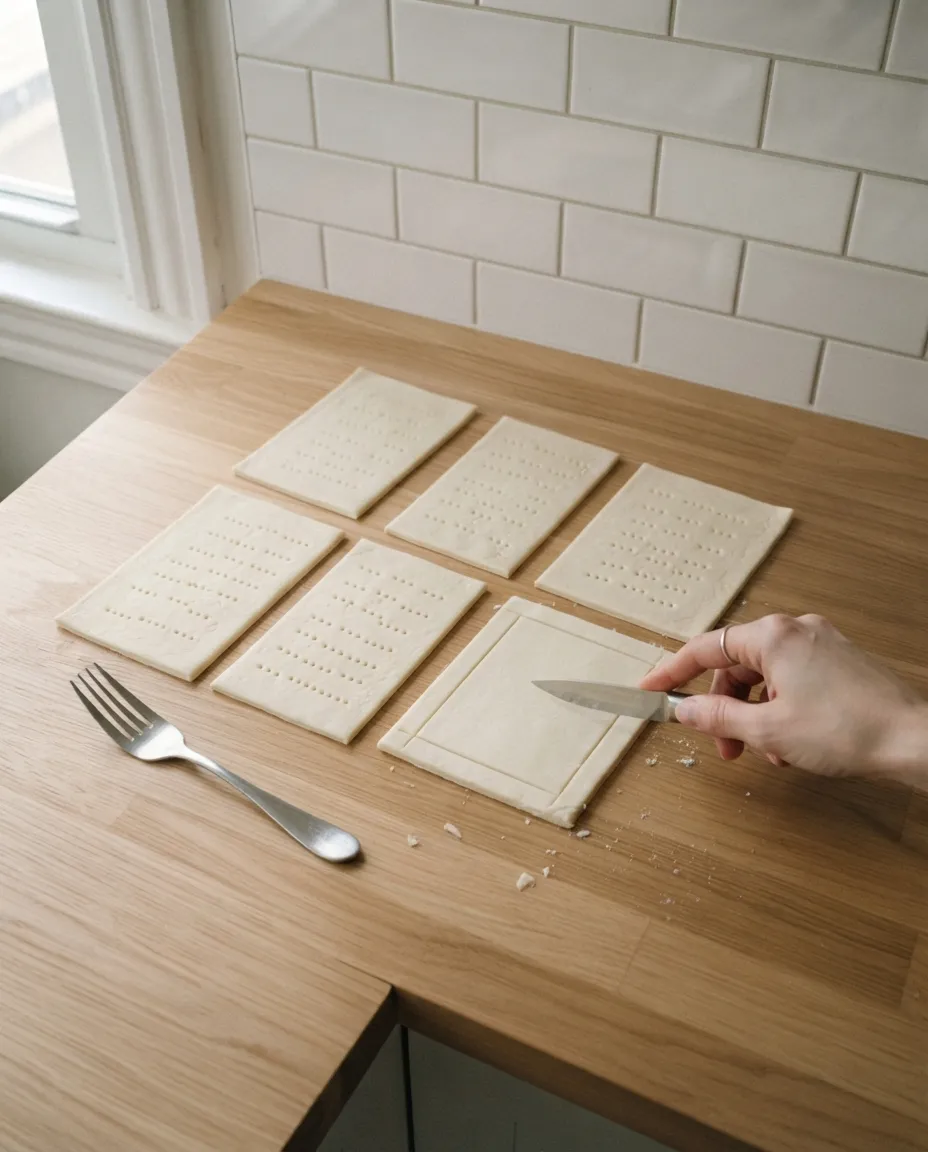
Without the frame, the whole rectangle puffs as one pillow and the filling toboggans off the top, which is why so many recipes end up with cheese soldering itself to the basket. With it, the danish comes out looking like the bakery made it: high glossy walls, sunken cream center, deliberate. Spread 2 tablespoons of cold filling inside each frame, wash the frames with the leftover egg white, and if the dough softened while you worked, give the built danishes 10 minutes in the refrigerator before they bake. Cold into hot is the whole religion with laminated dough.
Temperature and timing
350°F for 10 to 12 minutes, preheated 3 minutes, one temperature the whole way. The ranking recipes that open at 375 or 380 and then retreat are compensating for exposed cheese browning faster than pastry cooks; the yolk-only filling and the frame remove the need, because the filling sits low, protected by its walls, and does not spend the bake climbing into the airflow. Puff pastry gets a real preheat on this site, the same rule as our apple turnovers and the opposite of our canned-dough pages, because its lift depends on cold butter hitting hot air; the full when-it-matters logic is in do you need to preheat an air fryer for baking.
Bake 3 at a time with space between them, second batch about a minute shorter. Oven danish recipes run around 400°F, and 350°F is that number passed through the oven-to-basket drop our air fryer calculator applies to any recipe, minus a step for laminated dough's surface butter. If your machine runs hot and the frames bronze early, the rescues are in the burning guide; the answer is never a hotter, shorter bake. Every tested number on this site lives on the baking chart.
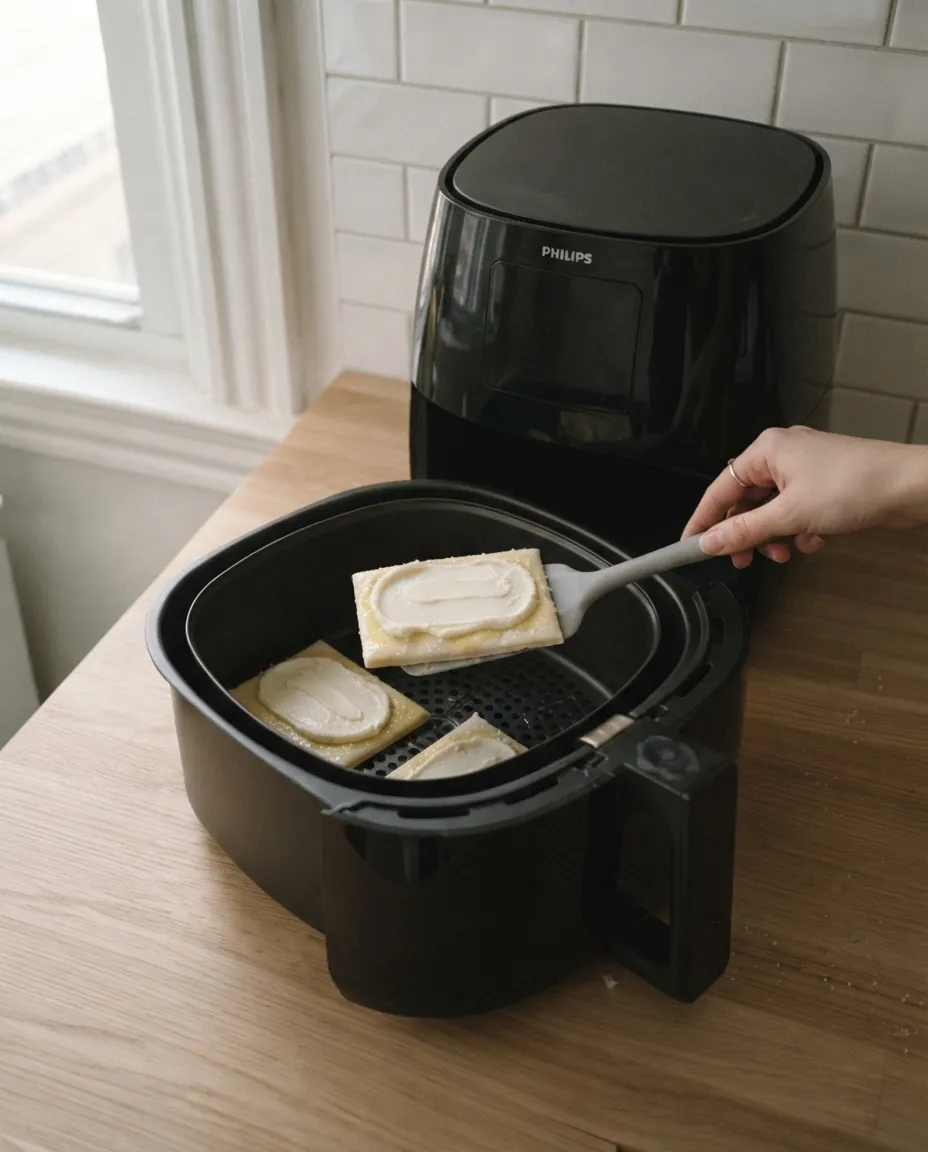
What done looks like
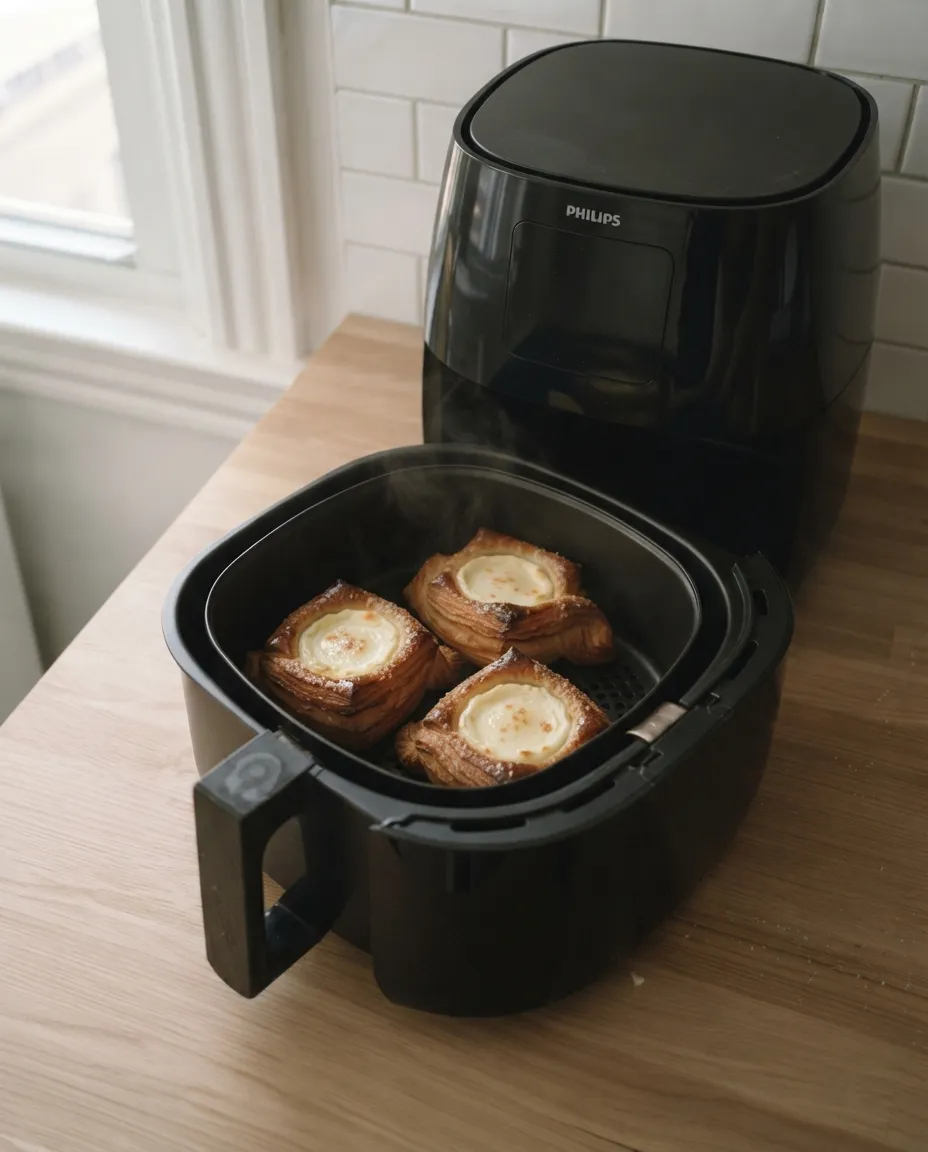
- Frames: tall, deep gold, glossy from the egg white, with visible layer lines on the sides.
- Centers: the filling should be set at the edges with a faint shine and the smallest wobble in the middle; it firms as it cools, exactly like its big cousin, our air fryer cheesecake.
- Freckles: a few pale gold spots on the cheese are correct and bakery-authentic. Mahogany blotches mean the machine runs hot; drop 10 degrees next batch.
- The base: lift one with a spatula. Golden and rigid underneath, because the docked center bakes dry against the open basket floor instead of steaming on a sheet pan.
Ingredients
For 6 danishes
- 1 sheet frozen puff pastry (about 8.6 oz), thawed overnight in the refrigerator
- 6 oz cream cheese, softened
- 3 tablespoons granulated sugar
- 1 teaspoon cornstarch
- 1 egg, separated: the yolk for the filling, the white for the wash
- 1/2 teaspoon vanilla extract
- 1 teaspoon lemon juice and a little zest if the lemon is already out
- Pinch of fine salt
- Coarse sugar for the frames, optional
- Powdered sugar to finish, optional
Full-fat brick cream cheese, not the spreadable tub kind, which carries extra water and bakes loose. Soften it on the counter, not in a microwave that half-melts it.
How to make them
- Beat the cream cheese, sugar, cornstarch and salt until completely smooth, then beat in the egg yolk, vanilla and lemon. Refrigerate the filling.
- Cut the cold puff pastry sheet into 6 rectangles with a sharp knife.
- Score a half-inch border around each rectangle, cutting about halfway through the dough, and prick the centers all over with a fork.
- Spread 2 tablespoons of the chilled filling flat inside each frame, keeping it off the borders.
- Brush the frames with the egg white and sprinkle them with coarse sugar if using.
- Refrigerate the built danishes for 10 minutes while the air fryer preheats at 350F for 3 minutes.
- Air fry 3 at a time at 350F for 10 to 12 minutes, until the frames are deep gold and the filling is set at the edges with a slight wobble in the center.
- Cool on a rack for 10 minutes; the filling finishes setting as it cools, and the base stays crisp off the counter.
- Dust with powdered sugar once they are warm rather than hot, and bake the second batch about a minute shorter.
The fruit danish detour
Every cheese danish is one teaspoon away from a fruit danish, and the frame makes it safe. Drop a teaspoon of thick jam, cherry, raspberry, or apricot for the classic bakery look, onto the center of the cheese filling before baking, and swirl it once with a toothpick or leave it as a proud dot. Thick jam only: runny preserves and pie fillings loosen in the heat and boil over the walls. A few fresh blueberries pressed lightly into the cheese also behave, and sliced strawberries do not, releasing juice that puddles. For deeper cream cheese and fruit ambitions in bar form, the cheesecake bars run the same flavor at twice the depth.
Fixing what goes wrong
| Problem | Cause | Fix |
|---|---|---|
| Filling slid off | No frame, warm loose filling, or both | Score the border, dock the center, and chill the filling until stiff before spreading |
| Filling puffed, then cracked and sank | Whole egg in the filling | Yolk only; the white goes on the frames as wash |
| Cheese browned before the pastry baked | Temperature above 350°F, the two-temp trap | 350°F flat; the walls shade the filling when the frame is scored |
| Flat, greasy pastry, no layers | Pastry went in warm, or no preheat | Cold sheet, 10 minute chill after building, 3 minute preheat |
| Centers ballooned under the filling | Skipped the docking fork | Prick the middle thoroughly, inside the scored line only |
| Soggy base by serving time | Cooled on a plate | Rack, always; a hot pastry fogs a plate and drinks it back in minutes |
Serving, storing, the Starbucks question
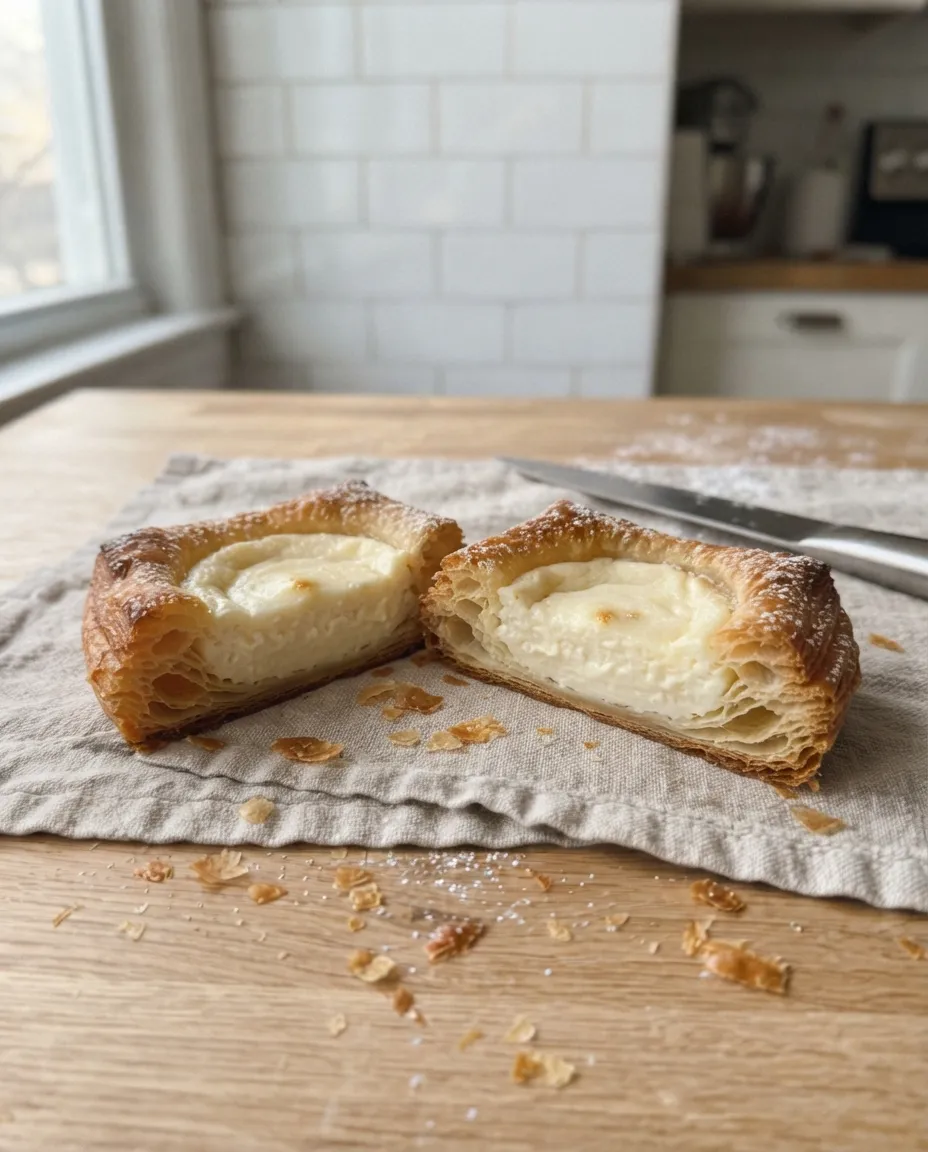
Warm but not hot is the danish's best moment, 10 minutes off the basket, when the frame still crackles and the filling has settled from molten to creamy. With coffee, obviously; alongside the bacon and eggs it turns a weekday breakfast into a diner order. And since half the searches for this recipe say Starbucks in them: yes, this is that pastry, and better. The coffee-shop danish is a par-baked freight item finished under a heat lamp; yours came off the rack 10 minutes ago with a frame it grew itself. Same idea, different weight class. The rest of this site's canned-and-frozen-dough repertoire keeps that energy at canned biscuits, cinnamon rolls and frozen croissants, and the same puff pastry sheet turns into sugar-crackled palmiers. Everything is indexed at the recipe index and the technique pages under guides.
Store leftovers airtight in the refrigerator, not the counter, because of the cheese, up to 3 days. Revive at 320°F for 3 to 4 minutes, which re-crisps the frame while the filling warms gently; the microwave turns the pastry to flannel and is banned here as everywhere on this site. You can also build the danishes a night ahead, unbaked and covered in the refrigerator, and bake them in the morning straight from cold, adding a minute. Fresh pastry for guests with zero morning assembly is the closest thing this site has to a magic trick.
Frequently asked questions
QWhat temperature do you cook a cheese danish in the air fryer?
350F for 10 to 12 minutes for puff pastry danishes, with a 3 minute preheat and one temperature the whole way. Recipes that start at 375 or 380 and drop partway are compensating for exposed cheese browning faster than pastry cooks; a scored frame and a low-sitting yolk-only filling remove the problem, so no thermostat gymnastics are needed. Crescent dough danishes run cooler, 330F for 8 to 10 minutes, because crescent dough scorches at puff pastry temperatures.
QShould I use puff pastry or crescent rolls for danish?
Puff pastry for the bakery-style result: crisp, glassy, shattering layers and a frame that rises tall around the filling. Crescent dough bakes into a softer, breadier pastry, closer to a sweet roll, which is genuinely better for small kids or anyone who finds flaky pastry messy. The filling and the frame technique are identical for both; only the numbers change, 350F for 10 to 12 minutes for puff pastry against 330F for 8 to 10 for crescent dough, with two crescent triangles pinched into one rectangle per danish.
QWhy did my cream cheese filling slide off or sink?
Sliding means the base puffed under a loose filling: score a half-inch border around each danish, prick the center with a fork so it cannot inflate, and chill the filling stiff before spreading, and the cheese stays in its tray for the whole bake. Sinking with a crack means a whole egg went into the filling, which whips in air and bakes like a tiny souffle, rising and then collapsing. Use only the yolk in the cheese; it sets dense and creamy with no rise to lose, and the white becomes the wash for the frames.
QIs this like the Starbucks cheese danish?
Same pastry family, and honestly a stronger version of it. The coffee-shop danish is sweetened cream cheese on laminated pastry, par-baked off-site and finished under hot lamps, which is why its base is always a little soft. This one uses the same sweet-cheese filling profile, vanilla and a little lemon on full-fat cream cheese, on puff pastry baked minutes before you eat it, with a frame that keeps the filling centered. If you want the copycat flavor exactly, skip the lemon zest and keep the filling plain vanilla.
QCan I make cheese danish ahead of time?
Yes, and the best way is to stop just before the bake. Build the danishes completely, filling, wash and all, cover them, and refrigerate overnight, then bake straight from cold at 350F, adding about a minute. The chill actually improves the pastry. Baked danishes keep refrigerated and airtight up to 3 days because of the cheese, and revive at 320F for 3 to 4 minutes, which re-crisps the frame while the filling warms. Do not microwave them; the pastry goes soft in seconds and stays that way.
QWhy does the recipe use only the egg yolk?
Because the yolk and the white do opposite jobs in a filling. The yolk carries fat and lecithin, so it sets the cream cheese dense, rich and custard-like with no lift. The white is nearly pure protein and water, and beaten into a filling it traps air that expands in the heat, puffing the cheese into a dome that cracks and collapses as it cools. Splitting the egg gives each half the right job: yolk in the filling for set and richness, white brushed on the pastry frames for gloss and browning. One egg, no waste, both problems solved.
Made it? Rate it.
It helps more people find the danish with the frame.
Air Fryer Cheese Danish
Six bakery-style cheese danishes from one sheet of puff pastry: scored frames, a yolk-only cream cheese filling that stays put, and 350°F for 10 to 12 minutes.
Ingredients
- 1 sheet frozen puff pastry (about 8.6 oz), thawed overnight in the refrigerator
- 6 oz cream cheese, softened
- 3 tablespoons granulated sugar
- 1 teaspoon cornstarch
- 1 egg, separated: the yolk for the filling, the white for the wash
- 1/2 teaspoon vanilla extract
- 1 teaspoon lemon juice and a little zest if the lemon is already out
- Pinch of fine salt
- Coarse sugar for the frames, optional
- Powdered sugar to finish, optional
Instructions
- Beat the cream cheese, sugar, cornstarch and salt until completely smooth, then beat in the egg yolk, vanilla and lemon. Refrigerate the filling.
- Cut the cold puff pastry sheet into 6 rectangles with a sharp knife.
- Score a half-inch border around each rectangle, cutting about halfway through the dough, and prick the centers all over with a fork.
- Spread 2 tablespoons of the chilled filling flat inside each frame, keeping it off the borders.
- Brush the frames with the egg white and sprinkle them with coarse sugar if using.
- Refrigerate the built danishes for 10 minutes while the air fryer preheats at 350F for 3 minutes.
- Air fry 3 at a time at 350F for 10 to 12 minutes, until the frames are deep gold and the filling is set at the edges with a slight wobble in the center.
- Cool on a rack for 10 minutes; the filling finishes setting as it cools, and the base stays crisp off the counter.
- Dust with powdered sugar once they are warm rather than hot, and bake the second batch about a minute shorter.

Sujata Thapa
Sujata bakes everything on this site in a 5.5 quart basket air fryer on a Kathmandu counter, then re-tests the keepers until the timings hold for anyone. The whole-egg filling failed for her twice, rising like a promise and cracking like one too, before the yolk-only rule went in the notebook underlined.