

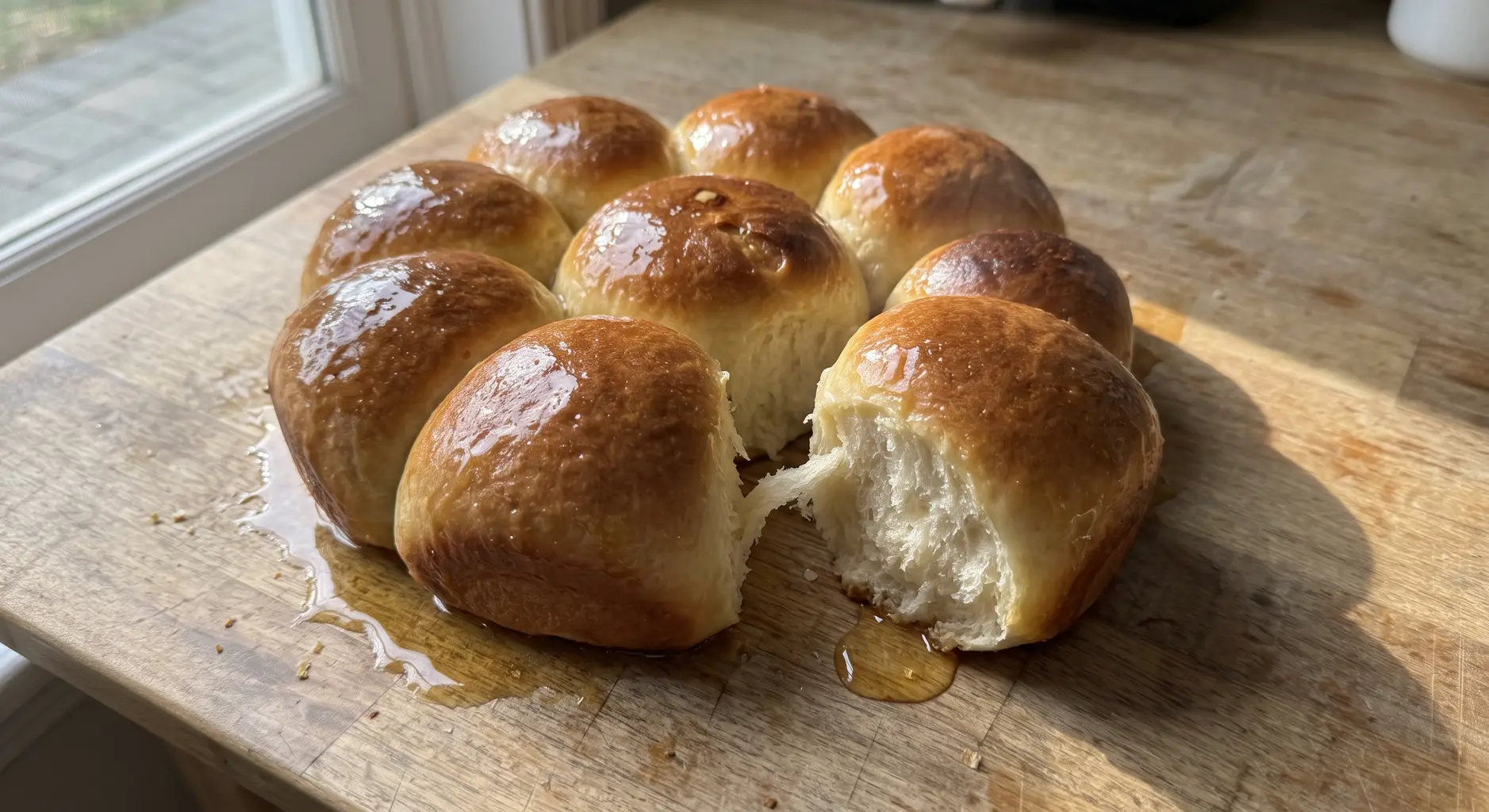
My first air fryer dinner rolls were excellent and completely wrong. Eight beautiful golden buns, spaced neatly in the basket like the biscuits I had made the week before, each one wearing a crust on all six sides. My daughter picked one up, turned it over, and asked why I had made hamburger buns for Thanksgiving.
She was right. A dinner roll is not a small crusty bread, it is a soft one, and the softness comes from a trick so simple most recipes forget to say it out loud: the rolls bake pressed against each other, in a pan, so that most of each roll's surface is not exposed to the heat at all. The crust happens only on top. Everything else stays cloud.
Quick answer: Make a soft milk-and-butter dough, rise it once, then arrange 8 balls touching in a greased 7-inch cake pan and let them rise again, right inside the switched-off air fryer with a cup of hot water beside the pan. Egg wash, then bake at 300°F for 15 to 18 minutes, tenting with foil at minute 8. Done at 195°F in the center roll, brushed with honey butter while hot.
Pull-apart means touching
Here is the rule that separates this page from the biscuit page two doors down, and it is worth putting plainly because the two contradict each other on purpose. The frozen biscuits demand an inch of space so hot air can crisp every side. Dinner rolls demand the opposite, and both are right, because they are chasing opposite textures.
Six crusts per roll
Air reaches every surface, so every surface browns. You get individual buns: great for burgers, wrong for the basket next to the gravy.
One crust per roll
The rolls rise into each other and fuse at the walls. Shared walls cannot brown, they steam against each other and set soft. Only the top meets the heat.
The pan makes it possible
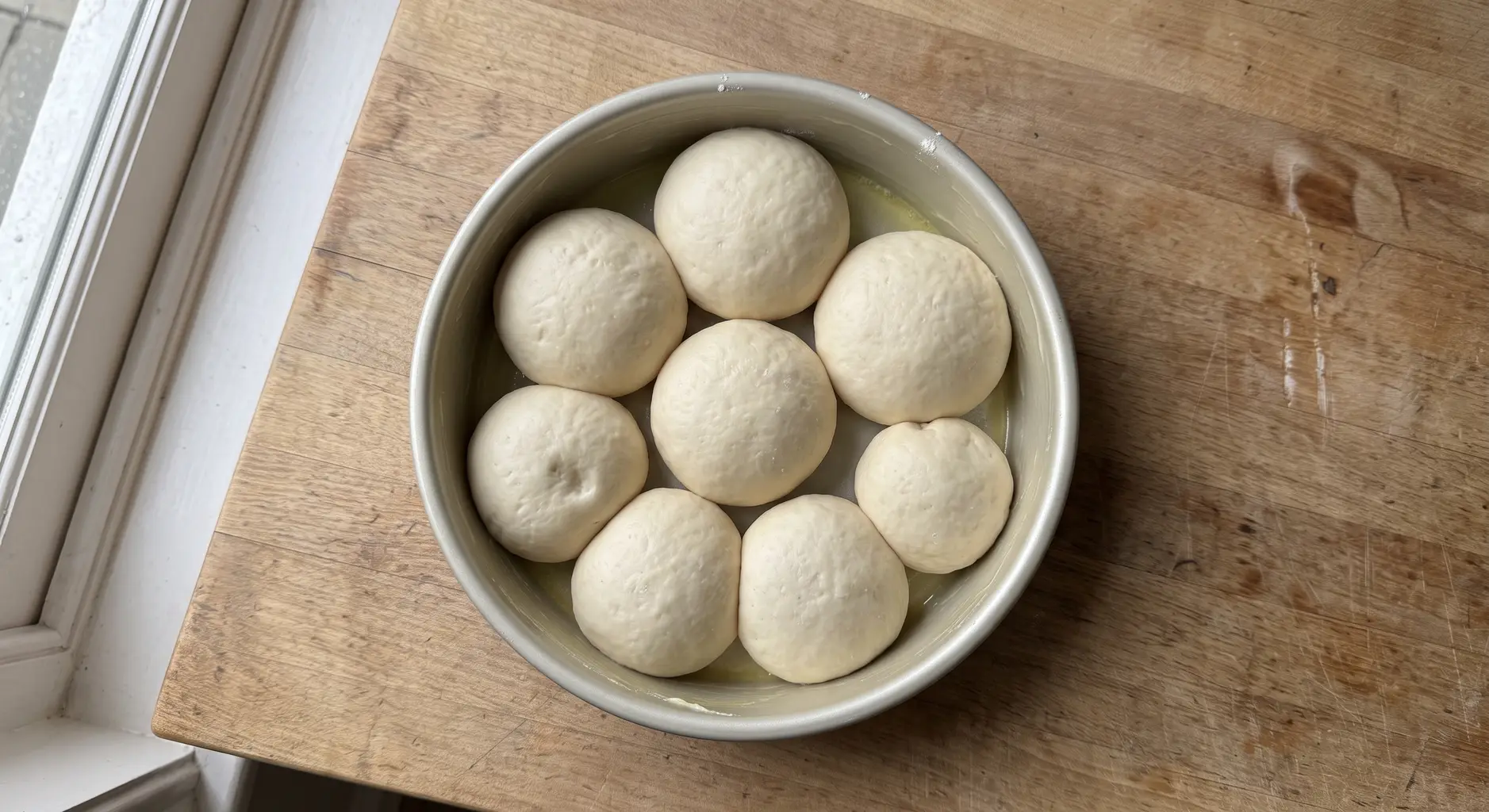
A bare basket cannot hold rolls in formation, they lean and slide. A greased 7-inch cake pan holds the huddle, catches the butter, and turns the basket into a pull-apart machine.
A 7-inch round pan holds 8 rolls snugly in most 5 to 6 quart baskets, and a 6-inch square takes 6. Not sure what fits yours? The pan size calculator settles it in seconds. This is also why the flip question never comes up here: rolls in a pan with an egg-washed top have one precious face and nowhere to go, the same one-precious-face logic that runs the whole bread shelf on this site.
The machine is also the proof box
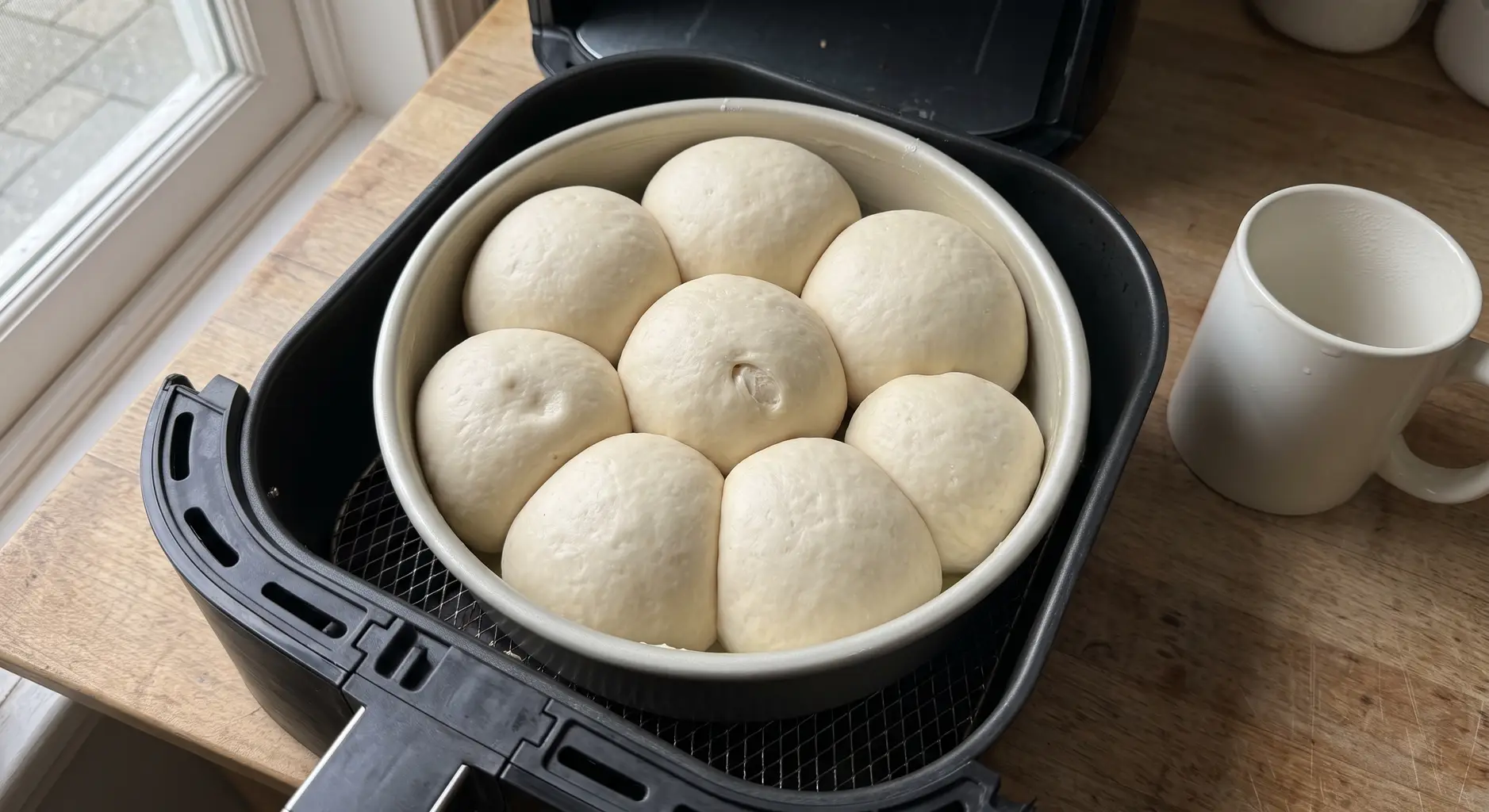
The most underused feature of an air fryer is the machine switched off. It is a small, sealed, draft-free box, which is exactly what rising dough wants and exactly what most kitchens do not offer in November.
For the second rise, set the pan of shaped rolls inside the cold machine, put a mug of just-boiled water in beside it, and close the drawer. The water warms and humidifies the little chamber, the dough rises in 30 to 40 minutes instead of an hour on a cold counter, and the surface never dries into a skin. Lift the mug out, wash the tops, and the pan is already home: the bake starts where the rise finished.
Two cautions that keep this trick honest. Never run the machine with the mug inside, it comes out before any heat goes on. And if your machine's drawer seals very tightly, crack it a finger's width so the dough gets air. The rest of the proofing story, first rises included, works the same way.
Why milk, butter and egg
Dinner roll dough is bread dough that has been to finishing school, and each enrichment has a job:
- Milk instead of water tenderizes the crumb and its sugars brown the tops at a temperature the inside can keep up with. Water doughs bake into lean, chewy rolls with pale faces.
- Butter shortens the gluten strands, which is the difference between tearing a roll and tearing a baguette.
- The egg adds richness and structure so the rolls stand tall instead of slumping into one flat pull-apart pancake.
- Sugar feeds the yeast and finishes the tops glossy amber under the egg wash.
None of it is optional if soft is the goal, and all of it is why this dough also makes the cinnamon roll and the burger bun: enriched dough is a family, not a recipe. The sweetest branch of it is monkey bread, which is these same rolls rolled in cinnamon sugar and stacked.
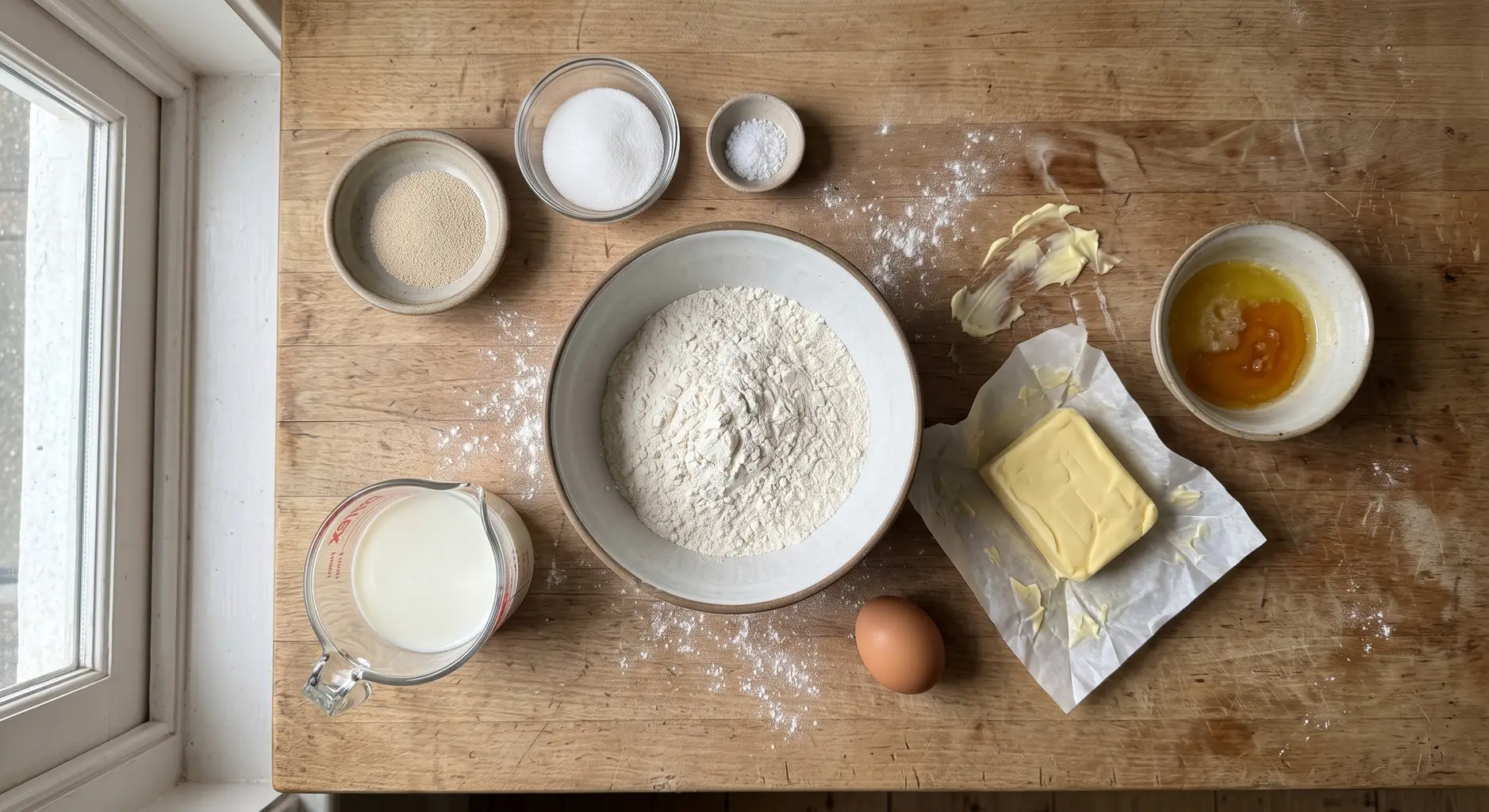
Ingredients
The dough
- 2 1/4 cups (280g) all-purpose flour
- 1 teaspoon instant yeast
- 2 tablespoons (25g) sugar
- 3/4 teaspoon fine salt
- 1/2 cup (120ml) warm milk
- 1 large egg, room temperature
- 3 tablespoons (42g) unsalted butter, softened
The finish
- 1 egg yolk beaten with 1 teaspoon milk, for the wash
- 2 tablespoons butter melted with 1 teaspoon honey, for after
- Optional: flaky salt on the buttered tops
Doubling for a crowd doubles the dough but not the pan: bake two pans in sequence rather than cramming one, and the recipe scaler keeps the quantities straight. In a hurry with no yeast in the house? The two-ingredient dough from the naan page, self-rising flour and Greek yogurt, shapes into 6 balls and bakes in the same pan at the same temperature for a denser but respectable 25-minute roll.
How to make them
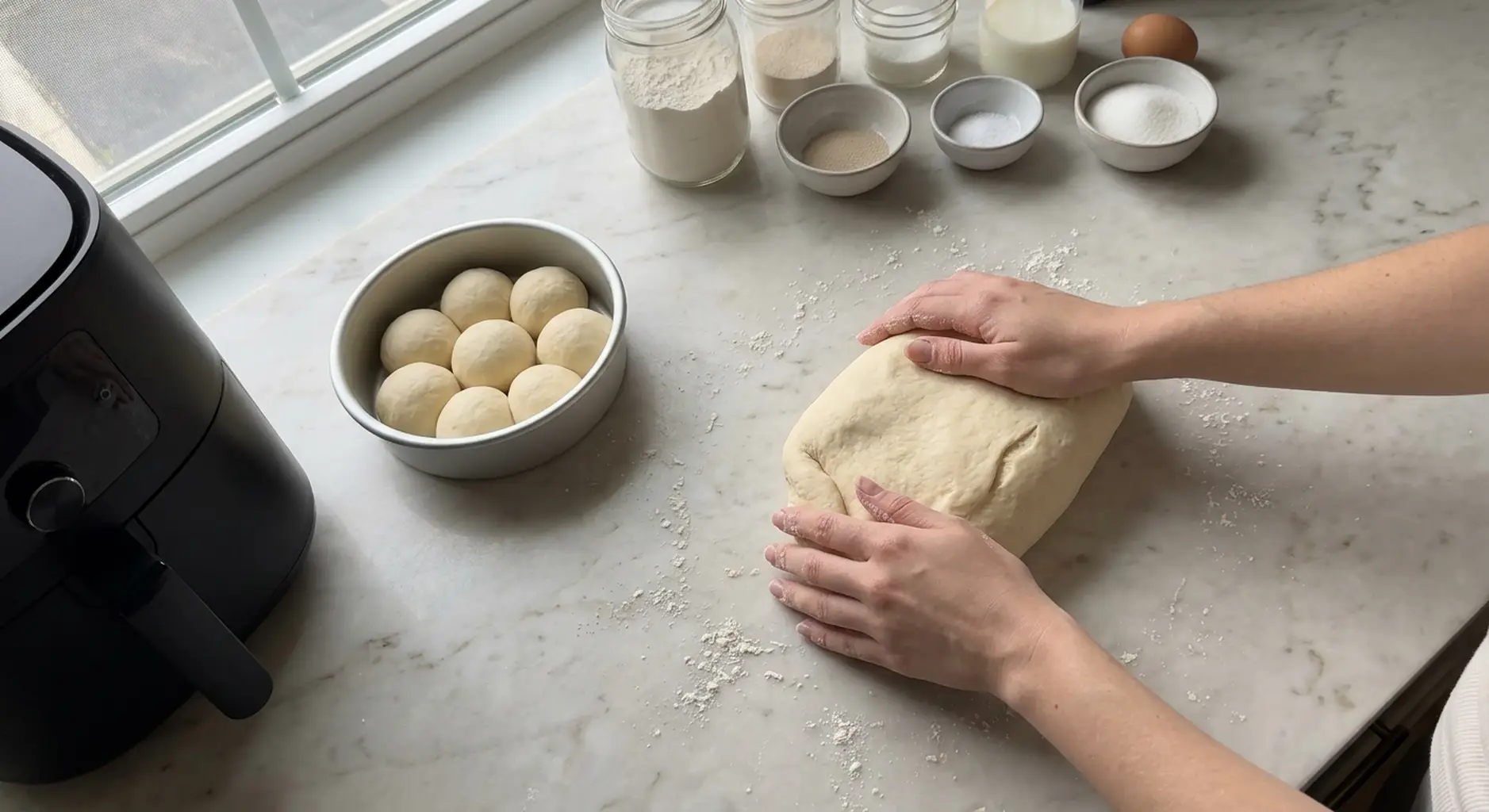
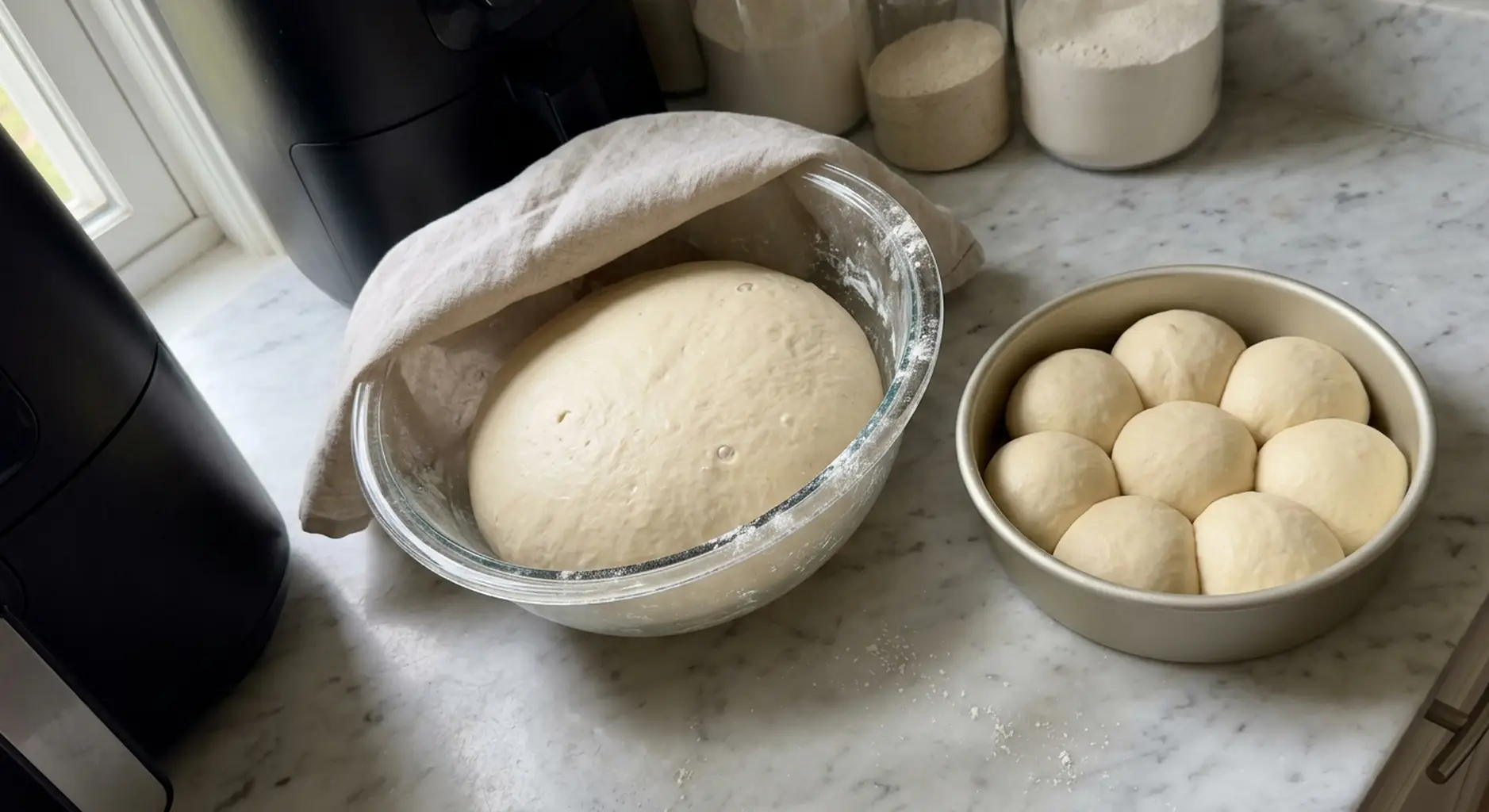
- Make the dough. Stir the flour, yeast, sugar and salt, then add the warm milk, egg and soft butter and knead 8 to 10 minutes by hand or 6 in a mixer, until smooth, supple and barely tacky. Enriched dough starts sticky and earns its manners through kneading, so resist the extra flour.
- First rise: 1 hour, covered, until doubled. The switched-off machine with a hot water mug works here too and shaves it toward 45 minutes.
- Divide into 8 equal pieces. A scale makes them even, about 65g each, and even rolls rise and bake as one.
- Shape tight balls: flatten each piece, gather the edges into the middle like a purse, flip it seam-down, and cup your hand over it in small circles until the surface is taut. Taut skins bake into smooth domes.
- Arrange them touching in a buttered 7-inch cake pan, seven around, one in the middle. They should kiss now and will be fused by bake time. That fusion is the entire point.
- Second rise, in the machine: pan into the cold air fryer, mug of just-boiled water beside it, drawer closed, 30 to 40 minutes until puffy and pressed together like a cobblestone street.
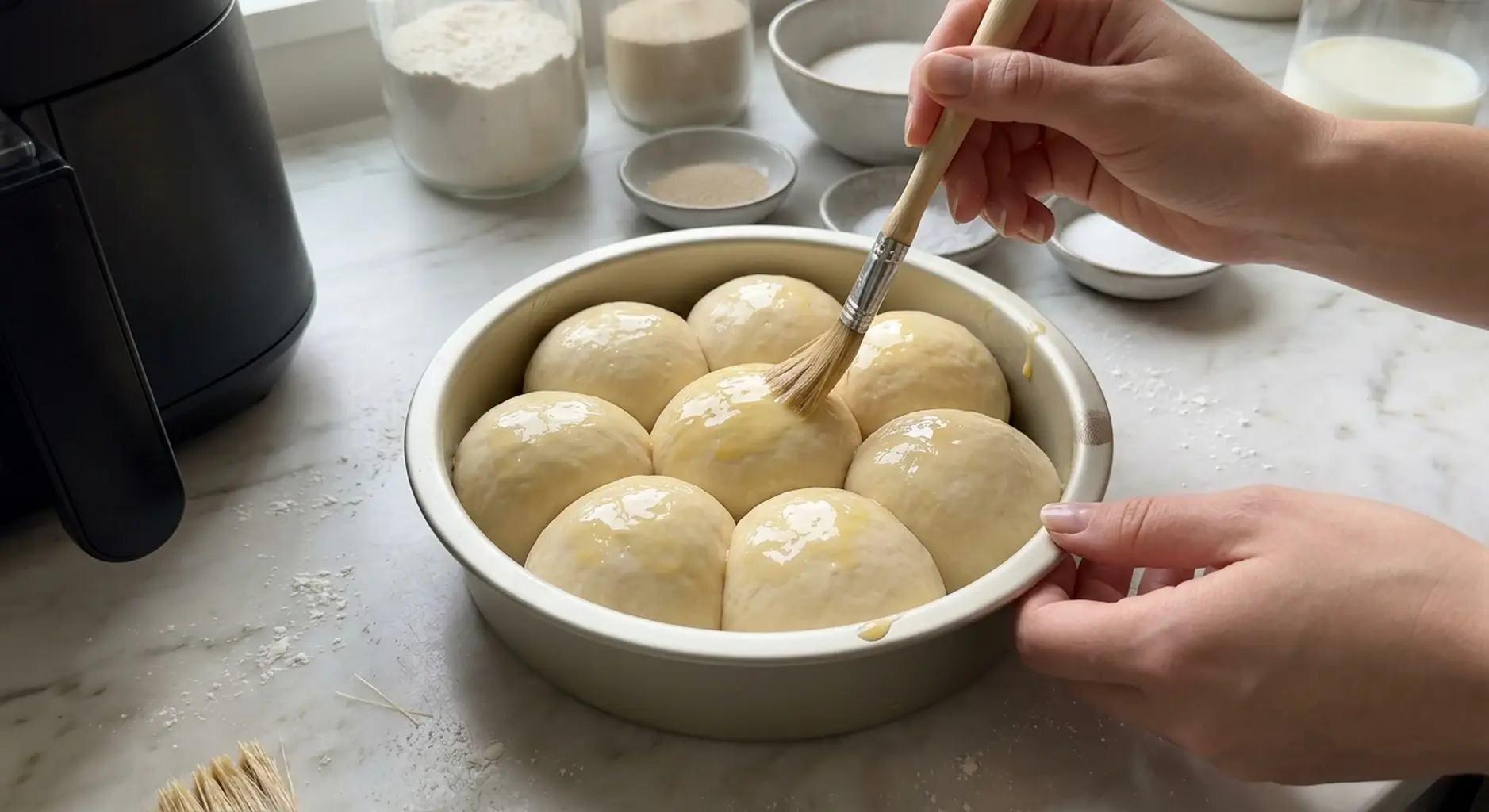
- Remove the mug, brush the tops with the yolk wash, gently, without deflating them.
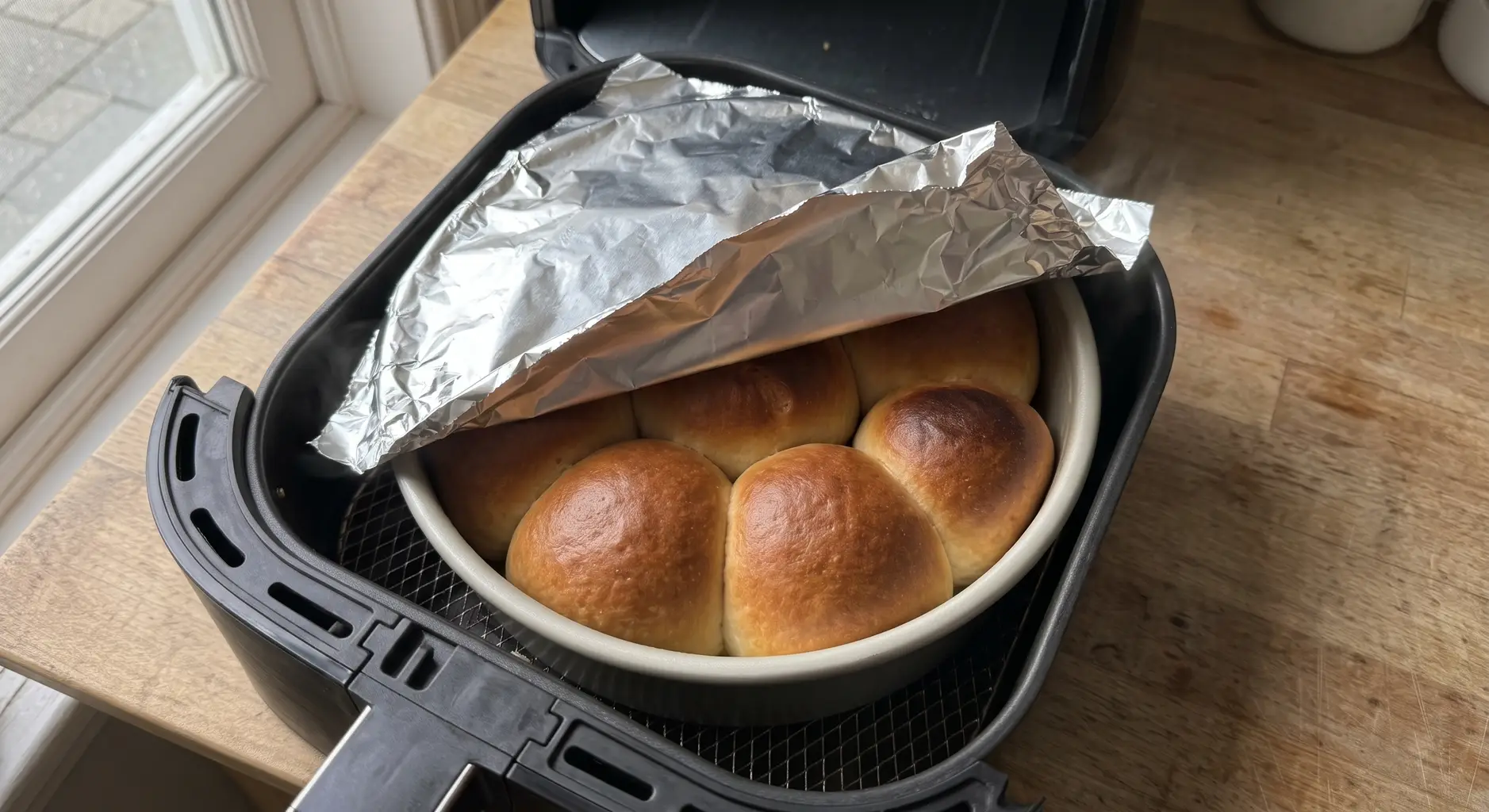
- Bake at 300°F for 15 to 18 minutes. No preheat, the rolls are already in position and the gentle ramp suits them, which is the rare exception to the rule in do you need to preheat an air fryer for baking. At minute 8, lay a foil tent loosely over the pan, edges tucked against the rim so the fan cannot lift it. The tops will already be golden and the tent holds them there while the middles finish.
- Check the center roll at 15 minutes: an instant-read thermometer pushed into the middle roll should read 195°F. The center roll is the last to finish, so its number speaks for the pan.
- Brush with the honey butter the moment they come out, flaky salt if you like, and let them sit 10 minutes in the pan. They release as one golden wheel, and pulling the first roll off it is somebody's favorite job.
The tent, and knowing they are done
The pan that makes pull-apart possible also creates this recipe's one hazard: a full pan of enriched dough is a deep bake, 15-plus minutes, under an element that finishes egg-washed tops in 8. Untented, the tops go from amber to mahogany to bitter while the doughy middle of the center roll waits.
So the tent is scheduled, not reactive: minute 8, foil laid loosely over the pan, edges tucked at the rim. Tucked matters, because the fan will lift a loose sheet into the element, and the full safety rules are in can you use foil or parchment paper in an air fryer.
| The check at 15 minutes | What it means |
|---|---|
| Center roll reads 195°F to 200°F | Done. Butter and rest. |
| Center roll reads under 190°F | 2 to 3 more minutes, tent on. The tops are protected, so time is free. |
| Tops deep brown before minute 8 | Machine runs hot. Tent at 6 next time and drop to 290°F. |
| Sides and bottoms pale at the finish | Normal. Pan walls do not brown what they touch, and pull-apart sides are supposed to be white and soft. |
The 195°F target is the same doneness family as the loaf on the air fryer bread page, because these are the same crumb wearing different shapes, and carryover adds the last degrees during the honey butter rest.
Frozen rolls: two different products
The freezer aisle sells two things called frozen rolls, and mistaking one for the other ruins a dinner schedule. The bag tells you which you have.
| Product | What it is | Air fryer plan |
|---|---|---|
| Par-baked rolls (Sister Schubert style) | Already baked, needs reheating | 350°F for 4 to 6 minutes, straight from frozen. Freezer to table inside ten minutes. |
| Frozen dough (Rhodes style) | Raw yeast dough, needs thawing and a full rise | Thaw and rise 3 to 5 hours in the greased pan, touching, then bake exactly like the homemade recipe: 300°F, 15 to 18 minutes, tent at 8. |
| Brown-and-serve | Baked pale, needs coloring | 330°F for 5 to 7 minutes until golden. |
The Rhodes-style bags are honestly a fine shortcut, they just are not a fast one: the shortcut is the kneading, not the clock. Set them in the pan at lunch and they are dinner rolls by dinner, and the switched-off-machine proof box speeds the rise the same way it does for scratch dough. The bag's oven numbers convert through the air fryer calculator like everything else, and every setting on this site is collected in the air fryer baking chart.
Troubleshooting
| What you got | Why | Fix |
|---|---|---|
| Crusty individual buns, no pull-apart | Baked spaced in the basket instead of touching in a pan. | The pan and the huddle. Touching is the recipe. |
| Dark bitter tops, doughy centers | No tent, or a single hotter temperature. | 300°F, tent at minute 8, and the 195°F check on the center roll. |
| Dense, heavy rolls | Under-kneaded dough, or a skipped second rise. | Knead to supple, and give the pan rise its full 30 to 40 minutes. Puffy going in is fluffy coming out. |
| Flat pancake pull-apart | Over-proofed second rise, or slack shaping. | Shape taut balls, and bake when puffy, not ballooned. A finger dent that springs back slowly is the go signal. |
| One side of the pan browner | A hot spot. | Rotate the pan 180 degrees when the tent goes on. Chronic scorching is machine-level: how to prevent burning in an air fryer. |
| Rolls stuck to the pan | Butter missed the corners, or honey butter seeped and caramelized. | Butter the pan thoroughly, and rest only 10 minutes before releasing. Welded sugar is a soak job: the bakeware cleaning guide. |
| Gummy line at the base of the center roll | Pulled early on looks alone. | The thermometer, always, and the center roll is the witness that counts. |
| Dough never rose in the machine | Water went in lukewarm, or the yeast was elderly. | Just-boiled water in the mug, and proof the yeast in the warm milk first if the jar is past its date. Rising problems across recipes belong to the troubleshooting guide. |
Variations
- Garlic butter rolls. Swap the honey butter for the grated-garlic butter from the garlic bread page, brushed on hot. Parsley on top, and the pan disappears first.
- Cheddar and chive. Knead 1/2 cup sharp cheddar and 2 tablespoons chives into the dough after the butter. The shared walls trap melted cheese pockets.
- Honey wheat. Swap 3/4 cup of the flour for whole wheat and double the honey in the finish. Nubblier, nuttier, still soft.
- Sweet milk rolls. Double the sugar, skip the salt flake, dust with powdered sugar after. The breakfast cousin, one step from the cinnamon rolls this dough family also builds.
- Slider bases. Bake the same dough spaced on parchment instead of touching, embracing the six-crust version on purpose, split and fill. The same dough, the opposite arrangement, and now the arrangement rule earns its keep twice.
On the holiday table these sit beside the corn and whatever the gravy is doing, and the rest of the bread shelf covers the other moods: the loaf for sandwiches, the soft pretzels for the afternoon that wants a project, and the crescent rolls or canned biscuits for the night the can wins. For chewier company there are bagels and english muffins, and if the basket is new to you, how to bake in an air fryer covers the ground rules this recipe assumes.
Make ahead and storage
- Room temperature: 3 days airtight, and a 10 second warm-up returns them to soft. Never the fridge, which stales enriched bread fastest of all.
- Reheat the wheel: 300°F for 3 minutes in the pan brings the whole batch back, tops re-glossed and walls steamy.
- The overnight head start: shape the rolls into the pan, cover, and refrigerate up to 18 hours. Next day, give them 1 hour of the warm-mug proof box and bake as written. Thanksgiving morning, solved the night before.
- Freeze baked: 2 months, whole wheel or split singles, thawed at room temperature and refreshed 2 to 3 minutes at 300°F.
- Freeze the shaped dough: raw balls freeze on a tray, bag them, and they become your own Rhodes-style bag: pan, thaw, rise, bake.
Frequently asked questions
QHow long do dinner rolls take in an air fryer?
15 to 18 minutes at 300°F for a pan of 8 homemade rolls, with a foil tent from minute 8 and doneness called at 195°F in the center roll. Par-baked frozen rolls reheat in 4 to 6 minutes at 350°F, and frozen raw dough bakes on the homemade schedule after its 3 to 5 hour thaw and rise. Published times range from 10 to 28 minutes because they describe different pan setups and different products.
QWhy are my air fryer rolls crusty instead of pull-apart?
They were baked with space between them. Pull-apart softness is geometry, not dough: rolls arranged touching in a pan fuse as they rise, and the shared walls steam against each other instead of browning, so only the tops crust. Rolls spaced in a bare basket brown on every side into individual buns. Same dough, opposite result, and the pan is the difference.
QCan dough rise in an air fryer?
Yes, with the machine switched off. The closed drawer is a small draft-free chamber, and a mug of just-boiled water set beside the pan warms and humidifies it into a proof box that cuts rise times by a third and stops the dough surface drying out. Two rules: the mug comes out before any heat goes on, and a very tightly sealed drawer gets cracked open a finger's width.
QWhy did the tops of my rolls burn before the middle cooked?
A pan of enriched dough is a deep bake under a close element: the egg-washed tops finish their browning in 8 minutes while the center roll needs 15 or more. The tent is the answer, scheduled rather than reactive: foil laid loosely over the pan at minute 8, edges tucked at the rim so the fan cannot lift it. After that, extra minutes are free, and the thermometer decides the end.
QAre frozen dinner rolls and frozen roll dough the same thing?
No, and the bag matters more than the brand. Par-baked rolls, the Sister Schubert style, are finished bread that reheats in 4 to 6 minutes at 350°F. Frozen dough, the Rhodes style, is raw yeast dough that needs 3 to 5 hours of thawing and rising in the pan before it bakes like homemade. One is a ten minute answer, the other is an afternoon plan, and both are legitimate as long as you know which one you bought.
QHow do I know when dinner rolls are done?
195°F to 200°F on an instant-read thermometer pushed into the center roll, which is always the last to finish and speaks for the pan. Color cannot be trusted here twice over: the tented tops stop changing, and the sides stay pale on purpose because pan walls and neighbor rolls do not brown what they touch. Golden top, pale sides, 195 in the middle is the finished state.
QCan I make dinner rolls without yeast?
Yes, with managed expectations. The two-ingredient dough, self-rising flour and Greek yogurt, shapes into 6 balls and bakes touching in the same buttered pan at 300°F for about 20 minutes, no rises at all. The crumb is denser and more scone-like than yeast rolls, but brushed with honey butter and served warm, it covers a weeknight honorably.
QCan I make dinner rolls ahead for Thanksgiving?
Yes, and the overnight fridge rise is built for exactly this. Shape the rolls into the buttered pan the night before, cover, and refrigerate up to 18 hours. On the day, give them an hour in the warm-mug proof box while the machine is otherwise idle, then wash, bake and butter as written. Fresh rolls land warm on the table without owning the oven anyone else is fighting over.
QHow do you reheat dinner rolls in an air fryer?
300°F for 3 minutes for the whole pan, or 2 minutes for loose rolls, which re-glosses the tops and steams the shared walls soft again. From frozen, split rolls take 2 to 3 minutes at the same temperature. The microwave makes them briefly soft and then gummy, and ten seconds of it is the only amount that ever helps.
Never overbake again
Get our one-page times & temps cheat sheet, plus a new tested recipe each week.
No spam · unsubscribe anytime