

I started keeping this list because I kept writing the same explanations into recipe notes. Someone would ask why their cake sank and the honest answer needed three words they had not met yet. So here they all are in one place, each with the temperature or the measurement that makes it useful rather than just correct.
Use the search box above for a term or a symptom. Type sinking and you will get the entry, type 212 and you will get the one that explains why nothing browns until a surface is dry.
No terms match that. Try a shorter word, or clear the box to see all 69.
The machine and its parts
What the hardware is called, and which bits actually change how a bake turns out.
Air fryer
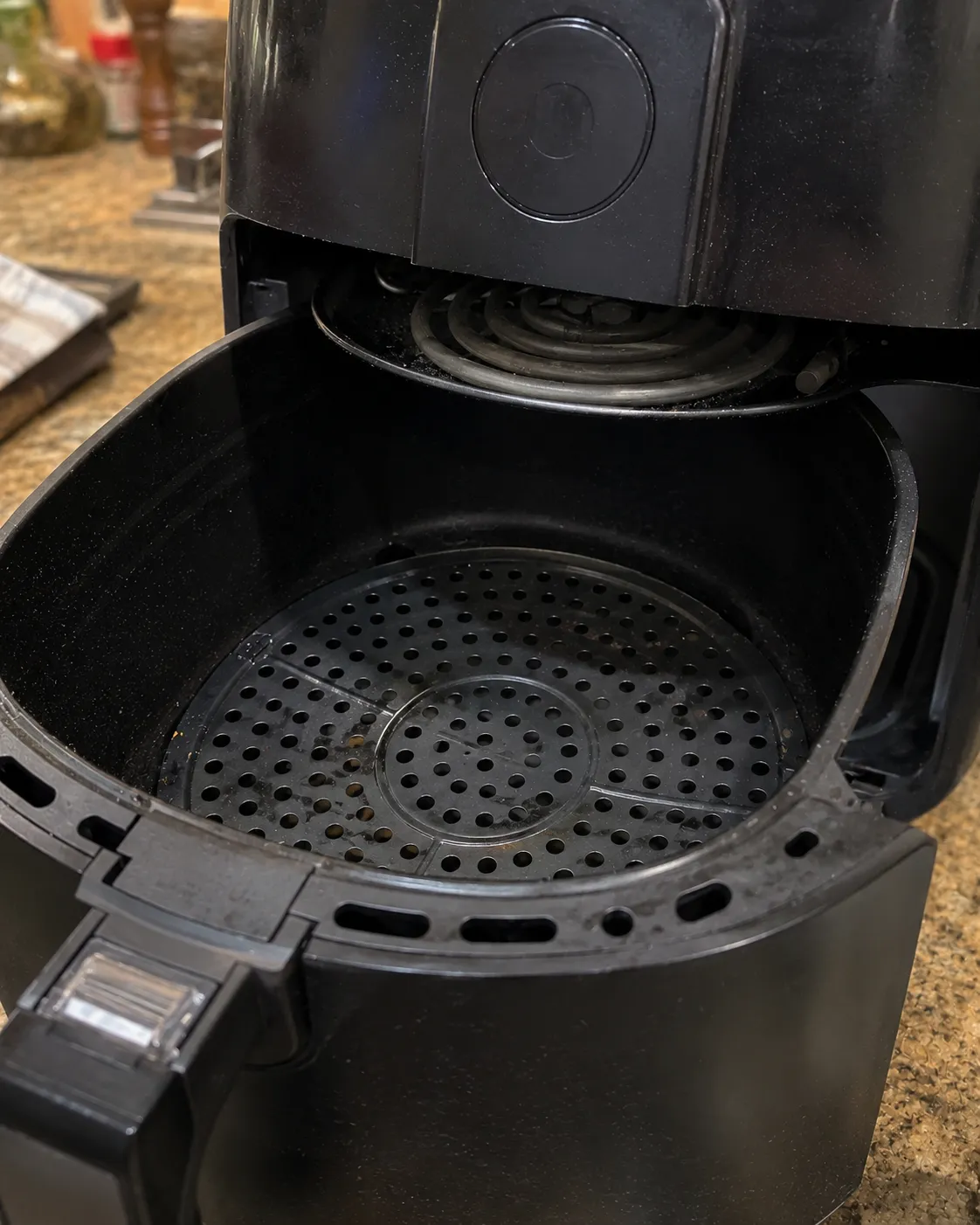
A small countertop convection oven with a high-speed fan. Nothing is fried: the fan moves hot air fast enough to dry and brown a surface the way hot oil does, using a fraction of the fat. Understanding it as a fast little oven rather than a fryer explains most of its behavior.
Basket air fryer
The drawer style, where food sits in a perforated basket inside a solid outer drawer. Deep and narrow, with the element only two to four inches above the food. Crisps best, holds least. See basket vs oven-style.
Cold start
Putting food into an unheated machine on purpose. Right for solidly frozen food, where the slower ramp narrows the gap between surface and core. Wrong for anything with butter or a raw batter.
Crisper plate
The perforated insert that sits in the bottom of a basket, lifting food off the floor so air can reach underneath. Removing it to gain depth is a common mistake: it stops airflow under the food and gives you a soggy base.
Drawer
The solid outer tray beneath the basket that catches drips. Where fat pools and reaches its smoke point, which is why a little water in it stops most greasy-food smoke. See why your air fryer smokes.
Dual zone
Two independent drawers with separate controls. Useful for cooking two things at once, but each drawer is narrower than a single basket of the same total capacity, so it takes a smaller pan, not a bigger one.
Duty cycle
The fraction of time an element is actually drawing power once up to temperature. An air fryer runs near 88 percent; an oven thermostat cycles down to roughly 40 percent. This is why wattage alone is a poor guide to running cost.
Forced convection
Heat moved by air that is being driven, rather than drifting on its own. The defining feature of an air fryer and the reason surfaces dry so much faster than in a still oven.
Heating element
The coil that produces the heat, mounted in the roof of the chamber. A basket air fryer has one only at the top, which is why bases stay pale. It is also where old splatter bakes on and later smokes.
Oven-style air fryer
The countertop-oven style, with racks and a door. Wider and shallower, food sits further from the element, and you can run two racks at once. Trades some crisping for capacity.
Preheat
Bringing the empty machine to temperature before the food goes in, usually 3 minutes. Needed for any batter or dough. Skipping it lets butter melt and separate before the structure sets. See do you need to preheat.
Wattage
Power draw, printed on the rating plate underneath the machine rather than the box. Typically 800 to 1800 W. It affects how fast the unit recovers heat and what a bake costs to run, which our running cost calculator works out.
How the heat behaves
The physics that explains almost every air fryer baking problem, in plain terms.
Caramelization
Sugar browning on its own, without protein. Sucrose starts around 320°F and turns bitter and smoky between 350 and 390°F. Honey and maple burn far lower, from around 230°F.
Carryover cooking
The cooking that continues after the food leaves the heat, driven by heat already inside it. Significant in anything dense. It is why you pull a cake at 200°F rather than waiting for a higher reading.
Conduction
Heat traveling through a solid, such as from the tin into the batter. Slow in a wet batter, and it scales badly: conduction time rises with roughly the square of thickness, so batter twice as deep takes about four times as long to heat through.
Convective heat
Heat carried to the food by moving air. The air fryer's main mechanism, and the one the fan controls.
Evaporative cooling
The chilling effect of water leaving a surface. It holds a wet surface below browning temperature and is why patting food dry buys you real minutes of actual cooking.
Hot spot
A part of the chamber that runs hotter than the rest, usually nearest the element or where airflow concentrates. The reason two identical cakes in one basket can come out visibly different, and the reason for rotating.
Maillard reaction
The browning reaction between a reducing sugar and an amino acid, responsible for most savoury brown flavor. Needs a dry surface and roughly 285°F to get going. Plain white sugar is not a reducing sugar, which is why sugar cookies stay pale.
Radiant heat
Heat traveling as infrared straight from the glowing element to whatever it can see. Falls off sharply with distance, which is why a pan two inches under the coil browns far harder on top than the same pan in an oven.
Recovery time
How long an appliance takes to return to temperature after the door or drawer opens. Seconds for an air fryer, minutes for a full oven.
Smoke point
The temperature at which a fat starts breaking down and smoking. Butter is only 302°F because of its milk solids, extra virgin olive oil about 375°F, refined avocado around 520°F. Most air fryer smoke is a fat past this point.
The 212 degree ceiling
Water cannot exceed 212°F while it is still liquid, and neither can a surface that is wet. Nothing browns or crisps until the surface water has gone, which is the whole principle behind getting things crisp.
Thermal mass
How much heat an appliance's own metal and air hold. An air fryer has very little, so it heats fast and recovers within seconds of the drawer opening. This is why the oven rule about never opening the door does not really apply.
What happens inside the bake
The changes going on in the batter while you wait, and the order they need to happen in.
Baking soda vs baking powder
Soda is sodium bicarbonate and needs an acid to react properly. Powder is soda with its own dry acid included, so it self-neutralizes. Soda in a recipe with nothing acidic leaves an alkaline residue that tastes faintly soapy.
Coagulation
Egg proteins unfolding and bonding into a network as they heat, giving a bake its structure. Starts near 150°F and completes well above that.
Emulsion
Fat and water held evenly together, as in a creamed butter batter. Cold eggs hitting warm melted butter break it, giving a greasy, slightly grainy result that never quite recovers.
Gelatinization
Starch granules absorbing water and swelling into a gel as they heat. Along with egg setting, this is what turns liquid batter into a solid crumb. It finishes around 195 to 200°F, which is where the doneness numbers come from.
Gluten
The elastic protein network formed when flour proteins meet water and get worked. Wanted in bread, unwanted in cake and pastry, where it makes things tough and shrink-prone.
Hydration
The ratio of liquid to flour, usually as a percentage of flour weight. Higher hydration gives an open crumb and needs longer to set; lower gives a tighter, faster-setting bake.
Invert sugar
Sucrose split into glucose and fructose. Present in honey, golden syrup and molasses. Browns faster, holds moisture better, and burns at a lower temperature than plain sugar.
Leavening
Anything that puts gas into a batter or dough: baking powder, baking soda, yeast, or air beaten in mechanically. Too much inflates a cake beyond what the structure can hold, and it falls.
Oven spring
The last burst of rise in the first minutes of baking, as trapped gases expand and liquid turns to steam before the structure sets. An early-forming crust cuts it short.
Reducing sugar
A sugar with a free carbonyl group, such as glucose or fructose, able to take part in the Maillard reaction. Sucrose is not one until heat splits it, which is why brown sugar browns and white sugar does not.
Starch retrogradation
Cooked starch slowly recrystallising as it cools and sits. The main mechanism of staling, and the reason refrigerating bread makes it go stale faster than leaving it out.
Technique and method
The verbs in a recipe, and what each one is actually for in a basket.
Batch baking
Cooking in successive loads because everything will not fit at once. The real cost of a basket: a batch of cookies can be six loads.
Blind baking
Baking a pastry case before its filling goes in, so the base cooks through. Harder in a basket, because there is no bottom element to set the base.
Creaming
Beating fat and sugar together until pale and lighter in volume, usually 2 to 3 minutes. The sugar crystals cut air pockets into the fat, and that air is a large part of the rise.
Docking
Pricking a pastry base with a fork so trapped steam escapes instead of lifting it into a dome.
Doneness
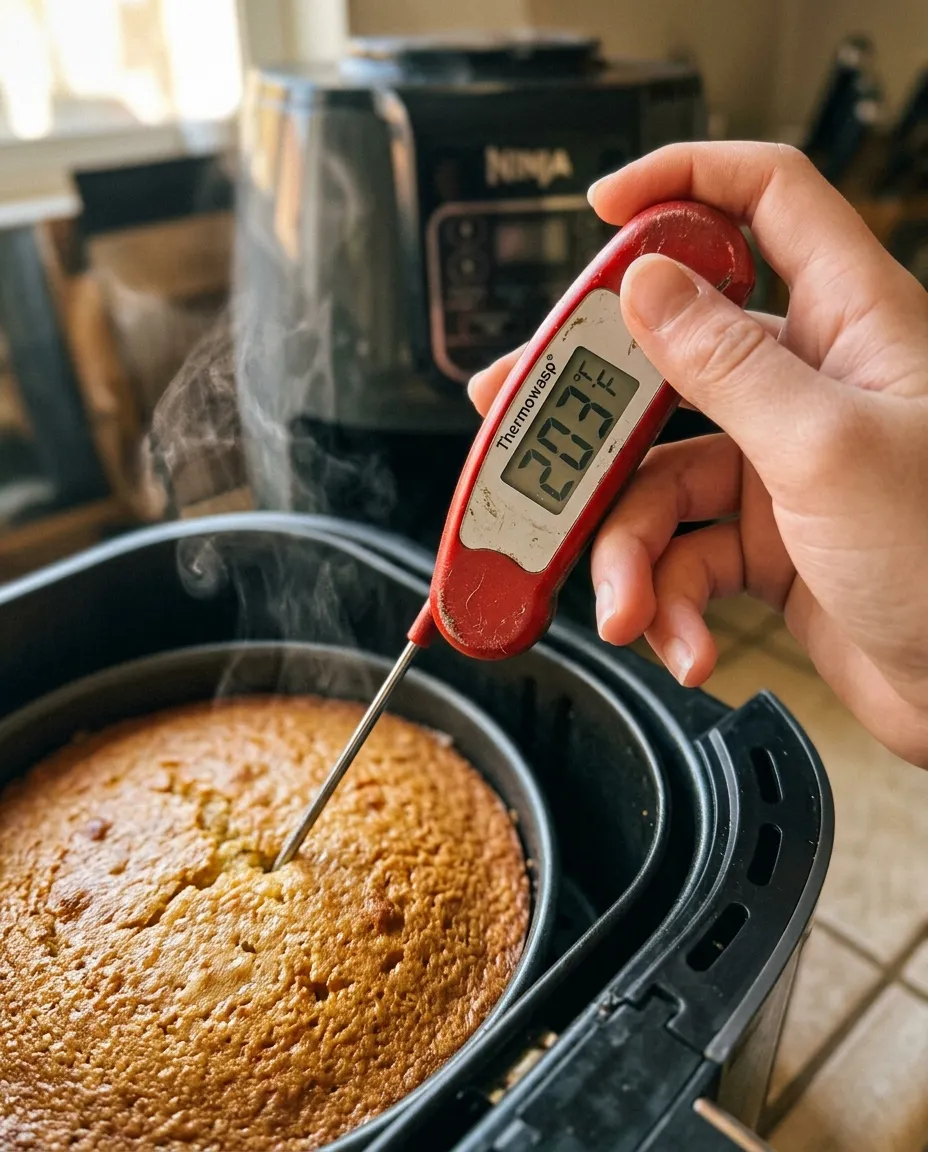
The point a bake is actually cooked, best measured by internal temperature: cake 200 to 205°F, quick bread the same, bread 190 to 210°F, brownies 165 to 175°F because they are meant to be underbaked. Full list in the baking chart.
Folding
Combining gently with a spatula so you keep the air already beaten in. Used once flour is added, because beating at that point builds gluten and knocks out the lift.
Proofing
The rest that lets yeast produce gas and the dough relax and rise. An air fryer at its lowest setting is usually still too hot for proofing, so do it on the counter.
Resting
Leaving a bake to finish setting as it cools. Not a pause before the real work, but part of it: a brownie's structure forms while it cools, and cutting early gives you rubble.
Ribbon stage
When a whisked mixture falls off the beater in a thick trail that sits on the surface for a moment. The visual cue that enough air has been beaten in and the sugar has dissolved.
Rotating
Turning a pan halfway through so a hot spot does not brown one side harder than the other.
Shaking
Tossing loose food mid-cook so pieces underneath swap places with pieces on top. Not optional in a basket, where anything stacked is steaming rather than crisping.
Single layer
One layer of food with air gaps between the pieces. The condition an air fryer needs to work as advertised, and the reason a basket holds so much less than its quart rating suggests.
Tenting
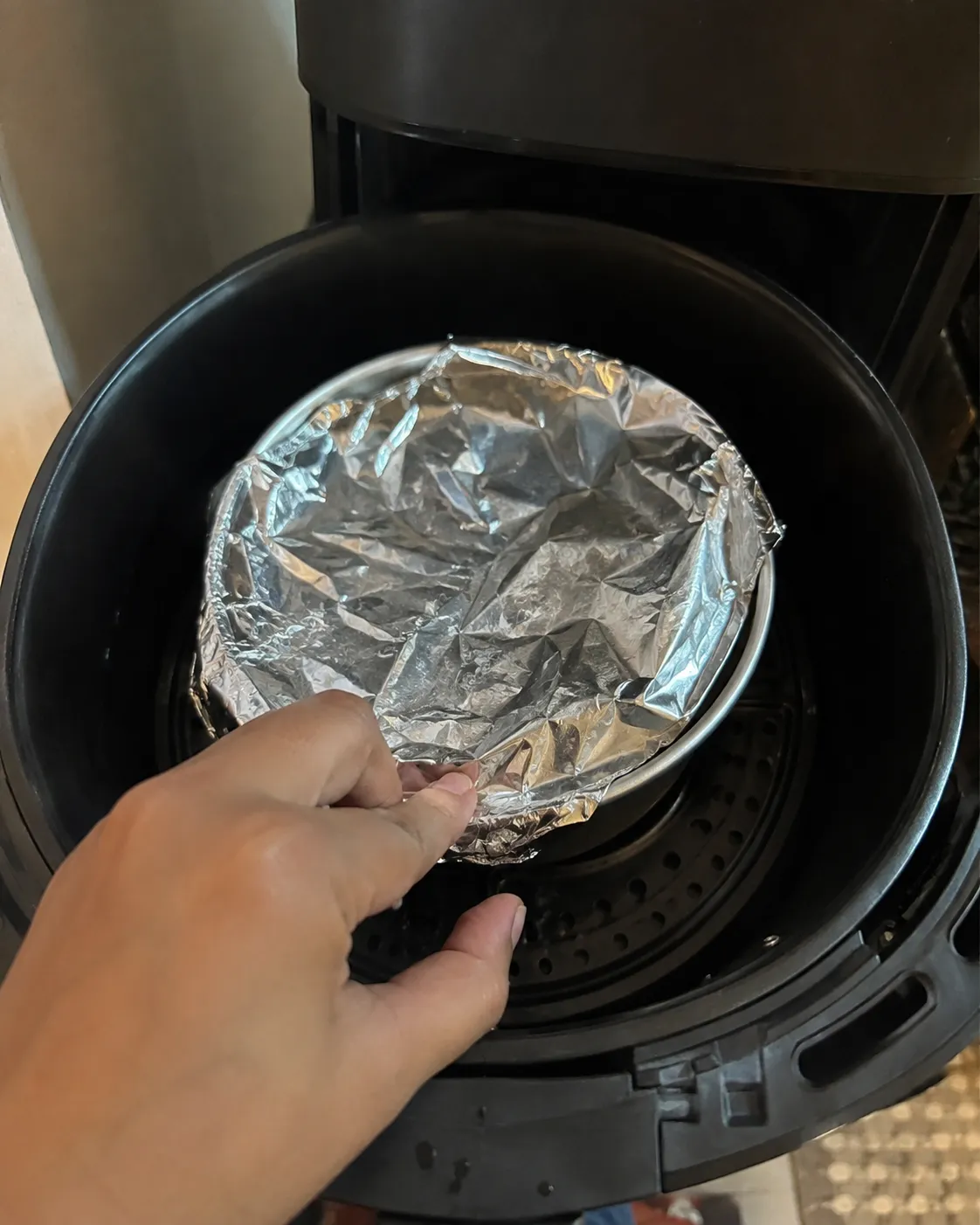
Laying foil loosely over the top of a bake to block direct radiant heat while the sides and base keep cooking. The single most useful trick for anything that browns before the middle is done. Tuck it under the pan rim so the fan cannot lift it.
Toothpick test
Judging doneness by whether a skewer comes out clean. Unreliable in an air fryer, because the crumb around the skewer sets before the very center does, and a melted chocolate chip reads exactly like raw batter.
When it goes wrong
The names for the specific ways an air fryer bake fails, and what each one is telling you.
Burnt edge, raw center
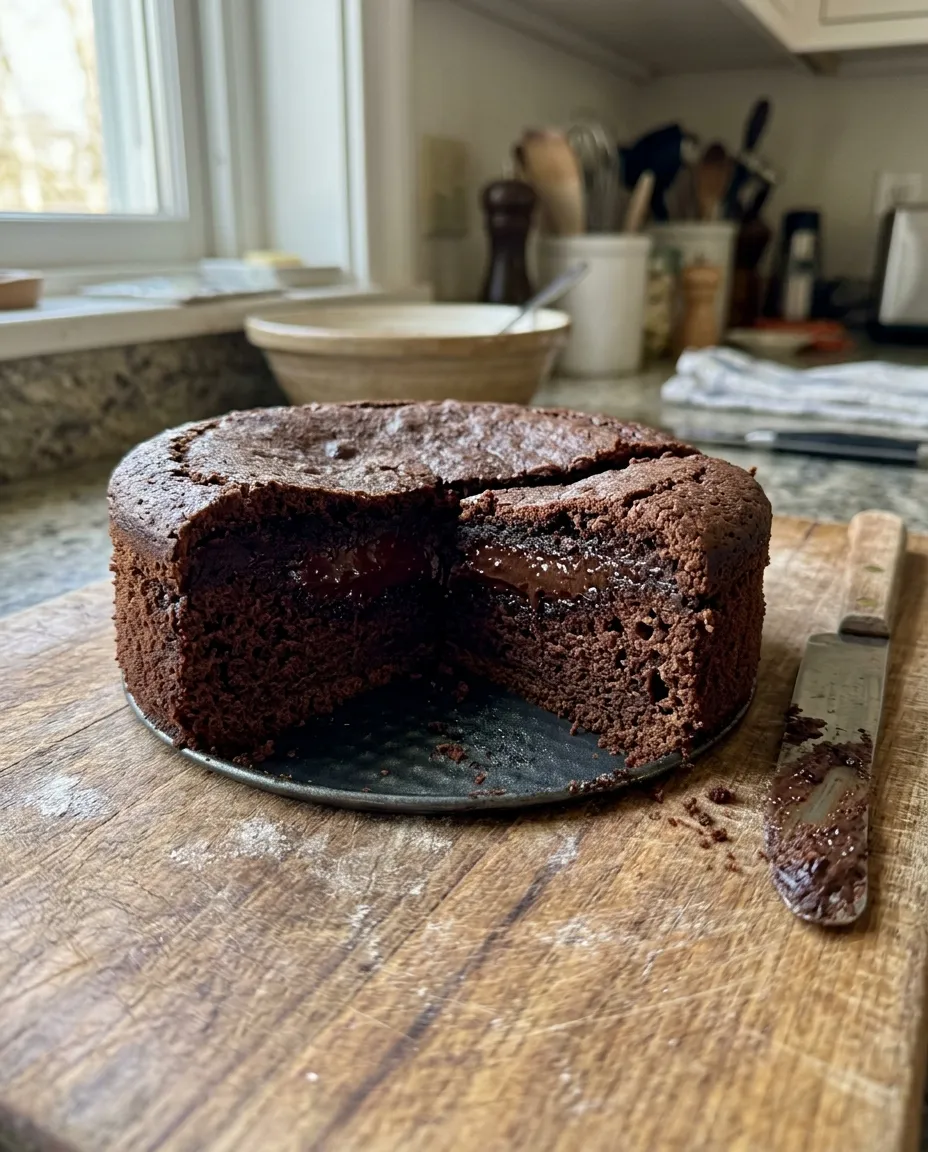
The signature air fryer failure: the outside is finished long before the middle. Every fix is some version of slowing the surface down, whether by dropping the temperature, tenting foil, or moving to a shallower pan. Covered in troubleshooting.
Case hardening
A surface that dries and stiffens so early that it stops the inside cooking properly. The mechanism behind sinking, gummy layers and raw centers alike.
Cracking
A split across a domed top, one step past doming. The crust set hard and the batter underneath kept expanding until it tore through. Drop 15 to 25°F.
Curdling
A creamed mixture separating into specks of fat and liquid, usually from adding cold eggs to warm butter. Warm the eggs for five minutes and add them one at a time.
Doming
A cake rising much higher in the middle than at the edges, because the edges set first and the only place left to expand is upward. Usually means the temperature is too high.
Gummy layer
A dense wet band just under the surface, caused by the top sealing early and trapping moisture that cannot escape.
Overproofing
Dough left to rise so long that the gluten can no longer hold the gas. It collapses in the heat instead of springing.
Sinking
A dip in the middle after baking, caused by the crust setting before the center had structure to hold it up. The commonest air fryer cake failure. See why your air fryer cake sinks.
Soggy bottom
An underbaked, pale base. Almost structural in a basket, which has no bottom element. Perforated liners and a preheated pan help; a toaster oven fixes it outright.
Spread
How far a cookie flattens as the fat melts. Too much means warm dough, too little butter control, or no preheat. Chilling the shaped dough is the usual fix.
Pans, liners and kit
The equipment vocabulary, with the sizes that actually fit a basket.
Cooling rack
A wire rack that lets air circulate under a bake as it cools, so the base does not sit in its own steam and go soft.
Fill level
How full you load a tin. Cakes want half full, not the two thirds an oven recipe assumes, because a risen top in a basket ends up close to the element.
Instant-read thermometer
A probe that gives a fast internal temperature. The single most useful thing you can own for air fryer baking, because it replaces every unreliable visual doneness cue.
Oil mister
A pump bottle you fill with plain oil. Better than aerosol spray, which contains lecithin and propellants that polymerise into a sticky film, smoke, and wreck the basket coating.
Oven thermometer
A standalone dial or digital gauge left inside the machine. Air fryers are commonly out by 15 to 25°F, and knowing your own offset is worth more than any conversion chart.
Pan conversion
Rescaling a recipe for a different tin by volume. Moving from a 9x13 to a 6 inch round is roughly a third of the batter, and the batter also sits deeper, which needs lower and longer. Our pan size calculator and recipe scaler handle both halves.
Perforated parchment
Baking paper with holes punched in it, so air can still reach the underside. A solid sheet turns the basket floor into a flat pan and gives you a pale soggy base. Never preheat with an empty sheet in there, since the fan will lift it into the element.
Ramekin
A small straight-sided ceramic dish. Ideal in an air fryer because the portion is shallow and the middle is never far from the heat. Four fit most 6 quart baskets.
Silicone mold
A flexible non-stick pan. Insulates rather than conducting, so it slows the edges and lets the center catch up. Drop about 10°F and add a few minutes. See using silicone molds.
Springform
A round tin with a clamped, removable side, for anything too delicate to turn out. Tall, so check the height clears the element as well as the width.
Frequently asked questions
QWhat is the most important term in air fryer baking?
Doneness by internal temperature. Almost every other term on this page describes something that goes wrong when a bake is pulled at the wrong moment. Cake and quick bread are done at 200 to 205F, bread at 190 to 210F, and brownies at 165 to 175F because they are meant to be underbaked. An instant-read thermometer replaces every unreliable visual cue, including the toothpick test.
QWhy do baking terms mean something different in an air fryer?
Because two things about the machine are unusual: the heating element sits only two to four inches above the food, and the fan drives air onto it at speed. Both make surfaces dry and set much earlier relative to the center than they would in an oven. Terms like case hardening, sinking and soggy bottom describe the consequences, and they come up far more often in a basket than in a full-size oven.
QWhat does case hardening mean?
A surface that dries and stiffens so early in the bake that it stops the inside cooking properly. It is the single mechanism behind several separate-looking failures: a sunken cake, a gummy layer under the crust, and a raw center with a dark top. Fixing it always means slowing the surface down, by lowering the temperature, tenting foil over the top, or using a shallower pan.
QIs air frying the same as baking?
Technically yes, mechanically no. Both are dry heat cooking, but an air fryer is a small convection oven with a fast fan very close to the food. Nothing is fried in it. The practical difference is that the fan strips moisture off surfaces quickly, which is excellent for anything you want crisp and works against anything that needs to rise gently and set from the middle out.
QWhat temperature should I bake at in an air fryer?
Lower than the oven recipe says. Most cakes want 310 to 320F, cookies around 325F, and brownies 320F, which is typically 25 to 30F below the original. The flat rule of subtracting 25F is a starting point rather than an answer, since cakes and cookies need a deeper cut than roasts do. Running the original numbers through the air fryer calculator applies the right adjustment for the food type.
QWhat is the 212 degree ceiling?
Water cannot get hotter than 212F while it is still liquid, and neither can any surface that is wet. Until the surface water has evaporated, nothing browns and nothing crisps, because all the energy going in is being spent turning water into steam. It is the reason patting food dry before it goes in genuinely buys you minutes of real cooking.
If a term sent you here from a recipe, the pages behind most of them go much further: how to bake in an air fryer for the method, the baking chart for every temperature and internal target we use, troubleshooting for when something has already gone wrong, and the free tools for the conversions and pan maths.
Was this glossary useful?