

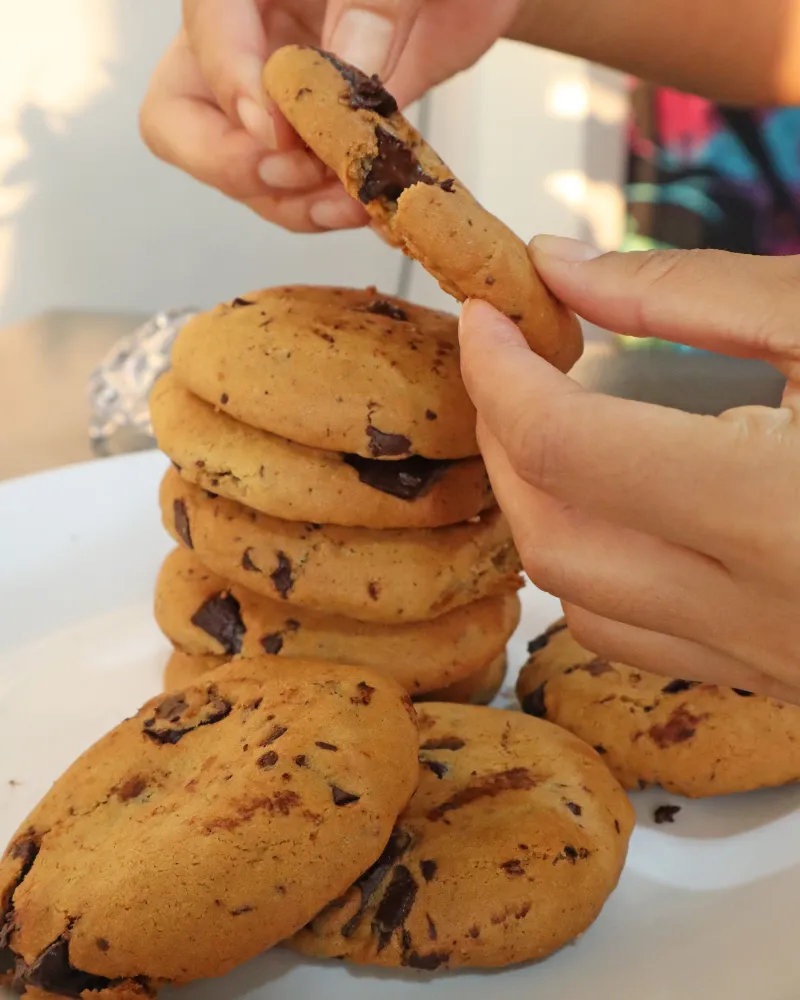
The first tray came out perfect. Golden at the edges, soft in the middle, exactly what I wanted. The second tray was a little darker. The third came out with the bottoms genuinely burnt, and I had not touched a dial.
That happens to almost everybody who makes cookies in an air fryer, and it is not the machine misbehaving. It is two things about a basket that nobody explains, and once you know both of them cookies stop being a lottery.
Quick answer: Bake at 325°F, four cookies at a time, on vented parchment. Batch one takes 8 to 9 minutes, batch two 7 to 8, and batch three 6 to 7, because the machine gets hotter as you go. Pull them when the edges are set and the middle still looks underdone, then leave them in the basket 3 minutes to finish. Chill the dough at least 30 minutes or they will spread.
An air fryer bakes a cookie upside down
Think about where the heat comes from in a normal cookie.
In an oven the dough sits on a metal sheet that has been in there getting hot. A large share of what actually sets that cookie arrives by conduction, straight up through the pan into the base. That is why every serious cookie recipe has an opinion about your baking sheet, and why putting dough onto a sheet that is already hot changes the result so much.
Now look at what happens in a basket. The cookie sits on a square of parchment, which sits on a perforated crisper plate, which has air underneath it. Parchment is a poor conductor, the plate is mostly holes, and there is no hot mass anywhere near the base. Meanwhile the element is a few inches above and the fan is driving air straight down onto the top.
The top finishes first
Fast air over the surface browns it early. The cookie looks properly baked well before the middle or the base have caught up, which is exactly how people end up overbaking them.
The base sets last
With almost no conduction from below, the bottom of the cookie is the final thing to firm up. A cookie that feels done on top can still be raw underneath.
So it spreads further
Nothing is setting the base early, so the melted butter has longer to run before anything holds it in place. Air fryer cookies spread more than the same dough does in an oven.
All three of those follow from one fact, and all three have the same set of fixes. Chill the dough hard so the butter melts later in the bake. Preheat properly so the basket and plate are hot rather than starting cold. And use vented parchment rather than a solid sheet, so at least some warm air reaches the underside.
On parchment: vented or perforated, and always weighted. A solid square of parchment insulates the base and makes the whole problem worse. Buy perforated rounds, or cut four or five slits in a plain square with scissors. And it has to have dough sitting on it before it goes anywhere near the machine. An empty sheet of parchment weighs almost nothing and an air fryer fan will lift it into the heating element, where it scorches and can catch. Never preheat with a bare sheet in the basket. Foil and parchment in an air fryer covers this properly.
There is one more option worth knowing about, which is to bake them on a small solid metal pan that sits in the basket. That restores the conduction an oven gives you, and the cookies behave much more like oven cookies. It also blocks airflow to the base entirely, so add about a minute. I use vented parchment for everyday batches and a small pan when I want the bases properly crisp.
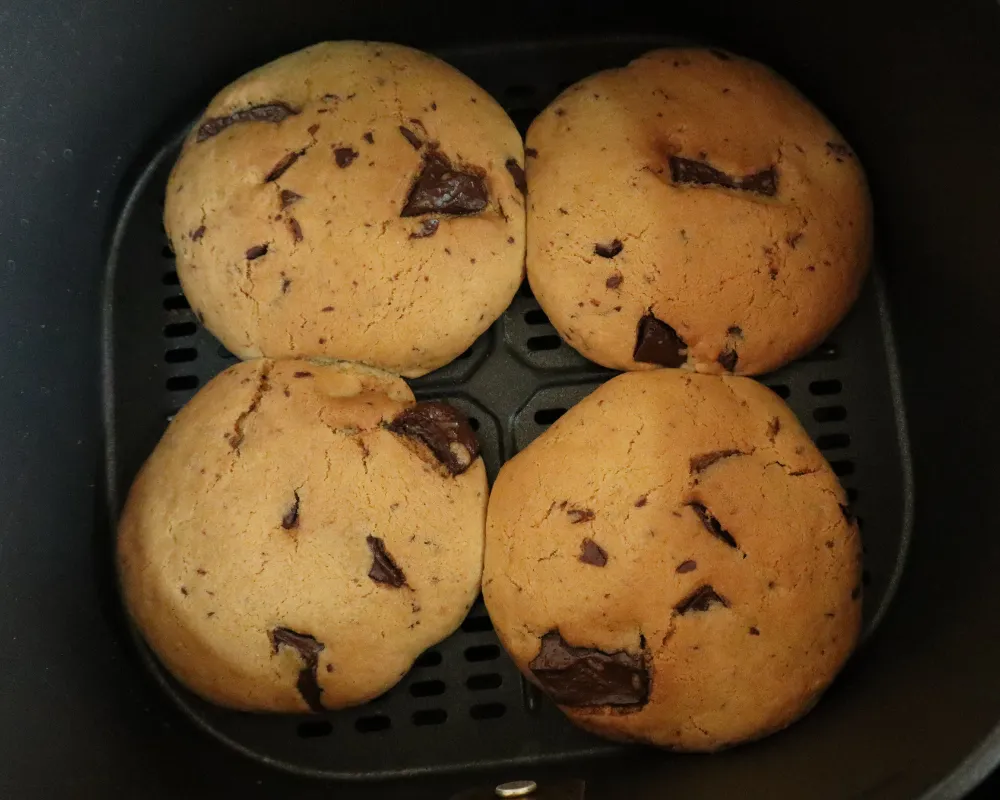
Batch three is not batch one
This is the burnt-bottom problem, and cookies are where it bites hardest of anything you will bake.
When your air fryer beeps to say it has reached 325°F, only the air has reached 325°F. The basket, the crisper plate and the walls of the cavity are all still climbing, and they go on absorbing heat for another ten minutes or so. That is thermal mass, and while it is charging up it is quietly taking energy that would otherwise be going into your food.
By the time batch one comes out, all that metal is saturated and hot. It has stopped absorbing and started radiating, from every surface around the food, on top of the air that was already there. Batch two bakes in a meaningfully hotter machine than batch one did, even though the dial has not moved.
| Batch | Time at 325°F | Why |
|---|---|---|
| First | 8 to 9 min | Air is up to temperature but the metal is still heating |
| Second | 7 to 8 min | Everything is heat soaked and radiating back |
| Third and after | 6 to 7 min | Fully saturated. It stops getting faster after this |
Two minutes off an eight minute bake is a quarter of the cooking time, which is why the third tray goes from golden to burnt while you are doing nothing differently. Almost every cookie is baked in more than one batch, so this matters more here than on any other recipe on the site. The glossary entry on batch baking covers the general case, and our air fryer cupcakes page works through the same effect at greater length.
One thing partly cancels it out and is worth knowing. Every time you open the basket the temperature inside drops sharply and the machine has to claw it back, which is recovery time. If the basket sits open on the counter while you scoop the next four cookies, some of your head start has already gone. Have the next batch scooped and waiting before the current one comes out.
Thin cookies feel this hardest because they have so little mass to buffer it. Thicker drop cookies like monster cookies and shaped ones like thumbprint cookies shrug off a minute of drift; these will not. Starting temperatures for everything else this site bakes are on the air fryer baking chart.
Why they spread, and the ratio I changed
A cookie spreads because the butter melts and runs before the flour and egg have set anything solid enough to stop it. It is a race, and in an air fryer the base of the cookie is the last thing to set, so the butter wins by more than it would in an oven.
Three things decide that race, in order of how much difference they make.
- Chill the dough. 30 minutes minimum, an hour is better. Cold butter takes longer to melt, which pushes the start of spreading later into the bake, by which point the edges have begun to set. This is the single biggest lever and it is the one most people skip. Our air fryer sugar cookies page makes the full case for chilling, including why doing it twice beats doing it once.
- Get the flour ratio right. The version of this recipe I had here before used a cup of flour to half a cup of butter, which is a genuinely fat-heavy ratio and it spreads. I have taken it to a cup and a third of flour for the same butter. It is a small change on paper and it visibly firms up the finished cookie.
- Do not overcream. Two minutes, not four. Air beaten into the butter expands in the heat and pushes the cookie outward as well as upward, so a heavily creamed cookie dough spreads thinner. This is the opposite of what you want here and the opposite of what you want in a cake, which is why the instruction is different.
A trick worth knowing. If a cookie comes out with an odd, lopsided edge, take a round cookie cutter or a wide glass, put it over the cookie while it is still hot and soft, and swirl it in a circle for a couple of seconds. The edges pull back into a perfect round. It takes about three seconds a cookie and it is the reason bakery cookies look the way they do.
Ingredients
Makes 12 generous cookies, which is three batches of four in most baskets.
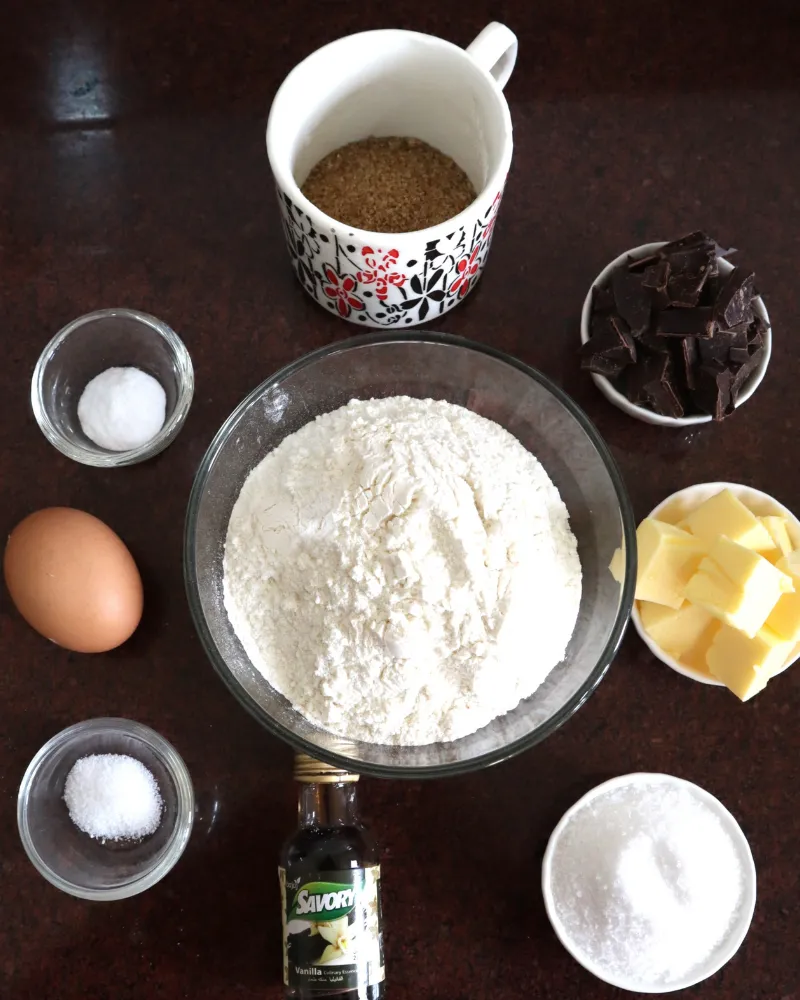
- 1 1/3 cups (170g) all-purpose flour
- 1/2 teaspoon baking soda
- 1/2 teaspoon salt
- 1/2 cup (113g) unsalted butter, softened
- 1/2 cup (100g) light brown sugar, packed
- 1/4 cup (50g) granulated sugar
- 1 large egg, room temperature
- 1 1/2 teaspoons vanilla extract
- 3/4 cup (130g) chopped dark chocolate or chips
- Optional: flaky salt for the tops
Two notes. Chopped bar chocolate beats chips for the same reason it does everywhere else: baking chips are made with less cocoa butter and extra stabilizers specifically so they hold their shape through a bake, which is the opposite of what you want. Chopped chocolate melts into real puddles and streaks. And more brown sugar than white is deliberate. Brown sugar holds onto water, so it keeps the middle soft, and it is slightly acidic, which helps the baking soda along.
How to make them
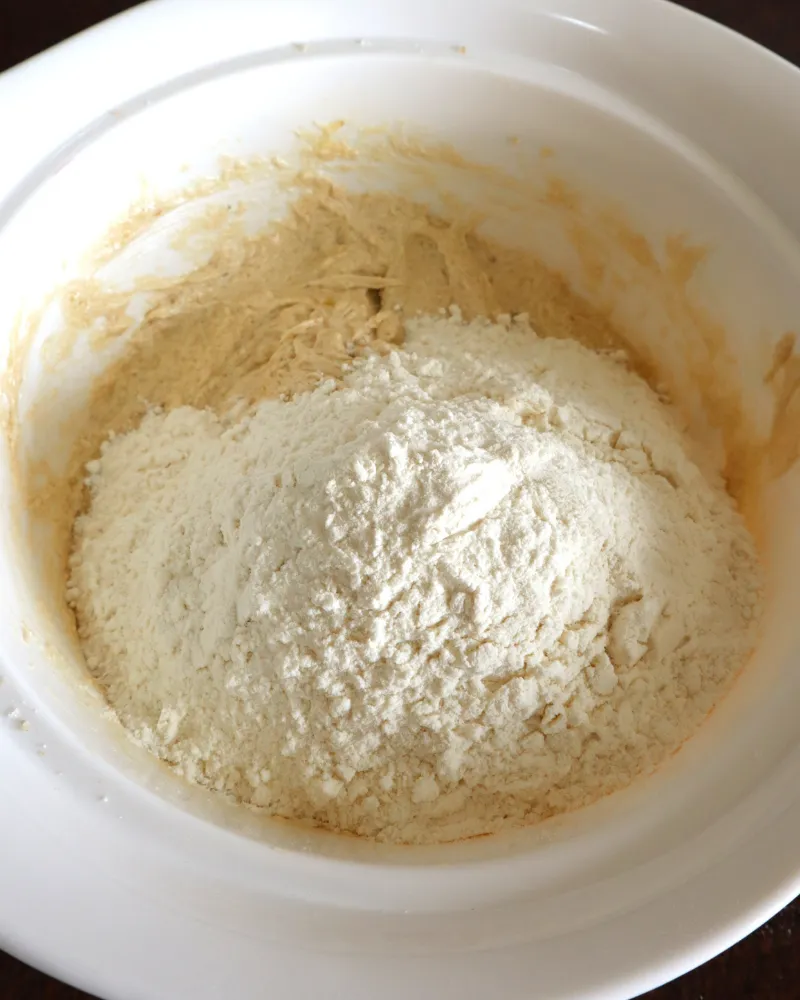
- Whisk the flour, baking soda and salt together in a bowl and set it aside.
- Cream the butter and both sugars for about 2 minutes, until combined and slightly lighter. Not four minutes. Too much air here makes the cookies spread thin.
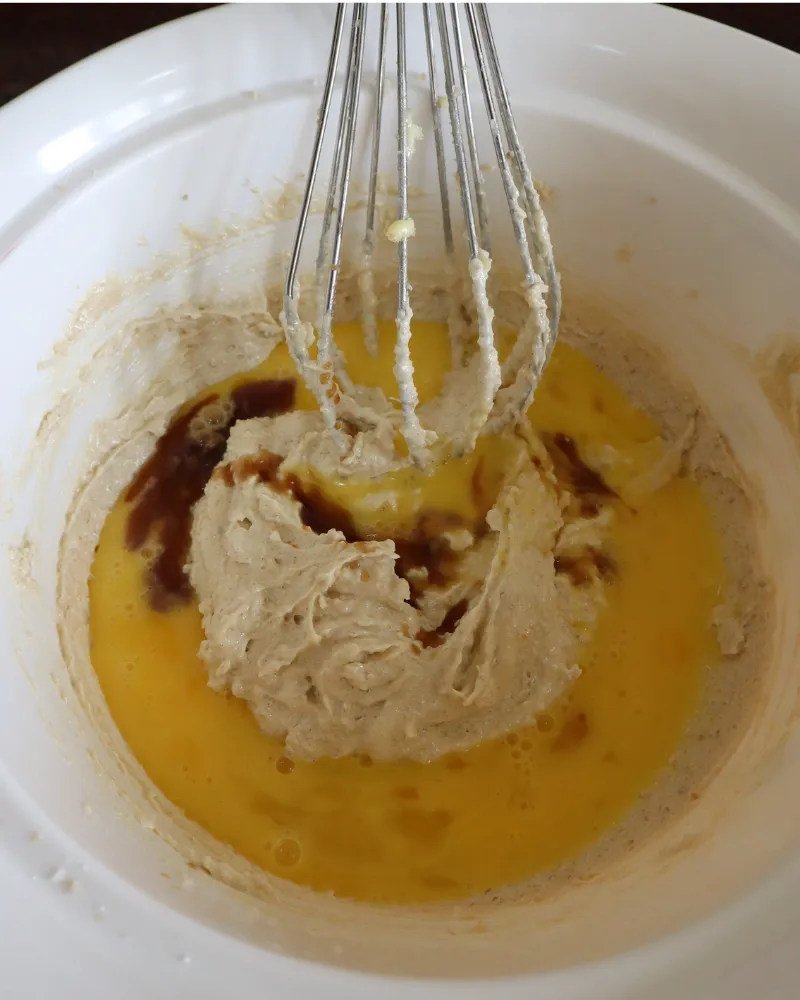
- Beat in the egg and vanilla until smooth.
- Add the dry ingredients and mix on low just until the last streak of flour disappears. Overmixing develops gluten and gives you a tough cookie.
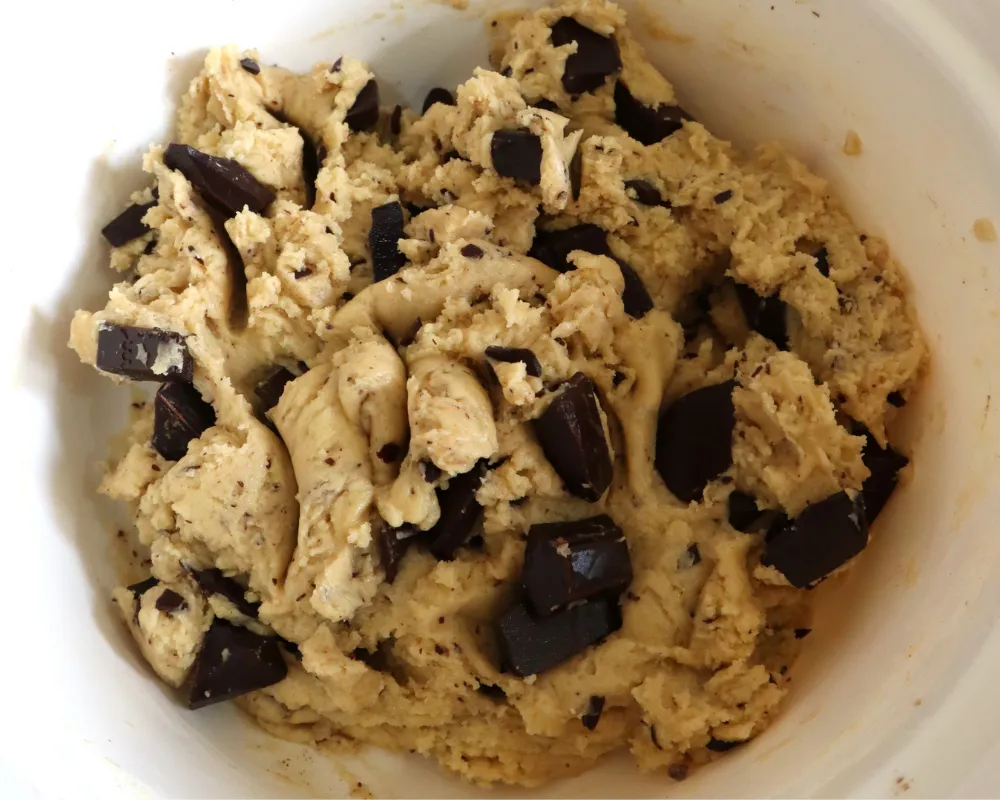
- Fold in the chocolate by hand, keeping a little back to press onto the tops later.
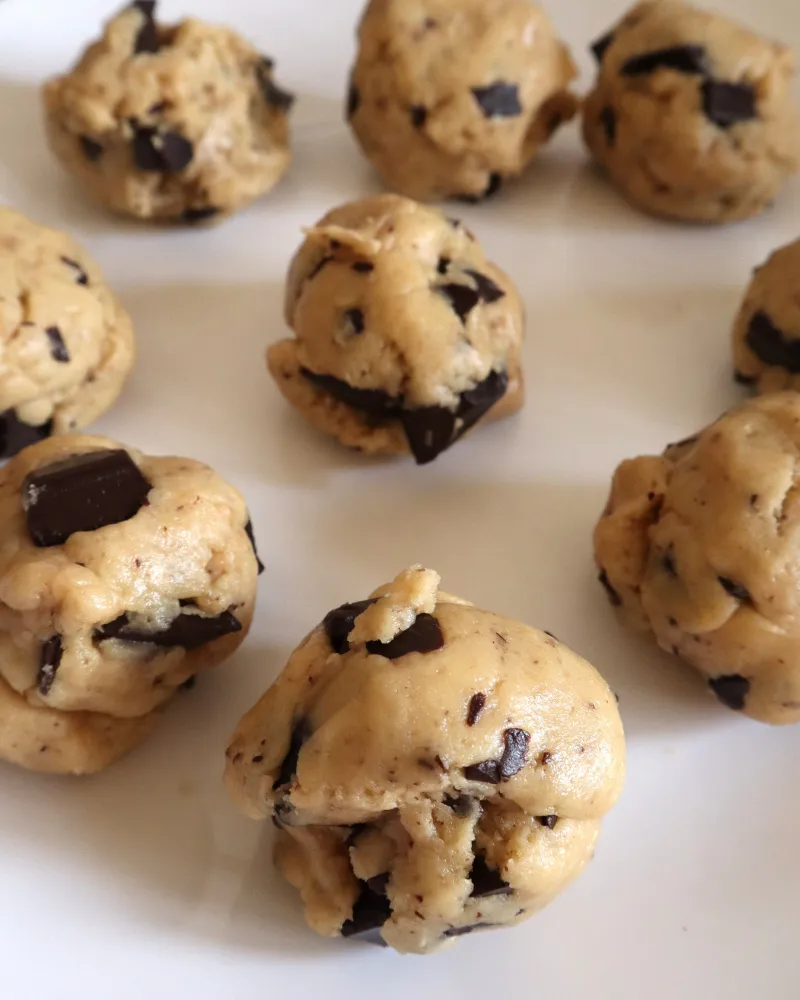
- Scoop 12 balls of about 2 tablespoons each and chill them at least 30 minutes. An hour is better. Do not skip this.
- Preheat to 325°F (163°C) for 3 minutes with nothing in the basket. Never preheat with an empty sheet of parchment in there. Whether you need to preheat covers why it matters more than usual here: a hot plate is part of what sets the base.
- Line with vented parchment and add four dough balls, spaced well apart. They spread. Four is the honest number for most 5 to 6 quart baskets, whatever the box claims.
- Bake batch one 8 to 9 minutes. Batch two 7 to 8, batch three 6 to 7. Start checking a minute before you think you need to.
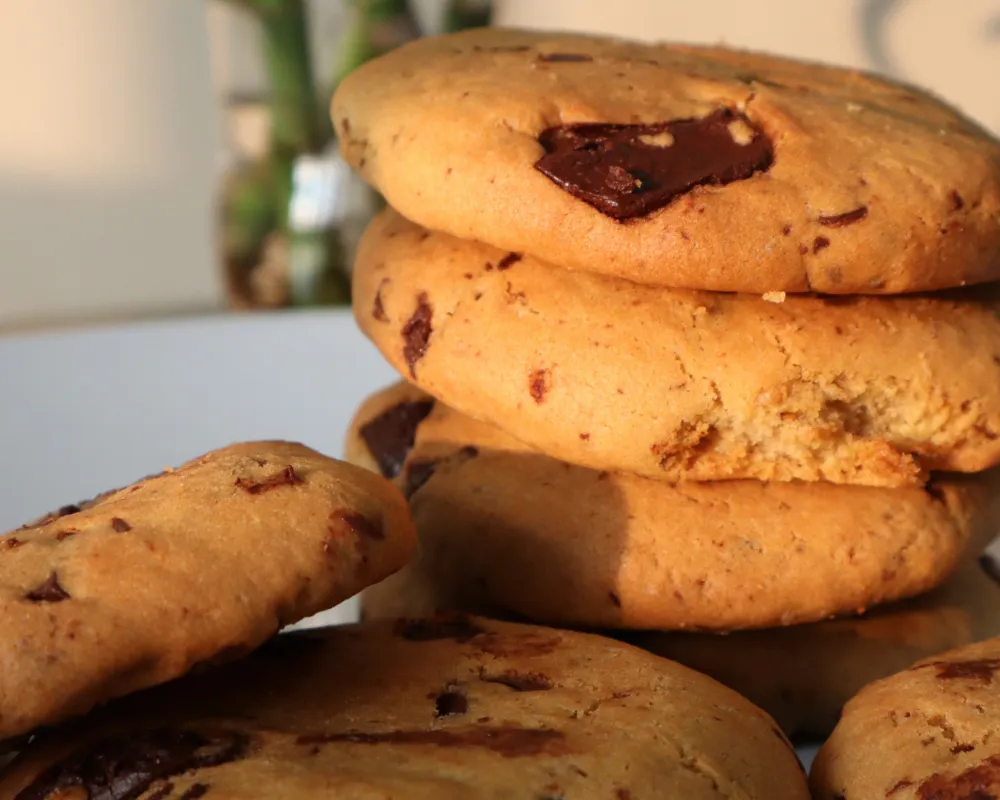
- Pull them when the edges are set and the middle still looks slightly underdone. Not when they look finished. The reason is in the next section.
- Leave them in the basket 3 minutes with the machine off, then move them to a rack. They are too soft to lift straight away and they are still cooking.
- Press a few extra chocolate pieces and a pinch of flaky salt on top in the first minute, while the surface is still soft enough to take them.
When to pull them out
Every recipe for these says to bake until the edges are golden and the centers are still soft, including the version of this page I wrote before. That is not wrong, but it leaves out the part that actually causes trouble.
A cookie in an air fryer looks finished before it is finished, because the fast air over the top browns the surface well ahead of the middle and the base. So the visual cue is running early, and if you wait for the cookie to look properly done you have overbaked it.
| What you see | What is actually happening | Do this |
|---|---|---|
| Top pale, edges still glossy | Not there yet | Another minute |
| Edges set and matte, middle still puffy and slightly wet looking | Done. It will finish on the residual heat | Take it out |
| Whole top looks evenly baked and firm | Past it. The base is now well done | Out immediately, and take a minute off the next batch |
| Top firm, edges browning hard | Overbaked. It will be crisp all through when cold | Two minutes off the next batch |
If you want a number rather than a look, an instant-read thermometer into the middle of a cookie reads about 185°F for a chewy one and around 200°F for a crisp one. It is fiddly on something this thin, and honestly the three minute rest matters more than the reading does, but it is there if you want to calibrate your eye once and then stop bothering.
The three minutes in the switched-off basket is not a cooling step, it is the last part of the bake. A cookie sitting on hot parchment on a hot plate carries on cooking, and this recipe assumes it. That is why the cookie you pull out looks underdone and the cookie you eat does not.
Fixing what goes wrong
| What you got | Why | Fix |
|---|---|---|
| Third batch burnt on the bottom | The machine is heat soaked and running hotter than for batch one. | Take 2 minutes off by batch three. Check early. |
| Spread into one flat sheet | Warm dough, and nothing setting the base early. | Chill 30 minutes minimum. Preheat properly. |
| Raw underneath, done on top | Solid parchment insulating the base. | Vented parchment, or bake on a small metal pan. |
| Dry and crisp all through | Waited for the top to look done, which is late. | Pull when the middle still looks underdone. |
| Cakey rather than chewy | Overcreamed, or too much flour. | Cream 2 minutes, not 4. Weigh the flour if you can. |
| Tough and chewy in a bad way | Overmixed after the flour went in. | Stop the moment the flour disappears. |
| Chips stayed hard | Baking chips are stabilized to hold their shape. | Chop a bar instead. |
| Cookies ran into each other | Too many in the basket. | Four. Not six, whatever the capacity says. |
| The parchment flew up and scorched | It went in empty, or during the preheat. | Never preheat with bare parchment. Dough goes on first. |
| Fell apart lifting them out | Moved too soon. They set as they cool. | Three minutes in the basket first. |
| One darker than the others | Basket hot spot. | Rotate the parchment 180 degrees at halfway. |
If burning is a pattern across your air fryer cooking rather than just here, how to prevent burning in an air fryer covers the general causes, and the troubleshooting guide has the rest.
Variations
- Brown butter. Brown the butter, then chill it until it sets solid again before creaming. Do not skip the resetting step or there is nothing to beat air into. It is the single biggest flavor upgrade available here.
- Double chocolate. Swap 3 tablespoons of the flour for cocoa powder and add a tablespoon of milk, because cocoa is thirsty. Judge these by the edges rather than the color, since a dark cookie tells you nothing.
- Thick bakery style. Scoop the dough into taller balls rather than flatter ones, chill overnight, and add 2 minutes. Height is what stops a cookie spreading into a wafer.
- Oatmeal chocolate chip. Swap half a cup of the flour for rolled oats. Our air fryer oatmeal cookies page has the full version.
- Peanut butter chip. Half chocolate, half peanut butter chips. If you want the full peanut butter version, air fryer peanut butter cookies is a three ingredient recipe and a completely different bake.
- Store-bought dough. Works, and there is no shame in it. Chill the pucks first anyway, drop to 310°F, and start checking at 6 minutes, because commercial dough is usually softer and higher in fat than this one. Full timings for both formats are on refrigerated cookie dough and frozen cookie dough.
- One giant cookie. Press the whole batch into a greased 6-inch pan and bake at 310°F for 16 to 20 minutes. Closer to our air fryer brownies in spirit, and very good with ice cream. Push it further and you get brookies, which stack cookie dough and brownie batter in the same tin.
This dough is the base the rest of the cookie shelf is built on. Chill it longer and roll it in cinnamon sugar for snickerdoodles; drop the egg and the chocolate and you are close to shortbread; press it flat in a pan with brown sugar doing all the work and it becomes blondies. The bar side of the family, from magic bars to lemon bars, lives in the cookies and bars collection.
Storage and freezing
- Room temperature: 4 days in an airtight container. A slice of sandwich bread in the container keeps them soft, which sounds like nonsense and works: the cookies pull moisture from the bread instead of drying out.
- Do not refrigerate baked cookies. Cold makes them hard and stale-tasting faster than the counter does.
- Freeze the dough, not the cookies. This is the real win. Freeze the scooped balls solid on a tray, then bag them, and bake from frozen at 325°F adding about 2 minutes. Four fresh cookies on a weeknight with no mixing bowl involved.
- Frozen baked cookies: 3 months, well wrapped. Thaw at room temperature.
- Reviving a day-old cookie: 60 seconds at 300°F brings the chocolate back to molten and the cookie back to soft. This is one of the things an air fryer does better than anything else in the kitchen.
Running an air fryer for eight minutes a batch costs very little against heating a full oven for a dozen cookies, and if you want the real figure for your electricity rate the running cost calculator will work it out. If you are converting an oven cookie recipe of your own, put its numbers through the air fryer calculator, then drop another 10°F on top of what it gives you because the element sits so close, and the recipe scaler will cut a 60 cookie recipe down to something a basket can handle. All four air fryer tools are in one place, and the full recipe index has everything else.
Frequently asked questions
QHow long do chocolate chip cookies take in an air fryer?
8 to 9 minutes at 325F for the first batch, then 7 to 8 for the second and 6 to 7 for the third. The time genuinely changes as you go, and that is not your machine misbehaving. When an air fryer beeps to say it has reached temperature, only the air has: the basket, the crisper plate and the walls are still heating and go on absorbing energy for another ten minutes. By batch two all that metal is saturated and radiating heat back at your food, so the same dough bakes faster. Two minutes off an eight minute bake is a quarter of the cook time, which is why the third tray burns while you are doing nothing differently.
QWhy do my air fryer cookies burn on the bottom?
Almost always because it is a later batch and the machine is hotter than it was for the first one. Take a minute off batch two and two minutes off batch three. If it is happening on the very first batch, the likely cause is a solid sheet of parchment trapping heat under the cookie, or a cookie left sitting in the basket after the timer went. The three minute rest is part of the recipe, but it should be with the machine switched off, not still running. Bases also darken faster on a metal pan than on vented parchment, so if you switched to a pan take a minute off.
QWhy are my air fryer cookies raw in the middle but done on top?
Because an air fryer bakes a cookie upside down compared to an oven. In an oven the dough sits on a hot metal sheet, and a large share of what sets the cookie arrives by conduction straight up through the pan. In a basket the cookie sits on parchment on a perforated plate with air underneath, so there is almost no conduction from below, while the fan drives hot air onto the top. The result is a top that browns and sets early over a middle and a base that are still catching up. Use vented rather than solid parchment, preheat properly so the plate is hot, and give them the full three minute rest in the basket afterwards.
QWhy did my cookies spread so much?
A cookie spreads because the butter melts and runs before the flour and egg have set anything solid enough to stop it, and in an air fryer the base of the cookie is the last part to set, so the butter wins by more than it would in an oven. Three fixes in order of effect. Chill the dough for at least 30 minutes, and an hour is better, because cold butter melts later in the bake by which point the edges have begun to firm. Check your flour to butter ratio: a cup of flour to half a cup of butter is fat-heavy and spreads, so this recipe uses a cup and a third. And cream for two minutes rather than four, since air beaten into the butter pushes the cookie outward as well as up.
QDo I need to chill the cookie dough?
For an air fryer, yes, and more than you would for an oven. Thirty minutes is the minimum and an hour is better. Cold butter takes longer to melt, which delays the moment spreading starts until the edges have begun to set, and since an air fryer sets a cookie's base last there is more spreading to hold back than usual. Chilling also improves the flavor, because the flour hydrates and the sugars break down slightly, which is why dough rested overnight tastes deeper. If you are short of time, twenty minutes in the freezer does roughly what thirty in the fridge does.
QDo you need parchment paper for air fryer cookies?
You need something, because raw dough will drip through the holes in the crisper plate. Use perforated parchment rounds, or cut four or five slits in a plain square with scissors, so warm air can still reach the underside of the cookie. A solid sheet insulates the base and makes the raw-bottom problem worse. The safety point matters more than the convenience one: an empty sheet of parchment weighs almost nothing and the fan will lift it into the heating element, where it scorches and can catch. Never preheat with a bare sheet in the basket. The dough goes on first, and it goes in together.
QHow many cookies fit in an air fryer at once?
Four, in most 5 to 6 quart baskets, and that is an honest four rather than an optimistic one. They need real space between them because they spread, and crowding them means they run into each other and the air cannot circulate, which gives you pale sides and uneven baking. A large oven-style unit with a full shelf will take six to eight. This recipe makes twelve, which is three batches, and the times change between batches so it is worth reading the batch section before you start rather than after the third tray comes out dark.
QWhat temperature should air fryer cookies be inside?
About 185F in the middle for a chewy cookie and around 200F for a crisp one. It is fiddly to measure on something this thin, and in practice the visual cue plus the rest matters more, but it is worth checking once to calibrate your eye. The important part is that you pull them when the edges are set and the middle still looks slightly underdone, then leave them in the switched-off basket for three minutes. That rest is not cooling, it is the last part of the bake: the cookie is sitting on hot parchment on a hot plate and carries on cooking. The cookie you take out should not look like the cookie you eat.
QCan I use store-bought cookie dough in an air fryer?
Yes, and it works well. Two adjustments. Chill the pucks first even though they came out of the fridge, because commercial dough is usually softer and higher in fat than homemade and spreads more. And drop the temperature to 310F, starting to check at 6 minutes, since the higher sugar content browns faster. Everything else on this page still applies: vented parchment, four at a time, take time off for later batches, and pull them looking underdone. Frozen pucks go straight in without thawing and need about 2 extra minutes.
QCan I freeze air fryer cookie dough?
Yes, and freezing the dough rather than the baked cookies is genuinely the best thing you can do with this recipe. Scoop the balls, freeze them solid on a tray so they do not stick together, then bag them. They keep three months. Bake from frozen at 325F and add about two minutes, and do not thaw them first, because thawed dough spreads badly. It turns a batch of cookies into a weeknight thing: four fresh cookies in ten minutes with no mixing bowl involved, which is the single best argument for making cookies in an air fryer at all.
QShould I use chocolate chips or chopped chocolate?
Chopped bar chocolate, if you have the choice. Baking chips are formulated with less cocoa butter and extra stabilizers specifically so they keep their shape through a bake, which is exactly the opposite of what you want in a cookie. Chopped chocolate melts into real puddles and streaks that run through the crumb. Chop it roughly and unevenly rather than into neat cubes, so you get a mix of fine shards that disappear into the dough and larger chunks that stay as pools. If chips are what you have, use them and expect them to soften rather than melt.
QCan I make gluten free air fryer cookies?
Yes, with a cup for cup gluten free blend that contains xanthan gum, swapped in by weight rather than by volume. Two things to expect. Gluten free doughs spread more, because there is no gluten network holding the cookie together, so chill for the full hour rather than thirty minutes and scoop the balls taller than you would otherwise. And they brown faster, so drop to 315F and start checking at 6 minutes even on the first batch. Letting the dough rest an extra 30 minutes after mixing helps a lot too, since gluten free flours hydrate more slowly than wheat does.
Never overbake again
Get our one-page times & temps cheat sheet, plus a new tested recipe each week.
No spam · unsubscribe anytime