

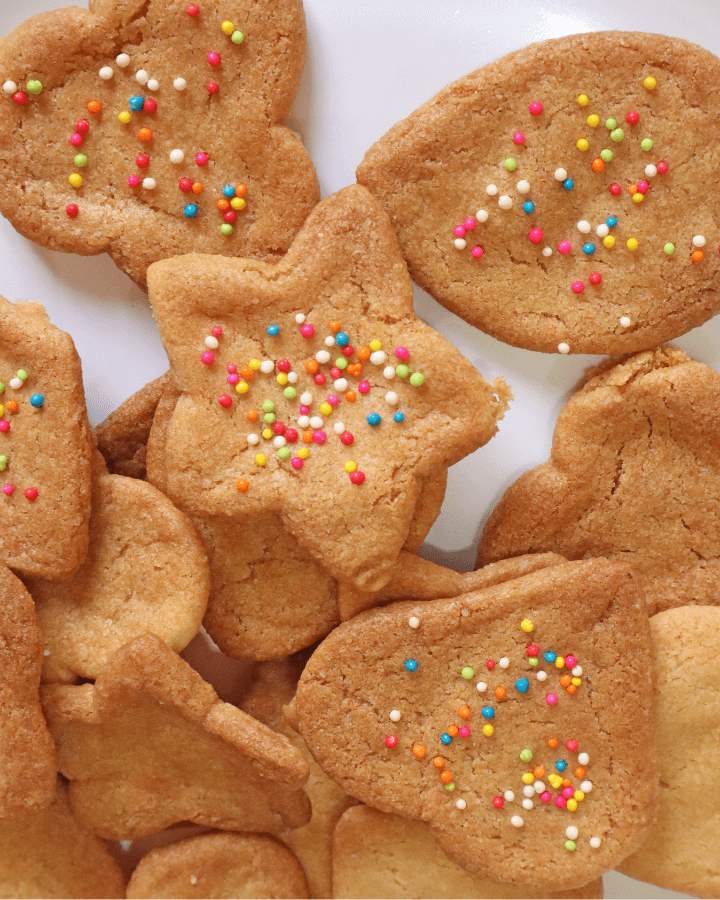
Sugar cookies were the batch I got wrong more than any other, and for a long time I could not work out why. My chocolate chip cookies were fine. My oatmeal cookies were fine. Sugar cookies kept coming out dry and slightly sandy, with a texture more like a cracker than a cookie.
The reason turned out to be embarrassingly simple. I was waiting for them to go golden brown, because that is what every other cookie does when it is ready. A sugar cookie does not really do that. By the time one looks properly browned across the top, it has been done for two or three minutes and it has spent those minutes drying out. Once I stopped using color as the signal, the problem went away.
Quick answer: Roll the chilled dough to ¼ inch, cut your shapes, chill the shapes another 10 minutes, then air fry at 325°F (160°C) for 7 to 9 minutes. Pull them when the outer quarter inch has turned matte and the middle still looks faintly damp. They finish setting on the rack. Four cut-outs fit a standard basket.
The doneness cue that isn't there
Browning in baking comes mostly from the Maillard reaction, which needs two things in the same place: a reducing sugar and an amino acid. That is a real chemical requirement, not a rule of thumb, and it explains the whole problem.
Plain granulated white sugar is sucrose, and sucrose is not a reducing sugar. It cannot take part in that reaction until heat splits it into glucose and fructose, which happens slowly. Compare that with the cookies that do brown nicely:
- Chocolate chip cookies use brown sugar. Molasses brings invert sugars, which are reducing, plus a little acid that speeds the splitting along.
- Most cookie recipes include an egg, and egg white is almost pure protein, which is the amino acid half of the reaction.
- A sugar cookie is white sugar, butter and flour. This one has no egg either. It is short on both halves.
You do eventually get color, from the flour's own protein, from milk solids in the butter, and from sucrose caramelizing, which starts around 320°F at the surface. But it arrives late, and it arrives at the thin dry edges first while the middle stays pale. Waiting for an even golden top means waiting well past the point where the cookie was good.
Use the matte line instead. Raw dough has a faint sheen to it, because there is soft butter at the surface catching the light. As the cookie sets, that sheen goes and the surface turns matte and slightly dull. Pull the batch when the matte ring has worked about ¼ inch in from the edge and the center still looks a shade darker and very slightly damp. Nudge the basket while you look: a set cookie sits still, an underdone one ripples.
The middle finishing on the rack is not a compromise, it is the plan. There is enough heat left in a hot cookie to carry it the rest of the way, and it does that without losing more water. Our air fryer peanut butter cookies lean on exactly the same idea, and if you want the general version of why hot air dries baked goods faster than an oven does, avoiding dry air fryer bakes covers it.
Cut-outs and drop cookies are not the same bake
Search for this recipe and you will get two different cookies under one name, with times that are not interchangeable. Worth sorting out before you start, because it changes almost everything downstream.
| Style | Shape going in | Time & temp | What you get |
|---|---|---|---|
| Rolled cut-outs (this recipe) | Flat, ¼ inch, 2 to 3 inches wide | 325°F, 7 to 9 min | Crisp edge, tender middle, holds its shape for decorating |
| Dropped balls | Tall, about 1 inch across | 325°F, 9 to 11 min | Thicker, chewier, spreads into a round, no cutter needed |
The cookies on this page are cut-outs, which is the harder of the two in an air fryer and the one worth writing about. A cut-out is flat, wide and very light, and that is the worst possible combination under a fan. A thin star or a paper-thin heart tip can lift off the basket floor and flip over, the same way a slice of bread does in our air fryer toast guide. Chilling the shapes properly is most of the answer, and the rest is not rolling them too thin.
A lot of published sugar cookie recipes tell you to roll the dough into balls and then show photographs of cut-out shapes. They are describing one cookie and picturing another. If your recipe says balls, use the drop cookie timings in the table.
Two changes I made to the usual ingredient list
The standard sugar cookie ingredient list that circulates online has two things in it that I think are mistakes. Neither will wreck a batch, but both make it worse, and one of them explains a complaint I see constantly.
The baking soda has nothing to react with
Most versions of this recipe call for baking powder and baking soda. Baking soda is sodium bicarbonate, and it needs an acid to work properly. Look at what is actually in a sugar cookie: white sugar, butter, flour, vanilla, a splash of milk. There is nothing meaningfully acidic anywhere in that list.
Heat alone will break soda down above roughly 175°F and you do get some gas out of it, so it is not inert. The problem is what it leaves behind, which is sodium carbonate. That is alkaline, and alkaline is what people are tasting when they describe a cookie as faintly soapy or metallic. The alkalinity also pushes browning along, which is why so many sugar cookies come out tan when the whole point was a pale, buttery cookie.
The fix: drop the baking soda and use ¾ teaspoon baking powder on its own. Baking powder is baking soda that already has its own dry acid packed in with it, so it neutralizes itself as it reacts and leaves no alkaline aftertaste. You lose nothing in lift.
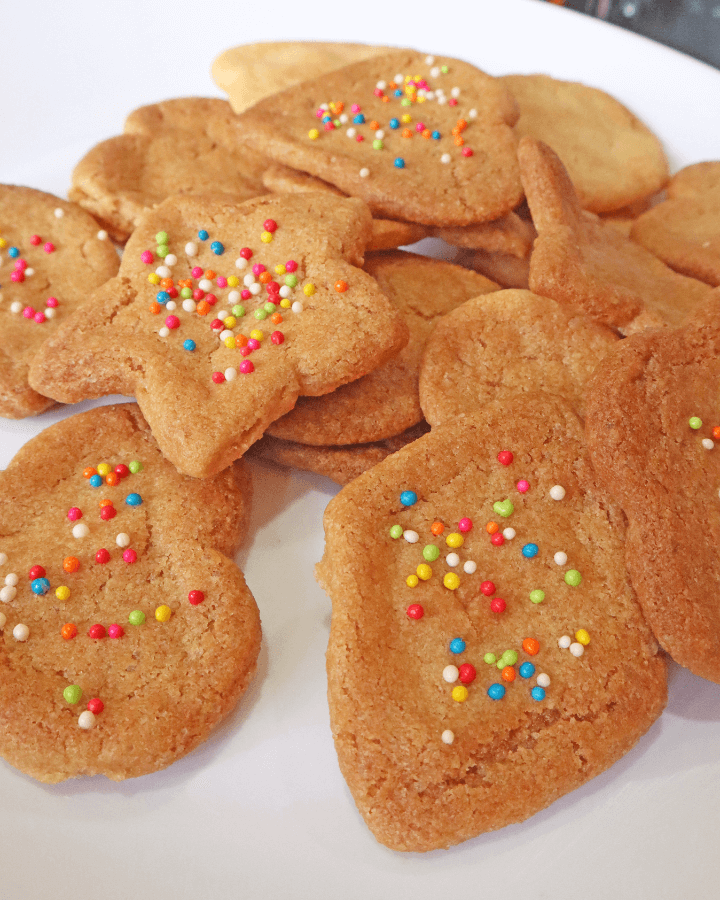
If you like the browner look in the photos on this page, which were baked with the soda still in, keep a bare pinch, about ⅛ teaspoon. That is enough to nudge the color without enough left over to taste.
A teaspoon of salt is roughly double
One teaspoon of salt against 1½ cups of flour works out to a bit over 3 percent salt by flour weight. Bread dough sits around 2 percent and tastes properly salted. A cookie this small wants half a teaspoon at most. I suspect the teaspoon is a typo that got copied around, and it is worth catching, because oversalted butter cookies are unpleasant in a way that is hard to place.
One thing I have deliberately left alone: the butter and sugar are both high against the flour, closer to a shortbread ratio than a classic cut-out. That is what makes these snap rather than bend, and it is also why the dough needs a real chill. If you want sharper shape definition and less spread, pull the sugar back to ¾ cup. The cookie gets less sweet and holds a star point better.
Ingredients
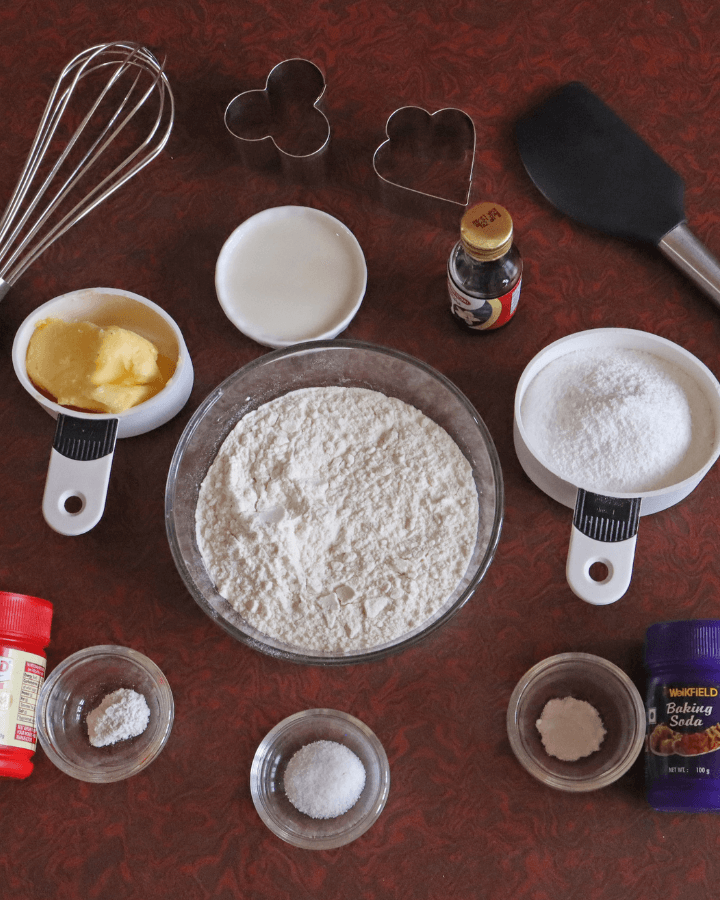
For the dough
- 1½ cups all-purpose flour
- 1 cup granulated sugar
- ¾ cup unsalted butter, softened
- ¾ teaspoon baking powder
- ½ teaspoon salt
- 1 teaspoon vanilla extract
- 2 to 3 tablespoons milk
To decorate (optional)
- Nonpareils or sprinkles
- Powdered sugar and a little milk, for icing
Why there is no egg, and why that helps here
Nearly every sugar cookie recipe on the first page of Google has an egg in it. This one does not, and after making both I would not add one back for an air fryer.
Egg does two jobs in a cookie: the yolk adds fat and richness, and the white adds water and protein that sets into structure. That protein is what makes an egg cookie puff slightly and go a little cakey. In an air fryer, where the top surface is hit hardest and sets first, that puff works against you. The top locks in place while the middle is still soft, and you get a domed cookie with a cracked surface, which is exactly what you do not want under icing.
Take the egg out and replace its liquid with a couple of tablespoons of milk, and you get a shorter, firmer, more shortbread-like dough. It rolls without tearing, it holds a cut edge, and it stays flat. It also happens to be a genuinely eggless recipe if you need one.
How to make air fryer sugar cookies
- Cream the butter and sugar for 2 to 3 minutes. You want it pale and noticeably lighter in volume. This is the only aeration this dough gets, so do not rush it.
- Beat in the vanilla and 2 tablespoons of milk. It may look split for a moment. It comes back together with the flour.
- Whisk the flour, baking powder and salt separately, then add in two goes. Mix only until no dry flour is left. Overworking builds gluten, and gluten in a cut-out cookie means it shrinks and toughens.
- Add the last tablespoon of milk only if it will not come together. The dough should be firm and smooth, not tacky.
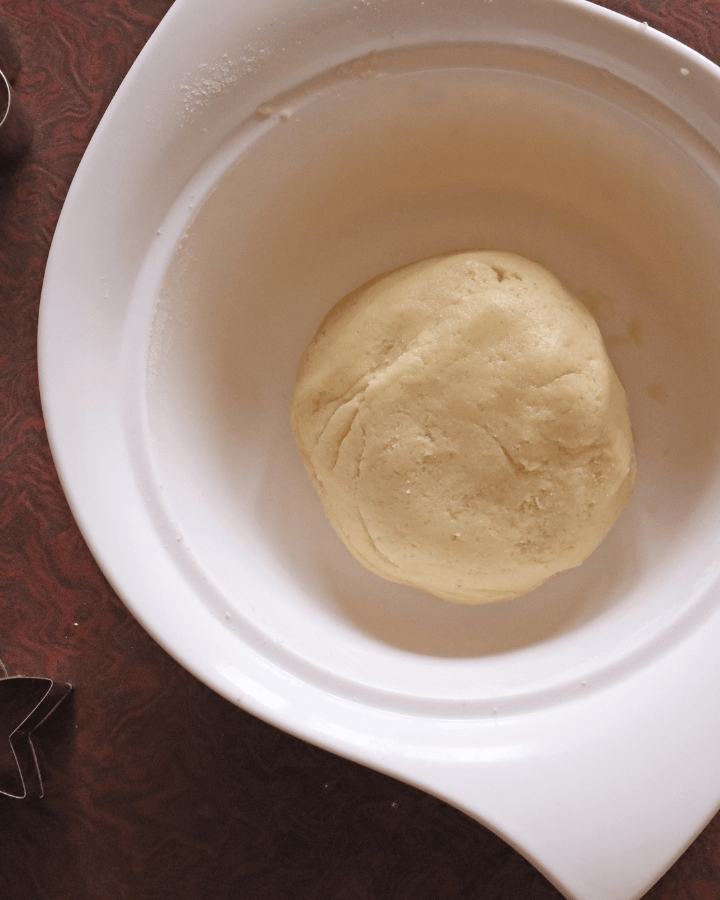
- Flatten into a disc, wrap, and chill 30 minutes. A disc chills through faster than a ball and is easier to roll out later.
- Roll to ¼ inch on a lightly floured surface and cut your shapes. Use as little extra flour as you can. Re-roll scraps once, and no more than that.
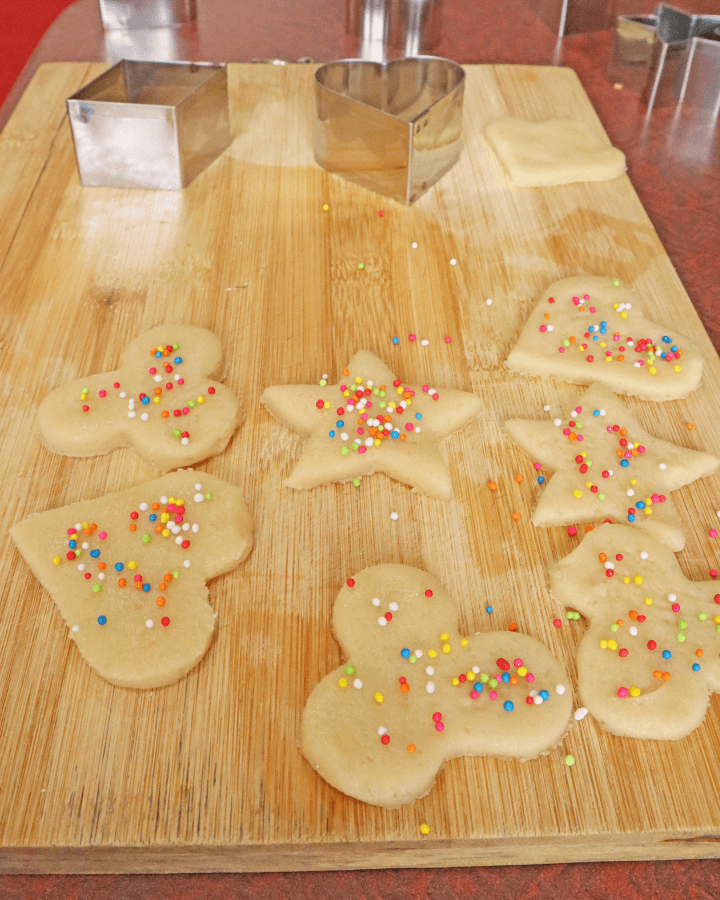
- Press sprinkles in now, then chill the cut shapes 10 minutes in the freezer. This second chill is the one most people skip and the one that keeps the edges sharp.
- Line the basket with perforated parchment and lay in 4 cookies, not touching. Solid parchment blocks the airflow that is doing the cooking.
- Air fry at 325°F for 7 to 9 minutes. No flipping. Pull when the outer ¼ inch has gone matte and the center still looks slightly damp.
- Leave them in the basket for 2 minutes, then move to a rack. Straight out of the machine they are too soft to lift without bending.
Do preheat for this one. Most of the frozen food on this site goes in cold on purpose, but a butter cookie is the opposite case. Dough that sits in a cold basket while the element warms up gives the butter time to melt and run before the structure sets, and you get thin, greasy, spread-out cookies. Three minutes at 325°F is enough. Our guide on whether you need to preheat an air fryer for baking explains which bakes care and which do not.
Thickness sets the outcome, not the timer
How thick you roll matters more than any other decision here, and it is the one variable most recipes leave to chance with the phrase "roll out the dough." A quarter inch is the number I would actually give you.
| Rolled thickness | 325°F takes | Result |
|---|---|---|
| ⅛ inch | 5 to 6 min | Crisp all the way through, snaps. Points scorch easily. |
| ¼ inch (recommended) | 7 to 9 min | Crisp edge, tender center. Best for icing. |
| ⅜ inch | 10 to 12 min | Soft and cakey through. Edges may brown before the middle sets. |
Temperature is the smaller dial, but it is worth knowing which way it moves things, especially since published recipes for this cookie run anywhere from 320°F to 400°F.
| Temperature | Time at ¼ inch | Trade-off |
|---|---|---|
| 300°F | 10 to 12 min | Palest and softest. Good if you are icing heavily. |
| 325°F | 7 to 9 min | The default. Edge sets before the middle dries. |
| 350°F | 6 to 7 min | Faster, more spread, browner rim. Watch thin points. |
| 375°F and up | 4 to 5 min | Not for cut-outs. Star points and heart tips burn before the body sets. |
That last row is the reason I do not recommend the high-heat method you will see on some sites. It works fine for a thick ball of dough, which has no thin extremities to lose. A cut-out shape is mostly thin extremities. If burnt edges are a recurring problem for you generally, preventing burning in an air fryer goes through the other common causes.
Why you chill twice, not once
Almost every recipe tells you to chill the dough. Very few tell you to chill the cut shapes as well, and that second chill is what actually protects the edges.
- The first chill, 30 minutes on the dough, firms the butter so the dough rolls instead of smearing, and lets the flour hydrate so it tears less.
- The second chill, 10 minutes in the freezer on the cut shapes, does something different. Between rolling, cutting and lifting, the dough warms up in your hands. Cold butter melts slowly enough that the flour and egg-free structure set before the shape can slump. Warm butter melts immediately and the star turns into a blob.
The second chill has a bonus in an air fryer specifically. A cold, firm cookie is a heavier and stiffer object, which makes it much less likely to be picked up by the fan and thrown against the heating element. Ten minutes in the freezer costs nothing and solves two problems at once.
Never overbake again
Get our one-page times & temps cheat sheet, plus a new tested recipe each week.
No spam · unsubscribe anytime
How many fit at once, and the honest math on that
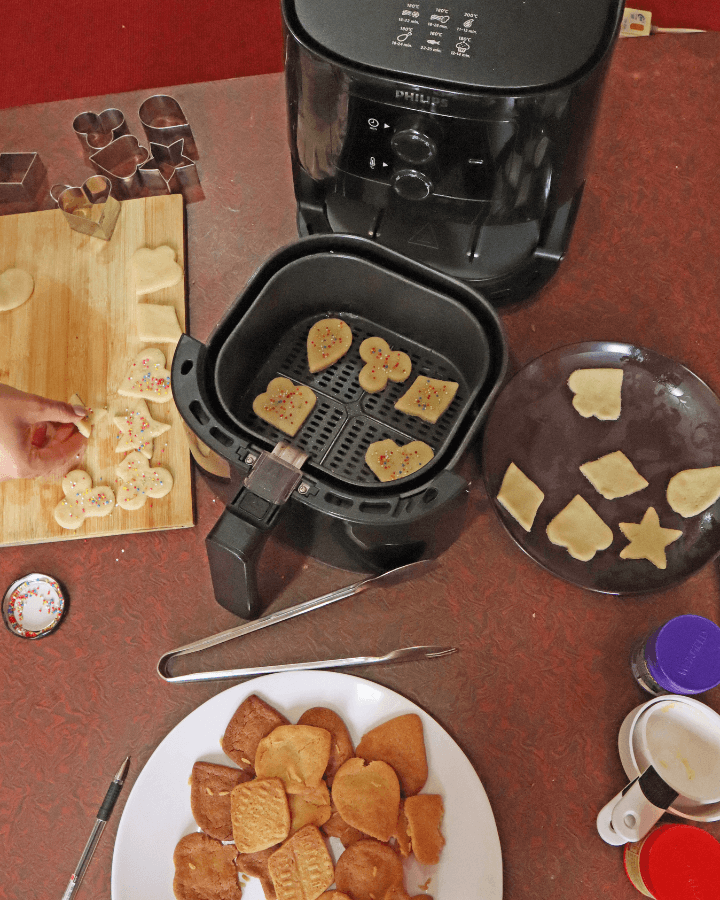
This is the part of the recipe I would want to know before starting rather than halfway through. A batch of this dough makes about 24 cookies at 2½ inches across. A standard basket takes four of them at a time.
That is six batches. At roughly eight minutes each, plus a minute to load and unload, you are looking at close to an hour of standing at the machine.
| Machine | Cookies per batch | Batches for a full recipe |
|---|---|---|
| 3 to 4 quart basket | 3 | 8 |
| 5 to 6 quart basket | 4 | 6 |
| 8 quart or dual zone | 6, or 4 per zone | 3 to 4 |
| Oven-style air fryer | 9 per rack, 18 over two | 1 to 2 |
Cut-out cookies are the clearest example I know of a bake where the shape of the machine matters more than its power. Cookies are flat and wide, so they compete for floor area, and floor area is exactly what a basket does not have. An oven-style unit with two racks turns an hour into about fifteen minutes. Our comparison of basket vs oven-style air fryers for baking works through this trade-off properly, including what you give up on the oven-style side.
If you are staying with a basket, halve the recipe. Twelve cookies in three batches is a pleasant afternoon. Twenty-four in six is a chore, and the last batches suffer because the dough has been sitting out warming up the whole time.
Adapting an oven recipe you already like? Put its temperature and time through our air fryer calculator to get a starting point, then apply the doneness test from the top of this page rather than the clock. Cookies are the bake where converted times go wrong most often, because an oven recipe assumes a full tray absorbing heat evenly while your basket has four cookies and a lot of moving air. The calculator gets you close. The matte ring tells you when to stop.
Sprinkles before, icing after
These two get muddled, and doing either at the wrong moment is annoying to fix.
Sprinkles go on raw dough
Press nonpareils into the shapes before they go in, with a fingertip, firmly enough to seat them in the surface. As the cookie sets around them they anchor in place and survive being handled. Scattered onto a baked cookie they simply roll off, and scattered onto wet icing they are fine but you are now committed to icing everything.
Icing goes on a completely cold cookie
Not warm, not room-temperature-ish. Completely cold, which for these is about 20 minutes on a rack. There is enough residual heat in a barely-warm butter cookie to thin the icing and send it running over the edges. For a simple glaze, whisk 1 cup powdered sugar with 1 to 2 tablespoons of milk until it ribbons off the whisk, then leave the iced cookies an hour to set hard before stacking them.
On parchment: use the pre-perforated rounds or punch your own holes. A solid sheet turns the basket floor into a flat pan and blocks the airflow underneath, which is what browns the bottom. Our guide to using foil and parchment paper in an air fryer covers the safety side, including why you never preheat with an empty sheet in there.
Fixing what goes wrong
They spread into shapeless blobs
Warm dough, almost always. Either the shapes were not chilled after cutting, or the machine was not preheated so the butter had a long slow melt before anything set. Chill the cut shapes 10 minutes in the freezer and preheat for 3 minutes. If it keeps happening, your butter was too soft when you creamed it: softened means it dents under a finger, not that it is glossy.
They taste faintly soapy
Baking soda with nothing acidic to neutralize it. See the ingredient section above. Switch to baking powder alone and the taste disappears.
The edges are dark but the middles are raw
Rolled too thick, or the temperature is too high, or both. Thin points reach doneness long before a ⅜ inch center does. Roll to ¼ inch and drop to 325°F. A batch already out with soft middles can go back for 2 minutes at 300°F.
They are dry and sandy
Overbaked, which brings us back to the beginning. If you were waiting for even golden color, that is the cause. Pull them on the matte ring instead. Too much flour when rolling is the other suspect, so use the lightest dusting you can and brush off any excess before they go in.
A cookie flipped over mid-bake
Thin, light and not cold enough. The fan lifted it. Chill the shapes, avoid rolling below ¼ inch, and if a particular machine is a repeat offender, lay a second sheet of perforated parchment loosely on top for the first four minutes to hold everything down.
The bottoms are pale
Solid parchment underneath, or too many cookies in the basket. Both stop air from reaching the underside. If you want a bit more color down there, our guide to making bakes crispy in an air fryer explains what is actually happening at the contact surface.
Flavor variations
- Lemon: beat the zest of one lemon in with the butter and sugar so the oils get worked into the fat, which carries the flavor much better than adding it later.
- Almond: swap ½ teaspoon of the vanilla for almond extract. This is the flavor most bakery sugar cookies actually have.
- Brown butter: melt the butter, cook it to the nutty stage, then chill it back to a soft solid before creaming. It solves the browning problem from the top of this page by bringing the browned flavor in ready-made.
- Cinnamon sugar: roll the shapes in a mix of 2 tablespoons sugar and 1 teaspoon cinnamon before baking. The extra surface sugar also gives you a bit more color.
- Chocolate chip: fold in ½ cup of mini chips. Full-size chips make a cut-out shape awkward to cut cleanly, so if you want the proper version see our air fryer chocolate chip cookies.
Storage
- Room temperature: 5 to 7 days in an airtight tin once completely cool. They are dry cookies to begin with, so they keep better than most.
- Iced cookies: let the icing set hard for an hour before stacking, and put parchment between the layers.
- Freezing baked cookies: up to 3 months, un-iced, in a rigid container so the points do not snap off.
- Freezing the dough: the better option. Freeze the cut shapes flat on a tray, then bag them. Bake straight from frozen at 325°F, adding 2 minutes. Freshly baked cut-outs whenever you want four of them, which suits the basket capacity nicely.
- Refreshing: 2 minutes at 300°F brings back the snap on a cookie that has gone soft in a humid kitchen.
If you want more cookies from the same machine, our air fryer oatmeal cookies are the forgiving end of the spectrum, and the full air fryer baking chart has times and temperatures for everything else on the site in one place.
Frequently asked questions
QWhat temperature do you cook sugar cookies in an air fryer?
325°F (160°C) for 7 to 9 minutes for cut-outs rolled to a quarter inch. Thicker dropped balls need 9 to 11 minutes at the same temperature. Avoid anything above 350°F for cut-out shapes, because thin points like the tips of a star burn before the body of the cookie sets.
QWhy don't my sugar cookies turn golden brown?
Because they largely cannot. Browning needs a reducing sugar and an amino acid together, and plain white granulated sugar is sucrose, which is not a reducing sugar until heat splits it. A sugar cookie with no brown sugar and no egg is short on both ingredients for the reaction. You get some color from the flour protein, the milk solids in butter and sucrose caramelizing near 320°F, but it shows up at the edges first and late. Judge doneness by the matte ring at the edge instead, not by color.
QHow do I know when air fryer sugar cookies are done?
Look for the surface to change from slightly shiny to matte, starting at the rim and working inward. When that matte ring is about a quarter inch wide and the center still looks a shade darker and faintly damp, take them out. They finish setting from their own residual heat over the next couple of minutes in the basket. A done cookie also sits still when you nudge the basket, while an underdone one ripples.
QCan you make sugar cookies in an air fryer without eggs?
Yes, and this recipe is written that way on purpose. Replacing the egg with 2 to 3 tablespoons of milk gives a firmer, shorter, more shortbread-like dough that rolls cleanly and holds a cut edge. It also stays flatter, which matters in an air fryer because egg protein makes cookies puff and dome just as the fan is setting the top surface. Flat cookies are much easier to ice.
QWhy do my sugar cookies taste soapy or metallic?
Baking soda with nothing acidic in the recipe to neutralize it. Sodium bicarbonate needs an acid to react properly, and a sugar cookie contains sugar, butter, flour, vanilla and milk, none of which qualify. Heat breaks the soda down anyway but leaves alkaline sodium carbonate behind, and that is the taste. Use three quarters of a teaspoon of baking powder on its own instead, since baking powder includes its own dry acid and neutralizes itself.
QDo I need to preheat the air fryer for sugar cookies?
Yes, three minutes at 325°F. This is one of the bakes where it genuinely matters. Butter cookie dough sitting in a cold basket gives the butter a long slow melt before any structure has set, and the cookies spread thin and greasy. That is the opposite of frozen food, which does better from a cold start.
QHow many sugar cookies fit in an air fryer at once?
Four cut-outs of about two and a half inches in a standard 5 to 6 quart basket, three in a small one, six in an 8 quart, and around nine per rack in an oven-style unit. They must not touch, because dough that meets other dough steams instead of setting. A full batch of this recipe makes about 24 cookies, which is six basket loads, so halving the recipe is a reasonable idea if you are using a basket machine.
QWhy did my cut-out cookies lose their shape?
The dough was too warm going in. Chilling the dough before rolling is only half of it. You also need to chill the cut shapes for 10 minutes in the freezer right before they go in the basket, because the dough warms up considerably while you roll, cut and lift it. Cold butter melts slowly enough for the cookie to set before it can slump. Not preheating makes the same problem worse.
QCan I use parchment paper for air fryer cookies?
Yes, but use perforated parchment or punch holes in a plain sheet. A solid sheet blocks the airflow under the cookies, which is what sets and colors the bottoms, and you end up with pale soggy undersides. Never preheat with an empty sheet in the basket either, since nothing is holding it down and it can blow into the heating element.
QHow thick should I roll sugar cookie dough for an air fryer?
A quarter inch. Thinner than that and the cookie goes crisp all the way through and the thin points scorch, and it is also light enough that the fan can flip it over. Thicker than about three eighths of an inch and the edges brown before the center sets. A quarter inch at 325°F for 7 to 9 minutes gives a crisp edge with a tender middle, which is the texture most people are after.
QShould sprinkles go on before or after baking?
Before, if you are using nonpareils and not icing the cookies. Press them into the raw dough with a fingertip so they seat into the surface, and the cookie sets around them as it bakes. Sprinkles scattered onto a plain baked cookie just roll off. If you are icing, then sprinkles go onto the wet icing instead, immediately after you spread it and before it starts to skin over.
QCan I bake sugar cookies from frozen dough in the air fryer?
Yes, and it is the best way to store this dough. Freeze the cut shapes flat on a tray until solid, then bag them. Bake straight from frozen at 325°F and add about 2 minutes to the time. Frozen shapes actually hold their edges better than chilled ones, because the butter has even longer before it melts.
Made these? Rate the recipe