


The first time mine really smoked I was baking cinnamon rolls, which felt unfair. No bacon, no wings, nothing greasy. Just a tray of pastry and suddenly a grey haze coming out of the vent and the smoke alarm in the hallway thinking about it.
I turned the temperature down. It still smoked. I moved the pan. It still smoked. What actually fixed it was wiping a patch of burnt sugar off the underside of the heating element, left there by something I had made two days earlier.
Short answer: Air fryer smoke comes from fat or sugar landing on a surface hotter than its burning point. Usually that is old residue on the element from a previous cook, or fat dripping into the drawer during this one. Clean the element, keep your cooking temperature under the smoke point of whatever fat you are using, and put a little water in the drawer under the basket if the food is greasy.
The smoke is almost never the food you are cooking
This is the part that changes how you approach it. When something smokes in a regular oven, the food is usually burning and you can see it. In an air fryer the food is often perfectly fine, because the smoke is being made somewhere you cannot see.
There are only three places it can come from:
The element
Splatter from a previous cook baked onto the coil above the food. It reheats every time and burns a little more. The most common cause by a distance.
The drawer
Fat drips through the basket onto the hot metal underneath, pools, and reaches its smoke point. This is the one that starts partway through a cook.
The surface of the food
Oil, butter, sugar or a marinade on the outside of the food going past its own burning point. The only one that is genuinely about what you are cooking.
Notice that two of the three have nothing to do with today's recipe. That is why turning the temperature down or moving the pan so often does nothing: you are adjusting the third cause when you have got one of the first two.
When the smoke starts tells you which one it is
You do not need to guess. The timing narrows it down to one, and it takes no equipment.
| When it starts | Almost certainly | Do this |
|---|---|---|
| During preheat, basket empty | Old residue on the element | Cool it, wipe the element |
| Within a minute of food going in | Residue, disturbed by the airflow | Same. Clean before you carry on. |
| Five to ten minutes in, greasy food | Fat pooling in the drawer | Water in the drawer, or drain it mid-cook |
| Only when you go above about 375°F | Oil past its smoke point | Change the oil or drop the temperature |
| Near the end, on something sweet | Sugar caramelising past burning | Lower the heat, glaze later |
| First two or three uses, brand new machine | Manufacturing oils burning off | Nothing. It stops on its own. |
| Any time, with a smell of hot plastic or wiring | Not a cooking problem | Unplug it. See the safety section. |
One more signal worth knowing. Thin white or pale grey wisps that drift are usually steam or fat right at the edge of its smoke point, and they are a warning rather than a problem. Thick blue-grey smoke with a sharp acrid smell means something is actively burning, and that one needs you to stop and look.
The temperatures that actually matter
Every guide tells you to use a high smoke point oil. Very few tell you what the numbers are, which is a shame, because once you see them next to the temperatures you actually cook at the problem becomes obvious.
| Fat | Smokes at | Safe up to |
|---|---|---|
| Butter | 302°F / 150°C | Almost nothing. Milk solids burn first. |
| Virgin coconut oil | 350°F / 177°C | Gentle bakes only |
| Unrefined sesame oil | 350°F / 177°C | Finishing, not cooking |
| Extra virgin olive oil | 375°F / 190°C | Most baking, not roasting |
| Vegetable / canola | 400 to 450°F | Everything an air fryer does |
| Grapeseed | 420°F / 216°C | Everything |
| Peanut, refined sunflower | 440 to 450°F | Everything |
| Light or refined olive oil | 465°F / 240°C | Everything |
| Ghee / clarified butter | 485°F / 252°C | Everything. Butter without the solids. |
| Refined avocado oil | 520°F / 271°C | Everything, comfortably |
Look at the top of that table and then think about what most people reach for. Extra virgin olive oil at 400°F is 25 degrees past its limit. Virgin coconut oil at 375°F is well past. And butter is past its smoke point at almost any air fryer setting at all.
The simplest fix on this whole page: keep a bottle of refined avocado or grapeseed oil for anything above 375°F, and save the extra virgin olive oil for dressing things afterwards. It costs nothing in flavour, because the good flavour compounds in extra virgin oil are destroyed by that heat anyway.
If your recipe temperature is the thing pushing you past a smoke point, it is worth checking whether that temperature is right for an air fryer in the first place. Oven recipes converted straight across run hot. Put the original numbers through our air fryer calculator and you will often find the correct setting is 25 to 30°F lower, which quietly solves the smoking as well.
Butter and sugar, the two that catch bakers out
Every guide on this subject is written about wings, bacon and burgers. Fair enough, they are the worst offenders. But if you are baking, your two problems are different and nobody mentions them.
Butter smokes below your baking temperature
Butter is roughly 80 percent fat and the rest is water and milk solids. Those milk solids are protein and sugar, and they brown and then burn at around 302°F. That is below the temperature of essentially every bake on this site.
Inside a cake batter this does not matter, because the butter is bound up in the mixture and the interior never gets near that. It matters when butter is exposed: a buttered tin, butter brushed on top, a buttery dough that leaks, or butter that overflows a pan onto the drawer. That is when you get a smell like burnt toast and a haze from the vent.
The fix is to butter the tin thinly and use parchment underneath, or to use ghee or oil for greasing, which have no milk solids to burn. Our air fryer peanut butter cookies and anything else high in fat are worth baking on a liner for exactly this reason.
Sugar burns lower than you would guess, and honey lower still
Sucrose begins to caramelise around 320°F and turns acrid and smoky somewhere between 350 and 390°F. That is squarely inside the range people bake cookies and rolls at.
Honey, maple syrup and anything with invert sugar burn considerably lower than white sugar. Fructose starts to caramelise around 230°F, which is why a honey glaze scorches long before a plain sugar one does. If you are glazing something, do it in the last few minutes or after it comes out, not at the start.
The other sugar problem is drips. A glaze that runs off, a filling that bubbles over, a stuffed roll that leaks. It lands on the drawer, sits there at full temperature for the rest of the bake, and carbonises. This is what happened with my cinnamon rolls, and it is why our air fryer cinnamon rolls recipe has you glaze them after rather than before.
Overfilling causes the same thing from a different direction. Batter that rises over the rim of a tin goes straight onto the hot metal below. If you are not sure how much your tin should hold, the pan size calculator works out both the largest tin that fits your basket and roughly how much batter it takes at a sensible fill, and the recipe scaler handles cutting a recipe down to match.
Last week's dinner is still in there
This is the cause people underestimate most, partly because the evidence is somewhere you never look.
Hot air in an air fryer moves fast enough to carry droplets of fat upward and sideways. Over a few cooks a film builds on the underside of the heating element and the roof of the chamber. Every time you preheat, that film reheats. It does not wash off in the basket, because the basket is not where it is.
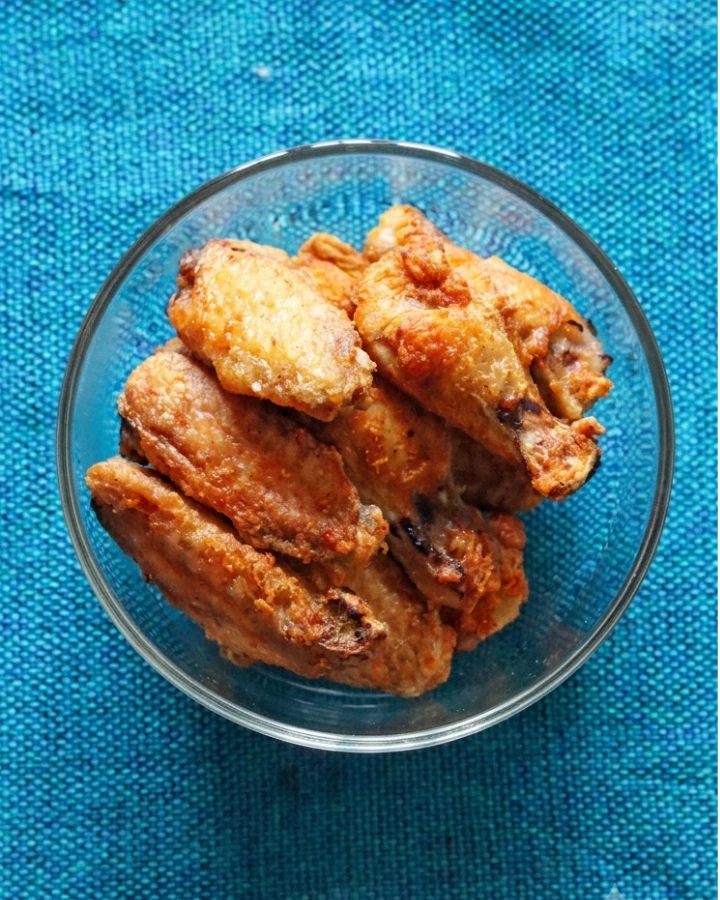
Cleaning the element is the fix, and it is a ten minute job:
- Unplug it and let it cool completely. Not warm. Cool. You are going to be putting your hand near a coil that holds heat far longer than it looks like it should.
- Turn the unit upside down or tip it back so you can see the element. On most basket models it is a coil in the roof of the chamber, above where the basket sits.
- Wipe it with a damp cloth and a little dish soap. Warm water, wrung out well. Nothing should drip into the housing.
- For baked-on patches, use a paste of bicarbonate of soda and water. Leave it a few minutes, then wipe. Do not use anything abrasive or metal on the coil.
- Wipe the roof of the chamber too, not just the coil. That is where a lot of the film sits.
- Let it dry fully, then run it empty at 350°F for five minutes with a window open, to burn off anything left.
Do that every couple of weeks if you cook greasy food, or once a month otherwise, and most smoking problems simply stop happening. Our air fryer bakeware cleaning guide covers the tins and accessories, which is a separate job from the machine itself.
Never overbake again
Get our one-page times & temps cheat sheet, plus a new tested recipe each week.
No spam · unsubscribe anytime
The water trick, and the three times it does not work
The advice everyone gives is to put a couple of tablespoons of water in the drawer under the basket. It is good advice and it works, for a reason worth understanding: water cannot get hotter than 212°F while it is still liquid, so fat that drips into it is held well below its smoke point instead of frying on bare metal.
What nobody tells you is when it will not help, and it is worth knowing before you tip water into your machine.
| Situation | Does the water trick work? |
|---|---|
| Basket model, perforated basket inside a solid drawer | Yes. This is what it is for. |
| The basket is the drawer, with no separate tray under it | No. The water sits with the food and steams it. |
| Oven-style unit with racks and a crumb tray | No. A shallow tray will spit. Line it with foil instead. |
| Smoke is coming from the element, not the drawer | No. You are treating the wrong cause. |
| You want a crisp bottom on whatever you are cooking | It works, but it costs you. You are adding steam. |
That last row is the trade nobody mentions. Water in the drawer puts moisture into the chamber, and moisture is the enemy of a crisp surface. For wings or chips you will notice. Our guide on getting things crisp in an air fryer explains why surface water pins everything at boiling point until it has gone.
A slice of bread in the drawer is the other common suggestion, and it does soak up fat. It also dries out, and a dry slice of bread sitting under a heating element for twenty minutes is its own small fire risk. I would use water.
Why aerosol cooking spray makes it worse
This one surprises people because spray feels like the sensible, controlled way to oil a basket.
Most aerosol cooking sprays contain more than oil. There is usually lecithin as an emulsifier and a propellant, and under repeated heat those additives polymerise into a sticky brown varnish that bonds to the basket coating. It does not wash off with normal cleaning. It builds up, and then it smokes, and it also degrades the non-stick surface underneath so things start sticking as well.
Several manufacturers specifically tell you not to use aerosol spray in their baskets, which is a strong hint. Use a pump mister you fill yourself with plain oil, or brush oil on with a pastry brush, or toss the food in oil in a bowl before it goes in. All three avoid the additives entirely.
If your basket already has that tacky brown film on it, bicarbonate of soda paste and a soft brush will lift most of it. Once it is gone, keep it gone by not putting the additives back.
A brand new air fryer that smokes
If the machine is new and it smokes a little on the first two or three uses, with a faint chemical smell rather than a burning food smell, that is almost always manufacturing oils and protective coatings burning off. It is normal and it stops.
Run it empty at 400°F for ten minutes with a window open before you cook anything in it. That gets it over with in one go rather than over your first few dinners. Wash the basket and any accessories first.
What is not normal is a new machine that keeps smoking past the third or fourth use, or one that smells of hot plastic rather than hot oil. That is a returns conversation, not a cleaning one.
When smoke means stop and unplug
Almost everything on this page is a nuisance rather than a hazard. These are the ones that are not, and they are worth knowing so you can tell the difference quickly.
Unplug the machine immediately if any of these happen:
- The smell is hot plastic, burning insulation or an electrical smell rather than food or oil.
- Smoke is coming from the housing or the vents at the back rather than from the cooking chamber.
- You see any flame inside, even briefly.
- The outer casing is too hot to touch, or you can see discolouration or melting.
- The unit trips your breaker or the plug feels hot.
Do not open the drawer if you think there is a flame inside. Opening it feeds the fire oxygen. Unplug at the wall, leave it shut, and let it smother.
The other one to be careful with is loose parchment paper. A sheet with no food weighing it down gets picked up by the fan and pressed against the element, where it will scorch and can catch. Only use parchment with food on top of it, never during a preheat, and use the perforated rounds rather than a solid sheet. Our guide on using foil and parchment in an air fryer covers the safe way to do it.
The ten minute fix
Clean the element
Unplugged and cool, damp cloth and soap, bicarbonate paste for baked-on patches. This alone fixes most cases.
Check your oil
Anything above 375°F wants refined avocado, grapeseed or canola. Not extra virgin olive, not butter.
Water in the drawer
Two tablespoons, basket models only, for greasy food. Skip it if you need a crisp base.
Glaze at the end
Sugar and honey burn well below your baking temperature. Add them in the last few minutes.
Bin the aerosol
Pump mister or a brush. The additives in spray varnish onto the basket and then smoke.
Do not overfill
Half fill cake tins. What goes over the rim lands on hot metal and stays there.
If the food itself is scorching as well as smoking, that is a related but separate problem and our guide on preventing burning in an air fryer covers the technique side. For everything else that goes wrong with an air fryer bake, from sunken middles to soggy bottoms, start at air fryer baking troubleshooting. And the temperatures we actually bake at, which are lower than most people expect, are collected in the air fryer baking chart.
Frequently asked questions
QWhy is my air fryer smoking?
Almost always fat or sugar landing on a surface hotter than its burning point. There are only three places it can come from: old residue baked onto the heating element from a previous cook, fat dripping into the drawer during this cook, or oil and sugar on the surface of the food going past their own smoke points. The first two have nothing to do with what you are cooking today, which is why changing the recipe usually does not help. Clean the element first, since that is the most common cause.
QWhy does my air fryer smoke when it is empty?
Because the residue causing it is not in the basket. Hot air carries fat droplets upward, and a film builds on the underside of the heating element and the roof of the chamber, where washing the basket never reaches it. Unplug the machine, let it cool completely, tip it so you can see the coil, and wipe it with a damp soapy cloth. Use a bicarbonate of soda paste on baked-on patches. If the machine is brand new, a little smoke on the first two or three uses is manufacturing oils burning off and it stops on its own.
QShould I put water in my air fryer to stop smoke?
Two tablespoons in the drawer underneath the basket, and only on models where the basket is perforated and sits inside a separate solid drawer. Water cannot exceed 212F while it stays liquid, so dripping fat is held below its smoke point instead of frying on bare metal. It does not work if the basket is the drawer, on oven-style units with a shallow crumb tray, or when the smoke is coming from the element rather than the drawer. It also adds steam, so skip it when you need a crisp base.
QWhat oil should I use in an air fryer to avoid smoke?
Refined avocado oil smokes at about 520F, grapeseed at 420F, and canola or vegetable at 400 to 450F, so any of those handle anything an air fryer does. Avoid extra virgin olive oil above 375F, virgin coconut oil above 350F and butter above about 302F. Butter is the one that catches people out, because its milk solids burn below almost every air fryer setting. Ghee has the solids removed and is fine to 485F.
QWhy does my air fryer smoke when I bake sweet things?
Sugar. Sucrose starts caramelising around 320F and turns acrid and smoky between roughly 350 and 390F, which is inside the range people bake cookies and rolls at. Honey, maple syrup and anything with invert sugar burn considerably lower, since fructose caramelises from around 230F. The usual culprit is a glaze or filling that ran off onto the hot drawer and carbonised there. Glaze in the last few minutes or after the bake, and do not overfill tins.
QIs it bad to use cooking spray in an air fryer?
Aerosol spray, yes. Most contain lecithin and propellants alongside the oil, and under repeated heat those additives polymerise into a sticky brown varnish that bonds to the basket, smokes, and degrades the non-stick coating underneath. Several manufacturers specifically warn against it. Use a pump mister you fill with plain oil, brush it on, or toss the food in oil in a bowl first. If the film is already there, bicarbonate of soda paste and a soft brush will lift most of it.
QIs air fryer smoke dangerous?
Smoke from burning food or oil is unpleasant and sets off alarms, but it is not itself an emergency. Unplug the machine immediately if the smell is hot plastic or electrical rather than food, if smoke is coming from the housing or rear vents rather than the cooking chamber, if you see any flame, if the casing is too hot to touch or discoloured, or if the plug feels hot or it trips the breaker. If you think there is a flame inside, do not open the drawer, because that feeds it oxygen. Unplug at the wall and leave it shut.
QWhy does my new air fryer smoke?
Manufacturing oils and protective coatings burning off, which is normal for the first two or three uses and comes with a faint chemical smell rather than a burnt food smell. Wash the basket and accessories, then run the machine empty at 400F for ten minutes with a window open to get it over with in one go. If it is still smoking after the third or fourth use, or the smell is hot plastic, that is a fault rather than break-in and worth returning.
QHow often should I clean my air fryer to stop it smoking?
Wipe the heating element and the roof of the chamber every couple of weeks if you cook greasy food regularly, or monthly otherwise. The basket and tray should be washed after every use, but the basket is not usually where the smoking residue is. That distinction matters: people wash the basket diligently, watch the machine keep smoking, and conclude it is broken when the film is sitting on the coil above.
QDoes parchment paper cause smoke in an air fryer?
It can, and it is one of the riskier causes. A loose sheet with nothing weighing it down gets picked up by the fan and pressed against the heating element, where it scorches and can catch. Only use parchment with food on top of it, never during a preheat with an empty basket, and use perforated rounds rather than a solid sheet so airflow is not blocked. Parchment is rated well above air fryer temperatures, so the paper itself is not the problem, contact with the element is.
QWhy does my air fryer smoke with chicken wings or burgers?
Because they render a lot of fat at a high temperature. Some spatters upward onto the element and stays there, and some drips into the drawer, pools and reaches its smoke point. Both are normal for fatty food. Put two tablespoons of water in the drawer, pause and drain it halfway through a long cook, and wipe the element afterwards rather than waiting. The batch that smokes is often the one you cook after the wings, not the wings themselves.
QWill lowering the temperature stop the smoke?
Only if the cause is oil or sugar on the food going past its burning point. If the smoke is coming from old residue on the element or fat pooling in the drawer, lowering the temperature does very little, which is why so many people try it and conclude nothing works. Use the timing of the smoke to identify the cause first. That said, many air fryer recipes are converted straight from oven temperatures and run hotter than they need to, so checking the setting is worthwhile regardless.
Did this stop the smoke?