

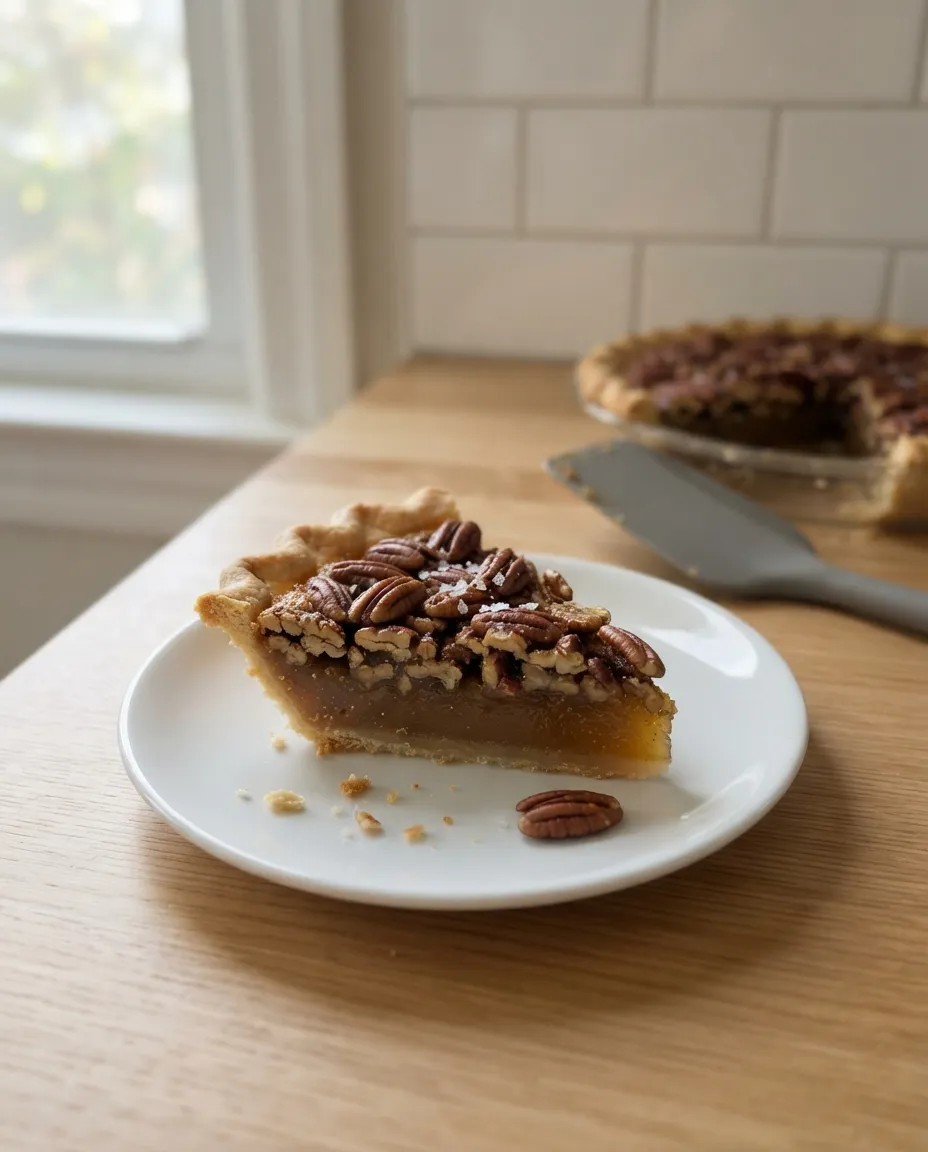
Pecan pie is the pie that loses the Thanksgiving oven war. The turkey holds the oven for hours, the sides fight over the leftovers scraps of rack space, and the pie that needs the longest, gentlest bake of anything on the menu gets whatever is left. The year I finally moved it to the air fryer, it was out of desperation, not curiosity, and the first attempt earned its keep as a warning: pecans the color of mahogany furniture by minute eighteen, a bottom crust like wet cardboard, and a center that poured.
That one ruined pie was weirdly clarifying, because it failed in every direction at once, and each failure had a different cause. The top burned because pecans are half oil and sat closest to the element. The bottom went soggy because raw dough spent forty minutes under a lake of syrup. The middle stayed liquid because I trusted a timer over a temperature. Fix those three things separately and the air fryer stops being the compromise option; it becomes the best tool in the house for this pie, and it hands the oven back to the turkey.
Quick answer: Build it in a 7 inch pan on a par-baked, egg-white-sealed shell. Pour in the filling, bake at 300°F for 20 minutes uncovered so the pecans toast, then lay a flat foil shield over the top and keep going 20 to 30 minutes more, until the center reads 200°F and the surface moves as one piece when you nudge the pan. Then the hard part: 2 hours on a rack before slicing, because a pecan pie finishes setting on the counter, not in the machine.
The three-layer problem
Most pecan pie trouble makes sense the moment you stop thinking of it as one thing baking and start thinking of it as three different materials stacked in a pan, each wanting a different bake:
Pastry below
Wants dry, direct heat, and wants it before anything wet arrives. Under a pound of syrup it cannot crisp; it can only steam. This layer's bake has to happen first, on its own.
Custard in the middle
Eggs, syrup and sugar that set into a sliceable gel at exactly 200°F and start curdling not far past it. This layer wants low, patient heat and a thermometer, not a deadline.
Pecans on top
Already full of oil, already eager to brown, parked directly under the element. They need about twenty minutes of toasting and then protection from every minute after that.
An air fryer's heat comes mostly from above, which means it addresses these three layers in exactly the wrong order: nuts first, custard second, crust barely at all. You cannot fix that with one clever temperature. You fix it with a schedule, and the schedule is the whole recipe: crust bakes alone, pecans get their twenty minutes, shield goes on, thermometer calls the end.
The jiggle, translated into a number
Every pecan pie recipe I tested against says some version of the same sentence: the center should have a slight jiggle, and it will set as it cools. All of that is true, and none of it is usable. Two bakers reading "slight jiggle" will pull two very different pies, and only one of them is getting clean slices on Thursday. The jiggle is real; it just deserves a number.
Pecan filling is a custard carrying an unusual amount of sugar, and dissolved sugar raises the temperature at which eggs set. That is why this site's custard bakes climb a ladder instead of sharing one number: the pumpkin cheesecake comes out at 170°F, the pumpkin pie at 175°F, and pecan pie, the most sugar-loaded custard in the lineup, needs 200°F at the center before its gel is actually formed. Pull it at pumpkin pie numbers and you get Thursday soup, no matter how convincing the jiggle looked.
- Probe from the top, at a slight angle, through a gap between pecans to the middle of the filling depth. The hole self-seals in a filling this thick; nobody at the table will ever find it.
- 200°F, then out. Carryover coasts the center a few degrees higher on the rack, which is exactly the margin the set needs. Chasing 210 in the machine is how fillings curdle and weep.
- The jiggle still gets a vote: at 200°F the surface moves as one piece when you nudge the pan, like set gelatin. Rippling liquid under the middle means keep going, in 4 minute rounds.
- No instant-read thermometer? This is the pie that will finally justify buying one. It costs less than the pecans.
The bottom crust: par-bake or pay
Here is the part most air fryer pecan pie recipes skip, and it is the entire second half of this page's keyword. They press raw dough into a pan, pour syrup on it, and hope. But the bottom of an air fryer basket is the weakest heat in the machine, and pecan filling is one of the wettest, densest things you can put over pastry. Weakest heat, meeting the wettest filling, through a metal pan: the dough never stands a chance. It does not bake down there. It poaches.
So the shell bakes alone first, exactly by the numbers in the blind baking guide: 15 minutes at 300°F under weights, 6 to 8 more unweighted until the floor looks matte and sandy, then a brushed film of egg white and 2 final minutes. That egg white layer reads as fussy until you watch it work; it dries into a varnish that the syrup cannot cross while the filling sets. The same par-baked foundation carries the pumpkin pie and the sweet potato pie, and it is even less optional here, because this filling is wetter, heavier and in the machine longer.
Two practical notes. Use a 7 inch metal pie pan, the honest air fryer pie format; run yours past the pan size calculator before committing dough to it. And pour the filling into the shell while the shell is still warm from its par-bake, so the bottom of the custard starts setting on contact instead of soaking in.
The pecan shield: scheduled, not panicked
The other advice the ranking recipes agree on: "if the top starts browning too fast, cover it with foil." Read that sentence again and notice what it makes you do. It posts you at the basket as a lookout, and by the time you see "too fast," the pecans on the outer ring are already past saving. A nut that sat under a top element while full of its own frying oil does not brown on a curve you can monitor; it goes from toasted to bitter while you are deciding.
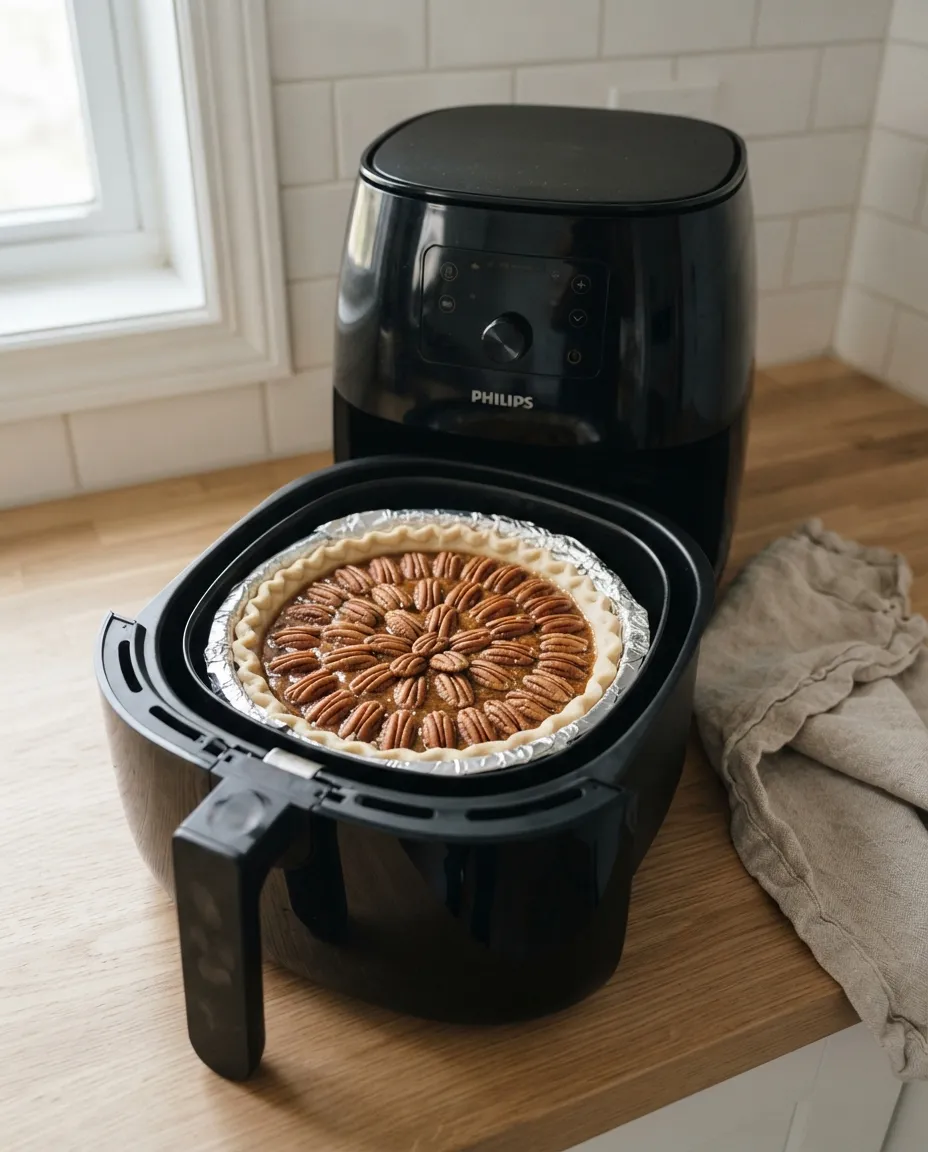
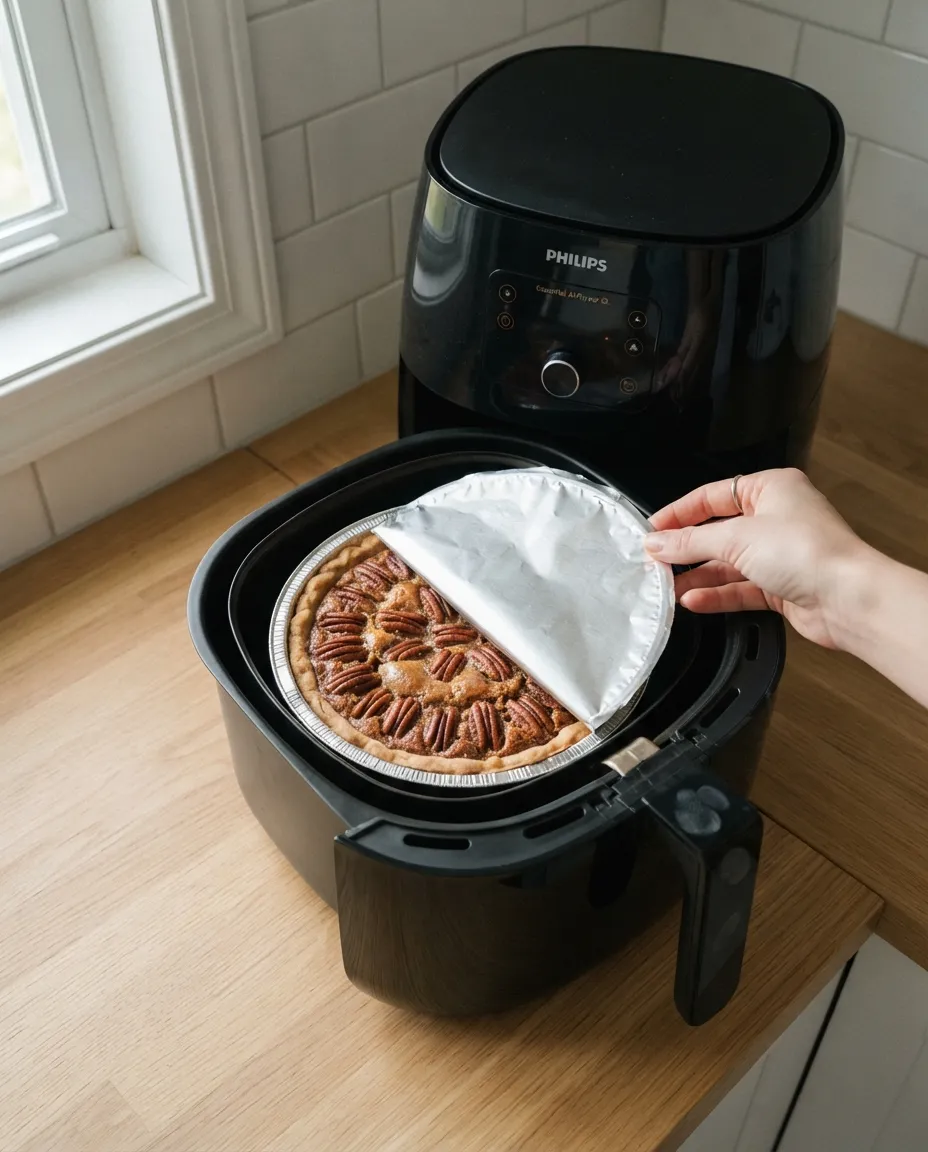
The fix is to stop treating the foil as an emergency response and put it on the schedule. At 300°F, pecans reach handsome, fragrant, deep amber at right around the 20 minute mark, in every machine I have run this in. So the recipe simply plans for it: 20 minutes naked, which is also the toasting those pecans needed anyway and the reason this recipe never pre-toasts them, then a flat disc of foil laid loosely on the pan rim for every remaining minute. Not crimped, not sealed; it is a parasol, not a lid, and the Maillard browning underneath it simply stops while the custard finishes at its own pace. The legality and physics of loose foil in a basket live in the foil and parchment guide; a foil disc resting on a full pie pan is the textbook safe case. The already-golden crust rim gets its ring of foil from minute zero, since its baking finished during the par-bake, and anything that darkens past intention is covered in the burning guide.
About the temperature: oven pecan pie bakes at 350°F, and the air fryer calculator converts that honestly to about 325°F. This recipe runs 300°F anyway, the same deliberate step below the conversion as the pumpkin pie, because the calculator translates heat faithfully but cannot know it is pointing a fan at a curdle-prone custard wearing flammable jewelry. Gentle costs ten extra minutes and buys back the whole pie. The full family of numbers lives in the air fryer baking chart.
The syrup question
Corn syrup is in pecan pie for structure, not sweetness. It is a crowd of long glucose chains that keeps the brown sugar from crystallizing back into grit and gives the gel its glassy, sliceable body. Knowing the job makes the substitutions honest:
- Dark corn syrup is this recipe's default: the added molasses reads as caramel depth against the toasted nuts. Light corn syrup works identically and lets the brown sugar's butterscotch lead instead.
- Maple syrup swaps in cup for cup and tastes wonderful, with two honest costs: the set is softer, a spoon-slice rather than a knife-slice, and the pie weeps a little by day two. Worth it for maple people; know what you bought.
- Honey works structurally but shouts over the pecans and browns faster; move the shield to minute 15.
- Skipping syrup entirely makes a different dessert, closer to a brown sugar chess pie with nuts. Sometimes that is what you wanted anyway, but this page will not pretend it slices the same.
How to make it
- Par-bake the shell: one crust round in the 7 inch pan, 15 minutes at 300°F weighted, 6 to 8 unweighted until matte, egg white brush, 2 more minutes. Keep it warm. The guide walks every minute of this.
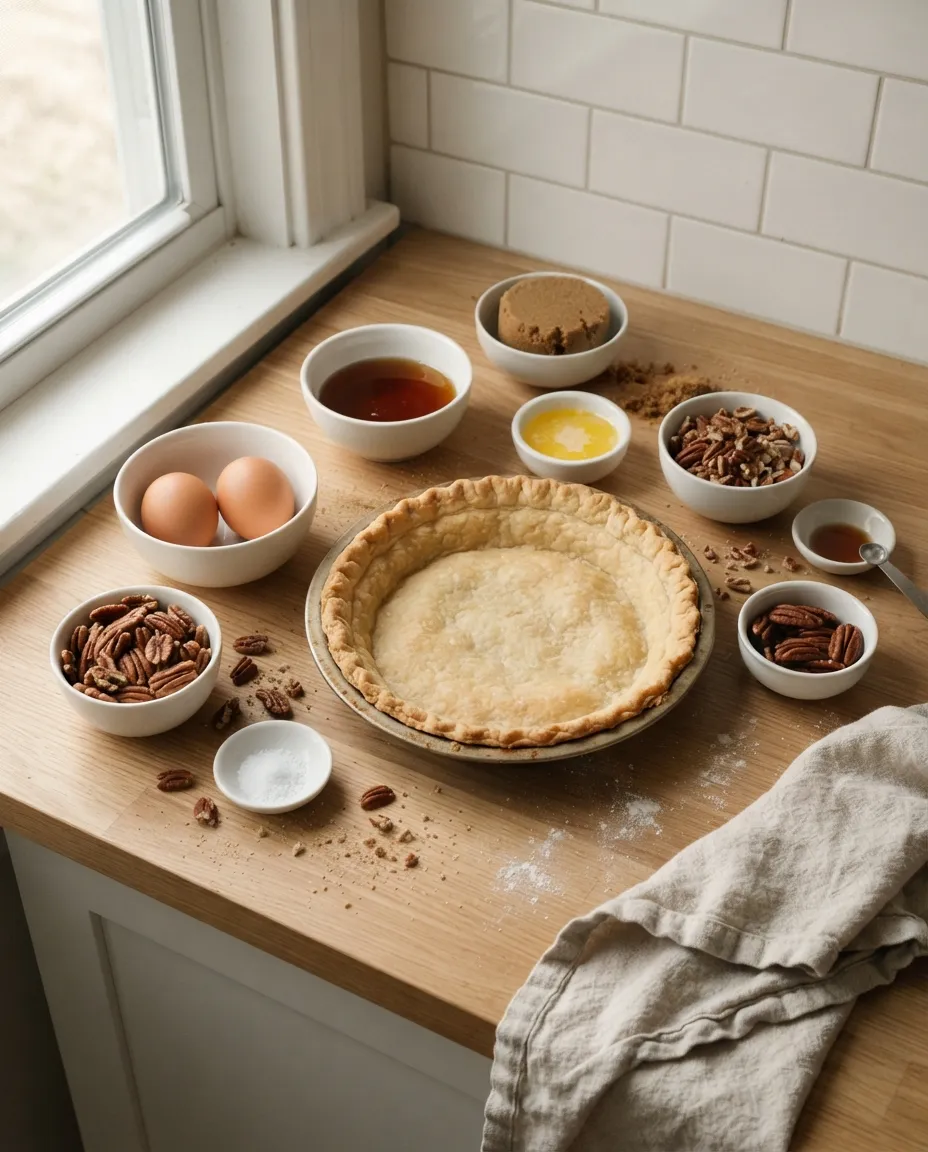
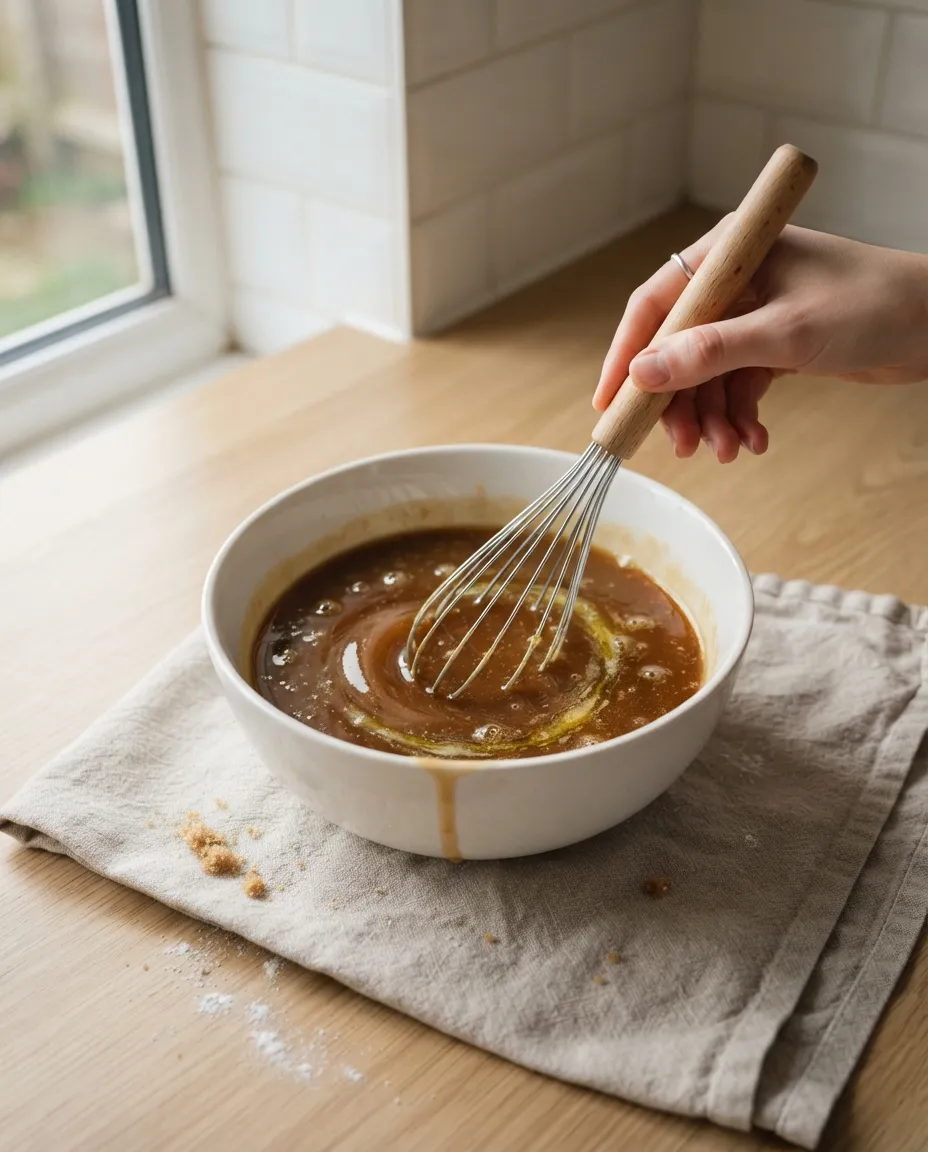
- Whisk the custard: 2 eggs, 1/2 cup dark corn syrup, 1/2 cup packed brown sugar, 3 tablespoons melted butter that has cooled until you can hold a finger in it, 1 teaspoon vanilla, 1/4 teaspoon salt. Cooled matters; hot butter scrambles the eggs it touches.
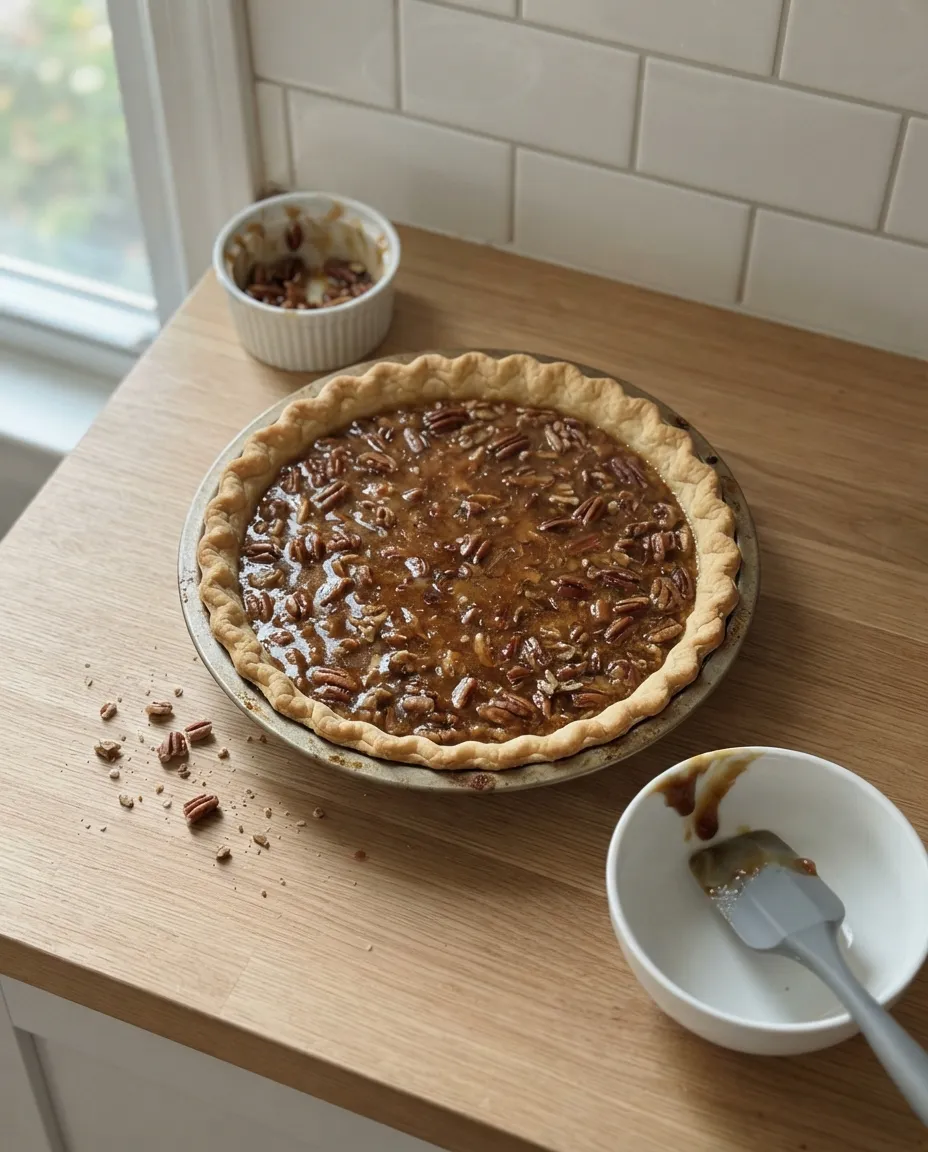
- Stir in 1 cup roughly chopped pecans, then pour into the warm shell, stopping a quarter inch below the rim. The filling puffs before it settles, and that quarter inch is the puff's room. Extra filling bakes in a ramekin beside the pie, baker's privilege.
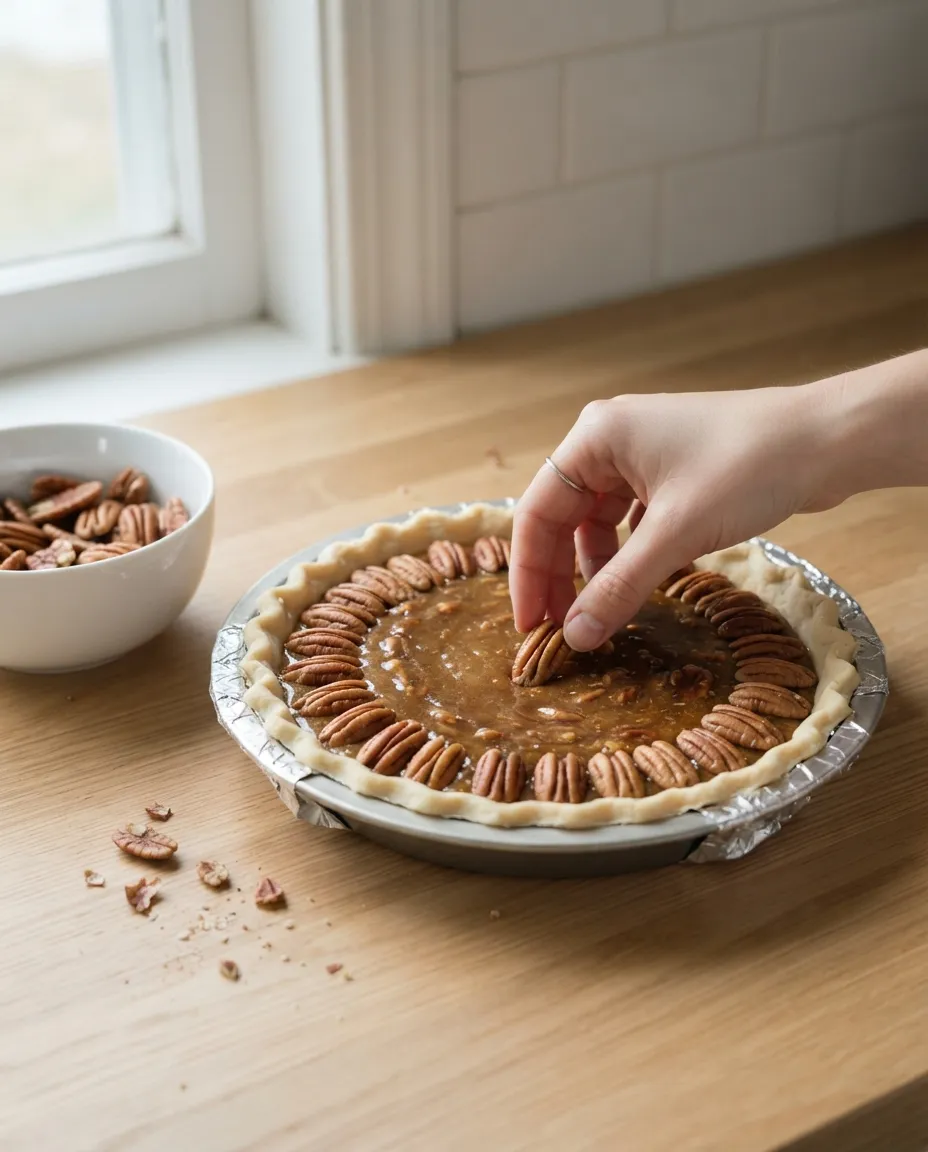
- Arrange 1/2 cup pecan halves on top in rings if you want the classic look. Yes, halves scorch in most air fryer recipes; that is a naked-bake problem, and yours are getting a shield at minute 20.
- Ring the crust rim with foil, then bake at 300°F, no preheat, 20 minutes uncovered. The machine warms gently with the pie in it, which suits a custard fine, per the preheat guide.
- Minute 20: lay the flat foil shield on, give the pan a half turn while you are in there, and continue 20 to 30 minutes.
- Pull at 200°F in the center, probed between pecans, when the surface nudges as one piece. Short of it? Back in for 4 minute rounds; the shield makes patience free.
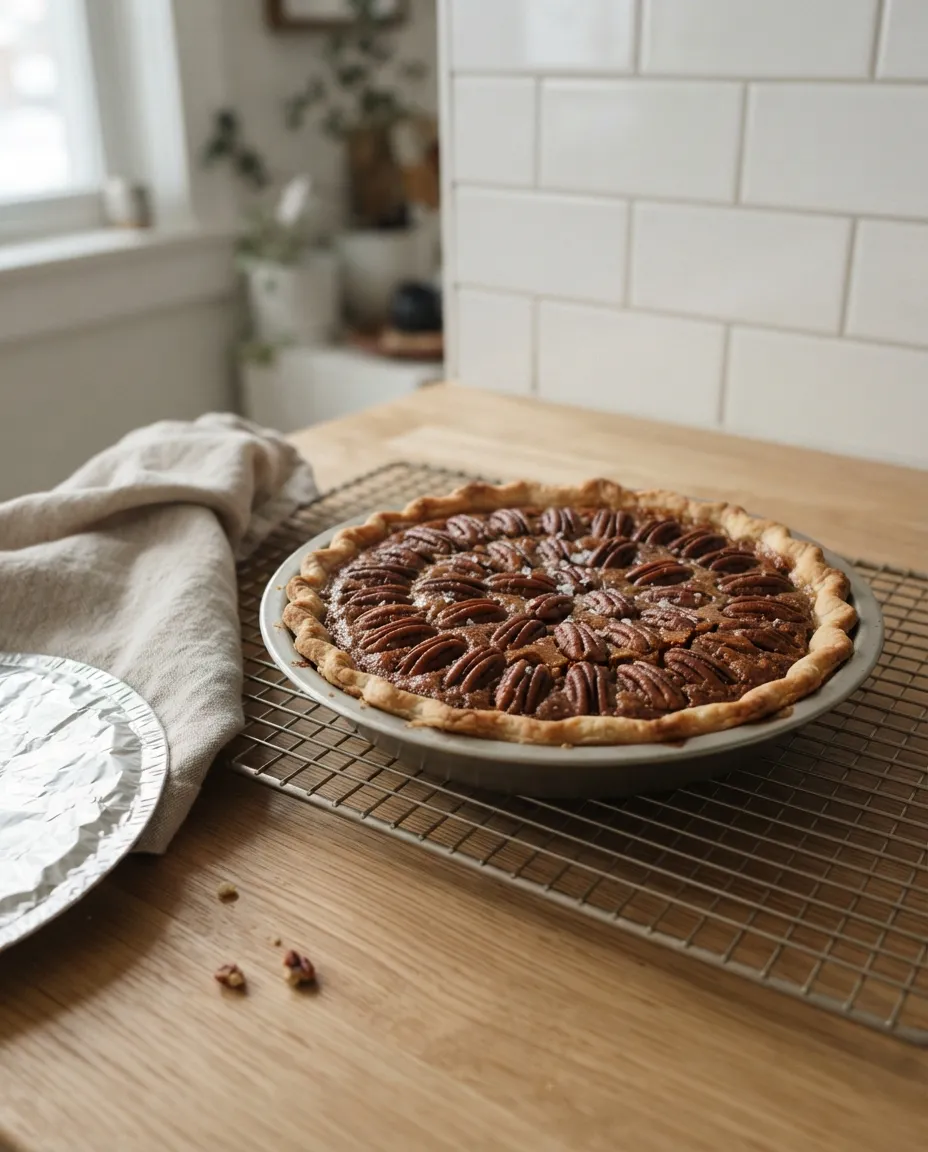
- Cool 2 full hours on a rack. Not in the pan-warmer, not in the machine, and absolutely not sliced at minute 40 no matter how it smells. The gel finishes on the counter.
Cooling is half the bake
At 200°F the custard's proteins have set, but the gel they built is hot, fragile and still full of moving syrup. Cut into it now and it flows like lava, and the internet calls the recipe a failure when the recipe was two hours from finished. As the pie cools through the low 100s, the sugars thicken and the set completes; the difference between a warm slice and a 2 hour slice is the difference between a puddle and a clean wedge with visible layers.
Which points at this pie's best-kept holiday secret: it prefers to be made a day ahead. Day two pecan pie is cleaner-slicing and deeper-tasting than day one, and an air fryer pecan pie baked Wednesday night means Thursday's machine is free for dinner rolls and the oven never hears about any of it. If you are scaling up to two pies for a crowd, the recipe scaler resizes the filling honestly, but bake the pies one at a time; they share a schedule, not a basket.
Troubleshooting
| What you got | Why | Fix |
|---|---|---|
| Runny center, even next day | Pulled by clock or jiggle guesswork; the custard never reached its set point. | 200°F at the center, probed between the pecans. The jiggle can lie; the number cannot. |
| Soggy, pale bottom crust | Raw dough spent the whole bake under syrup, over the machine's weakest heat. | Par-bake and egg-white-seal the shell, and pour the filling in while the shell is warm. |
| Bitter, blackened pecans | Naked top past minute 20, or a foil response that waited for visible trouble. | Shield on schedule at minute 20, every time, before anything looks wrong. |
| Curdled, weeping filling | Overshot well past 200°F chasing extra insurance. | Pull at the number and let carryover add the margin on the rack. |
| Filling overflowed the rim | Poured to the top; the puff had no room. | Stop a quarter inch short. The overflow bakes into cement; the ramekin bakes into a treat. |
| Crust rim burnt, center fine | The rim finished baking in the par-bake and then stood unprotected. | Foil ring on the rim from minute zero; it has nothing left to prove. |
| Greasy slick on the surface | Butter went in hot and broke the emulsion before the bake began. | Melt the butter first, then let it cool while you measure everything else. |
| One side dark, one side blond | A machine hot spot. | The half turn at shield time is already in the schedule for exactly this reason. |
Problems that follow you across recipes live in the troubleshooting guide.
Variations
- Bourbon: 1 tablespoon into the custard. It bakes down to a warmth you notice only when it is missing, which is the correct amount of bourbon for a pie.
- Chocolate chunk: a scattered handful of bittersweet chunks on the shell floor before the filling goes in. They melt into a hidden stratum that makes people quiet.
- Maple: the full swap from the syrup section above, softer set accepted and understood.
- Salted top: flaky salt the moment the pie leaves the machine, while the surface is still tacky enough to hold it. Sweetness this deep needs a counterweight.
- Bars for a crowd: the pecan bars put this filling on a press-in shortbread crust with the same toast-then-shield schedule and 200°F pull, cut into 16 squares.
- Handheld: the fold-over format at the hand pies page takes a spoonful of this filling beautifully, cooled and thickened first.
- Walnut version: works with the identical schedule, and if the sugared-nut direction is what you are actually craving, the candied walnuts get you there in a tenth of the time.
For the sake of the pie shelf's role call: this is the shelf's slow custard, finishing at 200°F under a shield. The pumpkin pie is the delicate 175°F custard, the apple pie is the fruit bake judged by bubbling rather than a probe, the cherry pie is the lattice pie baked behind the same foil rim ring, and the frozen pie page is the no-shame shortcut for the year the schedule wins. Different pies, one machine, and the oven stays out of all of it.
Storage and make-ahead
- Serving day: counter is fine, loosely covered, the way every bakery in America displays them.
- After that: refrigerator, loosely covered, 4 days. It is an egg custard under its confidence, and the fridge also firms the slice.
- A cold slice is legitimately great, chewy at the edges like pecan candy, but 60 seconds at 300°F in the machine brings back the bakery version, crust re-crisped and all.
- Freeze 2 months, whole or as wrapped slices, thawed overnight in the fridge. A November pie baked in October is a very calm way to enter the holidays.
Frequently asked questions
QHow long does pecan pie take in an air fryer?
40 to 50 minutes at 300°F for a 7 inch pie: 20 minutes uncovered while the pecans toast, then 20 to 30 more under a flat foil shield until the center reads 200°F. Add about 25 minutes up front for par-baking the shell, and 2 hours of cooling before it will slice cleanly. The bake is hands-off; the schedule does the supervising.
QWhat temperature should pecan pie be when it's done?
200°F on an instant-read thermometer at the center of the filling, probed at an angle through a gap in the pecans. Pecan filling carries so much sugar that it sets a full 25 degrees above the 175°F that finishes a pumpkin pie. At 200°F the surface should also move as a single piece when you nudge the pan, and carryover on the rack completes the set.
QWhy is my pecan pie runny in the middle?
It was pulled before the custard reached its set point, almost always because a timer or a vague jiggle made the call. The fix is baking to 200°F in the center rather than to a number of minutes. A second, sneakier cause: slicing warm. The gel does not finish until the pie has cooled about 2 hours, so a pie cut at minute 40 pours even when it was baked perfectly.
QHow do you keep the bottom crust from getting soggy?
Bake the crust before the filling ever meets it: 15 minutes weighted at 300°F, 6 to 8 unweighted, then an egg white brush and 2 more minutes to varnish the floor against the syrup. Pour the filling into the shell while it is still warm. Raw dough under pecan filling cannot crisp in an air fryer, because the basket's bottom heat is the machine's weakest and the filling is the machine's wettest job.
QWhy did my pecans burn on top?
Pecans are roughly seventy percent oil and sit closest to an air fryer's top element, so they toast beautifully for about 20 minutes at 300°F and then head for bitter fast. Recipes that say to add foil "if it browns too fast" have you reacting after the damage starts. Put the shield on the schedule instead: a flat foil disc on the pan rim at minute 20, no exceptions, and pecan halves on top survive in full glory.
QDo you need corn syrup for pecan pie?
You need what corn syrup does: an anti-crystallizer that keeps the sugar glassy and gives the filling its sliceable body. Maple syrup swaps cup for cup with a softer, spoonable set and a little weeping by day two. Honey works but dominates the flavor and browns faster, so shield at minute 15. Skip syrup entirely and you have a brown sugar chess pie with nuts, pleasant but a different dessert.
QCan I use a store-bought frozen crust?
Yes, with two checks. Most frozen crusts come in 9 inch foil pans that miss most baskets, so either buy the small ones or re-press the thawed dough into your own 7 inch pan, and confirm the fit before filling it. Then par-bake it exactly like homemade; frozen dough is still raw dough, and raw dough under syrup poaches. A fully frozen filled pie is a different project, covered on the frozen pie page.
QDoes pecan pie need to be refrigerated?
On serving day, the counter is fine under a loose cover. Beyond that, refrigerate it: the filling is an egg custard, and food safety guidance treats it like one regardless of how bakeries display theirs. The fridge costs you nothing anyway, since a cold slice is excellent and 60 seconds at 300°F in the air fryer restores the warm-bakery version whenever you want it.
QCan I make pecan pie the day before Thanksgiving?
You should, not just can. The set is firmer, the slices are cleaner and the flavor is deeper on day two, and baking it Wednesday evening in the air fryer keeps Thursday's machine free for rolls while the oven deals with the turkey. Cool it the full 2 hours, cover loosely, refrigerate overnight, and bring it toward room temperature during dinner.
Never overbake again
Get our one-page times & temps cheat sheet, plus a new tested recipe each week.
No spam · unsubscribe anytime