

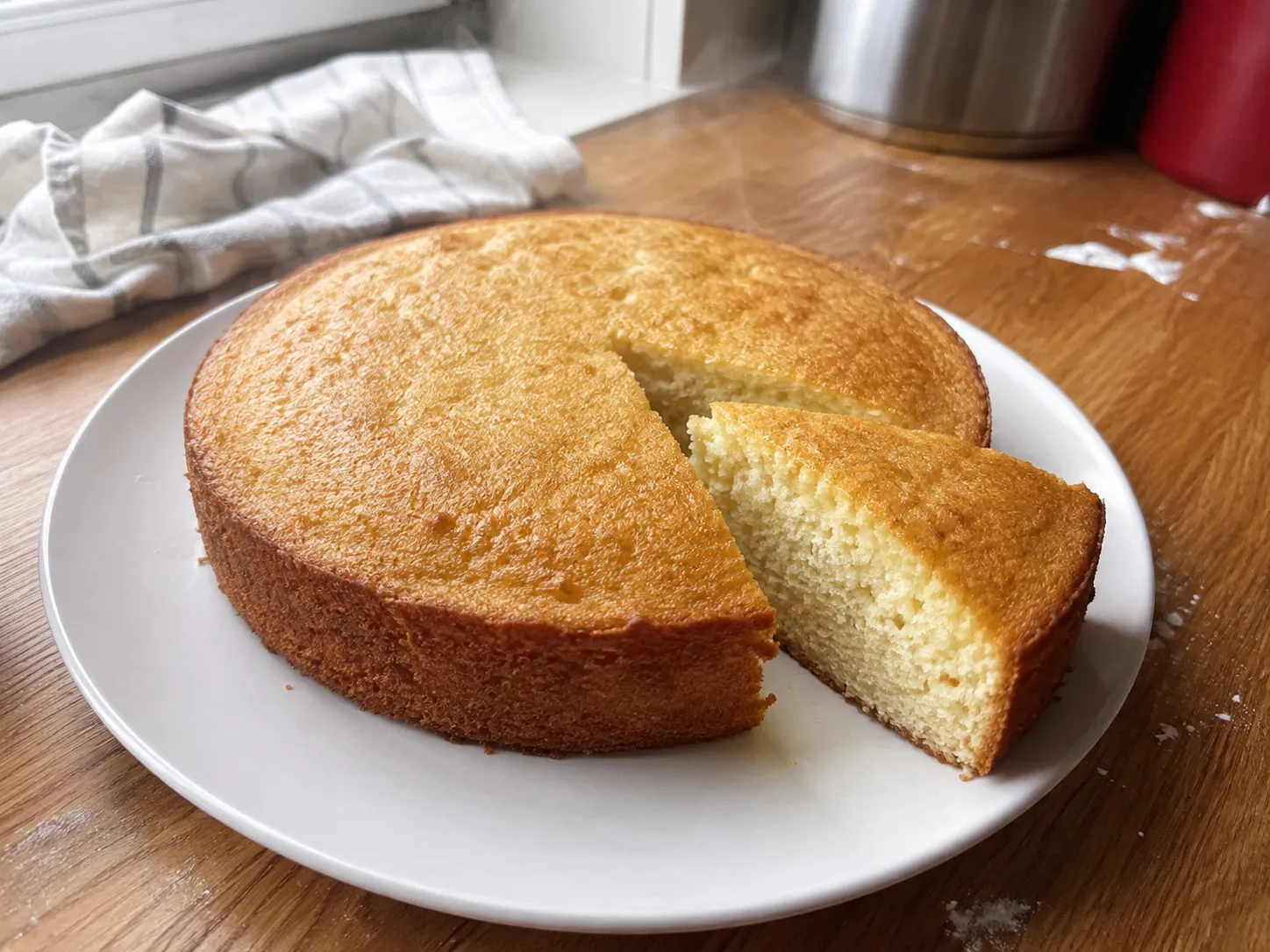
I put off writing this one for a long time. Carrot cake, banana bread and brownies all forgive an air fryer a great deal, because they are dark, wet and heavily flavored. A plain vanilla cake forgives nothing. If the top browned too fast you can see it. If the crumb dried out you can taste it immediately. If it sank there is no frosting thick enough to pretend otherwise.
Which also makes it the recipe worth getting right, because once a vanilla cake works in your basket, everything else will.
Quick answer: Bake in a 6-inch round tin, filled half full, at 320°F (160°C). Tent foil over the tin for the first 22 minutes, then uncover for another 8 to 12. Pull the cake when the center reads 200 to 205°F, not when a skewer looks clean. Cool in the tin for 15 minutes before turning out.
Why vanilla is the hard one
Every problem an air fryer has with cake shows up worst here, and it is worth naming them because the method below is built around all three.
Nothing hides the color
A chocolate cake is already dark. A vanilla cake that browned too hard looks scorched, because you can see exactly how far past golden it went.
Nothing holds the moisture
Banana, carrot and zucchini all bring water and sugar that keep a crumb soft. Vanilla brings none. It is flour, sugar, fat and egg, and it dries out fast.
Nothing masks the texture
No chips, no fruit, no spice. A dense or rubbery crumb is the whole eating experience rather than a background detail.
Look at what is currently published for this recipe and the numbers are all over the place: 320°F to 375°F, and anywhere from 25 to 50 minutes, in pans from 5 to 7 inches. Those are not all describing the same cake. What almost none of them give you is the one measurement that actually decides whether it works.
The two techniques that do most of the work
If you take nothing else, take these. Everything else in the recipe is ordinary cake making.
Tent the top for the first two thirds
In a basket the heating element sits two to four inches above the tin and the fan drives air straight down onto the batter. The surface of a vanilla cake can set into a firm crust within the first six or seven minutes, long before the middle has any structure. After that you are baking under a lid: the top browns while the center struggles, and when it cools the unsupported crust falls into the hollow.
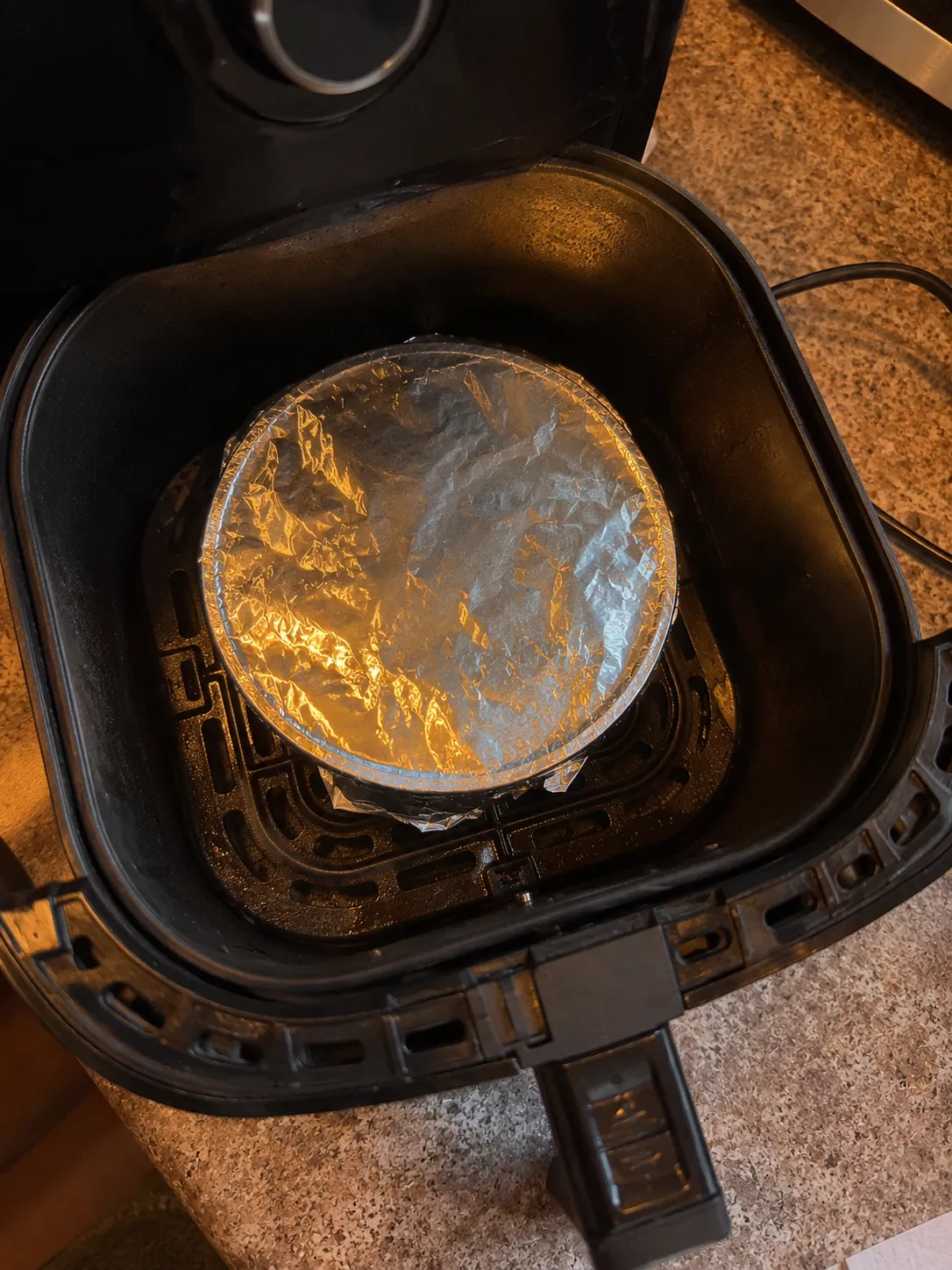
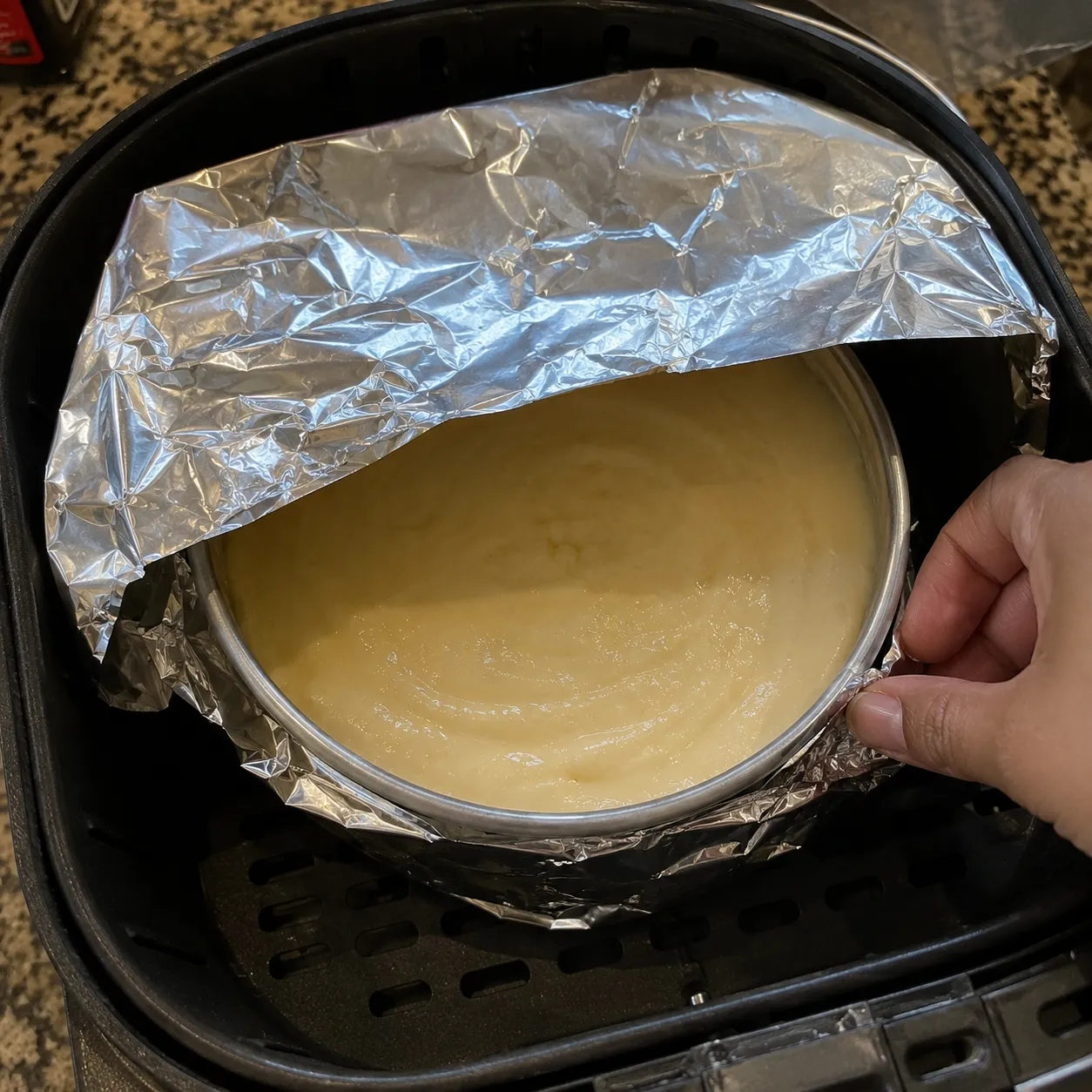
A loose sheet of foil over the tin blocks that direct radiant heat. The sides and base keep cooking, the middle catches up, and you take the foil off at the end to get the color back. This one change is the difference between a cake that domes and cracks and one that rises flat.
Tuck the foil under the rim of the tin. An air fryer fan will lift a loose sheet into the heating element, which is a real hazard rather than a theoretical one. Our guide on using foil and parchment in an air fryer covers the safe way to do it.
Bake to 200°F, not to the clock
A cake is done when the starch has finished gelatinizing, which happens at 200 to 205°F in the center. Below about 195°F it has not set and the cake will sink as it cools, no matter how clean your skewer came out.
The skewer test is where people get caught. It tells you the crumb immediately around the skewer has stopped sticking, and in an air fryer the outer part of the cake runs well ahead of the middle, so a clean skewer and an underbaked center happen together far more often than they should. An instant-read thermometer costs very little and turns this from a judgement call into a reading. Push it in at an angle so you are measuring the middle of the depth rather than the base of the tin.
If your cake has sunk before, that is almost certainly what happened, and why your air fryer cake sinks in the middle goes through the mechanism in full.
Getting the vanilla to survive the bake
Here is something specific to this cake that I have not seen anyone mention, and it explains why an air fryer vanilla cake can taste oddly flat even when the texture is perfect.
The compounds that make vanilla smell like vanilla are volatile, and extract carries them in alcohol which evaporates readily. A fast-moving stream of hot air over the surface of a batter is very good at carrying volatiles away. You lose some of that aroma in any oven, but an air fryer takes more of it, and in a cake where vanilla is the entire flavor you notice.
Three things that help, in order of how much difference they make:
- Use more than you think. A tablespoon in a 6-inch cake is not excessive here. It is compensating for what the airflow removes.
- Use vanilla bean paste if you have it. Less alcohol to carry the aroma off, and the seeds stay put regardless.
- Add some after the bake. Half a teaspoon in the frosting, or brushed on as a thin vanilla syrup while the cake is warm, puts back what the heat took. This is the one that works best.
Ingredients
For the cake
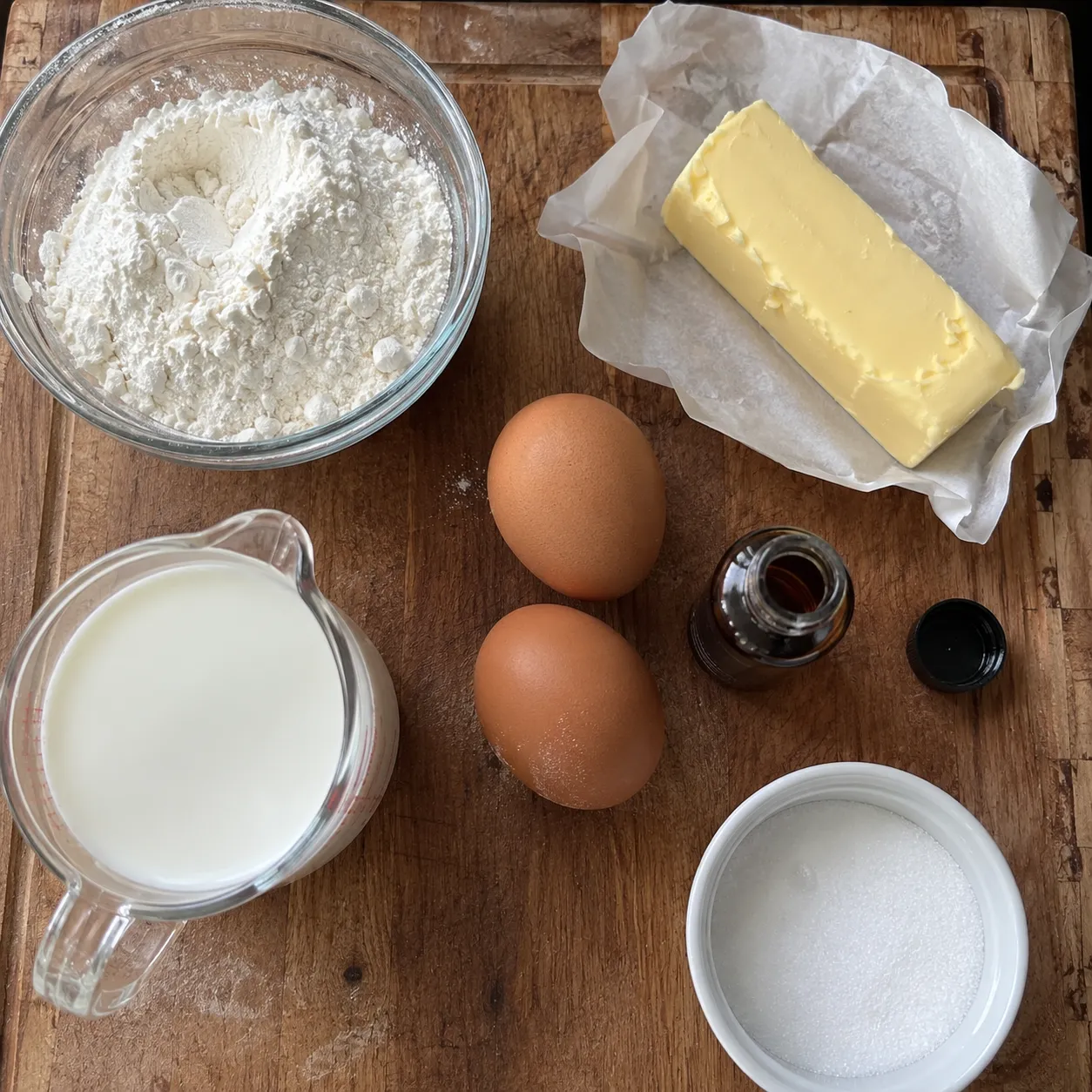
- 1 cup (125g) all-purpose flour
- ⅔ cup (133g) granulated sugar
- 1¼ teaspoons baking powder
- ¼ teaspoon salt
- 6 tablespoons (85g) unsalted butter, softened
- 2 large eggs, room temperature
- ¼ cup (60ml) whole milk, room temperature
- 1 tablespoon vanilla extract or bean paste
Room temperature eggs and milk are not optional here. Cold eggs hitting creamed butter make the fat seize into specks, and that broken emulsion never fully recovers. You lose the air you creamed in and the crumb comes out coarse. Sit them in warm water for five minutes if you forgot.
Softened butter means it dents under a finger, not that it is glossy or melting. Butter too soft to hold air will not cream properly, and creaming is where most of this cake's lift comes from.
A tablespoon of vanilla looks like a lot. It is deliberate, for the reason above. If you are using a good bean paste you can drop to two teaspoons.
How to make air fryer vanilla cake
- Line a 6-inch round tin with a parchment circle in the base and a collar up the sides, leaving a little above the rim to lift by.
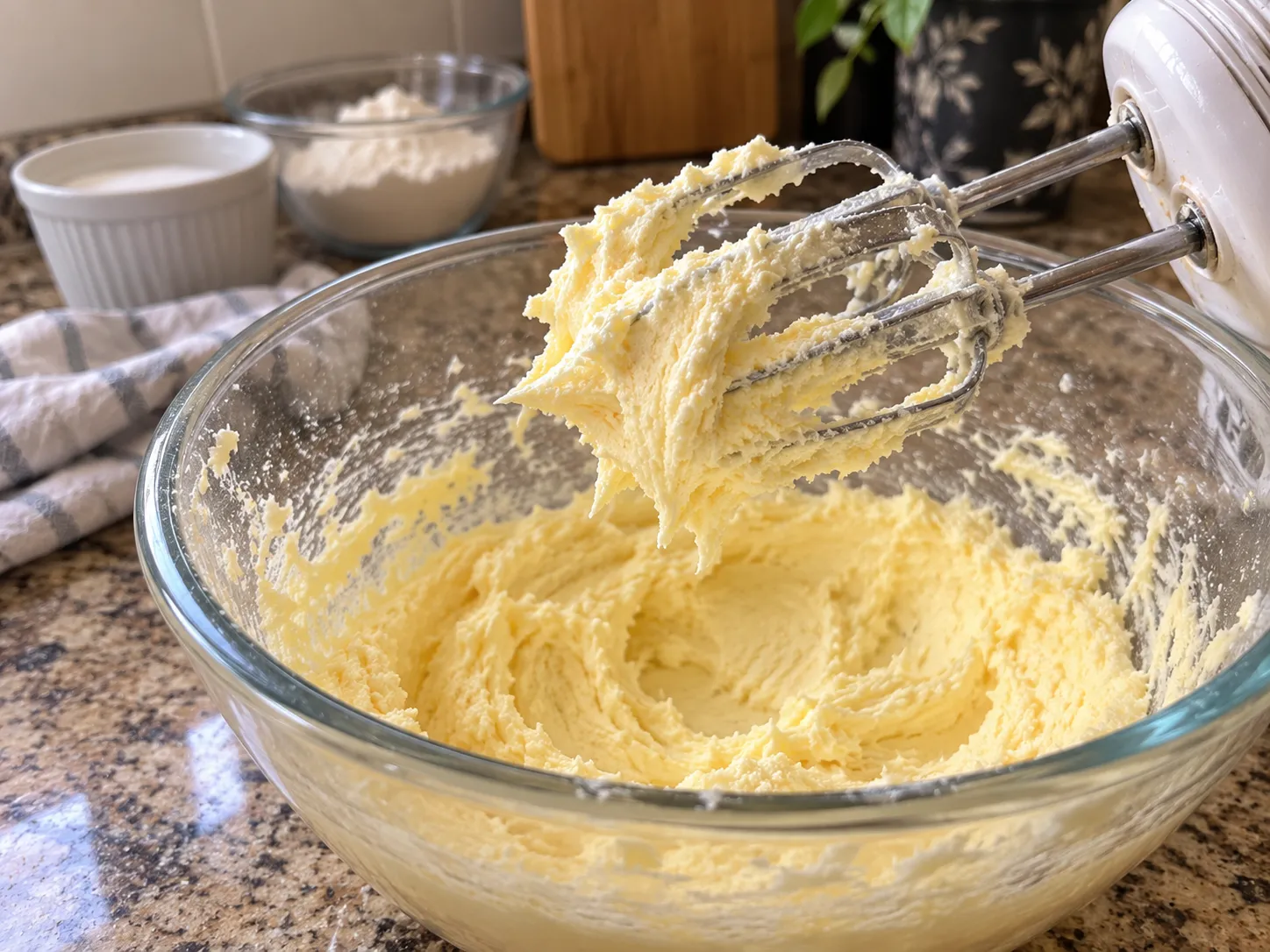
- Cream the butter and sugar for 3 minutes until noticeably paler and lighter. This is the only aeration the cake gets, so give it the full time.
- Beat in the eggs one at a time, waiting until the first is fully incorporated before the second. If it looks like it is splitting, add a spoonful of the flour.
- Beat in the vanilla.
- Whisk the flour, baking powder and salt together, then add in two additions alternating with the milk, folding rather than beating.
- Stop as soon as the last streak of flour disappears. A slightly imperfect batter bakes a better cake than a smooth one, because beating flour builds gluten and gluten makes a tough crumb.
- Scrape into the tin and level the top. It should come no higher than halfway. Tap the tin on the counter twice.
- Preheat the air fryer to 320°F for 3 minutes. A batter that sits in a cold basket separates before it sets.
- Tent foil loosely over the tin, tucked under the rim, and bake at 320°F for 22 minutes.
- Remove the foil and bake another 8 to 12 minutes, until the center reads 200 to 205°F and the top is evenly golden. Start checking at 8.
- Cool in the tin for 15 minutes, then lift out by the parchment onto a rack to cool completely before frosting.
Even rise, and why cakes dome
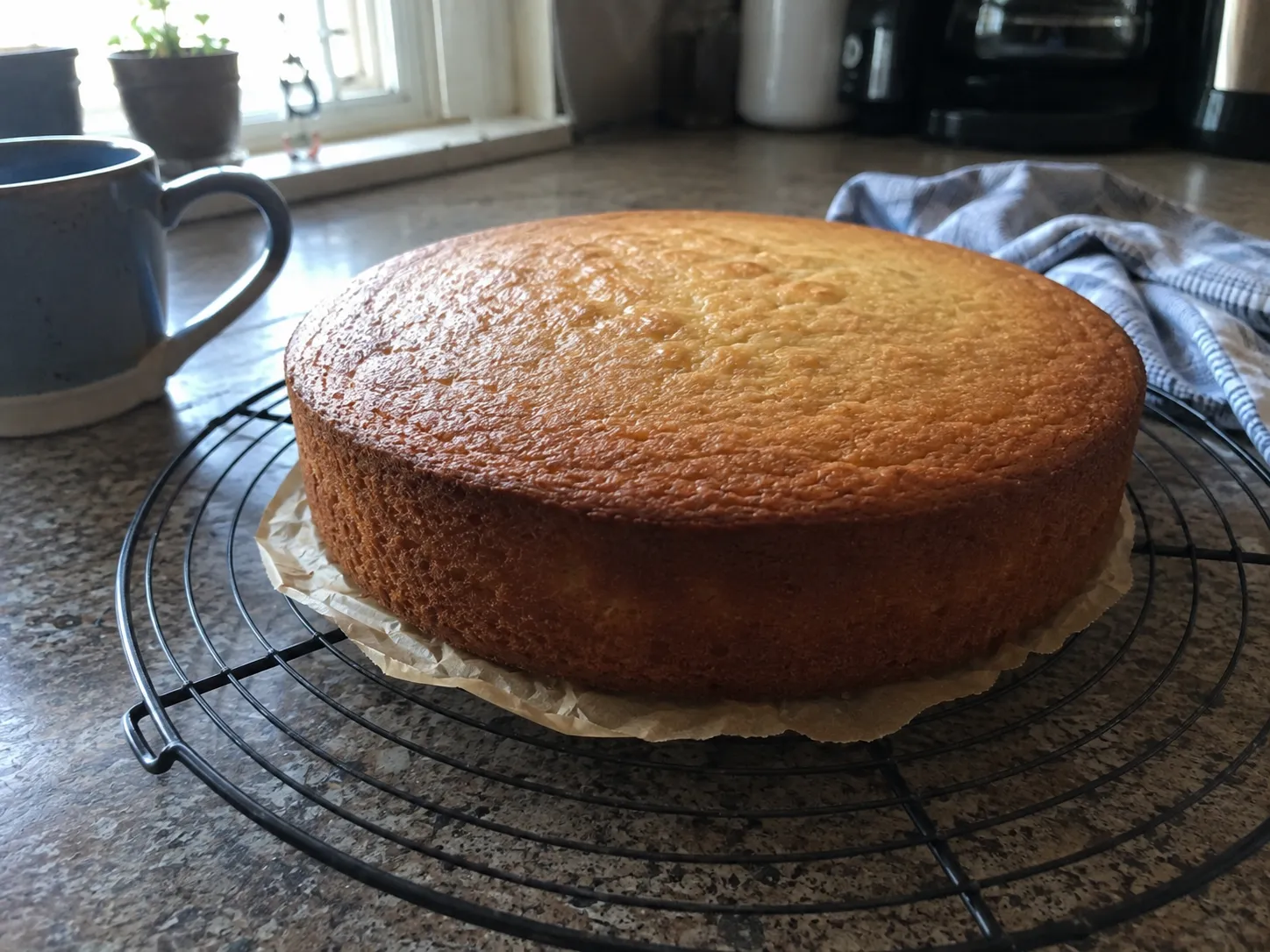
A domed cake is not a decorating problem, it is a heat problem. The batter closest to the tin wall sets first, so as the middle keeps expanding the only direction left is up. The steeper the temperature difference between edge and center, the higher the dome, and past a certain point the set crust splits and you get the crack.
| What you see | What caused it | Fix |
|---|---|---|
| Flat, even top | Edges and center set close together | Nothing. This is the target. |
| Gentle dome | Slightly hot, normal in most ovens | Acceptable. Level it if layering. |
| Tall dome, pale sides | Too hot, edges racing ahead | Drop to 310°F, tent for longer |
| Dome with a split across it | Crust set hard, batter tore through | Tent from the start, drop 15°F |
| Sunken middle | Pulled before the center set | Bake to 200°F internal |
| Higher on one side | Hot spot, or tin off center | Center the tin, rotate at 22 min |
Two things beyond the foil help with an even rise. A light-colored or silicone tin insulates rather than conducting, which slows the edges and lets the center catch up, at the cost of about 10°F and a few minutes. Dark metal does the opposite and is the worst choice for this cake. And filling only halfway keeps the risen top away from the element in the first place.
Soft crumb, and the three things that ruin it
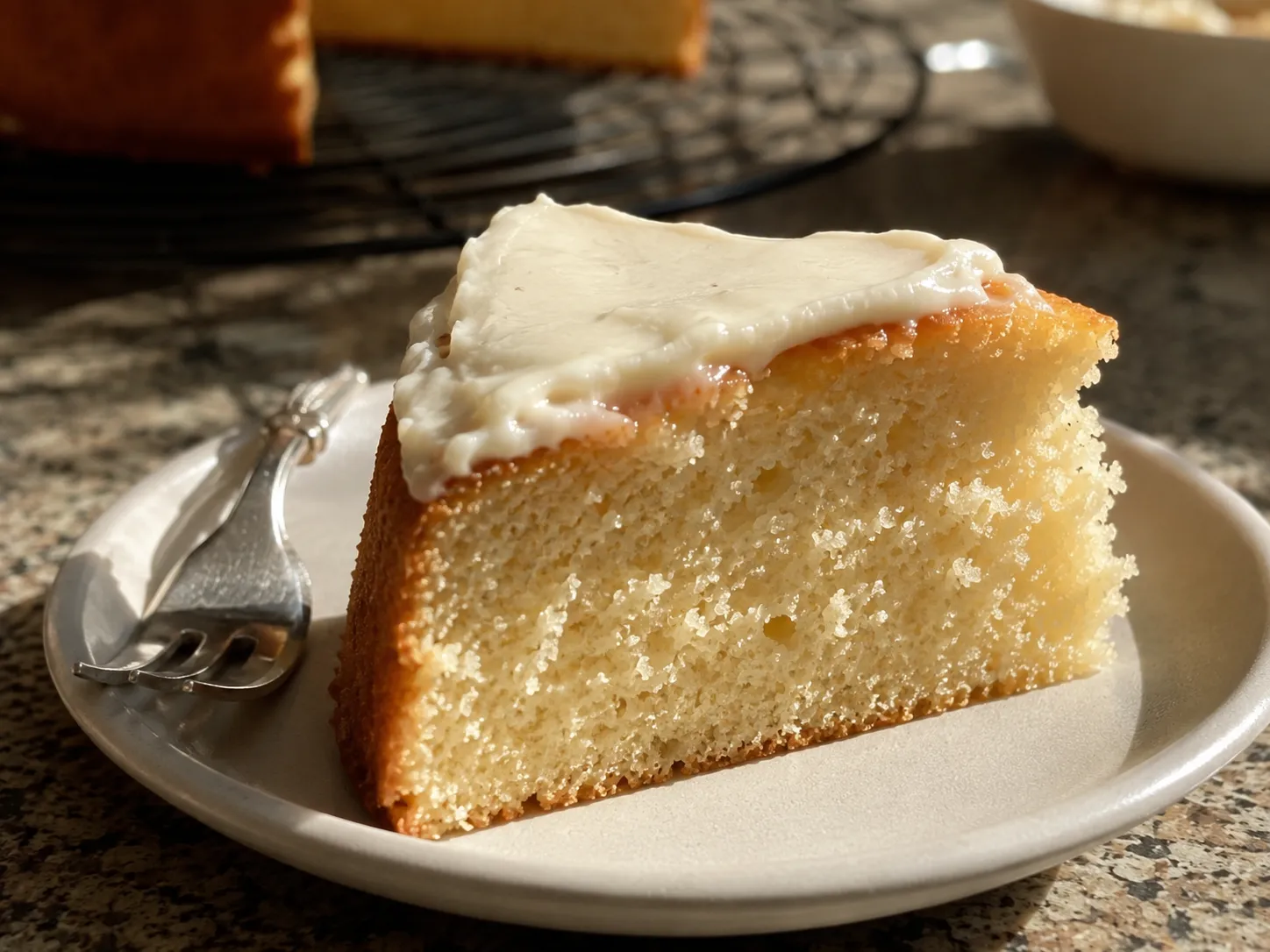
Texture in a plain cake comes down to how much gluten you developed, how much air you kept, and how long it stayed in the heat. In that order.
Overmixing after the flour
Beating flour into a wet batter develops gluten, and gluten in a cake gives you a tough, slightly chewy crumb that also traps gas and then collapses. Fold, do not beat, and stop at the last streak. This is the single most common cause of a disappointing plain cake.
Undercreaming at the start
The opposite mistake. Creaming butter and sugar is not just mixing: sugar crystals cut air pockets into the fat, and those pockets are where the raising agent's gas ends up. Rush it and you get a dense cake no amount of baking powder will save. Three minutes, until it visibly pales.
Two minutes too long in the basket
A small cake in a machine with fast-moving air dries quickly once it is past done. The window between 200°F and dry is narrower than in an oven, which is exactly why the thermometer matters. Our guide on avoiding dry air fryer bakes covers why the airflow makes this worse than you would expect.
Pan size and fill level
This recipe makes about two cups of batter, which half fills a 6-inch round tin. That is deliberate, and both halves of it matter.
Half full, not two thirds. Two thirds is the standard oven advice, and in an oven it is fine. In a basket the element is only a few inches above the tin, so an overfilled cake brings its own risen top straight into the strongest heat and sets a crust early. Deeper batter also takes far longer for heat to reach the middle, since conduction time rises with roughly the square of the depth.
| Tin | This recipe | 320°F takes |
|---|---|---|
| 6 in round (recommended) | Half full, as written | 30 to 34 min |
| 7 in round | Shallower, slightly wider | 24 to 28 min |
| 6 in square | Slightly shallower | 28 to 32 min |
| Two 4 in tins | Half each, bake together | 18 to 22 min |
| Silicone cups | Makes about 8 | 13 to 16 min |
If you are not sure what your basket takes, our pan size calculator works out the largest tin that still leaves an airflow gap and how much batter it holds at a sensible fill. To bake this in a different tin, the recipe scaler does the quantities, including how to handle part of an egg.
Bringing your own vanilla cake recipe across from an oven? Run its temperature and time through our air fryer calculator first. It applies a deeper cut for cakes than the flat 25°F rule, precisely because of the crust problem above. Then check the pan separately, because moving from a 9-inch oven tin to a 6-inch basket tin makes the batter much deeper and that needs longer again at a lower temperature. Those are two different corrections and most people only make one.
Never overbake again
Get our one-page times & temps cheat sheet, plus a new tested recipe each week.
No spam · unsubscribe anytime
Fixing what goes wrong
The middle sank
Pulled before the center set. Bake to 200°F internal rather than to a clean skewer. If the cake looked tall in the basket and dropped on the rack, that is the confirmation: it was being held up by hot gas rather than structure.
The top is dark but the middle is wet
Not tented, or tented too late. Foil over the tin from the start, tucked under the rim, and drop to 310°F. The top is only browning that fast because it is a few inches from the element.
It came out dense and heavy
Either undercreamed at the start or overmixed at the end. Three full minutes of creaming until the mixture pales, then fold the flour in and stop at the last streak. Tired baking powder is the third suspect, since it loses strength around six months after opening.
The crumb is dry
Overbaked, usually by only a few minutes. A plain cake has no fruit or vegetable holding water, so it has less margin than a banana bread. Check from 28 minutes and pull at 200°F.
It tastes of not very much
The vanilla went up the vent. Use a full tablespoon, and brush the warm cake with a thin vanilla syrup or add half a teaspoon to the frosting. See the section above.
It stuck to the tin
Parchment circle in the base and a collar up the sides, every time. Greasing alone is not enough for a sugar-heavy batter that caramelizes against the wall.
Frosting and variations
- Vanilla buttercream: 1 cup (225g) butter, 3 cups (360g) icing sugar, 2 tablespoons milk, 1 teaspoon vanilla. Enough to cover this cake generously.
- Cream cheese frosting: lighter and less sweet, and it suits a plain crumb better than buttercream does in my opinion.
- Vanilla syrup: 2 tablespoons sugar dissolved in 2 tablespoons hot water with a teaspoon of vanilla, brushed over the warm cake. The single best thing you can do for flavor.
- Sprinkles: fold 3 tablespoons into the finished batter for a funfetti version. Use jimmies rather than nonpareils, which bleed.
- Lemon: beat the zest of one lemon in with the butter and sugar so the oils get into the fat.
- Layered: bake two 4-inch cakes side by side and stack them. Easier than splitting one 6-inch cake horizontally.
If you want the same method with more forgiveness built in, our air fryer carrot cake and air fryer banana bread both carry enough moisture to hide small timing errors, and air fryer lava cake is the one bake where an underdone center is the point.
Storage
- Room temperature: 3 days in an airtight container, unfrosted or with buttercream. A plain cake stales faster than a fruit-based one.
- Refrigerated: up to 5 days if frosted with cream cheese. Bring back to room temperature before serving, because cold butter in the crumb reads as dry.
- Frozen: 3 months, unfrosted and well wrapped. Thaw in the wrapping so the condensation forms on the outside rather than the cake.
- Reviving a day-old slice: 90 seconds at 300°F. Do not go hotter, since a small slice dries out fast.
For everything else the machine can and cannot do, how to bake in an air fryer covers the method end to end, and the air fryer baking chart collects every temperature and internal target on the site in one place.
Frequently asked questions
QWhat temperature do you bake a vanilla cake in an air fryer?
320F (160C) in a 6-inch round tin, tented with foil for the first 22 minutes and then uncovered for another 8 to 12. That is lower than several published recipes, which run as high as 375F, and the reason is that the heating element sits only a few inches above the tin. A high setting browns and sets the top long before the middle cooks, which is what gives you a domed, cracked cake with a wet center.
QHow do I know when an air fryer cake is done?
The center should read 200 to 205F on an instant-read thermometer, pushed in at an angle so you are measuring the middle of the depth rather than the base of the tin. That is when the starch has finished setting. A skewer is unreliable here, because it only tells you the crumb immediately around it has stopped sticking, and in an air fryer the outside runs well ahead of the middle, so a clean skewer and an underbaked center often happen together.
QWhy do I need to cover the cake with foil?
Because the element is two to four inches above the tin and the fan drives air straight onto the batter, so the surface can set into a firm crust within six or seven minutes. After that the top browns while the center struggles, and the unsupported crust falls in as it cools. Foil blocks that direct radiant heat while the sides and base keep cooking. Tuck it under the rim so the fan cannot lift it into the element.
QWhy does my air fryer vanilla cake taste bland?
The vanilla went up the vent. Vanilla's aroma compounds are volatile and extract carries them in alcohol, and a fast stream of hot air over the batter surface is very effective at carrying them away. Use a full tablespoon in a 6-inch cake rather than the teaspoon most recipes call for, use bean paste if you have it, and put some back afterwards by brushing the warm cake with a thin vanilla syrup or adding half a teaspoon to the frosting.
QWhat size pan should I use?
A 6-inch round, filled half full. This recipe makes about two cups of batter, which is exactly that. A 7-inch works and bakes faster at 24 to 28 minutes because the batter is shallower. Do not use anything bigger than your basket allows with a half inch airflow gap all round, and do not fill past halfway, because a risen top in a basket ends up very close to the element.
QWhy did my cake dome and crack on top?
The edges set before the center, so the only direction left for the middle to expand was upward, and past a point the set crust split. It means the temperature is too high for the position of the element. Drop to 310F, tent the foil from the start, and use a light colored or silicone tin rather than dark metal, which absorbs radiant heat and races the edges ahead.
QCan I make this eggless?
You can, but it becomes a different cake. Egg provides both structure and lift here, and there is nothing else in a plain vanilla batter to take over. Replacing two eggs with 1/2 cup of yogurt plus an extra 1/4 teaspoon of baking powder works, giving a denser, more tender crumb closer to a sponge than a butter cake. Add a couple of minutes and still bake to 200F internal.
QDo I need to preheat the air fryer?
Yes, three minutes at 320F. A wet batter sitting in a basket that is slowly warming up gives the butter time to melt and separate before any structure sets, and you get a greasy layer at the base. Frozen food does better from a cold start but a fresh batter does not.
QWhy is my cake dense instead of light?
Either the butter and sugar were not creamed long enough or the flour was beaten in rather than folded. Creaming for a full three minutes cuts air pockets into the fat, and those pockets are where the raising agent's gas ends up, so rushing it costs you most of the lift. Overmixing after the flour goes in develops gluten, which makes a tough crumb that traps gas and then collapses. Check the baking powder date too.
QCan I bake this in silicone cups instead?
Yes, and it is the easiest version. The batter makes about eight cupcake-sized portions, which bake in 13 to 16 minutes at 320F. Shallow individual portions almost never sink, because the middle is never far from the heat, and you can skip the foil. Silicone insulates, so if anything drop about 10F. Bake in batches with space between the cups rather than crowding them.
QHow long does it keep?
Three days at room temperature in an airtight container, or five refrigerated if it has cream cheese frosting. A plain vanilla cake stales faster than a banana or carrot cake because it has no fruit holding water in the crumb. It freezes well for three months unfrosted, and a day-old slice comes back nicely with 90 seconds at 300F.
QCan I double the recipe?
Not into one tin. Doubling makes about four cups of batter, and pouring that into a taller tin gives you deep batter with the element right above it, which is the worst possible combination in a basket. Bake two 6-inch cakes one after the other, or use two 4-inch tins side by side if they fit. If you do go to a bigger tin, drop to 310F and expect to add a good deal of time.
Made this? Rate the recipe