
Air Fryer Pop Tarts: Homemade or Boxed, Here's the Timing
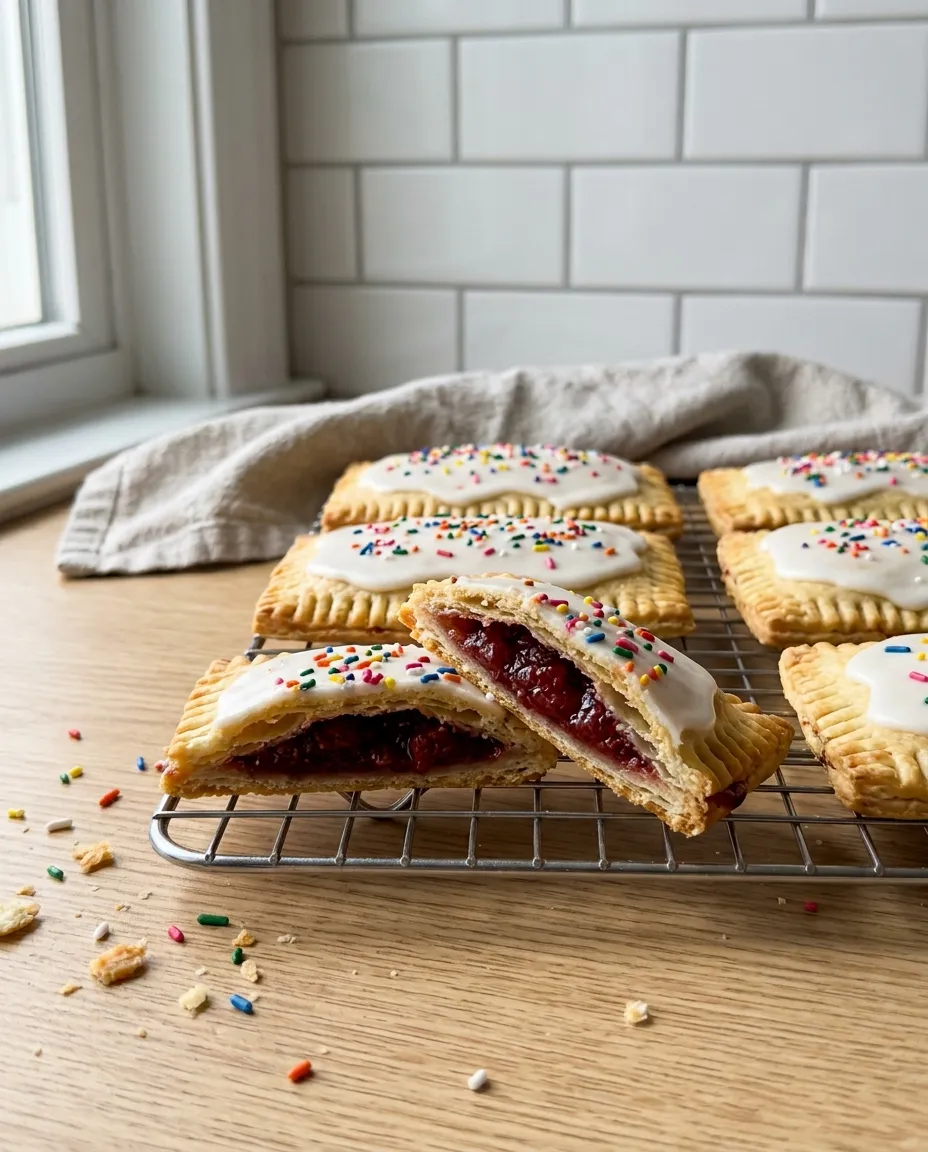
Two very different people search for air fryer pop tarts. One is holding a silver foil packet and wants to know if the basket beats the toaster, and the answer is yes, in about 3 minutes, with one warning about frosting that half the internet skips. The other wants to build the nostalgic rectangle from scratch on pie crust and ice it like the box art. Every ranking page serves one of them and strands the other. This page seats both: the boxed timing is in the first section because impatience deserves respect, and the rest is the homemade version, six tarts from one box of pie crust, jam that stays inside its walls, and icing that sets matte and holds its sprinkles because it waited for the pastry to cool.
What’s on this page
- The short answers, both of them
- Boxed Pop-Tarts in the basket
- The dough: pie crust, on purpose
- Fillings that stay inside the walls
- Cut, seal, dock
- Temperature and timing
- What done looks like
- Ingredients
- How to make them
- Icing like the box art
- Fixing what goes wrong
- Lunchbox company and storage
- Frequently asked questions
The short answers, both of them
Boxed Pop-Tarts: 330°F for 3 to 4 minutes unfrosted, and 320°F for 2 to 3 minutes if frosted, frosted side up, never flipped. Homemade on pie crust: 350°F for 10 to 12 minutes in a preheated basket, iced only after they cool completely. That is the whole card trick, and the rest of this page is why those numbers work, what everyone else gets wrong about frosting, and how to build the from-scratch version that makes the boxed kind taste like a photocopy.
Boxed Pop-Tarts in the basket
The air fryer genuinely beats the toaster here, and not by a little. A toaster blasts the two faces and leaves the edges cold; the basket's moving air crisps the whole pastry evenly, warms the filling through, and never launches your breakfast across the counter. Three to four minutes at 330°F for unfrosted varieties, straight from the wrapper, and about a minute longer if they came from the freezer. The other boxed breakfast pastry, the toaster strudel, has its own page and its own icing timing.
The frosted ones are where the ranking advice gets careless. That white frosting is a dried sugar shell, and somewhere north of 330°F it stops being a shell and starts being a glaze again: it slicks, slides toward the edges, and can brown into bitterness in the last minute. So frosted Pop-Tarts run 320°F for 2 to 3 minutes, frosted side up so the floor never touches the sugar, and they never get flipped. The recipes telling you 400°F for 3 minutes are toasting the frosting off the pastry and calling the smell caramelization. One more piece of respect for the physics: the fruit filling holds heat like lava long after the pastry feels friendly, the same warning that applies to every filled pastry on this site, so give one to a kid only after a two minute rest.
The dough: pie crust, on purpose
A real Pop-Tart is not puff pastry and not cookie dough; it is a sturdy, snappy short crust, and the closest thing in the store is a box of refrigerated pie crust, the same two-roll box our air fryer apple pie is built on. Pie crust bakes flat and crisp with a tender snap, holds a crimp through handling, and tastes like the memory. Puff pastry makes a fine turnover and a wrong pop tart: it inflates, shatters, and refuses to be eaten from one hand on the way out the door, which is the entire job description.
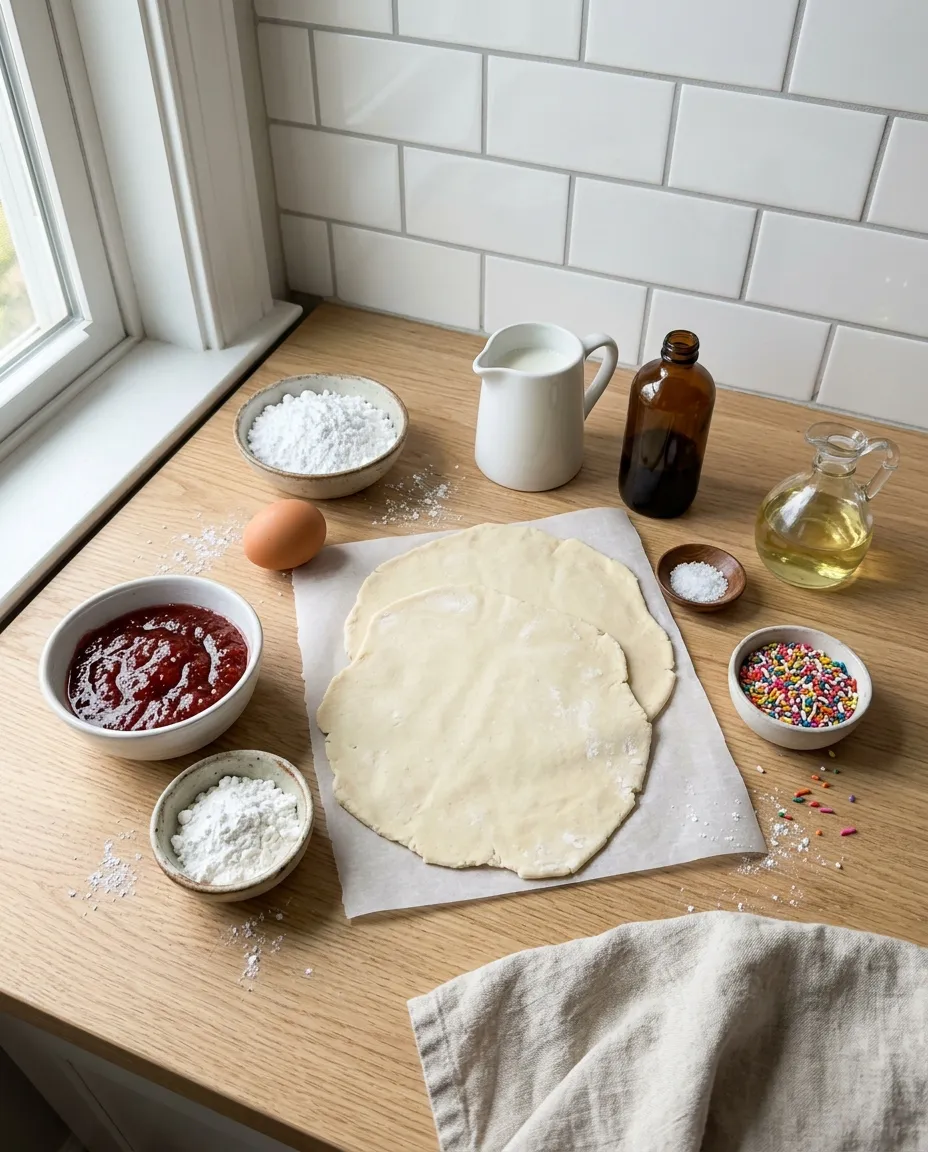
Work it cold, like every pastry on this site: unroll the crusts straight from the refrigerator, and if the rectangles soften while you build, park them on a plate in the refrigerator for 10 minutes before they bake. Cold fat in the crust is what flakes; warm fat is what greases.
Fillings that stay inside the walls
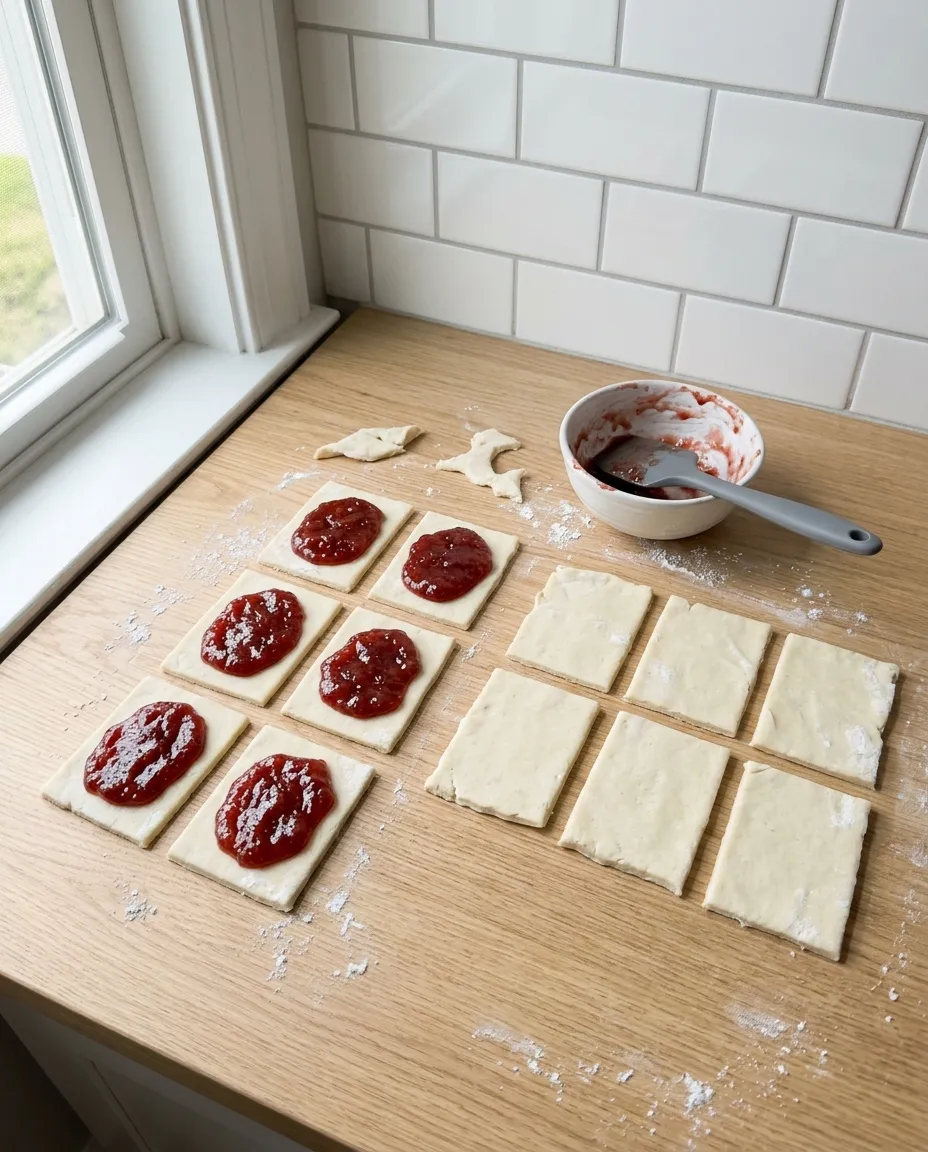
The classic failure is jam boiling out through the crimp and burning on the floor, and it happens because plain jam thins dramatically when hot. The fix costs five seconds: stir cornstarch into the jam before it goes in, a quarter teaspoon per tablespoon. Cold, it changes nothing; hot, it thickens the jam right as the jam is trying to escape, and the filling stays a filling instead of becoming a leak. A tablespoon per tart, no more, spread inside a half inch border. The border is the gasket, and overfilling is how gaskets fail.
For the brown sugar cinnamon faithful, and they are legion: mix ½ cup brown sugar, 1½ teaspoons cinnamon, and 2 teaspoons flour, and use a scant tablespoon per tart. The flour does the cornstarch's job, soaking up the melted sugar so it sets fudgy instead of running. Both fillings arrive already cooked or inert, which keeps this page aligned with the house rule the pie page is named for: nothing goes inside a pastry that still has cooking left to do.
Cut, seal, dock
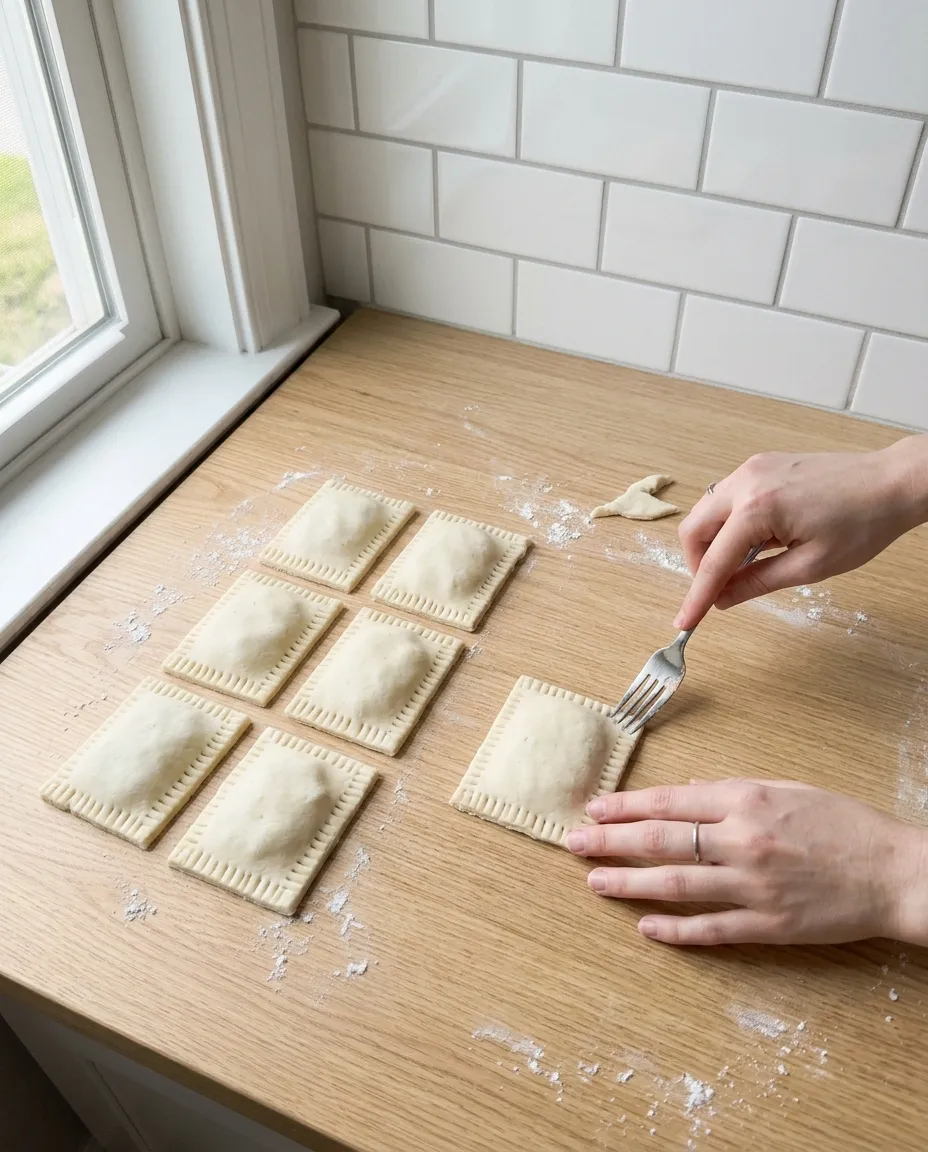
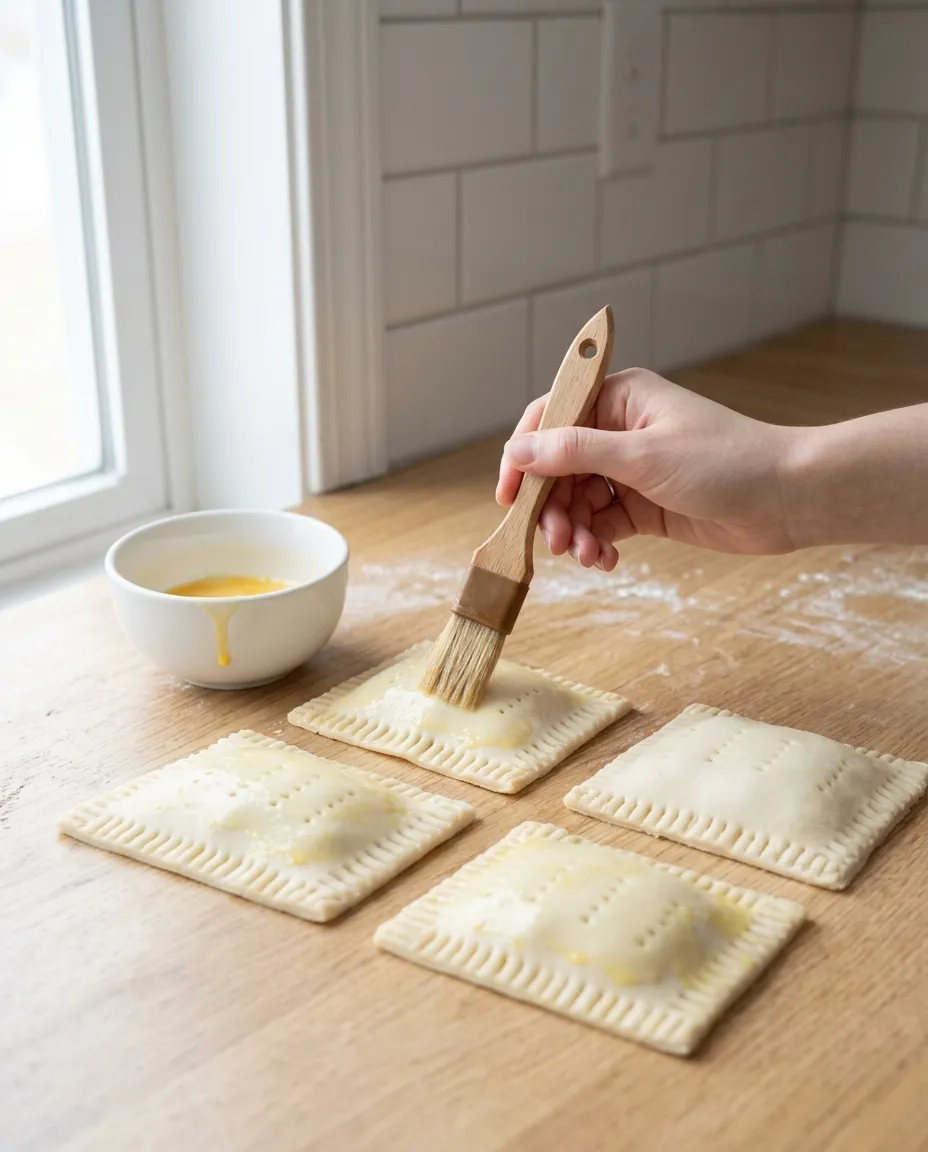
Cut the two crusts into 12 rectangles, about 3 by 4 inches, rerolling the scraps once for the last pair. Six get filling; six become lids. Brush the borders with water, lay the lids on, press the edges closed with your fingers, then crimp all four sides with a fork, the signature Pop-Tart hem doing real structural work.
Then dock the tops: four neat rows of fork holes straight down through the lid, exactly like the factory does it. The holes are not decoration and never were; they are steam vents. A sealed tart with no vents inflates like a pillow, and the steam that cannot leave through the roof forces the crimp open at a corner and takes the jam with it. Dock honestly and the tart bakes flat, dense, and true to the original, with the steam leaving politely through the ceiling.
Temperature and timing
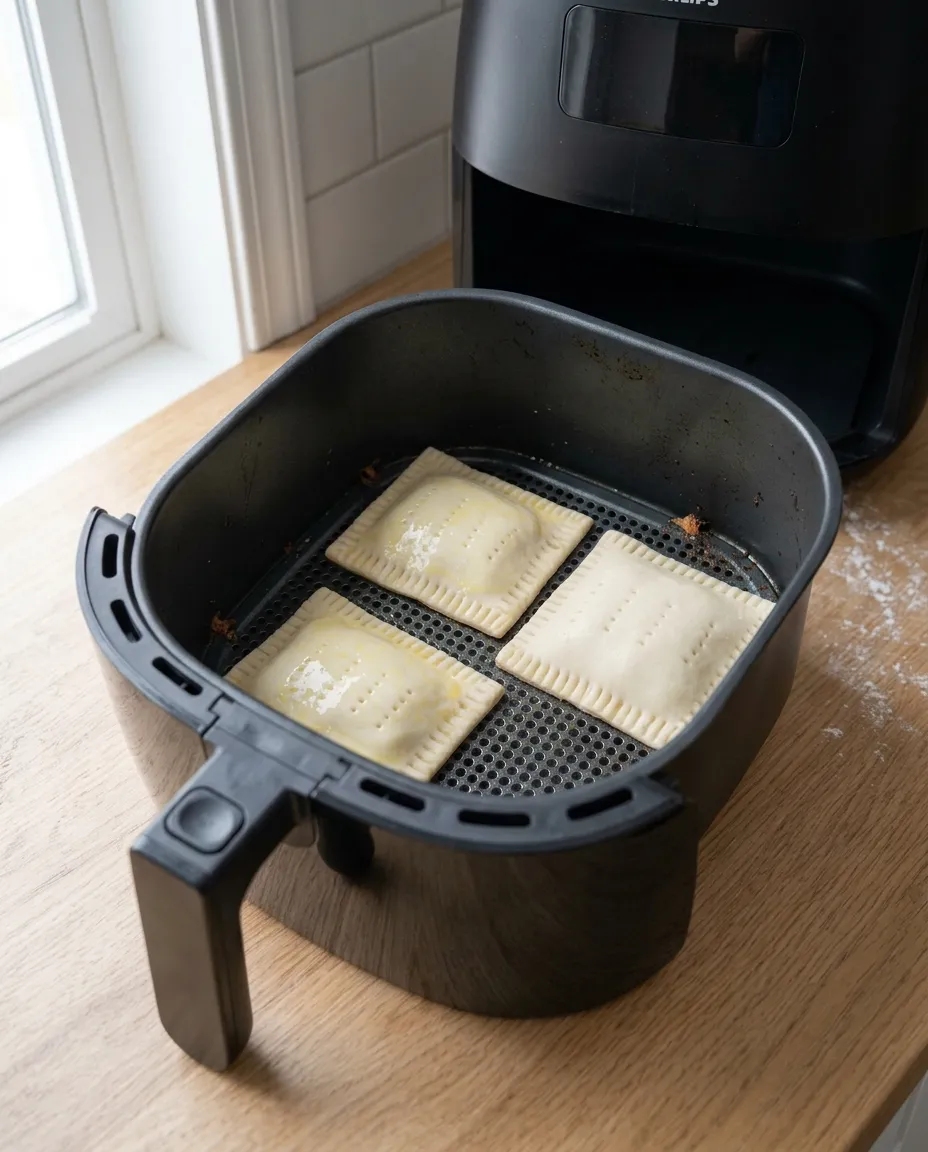
350°F for 10 to 12 minutes, preheated 3 minutes, no flip. The SERP runs anywhere from 350 to 375, and the hotter versions are trading interior flake for surface color: pie crust is a thick, dense pastry, and at 375 the egg-washed top is bronzing while the middle layer under the jam is still pale putty. Oven pop tart recipes bake around 400°F, and dropping that for a basket is the same standard conversion our air fryer calculator applies to any oven recipe. The preheat matters for the same cold-fat reasons as everything flaky, argued in full in do you need to preheat an air fryer for baking: cold crust into hot air flakes, cold crust into a warming machine slumps.
Three tarts to a batch in most baskets, a finger of space between, second batch about a minute faster. Bare, lightly oiled floor, no liner; the perforations are what keep the underside as crisp as the top, and the full case for skipping the paper is in foil or parchment paper in an air fryer. Every number on this site is collected on the baking chart.
What done looks like
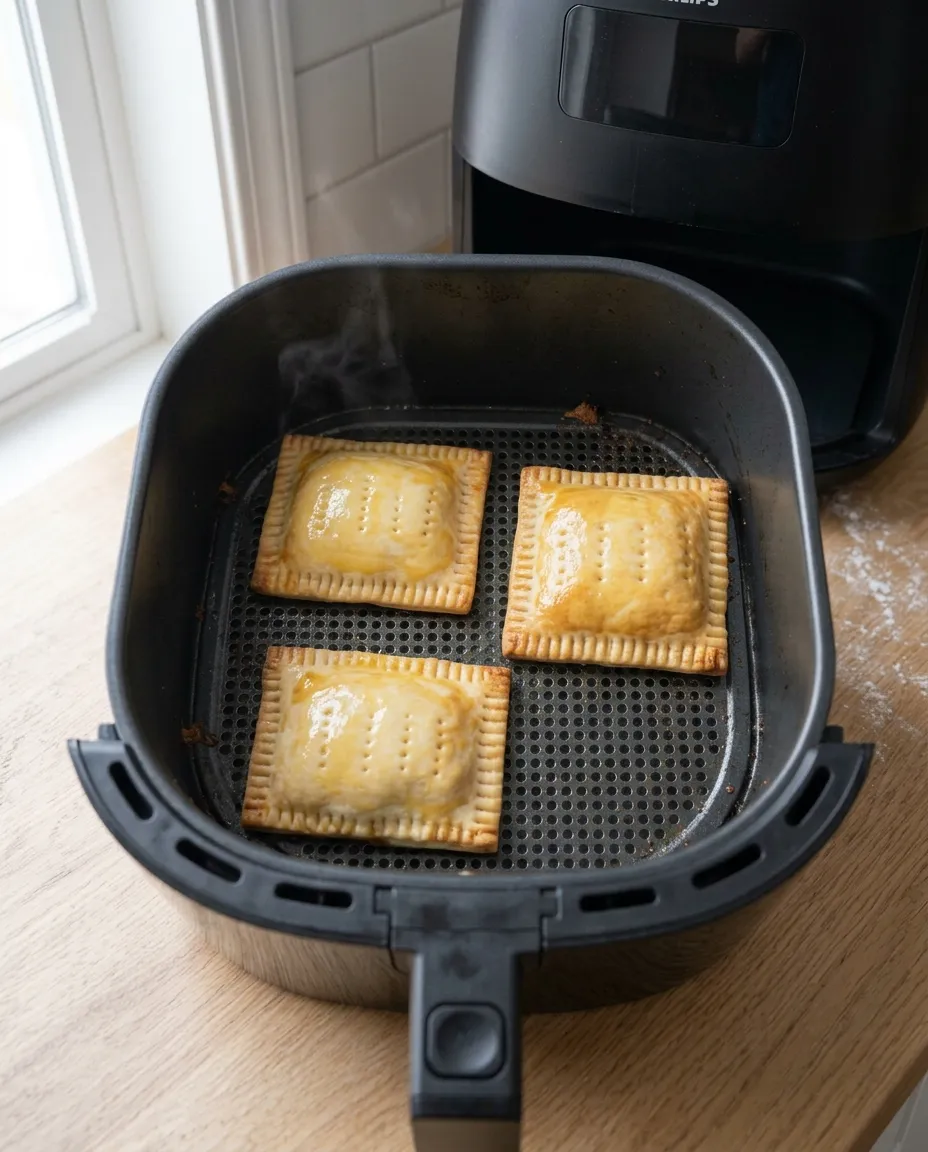
- Top: even gold with darker fork-hole rows and crimps, the egg wash doing its glossy work.
- Edges: the crimp should look dry and set, with no jam bubbling through. A bead of jam at one corner means pull it now; that corner was underfilled with border.
- Underside: tip one up with a spatula; golden and rigid, matching the top, courtesy of the bare floor.
- The tap: a done tart tapped in the center sounds dull and solid, not hollow. Hollow means the dock holes sealed over and the tart inflated; it will still taste right, but dock deeper next time.
Ingredients
For 6 tarts
- 1 box (2 rolls) refrigerated pie crust, cold
- 6 tablespoons thick strawberry jam
- 1½ teaspoons cornstarch, stirred into the jam
- 1 egg beaten with 1 teaspoon water, for the wash
- 1 cup powdered sugar
- 4 to 5 teaspoons milk
- ¼ teaspoon vanilla extract and a pinch of fine salt, for the icing
- Rainbow sprinkles, non-negotiable for the full effect
- Neutral oil for the basket floor
Brown sugar cinnamon version: swap the jam for a mix of 1/2 cup brown sugar, 1 1/2 teaspoons cinnamon and 2 teaspoons flour, a scant tablespoon per tart, and add a pinch of cinnamon to the icing.
How to make them
- Stir the cornstarch into the jam and set it in the refrigerator while you work.
- Unroll the cold pie crusts and cut 12 rectangles, about 3 by 4 inches, rerolling the scraps once for the final pair.
- Spread a tablespoon of the jam mixture onto 6 rectangles, leaving a clean half inch border on all sides.
- Brush the borders with water, top each with a lid rectangle, press the edges closed, and crimp all four sides firmly with a fork.
- Dock the top of each tart with four rows of fork holes, pressed all the way through the lid.
- Brush the tops with egg wash, and chill the built tarts 10 minutes if the dough has gone soft.
- Preheat the air fryer at 350F for 3 minutes and lightly oil the basket floor.
- Air fry 3 at a time at 350F for 10 to 12 minutes, no flip, until evenly gold on top and bottom.
- Cool completely on a rack, about 20 minutes; a warm tart melts icing into a glaze, and this icing is meant to be a shell.
- Whisk the powdered sugar, milk, vanilla and salt into a thick, barely-pourable icing, spread it inside the crimp lines, and land the sprinkles in the first minute before it sets.
Icing like the box art
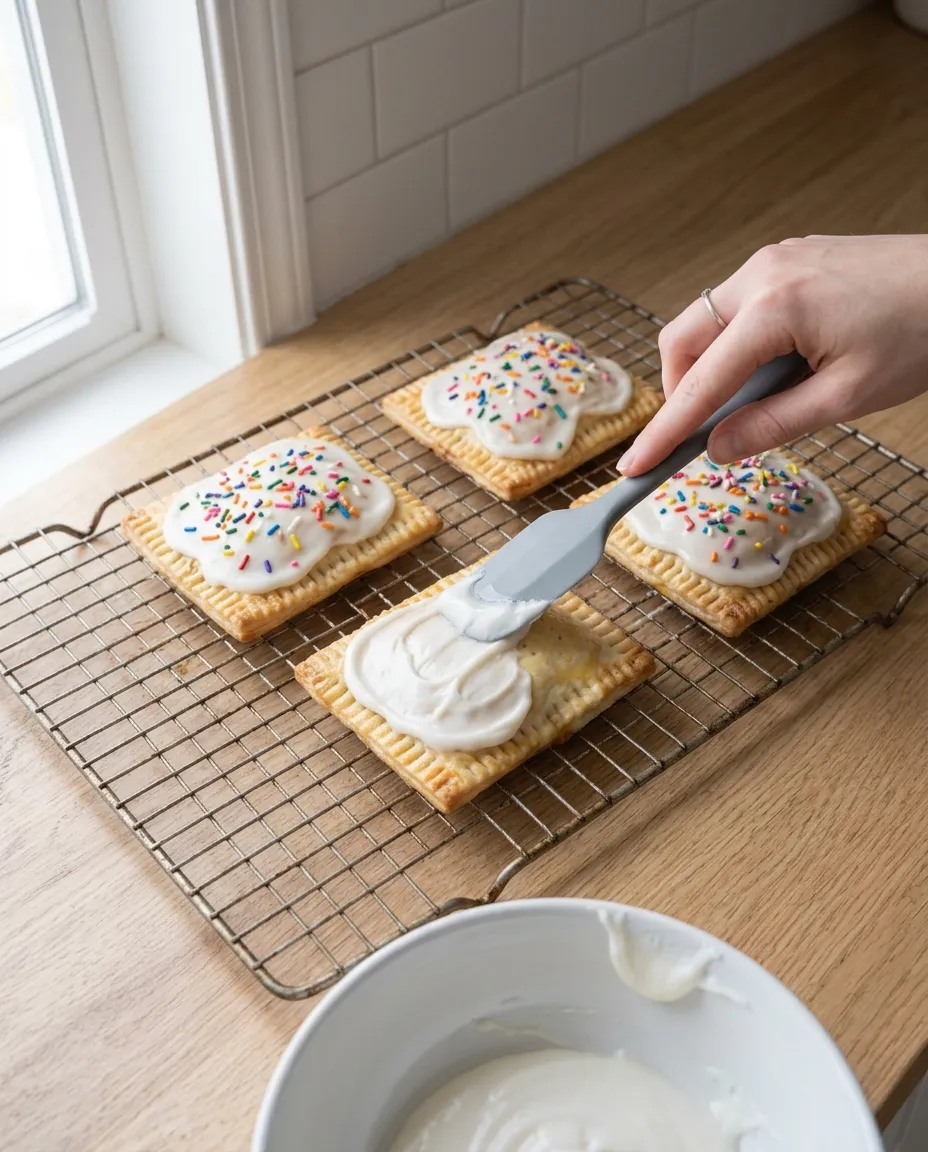
The factory finish is a matte, opaque shell with sprinkles locked in place, and it comes from two decisions. First, the tart must be fully cool, which is the opposite rule from our glazed donuts and it is worth being precise about the difference: a glaze wants a warm surface so it thins and drapes, while an icing shell wants a cool one so it sits exactly where the spatula left it and dries matte. Twenty minutes on the rack is the price of the look. Second, mix the icing thick, barely pourable, more paste than syrup; thin icing dries glossy and translucent, which reads homemade in the wrong way. Spread it inside the crimp border like a little swimming pool, sprinkle within the minute, and give it 15 undisturbed minutes to set before anyone stacks them. Set properly, they stack like the real thing, wax paper between layers, and survive a lunchbox.
Fixing what goes wrong
| Problem | Cause | Fix |
|---|---|---|
| Jam boiled out at the crimp | Plain jam, overfilled, or skimpy border | Cornstarch in the jam, one level tablespoon, half inch border, fork crimp with intent |
| Tart inflated like a pillow | Dock holes too shallow or too few | Four full rows, pressed through the lid; the holes are vents, not decor |
| Frosting melted off a boxed tart | Toasted above 330°F, or flipped | 320°F, 2 to 3 minutes, frosted side up, hands off |
| Pale, doughy middle layer | 375°F recipes browning the outside first | 350°F for the full 10 to 12; color and center finish together |
| Icing turned to glaze and slid | Iced warm | Fully cool tart, thick icing; patience is an ingredient here |
| Scorched sugar smell mid-bake | Leaked filling burning on the floor | Wipe the floor between batches; more in the burning guide and troubleshooting |
Lunchbox company and storage
These sit squarely in this site's nostalgia wing, and they keep good company: rice krispie treats for the same lunchbox, air fried Oreos and funnel cake for the county fair mood, the refrigerated cookie dough page for the rest of the chilled-dough shelf, and the cinnamon rolls when the morning wants something warmer than a rectangle. Homemade tarts keep airtight at room temperature 3 days, un-iced ones revive at 330°F for 2 minutes, and iced ones are eaten as they are, because the shell does not survive reheating. The full catalog lives at the recipe index, with the technique pages under guides.
Frequently asked questions
QHow long do you put Pop-Tarts in the air fryer?
Boxed Pop-Tarts take 3 to 4 minutes at 330F unfrosted, or 2 to 3 minutes at 320F if frosted, straight from the wrapper with no preheating needed for a simple toasting job. Add about a minute if they were stored in the freezer. Homemade pop tarts on pie crust are a real bake: 350F for 10 to 12 minutes in a preheated basket. Either way, rest them 2 minutes before eating; the filling holds heat far longer than the pastry suggests.
QCan you put frosted Pop-Tarts in an air fryer?
Yes, with two rules the hotter recipes skip. Keep the temperature at 320F, because the frosting is a dried sugar shell that re-melts somewhere above 330F, slides toward the edges, and browns bitter in the final minute. And keep them frosted side up with no flipping, so the sugar never touches the basket floor. Two to 3 minutes gets the pastry crisp and the filling warm while the frosting stays matte and intact. The 400F advice floating around toasts the frosting right off the tart.
QWhat temperature do you bake homemade pop tarts in an air fryer?
350F for 10 to 12 minutes with a 3 minute preheat and no flipping. Pie crust is a dense pastry, and the recipes running 370F or 375F brown the egg-washed top while the middle layer under the filling is still underbaked, which is why their tarts look right and eat doughy. At 350F the top, the underside on the bare basket floor, and the interior all finish together. Oven versions of this recipe run around 400F, and the drop is the standard oven-to-basket conversion.
QWhy did the filling leak out of my pop tarts?
Because jam thins sharply when hot, and a thin liquid will find any gap in a crimp. Three defenses work together: stir a quarter teaspoon of cornstarch into each tablespoon of jam, which thickens it exactly when it gets hot enough to escape; keep a clean half inch border and never overfill past one level tablespoon; and dock the tops thoroughly, because trapped steam is what pries crimps open from the inside. Do all three and the crimp stays shut for the whole bake.
QCan I make pop tarts ahead and freeze them?
Yes, on both sides of the bake. Unbaked, built tarts freeze beautifully on a tray, then bag them and bake straight from frozen at 350F, adding about 2 minutes, and ice after cooling. Baked but un-iced tarts freeze for a month and revive at 330F for 3 to 4 minutes, crisp as day one. The one thing that does not freeze or reheat is the icing shell, which weeps when thawed and melts when warmed, so always ice on the day of serving. Five minutes of icing on a made-ahead tart is still faster than a store run.
QHow do I get the icing to look like a real Pop-Tart?
Two rules: cool tart, thick icing. The factory finish is a matte, opaque shell, and it only happens when stiff icing, mixed barely pourable with about 4 teaspoons of milk per cup of powdered sugar, is spread on a completely cooled pastry. On a warm tart the same icing melts into a translucent glaze and slides; thinned icing dries glossy and see-through. Spread it inside the crimp border, add sprinkles in the first minute while the surface is tacky, and let it set 15 minutes before stacking.
Made it? Rate it.
It helps more people find the tart that out-toasts the toaster.
Air Fryer Pop Tarts
Six homemade strawberry pop tarts on refrigerated pie crust, docked and crimped like the original, baked at 350°F for 10 to 12 minutes and iced matte with sprinkles once fully cool.
Ingredients
- 1 box (2 rolls) refrigerated pie crust, cold
- 6 tablespoons thick strawberry jam
- 1½ teaspoons cornstarch, stirred into the jam
- 1 egg beaten with 1 teaspoon water, for the wash
- 1 cup powdered sugar
- 4 to 5 teaspoons milk
- ¼ teaspoon vanilla extract and a pinch of fine salt, for the icing
- Rainbow sprinkles, non-negotiable for the full effect
- Neutral oil for the basket floor
Instructions
- Stir the cornstarch into the jam and set it in the refrigerator while you work.
- Unroll the cold pie crusts and cut 12 rectangles, about 3 by 4 inches, rerolling the scraps once for the final pair.
- Spread a tablespoon of the jam mixture onto 6 rectangles, leaving a clean half inch border on all sides.
- Brush the borders with water, top each with a lid rectangle, press the edges closed, and crimp all four sides firmly with a fork.
- Dock the top of each tart with four rows of fork holes, pressed all the way through the lid.
- Brush the tops with egg wash, and chill the built tarts 10 minutes if the dough has gone soft.
- Preheat the air fryer at 350F for 3 minutes and lightly oil the basket floor.
- Air fry 3 at a time at 350F for 10 to 12 minutes, no flip, until evenly gold on top and bottom.
- Cool completely on a rack, about 20 minutes; a warm tart melts icing into a glaze, and this icing is meant to be a shell.
- Whisk the powdered sugar, milk, vanilla and salt into a thick, barely-pourable icing, spread it inside the crimp lines, and land the sprinkles in the first minute before it sets.

Sujata Thapa
Sujata bakes everything on this site in a 5.5 quart basket air fryer on a Kathmandu counter, then re-tests the keepers until the timings hold for anyone. The cornstarch-in-the-jam rule was written the morning a strawberry leak baked itself onto the basket floor in the shape of a comet.