

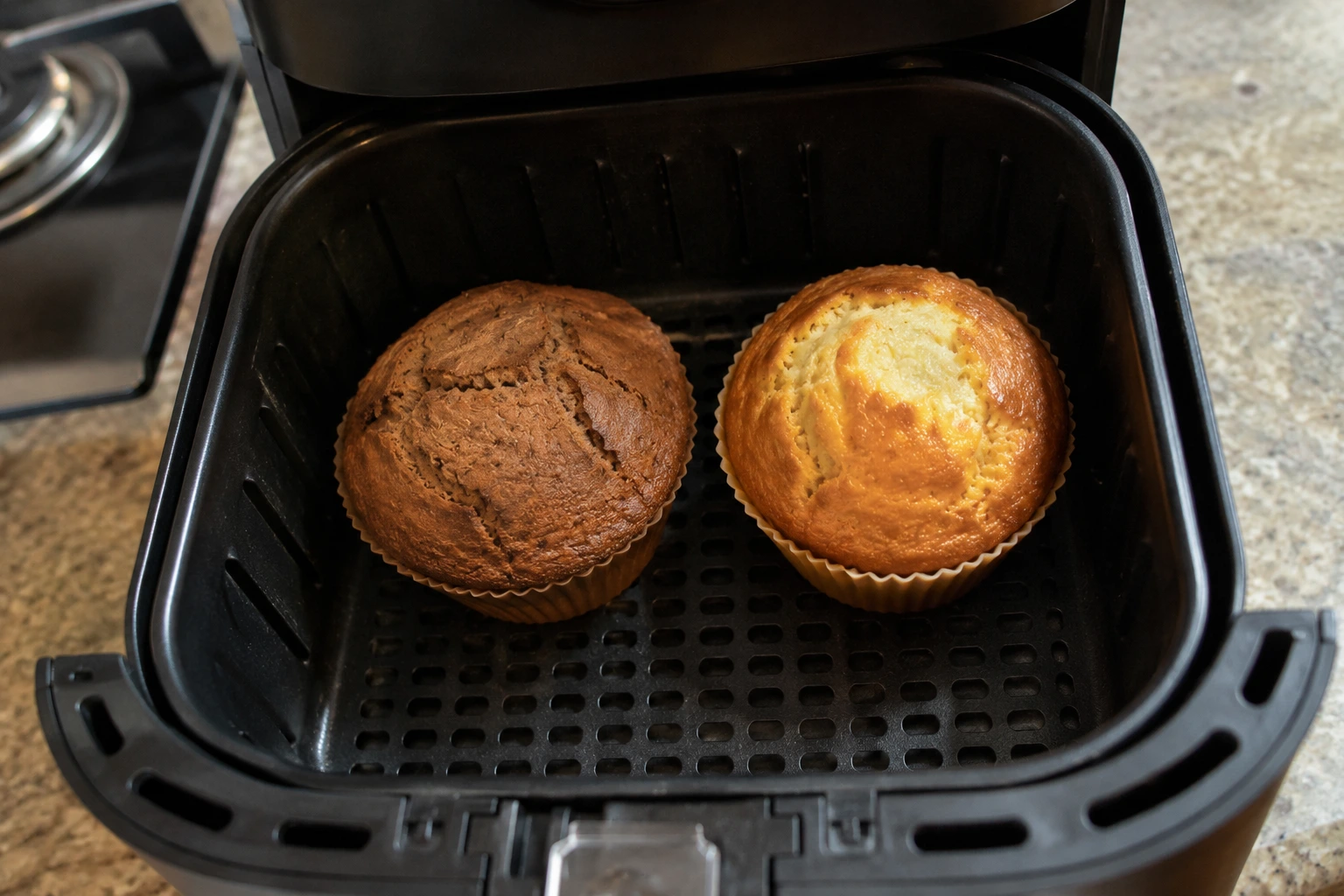
My first few air fryer cakes all did the same thing. They came out looking tall and golden, I set them on the rack feeling quite pleased, and by the time they were cool there was a dip in the middle deep enough to hold a spoonful of cream.
So I did what everyone does and looked it up. Every article said the same five things: you overmixed it, you used too much baking powder, your ingredients were cold, your oven runs cool, you opened the door. I went through all five. It kept happening.
The reason none of that helped is that all of it was written about ovens.
Short answer: In an air fryer a cake usually sinks because the top sets into a firm crust long before the middle has any structure. The crust rises on the gas underneath, the middle never sets to support it, and as it cools the crust drops into the hollow. Fix it by baking cooler for longer, filling the pan only half full, and pulling the cake at 200 to 205°F in the centre rather than guessing.
Why the usual advice does not fit an air fryer
Look at what actually ranks for this question and you will notice something. Every one of the top results is a general baking article about ovens. Not one of them mentions air fryers at all, and the advice reflects that. It is all about what went into the bowl.
That advice is not wrong. Overmixed batter really does collapse. Too much raising agent really does over-inflate and fall. But those are batter faults, and if you have made the same recipe in an oven and it was fine, the batter is not your problem. Something about the machine is.
Two things are genuinely different in an air fryer, and both of them work against a cake:
- The heat source is close. In an oven the element is a foot or more from the top of your tin. In a basket it is two to four inches away. The top of your batter is getting a lot more radiant heat than the recipe ever assumed.
- The air is moving fast. A conventional oven is mostly still air. An air fryer drives a high-speed stream straight down onto the surface of your batter, which strips moisture off the top and lets that surface climb past boiling much sooner.
Put those together and the top of an air fryer cake sets much earlier, relative to the middle, than the same cake in an oven. That gap in timing is the whole problem.
What is actually happening when it sinks
A cake sets from the outside in. Nothing unusual there. What matters is the order, and there are three things happening at once inside that tin.
Baking powder inflates
Raising agent releases carbon dioxide, water turns to steam, and the batter expands. This starts almost immediately and runs out well before the bake is over.
Egg and starch set
Egg protein coagulates and flour starch gelatinises into a solid mesh. This is what holds the risen shape up, and it happens late, at around 180 to 200°F.
The surface dries
The top loses water and firms into a skin. In an oven this is late. In an air fryer it can happen within the first six or seven minutes.
In a working bake those finish in a sensible order: the gas inflates the batter, the structure sets and locks the shape, and the crust forms on top of something solid.
In a sinking air fryer cake the crust jumps the queue. You end up with a firm lid over a batter that is still liquid underneath. The gas keeps pushing, so the lid keeps rising, and from the outside the cake looks magnificent. Then the raising agent is spent, the steam condenses as things cool, and the pressure holding that lid up disappears. Underneath there is no set structure to take the load, so the lid falls into the hollow.
This is why the collapse so often happens after you take it out. The cake looked perfect in the basket because it was still full of hot gas. It sank on the rack. If that is your pattern, you almost certainly pulled it before the middle had set, and no amount of adjusting the baking powder will change that.
It is the same mechanism behind the hard border and raw centre people get with air fryer brownies, and the reason our guide to avoiding dry air fryer bakes spends so long on the surface rather than the crumb. Almost every air fryer baking problem traces back to the top setting before the middle.
Read the crater
The shape of the sink tells you which cause you are dealing with. This is the fastest way to narrow it down, and it takes one look.
| What it looks like | What happened | Fix |
|---|---|---|
| Dip in the middle, edges fine, centre damp or gummy | Underbaked. The most common one by a distance. | Bake to 200°F internal, not to the clock |
| Looked tall in the basket, sank on the rack | Same thing. The gas was holding it up. | Same fix, plus lower the temperature |
| Deep crack across a domed top, dark crust | Too hot. The crust set early and split as the inside pushed. | Drop 15 to 25°F and add time |
| Whole top wrinkled and fallen, not just the middle | Over-inflated. Too much raising agent, or overmixed. | Check the measure, fold less |
| Sank on one side only | Uneven airflow, or the pan sat off-centre. | Centre the pan, rotate halfway |
| Crusty shell over a hollow, batter at the bottom | Classic lid failure. Filled too deep as well. | Half fill the pan, bake cooler and longer |
If you are working through several problems at once, the wider air fryer baking troubleshooting guide covers burnt tops, soggy bottoms and the rest in the same diagnostic style.
The number that ends the guessing
Here is the single most useful thing on this page, and none of the articles ranking for this question mention it.
A cake is done at 200 to 205°F (93 to 96°C) in the centre. Not "when a skewer comes out clean". Not "when it springs back". A thermometer in the middle of the cake, away from the tin, reading 200°F or a little over. Below about 195°F the starch has not finished setting, and a cake pulled there will sink no matter how clean your skewer looked.
The skewer test is where people get caught out, because a skewer can come out clean from a cake that is not done. Once the crumb around it has set enough to stop sticking, the skewer reads clean, but the very centre can still be below setting temperature. In an air fryer, where the outer part of the cake is well ahead of the middle, that gap is wider than usual.
An instant-read thermometer costs very little and it turns this from a judgement call into a reading. Push it into the middle at an angle so you are measuring the centre of the depth, not the bottom of the tin.
| Centre reads | What you have |
|---|---|
| Under 190°F | Not set. It will sink as it cools. |
| 195°F | Borderline. Often sinks slightly. |
| 200 to 205°F | Done. Holds its shape and stays moist. |
| Over 210°F | Set but drying out. |
Different bakes want different numbers, which is worth knowing before you apply this everywhere. Brownies are done at 165 to 175°F because they are meant to be underbaked, and bread runs 190 to 210°F. The full set is in our air fryer baking chart.
Stopping the top from setting first
Everything else on this page is downstream of this. If you close the gap between when the top sets and when the middle sets, the cake stops sinking.
Bake cooler and longer
This is the big one. Most sinking cakes are being baked at too high a temperature, usually because the number came straight off an oven recipe. Drop to 310 to 320°F for most cakes and give it the extra time. A lower surface temperature means the crust forms later, which gives the middle a chance to catch up.
If you are converting a recipe rather than following one written for a basket, run the oven numbers through our air fryer calculator first. It applies a deeper cut for cakes than the flat 25°F rule, precisely because of this problem, and then you can go lower still if your machine runs hot.
Tent the top with foil
If the top is browning while the middle is clearly still soft, lay a piece of foil loosely over the tin and tuck it under the rim so the fan cannot lift it. It blocks the direct radiant heat while the sides and base keep cooking, and the middle catches up. Take it off for the last five minutes if you want colour back.
Do tuck it in properly. A loose sheet of foil in an air fryer will end up against the element, which is covered in our guide to using foil and parchment in an air fryer.
Use a pan that insulates rather than conducts
Silicone slows heat transfer at the wall, which sounds like a disadvantage and is actually helpful here: it holds the edges back so the middle is less far behind. Expect to drop about 10°F and add a few minutes. Dark metal does the opposite and is the worst choice for a cake that already sinks. Our guide on using silicone molds in an air fryer covers the trade in full.
Fill level and pan size
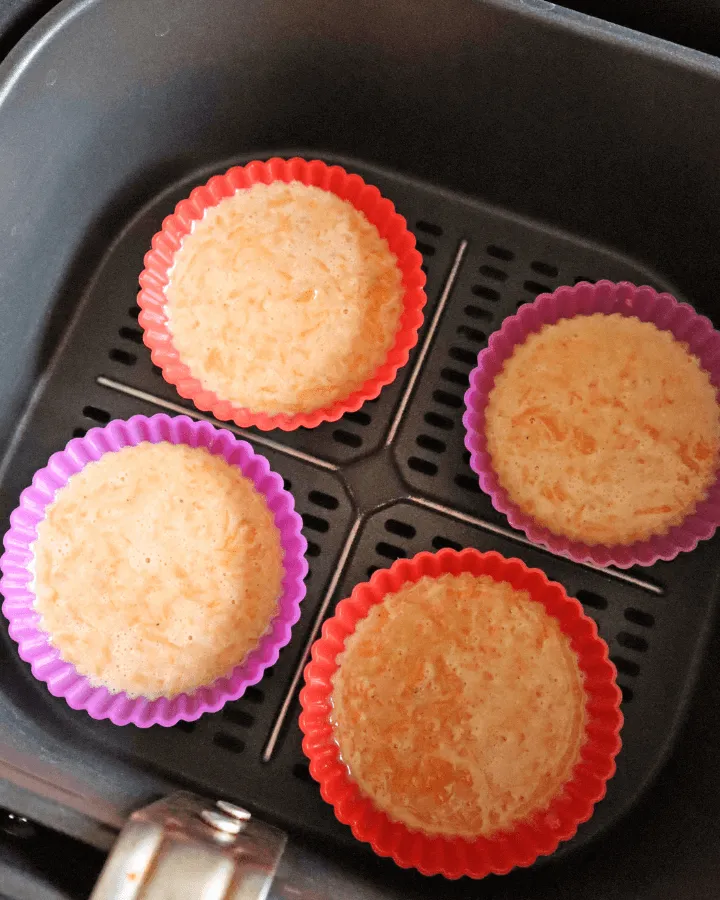
An air fryer pushes you toward small deep tins, because that is what fits a basket. A 6 inch round is often the biggest thing that will go in with any airflow around it. The trouble is that people then fill it the way they would fill a wide shallow oven tin, and deep batter is exactly what this problem feeds on.
Fill a cake tin half full. Not two thirds, not to the line, half. A cake needs room to double. Filled higher, the risen top gets close to the element, sets hard early, and you have built the lid yourself. Deep batter also takes far longer for heat to reach the middle, since conduction time rises with roughly the square of the depth.
If you are not sure what your basket will actually take, our pan size calculator works out the largest tin that still leaves an airflow gap, and tells you roughly how much batter that holds at a sensible fill. And if the recipe makes more batter than the tin should hold, the answer is to scale the recipe rather than overfill: the recipe scaler does the arithmetic including the awkward business of part of an egg.
Small individual cups are the easiest way out of this problem altogether. They are shallow, so the middle is never far from the heat, and they almost never sink. Our air fryer carrot muffins use exactly that approach.
The "never open it" rule does not really apply
Every oven guide tells you that opening the door mid-bake will collapse your cake, and they are right about ovens. A domestic oven loses a lot of heat when you open it and takes minutes to recover, and that temperature crash during the setting window can drop a cake.
An air fryer is a different situation. The cavity is small, there is very little thermal mass to re-heat, and the element is powerful relative to that space. Pull the drawer for three seconds and it is back to temperature almost immediately. You are not going to collapse a cake by looking at it.
This matters because the "never open it" rule actively stops people doing the one thing that would fix their problem, which is checking whether the middle is set before they commit. Check it. Take the temperature.
Two real cautions. Do not open it in the first two-thirds, when the structure is still forming, because you do lose some heat and there is no useful information to gain that early. And pull the drawer gently rather than yanking it, since a physical jolt to a half-set cake is a genuine risk in a way that the brief temperature dip is not.
Never overbake again
Get our one-page times & temps cheat sheet, plus a new tested recipe each week.
No spam · unsubscribe anytime
The batter faults that still apply
Having spent the page arguing that this is usually a machine problem, it is only fair to say when it is not. If your cake sinks in the oven too, the batter is the suspect, and these are the ones worth checking.
Too much raising agent
The classic. Excess baking powder inflates the batter faster and further than the structure can support, and what goes up that fast comes down. About 1 teaspoon per cup of flour is the normal ceiling. Also check the date: baking powder loses strength maybe six months after opening, and weak powder gives you a different failure, a dense flat cake rather than a sunken one.
Overmixing after the flour goes in
Beating flour into a batter builds gluten, and gluten makes a tough elastic crumb that traps gas, over-inflates, then collapses. Fold until the last streak of flour disappears and stop. A slightly lumpy batter bakes better than a smooth one.
Too much liquid or fat
Both weaken the structure. An extra splash of milk or an over-generous pour of oil gives you a batter that cannot hold itself up once the gas goes. This is the one that catches people who scale a recipe by eye rather than by measure.
Cold eggs into creamed butter
Cold eggs make creamed butter seize into specks, and the emulsion never fully recovers. You lose the air you creamed in, and an under-aerated batter behaves unpredictably. Sit the eggs in warm water for five minutes if you forgot to take them out.
Can you save a sunken cake?
If it is still hot and the middle is clearly wet, yes, sometimes. Put it straight back in at 300°F for another 5 to 8 minutes and check the centre with a thermometer. Going back in at a lower temperature than you started is deliberate: you want the middle to catch up without darkening the top any further. This works better than you would expect, as long as you have not already let it cool and set into its collapsed shape.
Once it is cool, the structure is what it is. But a sunken cake is not a wasted cake:
- Fill the dip. A sunken centre is a bowl. Whipped cream, cream cheese frosting, lemon curd or fruit all sit in it happily and nobody will know.
- Cut it into cubes for a trifle. A slightly dense cake is actually better for this than a light one, because it holds up to soaking.
- Level it and use it as a base. Trim the crusted top off, turn it over and use the flat bottom as the top.
- Blitz it into crumbs. Cake crumbs freeze well and make a good cheesecake base or a topping.
The five-point check before your next bake
Drop the temperature
310 to 320°F for most cakes, and add time. High heat is what sets the lid.
Half fill the tin
The cake needs room to double without reaching the element.
Preheat properly
Three minutes. A wet batter warming up slowly separates before it sets.
Tent if the top runs ahead
Foil over the tin, tucked under the rim, until the middle catches up.
Pull at 200°F
Measure the centre. This is the one that actually ends the problem.
On preheating, cakes are one of the bakes that genuinely need it, which is not true of everything. Our guide on whether you need to preheat an air fryer for baking sorts out which is which.
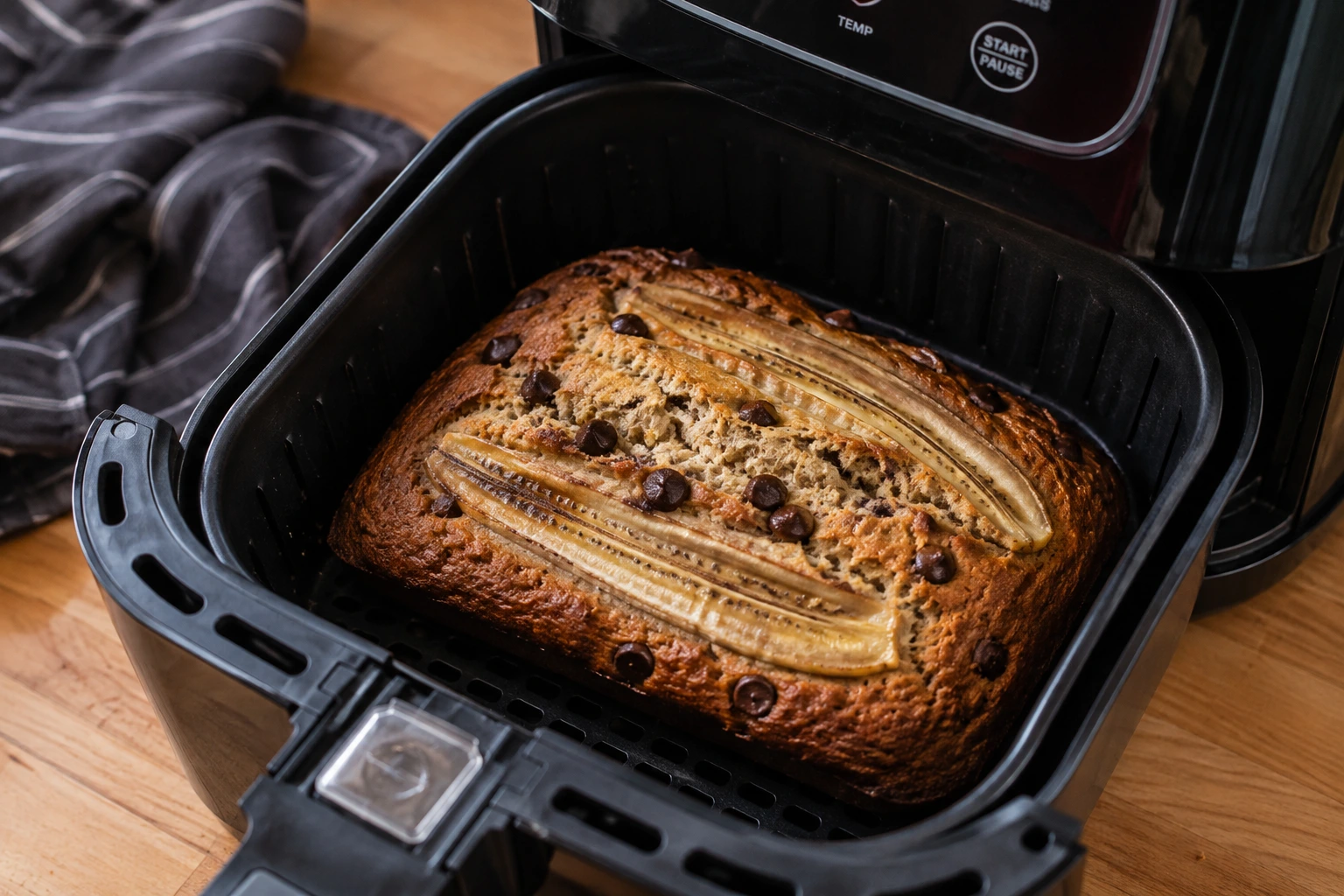
If you would rather start from something already worked out for a basket, our air fryer carrot cake and air fryer banana bread are both built around these numbers, and how to bake in an air fryer covers the method end to end. Machine format matters here too, since an oven-style unit puts the element much further from the tin: our basket versus oven-style comparison goes through it.
Frequently asked questions
QWhy does my air fryer cake sink in the middle?
Almost always because the top set into a firm crust before the middle had any structure. The heating element sits only a few inches above the tin and the fan drives air straight onto the surface, so the crust forms much earlier than it would in an oven. The raising agent keeps pushing that crust up, and when the gas is spent and the cake cools there is nothing set underneath to hold it, so it drops into the hollow. Bake cooler for longer, fill the tin half full, and pull the cake at 200 to 205F in the centre.
QWhat temperature should a cake be in the middle when it is done?
200 to 205F (93 to 96C) measured in the centre with an instant-read thermometer, away from the tin. Below about 195F the starch has not finished setting and the cake will sink as it cools. This is more reliable than a skewer, because a skewer can come out clean from a cake whose very centre is still under temperature, and in an air fryer that gap between the outside and the middle is wider than usual.
QMy cake looked fine in the air fryer and sank after I took it out. Why?
Because it was being held up by hot gas rather than by set structure. Carbon dioxide from the raising agent and steam from the batter inflate the cake and keep it tall while it is hot. If the middle has not reached setting temperature, then as the cake cools the steam condenses, the pressure drops and there is nothing solid to take the load. It falls. This pattern is the clearest sign that the cake was underbaked in the centre, regardless of how good the top looked.
QDoes opening an air fryer make a cake sink?
Not in the way it does with an oven. An air fryer has a small cavity, little thermal mass and a powerful element for its size, so it recovers temperature within seconds of the drawer closing. A three second check will not collapse a cake. The advice not to open the door is carried over from ovens, where the heat loss is much larger and recovery takes minutes. Two sensible cautions still apply: leave it alone for the first two-thirds, and pull the drawer gently rather than jolting a half-set cake.
QWhat temperature should I bake a cake at in an air fryer?
310 to 320F for most cakes, which is lower than people expect and lower than a flat conversion from an oven recipe would give you. The element is close to the tin and the airflow is fast, so a high setting browns and sets the top long before the middle cooks. Lower and slower closes that gap. If you are converting an oven recipe, put the original numbers through the air fryer calculator, which applies a deeper cut for cakes than the standard 25F rule.
QHow full should I fill a cake tin in an air fryer?
Half full. Not two thirds, which is the usual advice for ovens. A cake roughly doubles as it rises, and in a basket the element is only a few inches above the tin, so an overfilled cake brings its own top right up into the strongest heat and sets a crust early. Deep batter also takes much longer for heat to reach the centre, since conduction time rises with roughly the square of the depth. If the recipe makes more batter than half fills your tin, scale the recipe down rather than overfilling.
QCan I fix a cake that has already sunk?
If it is still hot and the middle is wet, put it back in at 300F for another 5 to 8 minutes and check the centre with a thermometer. Going back at a lower temperature lets the middle catch up without darkening the top further. Once the cake has cooled the structure is fixed, but it is still perfectly good to eat: fill the dip with whipped cream or frosting, cube it for a trifle, or trim the top off and turn it upside down.
QIs too much baking powder making my cake sink?
It can, but it is a less likely cause in an air fryer than the oven guides suggest. The test is simple: if the same recipe bakes fine in an oven, the batter is not the problem and the machine is. Too much raising agent shows a distinctive pattern too, with the whole top wrinkling and falling rather than just a dip in the middle. About 1 teaspoon per cup of flour is the normal ceiling, and baking powder loses strength around six months after opening.
QWhy did my cake crack on top instead of sinking?
Same underlying cause, one step further along. The crust set early and hardened, and then the batter underneath kept expanding with nowhere to go, so it split the crust open. A crack with a dark crust means the temperature was too high. Drop it 15 to 25F and give the cake more time, or tent foil loosely over the tin once the top has taken enough colour.
QDo silicone pans help stop cakes sinking?
They help a little. Silicone insulates rather than conducting, so it slows the edges down and lets the middle catch up, which narrows the gap that causes the collapse. Drop about 10F and add a few minutes. Dark metal does the opposite by absorbing radiant heat and racing the edges ahead, so it is the worst choice for a cake that already sinks. Silicone is not a substitute for the real fixes though: temperature, fill level and baking to 200F still matter more.
QWhy does only one side of my cake sink?
Uneven airflow, or the tin sitting off centre. Air fryers do not heat perfectly evenly, and a tin pushed toward one wall gets more heat on that side and less circulation on the other. Centre the tin with a gap all the way round, and rotate it halfway through the bake. If it happens every time in the same spot, your machine has a hot side, which is worth knowing and easy to work around once you do.
QShould I use a skewer or a thermometer?
A thermometer, if you have one. The skewer test tells you whether the crumb immediately around the skewer has stopped sticking, which happens before the very centre of the cake reaches setting temperature. In an air fryer, where the outside runs well ahead of the middle, a clean skewer and an underbaked centre happen together often enough to be the single most common reason people are surprised by a sinking cake. An instant-read thermometer costs very little and removes the guesswork.
Did this fix your cake?