
I read nine recipes for this before I made it, and every single one of them finished on the same sentence. Bake until a toothpick inserted in the center comes out clean.
Then most of them promised a fudgy chocolate cake.
Those two things cannot both happen. A toothpick comes out clean once the batter clinging to it has set, and in a cake that is somewhere around 198°F. Fudgy is done by 190. So the standard instruction walks you eight degrees past the thing it is promising you, and then you blame yourself for a dry mug cake.
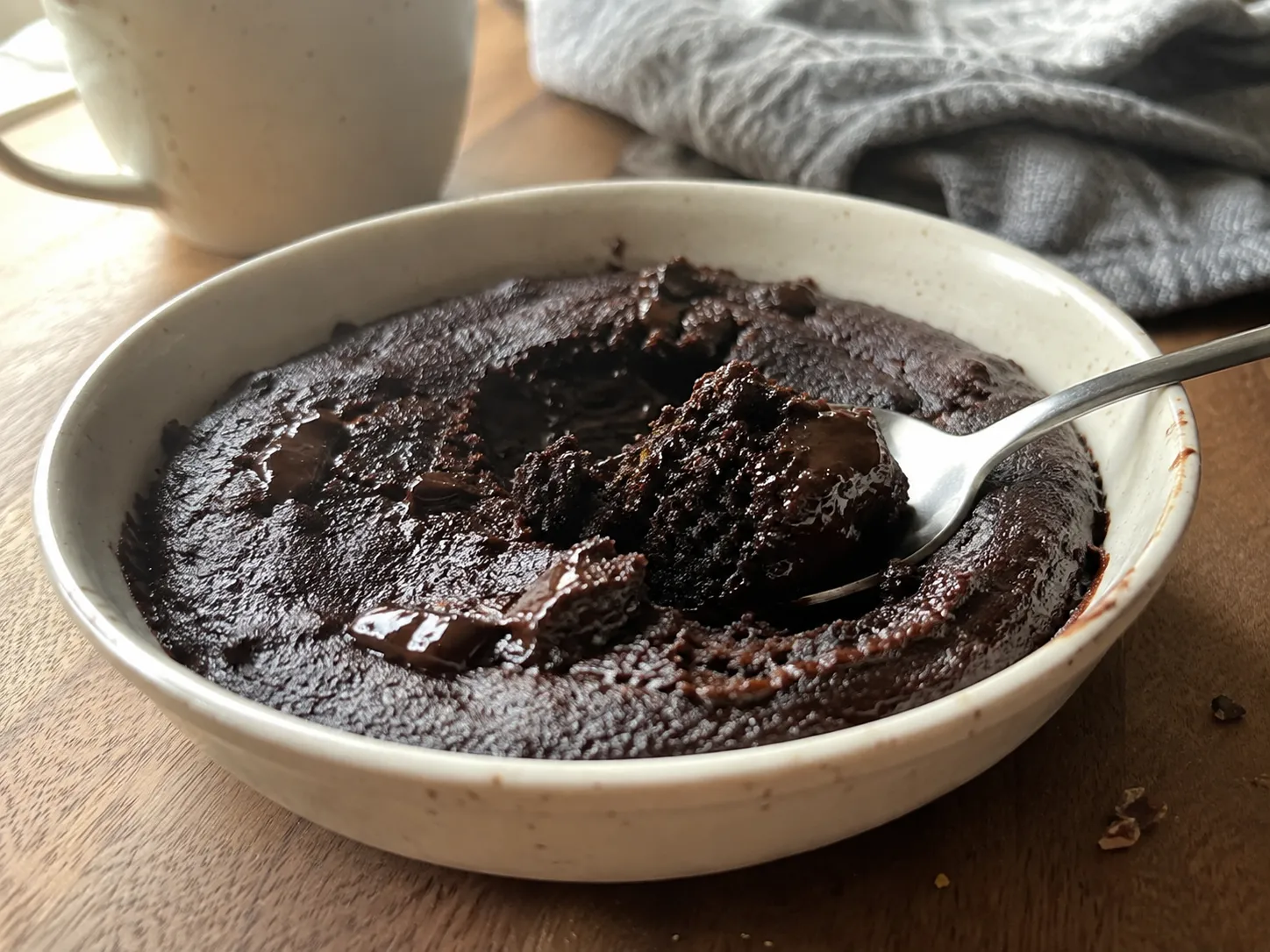
Quick answer: Bake at 330°F for 6 to 7 minutes in a 4 inch ramekin, and pull it at 190°F in the middle. Do not use a toothpick. The batter is deliberately heavier than a normal mug cake, with more butter and sugar than flour, and the cocoa goes into the hot melted butter first. In an actual mug it is 12 to 15 minutes instead, for reasons covered in our five minute mug cake.
Fudgy is a temperature, not an ingredient
People treat fudginess as something you add. More chocolate, more butter, a spoon of Nutella in the middle. Those help, and we will get to the ratio in a minute, but they are the second lever. The first one is when you take it out.
A chocolate cake batter passes through several genuinely different desserts on its way from raw to ruined, and they are only a few degrees apart.
| Center reads | What you actually have | Toothpick says |
|---|---|---|
| 180°F | Raw in the middle. Not fudgy, undercooked. | Wet batter |
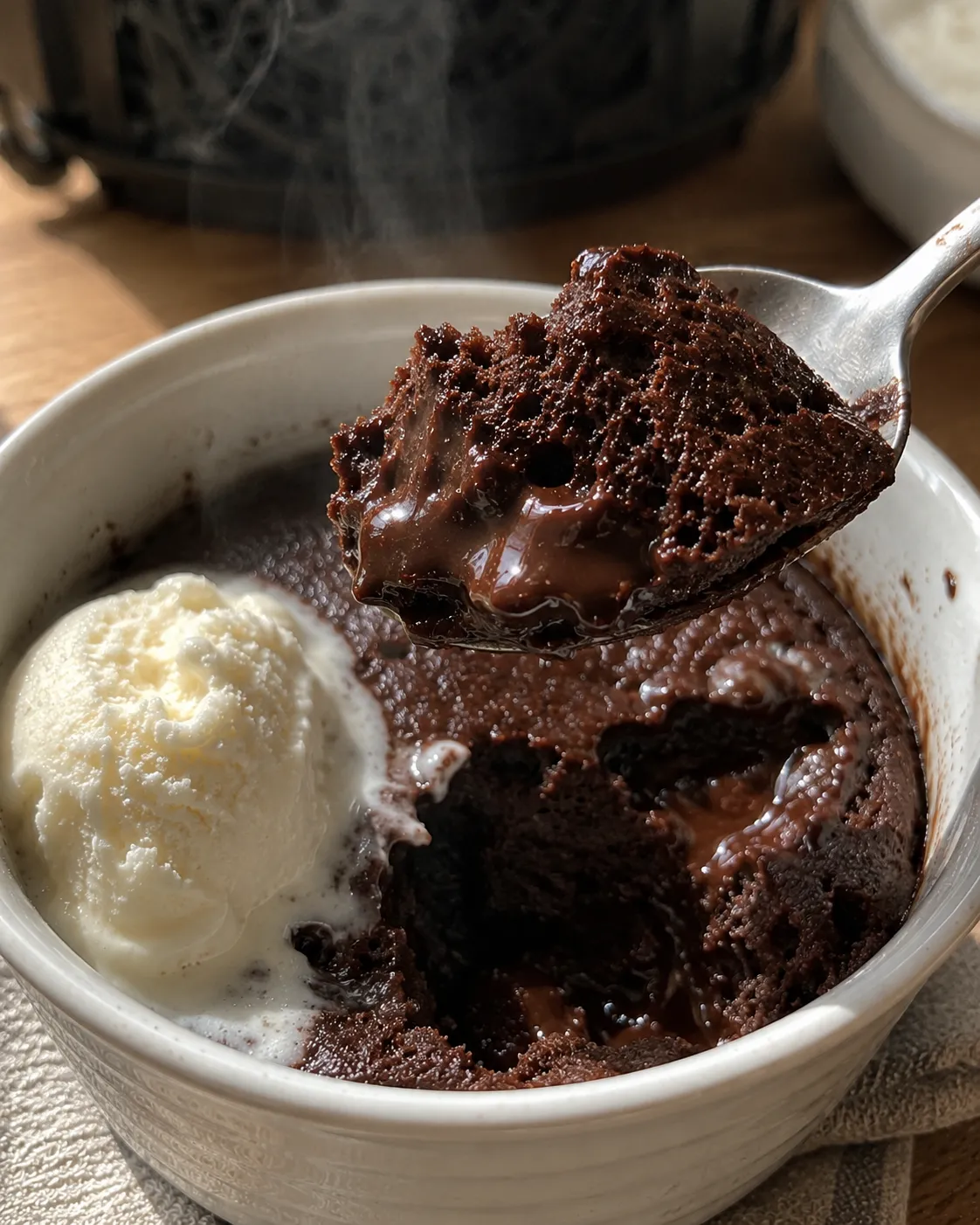
| 185°F | Molten center that runs when you cut it. Closer to our lava cake. | Wet batter |
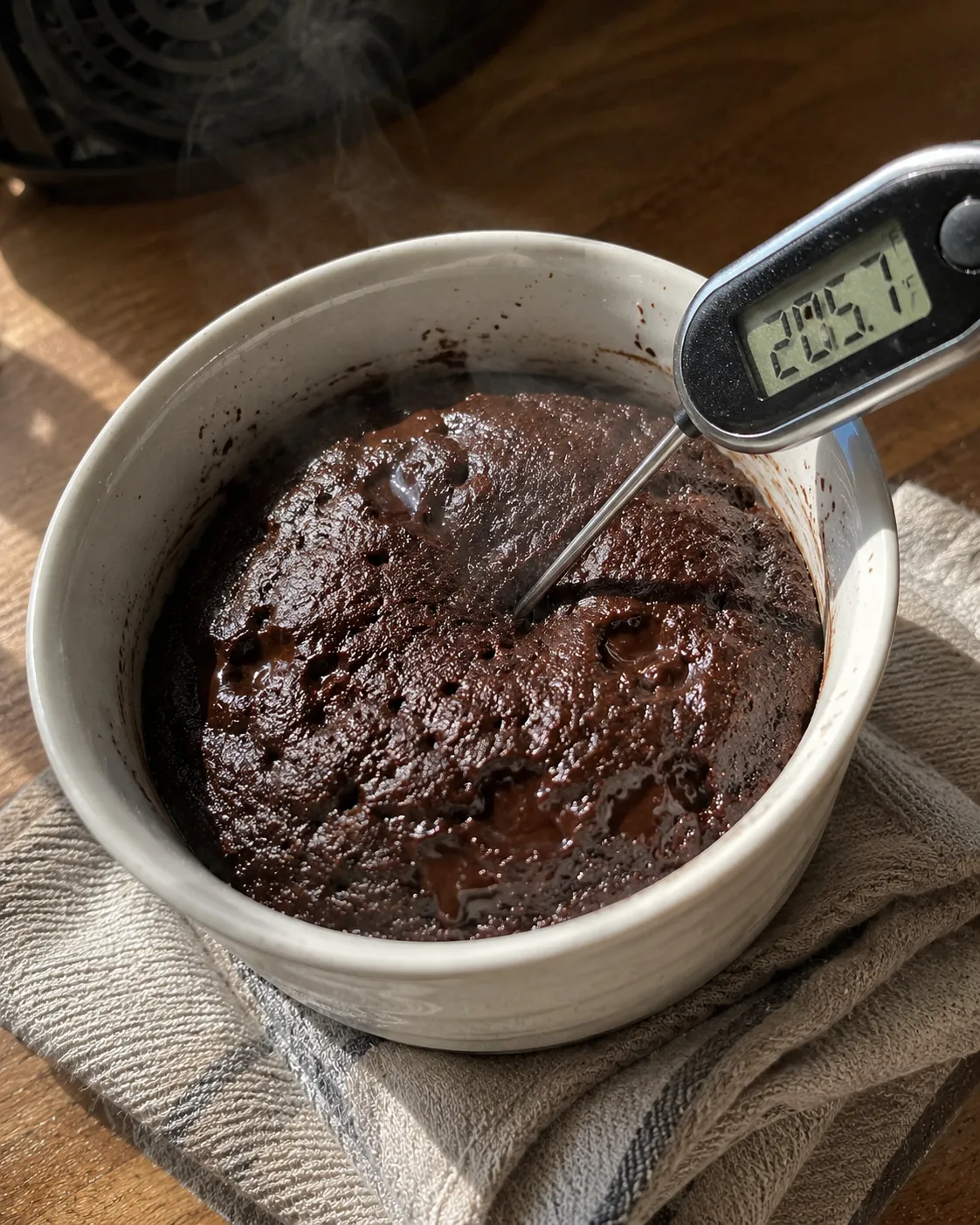
| 190°F | Fudgy. Dense, glossy, holds the mark of the spoon. This is the target. | Sticky crumbs |
| 195°F | Moist and cakey. Genuinely good, but it is a cake now. | A few moist crumbs |
| 200°F | A proper little chocolate cake. This is where our standard mug cake lands on purpose. | Clean |
| 205°F and up | Dry. And note the toothpick has been telling you it is ready since about 198. | Clean |
This is why the toothpick test is the wrong tool for this particular job. It is not that it lies. It answers a real question honestly, and that question is has the batter finished setting, which for a fudgy cake is exactly what you do not want. Internal targets for the rest of the site are collected in the air fryer baking chart.
There is a second problem with a toothpick here that has nothing to do with temperature. There is melted chocolate in this batter. A toothpick that goes through a soft chip comes out smeared no matter how baked the cake is, so people give it another two minutes, and then another, and end up at 210°F chasing a reading that was never going to happen.
Get an instant-read thermometer if you are going to make these often. A cheap one is about the price of two coffees and it turns every small bake on this site from guesswork into a number. On something that goes from fudgy to dry in ninety seconds, it is not a luxury. The glossary entry covers what to look for.
What actually makes a batter fudgy
Pulling early gets you most of the way. But if you pull a standard mug cake batter at 190°F you do not get fudgy, you get a slightly underdone cake, which is a different and worse thing. Fudginess is a property of the batter as well as the bake.
Three changes, and they all move in the same direction: less structure, more richness.
Less flour
Flour is the scaffolding. Take some away and there is less starch network holding the crumb open, so what you get is denser and closer together. Three tablespoons instead of four.
More fat
Fat coats the flour and physically blocks gluten strands from linking up. It also stays soft at room temperature, which is most of what reads on the tongue as fudgy rather than crumbly.
More sugar
Sugar is not only sweetness here. It holds onto water and gets in the way of the starch setting, so a high sugar batter stays moist at a temperature where a low sugar one has gone dry.
Put the two batters next to each other and the difference is easier to see than to describe.
| Standard mug cake | This fudgy one | |
|---|---|---|
| Flour | 4 tablespoons (30g) | 3 tablespoons (23g) |
| Butter | 1 1/2 tablespoons (21g) | 2 1/2 tablespoons (35g) |
| Sugar | 2 tablespoons (24g) | 3 tablespoons (36g) |
| Baking powder | 1/4 teaspoon | 1/8 teaspoon |
| Pull at | 200°F | 190°F |
| You get | A light, tender little cake | Dense, glossy, closer to a warm brownie |
Notice the fat and the sugar have both overtaken the flour by weight. That ratio is the actual definition of a brownie-ish crumb, which is why this ends up tasting like a single serving of our air fryer brownies rather than a slice of chocolate cake. Halving the baking powder matters too: lift is the enemy of dense.
And a yolk, no white
One egg yolk, and nothing of the white. Egg white is roughly 90 percent water and the rest is structural protein, both of which work against you here. In a portion this small the white takes over and gives you something springy and faintly omelette-like, which is the standard complaint about mug cakes and usually gets blamed on the microwave.
The yolk brings fat, and it brings lecithin, which is an emulsifier that keeps the butter and milk from separating in a batter this fat-heavy. Same reasoning as the extra yolk in our air fryer vanilla cake, just doing more work here because there is more fat to hold together.
Every one of the top recipes for this is eggless, incidentally. That is a legitimate choice and there is a good version of it in the variations below. It is just worth knowing that it is why so many of them come out with that slightly rubbery bounce.
Cocoa, and the swap that kills your rise
Two things about the cocoa, and the second one is the reason somebody's mug cake comes out flat and slightly soapy and they never work out why.
Bloom it in the hot butter
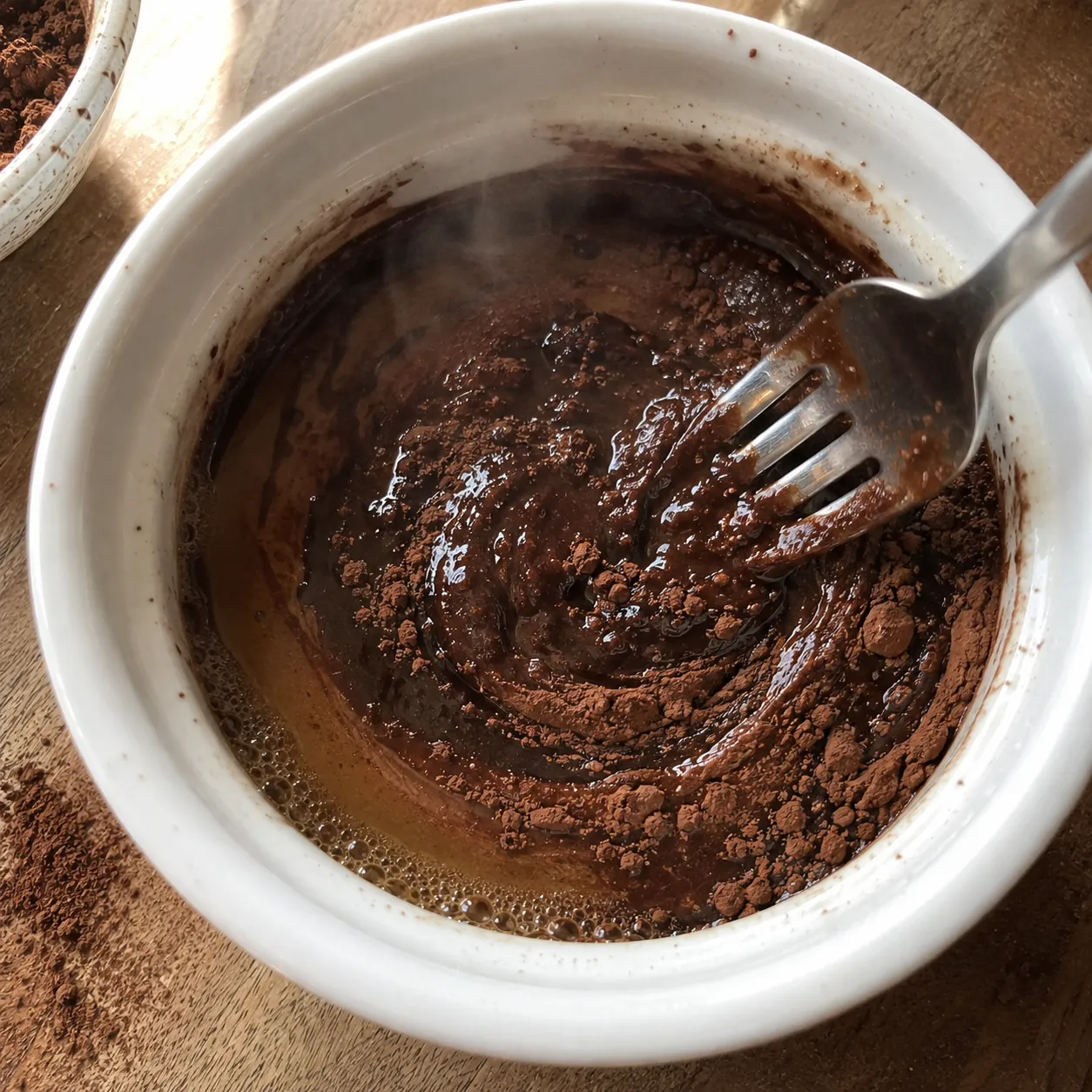
Melt the butter first, then stir the cocoa into it while it is still hot, before anything else goes in. It takes fifteen seconds and it is the single biggest flavor change on this page.
Cocoa powder is about a fifth fat and it carries a lot of its flavor in compounds that dissolve in fat rather than water. Stirred dry into flour and then hit with cold milk, most of that stays locked in the particles. Hot fat opens it up. Cocoa also contains around eleven percent starch, and warming it in liquid hydrates that starch, which is part of why bloomed cocoa tastes deeper and less dusty.
This is the one thing the better full-size chocolate cake recipes do and no mug cake recipe bothers with, presumably because it feels like a step too many for a five minute dessert. It is not. You are melting the butter anyway.
Natural or Dutch-process, and why it matters
Cocoa comes in two kinds and they are not interchangeable in every recipe.
| Cocoa | Roughly | With baking powder | With baking soda | Tastes |
|---|---|---|---|---|
| Natural (most US supermarket cocoa) | Acidic | Fine | Reacts and gives lift | Sharper, fruitier, lighter in color |
| Dutch-process (alkalized) | Close to neutral | Fine | Barely reacts. Flat, and unreacted soda tastes soapy | Mellower, deeper, much darker |
| Dark or special blends | In between | Fine | Partial reaction, unpredictable | Between the two |
The short version for this page: this recipe uses baking powder, so either cocoa works. That is deliberate. Baking powder brings its own acid, so it does not care what the cocoa is doing. If you ever swap Dutch cocoa into a recipe that leans on baking soda, that is where the flat, soapy result comes from. Baking soda versus baking powder has the longer version.
For looks, Dutch is worth buying if you want the near-black cake people photograph. For flavor at this size I slightly prefer natural, because the acidity cuts through all that butter. Neither is wrong.
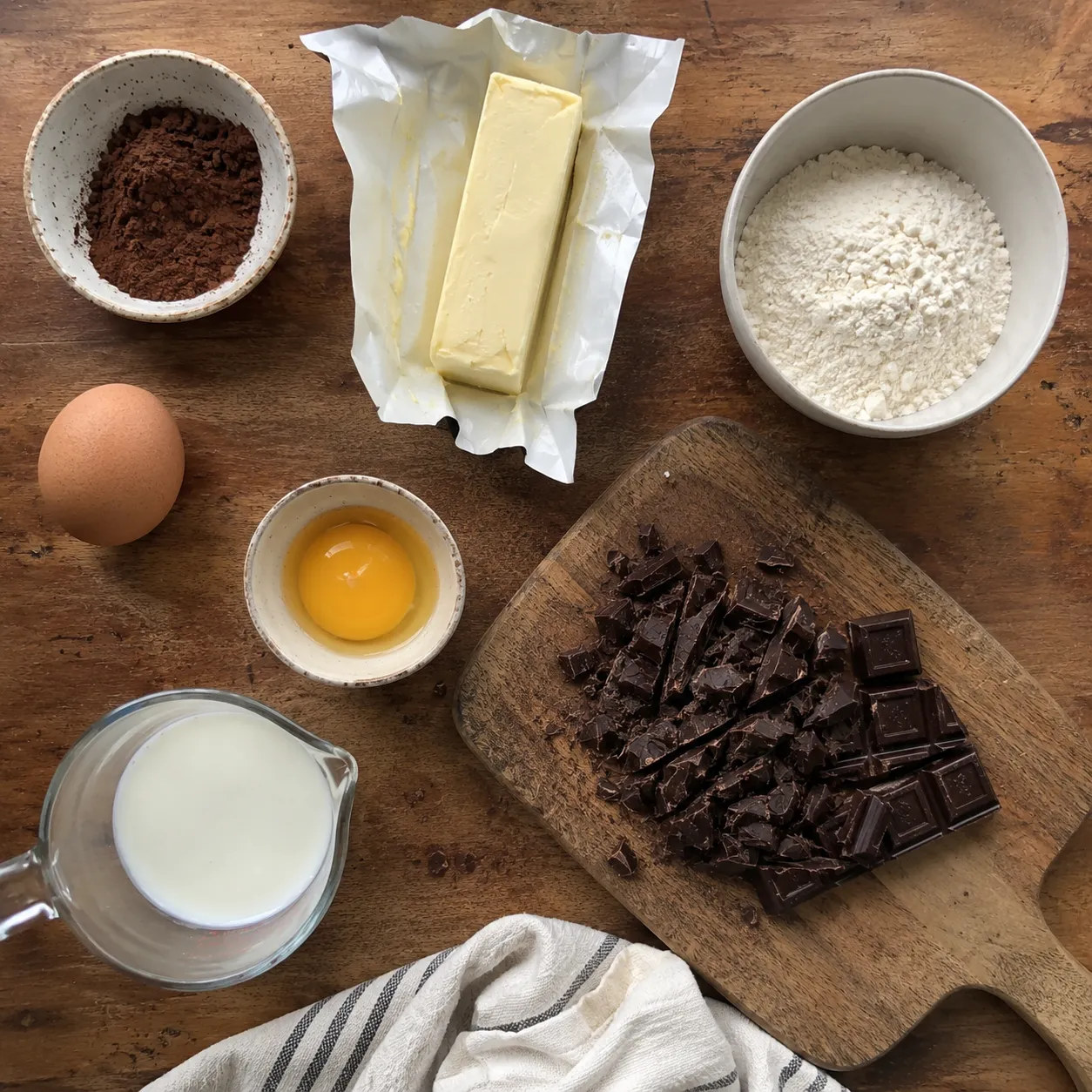
Ingredients
One serving. You can mix it directly in the ramekin and use no bowls at all.
- 2 1/2 tablespoons (35g) unsalted butter
- 2 tablespoons (10g) unsweetened cocoa powder
- 3 tablespoons (36g) granulated sugar
- 3 tablespoons (23g) all-purpose flour
- 1/8 teaspoon baking powder
- Pinch of salt
- 2 tablespoons (30ml) milk
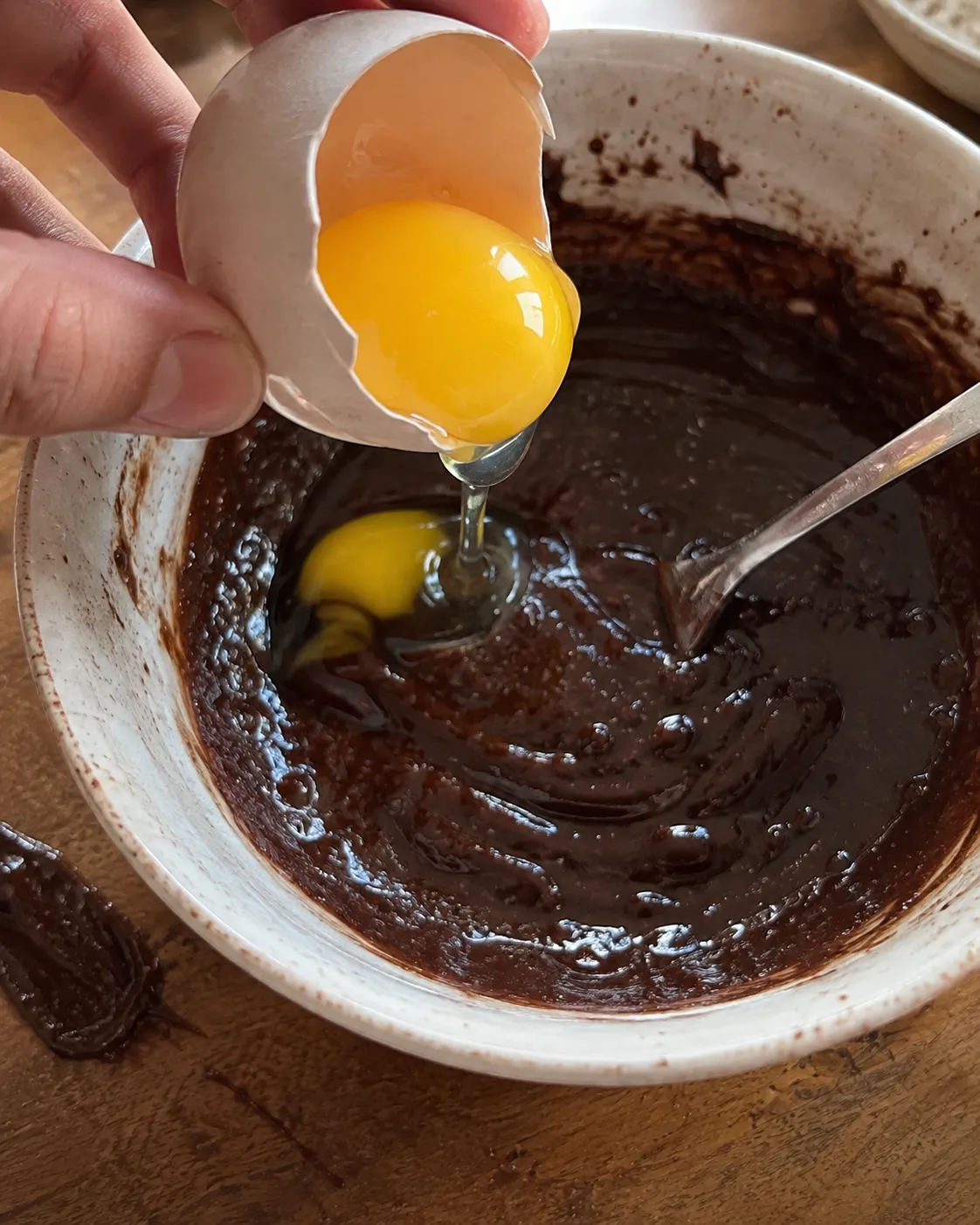
- 1 egg yolk, no white
- 1/2 teaspoon vanilla extract
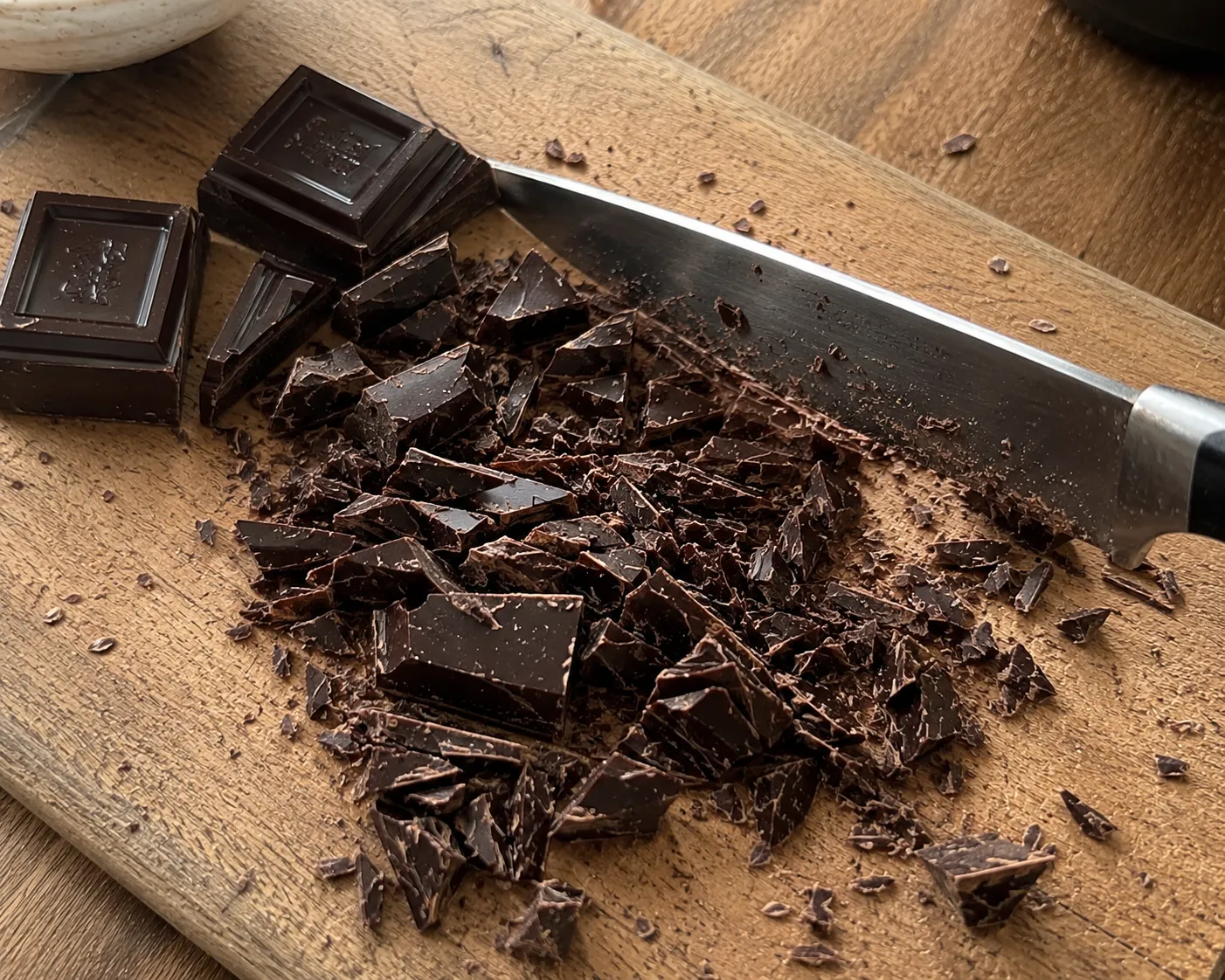
- 1 1/2 tablespoons (20g) chopped dark chocolate or chips
Chopped chocolate beats chips here. Chips are made with less cocoa butter and extra stabilizer specifically so they hold their shape in an oven, which is the opposite of what you want. Chopped bar chocolate actually melts into pockets.
How to make it
- Preheat to 330°F (165°C) for 3 minutes. Start it before you mix. On a six minute bake, the first two minutes going into warming a cold basket is a third of your cook time. Whether you need to preheat covers when it matters, and this is one of the clearest cases.
- Melt the butter in your 4 inch ramekin, about 25 seconds in the microwave, or in a small pan.
- Stir the cocoa into the hot butter until it is smooth and glossy. Fifteen seconds. Do not skip this.
- Stir in the sugar, then the milk, yolk and vanilla. It will look thin and slightly split at this point, which is normal.
- Add the flour, baking powder and salt and mix with a fork until the last dry streak disappears. About 20 seconds.
- Stop mixing. A little unevenness is fine. Beating it smooth develops gluten, and gluten is structure, and structure is the enemy of fudgy.
- Stir in most of the chopped chocolate, scattering the rest over the top.
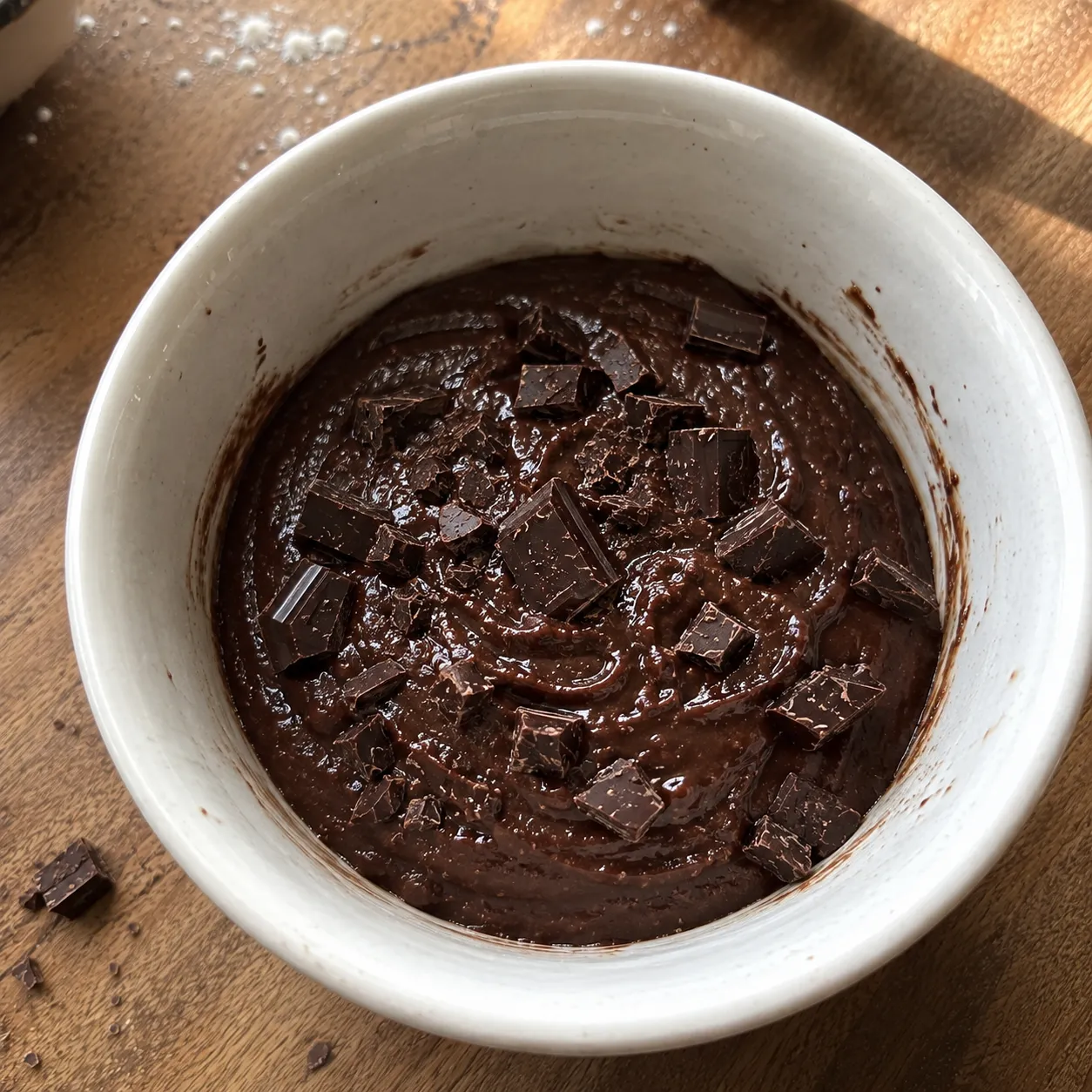
- Level it off. It should sit no more than halfway up the ramekin. This rises less than a normal mug cake because there is half the baking powder in it, but it still rises.
- Bake 6 to 7 minutes at 330°F. In an 8 oz mug, 12 to 15 minutes instead.
- Check at 6 minutes. Push an instant-read thermometer into the center. You want 190°F. At 185 give it 45 more seconds, not two minutes.
- Take it out and wait two minutes. The hot ramekin keeps cooking it, and this is built into the 190 target rather than being an afterthought.
- Eat it out of the dish with a spoon, ideally with something cold on top.
Why 330°F and not 350. Our standard mug cake runs at 350°F, and that is right for it, because it is baking all the way through to 200 and a hotter oven gets there faster. This one is stopping ten degrees short, which means the gap between the outside and the middle has to be smaller or the edges will be dry by the time the center is fudgy. Twenty degrees cooler buys you a more even bake and roughly a minute more room for error. If you are converting somebody else's oven recipe rather than starting here, put its numbers through the air fryer calculator first, then ignore the time it gives you and go by 190°F.
Ramekin, mug or silicone
The published times for air fryer chocolate mug cakes run from ten minutes to sixteen, and it is not machine variation. It is what people baked in, and hardly anybody says so.
Heat has to travel from the surface to the middle, and time through a solid goes roughly with the square of the distance. Batter that sits twice as deep does not take twice as long, it takes about four times as long. A wide shallow dish and a tall narrow mug hold identical batter at completely different depths. Our five minute mug cake is built entirely around this point if you want it in full.
| Vessel | Batter depth | Time at 330°F | Notes |
|---|---|---|---|
| 4 inch ramekin | About 3/4 inch | 6 to 7 min | The recipe as written. Even, easy to probe |
| 3 inch ramekin | About 1 1/4 inch | 9 to 11 min | Good, a little denser at the base |
| 8 oz mug | About 1 1/2 inch | 12 to 15 min | Works, but the top is well past 190 before the middle arrives |
| Silicone ramekin | About 3/4 inch | 8 to 9 min | Silicone insulates. Drop 10°F and add 2 minutes |
All four hold the same batter. Only the shape changes. A tall mug is the worst case for a fudgy cake specifically, because the further apart the surface and the center are, the wider the temperature spread between them, and you are trying to stop in a narrow band. Using silicone molds in an air fryer covers the silicone adjustment, and the pan size calculator will tell you what fits your basket.
If you are using an actual mug, it has to be oven safe. Microwave safe is a different and lower standard and it does not qualify. A microwave heats what is inside the mug. An air fryer heats the mug itself to 330°F from the outside, and plenty of mugs that live happily in a microwave will craze or crack under that. Nothing with a painted or metallic finish, nothing with a glued handle, and nothing straight out of a cold cupboard.
Fixing what goes wrong
| What you got | Why | Fix |
|---|---|---|
| Dry, and cakey rather than fudgy | Baked to a clean toothpick, which is about 198°F. | 190°F and a thermometer. This is the whole page. |
| Fudgy in the middle, dry at the edges | Temperature too high, so the outside ran away from the middle. | 330°F, not 350. A wider, shallower dish helps too. |
| Actually raw, not fudgy | Pulled well under 185°F. | Back in for a minute. There is no harm in checking twice. |
| Rubbery and bouncy | Whole egg. Far too much white for a portion this small. | Yolk only, or go eggless properly. See the variations. |
| Tough and chewy | Overmixed. Gluten develops fast in a small amount of batter. | Stop when the flour disappears. Twenty seconds. |
| Flat and slightly soapy | A recipe using baking soda, made with Dutch-process cocoa. | Use baking powder, as here, and it stops mattering. |
| Greasy, with butter pooling | The batter split. Usually a cold yolk into hot butter. | Let the butter cool 30 seconds before the yolk goes in. |
| Dusty, weak chocolate flavor | Cocoa went in dry with the flour. | Bloom it in the hot butter first. |
| Chips stayed hard | Baking chips are stabilized to hold their shape. | Chop a bar instead. |
| Sank into a crater | Pulled before the structure could hold itself up. | 190°F. More in why air fryer cakes sink. |
| Overflowed onto the element | Filled past half. | Halfway is the ceiling. See fill level. |
If dryness is a pattern across your bakes rather than just this one, how to avoid dry air fryer bakes covers the general causes and the troubleshooting guide has the rest.
Variations
- Molten center. Push a square of chocolate or a teaspoon of Nutella into the middle before baking and pull at 185°F instead of 190. Effectively a single serving of our air fryer lava cake.
- Eggless, done properly. Leave the yolk out and add another tablespoon of milk plus half a teaspoon of oil. Pull at 188°F, because without the yolk there is less protein setting and it firms up less on the counter. This is genuinely good, and it is closer to a warm brownie than the version with the yolk.
- Double chocolate. Swap a tablespoon of the flour for another tablespoon of cocoa and add a teaspoon of milk to make up for how thirsty cocoa is.
- Espresso. A quarter teaspoon of instant espresso powder into the hot butter with the cocoa. It does not taste of coffee at that dose, it just makes the chocolate read darker.
- Salted. Flaky salt over the top as it comes out, not stirred in. All that butter and sugar takes it well.
- Peanut butter. A tablespoon swirled in at the end, and drop the butter to 2 tablespoons since the peanut butter brings its own fat.
- Make it two. It doubles cleanly into two ramekins side by side and the time does not change as long as they are not touching. The recipe scaler handles other multiples.
For the same idea in a batch rather than a single serving, air fryer brownies are the obvious next stop, and air fryer chocolate chip cookies use the same underbake-on-purpose thinking with a different set of numbers.
Making it ahead
A mug cake is a now food. That is the trade you make for a five minute dessert and it is worth being straight about.
- Eat it within about ten minutes. A fudgy one has an even shorter window than a cakey one, because what makes it fudgy is soft fat, and soft fat firms up as it cools. At twenty minutes it is a decent brownie. At an hour it is a dense little puck.
- Do not refrigerate it. Cold sets the butter solid and takes the fudginess with it.
- The dry mix keeps. Whisk the flour, sugar, cocoa, baking powder and salt in a jar, multiplied by however many you want. Then it genuinely is a five minute dessert. Note that you lose the blooming step this way, so add a splash of the hot butter to the dry mix first and stir before the rest goes in.
- Do not mix the full batter ahead. Baking powder starts working the moment it meets liquid, and there is only an eighth of a teaspoon in here to begin with.
Running an air fryer for nine minutes including the preheat costs very little, and against heating a full oven for one small cake it is not close, but if you want the actual figure for your electricity rate the running cost calculator will work it out. All four air fryer tools are in one place, what you can and cannot bake in an air fryer is the honest list if you are wondering what else is worth trying, and the full recipe index has everything else.
Frequently asked questions
QHow do you make an air fryer chocolate mug cake fudgy instead of dry?
Stop baking it sooner, and change the batter to suit. Pull it at 190F in the center rather than baking until a toothpick comes out clean, because a toothpick only goes clean at around 198F, which is already past fudgy and heading for dry. Then shift the ratio: less flour, more butter and more sugar than a standard mug cake, so there is less starch structure and more soft fat holding it together. Halve the baking powder as well, since lift works against density. Do both and you get something closer to a warm brownie than a slice of cake.
QWhat temperature should a chocolate mug cake be inside?
190F in the center for fudgy. The few degrees on either side genuinely matter: 185F gives you a molten middle that runs when you cut it, 195F is moist and cakey, and 200F is a proper little chocolate cake. Past about 205F it is dry. Push an instant-read thermometer straight into the middle at six minutes. Take it out at 190 rather than waiting for it to look done, because a hot ceramic ramekin carries on cooking the cake for another minute or two on the counter, and that carryover is already built into the 190 target.
QWhy does my mug cake come out dry when I follow the recipe?
Almost always because the recipe told you to bake until a toothpick comes out clean. That instruction is inherited from full-size cakes, where it is fine, and it corresponds to roughly 198 to 205F internal. A fudgy mug cake is finished at 190. So following it correctly walks you eight degrees past what you were promised. There is a second trap on top of that: this batter has melted chocolate in it, and a toothpick that goes through a soft chip comes out smeared however baked the cake is, so people keep adding minutes chasing a clean reading that will never arrive.
QShould I use Dutch-process or natural cocoa powder?
For this recipe either one works, and that is on purpose. It uses baking powder, which brings its own acid, so it does not care what the cocoa is doing. The difference matters when a recipe leans on baking soda instead. Natural cocoa is acidic and reacts with baking soda to produce lift. Dutch-process cocoa has been alkalized to close to neutral, so it barely reacts, and the soda that never reacts tastes faintly soapy. That combination is where a flat, oddly flavored chocolate cake usually comes from. For taste, Dutch is mellower, deeper and much darker, and natural is sharper and fruitier, which cuts through the butter nicely at this size.
QWhat does blooming the cocoa do, and is it worth it?
Yes, and it costs fifteen seconds. Melt the butter, then stir the cocoa into it while it is still hot, before anything else goes in. Cocoa powder is around a fifth fat and carries much of its flavor in compounds that dissolve in fat rather than water, so stirring it in dry and then adding cold milk leaves most of that locked inside the particles. Hot fat releases it. Cocoa also contains about eleven percent starch, and warming that in liquid hydrates it, which is part of why bloomed cocoa tastes deeper and less dusty. Full-size chocolate cake recipes do this routinely. Mug cake recipes almost never bother, even though you are melting the butter anyway.
QHow long does a chocolate mug cake take in an air fryer?
6 to 7 minutes at 330F in a 4 inch ramekin, plus 3 minutes to preheat. In an actual 8 oz mug it is 12 to 15 minutes, and that is not your machine being slow. Published times for this run from 10 to 16 minutes and the spread is almost entirely down to what people baked in without saying so. The same batter sits about three quarters of an inch deep in a wide ramekin and an inch and a half deep in a mug, and heat travel time goes roughly with the square of the distance, so twice the depth is about four times the bake.
QCan I make this without eggs?
Yes, and the eggless version is very good. Leave the yolk out, add another tablespoon of milk and half a teaspoon of oil to replace the fat, and pull it a touch earlier at 188F, because without the yolk there is less protein setting so it firms up less as it sits. The result is denser and closer to a warm brownie. Worth knowing: every one of the top-ranking recipes for air fryer chocolate mug cake is eggless, and several of them come out with a slightly rubbery bounce. That is not the missing egg, it is usually overbaking. Handle the temperature and eggless is a real option rather than a compromise.
QWhy a yolk instead of a whole egg?
Egg white is roughly 90 percent water and the rest is structural protein, and in a portion this small it takes over. You end up with something springy and faintly omelette-like, which is the usual complaint about mug cakes and normally gets blamed on the microwave. The yolk brings fat and it brings lecithin, an emulsifier that holds the butter and milk together in a batter with this much fat in it. In a fudgy cake specifically the white is working directly against you, because setting protein is structure and structure is what you are trying to have less of.
QIs this the same as your five minute mug cake?
No, and they are worth keeping apart. The five minute mug cake is a light, tender little chocolate cake baked at 350F all the way through to 200F internal, and it is built around getting five minutes to be honestly true. This one is a different dessert: heavier batter with more butter and sugar than flour, half the baking powder, baked cooler at 330F and stopped ten degrees earlier at 190F. One gives you cake, the other gives you something much closer to a warm brownie in a dish. If you want the light version, or the full argument about why a mug takes fourteen minutes and a ramekin takes five, that is the other page.
QCan I use chocolate chips instead of chopped chocolate?
You can, but chopped bar chocolate is genuinely better here and the reason is in how chips are made. Baking chips are formulated with less cocoa butter and extra stabilizers specifically so they keep their shape through an oven bake, which is exactly the opposite of what you want in a fudgy mug cake. Chopped bar chocolate melts into real pockets that run when you put a spoon in. If chips are what you have, use them and expect them to soften rather than melt, and chop them roughly first with a knife to help them along.
QAir fryer or microwave for a chocolate mug cake?
A microwave takes 90 seconds and an air fryer takes 6 minutes plus 3 to preheat, so the honest question is what the extra time buys. A microwave agitates the water throughout the batter at once, which steams it: the texture comes out uniform and springy, and the surface never gets above 212F so nothing browns. An air fryer bakes it from the surface inward, which gives you a thin baked top with real color and a slightly crisp edge where the batter met the dish. For a fudgy cake the air fryer has a second advantage that matters more: the microwave window is a matter of seconds, while the air fryer gives you closer to a minute either side of the target.
QDo I have to preheat the air fryer for this?
Yes, three minutes at 330F. On a six minute bake the preheat is not a nicety. A cold start means the first couple of minutes go into warming the basket and the ramekin rather than the cake, which is a third of your cook time spent at an unknown and rising temperature. That makes the clock meaningless, and on a bake where you are trying to stop inside a narrow band, meaningless timing is the whole problem. Preheat, then go by the 190F reading rather than the minutes, and the starting conditions stop mattering.
Never overbake again
Get our one-page times & temps cheat sheet, plus a new tested recipe each week.
No spam · unsubscribe anytime