

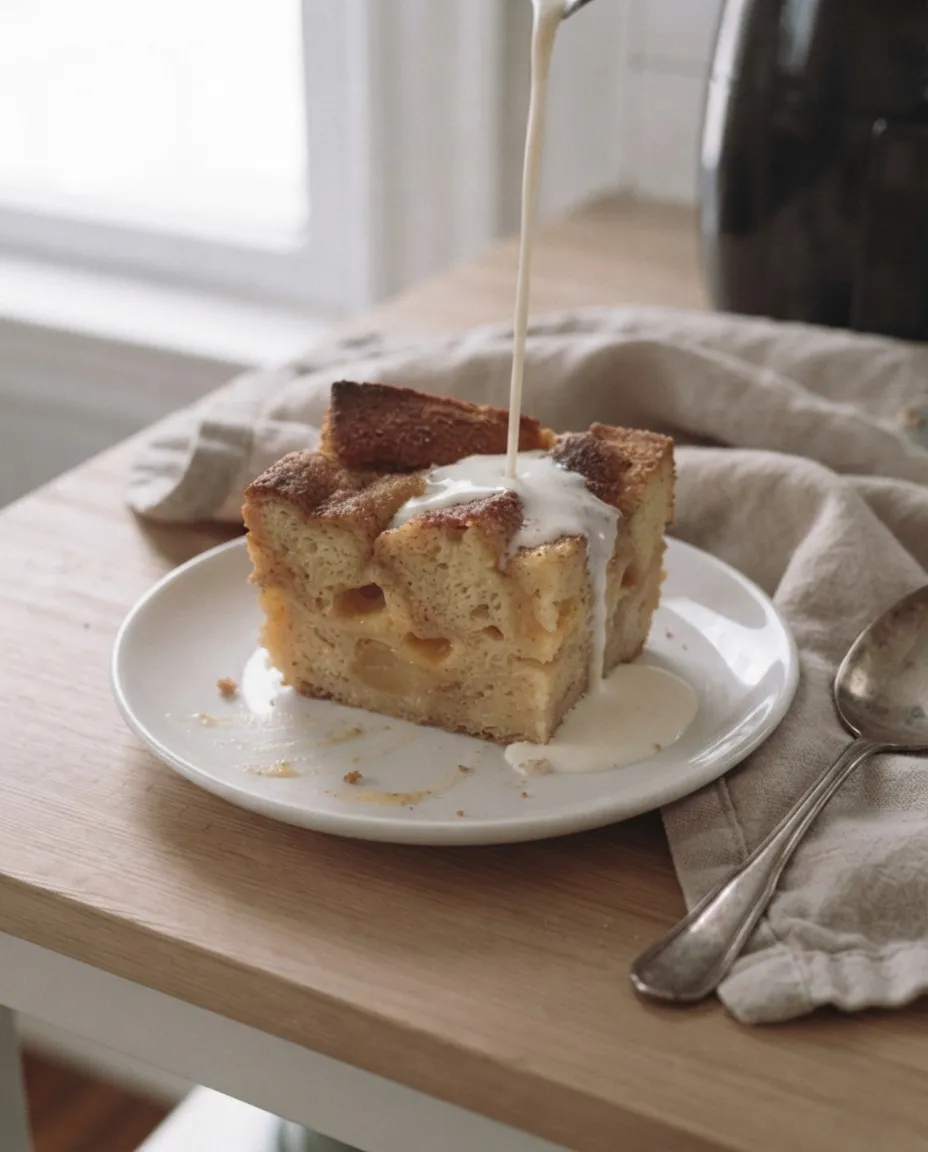
Bread pudding is what thrift tastes like when it dresses up. Stale bread, eggs, milk, sugar: the four cheapest things in the kitchen, and somehow the result gets served in restaurants with a candle on the table. My grandmother would have called the restaurant markup a scandal. She would also have inspected an air fryer version with deep suspicion, and on the evidence of my first three attempts, she would have been right to.
Attempt one had a gorgeous crackled top over a center of warm milk. Attempt two fixed the center and burned the top to mahogany. The machine was not being difficult; it was being honest about a contradiction the oven versions hide. A custard center and a crisp top want opposite kinds of heat, and an air fryer delivers whichever one you ask for with such enthusiasm that the other loses. The fix is not a compromise temperature. It is a schedule that gives each texture its own shift, plus a soak long enough that the bread stops being the wild card.
Quick answer: Cube 5 cups of day-old bread (or dry fresh cubes 8 minutes at 300°F), then soak them in the custard, 3 eggs to 1 1/2 cups dairy, for a full 20 minutes, pressing once. Bake in a buttered 7 inch pan covered with foil at 310°F for 15 minutes, then uncovered at 340°F for 7 to 9 minutes until the top is chestnut and the center reads 175°F with a bouncy, unified jiggle. Rest 15 minutes; the custard finishes setting on the counter.
One dessert, two opposite demands
The center is a custard
Eggs and dairy that set into a tender, sliceable middle at 175°F and curdle into scrambled sweetness not far beyond it. It wants low heat, protection from the fan, and a thermometer to call the finish.
The top is toast
Butter-brushed bread corners that want direct, moving, dry heat, the exact thing custard fears. No oven crisps a bread pudding top like an air fryer fan; it just has to be allowed in at the right moment.
The bread is the wild card
Underhydrated cubes float as dry pockets; oversoaked fresh bread collapses to porridge. The bench and the soak below turn the wild card into a constant.
Most recipes bake this dessert in one uncovered stretch and let the fan decide who wins. The fan always picks the top. This page splits the bake instead, and the split is the whole trick.
The bread bench
- Best in show: brioche or challah, a day old. The eggy crumb drinks custard without dissolving and tastes like it was born for this.
- The everyday pick: soft French or Italian loaf. Sturdier, a little humbler, completely reliable. A few leftover dinner rolls, cubed, fall in the same camp.
- The house favorite: yesterday's heels of the no-knead loaf. A crusty artisan loaf needs 5 extra minutes of soak, and repays it with corners that crisp like croutons.
- Avoid dense seeded loaves, which never surrender, and pre-sliced sandwich bread, which surrenders instantly and completely.
- No stale bread? The machine makes its own. Spread fresh cubes in the basket, 8 minutes at 300°F, shaking once, until dry to the touch but not colored. Staling is just moisture loss with extra waiting, and the air fryer is a moisture-loss appliance. This step is why the recipe never has to wait for Tuesday's bread to age.
The soak is the recipe
Here is where the ranking air fryer recipes quietly fail. They stir bread into custard and bake within five minutes, because the machine is fast, so the recipe should feel fast too. But dry bread drinks slowly, exactly like the cornmeal in the corn muffins, and custard that has not been absorbed does not become custard-soaked bread in the bake. It becomes a puddle with croutons in it, which is the soggy-middle complaint in its entirety.
So the soak gets the respect the bake usually hogs: 20 minutes in the bowl, with one firm press at minute 10 to submerge the floaters and open the stubborn cubes. The finished mixture should look overhydrated, glossy and slumped, with no white dry pockets when you press a cube in half. A 20 minute soak feels long next to a 24 minute bake; that ratio is the recipe working. And if the evening gets away from you, the soak holds overnight in the fridge, which quietly turns this into the best make-ahead breakfast on the site.
The custard math, and the 175 rung
The custard is 3 eggs to 1 1/2 cups of dairy, a cup of whole milk plus a half cup of cream, with a third cup of brown sugar, vanilla, cinnamon and salt. That is one egg per half cup of liquid, richer than the loose one-per-cup formula older recipes use, because a sliceable center needs the extra structure and the air fryer's short bake gives loose custards nowhere to hide.
Regular readers know where this is going: the custard ladder. The cheesecake finishes at 170°F, the pumpkin pie at 175°F, the sugar-heavy pecan pie at 200°F. Bread pudding is a spiced milk custard like the pumpkin, so it shares the pumpkin's rung: 175°F at the center, read on an instant-read thermometer pushed to the middle of the pan. Past 185°F the eggs seize and the pudding weeps whey; under 170°F the center pours. The window is real, and the thermometer costs less than the cream.
Covered, then naked
The muffin pages on this site run a two-temperature schedule downhill, hot then gentle, to throw a dome. This bake runs the same idea uphill, gentle then hot, because the priorities are reversed: structure first, spectacle second.
- Phase one: 310°F, foil on, 15 minutes. The foil is pressed over the pan rim, a lid, not a tent, and under it the custard sets in still, humid calm while the fan howls uselessly outside. No skin forms, no top browns ahead of schedule, and the machine needs no preheat because gentle is the goal; the preheat guide keeps that roster. Foil legality and technique live in the foil and parchment guide.
- Phase two: foil off, 340°F, 7 to 9 minutes. Now the fan gets its shift: the sugared top corners fry to chestnut while the nearly-set center coasts the last few degrees to 175°F. The order matters; a top crisped first just gets steamed soft from below while the middle catches up.
- The honesty note: oven bread pudding bakes at 350°F, which the air fryer calculator converts to about 325°F. This schedule brackets that number on purpose, 310°F while the custard is exposed to risk, 340°F once it is nearly set and can afford the drama. The conversion is the anchor; the split is the judgment. The full ledger lives in the air fryer baking chart.
How to make it
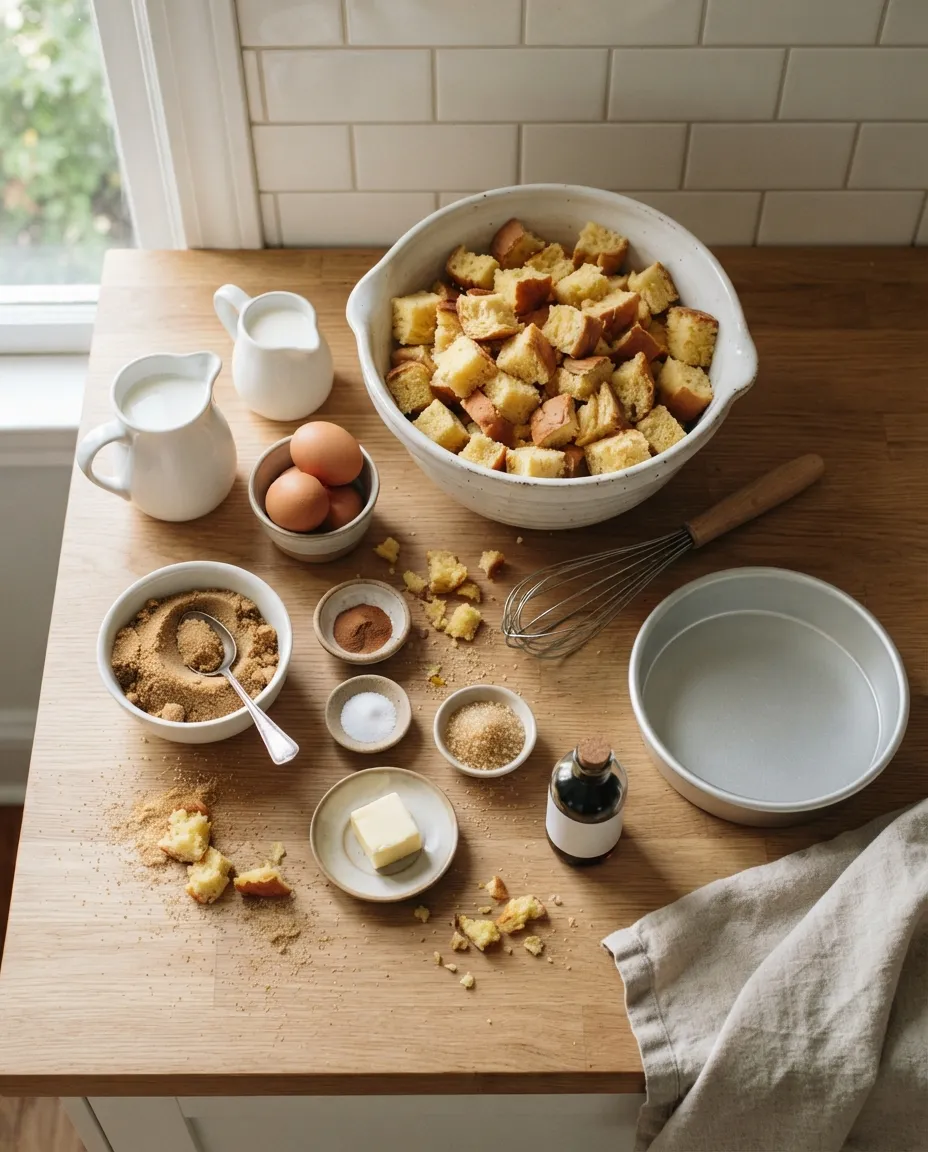
- Stale check: day-old cubes proceed; fresh cubes get 8 minutes at 300°F in the basket, shaken once, until dry but pale. You want 5 cups, about 1 inch square.
- Whisk the custard: 3 eggs, 1 cup whole milk, 1/2 cup cream, 1/3 cup brown sugar, 1 1/2 teaspoons vanilla, 1 teaspoon cinnamon, 1/4 teaspoon salt.
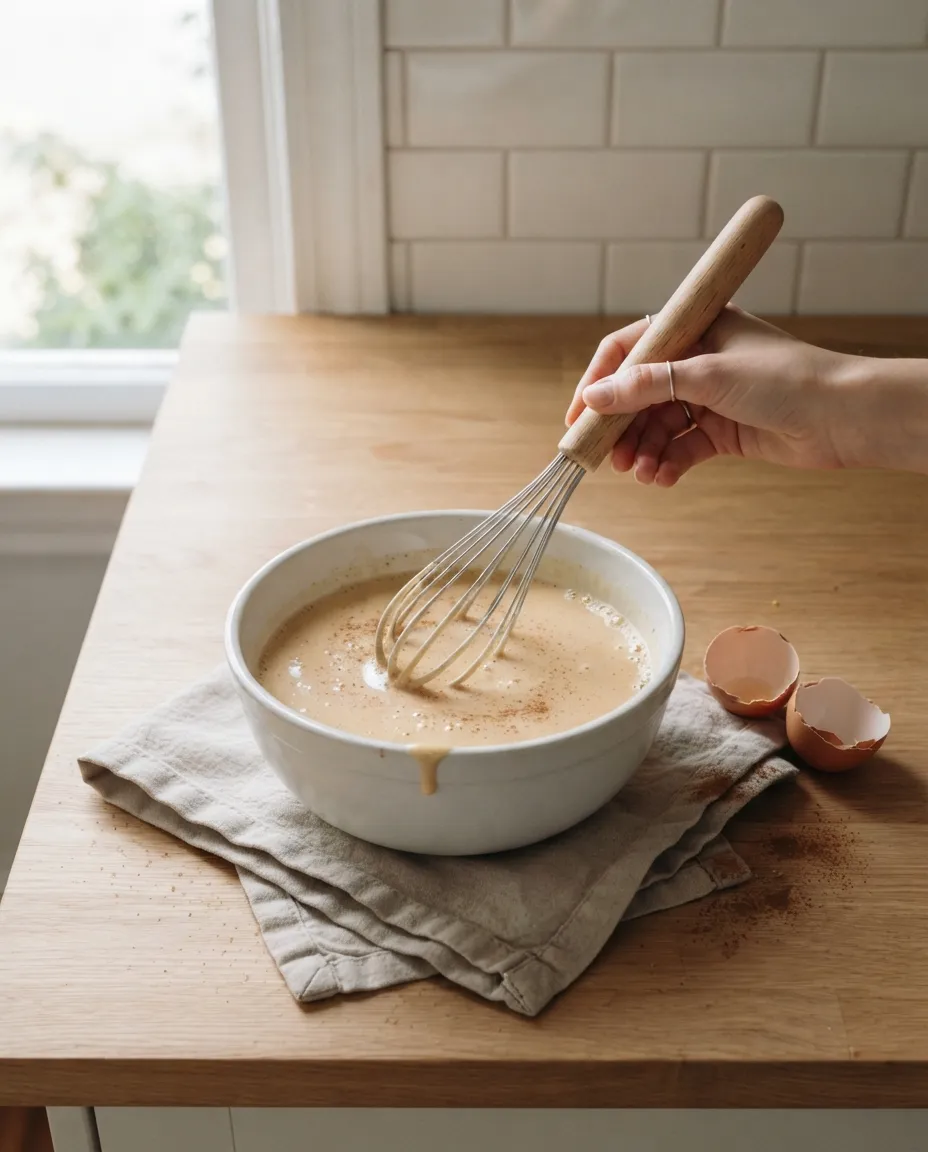
The custard, whisked until the egg disappears and the cinnamon is evenly spread. - Soak 20 minutes: cubes into custard, one firm press at minute 10. Every cube glossy, no dry cores. Raisins or chocolate go in now if they are coming.
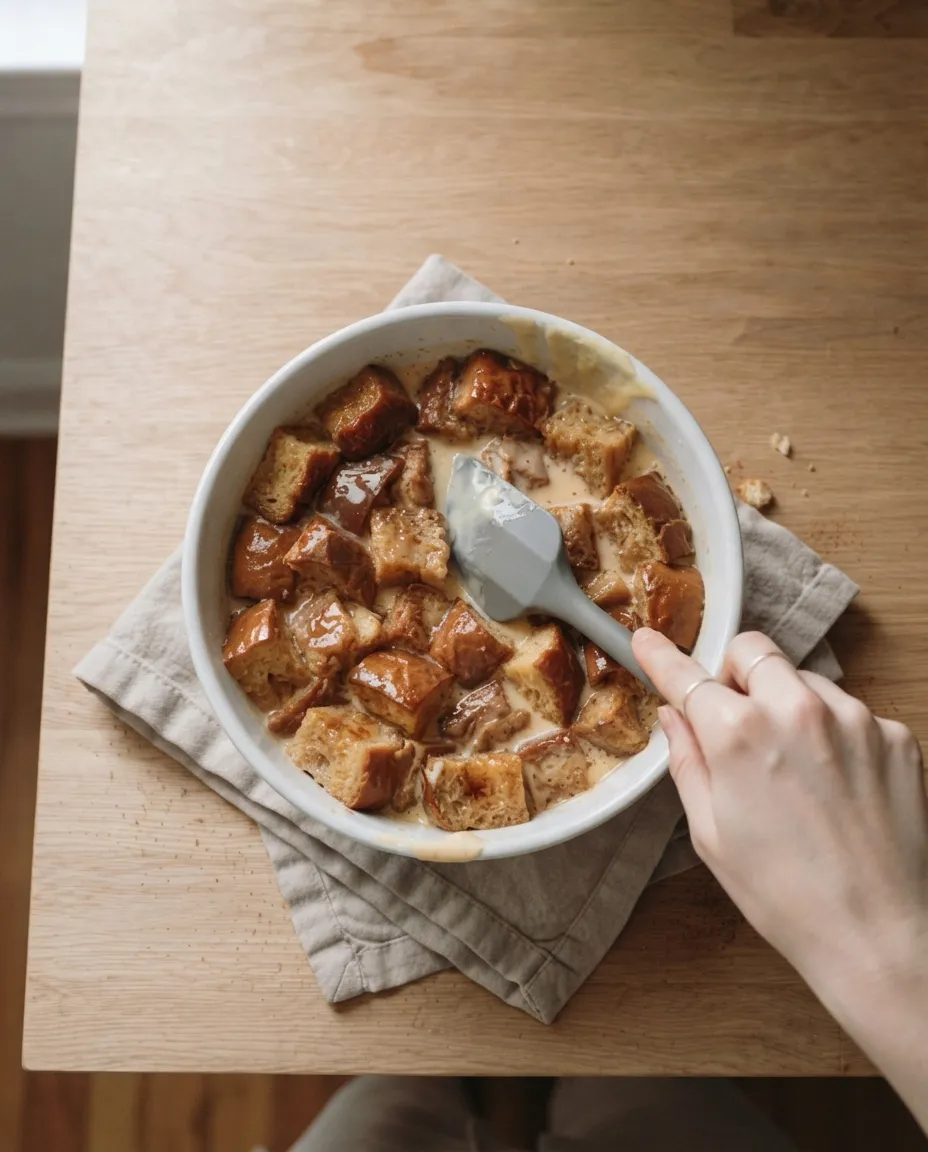
The press at minute 10: every cube pushed under once so none keeps a dry core. - Butter the 7 inch pan generously, including the sides; those buttered edges become the crust people fight over. Check the fit against the pan size calculator if the pan is new to the basket.
- Transfer, then tilt the last of the bowl's custard over the top, drizzle with the melted butter, and scatter the turbinado sugar.
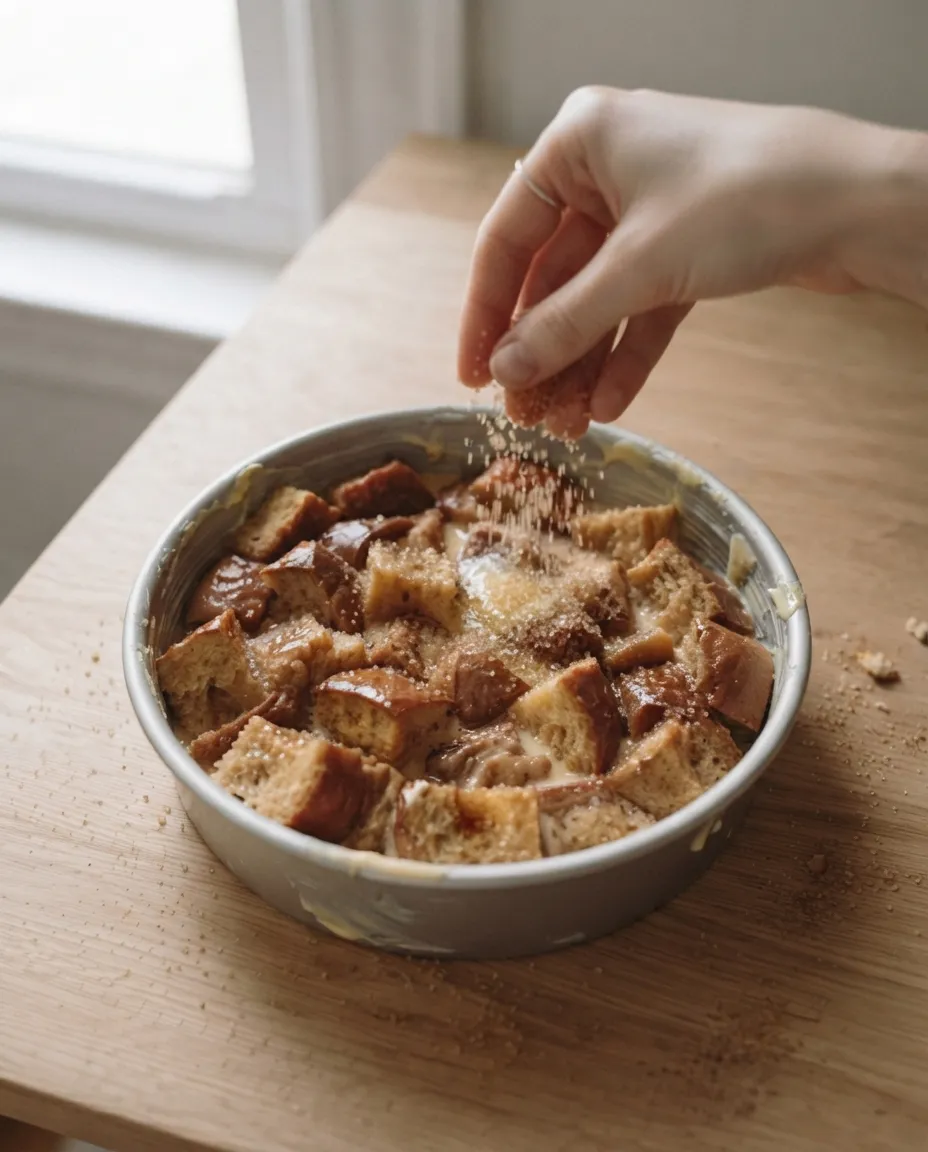
In the buttered pan, the last of the custard poured over, then turbinado sugar on the peaks. - Foil on tight, 310°F, 15 minutes, no preheat.
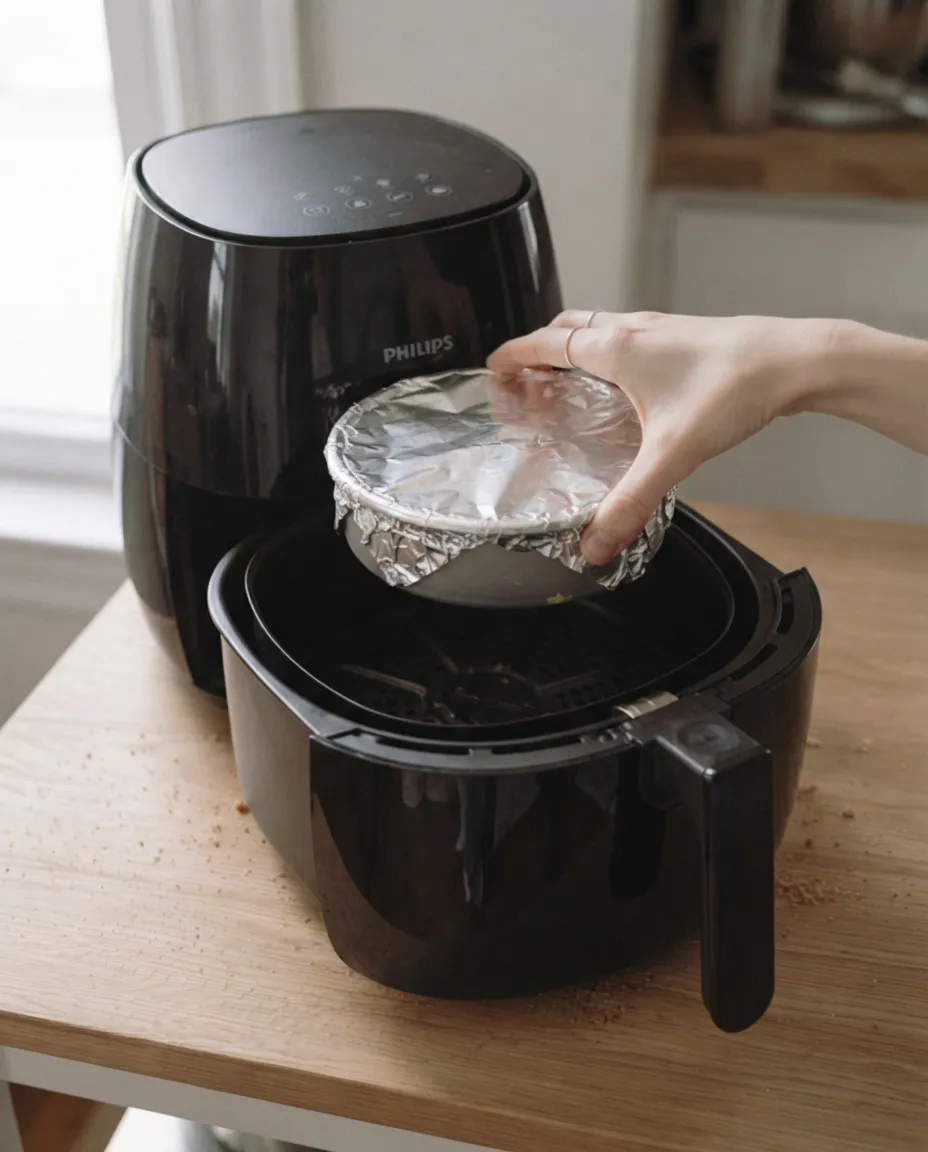
Phase one: foil on tight, into the cold machine at 310°F. - Foil off, 340°F, 7 to 9 minutes, until the peaks are deep chestnut and the pan's center reads 175°F. Short? Two-minute rounds, uncovered.
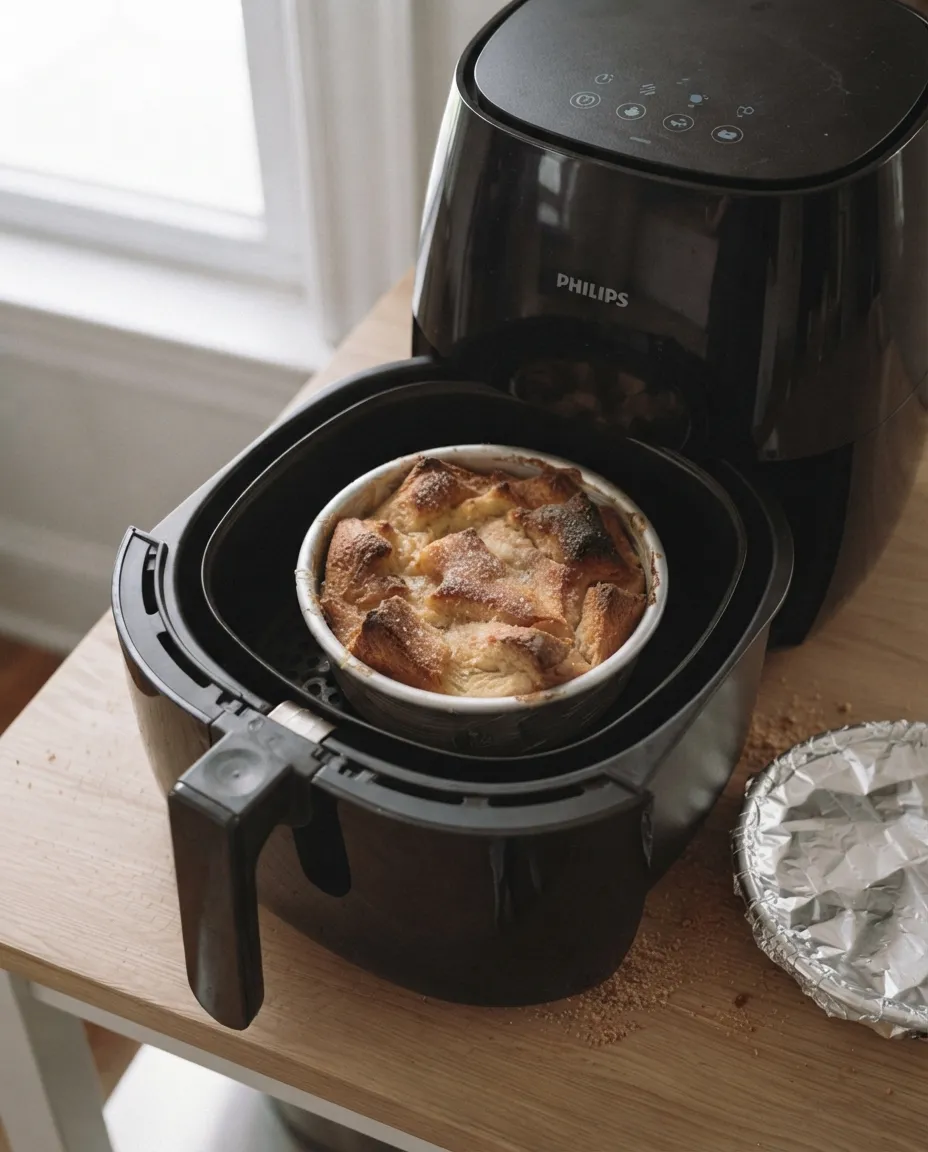
Phase two, foil off: the peaks have gone chestnut. The thermometer in the center decides when it comes out, at 175°F. - Rest 15 minutes on a rack. The jiggle firms into slices as it cools through the 160s, and carryover does the last of the setting for free.
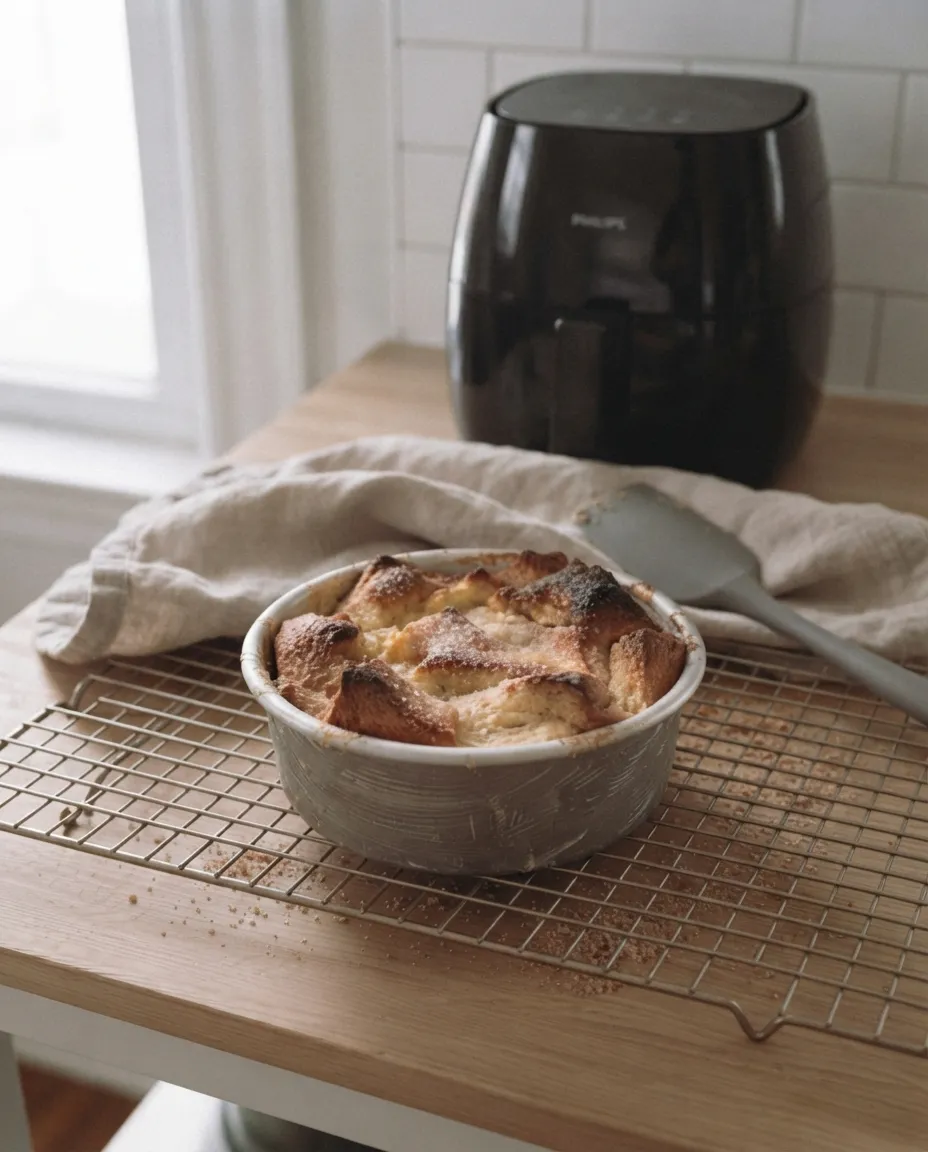
Fifteen minutes on the rack. The center firms enough to slice cleanly.
Doneness: the toothpick meets its match
Bread pudding is the dessert the toothpick test was least designed for. The pick comes out of a perfect pudding wet, because it passed through moist custard-soaked bread, and it comes out of an underbaked one looking similar, because wet bread and liquid custard read the same on a splinter of wood. Every recipe that says "toothpick comes out clean" is describing an overbaked pudding without knowing it.
- The number: 175°F at the center. Probe from the top at a slight angle; the hole vanishes into the rubble. This is the entire verdict, and everything else below is corroboration.
- The bounce: nudge the pan and the center should move as one piece, a bouncy unified jiggle like the pumpkin pie's, not ripples chasing each other under the surface.
- The peaks tell the top's story: chestnut corners and an audible dry rustle when tapped with a spoon. Pale peaks mean the naked phase deserves 2 more minutes regardless of what the center says.
- Then the rest does the slicing. Fifteen minutes turns spoonable into sliceable; serving straight from the machine is legal but it is a ladle situation, best embraced deliberately with cold cream poured over.
Troubleshooting
| What you got | Why | Fix |
|---|---|---|
| Soggy, liquid middle | The soak got minutes instead of twenty, or the pull beat the thermometer. | Full 20 minute soak with the press, and 175°F before anything leaves the machine. |
| Burnt top, loose center | One uncovered bake let the fan pick a winner. | The schedule: covered 310°F first, naked 340°F second. Never the reverse, never all-naked. |
| Weeping, curdled custard | Overshot past 185°F; the eggs seized and squeezed out their liquid. | Pull at 175°F and let carryover finish. The window between silk and scramble is ten degrees. |
| Dry pockets of pale bread | Cubes too big, soak too short, or floaters never pressed under. | Inch cubes, the minute-10 press, and no cube leaves the bowl with a white core. |
| Collapsed to mush | Fresh soft bread went in undried and dissolved. | The 8 minute staling run at 300°F. The machine makes its own stale bread; let it. |
| Top soft by serving time | Rested under the foil, which steamed the crackle away. | Rest uncovered on a rack. The foil's job ended when phase one did. |
| Stuck to the pan | Butter applied like a suggestion. | Butter like you mean it, sides included, and run a knife around before the rest. |
| One corner dark | A machine hot spot. | Half turn when the foil comes off, and the burning guide for the map. |
Failures that follow you between recipes live in the troubleshooting guide.
Variations
- Bourbon raisin: 1/2 cup raisins soaked in 2 tablespoons of warm bourbon while the bread soaks in its custard. Everyone spends 20 minutes drinking; it is only fair.
- Chocolate chunk: 1/2 cup bittersweet chunks folded in at the end of the soak. They pool in the valleys and lacquer the peaks.
- Croissant bread pudding: day-old croissants torn, not cut, and the soak drops to 10 minutes; laminated pastry drinks fast. The result is the luxury edition.
- Cinnamon roll edition: stale cinnamon rolls cubed with their icing left on, cinnamon in the custard halved. Excessive in the way holidays are supposed to be.
- The donut confession: yesterday's glazed donuts, cubed, sugar in the custard cut to 2 tablespoons. I made it once as a joke and now it gets requested by name.
- The sauce, if sauce: 2 tablespoons butter, 2 of brown sugar, 2 of cream, one minute in a saucepan, splash of vanilla or bourbon off heat. Poured warm over warm. Ice cream is the no-cook alternative and loses no points.
- Scaling: two ramekin puddings run covered 10, naked 5; a doubled batch wants two pans in sequence, not one deep pan, and the recipe scaler keeps the custard math honest either way.
Storage and reheating
- Fridge, covered, 4 days. It is custard; it lives cold, and honestly day two, chilled and dense, has its own following at this house.
- The revival: 4 minutes at 320°F brings back the top's crackle and warms the middle without recooking the eggs. The microwave warms it too, but returns the top to its soggy ancestors.
- Freeze in wrapped squares, 2 months; thaw overnight in the fridge, then the same 4 minute revival.
- The make-ahead move: assemble through the soak the night before, fridge the covered bowl, and run both bake phases in the morning. Warm bread pudding for breakfast on a Tuesday is the entire argument for owning this machine.
Frequently asked questions
QHow long does bread pudding take in an air fryer?
22 to 24 minutes of baking for a 7 inch pan: 15 minutes covered with foil at 310°F so the custard sets gently, then 7 to 9 minutes uncovered at 340°F to crisp the top, finishing when the center reads 175°F. Budget the 20 minute soak before the bake and a 15 minute rest after; both are load-bearing, not padding.
QWhat bread is best for bread pudding?
Day-old brioche or challah are the aristocrats; soft French or Italian loaves are the dependable middle class; crusty artisan loaves work with 5 extra soak minutes and give the crispest corners. Skip dense seeded breads, which never absorb properly, and pre-sliced sandwich bread, which dissolves. Torn day-old croissants make the luxury version with a shorter soak.
QDo I have to use stale bread?
The bread has to be dry; it does not have to be old, because the air fryer manufactures staleness on demand. Spread fresh cubes in the basket for 8 minutes at 300°F, shaking once, until they feel dry but have not colored. Staling is only moisture loss, and the machine removes moisture for a living. Dried cubes then drink the custard properly instead of collapsing into it.
QWhy is my bread pudding soggy in the middle?
Two causes stack: the bread never absorbed the custard, so liquid pooled between cubes, and the pudding left the machine before the eggs set. The fixes are the two numbers this recipe is built on: a full 20 minute soak with a press at minute 10, until no cube has a dry core, and a 175°F reading at the center before the pan comes out. Skip either and the middle tells on you.
QWhat temperature should bread pudding be when done?
175°F at the center, the same finish as a pumpkin pie, because both are spiced milk custards. Under 170°F the middle is still liquid; past 185°F the eggs curdle and weep. The toothpick test cannot referee this dessert, since wet custard-soaked bread and unset custard look identical on a pick. A thermometer angled into the middle settles it in five seconds.
QWhy is the top burnt but the middle still liquid?
The pudding baked uncovered from minute one, so the fan crisped and then torched the top while the insulated center lagged far behind. Reverse the priorities: 15 minutes at 310°F under a foil lid sets the custard in calm, humid heat, and only then does the foil come off for 7 to 9 minutes at 340°F of top-crisping. The order is the recipe.
QCan I make bread pudding in ramekins?
Yes: divide the full recipe among four 6 to 8 ounce buttered ramekins, or halve it for two, and shorten both phases: about 10 minutes covered, then 5 uncovered, same temperatures, same 175°F finish. Ramekins run faster because the custard sits shallower. Leave airflow space between them, and lift them out with tongs rather than optimism.
QCan I use croissants, donuts or cinnamon rolls instead of bread?
Enthusiastically. Day-old croissants, torn, need only a 10 minute soak; stale cinnamon rolls go in cubed with their icing, with the custard's cinnamon halved; cubed glazed donuts work scandalously well with the sugar cut to 2 tablespoons. The schedule never changes, only the soak time and sugar. Anything tender, eggy and slightly dry is bread pudding waiting for paperwork.
QCan I make bread pudding ahead of time?
The soak is the make-ahead: assemble everything the night before, refrigerate the covered bowl, and bake both phases fresh in the morning; cold custard adds about 2 covered minutes. A fully baked pudding also holds 4 days in the fridge and revives in 4 minutes at 320°F, top crackle included. The one state to avoid is baked-and-left-in-the-pan overnight, where the crust steams soft.
Never overbake again
Get our one-page times & temps cheat sheet, plus a new tested recipe each week.
No spam · unsubscribe anytime