

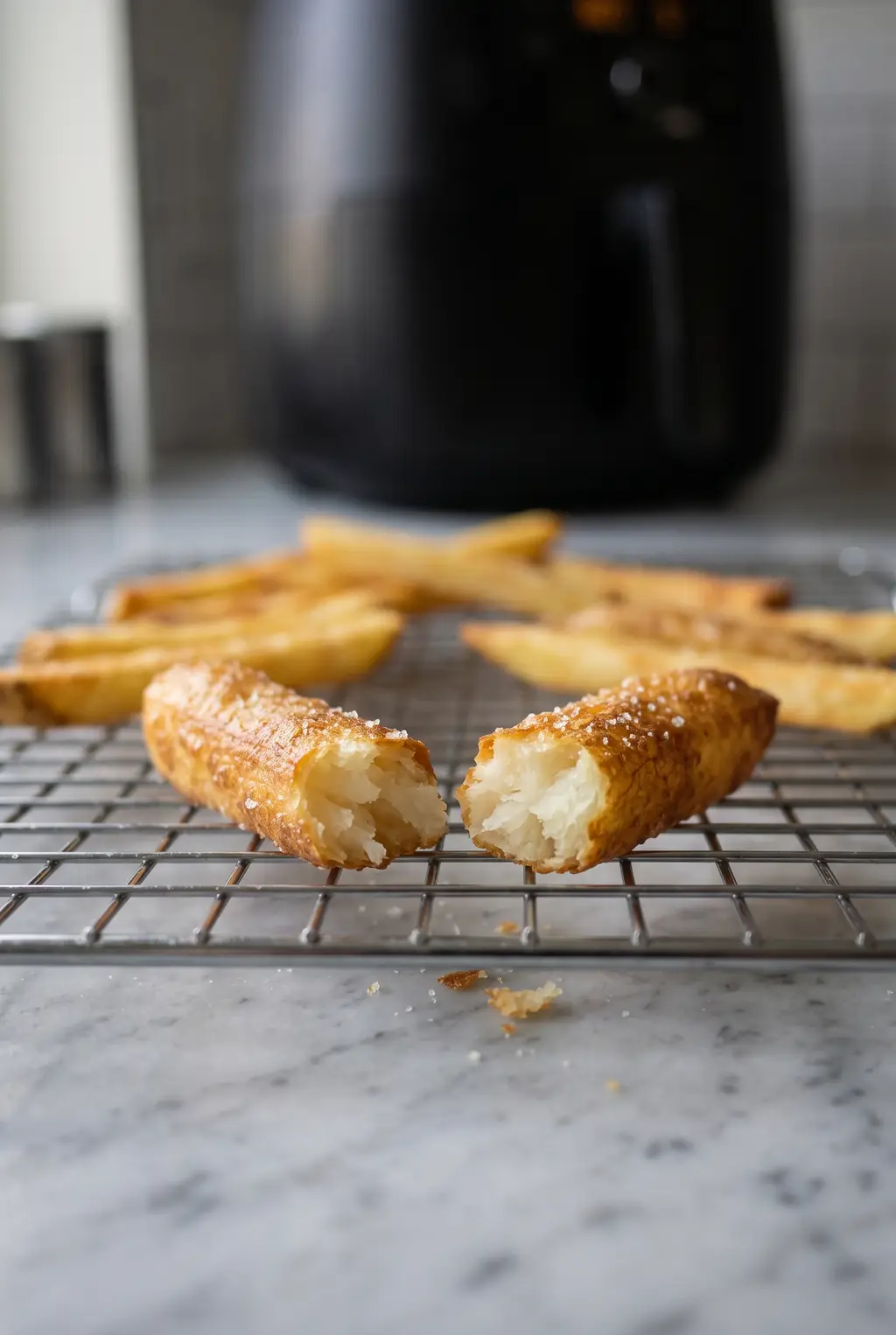
Why fries die, and why they revive so well
A fresh fry is a steam-filled potato interior wearing a rigid, oil-set crust. From the moment it leaves the fryer, that architecture starts failing in two directions at once. Interior steam pushes outward into the crust and softens it from below, and overnight in the fridge the starch recrystallizes, the process our glossary files under starch retrogradation, which is why day-old fries are not just limp but oddly leathery.
Here is the good news the reheating roundups never quite explain: fries revive better than almost any leftover food, because the crust is saturated with oil from the first cook. Put a cold fry in fast dry heat and two things happen together: the surface moisture that soaked the crust gets scrubbed off by moving air, and the oil already living in that crust re-crisps it from within, like a fryer the fry carries around in its own skin. Warming the interior past 140°F reverses some of the staling at the same time. That is why no oil needs adding, and why the microwave, which drives more steam into the crust instead of out of it, cannot do this job at any setting.
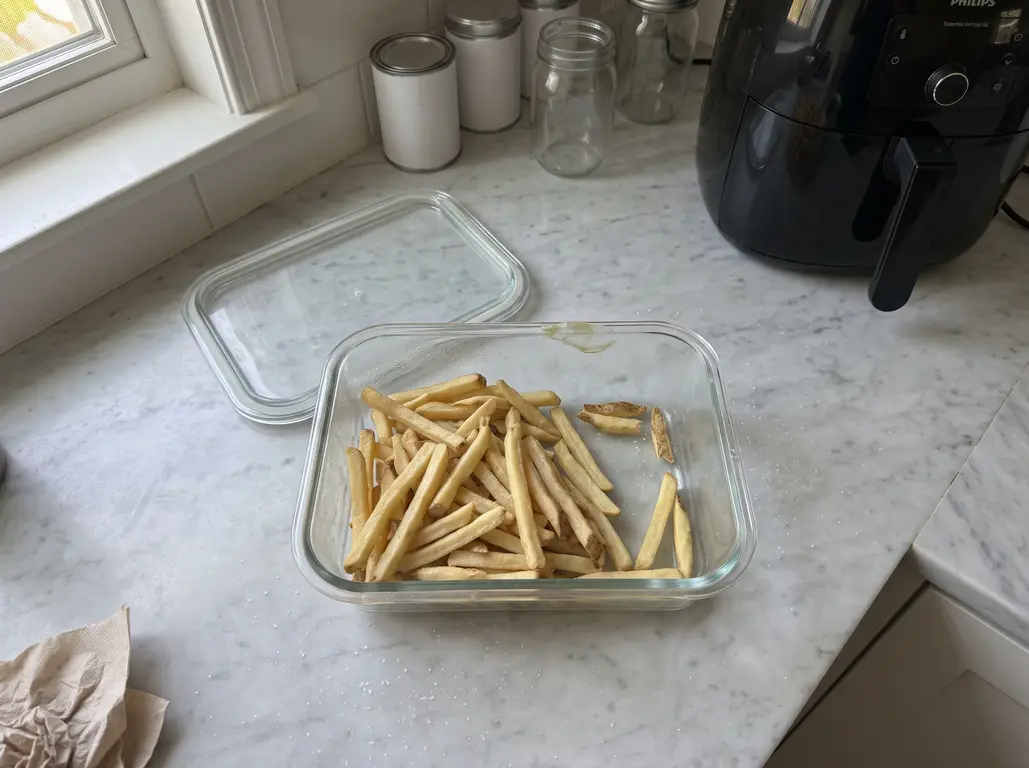
The method, four steps
- Preheat, 380°F, 3 minutes. A reheat this short cannot afford a cold start; in an unpreheated basket the fry spends the whole run steaming instead of crisping. The preheating guide covers why short runs are exactly where preheating earns its keep.
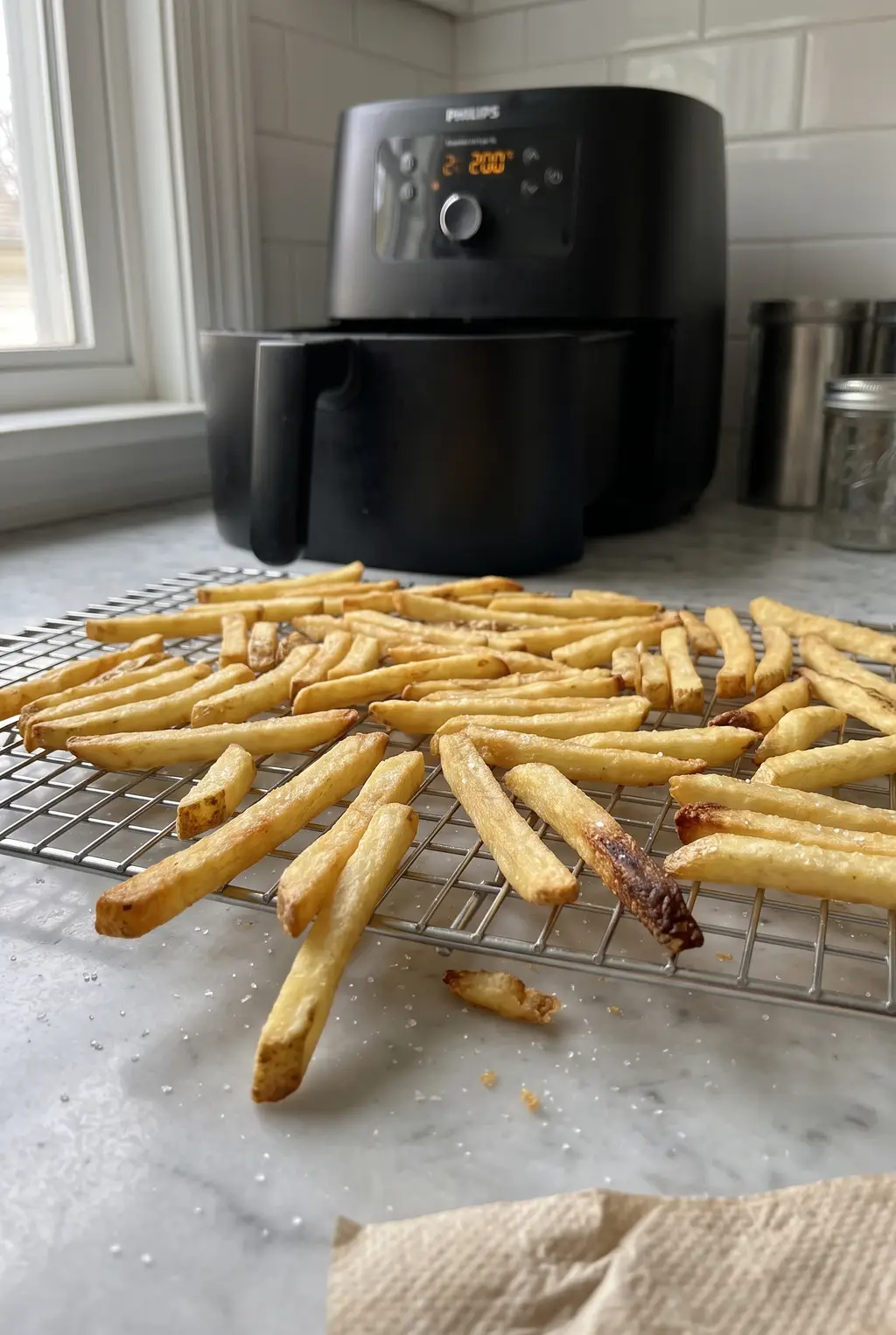
- Fridge to basket, directly. No thawing, no counter rest, no oil. A fry is thin, so the middle warms in the time the crust takes to re-dry; the room-temperature rule belongs to thick food like reheated fried chicken, not to a potato stick. Spread them one loose layer, half the basket floor at most, so the single layer can breathe.
- 3 to 4 minutes, one shake at 2. Listen as much as you look: revived fries rattle against the basket when shaken, soft ones thud. If they are rattling at 3 minutes, they are done at 3.
- Serve immediately, or hold on a rack. A pile on a plate steams itself soft from the middle out. If a batch has to wait, it waits in one layer on a wire rack, uncovered, because crisp is a countdown and a cover speeds the clock.
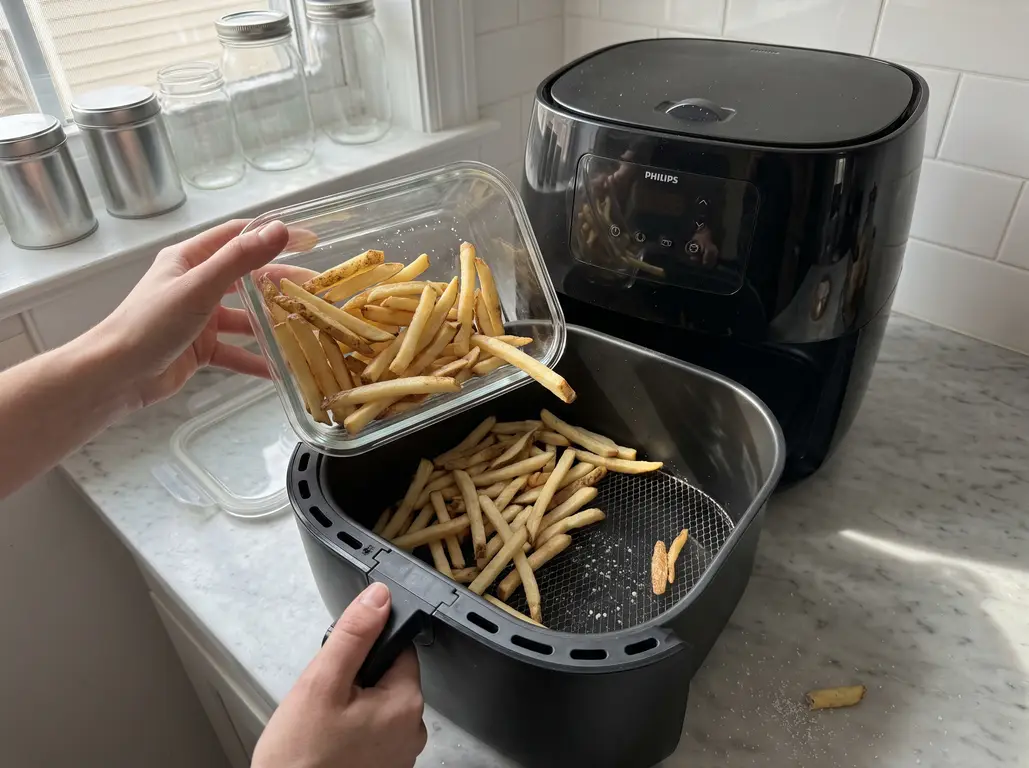
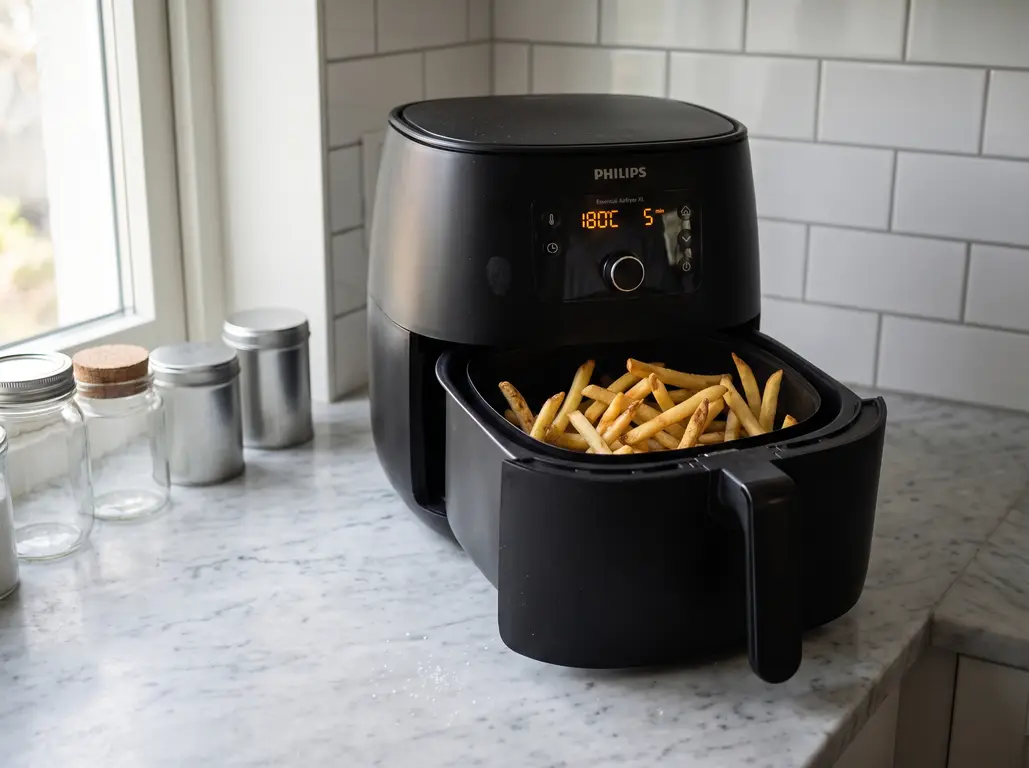
The cut-by-cut chart
All numbers assume fridge-cold fries in a preheated 5 to 6 quart basket. The pattern is simple: the thinner and browner the fry, the cooler and shorter the run, because a surface that already browned once has no margin left.
| The fries | Setting | Time | Worth knowing |
|---|---|---|---|
| Drive-through, shoestring | 375°F | 2-3 min | Already fully browned; revived at 2, scorched by 4. Watch them |
| Standard restaurant cut | 380°F | 3-4 min | The default. About ninety percent of day one comes back |
| Crinkle cut | 380°F | 3-4 min | The ridges re-crisp first; shake gently so they do not chip |
| Waffle fries | 375°F | 3-4 min | All lattice, all surface; they brown fast and finish early |
| Curly fries | 375°F | 3-4 min | The seasoning coat scorches before the potato does; cooler run protects it |
| Steak fries | 380°F | 4-6 min | Real mass inside; give the middle the extra minutes |
| Potato wedges | 380°F | 5-6 min | Cut side down, flipped once, exactly like their first cook |
| Sweet potato fries | 375°F | 3-4 min | Hot and tender-edged, never fully crisp again. That is chemistry, not your fault |
| Tater tots | 380°F | 4-5 min | The dense shell revives nearly perfectly; closest thing to a free lunch here |
| Loaded or cheese fries | 350°F | 4-5 min | Reheats into excellent nachos. It will not return to being separate fries |
Cooking from the bag instead of reviving leftovers is a different job with longer times; the frozen french fries page has that chart cut by cut, and tater tots and Alexia sweet potato fries have their own tested pages. If a bag or restaurant gives oven reheating directions instead, the air fryer calculator converts them to basket settings.
The drive-through bag problem
Fast food fries have a special enemy, and it is the ride home. A closed paper bag over a hot carton is a steam tent: the fries' own heat evaporates moisture that condenses right back into the crust, and ten minutes of that undoes what the pressure fryer spent three minutes building. This is why drive-through fries are dead on arrival even before the fridge gets involved.
The air fryer fixes both versions of the problem. Tonight, straight from the bag: 375°F for about 2 minutes returns bag-steamed fries to counter condition while the burgers get plated. Tomorrow, from the fridge: 375°F for 2 to 3 minutes, and thin chain fries come back to roughly ninety percent, salt intact. The only rule is respect for how thin they are; a fry that was fully browned at the restaurant has no browning margin left, so past 3 minutes you are not reheating anymore, you are burning.
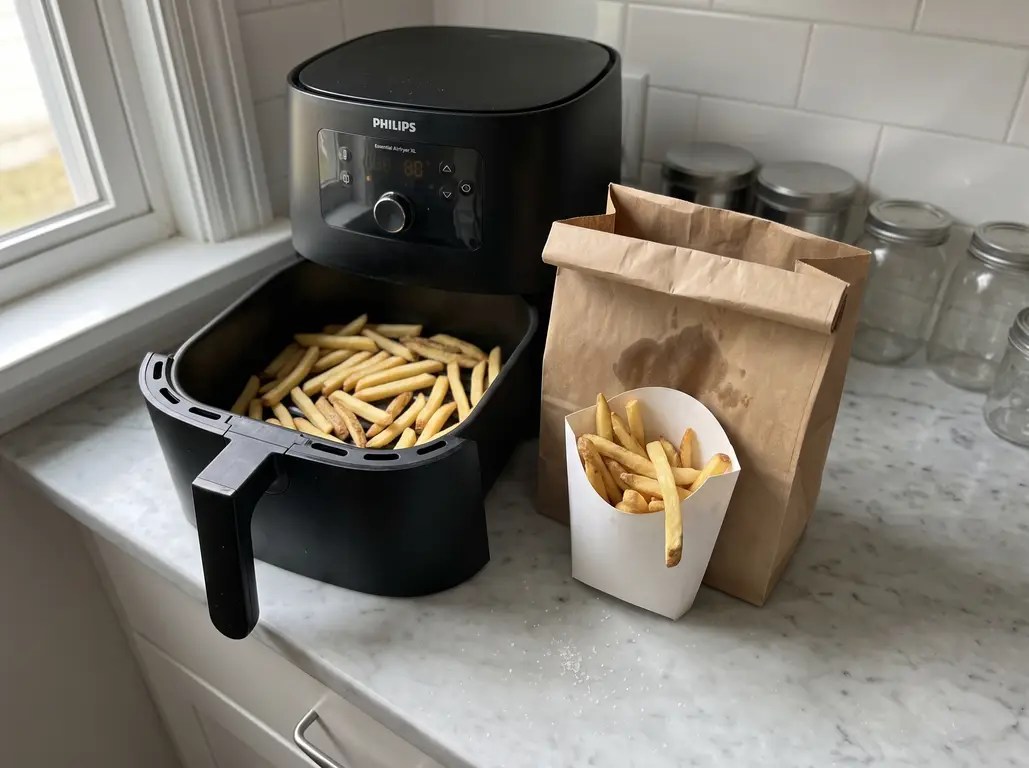
Storage, so tomorrow works: out of the bag and carton the moment you know they are leftovers, into an airtight container once cool, three days maximum in the fridge. Never refreeze cooked fries; ice crystals shred the interior and they thaw mealy, beyond what any reheat can fix.
The oil question, settled
Half the ranking pages tell you to spritz oil before reheating, and it is worth being precise about why they are wrong for most fries. A deep-fried fry is up to a third oil by weight, most of it held in the crust. That oil never left; it just cooled and stiffened. Hot moving air re-melts it and the crust effectively re-fries itself, which is the entire reason reheated fries can taste fresh instead of merely warm. Spraying more oil onto that does not add crispness, it adds grease, and it is how reheated fries end up heavier than they were the first time.
The exception is the lean fry: oven-baked from scratch with a teaspoon of oil, or an air-fried homemade batch that ran light. Those crusts are oil-poor, and a single light spritz before reheating gives the surface something to fry in. If you keep oil in a mister for exactly this, the oils guide covers which bottle and why the smoke point panic is mostly misplaced. And skip aerosol cans entirely; the lecithin in them lacquers the basket, which is a cleaning problem this site has already written about at length.
More than one serving
The half-basket rule is where most soggy reheats are born. Thin fries piled past half depth steam each other faster than the fan can dry them, so a large takeout order is two batches, not one deep one. Batching costs less time than it sounds: the second batch runs 30 to 60 seconds faster because the machine is fully heat-soaked, the effect our glossary calls recovery time, and finished fries hold happily on a wire rack in one layer while the second batch runs. Two batches of three minutes beats one batch of six that comes out half crisp and half steamed every single time.
Against the oven, the skillet and the microwave
| Method | Time, real | Result | Verdict |
|---|---|---|---|
| Air fryer | 6-7 min with preheat | Crust genuinely rebuilt, interior fluffy | The only method that returns fries to something like day one |
| Dry skillet | 6-8 min | Good bottom crust, uneven sides, needs attention | The respectable backup if no basket is available |
| Oven at 425°F | 15-20 min with preheat | Decent but drier; the wait outlasts the appetite | Only worth it for a crowd-size pile, and even then, batches compete |
| Microwave | 60 sec | Hot, limp, and getting limper | A steamer wearing a different name. There is no fix at any power level |
The oven row is also the expensive row: twenty minutes of full-size oven for one serving of fries is the case study the running cost calculator prices out in seconds, and the rest of the site's tools live beside it.
When it goes wrong
| What you got | Why | The fix |
|---|---|---|
| Warm but still limp | Overfilled basket, nearly every time | Half full maximum for thin cuts. Two batches beat one pile |
| Scorched tips | Thin, already-brown fries run hot or long | Drive-through cuts get 375°F and a hard stop at 3 minutes |
| Hard and hollow | Second or third reheat | Once is the limit; revive only the portion being eaten |
| Crisp out, soggy five minutes later | Piled on a plate or covered | One layer on a rack, uncovered. Steam from the pile is the killer |
| Greasy mouthfeel | Oil sprayed onto already-fried fries | Skip the spray; fried fries carry their own |
| Smoke on a 3 minute run | Old oil on the drawer floor, not the fries | Wipe the drawer; the smoke guide has the two minute triage |
And if the fridge holds more fries than anyone wants to eat as fries, the second life is breakfast: chopped and crisped with onions they become a hash that outranks the original, and the hash browns page shows how far the basket can take a shredded potato on purpose.
Frequently asked questions
QWhat is the best temperature to reheat fries in an air fryer?
380°F for standard cut fries, 3 to 4 minutes straight from the fridge with one shake in the middle. That number is deliberate: hot enough to re-dry the crust before the inside dries out, but under the line where thin, already-browned fries start to scorch. Drop to 375°F for drive-through and shoestring fries, which are thinner and already well done, and they take only 2 to 3 minutes.
QHow long do you reheat fries in an air fryer?
3 to 4 minutes for regular fries, 2 to 3 for thin fast-food fries, 4 to 6 for steak fries, and 5 to 6 for wedges, all in a machine preheated for 3 minutes first. The runs are short because reheating is a surface job: the crust needs re-drying, and the inside only needs to get warm. Longer does not mean crisper; past the window, fries go hollow and hard.
QDo I need to add oil when reheating fries in an air fryer?
No, and this is where half the advice online gets it backwards. Fried fries already carry their oil; it is soaked into the crust from the first cook, and hot air re-activates it like a tiny built-in fryer. Extra spray just makes them greasy. The one exception is lean fries that were oven-baked with almost no oil to begin with, where a light spritz genuinely helps the surface brown.
QCan you reheat McDonald's fries in an air fryer?
Yes, and it is the single most satisfying trick in this guide: 375°F for 2 to 3 minutes brings thin drive-through fries back to about ninety percent of the counter experience, even from the fridge the next day. Watch them from 2 minutes, because thin fries that were fully browned once will go from revived to scorched in under a minute. The salt survives; taste before adding more.
QCan you reheat fries twice?
Once, honestly. Each trip through the heat spends interior moisture the fry cannot get back, so round two comes out hollow and round three is a crouton. Reheat only the portion you are eating and leave the rest in the fridge; the air fryer makes small batches so easy that there is no reason to revive the whole bag at once.
QShould fries come to room temperature before reheating?
No. That advice migrates over from thick foods like fried chicken, where a cold center matters. A fry is a thin stick that warms through in the time the crust takes to re-dry, so it goes from the fridge to the basket directly. The counter rest does nothing for a fry except give condensation time to soften the crust you are about to rebuild.
QCan you make sweet potato fries crispy again in an air fryer?
You can make them hot, freshly caramelized at the edges, and much better than the microwave would, at 375°F for 3 to 4 minutes. Fully crisp is not on the table, and it never was: sweet potatoes carry less starch and more sugar and water than russets, so they never build the rigid crust that regular fries do. Warm and tender-edged is the honest ceiling for a reheated sweet potato fry.
QHow long do leftover fries last in the fridge?
Three days in an airtight container. Do not freeze cooked fries; ice crystals wreck the interior and they thaw mealy no matter how they are reheated. If the fries came home in a takeout bag, get them out of it before storing, because a closed bag keeps steaming them long after the drive ends.
QWhy do fries get soggy in the microwave but crisp in the air fryer?
The microwave heats the water inside the fry, which sends steam outward through the crust and soaks it; it is a steamer wearing a different name. The air fryer heats the outside with fast dry air, so moisture leaves the crust while the oil already in it re-crisps the surface. One appliance moves water into the crust, the other moves it out, and that is the whole difference.
Made it? Rate it.
Never overbake again
Get our one-page times & temps cheat sheet, plus a new tested recipe each week.
No spam · unsubscribe anytime