

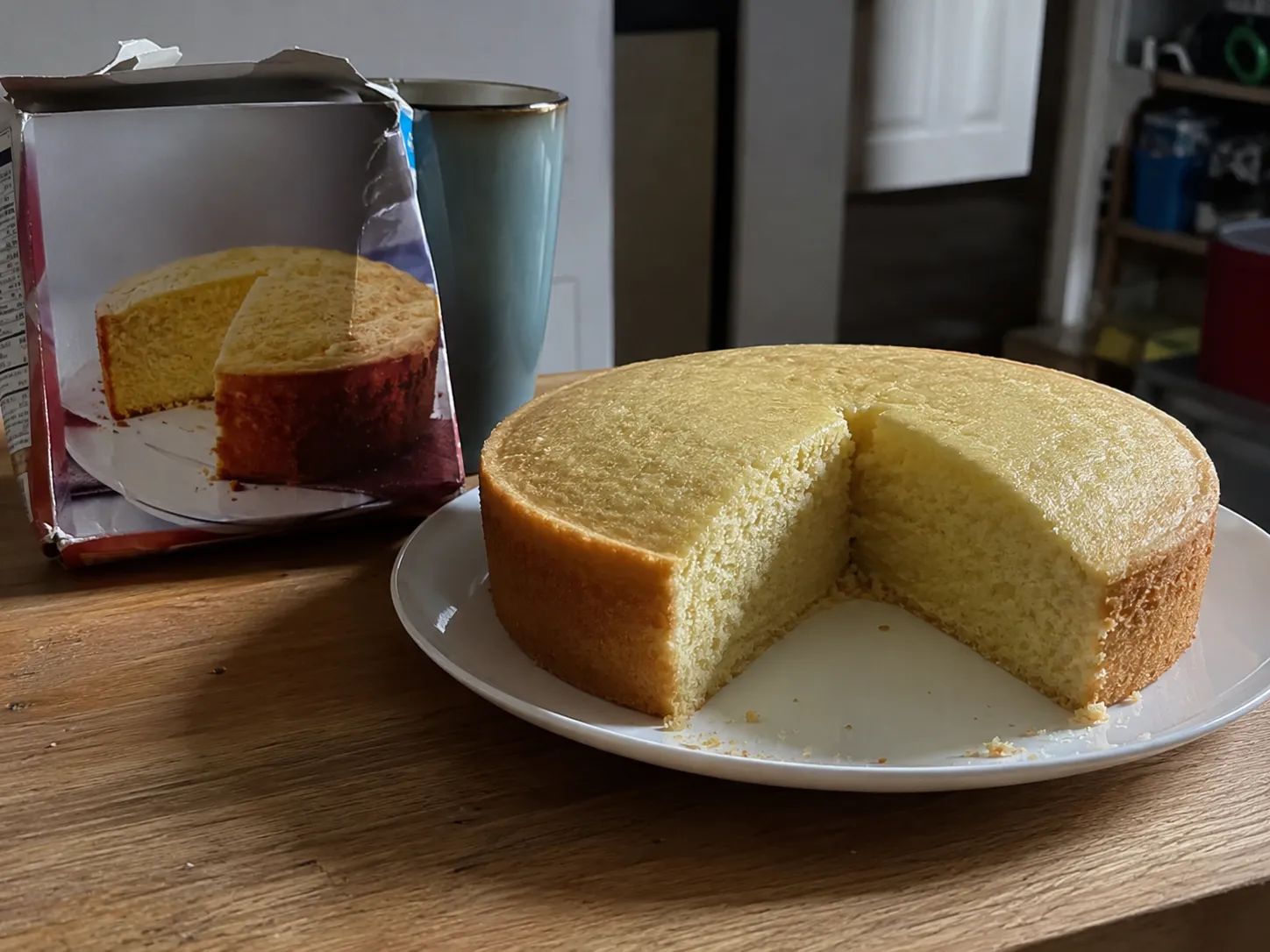
The first time I put a box mix in an air fryer I did the obvious thing. Mixed it as the box said, poured it into the only pan I owned that fit, and set the machine to the temperature printed on the side.
I ended up with a cake that was dark on top and raw in the middle, and about a cup and a half of leftover batter sitting in the bowl with nowhere to go. Both of those were predictable, and neither is mentioned on any of the pages currently ranking for this.
Quick answer: Ignore the temperature on the box and use 310 to 320°F. A standard 15.25 oz box makes about 4 cups of batter, which is roughly two 6-inch cakes or eighteen cupcakes, so plan to split it before you start. Bake to 200°F in the middle rather than to a time. The brand changes almost nothing except how much batter you get.
Why the brand barely matters
People search for this by brand, so it is worth saying plainly: Duncan Hines, Betty Crocker, Pillsbury and the supermarket own-brand all behave close enough to identically in an air fryer that one set of numbers covers them.
They are all the same kind of thing. Flour, sugar, a chemical raising agent, emulsifiers and powdered fat, mixed with eggs, oil and water. The proportions vary a little and the flavorings vary a lot, but none of that changes how heat moves through a pan of batter. What changes your bake is the depth of that batter and how far it sits from the element.
There is exactly one way the brand genuinely matters, and it is not the one people expect. It is how much mix is in the box, which is covered further down and which has quietly changed over the last fifteen years.
One box does not fit one pan
This is the practical problem and it comes first because it decides everything else.
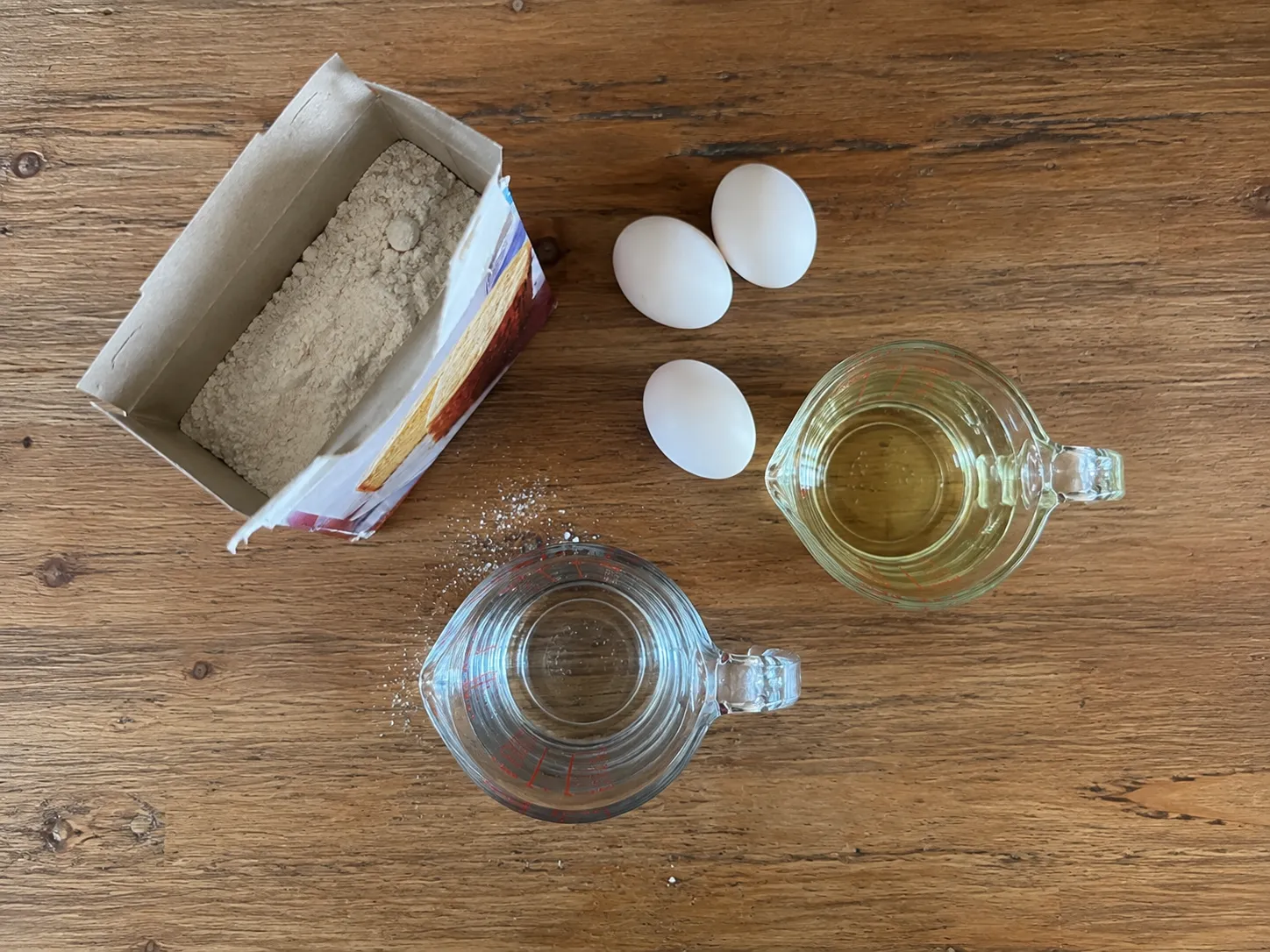
A standard 15.25 oz box, made up with three eggs, a cup of water and half a cup of oil, gives you roughly 4 cups of batter. Now compare that with what actually fits in an air fryer, remembering that a cake pan should be filled no more than half so the rising batter does not reach the element:
| Pan | Holds when half full | One 15.25 oz box fills |
|---|---|---|
| 6-inch round | About 2 cups | Two of them |
| 7-inch round | About 2 1/2 cups | One, plus 6 cupcakes |
| 8-inch round, if it fits | About 3 1/2 cups | One, plus 2 cupcakes |
| 6 x 3 inch loaf | About 1 1/4 cups | Three of them |
| Standard cupcake cup | About 1/4 cup each | About 18 |
Half full is not me being cautious. In a basket the element sits two to four inches above the pan, so a cake that rises to the rim is baking directly against the heat. The fill level entry in our glossary covers it, and it is the same rule that applies to every cake on this site.
So the honest answer to what pan do I use is that you almost certainly need two, or one pan and a set of cupcake cups. Nobody tells you this, and both of the most popular pages ranking for this term simply do not address what happens to the batter that does not fit.
Three sensible ways to split one box:
- Two 6-inch cakes, one after the other. Best if you want a layer cake. Remember the second one bakes faster, covered below.
- One 7-inch cake plus six cupcakes. My usual. The cupcakes go in while the cake cools and they are done in fifteen minutes.
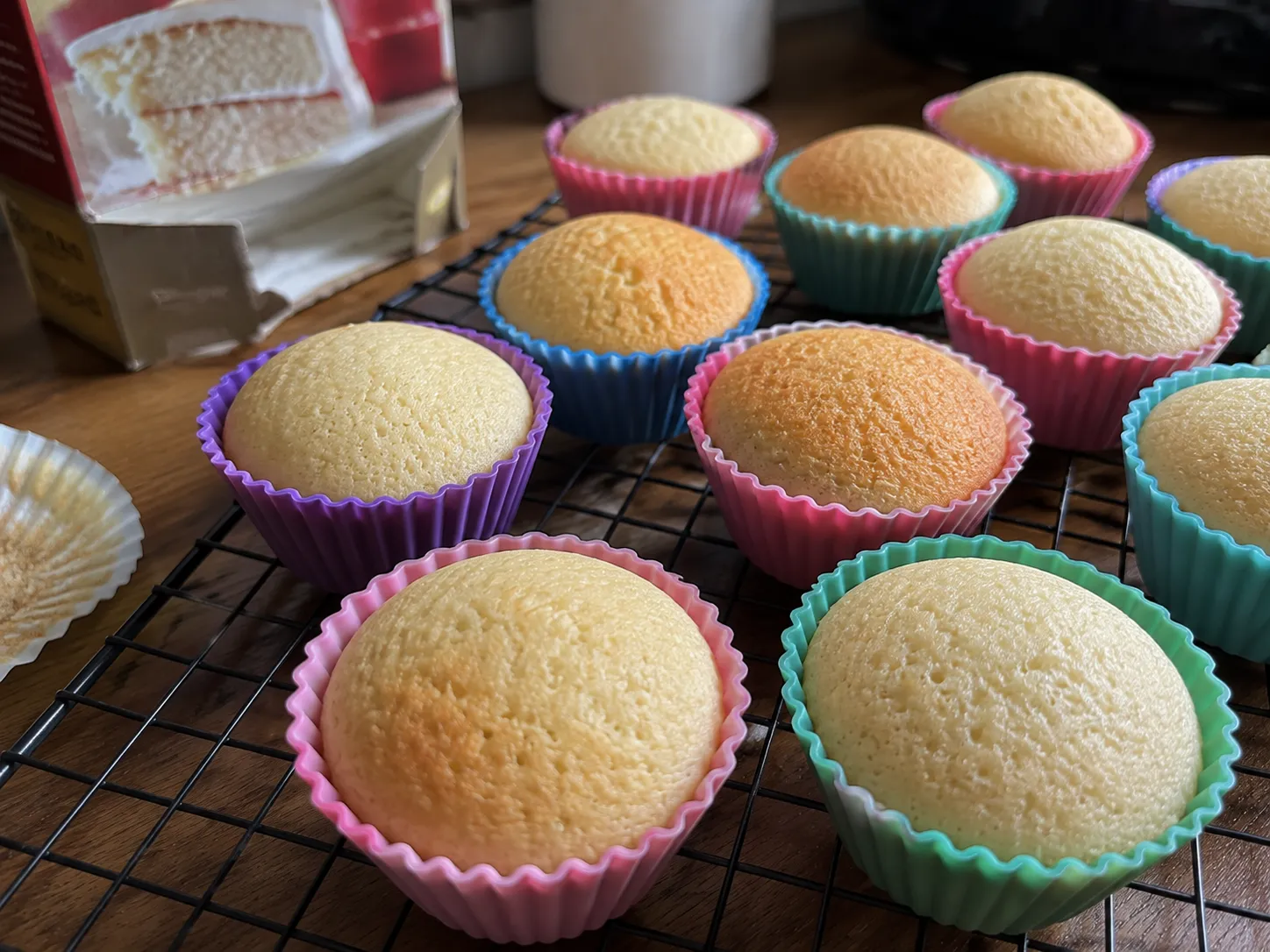
- All cupcakes, about 18. The most forgiving option by a distance, because a shallow cup has nowhere for a raw middle to hide. Our air fryer cupcakes guide covers the rotating and the batch timing in detail.
If you want to scale a box down to one pan rather than splitting it, the recipe scaler will do the arithmetic, and the pan size calculator will tell you what your basket actually takes if you have never measured it.
Do not be tempted to pour the whole box into one deep pan to avoid a second batch. Deep batter under a close element is the exact combination that gives you a dark crust over a wet middle, and no amount of extra time fixes it. That failure has its own page: why air fryer cakes sink in the middle.
Why you cannot use the box temperature
Every box says 350°F, give or take. That number is not wrong, it is just written for a different machine.
In a conventional oven the heating elements are a foot or more from your cake and most of the heat arrives as hot air circulating around a large cavity. In an air fryer basket the element is two to four inches above the top of the pan, and a fan is driving air straight down onto it. The surface of your cake is in a completely different position relative to the heat, even though the dial reads the same number.
The result at 350°F is that the top sets into a crust within the first several minutes, while the middle is still liquid. After that the crust just browns, and the middle has to cook through an insulating lid you have accidentally made.
| If the box says | Use in an air fryer | And expect |
|---|---|---|
| 350°F | 310 to 320°F | Roughly the same time, sometimes slightly less |
| 325°F | 295 to 305°F | Add a few minutes |
| 375°F | 335 to 345°F | Watch it closely, this is high for a basket |
The usual rule of thumb for air fryers is to drop 25°F and cut the time by a fifth. For cake specifically I drop closer to 30 or 40°F and leave the time alone, because the problem here is the surface getting ahead of the middle rather than the whole thing cooking too fast. Our air fryer calculator does the standard conversion, and for a cake I would take another 10°F off whatever it gives you.
One thing that does not need adjusting: the ingredients. Make the mix up exactly as the box says. The eggs, oil and water are balanced for that powder and changing them to compensate for the machine is solving the wrong problem.
The chart: time and temp by format
This is the part worth bookmarking. Every one of these is for a standard box mix made up as directed, in a preheated air fryer, with the pan filled no more than half.
| Format | Temp | Time | Pull at | Notes |
|---|---|---|---|---|
| 6-inch round | 320°F | 25 to 32 min | 200°F | The default. Two per box. |
| 7-inch round | 315°F | 28 to 35 min | 200°F | Shallower batter, but a wider top to brown. |
| 8-inch round | 310°F | 30 to 38 min | 200°F | Only if it clears the basket with an inch of airflow. |
| Cupcakes | 320°F | 13 to 16 min | 200°F | Second batch 11 to 14. About 18 per box. |
| 6 x 3 inch loaf | 310°F | 30 to 40 min | 200°F | Deepest format here, so the slowest. |
| Ramekin, single serving | 350°F | 5 to 6 min | 200°F | Wide and shallow. See our mug cake guide. |
| Silicone anything | Drop 10°F | Add 2 min | 200°F | Silicone insulates. More here. |
The pull temperature is the only column that never changes. Times shift with your machine, your pan and whether it is the first batch, which is why every recipe you find gives a different number. The internal temperature does not care about any of that.
Two adjustments that apply across the whole chart:
- The second batch runs about 2 minutes faster. When the machine beeps at temperature, only the air is there. The basket and cavity walls carry on absorbing heat for another ten minutes or so, and by the time batch one is out they are saturated and radiating back. This catches people out constantly. The glossary covers it under batch baking.
- Chocolate mixes brown faster than vanilla and give you nothing to look at while they do it. Cocoa and the darker sugars in a devil's food mix color sooner, so check chocolate a couple of minutes earlier and rely on the thermometer rather than the top.
How to bake it
- Decide how you are splitting the box before you mix. Two 6-inch pans, or one 7-inch plus cupcake cups, or all cupcakes. Get the pans lined and ready now, because batter should not sit around waiting.
- Preheat to the chart temperature for 3 minutes. The raising agent in a box mix starts working the moment the liquid goes in, and a batter that waits for a cold machine has already spent some of its lift. Whether you need to preheat covers why leavened batters care most.
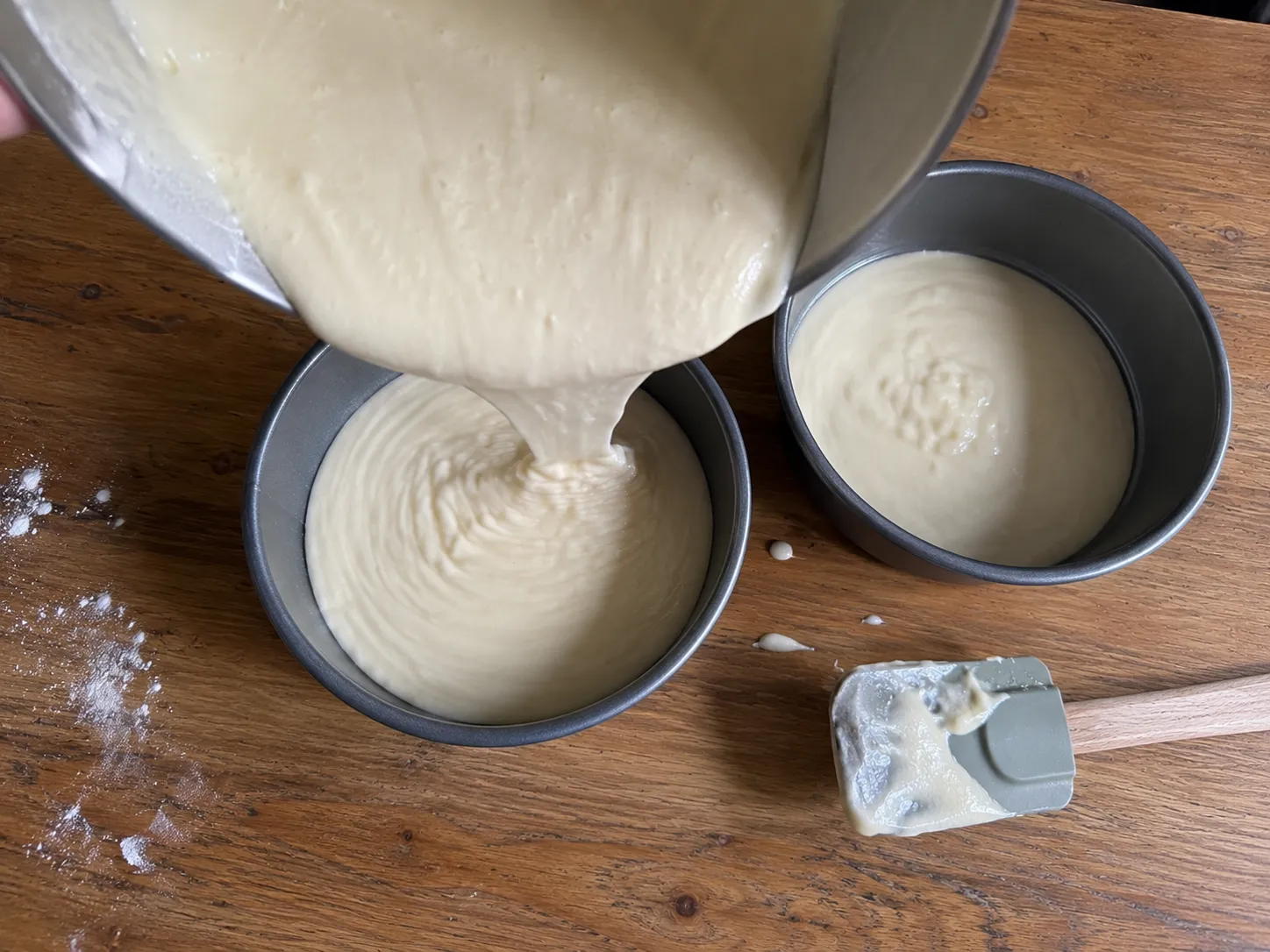
- Mix exactly as the box directs. Same eggs, same oil, same water, same beating time. Do not improvise here.
- Line the pan properly. Grease, then a parchment circle in the base and a collar up the sides. A box cake sticks more than you expect and the collar makes it liftable.
- Fill no more than half. Level the top with the back of a spoon and tap the pan on the counter twice to release large air pockets.
- Bake to the chart, but start checking early. Do not open the basket during the first two thirds. Every time you pull it out the temperature drops sharply and the machine has to rebuild it.
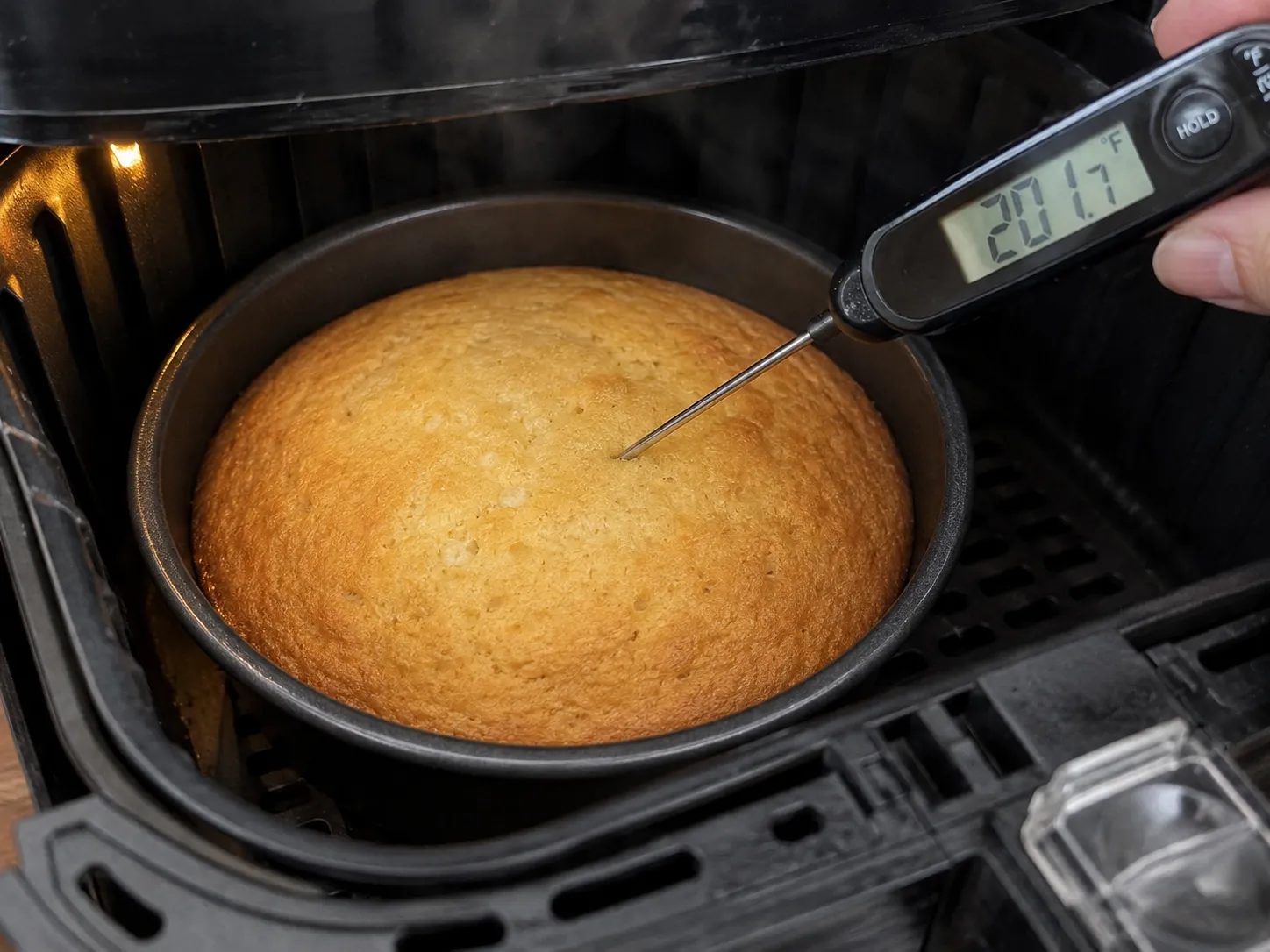
- Check the temperature, not the top. Push an instant-read thermometer into the center at an angle so the tip sits mid-depth rather than on the pan base. You want 200°F.
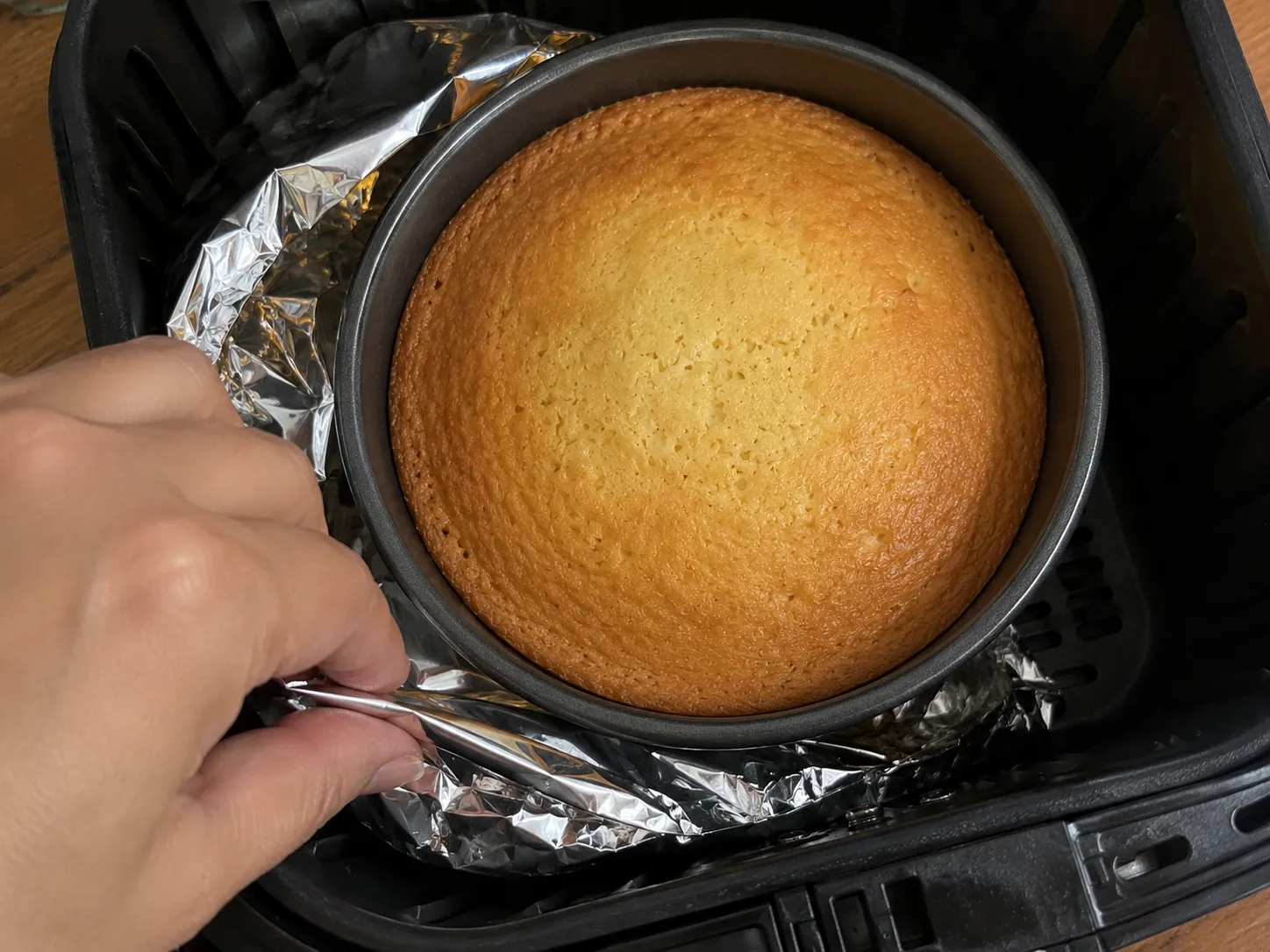
- If the top is browning too fast, tent it. A loose sheet of foil tucked under the rim blocks the direct radiant heat while the sides and base carry on cooking. Tuck it, do not drape it, or the fan will lift it into the element.
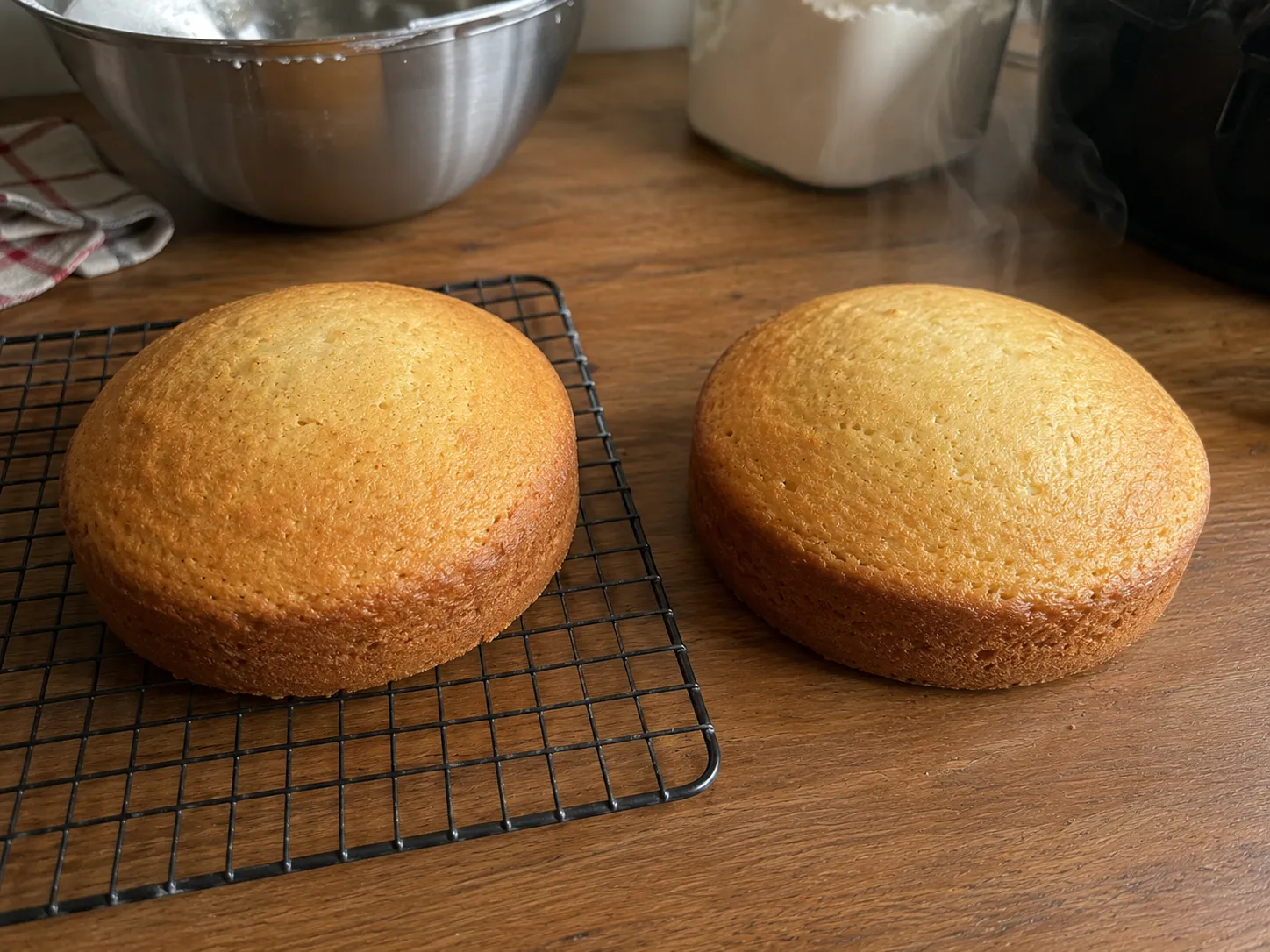
- Cool in the pan 10 minutes, then turn out onto a rack. Leaving it in the hot pan steams the base soft.
- Cool completely before frosting. Warm cake plus frosting is a slide, not a swirl.
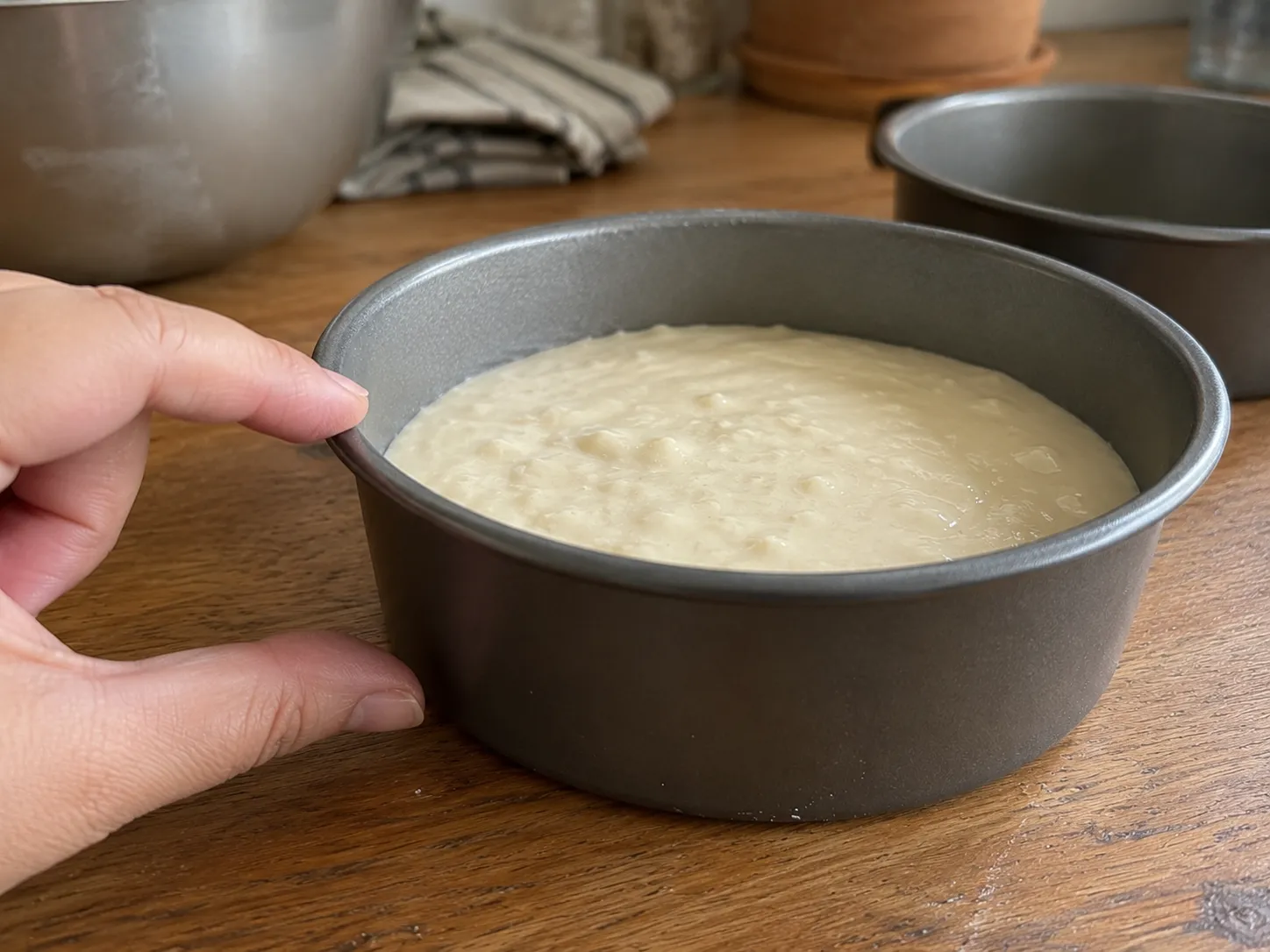
Do not double a box into one pan. This comes up every time and the answer is always no. Two boxes of batter in a deep pan under an element three inches away will be past 210°F on top while the middle is still under 150°F. If you need a bigger cake, bake two and stack them, or use a conventional oven, which is genuinely the better tool for anything above about 8 inches.
200°F, and why the toothpick is worse here
Every page ranking for this ends on the toothpick test. It is a reasonable test in an oven. In a basket it is noticeably worse, for a specific reason.
In an air fryer the surface of the cake runs well ahead of the middle, because the element is close and the fan is driving heat at it. That means the crumb immediately under the top can be perfectly set while there is still a band of wet batter an inch lower down. A toothpick pushed in vertically passes through the set part first, comes out looking clean, and tells you nothing about the band underneath. A clean toothpick and an underbaked center genuinely do happen together here.
200°F in the middle is where the starch has gelatinized and the egg protein has set. Push the probe in at an angle so the tip sits in the middle of the depth rather than resting on the base of the pan, take one reading, and pull it out.
| Reading | What you have |
|---|---|
| Under 190°F | Wet band in the middle. Needs 3 to 5 more minutes. |
| 195°F | Nearly there. Two more minutes. |
| 200°F | Done. Take it out. |
| Past 210°F | Drying out. It will be noticeably tighter and less moist. |
Box mixes have more emulsifiers and stabilizers than a scratch cake, which makes them a bit more forgiving of a few extra degrees. That is genuinely one of the advantages of a mix, and it is why they are a sensible thing to learn a new machine on. Internal targets for everything else are in the air fryer baking chart.
Brand by brand, honestly
Here is the one place the brand does change something, and it is not the temperature.
The boxes have shrunk. A standard cake mix used to be 18.25 ounces. Over the last fifteen years the major brands quietly reduced it, and they did not all land in the same place. Duncan Hines and Pillsbury are mostly 15.25 oz now. Betty Crocker went further, and a lot of their line is 13.25 oz.
| Box | Typical size | Batter | What that fills |
|---|---|---|---|
| Duncan Hines | 15.25 oz | About 4 cups | Two 6-inch cakes, or 18 cupcakes |
| Pillsbury | 15.25 oz | About 4 cups | Two 6-inch cakes, or 18 cupcakes |
| Betty Crocker | 13.25 oz | About 3 1/2 cups | One 6-inch cake plus 8 cupcakes |
| Older recipes | 18.25 oz | About 4 3/4 cups | Anything written before roughly 2010 |
This matters if you are following an older recipe or a pan chart that assumes the bigger box, and it is worth knowing that a Betty Crocker box will genuinely not fill the same pans as a Duncan Hines one. It is also the reason two people can follow identical instructions and get different results, then blame their air fryers.
Beyond size, the differences are ones of flavor and texture rather than method. Duncan Hines tends to be a slightly finer, lighter crumb. Betty Crocker is a touch denser and sweeter. Pillsbury sits between them. Supermarket own-brands are usually fine and occasionally excellent. None of that changes the temperature or the internal target.
Two specific cases worth flagging:
- Single-serve and mini cake kits from the same brands come with their own small pan and a much shorter time, often 4 to 6 minutes at around 320°F. Follow the kit rather than this chart. They are a different product.
- Gluten free mixes hold more water and set later, so add 3 to 5 minutes and still bake to 200°F. They also brown less, so do not judge them by color.
Fixing what goes wrong
| What you got | Why | Fix |
|---|---|---|
| Dark top, raw middle | Box temperature in a basket. The classic. | 310 to 320°F, and tent with foil if the top runs ahead. |
| Leftover batter and no pan | One box makes about twice what an air fryer pan holds. | Plan the split before you mix. Cupcake cups are the easy answer. |
| Overflowed onto the element | Pan filled more than half. | Half is the ceiling. See fill level. |
| Sank in the middle after cooling | Pulled before the center set, so nothing held the risen shape. | 200°F, measured. More in why cakes sink. |
| Clean toothpick but wet inside | The set crumb under the top hid a wet band lower down. | Thermometer at an angle, mid-depth. See above. |
| Second batch overdone | The machine was heat soaked and hotter than for batch one. | Take 2 minutes off every batch after the first. |
| Dry and tight | Past 210°F, or too long at too high a temperature. | Pull at 200°F. Also see avoiding dry air fryer bakes. |
| Domed and cracked | Edges set before the middle, so it could only expand upward. | Drop 10°F and add time. A light colored pan helps. |
| Stuck to the pan | Greased but not lined. Box mixes stick more than scratch cakes. | Parchment circle in the base and a collar up the sides. |
| Pale and anemic | Normal at 310 to 320°F, especially on a vanilla mix. | Nothing is wrong. Frost it, or give it 2 minutes at 350°F watching closely. |
If problems persist across different bakes rather than just this one, the air fryer baking troubleshooting guide works through the usual causes, and basket versus oven-style matters here because an oven-style unit puts the element much further from the pan and behaves more like a small conventional oven.
Making a box mix taste less like one
None of this is required and the plain version is perfectly good. But a box mix responds well to a few substitutions, and they cost almost nothing.
- Milk instead of water. The single biggest improvement. Same quantity, more flavor and a softer crumb, because you are adding fat and milk protein where there was none.
- Melted butter instead of oil. Use the same volume. You lose a little of the moistness that oil gives and gain a lot of flavor. Buttermilk plus butter together is the full version.
- One extra egg. Gives a richer, slightly denser crumb closer to a scratch cake. Add 2 to 3 minutes, and still go to 200°F.
- A teaspoon of vanilla, even in a chocolate mix. Box mixes are usually underflavored rather than oversweet.
- A pinch of salt. Most mixes are short on it, and it makes the sweetness taste like flavor rather than just sugar.
- Sour cream or yogurt, a quarter cup, for a denser and moister result. Add a couple of minutes since it brings water.
If you want to go the other way and bake from scratch, our air fryer vanilla cake is built for a 6-inch pan from the start, so there is no splitting to do, and how to bake in an air fryer covers the method end to end.
Storage
- Unfrosted, room temperature: 3 days in an airtight container, once completely cool. Box mixes keep slightly better than scratch cakes because of the emulsifiers.
- Frosted: 2 days at room temperature with buttercream, 4 refrigerated with cream cheese frosting.
- Cover it cold. Wrapping a warm cake traps condensation and drips it onto the surface.
- Frozen, unfrosted: 3 months, wrapped in plastic then foil. Thaw at room temperature.
- Leftover dry mix: if you only used part of the box, the powder keeps in a sealed bag for months, but the raising agent loses potency once opened. Use it within about three months or expect less lift.
Worth knowing what it costs to run: for one or two small pans an air fryer beats heating a full oven comfortably, and the running cost calculator gives you the figure for your own electricity rate. Where it stops being true is a big cake or three batches back to back, which is exactly the point at which a conventional oven becomes the better tool. All four of our air fryer baking tools are in one place, and the accessories guide covers pans that actually fit.
Frequently asked questions
QWhat temperature do you bake boxed cake mix in an air fryer?
310 to 320°F, not the 350°F printed on the box. The box temperature assumes a conventional oven where the elements are a foot or more from your cake. In an air fryer basket the element sits two to four inches above the pan with a fan driving air onto it, so at 350°F the top sets into a crust within minutes and then just browns while the middle is still liquid. Dropping 30 to 40°F gives the inside time to catch up. Make the mix up exactly as the box directs; only the temperature changes.
QHow long does boxed cake mix take in an air fryer?
25 to 32 minutes for a 6-inch round at 320°F, 28 to 35 for a 7-inch at 315°F, and 13 to 16 minutes for cupcakes at 320°F. A 6 by 3 inch loaf is the slowest at 30 to 40 minutes. Times shift with your machine and your pan, which is why every recipe you find online gives a different number, so treat them as a starting point and bake to 200°F in the middle instead. That target does not change with format, brand or machine.
QDoes the brand of cake mix change the time or temperature?
No. Duncan Hines, Betty Crocker, Pillsbury and supermarket own-brands all behave close enough to identically, because they are the same kind of formula and what governs your bake is the depth of the batter and its distance from the element rather than the powder. The one way the brand genuinely matters is how much mix is in the box. Duncan Hines and Pillsbury are mostly 15.25 oz, while a lot of the Betty Crocker line is 13.25 oz, so you get noticeably less batter and it fills fewer pans.
QWill one box of cake mix fit in my air fryer?
Almost certainly not in one pan. A standard 15.25 oz box makes about 4 cups of batter, and a 6-inch round pan filled to the halfway mark holds about 2 cups. So one box is roughly two 6-inch cakes, or one 7-inch cake plus six cupcakes, or about 18 cupcakes. Decide how you are splitting it before you mix, because batter should not sit waiting while you hunt for a second pan. Filling one pan deeper to avoid a second batch is the main cause of a dark top over a raw middle.
QHow full should I fill the pan?
Half, and no more. This is stricter than the two thirds you would use in an oven, and the reason is geometry rather than caution: the element is only a couple of inches above the pan, so a cake that rises to the rim is baking directly against the heat source. Half full leaves room for the rise and keeps the top away from the element. If batter is left over, that is expected, and it goes into a second pan or into cupcake cups rather than into the same pan.
QHow do I know when an air fryer box cake is done?
200°F in the center on an instant-read thermometer, pushed in at an angle so the tip sits mid-depth rather than resting on the pan base. The toothpick test is weaker in an air fryer than in an oven, because the close element makes the surface run well ahead of the middle. The crumb just under the top can be fully set while a band of wet batter sits an inch lower, so a toothpick pushed straight down passes through the set part and comes out clean while the cake is still underbaked.
QCan I bake a whole box in one pan?
Only if you have a pan that holds about 8 cups and still fits your basket with an inch of airflow around it, which most people do not. Pouring a full box into a smaller pan gives you deep batter under a close element, and the top will be past 210°F while the middle is still under 150°F. No amount of extra time fixes that, because the problem is the crust setting early rather than the total heat. Split it into two bakes, or use a conventional oven, which is genuinely the better tool above about 8 inches.
QWhy does my second cake bake faster than the first?
Because when the machine beeps at temperature, only the air has got there. The basket, crisper plate and cavity walls keep absorbing heat for another ten minutes, quietly taking energy that would otherwise go into your cake. By the time the first pan comes out, all that metal is saturated and radiating heat back rather than soaking it up, so the second one bakes in a hotter environment with the dial untouched. Take about 2 minutes off every batch after the first and start checking early.
QShould I change the eggs, oil or water?
No. Make the mix up exactly as the box directs. The liquid and fat are balanced for that specific powder, and adjusting them to compensate for the air fryer is solving the wrong problem, since the issue is the position of the heat rather than the batter. If you want to improve a box mix, the worthwhile swaps are milk instead of water and melted butter instead of oil, both at the same volume. Those are flavor decisions and they do not change the temperature or the internal target.
QCan I make cupcakes from a box mix in an air fryer?
Yes, and it is the most forgiving way to use a box mix in a basket, because a shallow cup gives a raw middle nowhere to hide. One 15.25 oz box makes about 18 standard cupcakes. Bake at 320°F for 13 to 16 minutes, fill the cups two thirds rather than three quarters since air fryer cupcakes rise more than oven ones, and rotate their positions halfway so the ones sitting outside the airflow catch up. Still bake to 200°F inside.
QWhy is my air fryer cake pale on top?
Usually nothing is wrong. At 310 to 320°F a cake has not spent long enough at a high enough surface temperature to brown much, and it will still be perfectly baked at 200°F inside. Air fryer cakes are generally paler than oven ones, and a vanilla mix shows it most. If you want color, give it 2 minutes at 350°F right at the end and watch it the whole time, because at that distance from the element it goes from pale to dark quickly. Frosting makes the question academic.
QDo gluten free or sugar free mixes need different settings?
Same temperature, a little more time. Gluten free mixes hold more water and set later, so add 3 to 5 minutes and still bake to 200°F. They also brown less, so do not judge them by the top. Sugar free mixes brown less again, since sugar is doing most of the coloring, and they can taste dry if you overshoot, so the thermometer matters more rather than less. Single-serve mini cake kits are a different product entirely and you should follow the kit, which is usually about 4 to 6 minutes.
Never overbake again
Get our one-page times & temps cheat sheet, plus a new tested recipe each week.
No spam · unsubscribe anytime