

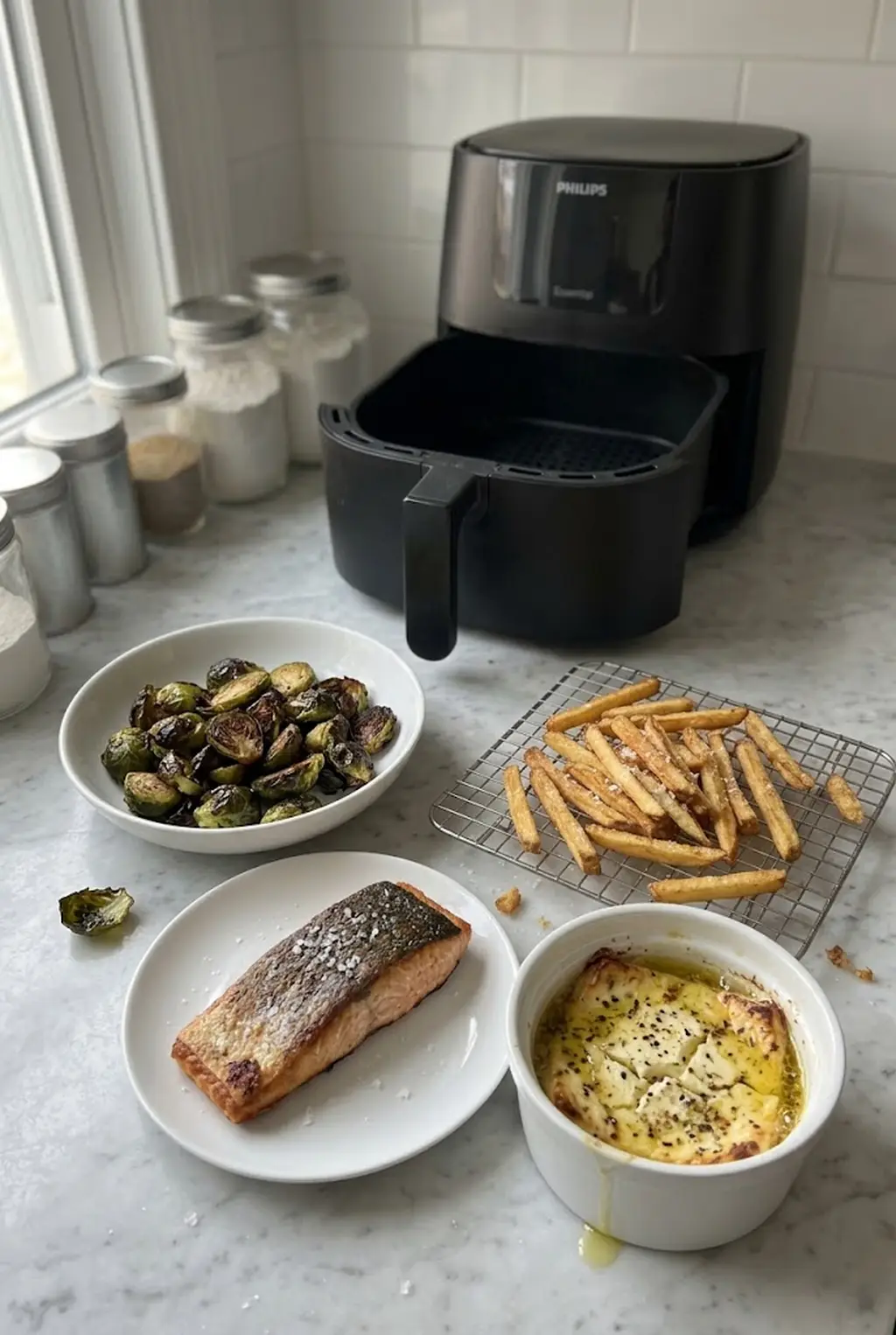
The first month I owned an air fryer, I cooked with one browser tab permanently open: some version of "can you put X in an air fryer," asked fresh for every X. The answers were always a listicle, always slightly contradictory, and always missing the thing I actually needed, which was a reason. One site said never bacon, the next had a bacon recipe. One banned broccoli, another swore by it. Nobody was lying, exactly. They were just reporting outcomes without the mechanism, which is how you end up with nine warnings and no understanding.
So this page is built backwards from every other page on the subject. The machine is a small, intense convection oven: a heating element above, a fast fan behind it, a cyclone of hot dry air through a perforated basket, the mechanism how an air fryer works takes apart in full. Foods that love hot moving air thrive. Foods that need water, need immersion, need still air, or cannot hold their shape against a wind fail, and they fail in exactly five predictable ways. Learn the five and you will never need a listicle again, including this one.
Quick answer: An air fryer excels at anything with a dry-ish surface and a stable shape that hot moving air can reach on all sides: frozen convenience foods, roastable vegetables, bone-in chicken, salmon, meatballs, reheated pizza, and a shockingly long list of baked goods. It fails at foods that need boiling water (rice, pasta, grains), true immersion (wet batters), still air (loose leafy greens), somewhere for fat to go safely (very greasy cuts, carelessly), or unobstructed airflow (oversized roasts, dense frozen bricks). Only about four foods are hard nos. Everything else is a yes with conditions.
The one rule that sorts everything
Here is the entire physics of the machine in one sentence: hot air moves fast over every exposed surface, drying and browning it, while the food's interior cooks by ordinary slow conduction. That means the ideal air fryer food has three properties. It has a surface that benefits from drying, which is what crisping is. It has a shape that holds still in a wind. And it is small enough that air can travel around it, because air that cannot circulate is just a hot cupboard.
Run any food through those three properties and the verdicts write themselves. Chicken wings: dryable skin, sturdy shape, palm-sized. Perfect. A cup of raw rice: no surface to crisp, needs to drink boiling water the machine cannot give it. Impossible. A slab of beer-battered cod: the batter is a liquid, and liquids do not hold still in a wind. Disaster, and a messy one. You just did in ten seconds what the listicles take nine slides to not explain.
What you can cook, by category
Frozen convenience food is the machine's birthright and the reason most people buy one. Fries, tots, nuggets, taquitos, fish sticks, mozzarella sticks, jalapeno poppers: all of it emerges crisper than an oven manages and faster, with no preheat tax. The freeze is doing quiet work here, which matters later in this page: frozen breaded cheese survives because the coating sets before the cheese inside fully liquefies. Run most of it at 380F, shake once, and take a minute off every batch after the first because the chamber recovers hot.
Vegetables that roast are the second franchise. Brussels sprouts halved and oiled, potatoes in wedges or cubes, carrots, peppers, zucchini, squash, green beans, cauliflower: 375F to 400F, single layer, shaken. The rule inside the rule is moisture: dense, moist vegetables crisp beautifully, while dry and feathery ones scorch. Broccoli, the listicles' favorite villain, is simply a borderline case: its florets are low in moisture and finely branched, so it goes from roasted to toasted fast. Oil it properly, cut large, run 375F, and pull early. That is not a ban. That is a setting.
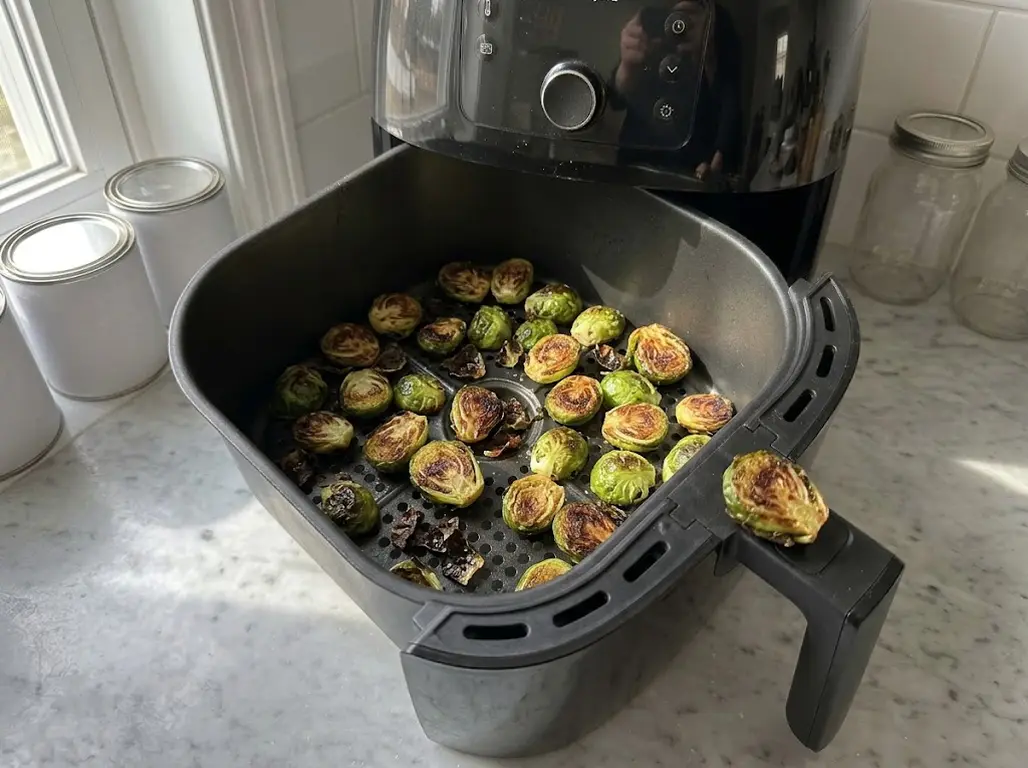
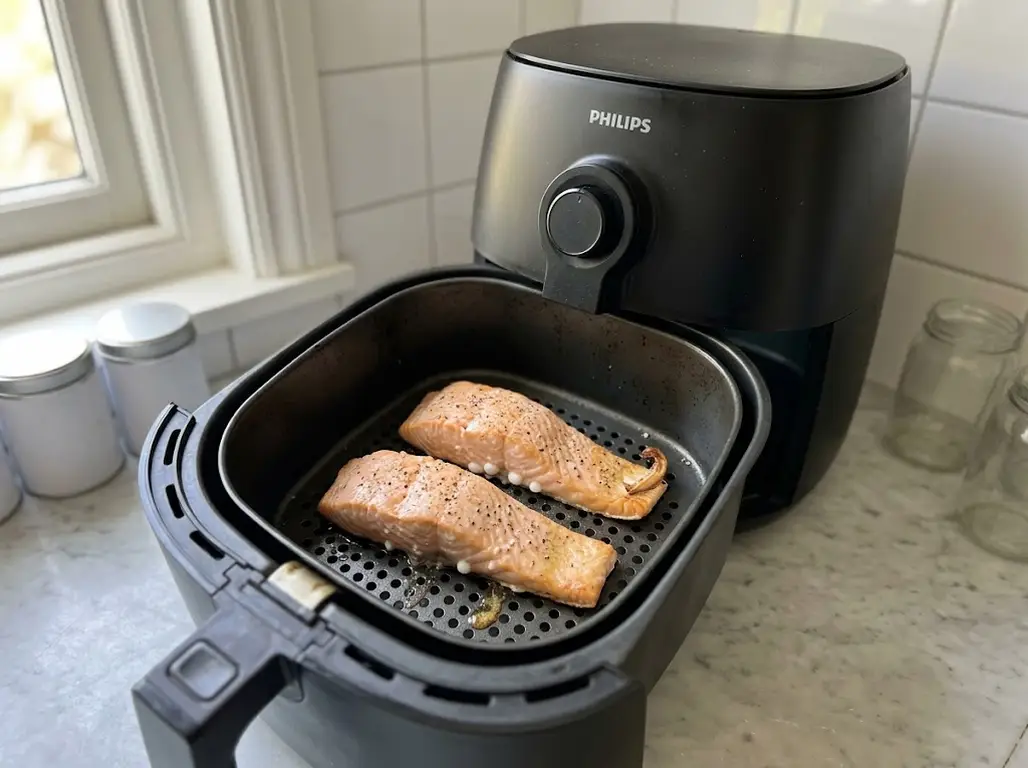
Proteins behave like they found their natural habitat. Chicken thighs and wings render and crisp better than most ovens can manage; boneless breasts stay juicy precisely because the cook is short; salmon fillets at 390F for 7 to 9 minutes are the fastest weeknight dinner in this house; meatballs, pork chops, and thick-cut steaks all work on the same logic of dryable surface plus stable shape. The one caveat is the thermometer, and it is the same caveat this site repeats about cake: moving air browns surfaces faster than centers cook, so color is a liar and an instant-read thermometer is the referee.
Reheating may be the machine's most underrated job. Leftover pizza at 350F for 3 to 4 minutes comes back with a crisp floor and melted top, which a microwave has never once achieved. Fried chicken, egg rolls, fries, roast potatoes: anything that was ever crisp can be crisp again, because the machine's whole personality is removing surface moisture, and surface moisture is exactly what ruined your leftovers. The crispness guide runs the full playbook.
Baking is the category the listicles skip entirely and the one this site exists for. Cookies, brownies, muffins, cinnamon rolls, quick breads, hand pies, even yeasted loaves and custards all work in the basket once you respect the machine's top-down heat and drying wind. That is a deep enough subject to deserve its own map, and it has one: what you can and can't bake in an air fryer is this page's sibling, ranking every baked good from thrives to needs-tricks to skip, and how to bake in an air fryer teaches the method from zero.
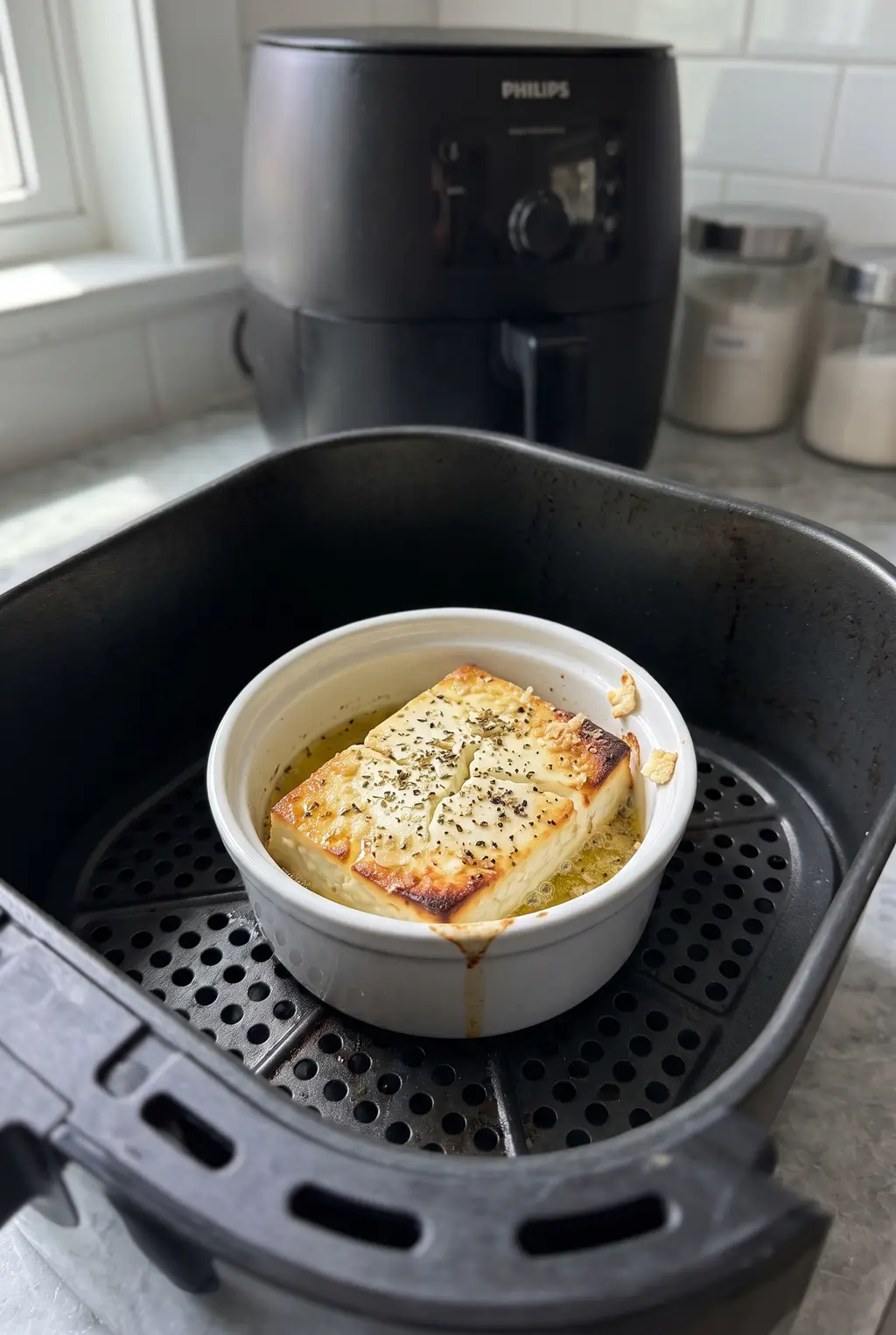
The surprises round out the yes column. Hard-cooked eggs in the shell, no water involved, 270F for 15 to 17 minutes. Croutons and toasted nuts, watched closely because they are light enough to care about the fan. Baked feta or brie in a ramekin, which previews a trick that matters below: a vessel converts several forbidden foods into legal ones. Grilled cheese, weighted with a toothpick so the top slice does not audition for flight. The pattern behind every surprise is the same rule as always: give the air a stable, reachable surface and it will do the work.
The five reasons foods fail
Every no on every list you have ever read is one of these five mechanisms in costume.
- 1. The fan is a wind. Anything lighter than the airflow becomes a participant in it. Loose spinach, microgreens, single sheets of parchment, dry coconut flakes: they lift, they land on the element, they burn, and occasionally they smoke. If a food would blow off a picnic table, it will blow around the basket.
- 2. Fat needs somewhere to go. Deep fryers hold fat as the medium; ovens spread drippings across a wide pan. An air fryer concentrates rendered fat in a small drawer directly below intense heat, where enough of it will smoke. Very greasy foods are not forbidden, but they are unmanaged fires waiting for management, which is the entire subject of the smoking guide.
- 3. There is no water in this machine. Rice, dry pasta, dried beans, oatmeal, anything that cooks by absorbing boiling liquid is a physical impossibility here, not a difficulty. The machine's one talent is removing water. Asking it to add water is asking a hair dryer to do the dishes.
- 4. There is no immersion. Wet batter sets instantly in hot oil because the oil supports and cooks it from all sides at once. In a basket, batter has no support, so it drips through the perforations, and no immersion, so the fan blows it sideways before it can set. This is the one failure that is also a safety problem, because liquid batter on a heating element is how smoke stories start.
- 5. Mass blocks the air. The machine cooks with circulation, so anything big enough to dam the circulation defeats it: a whole large chicken wedged against the walls, a frozen family lasagna, a Dutch-oven-sized roast. The outside sees all the heat and burns; the shadowed center sees almost none and stays cold. Crowding a batch of small foods fails the same way for the same reason, which is why the common mistakes guide puts overfilling at number one.
The shouldn't list, with redemptions
Now the famous villains, each with an honest verdict. Watch how few survive as actual nevers.
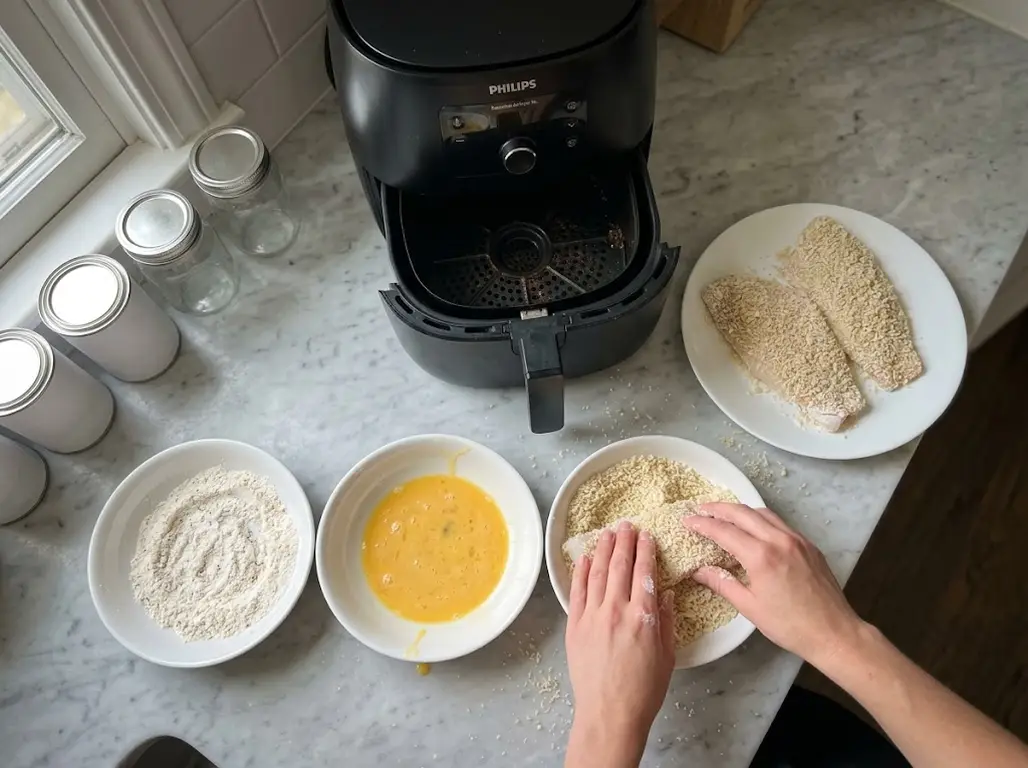
Wet battered foods. Verdict: hard no as written, full redemption available. Beer batter and tempura need immersion the machine cannot provide. But the same fish or vegetable in a dry dredge, flour, then egg, then panko pressed on firmly, crisps magnificently at 390F, because a dredge is a batter that already holds its shape. You lose the lacy tempura shatter; you keep dinner.
Raw rice, pasta, and grains. Verdict: the truest hard no on the internet. No water, no boiling, no absorption, no exceptions. The redemption lives one step away: cooked rice crisps into something near tahdig, leftover pasta turns into crunchy snacks, and chickpeas roast into the best road snack in this house. The machine cannot cook grains. It is outstanding at second-day grains.
Fresh cheese, naked. Verdict: no on the bare basket floor, yes in a vessel. Cheese melts through the perforations and burns on the drawer below, and that smell lives in the machine for a week. But feta baked in a ramekin, brie in its wooden box with the lid off, halloumi, which holds shape by nature, all thrive. Frozen breaded cheese was always fine because the crumb sets first. The ban was never on cheese. It was on cheese without a container.
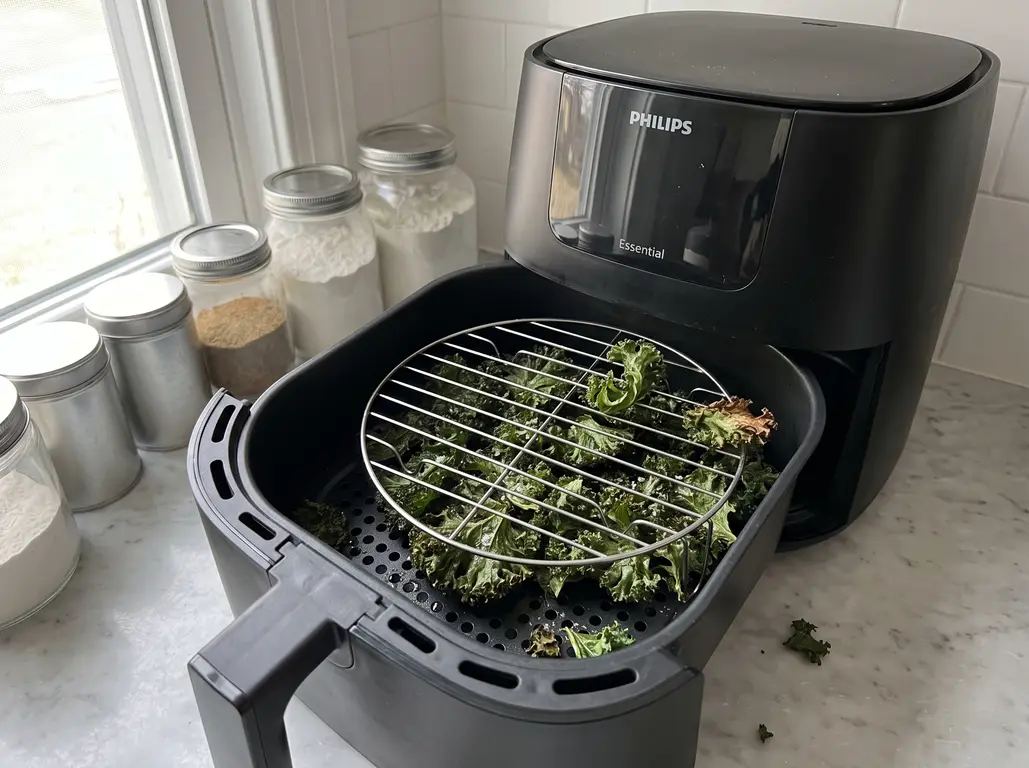
Loose leafy greens. Verdict: no for delicate leaves, conditional yes for sturdy ones. Spinach and microgreens obey failure mode one and fly. Kale is the exception that proves the mechanism: massage it with enough oil to add weight, single layer, 300F, and a rack or trivet laid over the top if your fan is aggressive, and you get kale chips. The oil is not flavoring. It is ballast.
Bacon and very fatty cuts. Verdict: conditional yes, and the condition is temperature. At 400F rendered bacon fat smokes in the drawer. At 350F, in a single layer, with a tablespoon of water under the basket to keep drippings below their smoke point, and the drawer drained between batches, bacon is excellent and evenly cooked. Sausages and skin-on duck follow the same rule: moderate heat, managed fat.
Whole large roasts and birds. Verdict: depends entirely on clearance, not on the food. A small chicken in a large basket-style machine, or most birds in an oven-style unit, roasts beautifully. A bird that touches the element or the walls blocks its own airflow and fails by mode five. The redemption is butchery: spatchcock the bird or cook it in pieces, and the problem disappears along with half the cooking time. The basket versus oven-style guide explains why the two machine shapes give different answers here.
Dense frozen bricks. Verdict: conditional. A frozen family lasagna dropped in whole browns outside and stays cold at heart. Thawed first, covered with foil for the first stretch so the top cannot finish early, then uncovered to brown, portion-sized casseroles reheat well. The foil move, and when it is safe, is covered in the foil and parchment guide.
Popcorn. Verdict: hard no, and a safety no. Kernels are light enough to blow into the element housing, most machines never reliably hit popping conditions across the basket, and a kernel lodged against a glowing coil is a genuine hazard. There is no redemption move. Use the stove; it takes three minutes.
Toast, for the record. Verdict: yes, despite occasionally appearing on never lists. Weight it or wedge it so the fan cannot flip it. The people who banned toast met failure mode one and blamed the bread.
The verdict table
| Food | Verdict | Failure mode | The move |
|---|---|---|---|
| Frozen fries, nuggets, sticks | Yes | None | 380F, shake once, minute off later batches |
| Roastable vegetables | Yes | None | 375–400F, oiled, single layer |
| Broccoli | Yes, watched | Dries fast | Big florets, real oil, 375F, pull early |
| Chicken, salmon, chops | Yes | None | Thermometer over eyeballs, always |
| Baked goods | Mostly yes | Top heat, wind | See the baking version of this page |
| Bacon, fatty cuts | Conditional | 2: pooling fat | 350F, water under basket, drain often |
| Fresh cheese | Conditional | Melts through | Give it a ramekin or a rind |
| Leafy greens | Conditional | 1: the wind | Kale only, oiled heavy, 300F, weighted |
| Whole large roasts | Conditional | 5: blocked air | Two inches of clearance or spatchcock |
| Frozen casseroles | Conditional | 5: dense mass | Thaw, foil first, uncover to finish |
| Wet battered anything | No as written | 4: no immersion | Dredge instead: flour, egg, panko |
| Raw rice, pasta, grains | Hard no | 3: needs water | Cook first; crisp leftovers instead |
| Popcorn | Hard no | 1, plus safety | The stove. Three minutes. |
Anything here that ends in smoke, mess, or mystery has a diagnosis page: smoking, burning, and general troubleshooting.
Cooking borrowed recipes: the settings engine
The yes column above is enormous, and most of it will arrive in your kitchen as an oven recipe, because the world's recipes were written for ovens. The translation is mechanical: drop the temperature about 25 degrees and expect roughly 20 percent less time, then verify with your eyes and a thermometer, because moving air cooks harder than the still air the recipe assumed. The air fryer calculator does that conversion for any temperature and time you type in, which makes it the practical engine behind this entire page: every oven recipe you already own, run through one honest formula. The conversion guide explains the why behind the numbers, the baking chart logs every setting this site has tested, and the pan size calculator settles whether your bakeware physically fits before you preheat, which is a better time to find out than after.
Two more tools earn their place in a page about what works. The oils guide matters because half the conditional yeses above lean on oil with a smoke point that can survive the chamber, and the preheat guide matters because the fast-recovering chamber makes preheating optional for most of the yes list and quietly mandatory for a few items at the crispy end of it.
Frequently asked questions
QWhat foods work best in an air fryer?
Anything with a dry-ish surface and a stable shape that air can circulate around: frozen convenience foods, oiled roastable vegetables, chicken in every form, salmon, meatballs, pork chops, reheated pizza and fried foods, and a long list of baked goods from cookies to cinnamon rolls. The machine rewards foods that benefit from surface drying, because crisping is drying, and punishes foods that need water, immersion, or still air.
QWhat should you never put in an air fryer?
The genuine hard nos are shorter than the internet suggests: raw rice, pasta, and grains, which need boiling water the machine cannot provide; wet batters as written, which need immersion and will drip and blow instead; popcorn, which is a safety issue because kernels can lodge against the element; and anything so large it blocks airflow entirely. Most other famous nevers, bacon, cheese, kale, whole chickens, are conditional yeses with a specific workaround.
QCan you cook raw meat in an air fryer?
Yes, and it is one of the machine's best jobs. Raw chicken thighs, wings, breasts, salmon, pork chops, meatballs, and thick steaks all cook beautifully because the hot moving air renders and crisps surfaces while the short cook keeps interiors juicy. The one rule is to verify doneness with an instant-read thermometer rather than color, because an air fryer browns the outside faster than the inside cooks, so appearance runs ahead of safety.
QWhy can't you use wet batter in an air fryer?
Wet batter needs hot oil to set: immersion supports the liquid coating and cooks it from all sides in seconds. In an air fryer there is no support, so batter drips through the basket perforations, and no instant set, so the fan blows it sideways onto hot surfaces where it smokes. The fix is to switch coatings, not machines: a dry dredge of flour, egg, and pressed-on panko holds its shape and crisps extremely well at 390F.
QCan you cook bacon in an air fryer?
Yes, with fat management. The risk was never the bacon; it is rendered fat pooling in a small drawer under intense heat, where it can smoke. Cook at 350F rather than 400F, keep slices in a single layer, add a tablespoon of water to the drawer beneath the basket to keep drippings below their smoke point, and drain between batches. Done that way, air fryer bacon is flat, even, and hands-off in about 8 to 10 minutes.
QCan you bake in an air fryer?
Extensively, and it is this site's entire specialty. Cookies, brownies, muffins, quick breads, cinnamon rolls, hand pies, yeasted loaves, and even custards work once you respect two facts: the heat is strongest from above, so deep bakes get foil tents, and the moving air dries surfaces, so oven temperatures convert down about 25 degrees. Some bakes need tricks and a few are not worth forcing, which is exactly what the companion baking guide ranks item by item.
QCan you put cheese in an air fryer?
In a container, yes; naked on the basket floor, no. Fresh cheese melts through the perforations and burns in the drawer below. But feta baked in a ramekin, brie warmed in its rind, and halloumi, which holds its shape by nature, all work beautifully, and frozen breaded cheese like mozzarella sticks was always fine because the coating sets before the interior fully melts. The rule is not about cheese. It is about giving liquids a vessel.
QCan you cook a whole chicken in an air fryer?
Only if air can still move around it. The machine cooks by circulation, so a bird that presses against the walls or sits close to the element blocks its own cooking and burns outside while lagging inside. Measure first: you want about two inches of clearance all around. If your basket cannot give a whole bird that space, spatchcock it flat or cook it in pieces, which also cooks faster and more evenly than the intact bird ever would.
QHow do I convert an oven recipe for the air fryer?
Drop the oven temperature by about 25 degrees Fahrenheit and start checking at about 80 percent of the stated time, because fast-moving air delivers heat harder than the still air the recipe was written for. Then trust evidence over the clock: color for crisp foods, an instant-read thermometer for meats and bakes. An online air fryer calculator automates the arithmetic for any time and temperature, and delicate wet batters deserve a slightly gentler drop still.
Never overbake again
Get our one-page times & temps cheat sheet, plus a new tested recipe each week.
No spam · unsubscribe anytime