
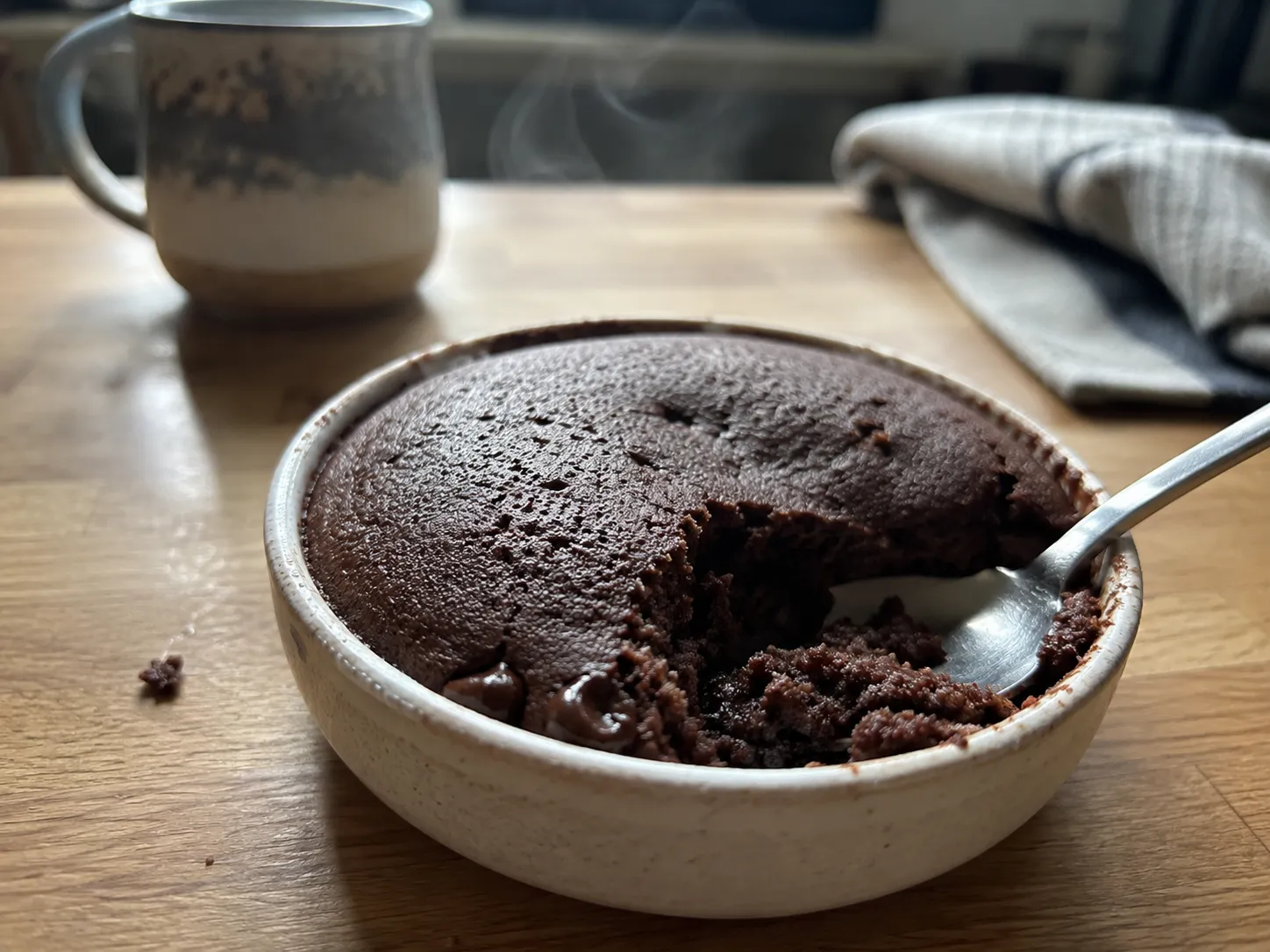
I want to deal with the number in the title straight away, because a lot of recipes wave it around and then quietly give you a fourteen minute bake.
Five minutes is real. I get it every time. But it depends entirely on one thing that almost nobody writing about this mentions, and if you get that thing wrong there is no temperature on the dial that will save you.
Quick answer: Mix everything in a wide, shallow dish rather than a tall mug. A 4 inch ramekin, filled no more than half, at 350°F for 5 to 6 minutes. If you insist on an actual mug, the same batter needs 11 to 14 minutes, and that is not your air fryer being slow. Pull it at 200°F in the middle and let it sit two minutes, because the dish keeps cooking it after it comes out.
The vessel is the recipe
Look at what is published for air fryer mug cake and the times make no sense next to each other. I found 6 to 8 minutes at 350°F. 7 to 9 at 320°F. 8 to 10 at 320°F. 12 to 13 at 350°F. 12 to 14 at 370°F. Same little cake, more than double the time, and several of them at the same temperature.
Everyone blames machine variation. It is not machine variation. Sort those recipes by what they cooked in and the pattern is immediate: the fast ones used ramekins, the slow ones used mugs.
Heat has to travel
Time through a solid goes with roughly the square of the thickness. Batter that is twice as deep does not take twice as long, it takes about four times as long.
A mug hides the batter
Tall ceramic walls, a narrow opening, and no airflow reaching the sides or base. The only surface actually exposed to moving air is the small circle on top.
Ceramic is slow
A thick mug is a lump of insulation that has to be heated through before it starts giving heat to the batter. It steals the first several minutes for itself.
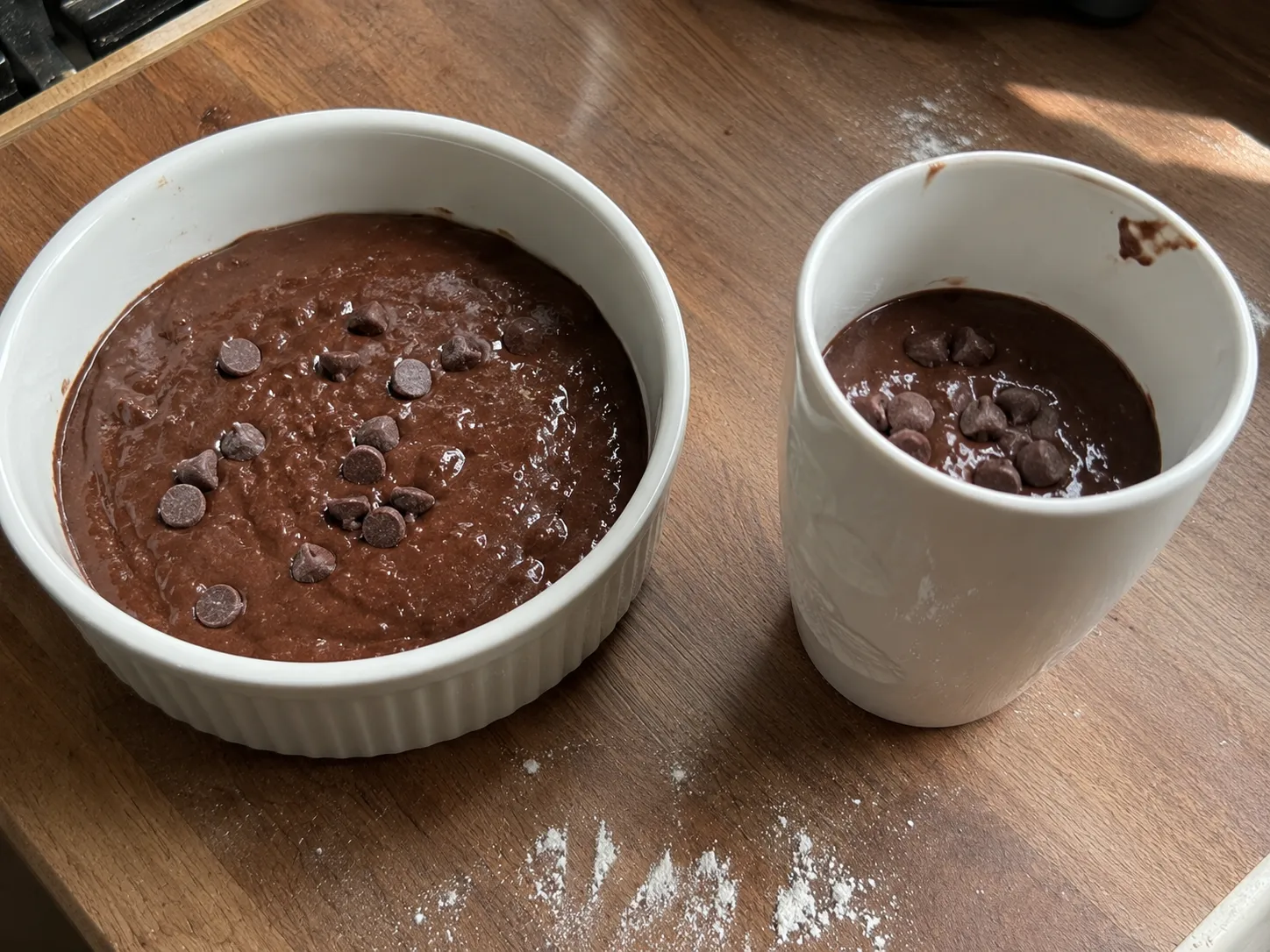
Put numbers on it. This recipe makes about 155ml of batter. In a 4 inch ramekin that spreads to roughly 3/4 of an inch deep. In an 8 ounce mug it stacks up to about 1 1/2 inches. Twice the depth, four times the conduction time, and that is before you account for the mug walls blocking the air.
So the fourteen minute recipes are not wrong. They are just describing a mug and not saying so. The glossary entries on conduction and thermal mass cover both halves of this in a couple of sentences each.
How to actually get 5 minutes
Three things, and only the first one really matters.
- Use a wide, shallow dish. A 4 inch ramekin is ideal. A small shallow gratin dish works. A ceramic creme brulee dish is close to perfect. What you want is the batter sitting no more than about 3/4 of an inch deep.
- Preheat properly. Three minutes at 350°F. A cold basket means the first two minutes go into warming the machine and the dish rather than the cake, and on a five minute bake that is nearly half your time gone. Whether you need to preheat goes through when it matters, and a five minute bake is the clearest case there is.
- Do not fill it more than half. Not for time, for the overflow. This batter rises a lot in a short burst, and a dish filled two thirds will send a chocolate tongue over the side and onto the element.
| Vessel | Batter depth | Time at 350°F | What you get |
|---|---|---|---|
| 4 inch ramekin | About 3/4 inch | 5 to 6 min | Even crumb, lightly domed, thin baked top |
| 3 inch ramekin | About 1 1/4 inch | 8 to 10 min | Good, slightly denser at the base |
| 8 oz mug | About 1 1/2 inch | 11 to 14 min | Works, but the top is well done before the middle sets |
| Tall narrow mug | 2 inches plus | 15 min and up | Dry rim, gummy center. Not worth it. |
All of these hold the same amount of batter. The only thing changing is the shape it is sitting in. If you want to work out what fits your basket before you commit, the pan size calculator will tell you.
None of this means a mug is wrong. If you want a mug cake in a mug because that is the whole appeal, make it in a mug and give it the eleven to fourteen minutes it honestly needs. Just do not follow a five minute time in a mug and then wonder why the middle is raw.
Is your mug air fryer safe?
Worth two minutes of your attention, because this is the one thing on this page that can actually go wrong rather than just come out badly, and I could not find a single recipe that covers it properly. The closest was one line saying to pick a mug that is safe to heat up.
An air fryer is not a microwave. The rules are different and they are stricter.
Use only dishes marked oven safe. Microwave safe is not the same thing and does not qualify. A microwave heats the contents; an air fryer heats the vessel to 350°F from the outside. Plenty of mugs that live happily in a microwave will craze or crack in an air fryer.
Avoid thermal shock. Do not put a mug straight from a cold cupboard, or worse from the fridge, into a preheated basket. The outside expands faster than the inside and ceramic does not tolerate that. Let it sit at room temperature while you mix.
Skip anything with a painted or metallic finish, a glued handle, or a hairline crack you have been ignoring. Also skip stoneware you inherited and know nothing about.
Nothing plastic, and no melamine. Obvious, but travel mugs and picnic ware end up in air fryers more often than you would think.
Safest options, in order: a proper ceramic ramekin, an oven-safe glass dish such as Pyrex, or a silicone mold. Silicone is genuinely good here and releases perfectly, though it insulates, so knock about 10°F off and add a minute. Using silicone molds in an air fryer covers that, and our accessories guide has what is worth owning if you are buying rather than raiding the cupboard.
Ingredients
One serving, one bowl, and you can mix it directly in the ramekin if you do not mind a slightly rougher texture.
- 4 tablespoons (30g) all-purpose flour
- 2 tablespoons (24g) granulated sugar
- 2 tablespoons (10g) unsweetened cocoa powder
- 1/4 teaspoon baking powder
- Pinch of salt
- 1 1/2 tablespoons (21g) butter, melted, or neutral oil
- 3 tablespoons (45ml) milk
- 1 egg yolk, no white
- 1/2 teaspoon vanilla extract
- Optional: 1 tablespoon chocolate chips
The yolk, and why there is no white
This is the second thing worth knowing, after the vessel.
A whole egg in a portion this small is too much egg. You end up with something bouncy and faintly omelette-like rather than cakey, which is the complaint people have about mug cakes generally and then blame on the microwave. Egg white is roughly 90 percent water and it is mostly structural protein, so in a single serving it dominates.
The yolk on its own gives you richness, fat and enough binding to hold the crumb together, without the rubberiness. It is the same reasoning behind the extra yolk in our air fryer vanilla cake, just more pronounced at this size.
If you would rather not have a spare white sitting in the fridge, leave the egg out entirely and add another tablespoon of milk. You get a slightly more fudgy, brownie-ish result that is honestly very good, and it is what I make more often than not.
How to make it
- Preheat to 350°F (175°C) for 3 minutes. Start this before you mix, so the machine is ready when the batter is. On a five minute bake, preheating is not a nicety.
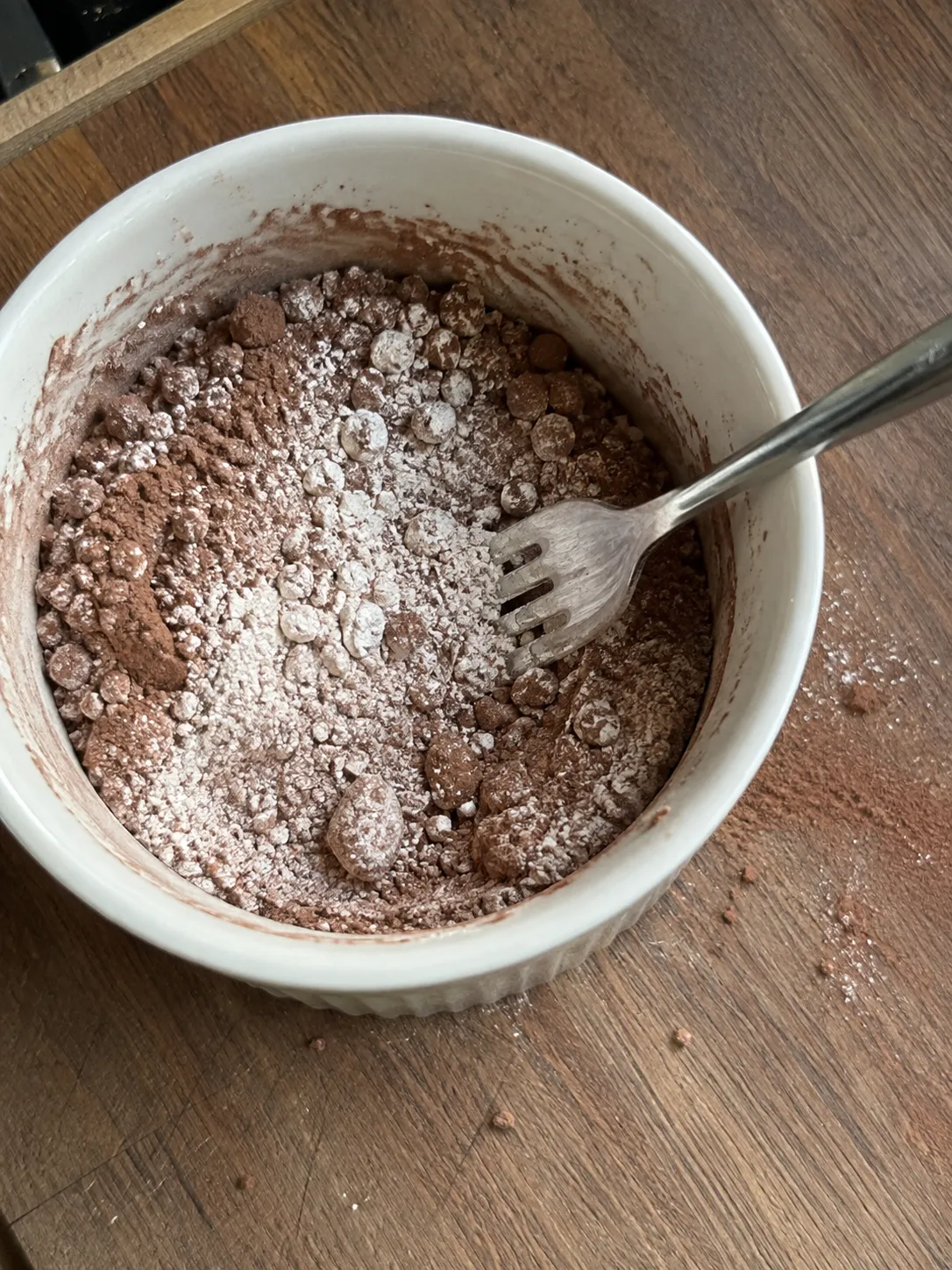
- Whisk the dry ingredients in your ramekin or a small bowl: flour, sugar, cocoa, baking powder and salt. Use a fork and break up every cocoa lump now, because they will not disappear later.
- Add the wet. Melted butter, milk, egg yolk and vanilla straight on top. Mix with the fork until it just comes together and no dry flour is left. About 20 seconds.
- Stop mixing. A little unevenness is fine. Beating it smooth develops gluten, and in a portion this small that turns a tender cake into a chewy one very quickly.
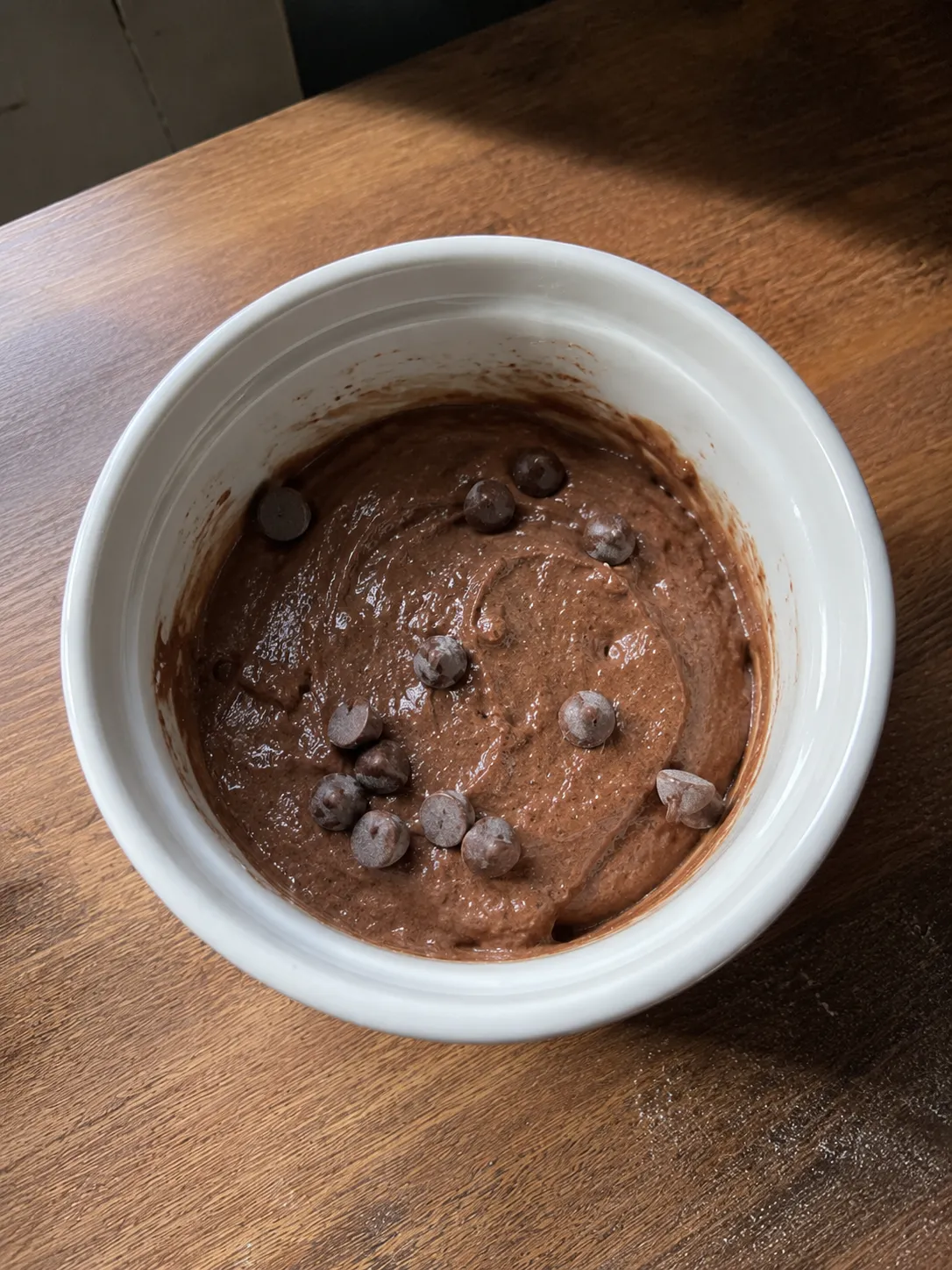
- Scrape into the ramekin if you mixed in a bowl, and level the top. It should come no more than halfway up. Scatter the chocolate chips over if you are using them.
- Bake 5 to 6 minutes at 350°F in a 4 inch ramekin. In an 8 oz mug, 11 to 14 minutes instead.
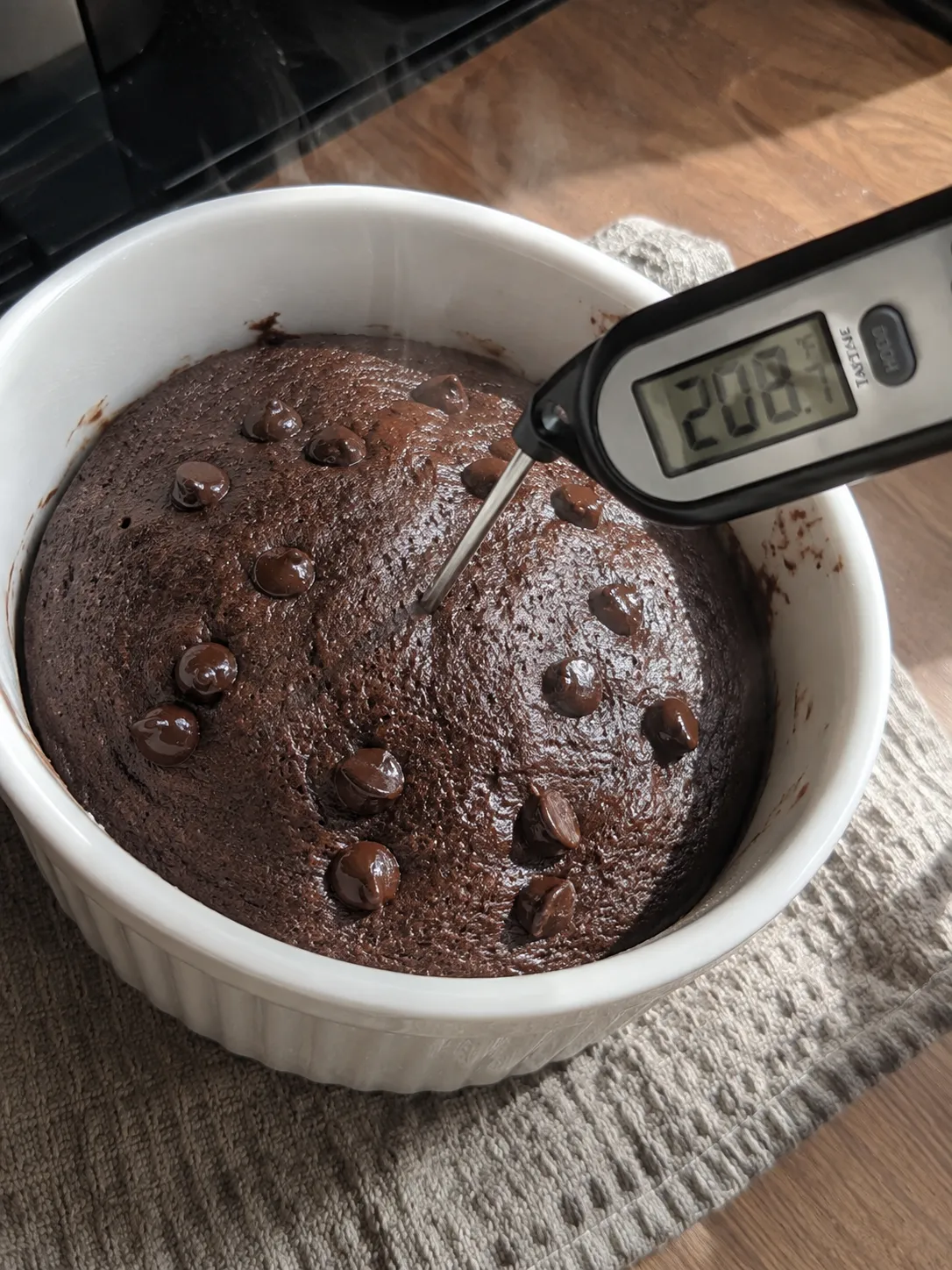
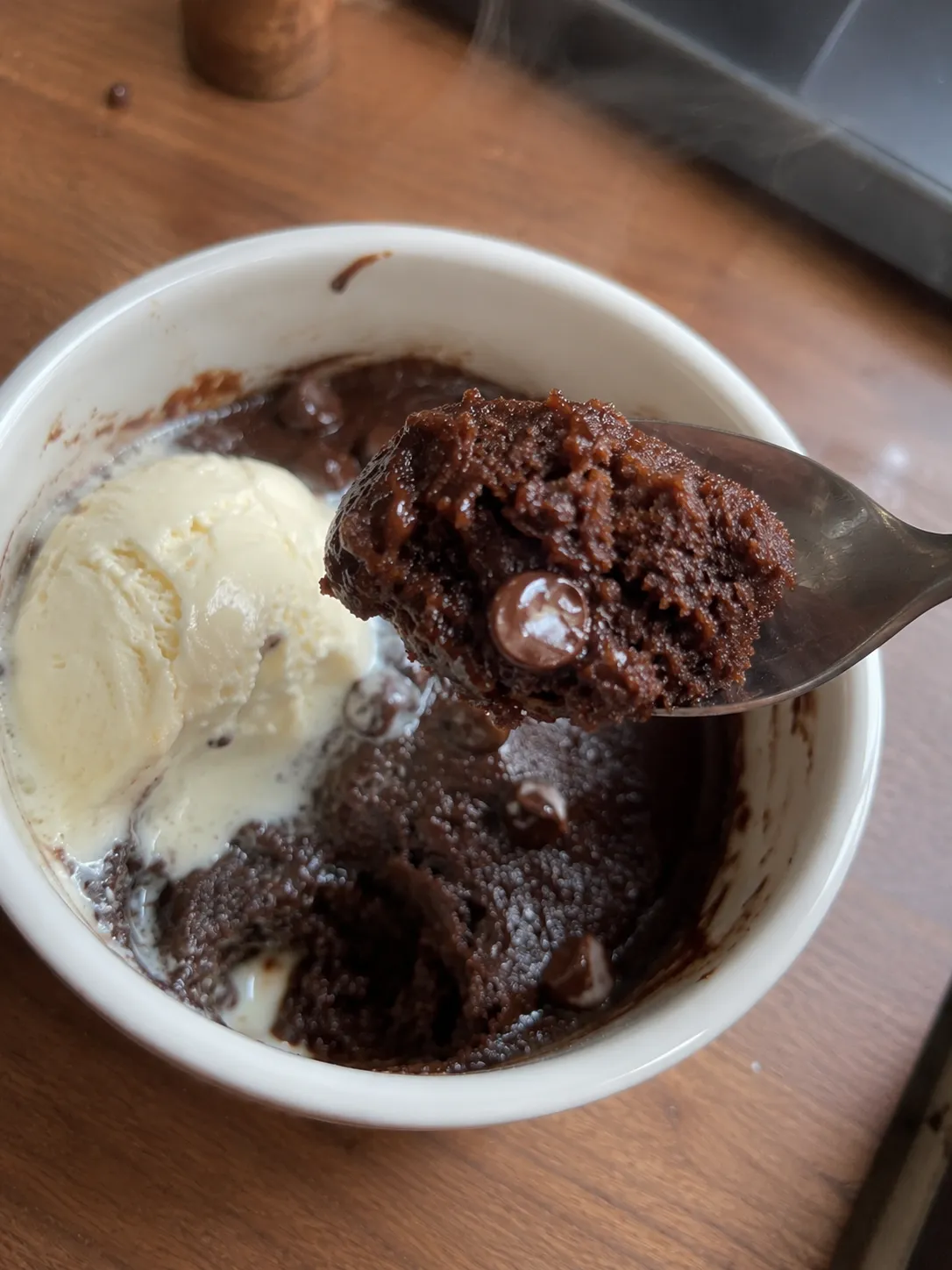
- Check the middle at 5 minutes. An instant-read thermometer into the center should read 200°F. The top should be set and matte with no wet shine.
- Take it out and wait two minutes. This is not optional and it is explained below. The dish carries on cooking it.
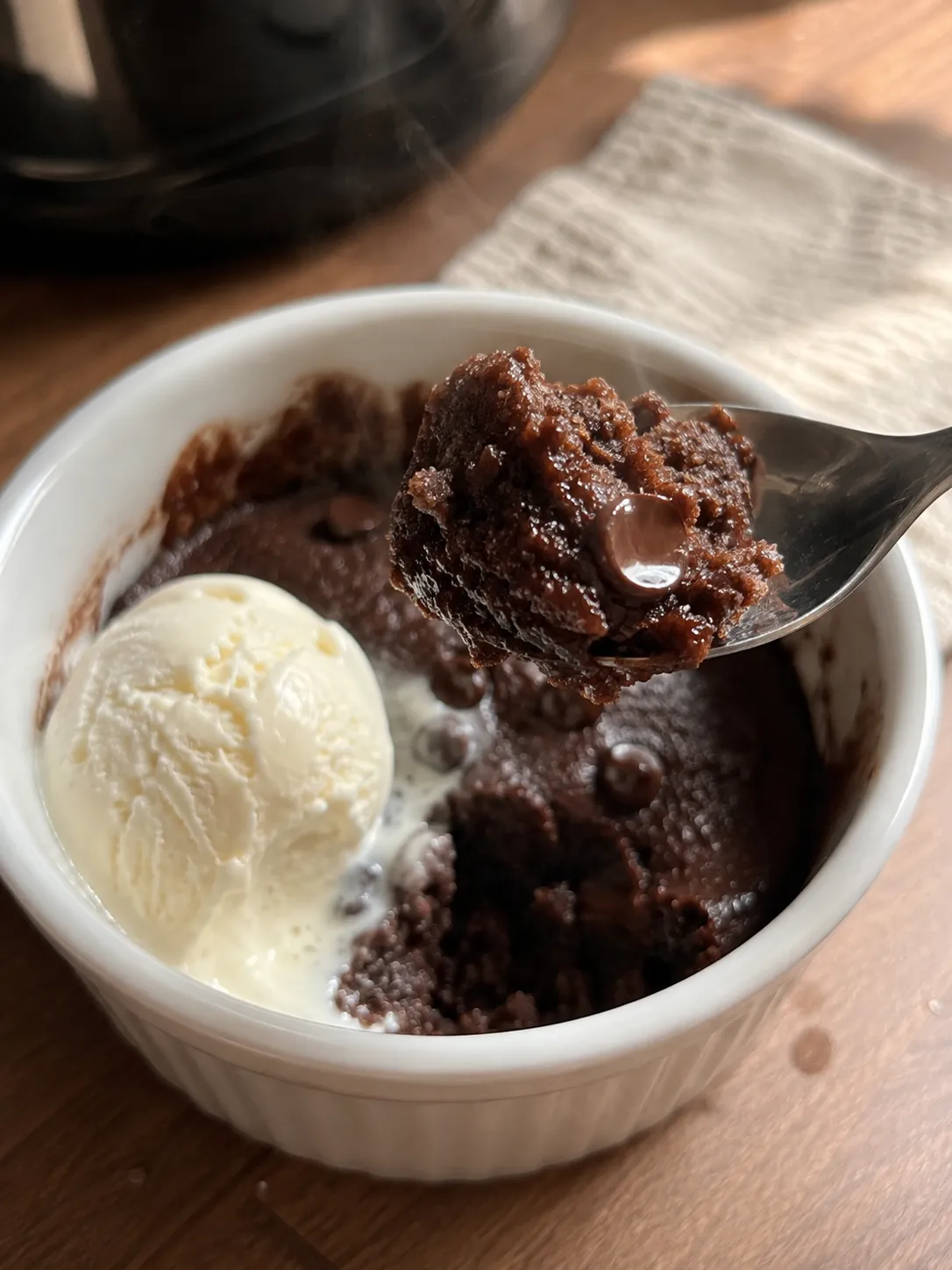
- Eat it out of the dish, with a spoon, ideally with something cold on top.
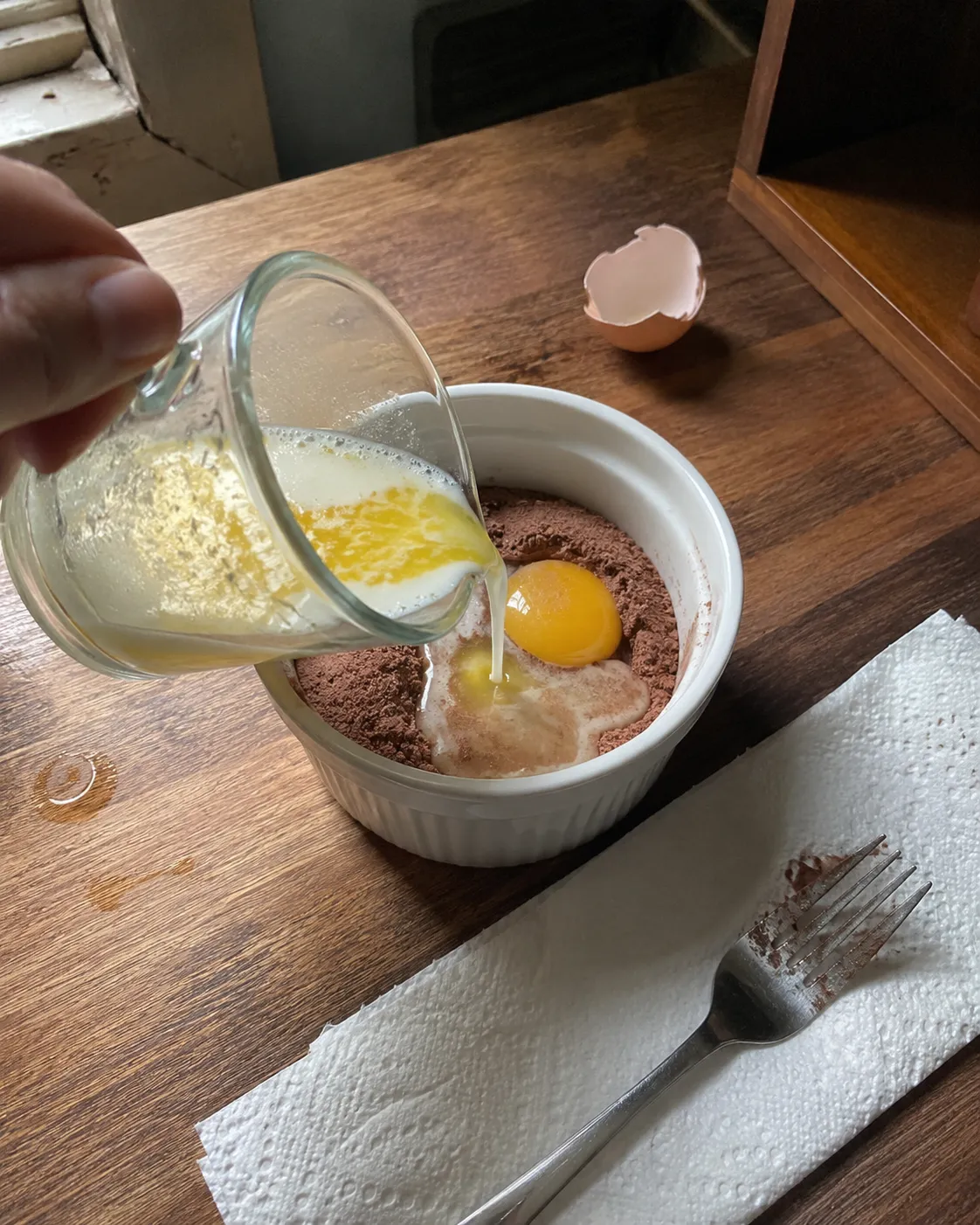
The one bowl claim, honestly. If you mix in the ramekin you use no bowls at all, which is the real appeal of a mug cake. The texture is very slightly coarser because a curved ramekin is harder to get a fork into the corners of than a bowl is. I do it in the ramekin on a weeknight and in a bowl if someone else is eating it.
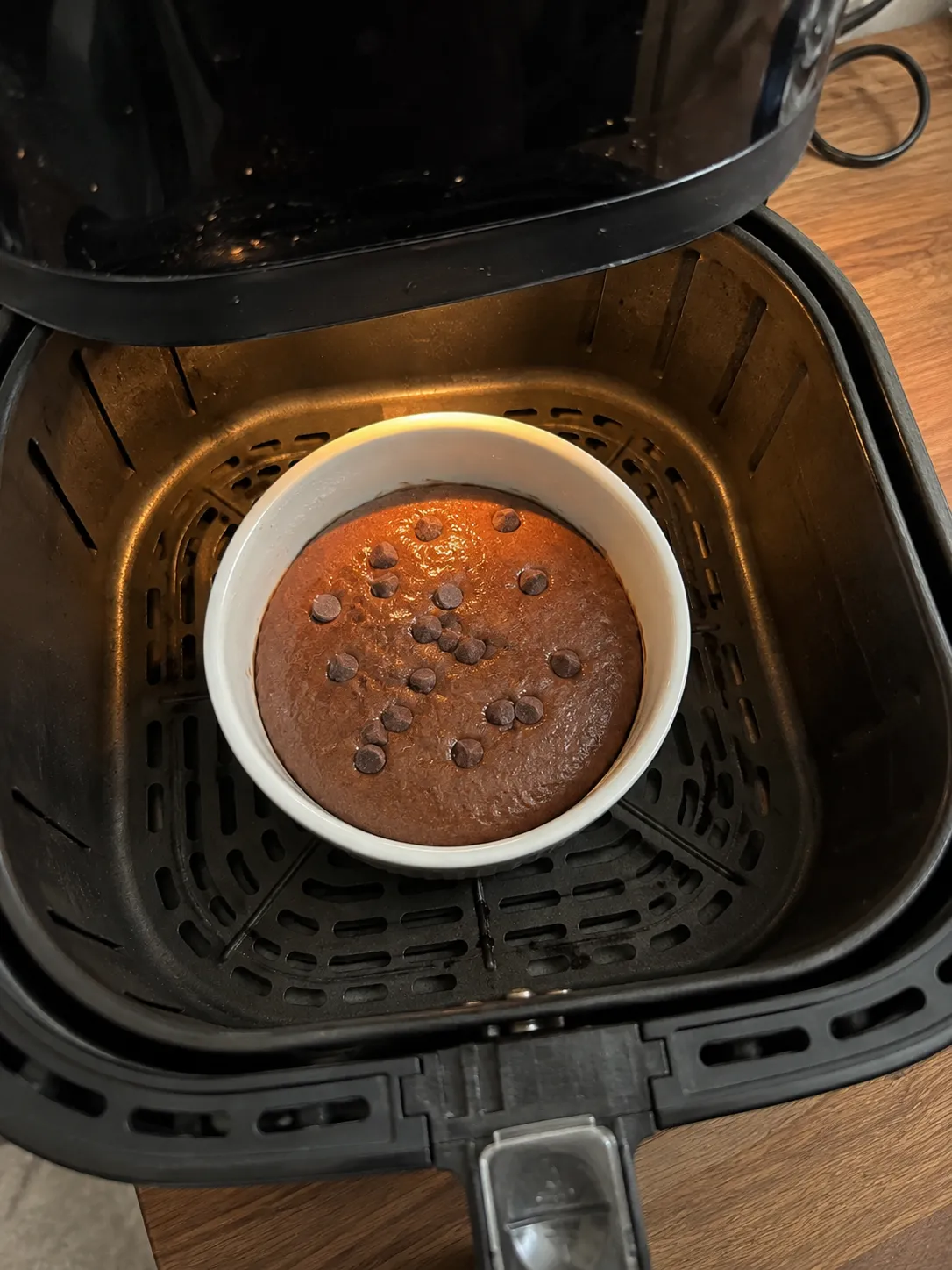
200°F, and the mug keeps cooking
Two things here, and the second one is the reason mug cakes have a reputation for being dry.
The first is the number. A cake is done when the starch has gelatinized and the egg protein has set, and for a small cake that is 200°F in the middle. Not a toothpick, which on a chocolate cake with melting chips in it is close to meaningless. Every recipe I read for this ends on a toothpick or a springy top, and neither tells you much when the whole cake is the size of a fist.
The second is carryover cooking, and it is unusually severe here. A ceramic ramekin at 350°F is holding a lot of stored heat, and a small cake sitting inside it is surrounded by that heat on five of its six sides. When you take it out, the dish does not stop. It keeps baking the cake for another minute or two.
| Out of the basket at | Two minutes later | Result |
|---|---|---|
| 195°F | About 200°F | Soft, slightly molten center. Very good if that is what you want. |
| 200°F | About 205°F | Properly baked all through, still moist. The target. |
| 210°F | 215°F and climbing | Dry by the time you eat it, and you will blame the recipe. |
This is why a mug cake that looked perfect in the basket can be disappointing three minutes later. You did not overbake it in the air fryer. You overbaked it on the counter. Internal targets for everything else are in the air fryer baking chart.
Air fryer or microwave, honestly
A microwave mug cake takes 90 seconds. This one takes five minutes plus three to preheat. So it is fair to ask what the extra time buys, and the honest answer is a real one, not a marketing one.
| Microwave | Air fryer | |
|---|---|---|
| Time | 90 seconds | 5 min, plus preheat |
| How it heats | Agitates water throughout the batter at once | Hot air on the surface, working inward |
| Texture | Steamed. Springy, sometimes rubbery, uniform all through | Baked. Tender crumb, slightly firmer top |
| Browning | None. The surface never gets above 212°F | A thin baked top with real color |
| Margin for error | Seconds. Ten too many and it is a puck | A minute or so either side |
The short version: a microwave cannot brown anything, because water in the batter holds the surface at 212°F and browning needs closer to 285°F. So a microwave mug cake is a steamed pudding wearing a cake's clothes. It is fine, and at 90 seconds it is hard to argue with, but it will never have a baked top or the slightly crisp edge where the batter met the dish.
Use the microwave when you want it now. Use the air fryer when you want it to taste like cake.
Fixing what goes wrong
| What you got | Why | Fix |
|---|---|---|
| Raw in the middle, done on top | The batter was too deep. This is a mug, not a machine problem. | Wide shallow dish, or give the mug 11 to 14 minutes. |
| Dry and crumbly | Carryover. It kept baking in the hot dish after it came out. | Pull at 200°F, not 210. Take it out of the basket promptly. |
| Rubbery and bouncy | Whole egg. Too much white for a portion this small. | Yolk only, or no egg and an extra tablespoon of milk. |
| Tough and chewy | Overmixed. Gluten develops fast in a small amount of batter. | Mix 20 seconds, stop when the flour disappears. |
| Overflowed onto the element | Filled more than half. It rises hard and fast. | Half full maximum. Fill level is covered in the glossary. |
| Sank in the middle | Pulled before the center set, so nothing held the risen shape. | 200°F. More on this in why air fryer cakes sink. |
| Cocoa lumps through it | Cocoa clumps and will not break up once liquid is in. | Whisk the dry ingredients properly before anything wet arrives. |
| Burnt top, pale sides | Too close to the element, which is common with a tall vessel. | A shallower dish sits lower. Or drop to 330°F and add 2 minutes. |
| The mug cracked | Thermal shock, or it was only microwave safe. | Oven safe only, at room temperature before it goes in. See above. |
If your bakes come out dry across the board rather than just this one, how to avoid dry air fryer bakes covers the general causes, and the troubleshooting guide has the rest.
Flavors and variations
- Vanilla. Leave out the cocoa and add another tablespoon of flour. Bump the vanilla to a full teaspoon, because there is nothing else carrying the flavor and moving air strips vanilla aroma quickly.
- Molten center. Push a square of chocolate or a teaspoon of Nutella into the middle of the batter before baking, and pull it at 195°F instead of 200. Effectively a single-serving version of our air fryer lava cake.
- Peanut butter. A tablespoon swirled in, and cut the butter to 1 tablespoon since the peanut butter brings its own fat.
- Biscoff or speculoos. Replace the cocoa with an extra tablespoon of flour and swirl in a tablespoon of the spread.
- Banana. Mash half a small banana in and cut the milk to 2 tablespoons. Add a minute, because the banana brings water.
- Funfetti. Vanilla base with a tablespoon of sprinkles folded in at the end. Use the jimmies rather than the round nonpareils, which bleed.
- Make it two. The recipe doubles cleanly into two ramekins side by side, and the time does not change as long as they are not touching. The recipe scaler handles other multiples.
If you want small desserts from a basket more generally, air fryer brownies are the batch version of this feeling, and what you can and cannot bake in an air fryer is worth a read before you try scaling anything up.
Making it ahead
A mug cake is a now food and it does not keep. That is the deal you make for a five minute dessert, and it is worth being straight about rather than pretending otherwise.
- Eat it within about ten minutes. It is best straight out, warm, with the chips still soft. After twenty minutes it is a fine but ordinary piece of cake.
- Do not refrigerate it. Cold makes a small cake dense and dry faster than almost anything else you could do to it.
- The dry mix does keep. Whisk together the flour, sugar, cocoa, baking powder and salt in a jar, multiplied by however many you want. Then it really is a five minute dessert: tip the mix in, add the wet, bake. This is the version worth prepping.
- Do not mix the full batter ahead. Baking powder starts reacting as soon as it meets liquid, and a batter that sat for an hour will barely rise.
Running an air fryer for eight minutes costs very little, but if you want the actual figure for your electricity rate, the running cost calculator will work it out, and against heating a full oven for one small cake it is not close. If you are adapting an oven mug cake recipe, put its numbers through the air fryer calculator first, then ignore its time and go by the 200°F reading. All four air fryer tools are in one place.
Frequently asked questions
QHow long does a mug cake take in an air fryer?
5 to 6 minutes at 350°F in a wide 4 inch ramekin, or 11 to 14 minutes for the same batter in an 8 oz mug. Published recipes range from 6 to 14 minutes and everyone blames machine variation, but sort them by what they cooked in and the pattern is obvious: the fast ones used ramekins and the slow ones used mugs. Heat travels through a solid with roughly the square of the thickness, so batter that is twice as deep takes about four times as long, and a tall ceramic mug also blocks airflow from the sides and base.
QCan you really make a mug cake in 5 minutes in an air fryer?
Yes, but only in the right dish. Use a wide shallow vessel, a 4 inch ramekin or a small gratin dish, so the batter sits no more than about 3/4 of an inch deep, and preheat the machine for 3 minutes first. In an actual mug the same batter genuinely needs 11 to 14 minutes and no temperature setting will change that. If a recipe promises 5 minutes without telling you what to bake it in, that is the detail it left out.
QCan you put a mug in an air fryer?
Only if it is marked oven safe. Microwave safe is not the same thing and does not qualify, because a microwave heats the contents while an air fryer heats the vessel itself to 350°F from the outside. Let the mug come to room temperature before it goes into a preheated basket, since ceramic does not tolerate thermal shock. Avoid anything with a painted or metallic finish, a glued handle, or a hairline crack, and never use plastic or melamine. A ceramic ramekin, oven-safe glass or a silicone mold are all safer choices.
QWhy is my air fryer mug cake raw in the middle?
The batter was too deep, almost certainly because you used a tall mug and a time written for a ramekin. The top of a mug is the only part getting direct airflow, so it sets and browns while the heat is still working its way down through an inch and a half of batter. Either move to a wide shallow dish and keep the 5 to 6 minute time, or stay with the mug and give it 11 to 14 minutes. Checking for 200°F in the center settles it either way.
QWhy did my mug cake come out dry?
Carryover cooking, most likely, and it is unusually severe with a mug cake. A ceramic dish at 350°F is holding a lot of stored heat and the cake is surrounded by it on five sides, so the dish keeps baking the cake for a minute or two after it leaves the basket. A cake pulled at 210°F will be past 215°F by the time you eat it. Pull at 200°F and let it sit two minutes. You did not overbake it in the air fryer, you overbaked it on the counter.
QDo I need an egg in a mug cake?
No, and a whole egg is actually too much for a portion this small. Egg white is about 90 percent water and mostly structural protein, so in a single serving it dominates and gives you something bouncy and faintly omelette-like rather than cakey. Use the yolk on its own for richness and binding without the rubberiness, or leave the egg out entirely and add another tablespoon of milk, which gives a fudgier, more brownie-like result that is very good in its own right.
QWhat temperature should an air fryer mug cake be inside?
200°F in the center, on an instant-read thermometer, which is where the starch has gelatinized and the egg protein has set. Take it out there rather than waiting for a firmer look, because the hot dish carries it up another 5°F while it sits. The toothpick test is close to useless on this cake: with cocoa and melting chocolate chips in a portion the size of your fist, a toothpick tells you where the chips are, not whether the crumb has set.
QIs an air fryer mug cake better than a microwave one?
Different rather than strictly better, and the difference is real. A microwave agitates water throughout the batter at once, so it steams the cake from the inside and the surface never gets above 212°F. Browning does not begin until around 285°F, so a microwave mug cake can never have a baked top: it is a steamed pudding wearing a cake's clothes. An air fryer bakes it from the surface inward, giving you a tender crumb, a thin browned top and a slightly crisp edge where the batter met the dish. The microwave takes 90 seconds and the air fryer takes 5 minutes plus preheat, so use the microwave when you want it now and the air fryer when you want it to taste like cake.
QWhy did my mug cake overflow?
Filled too high. This batter rises hard and fast in a short bake, and anything past half full will send a chocolate tongue over the side, usually onto the element where it burns and smokes. Half full is the maximum, and it is the same rule as for any air fryer cake, only more urgent because a small vessel gives the batter nowhere to go. If it has already happened, unplug the machine, let it cool completely and clean the element before the next cook.
QCan I make it without a ramekin or a mug?
Yes. A silicone muffin cup or small silicone mold works well and releases perfectly, though silicone insulates so drop about 10°F and add a minute. A small oven-safe glass dish is fine. A metal ramekin or a small cake tin is actually the fastest of all, because metal conducts far better than ceramic, so check it a minute early. What you cannot use is anything plastic, anything melamine, or anything marked microwave safe but not oven safe.
QCan I make two at once?
Yes, and the time does not change as long as the two dishes are not touching and there is airflow around each one. That is the useful thing about a small bake: you are limited by basket floor space rather than by anything to do with the batter. Three or four at once is fine in a larger basket. Just make sure none of them is tucked into a corner where the air cannot circulate, or that one will run behind the others.
QDo I have to preheat for a mug cake?
Yes, three minutes at 350°F, and it matters more here than on almost anything else. On a five minute bake, a cold start means the first couple of minutes go into warming the machine and the ceramic dish rather than the cake, which is nearly half your cooking time. It also makes the timing meaningless, because the temperature is climbing through an unknown range while the batter sits there. Preheat, then bake to 200°F internal and the starting conditions stop mattering.
Never overbake again
Get our one-page times & temps cheat sheet, plus a new tested recipe each week.
No spam · unsubscribe anytime