
I want to be honest about this one before you scroll to the recipe, because I think the honesty is what makes the rest useful.
You cannot make a funnel cake in an air fryer. Not really. A funnel cake is a specific thing that happens when thin batter meets 375°F oil, and no amount of hot air reproduces it. Every recipe you will find for this, including mine, is making something adjacent and calling it by the same name.
What you can do is get genuinely close, and closer than the popular versions manage, because most of them leave out a step that costs nothing.
Quick answer: Make the batter thicker than pancake batter, not thinner. Pipe it onto a parchment round in a preheated basket at 370°F. After 4 minutes, when it has set, slide the parchment out and flip the cake, brush the newly exposed side with melted butter, and give it 3 to 4 minutes more. Dust with powdered sugar while it is still hot. Brushed butter, not spray.
What air cannot do that oil does
Worth two minutes because it explains every compromise further down.
Hot oil does two things for a funnel cake, and an air fryer can only imitate one of them badly.
It surrounds the batter instantly
Oil is well over a thousand times denser than air. Every surface of every strand is in contact with the cooking medium the moment it hits, so the whole lacy web sets at once.
It holds the batter up
Batter floats. That buoyancy is why a funnel cake is a three dimensional tangle rather than a flat disc. Air provides no support at all.
Air gives you a flat, one-sided bake
Gravity pulls the strands down onto whatever they are resting on, and only the top surface sees moving air. That is a pancake in the shape of a funnel cake.
So the thing you are chasing is not the lace. The lace is gone the moment you take the oil away. What you are chasing is the texture: crisp shell, soft chewy inside, buttery, hot, buried in powdered sugar. That is achievable, and it is worth doing.
It is the same trade we go through on air fryer vegan donuts, which are honestly baked donuts rather than fried ones, and on air fried Oreos, the other fairground food on this site that had to be rethought for a basket. What you can and cannot bake in an air fryer is the general version of the argument.
Three different foods, one name
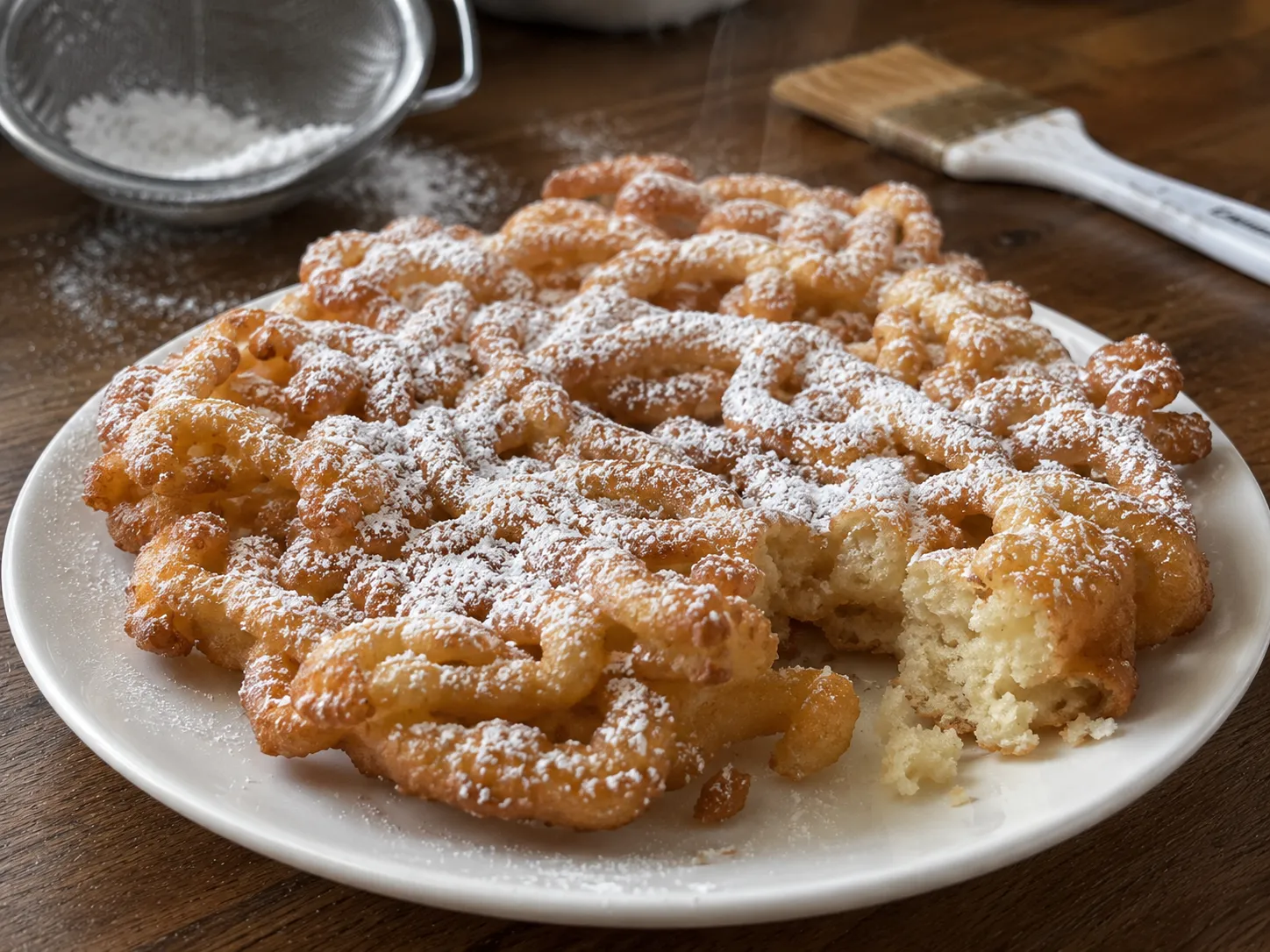
Search this and you will land on at least three genuinely different recipes, none of which mentions that the others exist.
| Version | What it is | Verdict |
|---|---|---|
| Piped batter | A thin pancake-style batter piped onto parchment. What this page makes. | Closest to the real thing. Worth the effort. |
| Two-ingredient dough | Self-rising flour and Greek yogurt rolled into ropes and coiled. | Perfectly nice, but it is a soft bread. Not a funnel cake in any sense. |
| Funnel cake bites | Small dollops of batter cooked as separate pieces. | Easiest and most reliable. Loses the shape entirely. |
| Box mix or frozen | Pre-made, reheated in the basket. | Fine. This page will not help you much. |
If you want the easiest possible version, make the bites. Small pieces have far more surface for their volume and they crisp properly without any of the shape problems below. If you want something that looks like a funnel cake on the plate, carry on.
The parchment step everyone gets wrong
This is the one that changes the result, and I have not seen it in any of the recipes currently ranking for this.
You need parchment. A thin batter piped straight into a basket runs through the perforations and lands in the drawer, and even in a solid tray it spreads into a puddle. So every recipe tells you to cut a parchment round, spray it, and pipe onto that. Correct so far.
Then they all leave it there for the whole cook. Which means the underside of your funnel cake spends the entire bake pressed against a solid sheet of paper, seeing no moving air whatsoever. It cannot brown, it cannot crisp, and the moisture leaving the batter has nowhere to go, so it sits in that layer and steams. That is why air fryer funnel cakes come out golden on top and pale, slightly doughy underneath.
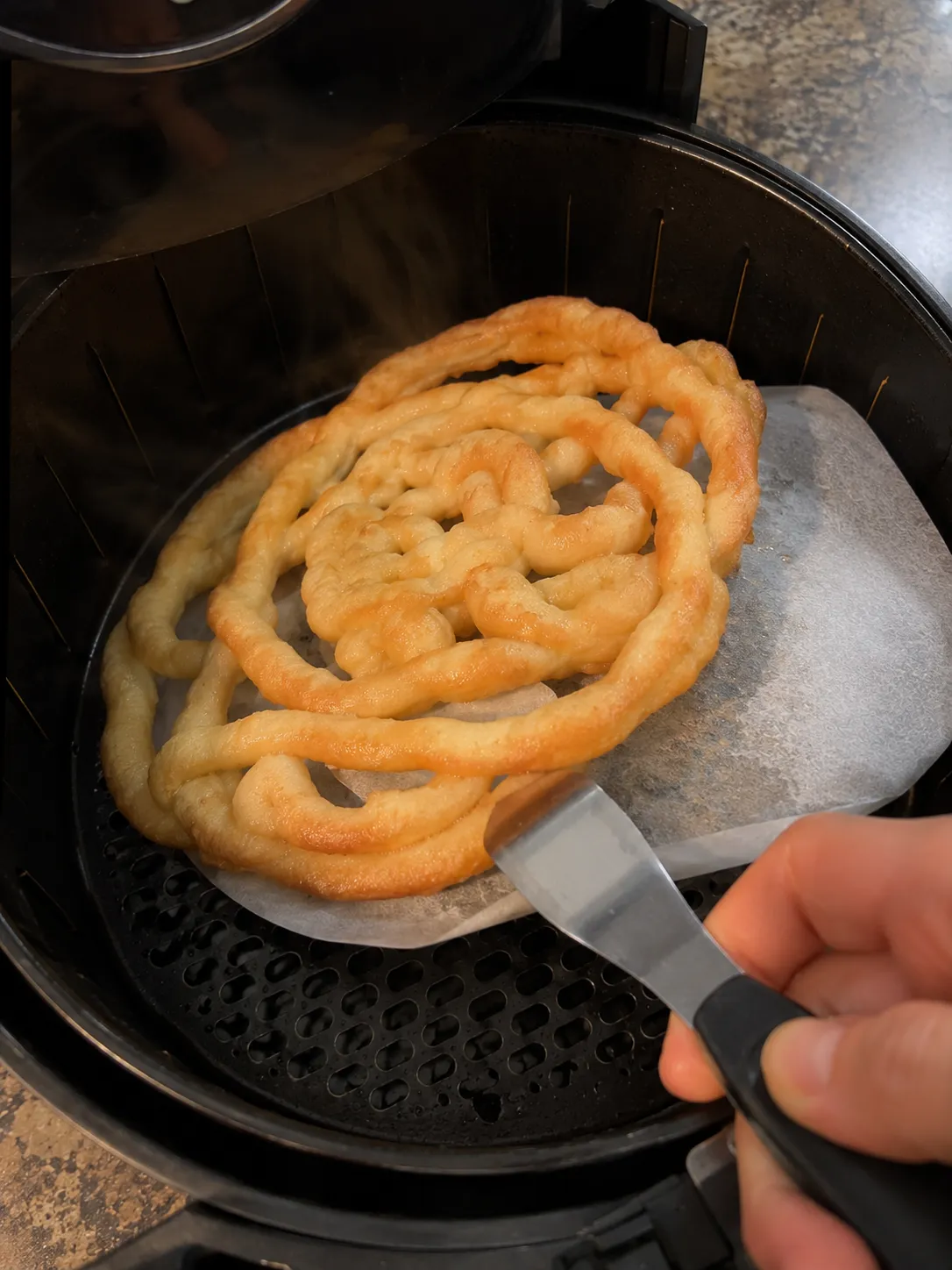
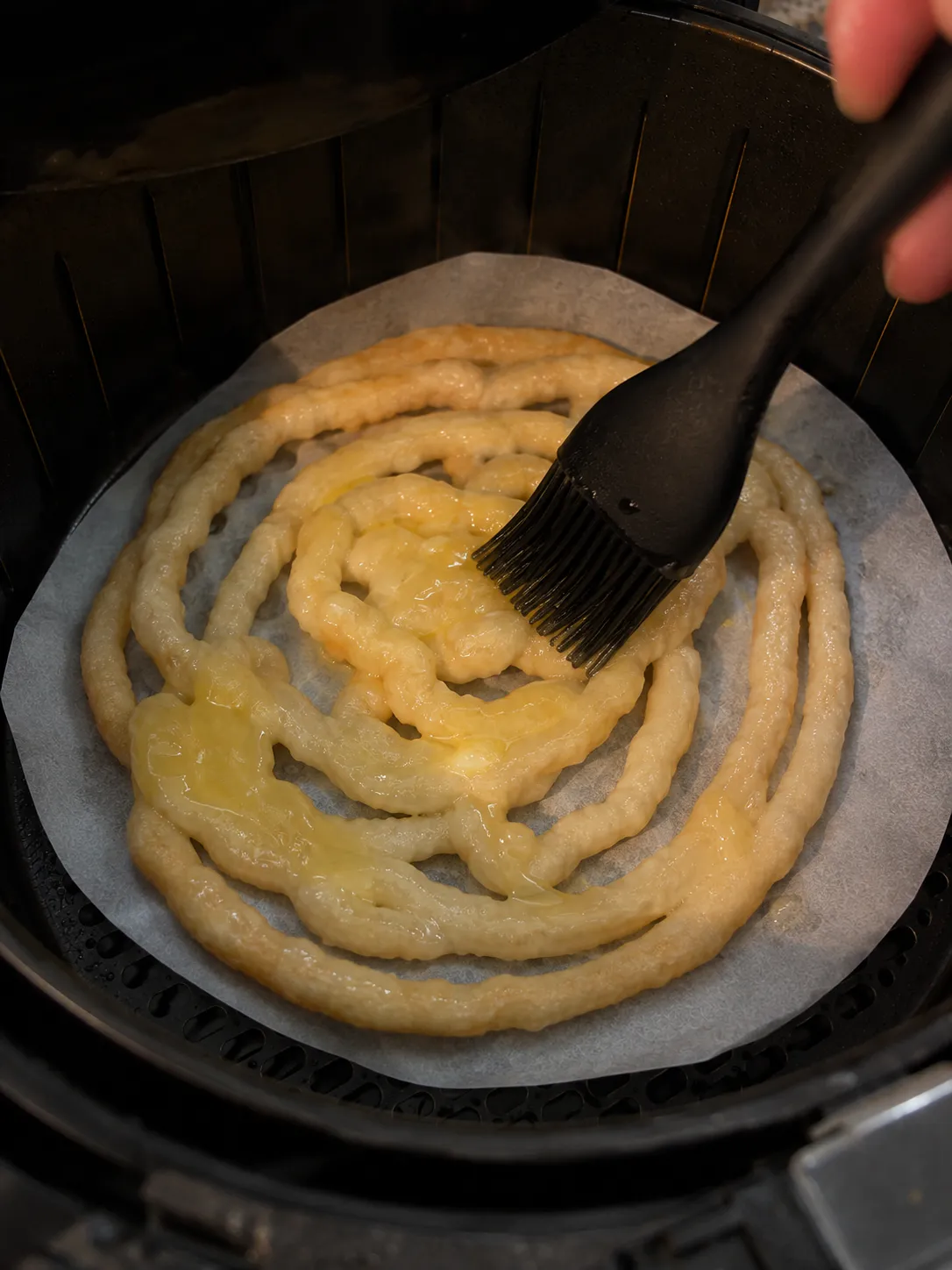
The fix, in one step: cook for about 4 minutes until the batter has set and holds together as a single piece. Then slide a thin spatula under it, lift the whole thing, pull the parchment out of the basket, and put the cake back in upside down. Brush the newly exposed side with melted butter and finish it for 3 to 4 minutes. Both sides now get direct airflow and both sides brown.
The four minute mark matters. Earlier than that the batter has not set and it will tear. Much later and the underside has already gone soggy and will not recover.
Never put loose parchment in a preheating air fryer. An empty sheet weighs almost nothing and the fan will lift it into the heating element, where it scorches and can catch. Preheat the machine empty, then put the parchment in with the batter already on it, so the weight holds it down. This is the same rule that applies to empty cupcake liners, and our guide to foil and parchment in an air fryer covers what is safe.
Perforated parchment rounds are better than plain ones for this, since some air gets through from the start. They still come out at the four minute mark. The glossary has an entry on perforated parchment if you have not used it.
Batter thickness, and the trade you cannot avoid
Here is a tension nobody resolves. A real funnel cake batter is thin, because thin batter poured into oil breaks into separate strands that set instantly into lace. Thin batter in an air fryer just spreads out and runs together into a disc, and the thin outer edges scorch while the middle is still wet.
The popular recipes call for a batter about the consistency of thin pancake batter, usually around three quarters of a cup of milk to a cup of flour. That is the deep-frying ratio, and in a basket it is too loose.
Mine uses half a cup of milk to a cup of flour, which is noticeably thicker, and that is deliberate.
| Batter | What happens in a basket |
|---|---|
| Thin, like the deep fry version | Spreads into a flat disc, edges burn before the center sets. Looks lacy going in, looks like a crepe coming out. |
| Thick pancake batter, this recipe | Holds a piped line for a couple of seconds before settling. You keep visible gaps and separate strands. |
| Too thick, like a dough | Will not pipe. You get a scone with delusions. |
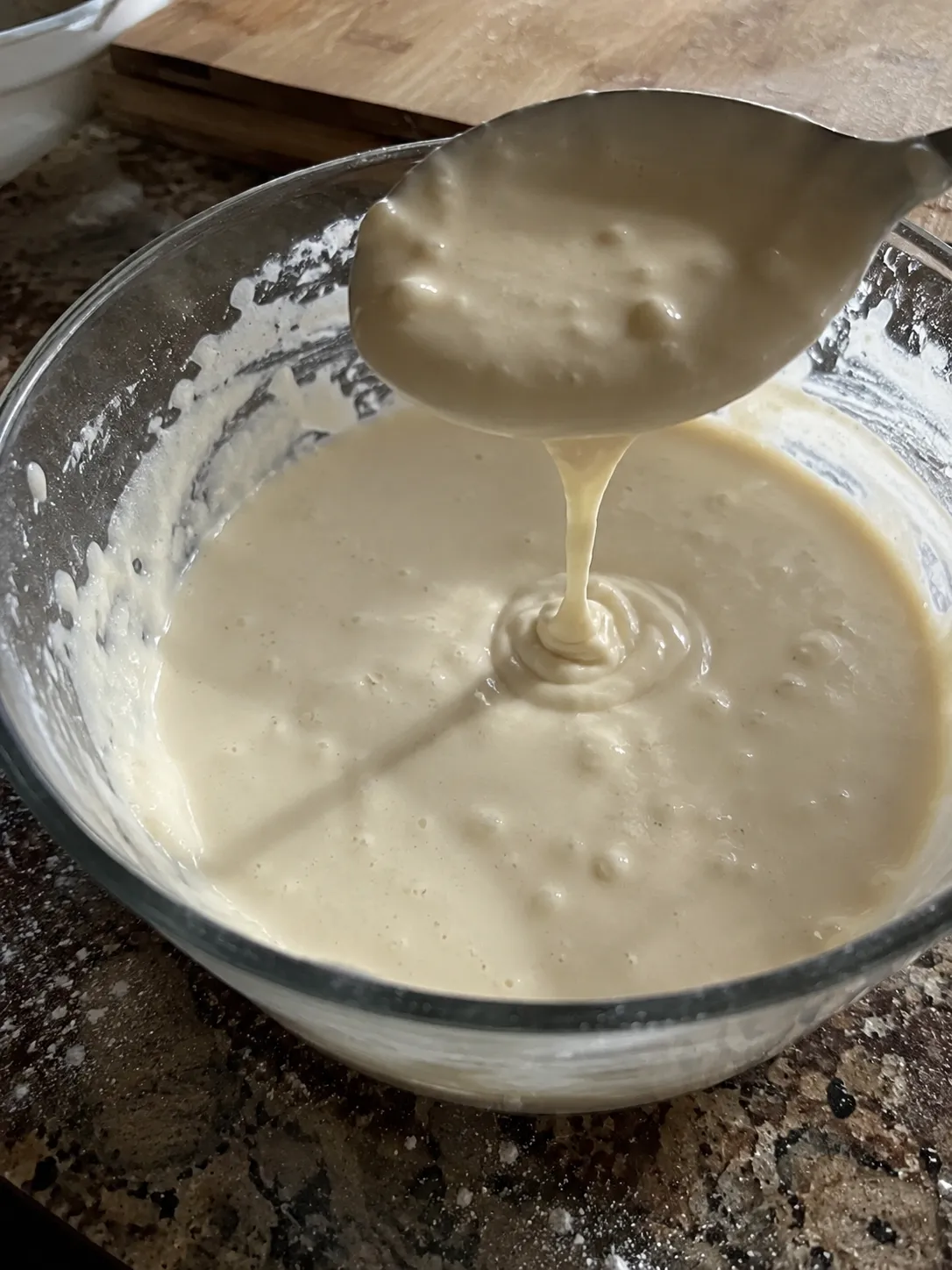
The test: lift the spoon out and let the batter fall back into the bowl. It should come off in a ribbon that stays visible on the surface for about two seconds before sinking back in. If it disappears instantly it is too thin, and one more tablespoon of flour fixes it.
You still will not get proper lace, and I would rather say so than promise it. What you get is a piped tangle with real gaps in it, which browns on both sides and eats like a funnel cake. That is a good outcome.
Ingredients
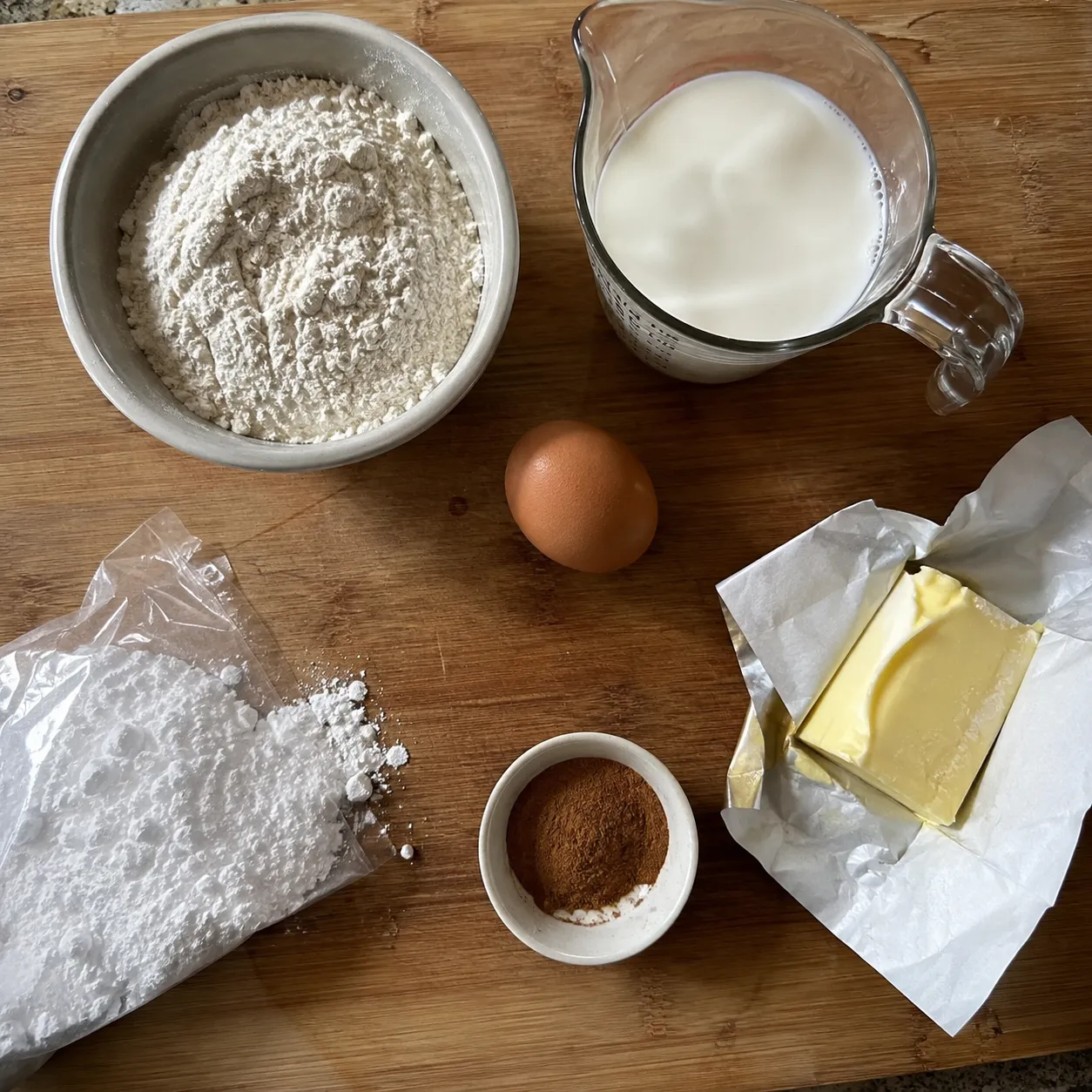
Makes two funnel cakes, about 6 inches across, cooked one at a time.
- 1 cup (125g) all-purpose flour
- 2 tablespoons (24g) granulated sugar
- 1 teaspoon baking powder
- 1/4 teaspoon salt
- 1/2 teaspoon ground cinnamon, optional
- 1/2 cup (120ml) milk
- 1 large egg, room temperature
- 1 teaspoon vanilla extract
- 2 tablespoons (28g) butter, melted, plus 1 more for brushing
- Powdered sugar, for dusting
Two things worth noting
- Half a cup of milk, not three quarters. This is the change that makes the shape work, and it is covered above. If your batter still runs flat, add a tablespoon of flour rather than reaching for a lower temperature.
- Butter, not oil, and not spray. The milk solids in butter brown in a way neutral oil does not, and browning is most of what you are missing without a fryer. Melted butter also brushes into a proper film. More on this below, because it is the second biggest thing after the parchment.
How to make it
- Preheat to 370°F (188°C) for 3 minutes, empty. No parchment in the basket while it preheats, for the reason in the warning above. A hot basket also matters here because you want the underside setting fast.
- Whisk the dry ingredients: flour, sugar, baking powder, salt and cinnamon.
- Whisk the wet separately: milk, egg, vanilla and the 2 tablespoons of melted butter.
- Combine and stop early. Pour wet into dry and whisk just until smooth. A few small lumps are fine. Overmixing builds gluten and makes it chewy in the wrong way.
- Check the consistency. A ribbon off the spoon should stay visible on the surface for about two seconds. Too thin, add a tablespoon of flour. Too thick, add a tablespoon of milk.
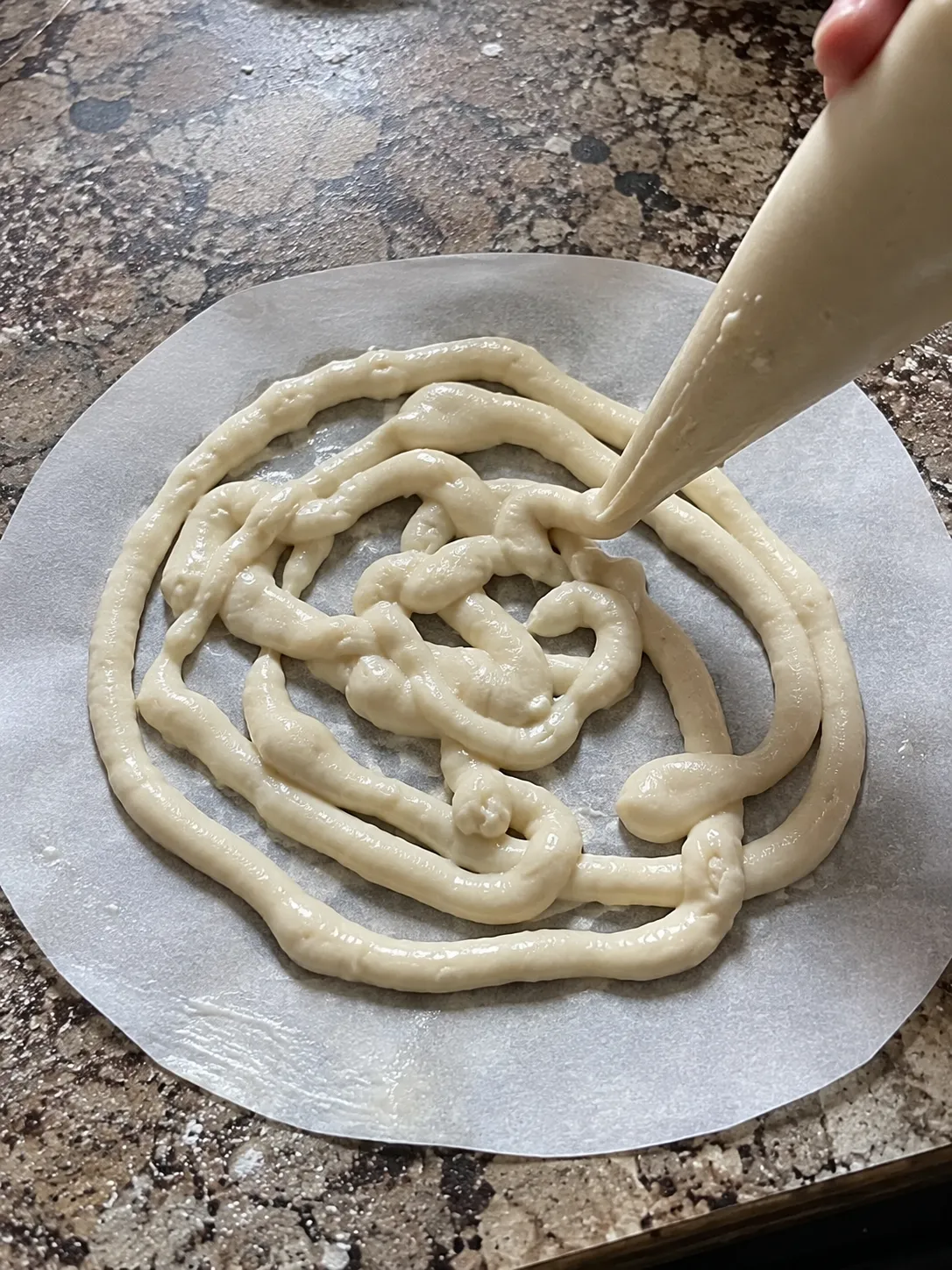
- Load a piping bag or squeeze bottle. A zip-top bag with a corner snipped off works. You want an opening about the width of a pencil.
- Cut a parchment round slightly smaller than your basket floor and brush it lightly with melted butter.
- Pipe the cake on the parchment, outside the basket. Work in overlapping loops and crisscrosses, starting from the middle and spiralling out, leaving visible gaps. About half the batter.
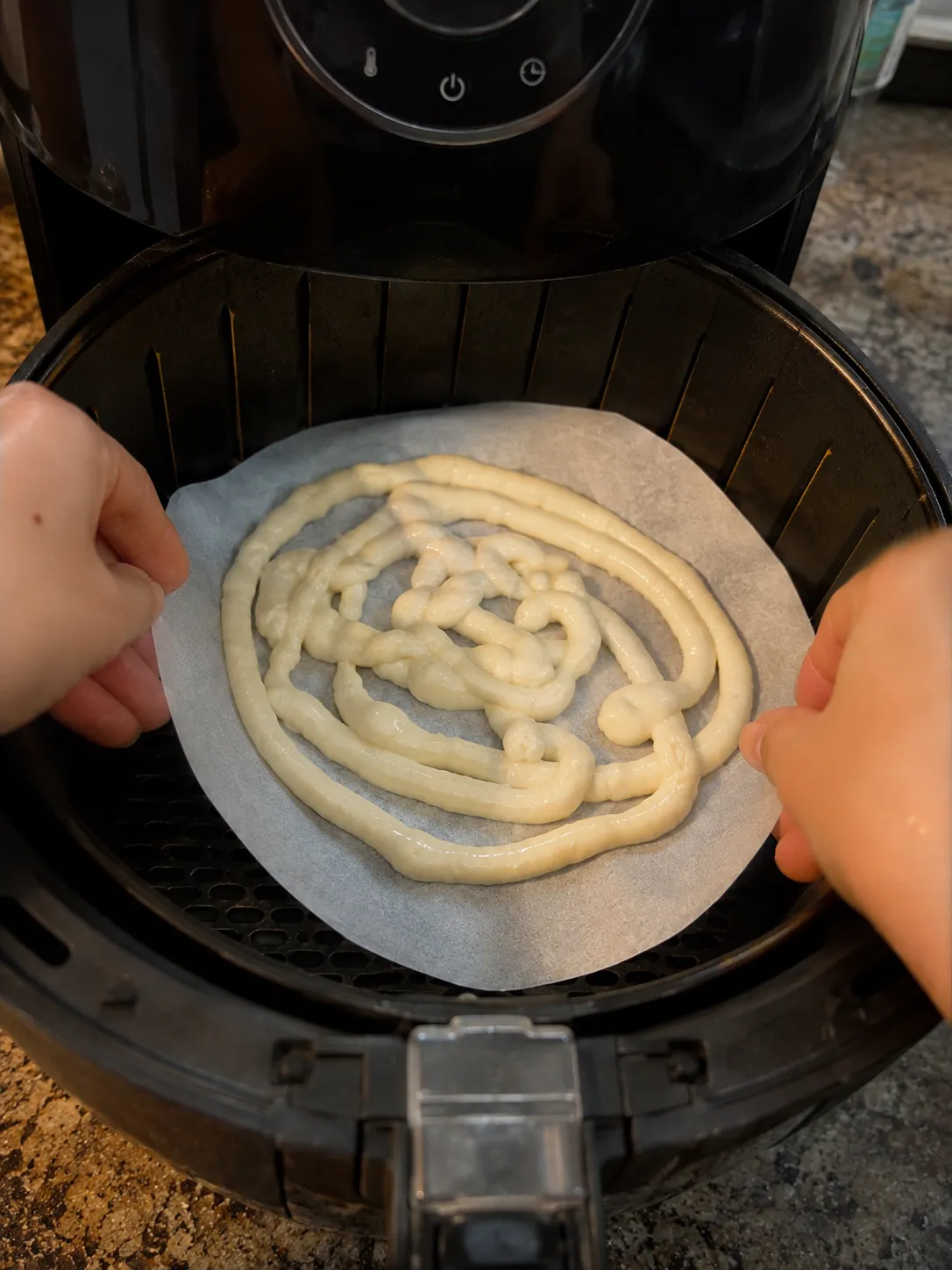
- Brush the top with melted butter, then lower the parchment and cake together into the hot basket.
- Cook 4 minutes. The batter will set and hold together as one piece. Do not open it before this.
- Pull the parchment out and flip. Slide a thin spatula under the cake, lift it clear, remove the parchment from the basket entirely, then lay the cake back in upside down.
- Brush the newly exposed side with butter and cook another 3 to 4 minutes, until both sides are deep golden and the edges feel rigid.
- Dust with powdered sugar immediately, while it is hot and still slightly buttery. Eat it now. Repeat with the rest of the batter.
Why 370°F and not 375. Deep fried funnel cake goes into 375°F oil and is done in about ninety seconds, so nothing has time to dry out. In a basket you need seven or eight minutes, and over that time 375°F will darken the thin outer edges before the thicker middle is ready. 370°F is a small concession that buys you a more even cake. If your machine runs hot, drop to 360°F and add a minute. Our air fryer calculator handles conversions from oven recipes, though for a deep fried original there is no clean conversion and the numbers here are the starting point instead.
Why spray is not enough
Most air fryer funnel cake recipes lean on using a fraction of the oil as the selling point, and then give you a cake that does not taste fried. Those two facts are connected.
A funnel cake is not a cake that happens to be cooked in oil. The oil is an ingredient. It saturates the surface, carries heat into it, and produces the flavor and the brittle shell. Remove it entirely and you have a pancake.
You do not need to deep fry to get most of the way there, but you do need real fat on the surface, and a mist of cooking spray is not that. Spray puts down a scattered film with gaps in it. Brushed melted butter puts down a continuous layer that browns evenly.
- Brush the parchment before the batter goes on.
- Brush the top before it goes in.
- Brush the second side when you flip it at four minutes.
Three brushings, about a tablespoon of butter total across both cakes. That is still a rounding error next to a quart of frying oil, and it is the difference between something that tastes like fair food and something that tastes like a baked good with sugar on it. The general principle is in how to get things crispy in an air fryer, and the same argument runs through our vegan donuts.
Aerosol cooking spray is worth avoiding here for a second reason: the propellants and additives build up on air fryer nonstick over time and pit it. A refillable pump mister with melted butter or oil in it is better if you would rather not brush.
Powdered sugar, and when to dust
Small thing, but it is the difference between a funnel cake and a funnel cake that looks like it came from a fair.
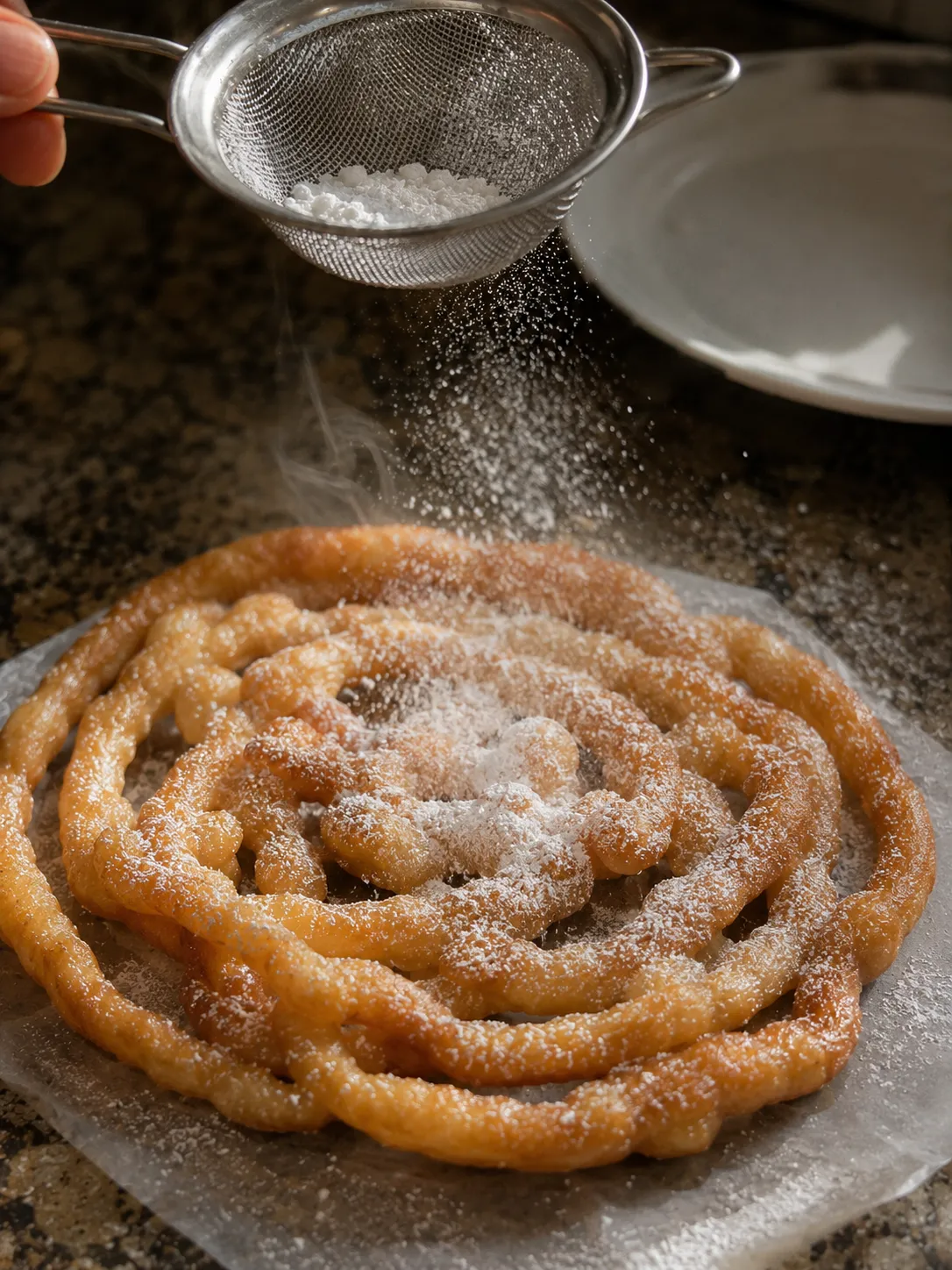
Dust it the moment it comes out, while the surface is hot and still carries a trace of butter. Some of the sugar melts on contact and glues the rest in place, which is why a fairground funnel cake keeps its snowdrift instead of shedding it onto your lap.
Wait two minutes and the surface has cooled and dried, and the sugar just sits there loose and slides off at the first bite. This matters more with an air fryer version than a fried one, because a fried surface stays greasy for much longer.
- Use a small sieve rather than shaking it from the bag. You want an even veil, not three dunes.
- Be generous. It looks like too much and it is not. A funnel cake is a sugar delivery system.
- Do not dust before storing. Powdered sugar draws moisture, and a dusted cake left overnight goes damp and gray. Dust after reheating instead.
Fixing what goes wrong
| What you got | Why | Fix |
|---|---|---|
| Pale, doughy underside | The parchment stayed in for the whole cook, so that side never saw moving air. | Pull the parchment at 4 minutes and flip. This is the main fix on this page. |
| Spread into a flat disc | Batter too thin. It was written for a deep fryer. | Half a cup of milk to a cup of flour, and use the two second ribbon test. |
| Burnt edges, wet middle | Thin outer strands finished long before the thicker center. | Thicker batter and 370°F, or 360°F if your machine runs hot. |
| Tastes like a pancake | Not enough fat on the surface. Spray does not do it. | Brush melted butter three times: parchment, top, and second side after the flip. |
| Tore when I flipped it | Flipped too early, before the batter had set into one piece. | Give it the full 4 minutes and use a thin spatula, not tongs. |
| Sugar slid straight off | Dusted after it had cooled and the surface had dried. | Dust within seconds of it leaving the basket. |
| Chewy and tough | Overmixed, which developed gluten. | Whisk until just smooth. Small lumps are fine. |
| Parchment blew into the element | It went into the basket empty while the machine preheated. | Preheat empty. Parchment goes in with batter already on it. |
| Batter ran through the basket | Piped directly onto a perforated crisper plate. | Always pipe onto parchment first, outside the basket. |
If burning is a recurring problem across different foods, thin light items are always the first to go: how to prevent burning in an air fryer covers it, and the troubleshooting guide has the rest. Machine format matters too, since an oven-style unit gives you a much bigger flat surface to work on: basket versus oven-style goes through it.
Toppings and variations
- Powdered sugar, and nothing else. The classic, and still the best. Do not overthink it.
- Cinnamon sugar. Two tablespoons of granulated sugar with half a teaspoon of cinnamon, tossed on while hot. Closer to a churro, which is no bad thing.
- Strawberries and cream. Macerate sliced strawberries with a teaspoon of sugar for ten minutes, spoon over, add whipped cream. The fairground upgrade.
- Chocolate or caramel drizzle. Warm, over the top, then the powdered sugar on top of that so it still looks right.
- Apple pie. Warm spiced apple compote and a scoop of vanilla ice cream. Uses the same logic as our air fryer baked apples if you want to make the topping properly.
- Funnel cake fries. Pipe straight lines about four inches long instead of a tangle. Far easier to flip, they crisp better because there is more edge, and they are honestly the version I make most often.
- Funnel cake bites. Small dollops, 5 to 6 minutes, no flipping needed. The most reliable version by a distance.
For more fairground food from a basket, air fried Oreos are the other one worth doing, air fryer soft pretzels cover the savory side, and air fryer cinnamon rolls scratch a similar itch on a Sunday morning.
Storage and re-crisping
- Eat them immediately. This is not me being precious. A funnel cake is at its best for about five minutes and everything after that is decline.
- Room temperature: a day in an airtight container, undusted, once completely cool. They go soft.
- Do not refrigerate. Cold and humid is the worst combination for anything crisp.
- Re-crisping: 3 minutes at 350°F brings them back well. Brush with a little butter first and dust with fresh powdered sugar after.
- The batter does not keep. Baking powder starts working as soon as the liquid goes in, so a batter left for an hour has spent its lift. Mix it when you want to cook.
- Freezing: works, undusted, for a month. Reheat from frozen at 350°F for 5 minutes.
Running an air fryer for sixteen minutes costs very little, and against heating a pot of oil you also save the oil itself and the disposal, which is the honest financial case for doing it this way. The running cost calculator gives you the electricity figure for your own rate. If you are scaling the batter up for a crowd, the recipe scaler handles it, and the pan size calculator will tell you how wide a cake your basket actually takes. All four air fryer tools are in one place.
Frequently asked questions
QCan you really make a funnel cake in an air fryer?
Not exactly, and it is worth knowing that before you start. A funnel cake is defined by thin batter meeting hot oil: the oil is well over a thousand times denser than air, so it surrounds every strand instantly, and the batter floats in it, which is what creates the three dimensional lacy tangle. Air does neither. What you can make is genuinely close in texture and flavor, a crisp buttery shell with a soft chewy inside, and this page is about getting as near as the machine allows rather than pretending the gap is not there.
QWhat temperature and how long for air fryer funnel cake?
370°F (188°C) for about 8 minutes total: 4 minutes on the parchment, then flip and give it 3 to 4 minutes more. Deep fried funnel cake goes into 375°F oil and is done in ninety seconds, so nothing dries out. In a basket you need seven or eight minutes, and over that span 375°F darkens the thin outer strands before the thicker middle is ready. If your machine runs hot, drop to 360°F and add a minute.
QWhy is my air fryer funnel cake soggy on the bottom?
Because the parchment stayed in for the whole cook. Every recipe tells you to pipe onto a parchment round, which is right, and then leaves it there, which is not. The underside spends the entire bake pressed against a solid sheet with no moving air, so it cannot brown and the moisture leaving the batter has nowhere to go. Cook 4 minutes until the batter sets into one piece, then lift it, remove the parchment from the basket entirely, and put the cake back upside down for the last 3 to 4 minutes.
QWhy did my funnel cake spread into a flat disc?
The batter was too thin. Most recipes call for about three quarters of a cup of milk to a cup of flour, which is the deep frying ratio: in oil that thinness breaks into separate strands that set instantly, but in a basket it just spreads and runs together. Use half a cup of milk to a cup of flour instead. The test is to lift a spoon and let the batter fall back: the ribbon should stay visible on the surface for about two seconds before sinking in. If it vanishes instantly, add a tablespoon of flour.
QDo I need parchment paper, and is it safe?
You need it, because thin batter piped straight into a basket runs through the perforations into the drawer. It is safe as long as it is weighed down. Never put loose parchment into a preheating air fryer: an empty sheet weighs almost nothing and the fan will lift it into the heating element, where it scorches and can catch. Preheat the machine empty, pipe the batter onto the parchment outside the basket, then lower them in together so the batter holds the paper down. Perforated rounds are better than plain ones, and they still come out at the 4 minute mark.
QCan I use cooking spray instead of brushing butter?
You can, and it is the main reason air fryer funnel cakes taste like pancakes. A funnel cake is not a cake that happens to be cooked in oil, the oil is an ingredient: it saturates the surface and produces the flavor and the brittle shell. Spray lays down a scattered film with gaps in it. Brushed melted butter lays down a continuous layer that browns evenly, and the milk solids in butter brown in a way neutral oil does not. Three brushings across two cakes is about a tablespoon of butter, which is still nothing next to a quart of frying oil.
QWhy did my funnel cake tear when I flipped it?
Flipped too early. Before about 4 minutes the batter has not set into a single connected piece and the strands are still separate, so lifting it pulls it apart. Give it the full 4 minutes, check that the top looks dry and matte rather than wet, and use a thin flexible spatula slid all the way underneath rather than tongs, which grab one strand and tear it away from the rest. If it does tear, push it back together in the basket. It will fuse as it finishes.
QWhen should I add the powdered sugar?
Within seconds of it leaving the basket, while the surface is hot and still slightly buttery. Some of the sugar melts on contact and glues the rest in place, which is why a fairground funnel cake keeps its snowdrift instead of shedding it. Wait two minutes and the surface has cooled and dried, and the sugar sits loose and slides off at the first bite. This matters more with an air fryer version than a fried one, because a fried surface stays greasy much longer. Use a small sieve for an even veil, and be more generous than feels sensible.
QWhat is the easiest version to get right?
Funnel cake fries or bites. Pipe straight lines about four inches long, or small separate dollops, instead of one tangle. Both are far easier to handle, they crisp better because there is proportionally more edge, and the bites need no flipping at all, just 5 to 6 minutes. You lose the classic shape, which is the whole visual appeal, so it depends whether you are making these to look at or to eat. The fries are what I make most often.
QCan I use pancake mix or box mix?
Yes, with one adjustment: make it thicker than the box says. Pancake mix made to package directions is far too loose for a basket and will spread into a disc. Start with about two thirds of the liquid the box calls for, then add a spoonful at a time until a ribbon off the spoon stays visible for two seconds. Everything else on this page still applies, including the parchment removal and the butter brushing, because those are properties of the machine rather than of the batter.
QHow big can I make one?
About 6 inches across in a standard 5 to 6 quart basket, which is smaller than a fairground one and is set by your basket floor rather than by the recipe. Do not try to make it fill the whole basket edge to edge: you need a gap all around for air to circulate, and a cake touching the sides will steam where it touches. An oven-style air fryer with a full flat tray gives you considerably more room and is genuinely the better machine for this particular recipe.
QCan I make the batter ahead?
No. Baking powder starts reacting the moment it meets liquid, so a batter that has sat for an hour has already spent most of its lift and will pipe flat and dense. Mix it when you are ready to cook, which takes about three minutes anyway. You can measure and whisk the dry ingredients ahead and keep them in a jar, which is the part worth prepping, and then it really is a five minute dessert.
Never overbake again
Get our one-page times & temps cheat sheet, plus a new tested recipe each week.
No spam · unsubscribe anytime