
Asparagus is one of the few things I cook where I do not use a timer at all. Not because I am confident, but because the timer is genuinely less reliable than looking at it, and asparagus gives you an unusually clear signal if you know what you are watching for.
Published times for this run from 4 minutes to 10, which sounds like the usual disagreement and mostly is not. It is the same recipe applied to spears that differ in thickness by a factor of three.
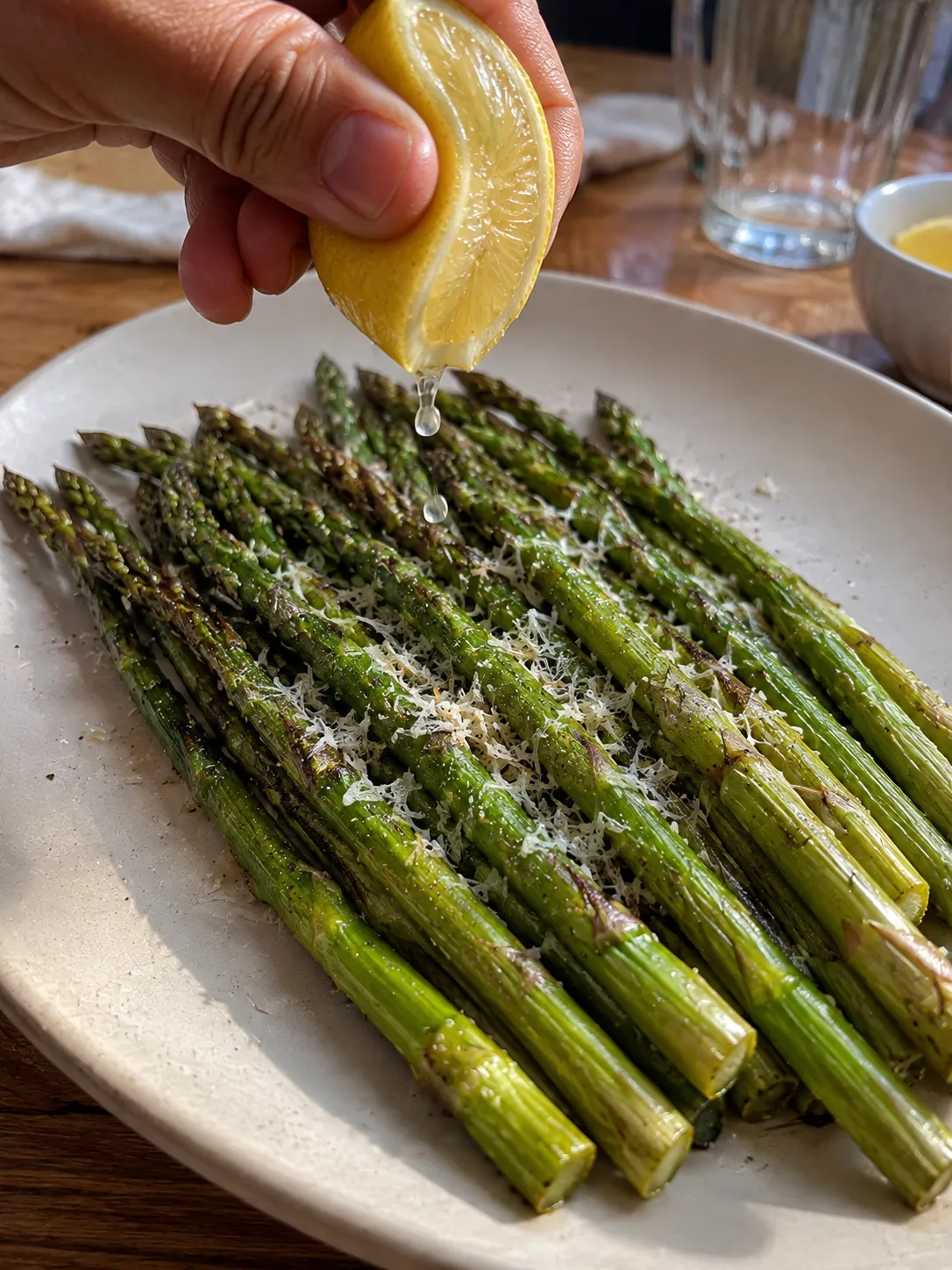
Quick answer: 400°F, single layer, tossed at the halfway point. Pencil spears 4 to 5 minutes, standard 6 to 8, jumbo 9 to 11 or peel them and do 7 to 8. Take them out when they turn vividly bright green with browned tips, not when a timer goes. And squeeze the lemon on after, at the table, because acid during cooking is what turns asparagus that drab olive color.
It changes color twice
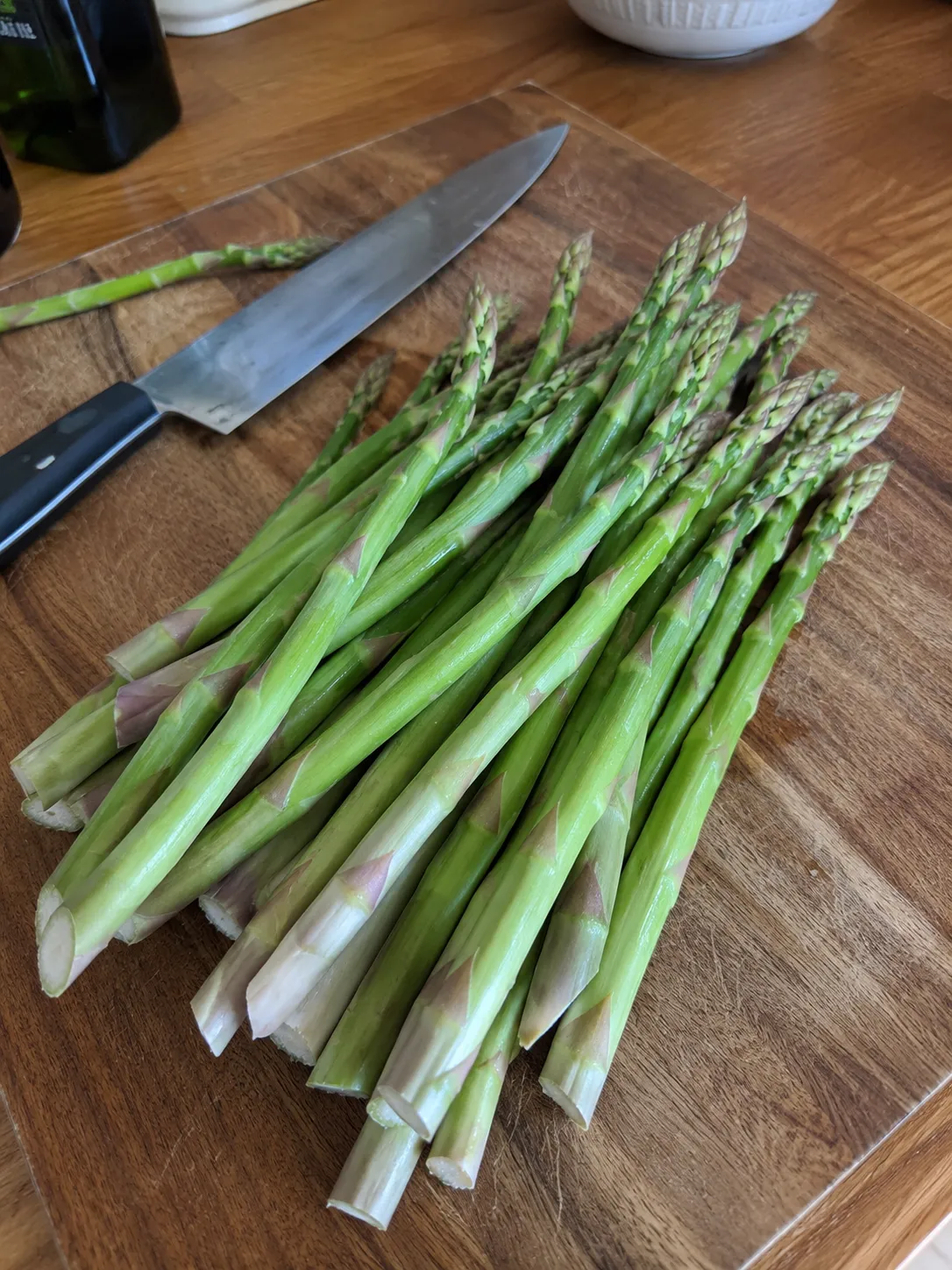
Raw asparagus is a fairly dull, matte green. Put it in heat and within a couple of minutes it goes startlingly bright, almost neon. Most people notice this and assume it means it is cooking. It does, and it is also a specific event worth understanding.
Between the cells of a raw spear there are tiny pockets of air, and those pockets scatter light before it reaches the chlorophyll underneath, which is what makes raw asparagus look muted. Heat drives that air out. Suddenly you are looking straight at the chlorophyll with nothing in the way, and it reads vivid.
Then, if you keep going, something else happens. The cell walls start breaking down and release the acids that were held inside them. Those acids react with the chlorophyll and convert it into a compound called pheophytin, which is a dull olive brown. That is the second color change, and it is not reversible.
Dull, matte green
Raw. Air pockets between the cells are scattering the light before it reaches the chlorophyll.
Vivid, almost neon
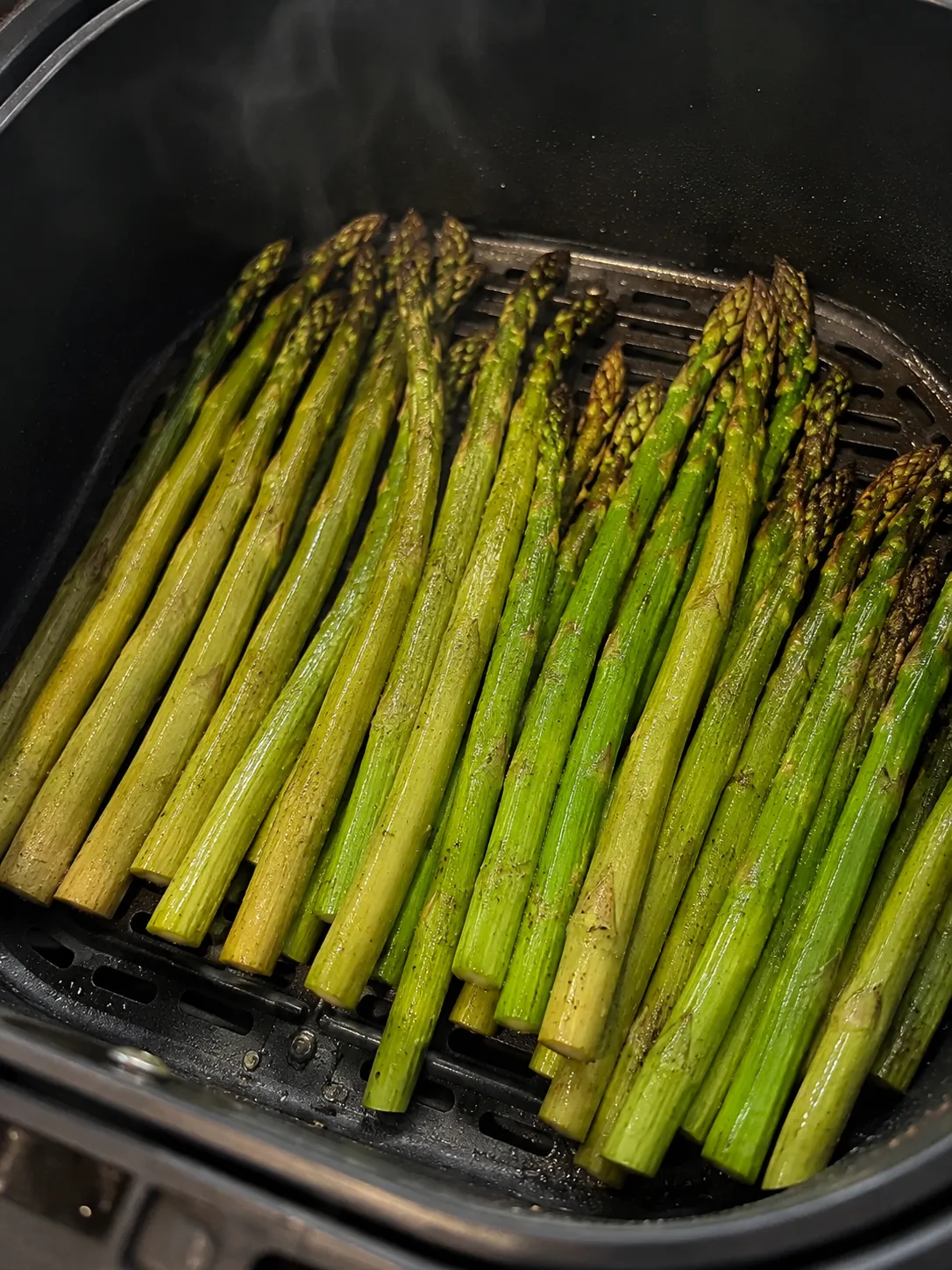
The air has gone and you are seeing the chlorophyll directly. This is the window. Crisp-tender, sweet, still has a snap.
Drab army green
Cell walls have broken down, released their acid, and turned the chlorophyll to pheophytin. Limp, and there is no way back.
So the instruction is not really about minutes. It is: take it out while it is at stage two, with the tips browned. On jumbo spears you have three or four minutes of stage two to work with. On pencil-thin ones you have closer to ninety seconds, which is exactly why thin asparagus is the version people ruin.
This is one of the rare recipes on this site where a thermometer is no use at all. Everywhere else I will tell you to stop guessing and measure. Here the thing you care about is a texture and a pigment reaction, not a temperature, and your eyes are genuinely the better instrument. Look at it at four minutes and then keep looking.
Which is why the lemon goes on after
Nearly every recipe for this finishes with a squeeze of lemon, which is correct, and describes it as a flavor choice, which is only half of it.
The reaction that turns chlorophyll into drab pheophytin is driven by acid. That is the whole mechanism. So adding lemon juice before or during cooking does not just season the asparagus, it actively accelerates the exact change you are trying to avoid. Toss spears in lemon juice and roast them and they will go army green faster and more thoroughly than the same spears cooked plain.
| When the acid goes on | What happens |
|---|---|
| Tossed in before cooking | Drab olive, and quickly. Avoid |
| Added partway through | Better, but it still dulls the color |
| Squeezed on after, off the heat | All of the brightness, none of the color loss |
| At the table, per person | Best. It also stops the leftovers going soggy |
The same applies to vinegar, and to anything with a lot of acid in it: balsamic glaze, a mustard dressing, pickled things. All of them go on at the end. Garlic, salt, pepper, chili and hard cheese are fine to add before, because none of them changes the pH in any meaningful way.
Thickness is the recipe
A bunch of asparagus at the store can be anything from the width of a pencil to the width of your thumb, and the two need genuinely different treatment. Most recipes give one time. That is where the 4 to 10 minute spread in published recipes actually comes from.
| Spear | Base thickness | At 400°F | Notes |
|---|---|---|---|
| Pencil thin | Under 1/4 inch | 4 to 5 min | Watch it. The window is about 90 seconds |
| Standard | 1/4 to 1/2 inch | 6 to 8 min | The recipe as written. The easiest to get right |
| Jumbo | Over 1/2 inch | 9 to 11 min | Or peel the bottom third and do 7 to 8 |
| Mixed bunch | All of the above | Sort them | Cook thick first, add thin for the last 4 minutes |
That last row is worth doing rather than ignoring. A bunch with mixed thicknesses cooked all at once gives you burnt pencil spears next to raw jumbo ones, and it is the single most common reason a batch comes out inconsistent. Thirty seconds of sorting fixes it. If you are converting a roasting recipe from the oven, the air fryer calculator will do the temperature, then ignore its time and go by the color.
There is a real quality difference between the two ends of this range and it is not the one people assume. Thin asparagus is not younger or more tender, and thick asparagus is not older or woodier. Spear thickness is set by the age and vigor of the crown it grew from, so a thick spear from an established plant is often sweeter and better than a thin one. Thick spears just need peeling and thin ones do not.
Snapping wastes a third of the spear
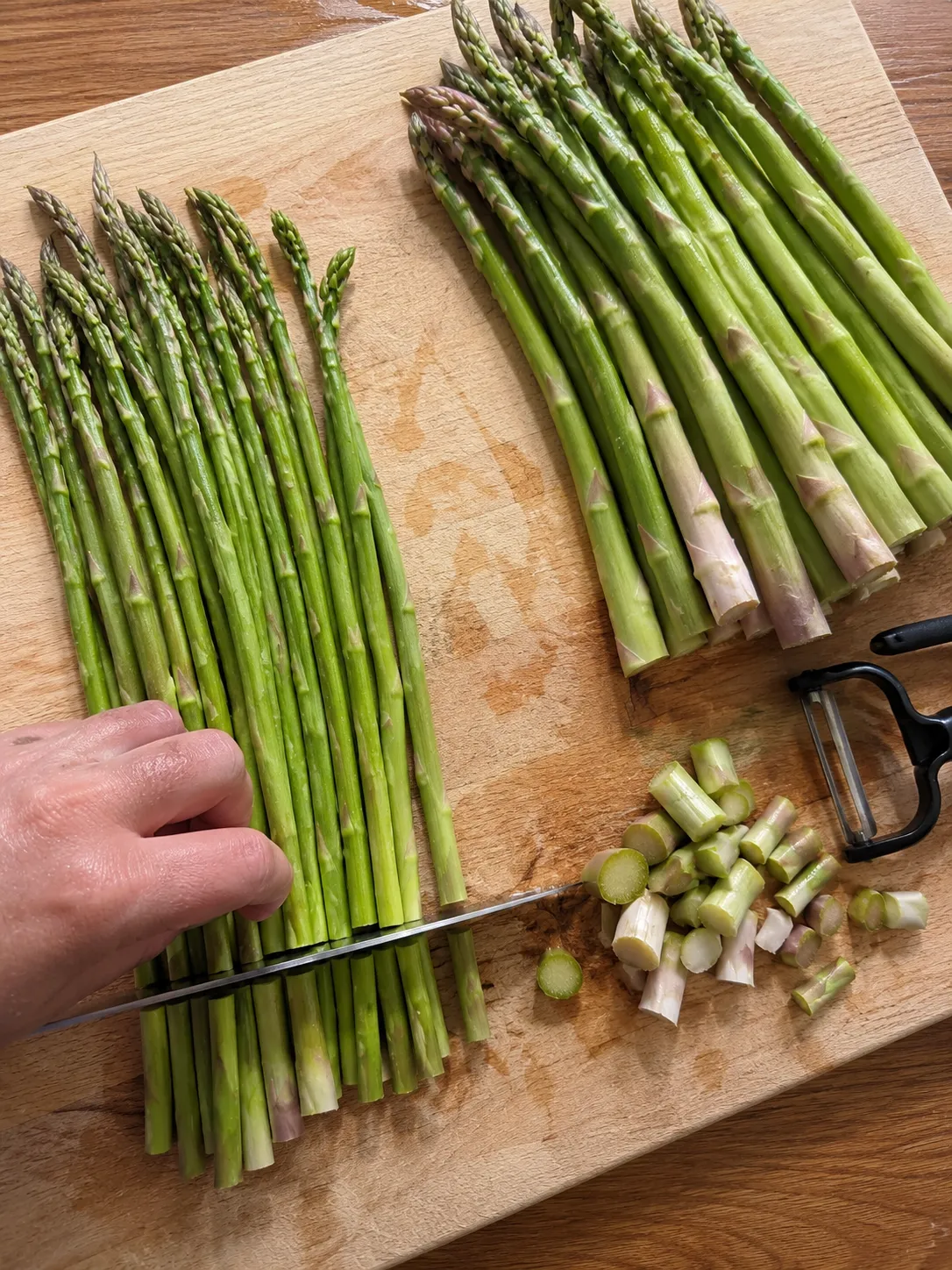
The standard advice, and it is on nearly every recipe for this, is to hold a spear at both ends and bend it until it snaps, on the theory that it breaks exactly where the woody part ends.
It does not. It breaks where the bending force is greatest for how the spear happens to be curved, which is related to where the woody part is but is not the same thing. And it errs badly on the safe side: on a thick spear you can lose two or three inches of perfectly good asparagus that way, which on a one pound bunch is a real amount of food.
| Method | Waste | Verdict |
|---|---|---|
| Snap one, cut the rest to match | Moderate | Fine, and faster than snapping every spear |
| Snap every spear | Up to a third on thick ones | Wasteful and uneven lengths |
| Cut about an inch off, then peel the bottom third of thick spears | Almost none | Best for jumbo. Everything is edible |
| Cut an inch off and cook as is | None | Fine for pencil and standard spears |
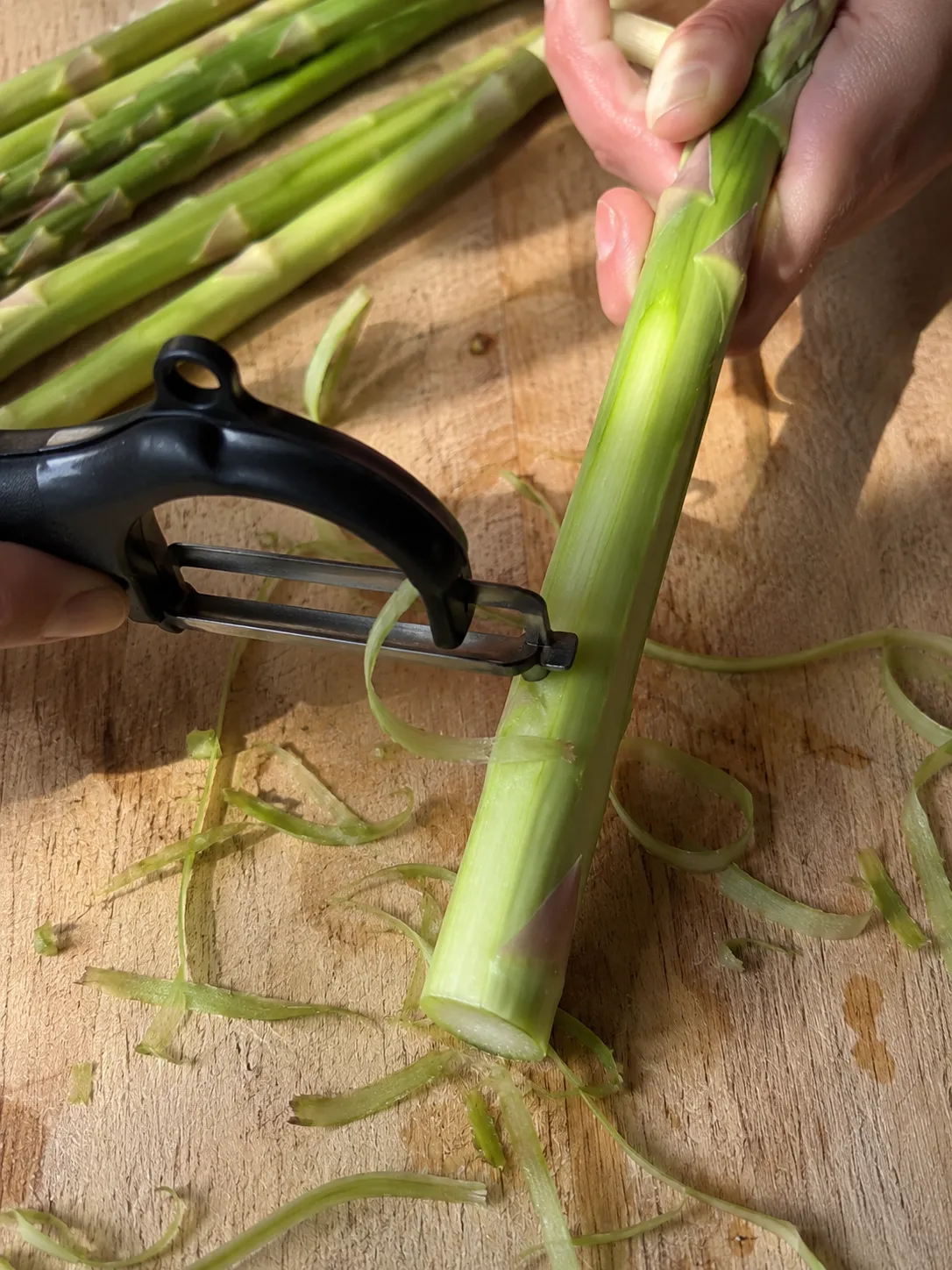
The woody texture at the base is lignin and thickened cell walls concentrated in the outer layer, which is exactly why peeling works. Take a vegetable peeler down the bottom two or three inches of a thick spear and what is left is tender all the way to the cut end. On pencil and standard spears there is not enough of that layer to bother with, so just cut an inch off and get on with it.
Ingredients
Serves 4 as a side. Deliberately short, because asparagus in season does not need much.
- 1 lb (450g) asparagus, standard thickness
- 1 tablespoon olive oil
- 1/2 teaspoon kosher salt
- Black pepper, freshly ground
- Optional: 1 clove garlic, minced
- To finish: lemon wedges, and grated parmesan if you like
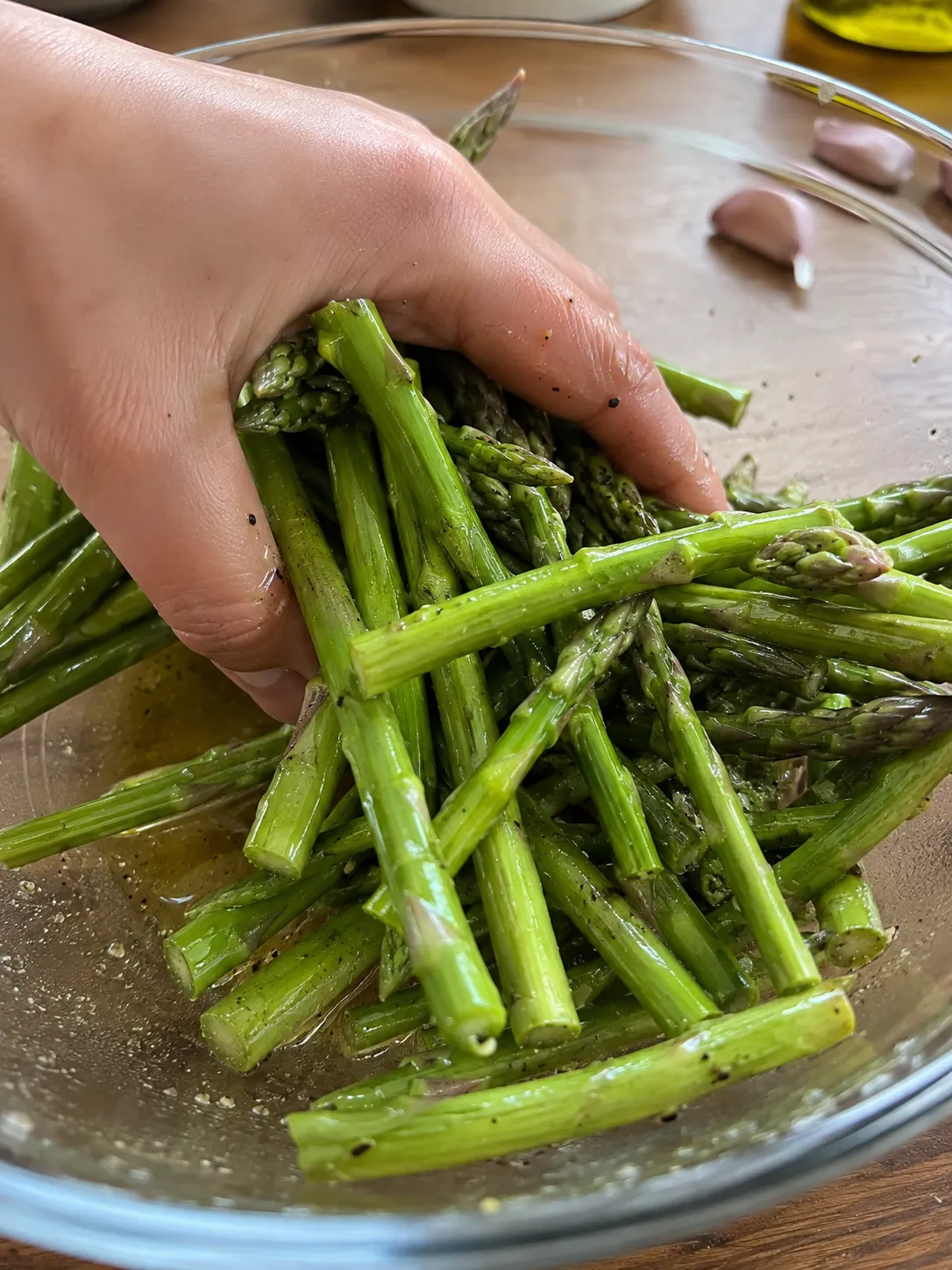
A tablespoon of oil for a whole pound is less than most recipes use, and it is enough. Asparagus has a waxy surface that oil clings to well, and too much oil pools in the bottom of the basket, smokes, and steams the spears sitting in it. Toss it in a bowl rather than drizzling it in the basket so every spear gets a thin coat. If you have an oil mister it does this job better than anything.
How to make it
- Preheat to 400°F (205°C) for 3 minutes. On a seven minute cook a cold start is a large fraction of your time, and asparagus wants to hit heat fast so the outside browns before the inside goes soft. Whether you need to preheat covers when it matters.
- Trim about an inch off the bottoms. Line the bunch up and cut them all together. If the spears are thicker than half an inch, run a peeler down the bottom two or three inches as well.
- Sort by thickness if the bunch is uneven. Thirty seconds now saves you a batch that is half burnt and half raw.
- Toss in a bowl with the oil, salt, pepper and garlic if you are using it. In a bowl, not in the basket, so the coating is even and no oil pools underneath.
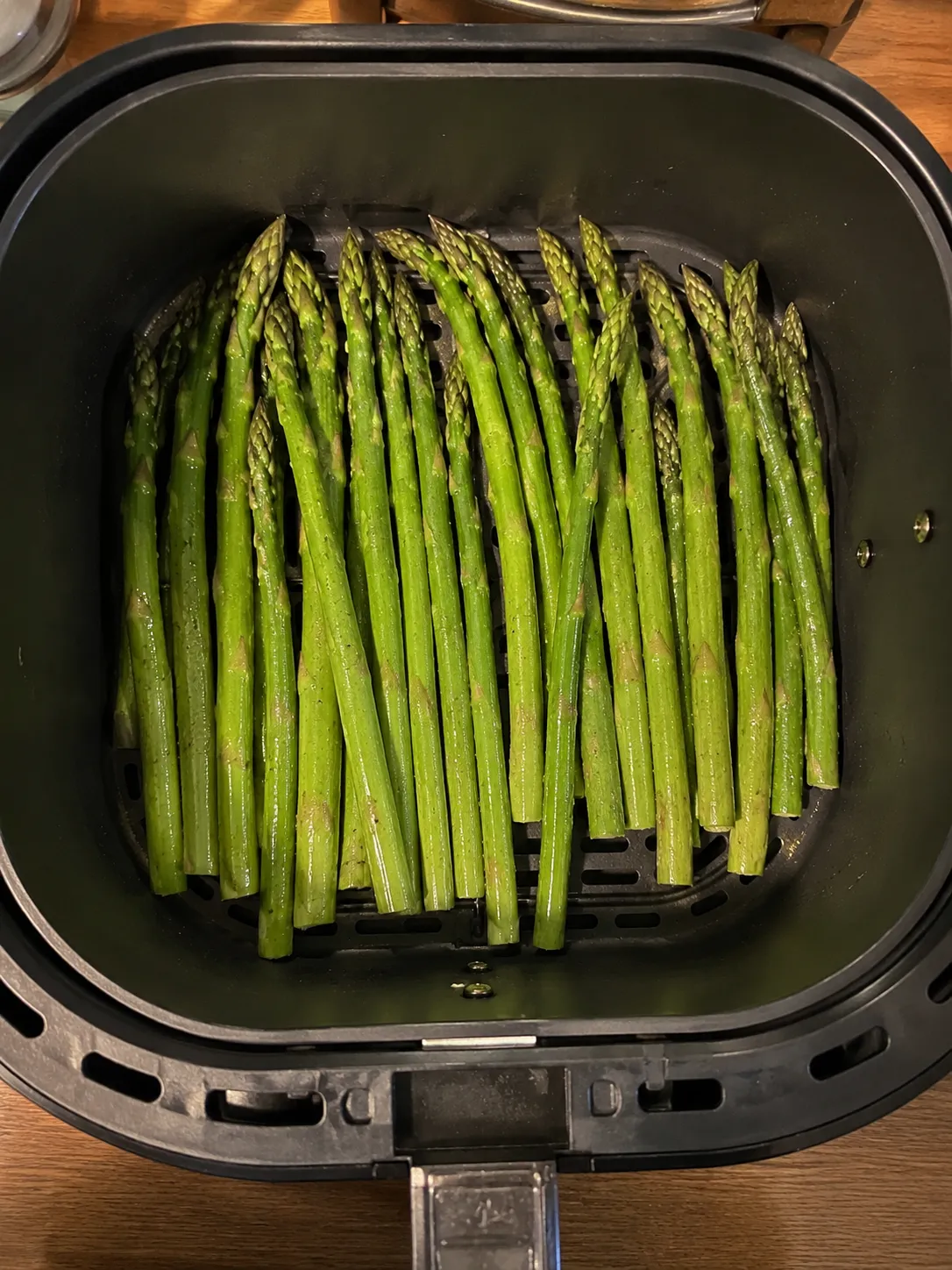
- Lay them in a single layer. They can touch, they should not stack. Asparagus is 93 percent water and crowded spears steam in their own moisture instead of browning. Two batches beat one crowded one.
- Cook 6 to 8 minutes at 400°F for standard spears. Pencil thin, 4 to 5. Jumbo, 9 to 11, or 7 to 8 if you peeled them.
- Toss or shake at the halfway point, and take the chance to move any spears from the middle of the basket out to the edges.
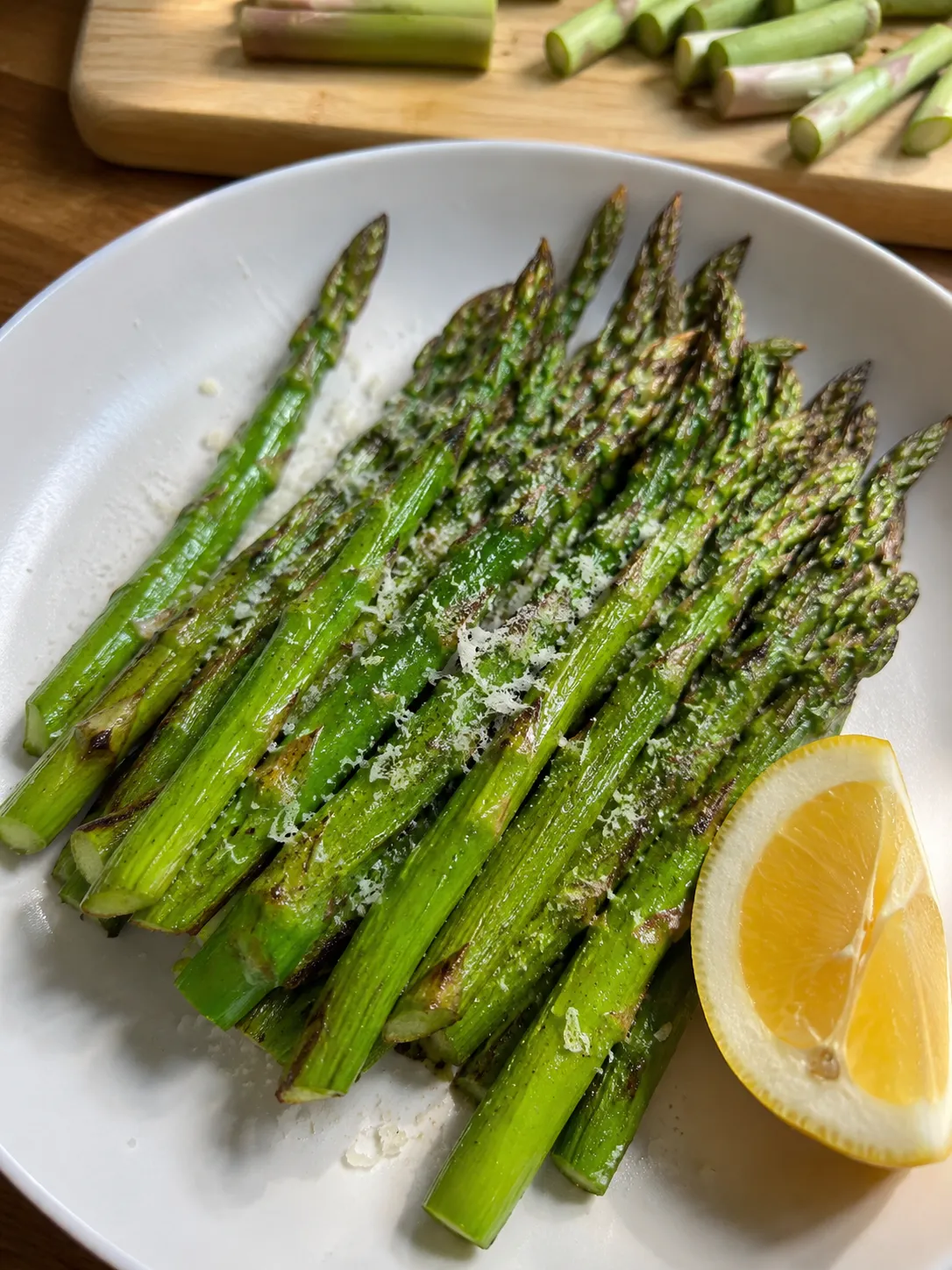
- Start looking at 4 minutes and keep looking. You want vividly bright green with browned, slightly frizzled tips. The moment the green starts to dull, it has gone past.
- Out onto a plate immediately. Left in the hot basket it carries on cooking and slides into stage three while you are getting everything else to the table.
- Lemon, parmesan and any acid go on now, off the heat. Not before.
Why 400°F and not lower. Most things on this site bake cooler in a basket than they would in an oven, and asparagus is the opposite case. It is thin and full of water, so the risk is not the outside running ahead of the inside, it is the whole spear going soft before anything browns. High heat and a short time browns the tips while the inside is still crisp. Drop to 350°F and you will get evenly cooked, evenly limp asparagus with no color on it. The full temperature reference for everything else is in the air fryer baking chart.
Fixing what goes wrong
| What you got | Why | Fix |
|---|---|---|
| Limp and drab olive | Past stage two. The chlorophyll has turned to pheophytin. | Out at vivid green. Start looking at 4 minutes. |
| Went drab even though it was quick | Lemon or vinegar went on before cooking. | Acid goes on after, off the heat. |
| Burnt tips, raw stalks | Jumbo spears. The tips are thin and the base is not. | Peel the bottom third, or cook 2 minutes longer at 375°F. |
| Half burnt, half raw | Mixed thicknesses cooked together. | Sort them. Thick first, thin in for the last 4 minutes. |
| Steamed and pale, no browning | Crowded. The water it releases had nowhere to go. | Single layer, two batches. See single layer. |
| Woody and stringy at the base | Not enough trimmed, or thick spears left unpeeled. | Peel the bottom two or three inches of anything thick. |
| Shriveled and leathery | Thin spears at a full 8 minutes. | Pencil spears are done at 4 to 5. |
| Oil smoking in the basket | Too much oil pooling under the spears. | A tablespoon for a pound, tossed in a bowl. See why your air fryer smokes. |
| Some spears darker than others | Basket hot spot. | Toss at halfway and move the middle ones outward. |
| Soggy by the time you sat down | Left in the hot basket, or dressed too early. | Straight onto a plate. Lemon at the table. |
If nothing you cook is browning properly, how to get things crispy in an air fryer covers the general causes, and the troubleshooting guide has the rest.
Variations
- Parmesan. Grated fine and tossed on in the last minute of cooking, so it melts and crisps against the spears rather than sitting on top. A hard aged cheese, not the shredded stuff in a bag, which has anti-caking starch in it and goes powdery.
- Garlic and chili. Minced garlic in with the oil, chili flakes at the end. Garlic burns readily at 400°F, so use it minced into the oil rather than sliced.
- Prosciutto wrapped. A half slice around the middle of each spear. Add 2 minutes and skip the oil entirely, since the prosciutto renders plenty.
- Balsamic. Drizzled after, never before, for exactly the reason in the acid section. A thick glaze rather than plain vinegar.
- Lemon and almond. Toasted flaked almonds and lemon zest at the end. Zest rather than juice keeps the flavor and skips the acid entirely.
- Everything bagel seasoning. Straightforward, and the sesame and onion suit asparagus better than they have any right to.
- Frozen asparagus. It works. Do not thaw it, do not oil it until it has been in for 3 minutes, and give it 9 to 11 minutes total. It will never brown the way fresh does because of the water released as the ice melts, so expect it to be good rather than excellent.
As a side it goes with almost anything out of the same machine. Air fryer frozen salmon is the pairing I make most, and if you are cooking both, do the salmon first and the asparagus while the fish rests. Air fryer brussels sprouts and corn on the cob are the other two green sides I fall back on, and chicken sausage turns this into a whole dinner.
Storage and leftovers
- Eat it now. Asparagus is genuinely at its best in the first few minutes and there is no version of it that improves by waiting. This is a make-and-serve vegetable.
- Refrigerated: 3 days in an airtight container. It will be soft rather than crisp, which is fine for what you will do with it next.
- Reheating: 2 minutes at 375°F brings back some texture. A microwave brings back none, and turns it a shade drabber.
- Leftovers are better cold than reheated. Chopped into a salad, into a frittata, or blitzed into a soup. Treat them as an ingredient rather than as reheated asparagus.
- Storing raw: stand the bunch upright in an inch of water in the fridge, like flowers, with a bag loosely over the top. It stays crisp for a week that way rather than three days.
Seven minutes of an air fryer against fifteen or twenty of a full oven for one tray of vegetables is a real saving, and if you want the number for your electricity rate the running cost calculator will work it out. If you are cooking for more than four, the recipe scaler handles the quantities, though the honest answer with asparagus is that a basket only holds one layer and you will be doing batches either way. All four air fryer tools are in one place, and the full recipe index has everything else.
Frequently asked questions
QHow long does asparagus take in an air fryer?
It depends almost entirely on thickness, which is why published times run from 4 minutes to 10. At 400F, pencil thin spears under a quarter inch take 4 to 5 minutes, standard spears between a quarter and half an inch take 6 to 8, and jumbo spears over half an inch take 9 to 11, or 7 to 8 if you peel the bottom third first. Toss at the halfway point. Rather than trusting any of those numbers, start looking at 4 minutes and take them out when they turn vividly bright green with browned tips. On thin spears the window is only about ninety seconds wide.
QHow do you know when air fryer asparagus is done?
By color, and asparagus gives you an unusually clear signal because it changes color twice. Raw spears are a dull matte green, because tiny air pockets between the cells scatter light before it reaches the chlorophyll. Heat drives that air out and the spear suddenly reads vivid, almost neon. That is the window: crisp-tender, sweet, still with a snap. Keep cooking and the cell walls break down and release acids that convert the chlorophyll into pheophytin, a dull olive brown, and by then the texture has gone limp too. Take it out at vivid green with browned tips. This is one of the rare recipes where a thermometer tells you nothing useful.
QWhy did my asparagus turn a dull army green?
Either it cooked too long or acid went on too early, and both cause the same chemical change. Chlorophyll turns into a dull olive compound called pheophytin when it meets acid, and there are two ways for that to happen. Overcooking breaks down the cell walls and releases the acids that were held inside them. Or you added lemon juice, vinegar or a balsamic dressing before or during cooking and supplied the acid yourself. That is why every acid on this page goes on afterwards, off the heat. Garlic, salt, pepper, chili and hard cheese are all fine to add before, because none of them changes the pH.
QShould you snap or cut the ends off asparagus?
Cut, and peel the thick ones. The snap method is on nearly every recipe and the theory behind it is not quite right: a spear breaks where the bending force is greatest for how that spear happens to be curved, which is related to where the woody part ends but is not the same thing, and it errs heavily on the safe side. On a thick spear you can lose two or three inches of perfectly good asparagus. Instead, line the bunch up and cut about an inch off all of them at once, then run a vegetable peeler down the bottom two or three inches of anything thicker than half an inch. The woody texture is concentrated in the outer layer, so peeling removes it and the whole spear is edible.
QWhat temperature should you cook asparagus at in an air fryer?
400F, and this is one of the few things where a high setting is right. Most baking in a basket goes cooler than the oven equivalent, because the risk is the outside running ahead of the inside. Asparagus is the opposite case: it is thin and about 93 percent water, so the real risk is the whole spear going soft before anything browns. High heat and a short time browns the tips while the inside is still crisp. Drop to 350F and you get evenly cooked, evenly limp asparagus with no color on it. The only exception is very thick spears, where 375F for a couple of minutes longer gives the base time to catch up with the tips.
QDo you need to peel asparagus?
Only the thick ones, and only the bottom two or three inches. The woody, stringy texture at the base of a spear is lignin and thickened cell walls, and they are concentrated in the outer layer rather than running all the way through. On a jumbo spear over half an inch thick there is enough of that layer to notice, and taking a vegetable peeler down the bottom third leaves something tender right to the cut end. It also cuts the cooking time from 9 to 11 minutes down to 7 to 8, because you have removed the toughest part. On pencil and standard spears there is not enough of that layer to bother with.
QWhy is my air fryer asparagus soggy instead of crisp?
Almost always crowding. Asparagus is about 93 percent water, and all of that has to leave as steam for the spears to brown. Pack the basket and the steam cannot escape, so the spears sit in their own moisture and effectively boil rather than roast. Lay them in a single layer where they can touch but not stack, and do two batches rather than one crowded one. Two other causes worth checking: too much oil pooling in the bottom of the basket, where a tablespoon for a whole pound is genuinely enough, and leaving them sitting in the hot basket after the timer goes instead of tipping them straight onto a plate.
QCan you cook frozen asparagus in an air fryer?
Yes, and do not thaw it first, because thawed asparagus is waterlogged and falls apart. Put it in frozen at 400F and give it 9 to 11 minutes, and hold the oil back until it has been in for about 3 minutes so it sticks to the spear rather than to the ice. Be realistic about the result: freezing ruptures the cell walls, so frozen asparagus releases far more water and never browns the way fresh does. It comes out good rather than excellent, and it is much better suited to being chopped into a frittata or a pasta than served as a side on its own.
QIs thin or thick asparagus better?
Neither, and the common belief that thin spears are younger and more tender is not right. Spear thickness is determined by the age and vigor of the crown it grew from, not by how long the spear was left in the ground, so a thick spear from a well established plant is often sweeter and more flavorful than a thin one. What actually differs is how you treat them. Thick spears need the bottom third peeled and a longer cook. Thin spears need nothing but a trim and a very short cook, and they are much easier to overshoot because the window between perfect and limp is under two minutes.
QDo I need to preheat the air fryer for asparagus?
Yes, three minutes at 400F, and it matters more here than on a long bake. On a seven minute cook, a cold start means the first two or three minutes happen at an unknown and rising temperature, which is a big share of the total. More importantly, asparagus wants to meet high heat immediately so the outside browns before the inside has time to go soft. A slow ramp up gives you the worst outcome for this vegetable, which is evenly cooked and evenly limp with no color on it at all.
QShould I toss or shake the basket?
Once, at the halfway point, and use it as a chance to move spears from the middle of the basket out to the edges. Every air fryer has a hot spot where the fan drives air down hardest, usually the middle on a basket model, and asparagus is thin enough that a couple of extra minutes in that spot is the difference between browned and burnt. Tossing also turns the spears so the side that was facing up gets some time facing down. One toss is enough. Opening the basket repeatedly dumps the hot air and the machine has to rebuild it, which on a seven minute cook you cannot afford.
QHow do you keep asparagus fresh before cooking?
Stand the bunch upright in about an inch of water in the fridge, like a bunch of flowers, with a plastic bag draped loosely over the tops. Asparagus is a cut stem and it keeps drawing water, so it stays crisp for a week that way against about three days lying flat in the crisper drawer. Trim a little off the bottoms before you stand them up, the same way you would with flowers, so the cut is fresh and can take up water. If the tips have started to look dark or feel soft, that is the first part to go and it is worth using them up soon.
Never overbake again
Get our one-page times & temps cheat sheet, plus a new tested recipe each week.
No spam · unsubscribe anytime