
Air Fryer Croissants: Canned Dough, Flaky Layers
Here is the uncomfortable truth the recipes ranking for this keyword tiptoe around: there is no croissant dough in a can. There is crescent dough, which is a lovely thing and a different thing, and every page that tells you to roll it up and call it a croissant is selling you a dinner roll in a beret. This page does something none of them do. It adds a layer of cold butter and one letter fold before shaping, which is a ten minute version of the exact process that makes real croissants flaky, and it changes what comes out of the basket. Four big croissants from one can, 330°F, layers you can peel.

What’s on this page
What is actually in the can
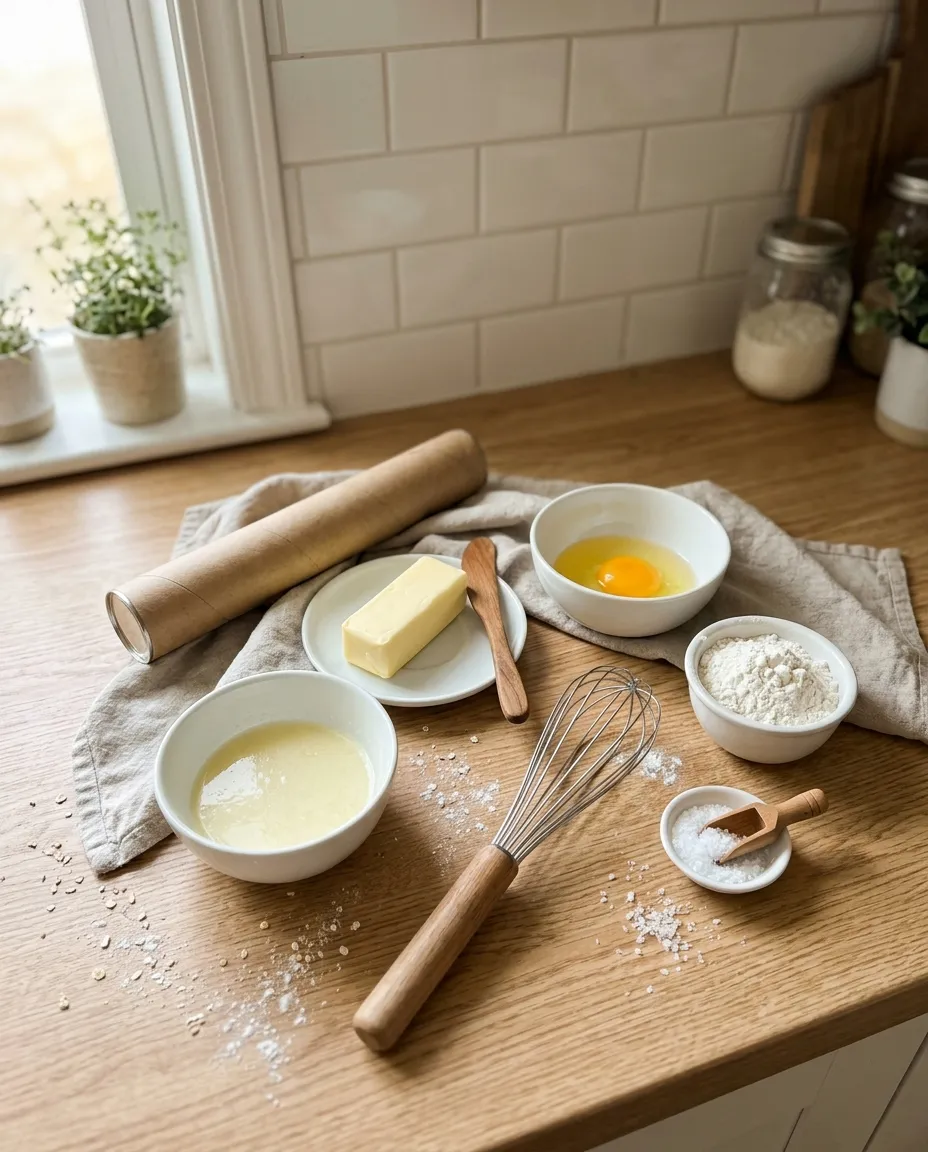
Crescent dough. Not croissant dough, no matter what the recipe title above it says. Real croissant dough is a yeasted dough wrapped around a slab of butter and folded over itself until there are dozens of paper-thin butter sheets inside; crescent dough is a soft yeasted dough with the fat mixed in, which is why a plain baked crescent roll is tender and bready rather than shattering. If bready and buttery is exactly what you want, that is a finished, tested recipe on this site already, and the air fryer crescent rolls page is where it lives, at the same 330°F this page uses, because the dough in the can does not care what shape you have rolled it into.
This page is for the other ambition: getting as close to a croissant as one can of dough allows. That takes two upgrades the ranking recipes skip entirely. One is butter in the middle, folded in, which is a fast imitation of real lamination. The other is shaping the dough like a croissant instead of a dinner roll, which changes how it bakes more than it changes how it looks. Neither adds more than fifteen minutes, and the result peels apart in sheets a plain crescent roll simply does not have. It is still not a Paris croissant; it is the best croissant a Tuesday and a refrigerator case can produce, and that turns out to be a genuinely good thing to eat.
Where flaky layers come from
Flakiness is not a flavor and not an ingredient. It is architecture: thin sheets of dough separated by thin sheets of cold butter. In the heat, the water in each butter layer turns to steam, the steam shoves the dough sheets apart, and the butterfat then fries each sheet crisp in place. Every visible flake on a bakery croissant is one of those steam-jacked layers. A real croissant carries this to extremes, with three rounds of folding producing dozens of layers and a day of chilling in between so the butter never softens into the dough. Store-bought puff pastry is the same architecture sold ready made, and the puff pastry guide covers how those factory layers behave in a basket.
Crescent dough skips all of that at the factory, which is why the recipes that just roll and bake produce something pleasant and smooth. But the mechanism itself is cheap to borrow. Spread cold butter across the dough, fold the sheet in thirds, and you have built a five-layer stack, two butter sheets between three dough sheets, in about ninety seconds. It will not make dozens of layers. It makes enough that the baked croissant visibly shears apart along them, and the difference between zero butter layers and two is much bigger than the difference between two and twenty.
The ten minute butter fold
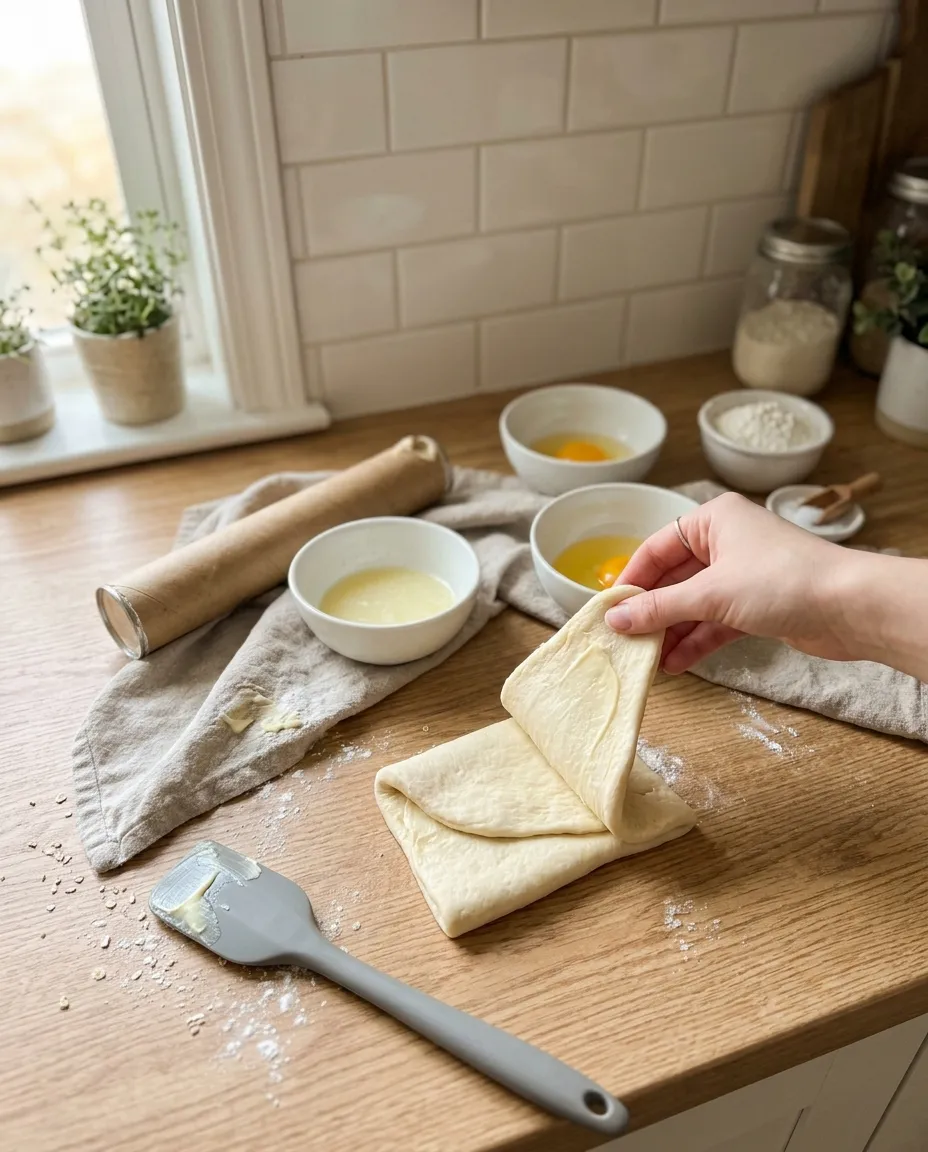
Unroll the can on a lightly floured counter and pinch every perforation firmly closed so you have one solid sheet; if your store carries the unperforated crescent dough sheet, it saves you the pinching. Spread 2 tablespoons of softened butter thinly across the whole surface, stopping an inch short of one short edge so the fold can seal. Fold the sheet in thirds like a letter, dry edge last.
Then the step that makes or breaks it: 10 minutes in the freezer. The fold has warmed the dough and softened the butter, and warm butter does not make layers, it makes grease. Ten minutes firms the butter back into a sheet and firms the dough enough to cut cleanly. Skip the chill and the butter smears into the dough as you shape, and you have done the work of lamination for the results of none. It is the same cold-fat logic that runs through half the baking on this site, and ten minutes is the cheapest price it ever charges.
Shaping a croissant, not a roll
Cut the chilled block into 4 long triangles. You are making four croissants from a can the label says serves eight, and that is on purpose: croissant layers need enough dough thickness to separate, and eight small pieces of a folded sheet would bake into cute, dense spirals. Four is the honest yield.
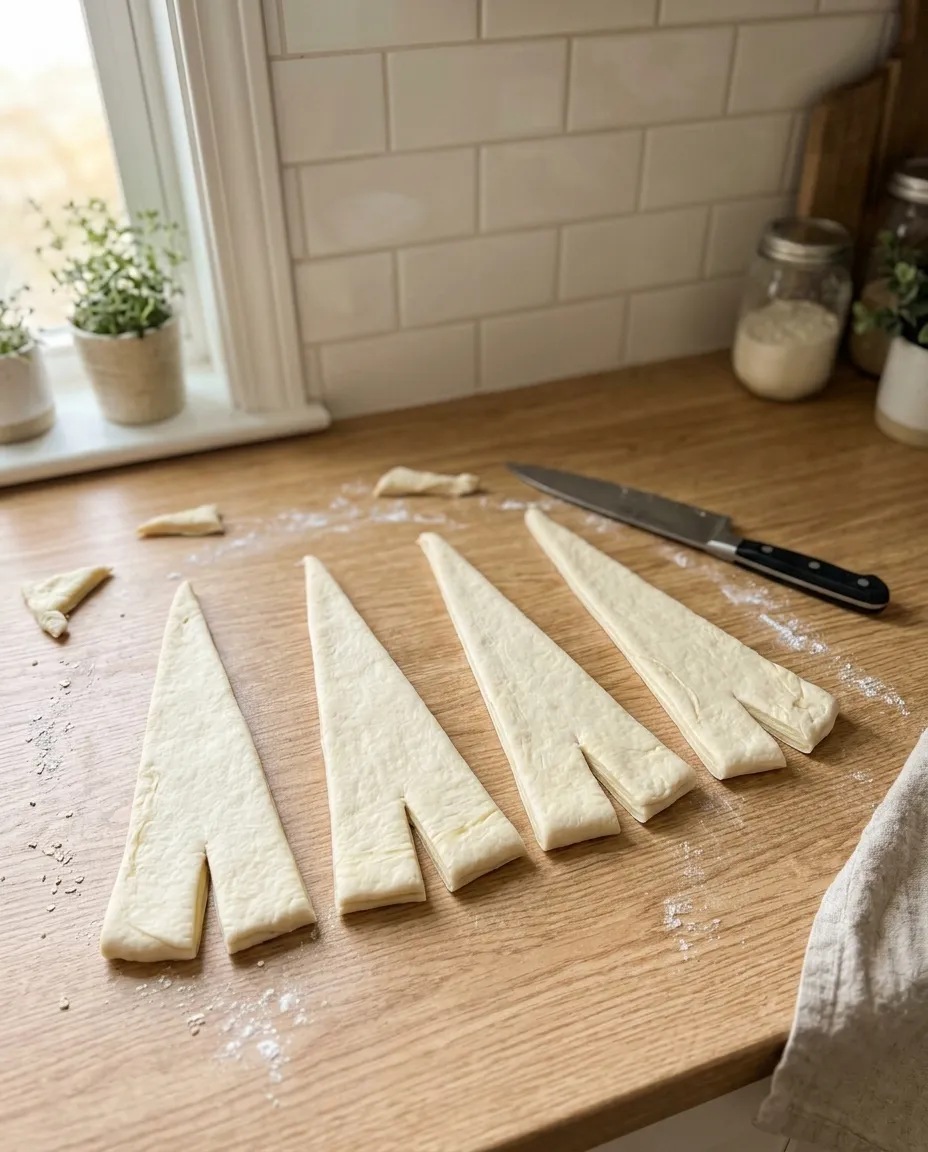
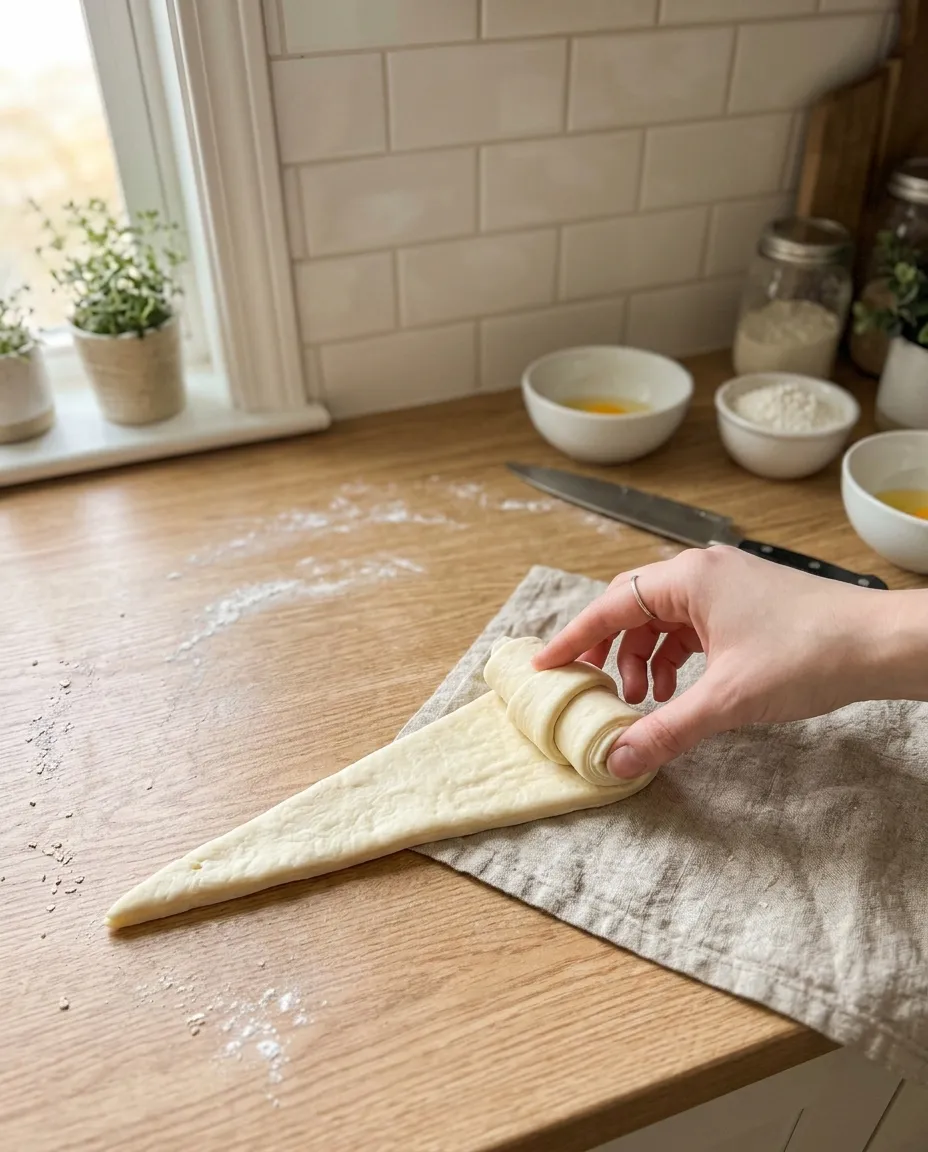
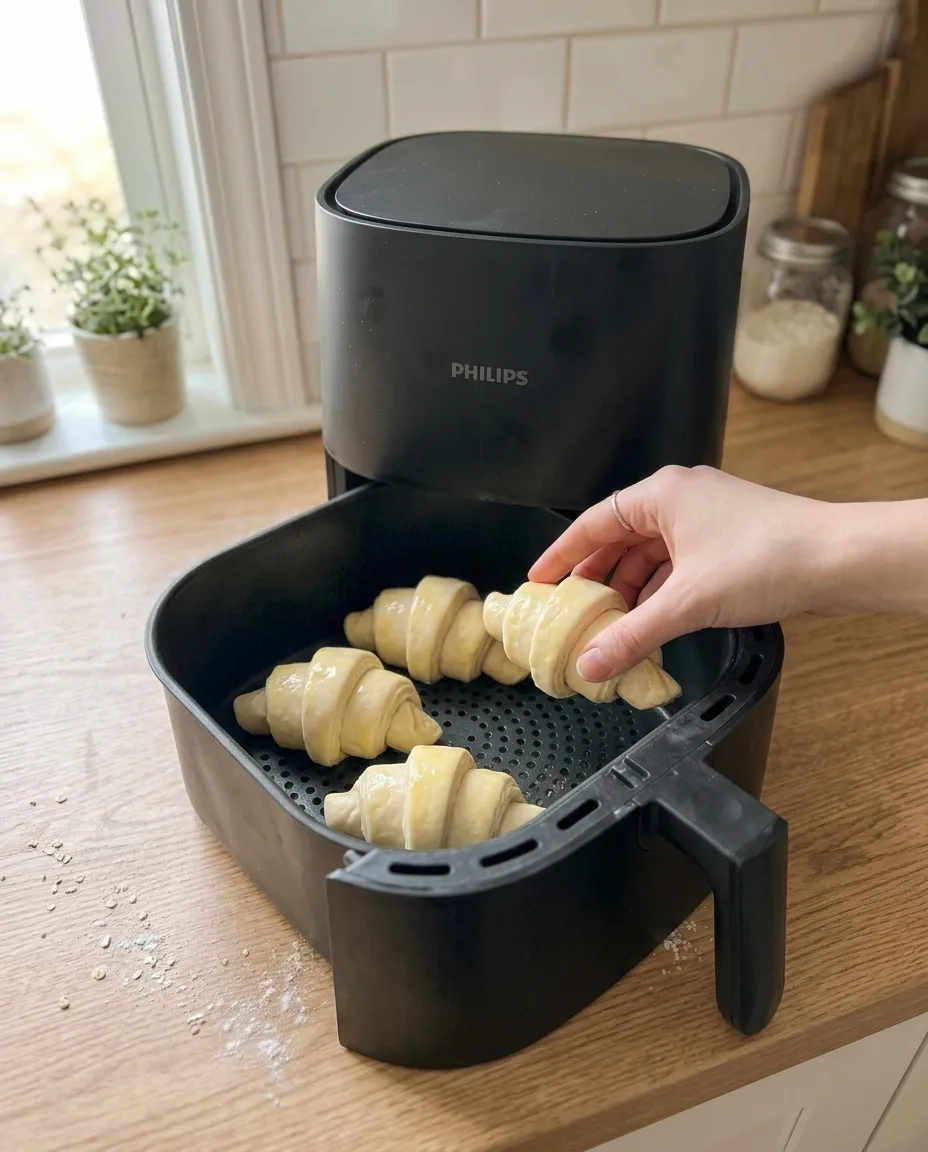
Three small moves separate croissant shaping from roll shaping. First, stretch: pick up each triangle and gently lengthen it by an inch or so, which thins the dough and adds a turn to the spiral. Second, notch: cut a half inch slit in the center of each wide end and spread the two flaps slightly apart as you start rolling, which lets the croissant take its curve without cracking and gives it the wide-shouldered look. Third, tip down: finish rolling with the point landed underneath, then curve the ends inward. A tip left on top peels up and burns; a tip underneath is pinned by the croissant's own weight, the same physics as the tuck on our garlic knots.
Egg wash the tops, and only the tops. Keep it off the cut sides where the layers show: egg is glue, and a glued edge cannot open in the heat. This one detail comes straight from bakery practice and costs nothing.
Temperature and timing
The pages that rank for this run from 300°F with a flip to 375°F with a preheat, which is less a disagreement than a shrug. The answer is 330°F for 7 to 9 minutes, no preheat, no flip, and it is the same answer for the same reason as everything else this site bakes from a refrigerated can: above 350°F the surface spends its browning budget in five minutes while the spiraled center is still two minutes behind, and the flip those recipes require is damage control for a temperature problem. At 330°F the outside and the center finish together, and the croissant bakes seam-down the whole way, undisturbed, which the layers appreciate.
The folded, four-to-a-can croissant is a thicker piece than a standard crescent roll, so it takes the longer end of the range, the same 7 to 9 minutes the crescent rolls page assigns to Grands. Bake all 4 in one batch if your basket lets them sit with a finger of space between; in a smaller basket, do 2 and 2, and the second pair will run about a minute faster in the warm machine. Running two cans for a crowd? The recipe scaler does the butter and egg wash math, but keep the batches separate; croissants that touch steam each other instead of crisping. The full temperature logic lives on the baking chart, and the case for skipping the preheat on canned doughs is in do you need to preheat an air fryer for baking.
What done looks like
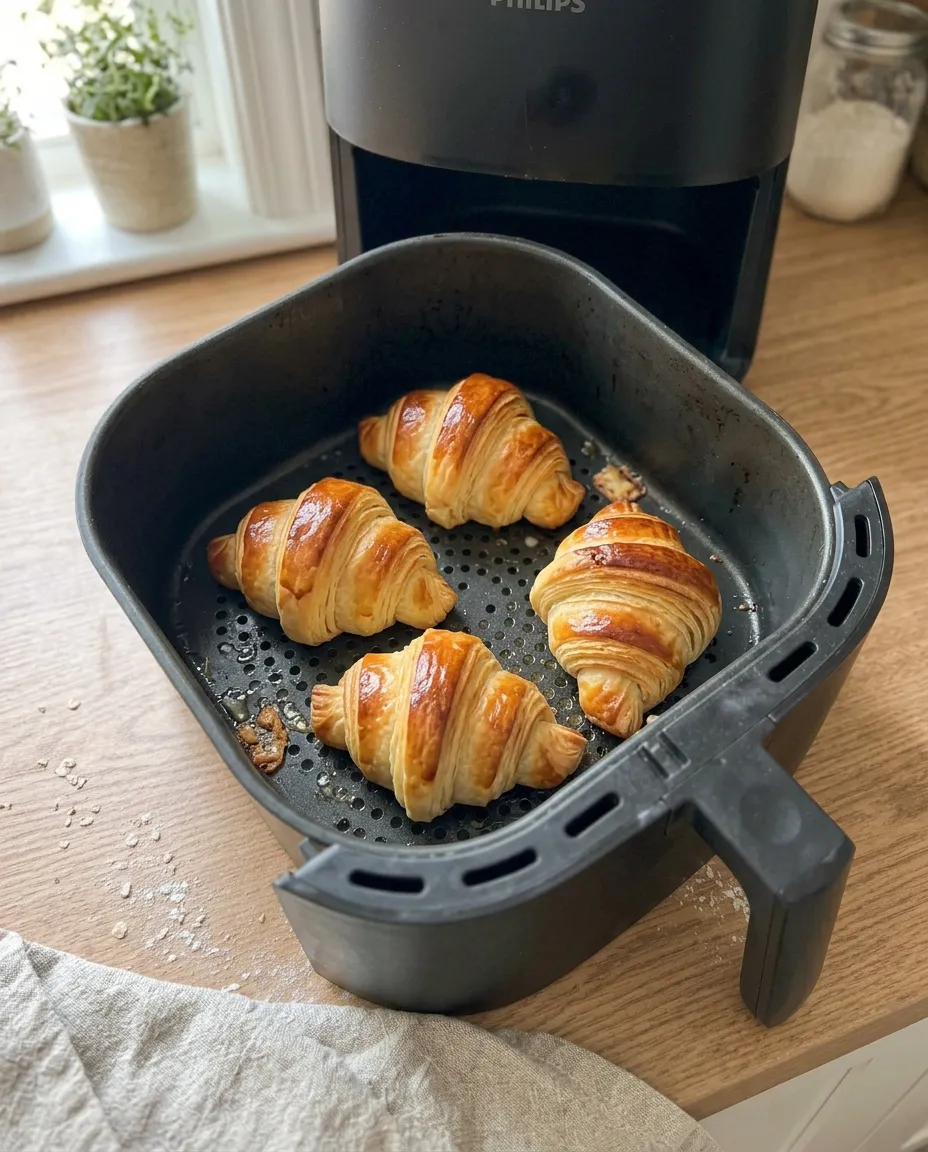
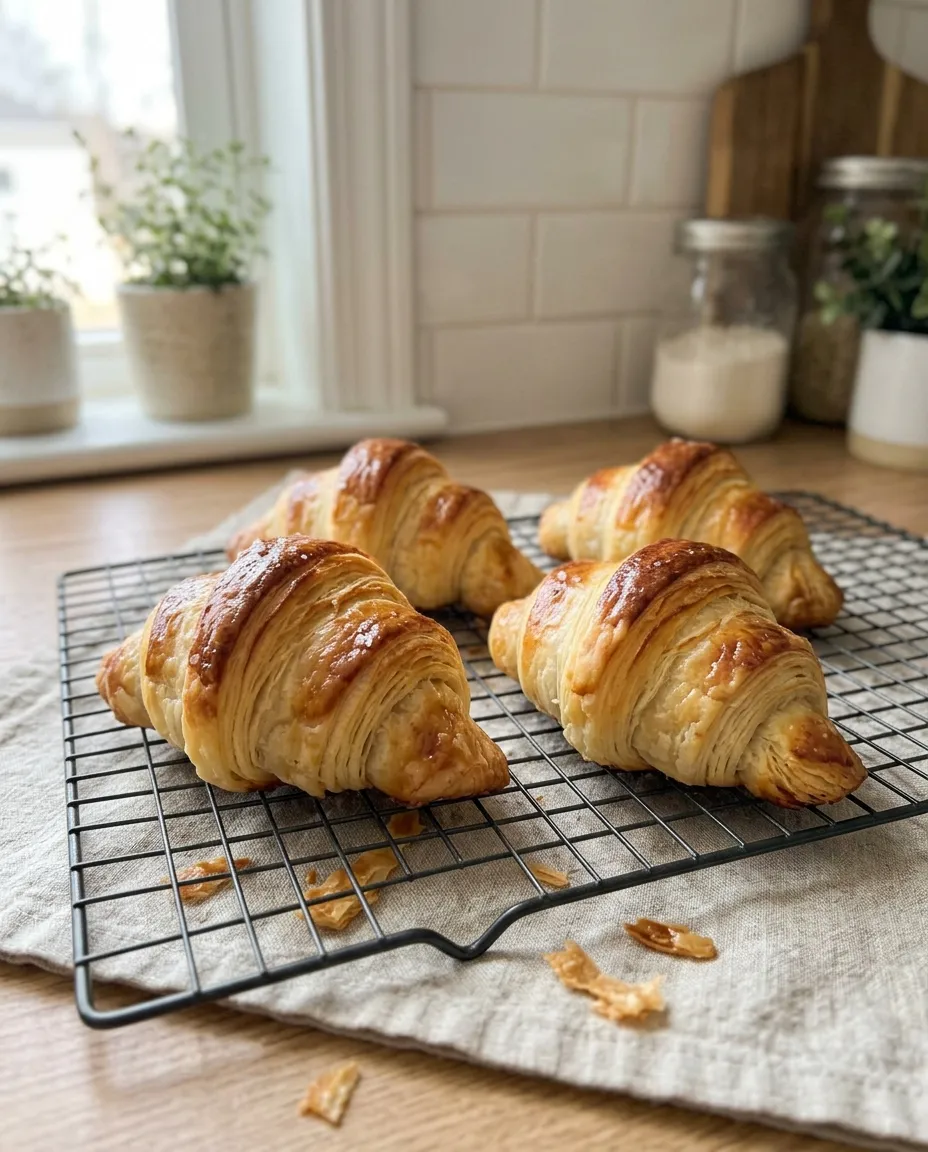
- Top: deep gold with the egg wash gloss, darker along the ridges of the spiral where the wash pooled.
- Underside: the real signal. Lift one with tongs; the bottom should match the top. A pale underside means two more minutes no matter how finished the top looks.
- Sides: the cut edges should have visibly opened, with the layers slightly fanned like a deck of cards pushed sideways. Sealed, smooth sides mean the egg wash wandered or the butter melted before baking.
- Weight: a done croissant feels light for its size. A heavy one has a doughy core and wants two more minutes at the same temperature.
Ingredients
For 4 large croissants
- 1 can (8 oz) refrigerated crescent roll dough, or a crescent dough sheet
- 2 tablespoons butter, softened, for the fold
- 1 tablespoon butter, melted, for finishing
- 1 egg beaten with 1 teaspoon water, for the wash
- Flour for the counter
- Pinch of flaky salt, optional but persuasive
The fold butter should be softened enough to spread without tearing the dough and no further; if it is shiny or greasy, it is too warm and belongs back in the refrigerator for five minutes.
How to make them
- Unroll the dough on a lightly floured counter and pinch every perforation firmly closed to make one solid sheet.
- Spread the softened butter thinly over the sheet, stopping an inch short of one short edge, then fold the sheet in thirds like a letter, dry edge last.
- Freeze the folded dough for 10 minutes, until firm but still bendable.
- Cut the block into 4 long triangles and gently stretch each one about an inch longer.
- Cut a half inch notch in the center of each wide end, then roll each triangle from the wide end to the tip, spreading the notch apart as you start.
- Land each tip underneath, curve the ends inward, and brush the tops with egg wash, keeping it off the cut sides.
- Air fry at 330F for 7 to 9 minutes with no preheat, spaced so they never touch, until the tops are deep gold and the undersides match.
- Brush with the melted butter the minute they come out and add a pinch of flaky salt if using.
- Cool 5 minutes on a rack; the layers set as the steam leaves, and a croissant torn at minute one collapses where a croissant torn at minute six shears.
The frozen croissant route
One honest paragraph for the other croissant in the store, because the ranking pages blur the two into one recipe and they could not be more different. Frozen bake-at-home croissants from the freezer aisle are real laminated croissant dough, factory folded with actual butter sheets, and they beat anything a crescent can produces. The catch is patience: most need to proof on the counter, usually overnight, until doubled and jiggly, and no air fryer setting rescues an unproofed one. It bakes into a dense comma.
Once proofed, they bake beautifully in the basket: 330°F for 9 to 11 minutes, no preheat, egg washed, which is the box's oven temperature dropped by the usual air fryer conversion. If your box says something different, our air fryer calculator does that oven-to-basket conversion for any packaged instruction, and the answer will land near this one. Watch the tops from minute 8; real lamination browns faster than crescent dough because there is more butter at the surface, and the fix for early browning is on the burning guide. So the decision tree is simple. Croissants tomorrow morning: buy frozen tonight, proof overnight. Croissants in half an hour: this page's can and fold.
Fixing what goes wrong
| Problem | Cause | Fix |
|---|---|---|
| No visible layers | Butter too soft at the fold, or no chill | Cold butter, full 10 minute freeze, and shape while the dough is still cool |
| Butter leaked into the basket | Butter spread too thick, or fold edges open | A thin, even 2 tablespoons; pinch the fold edges; a leak still bakes fine, wipe the basket after |
| Sides sealed shut | Egg wash ran over the cut edges | Wash the tops only, with an almost-dry brush near the edges |
| Tip unrolled and burned | Tip finished on top | Land the point underneath so the croissant pins it down |
| Top done, inside doughy | Temperature above 350°F | 330°F, and trust the underside color over the top |
| Dense little spirals | Can divided into 8 after folding | Cut 4; the fold halves the sheet area and the yield follows it |
Serving, reviving, storing
Warm from the rack with jam is the obvious morning, and these are sturdy enough to split for sandwiches, where the layers do their best work catching butter and drips; a fried egg and a slice of cheese in a warm one is a five minute breakfast that eats like a cafe order, and it shares a shelf with the avocado toast in this site's fast-morning rotation. For a dessert turn, lay a row of chocolate chips along the wide end before rolling and you have a pain au chocolat costume that fools most of the room, and the same laminated-pastry instinct runs the palmiers and the cheese danish. The rest of the canned-dough repertoire is nearby: cinnamon rolls, biscuits, and the sweeter end at refrigerated cookie dough, with everything indexed at the recipe index and the technique pages under guides.
The revive move matters beyond this recipe, because it works on bakery croissants too: 300°F for 2 to 3 minutes, straight in the basket, no foil. The heat re-crisps the outside while the inside steams soft again, and a day-old croissant comes back closer to fresh than any microwave or oven can manage. Store these airtight at room temperature up to 2 days, revived before serving; freeze baked and cooled up to a month, and give a frozen one 300°F for 4 minutes.
Frequently asked questions
QCan you really make croissants from crescent roll dough?
Honestly: you can make something meaningfully closer to a croissant than a plain crescent roll, and meaningfully short of a bakery croissant. Crescent dough is not laminated, so rolled and baked as-is it comes out tender and bready. Spreading 2 tablespoons of cold butter over the unrolled sheet and folding it in thirds builds real butter layers that steam apart in the heat, which is the same mechanism as true lamination at one tenth the effort. The result peels in visible sheets. For actual laminated dough without making it yourself, proof-and-bake frozen croissants are the better raw material.
QWhat temperature do you cook croissants in an air fryer?
330F for 7 to 9 minutes for croissants shaped from canned crescent dough, with no preheat and no flip. Recipes run anywhere from 300F to 375F for this, but above 350F the surface finishes browning while the spiraled center is still raw, which is why the hotter recipes all require flipping as damage control. Proofed frozen croissants, which carry more surface butter, take 330F for 9 to 11 minutes, and a day-old baked croissant revives at 300F for 2 to 3 minutes.
QWhy are my croissants not flaky?
Almost always a butter temperature problem. Layers form only when the butter stays a distinct cold sheet between sheets of dough; if it was too soft when you spread it, or the folded dough skipped its 10 minutes in the freezer, the butter smears into the dough and bakes up soft instead of flaky. The second culprit is egg wash on the cut sides, which glues the layers shut so they cannot fan open. Spread firm butter thin, chill the fold, shape while cool, and wash only the tops.
QCan I cook frozen croissants in the air fryer?
Yes, and they are the best croissants an air fryer can produce, with one non-negotiable step first: proofing. Bake-at-home frozen croissants are real laminated dough and must sit at room temperature, usually overnight, until doubled and jiggly before they see any heat. Baked straight from frozen they turn out dense and small at any setting. Once proofed, air fry at 330F for 9 to 11 minutes with an egg wash, watching the tops from minute 8, since laminated dough browns faster than crescent dough.
QHow do I reheat a croissant in the air fryer?
300F for 2 to 3 minutes, straight in the basket, no foil and no butter. The dry heat re-crisps the shell while the interior steams itself soft again, and it works as well on a day-old bakery croissant as on these. From frozen, give a baked croissant about 4 minutes at the same temperature. The microwave is the one tool to refuse here; it softens the very layers the air fryer restores, and thirty seconds in it undoes everything the lamination accomplished.
QWhy did I only get 4 croissants from an 8 count can?
Because the butter fold changes the arithmetic on purpose. Folding the sheet in thirds stacks the dough three deep, which roughly halves the sheet area, and cutting that thicker block into 8 would give you small dense spirals with layers too cramped to separate. Four triangles give each croissant enough dough for the layers to shear apart and enough size to split for a sandwich. If you want 8 smaller pieces from a can, skip the fold and make crescent rolls as intended; that is a different recipe doing a different job.
Made it? Rate it.
It helps more people find the fold that turns a can into a croissant.
Air Fryer Croissants From Canned Dough
Four large flaky croissants from one crescent roll can, laminated with a single butter fold, shaped like the real thing, and baked at 330°F with no preheat and no flip.
Ingredients
- 1 can (8 oz) refrigerated crescent roll dough, or a crescent dough sheet
- 2 tablespoons butter, softened, for the fold
- 1 tablespoon butter, melted, for finishing
- 1 egg beaten with 1 teaspoon water, for the wash
- Flour for the counter
- Pinch of flaky salt, optional but persuasive
Instructions
- Unroll the dough on a lightly floured counter and pinch every perforation firmly closed to make one solid sheet.
- Spread the softened butter thinly over the sheet, stopping an inch short of one short edge, then fold the sheet in thirds like a letter, dry edge last.
- Freeze the folded dough for 10 minutes, until firm but still bendable.
- Cut the block into 4 long triangles and gently stretch each one about an inch longer.
- Cut a half inch notch in the center of each wide end, then roll each triangle from the wide end to the tip, spreading the notch apart as you start.
- Land each tip underneath, curve the ends inward, and brush the tops with egg wash, keeping it off the cut sides.
- Air fry at 330F for 7 to 9 minutes with no preheat, spaced so they never touch, until the tops are deep gold and the undersides match.
- Brush with the melted butter the minute they come out and add a pinch of flaky salt if using.
- Cool 5 minutes on a rack; the layers set as the steam leaves, and a croissant torn at minute one collapses where a croissant torn at minute six shears.

Sujata Thapa
Sujata bakes everything on this site in a 5.5 quart basket air fryer on a Kathmandu counter, then re-tests the keepers until the timings hold for anyone. The butter fold went through five cans before the freezer step earned its place; the greasy fourth can is why it is written in bold.