
Air Fryer Empanadas: Crispy Without Frying
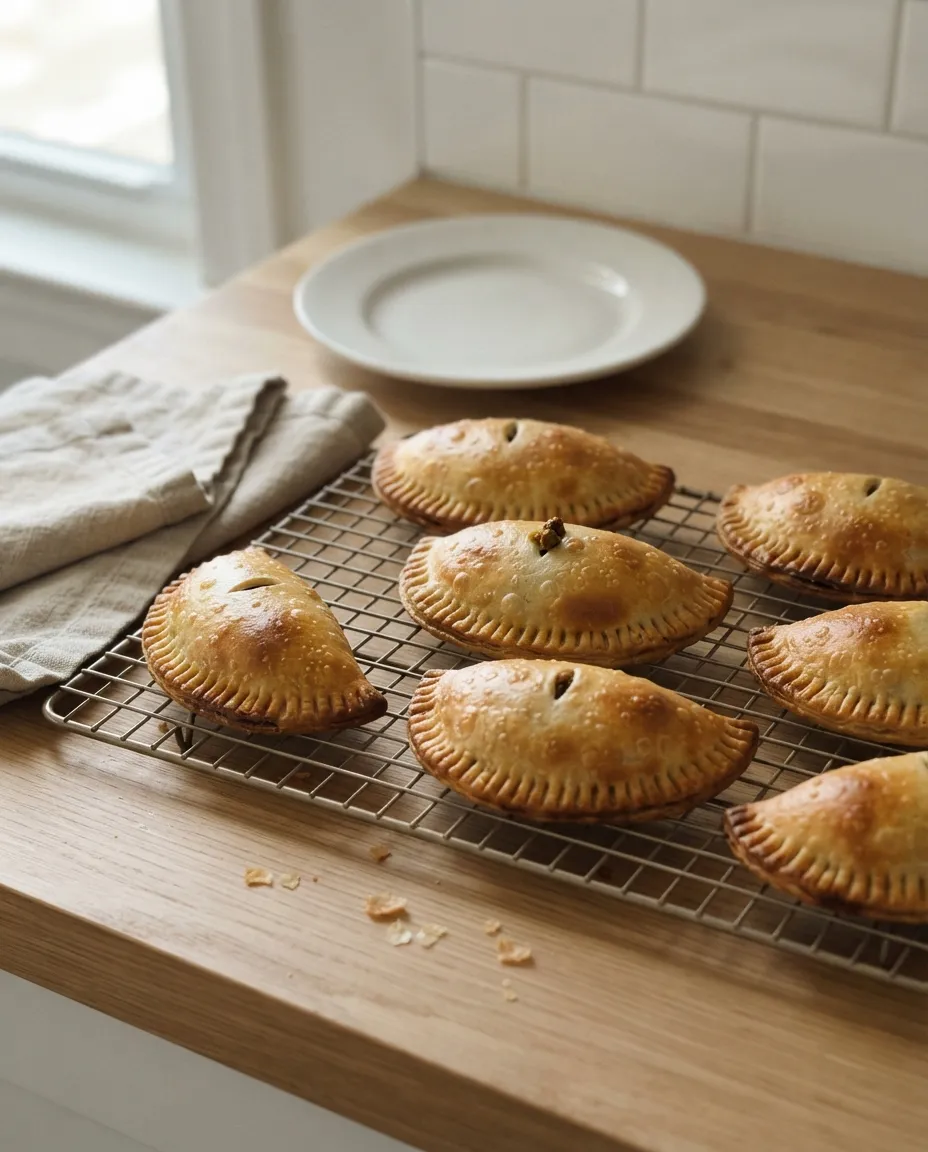
A fried empanada is a beautiful thing that costs a quart of oil, a splattered stove, and a kitchen that smells like a fryer until Tuesday. The basket gets you honestly close for the price of a pastry brush: blistered, deeply golden, crackling at the crimp, with a picadillo inside that stayed inside. The recipes ranking for this mostly copy each other's temperatures and then borrow advice from french fries, telling you to shake the basket halfway, which is a fine way to crack a sealed pastry. This page treats the empanada as what it is, a filled pastry with fry-shop ambitions: thawed discos handled cold, a filling cooked thick before it ever meets the dough, a seam built to survive, and one finishing decision, oil or egg, that decides whether it looks fried or baked.
What’s on this page
- What frying gives, and how close this gets
- Discos, pie crust, or homemade
- Picadillo that stays put
- The seal, and the repulgue question
- Temperature and timing
- What done looks like
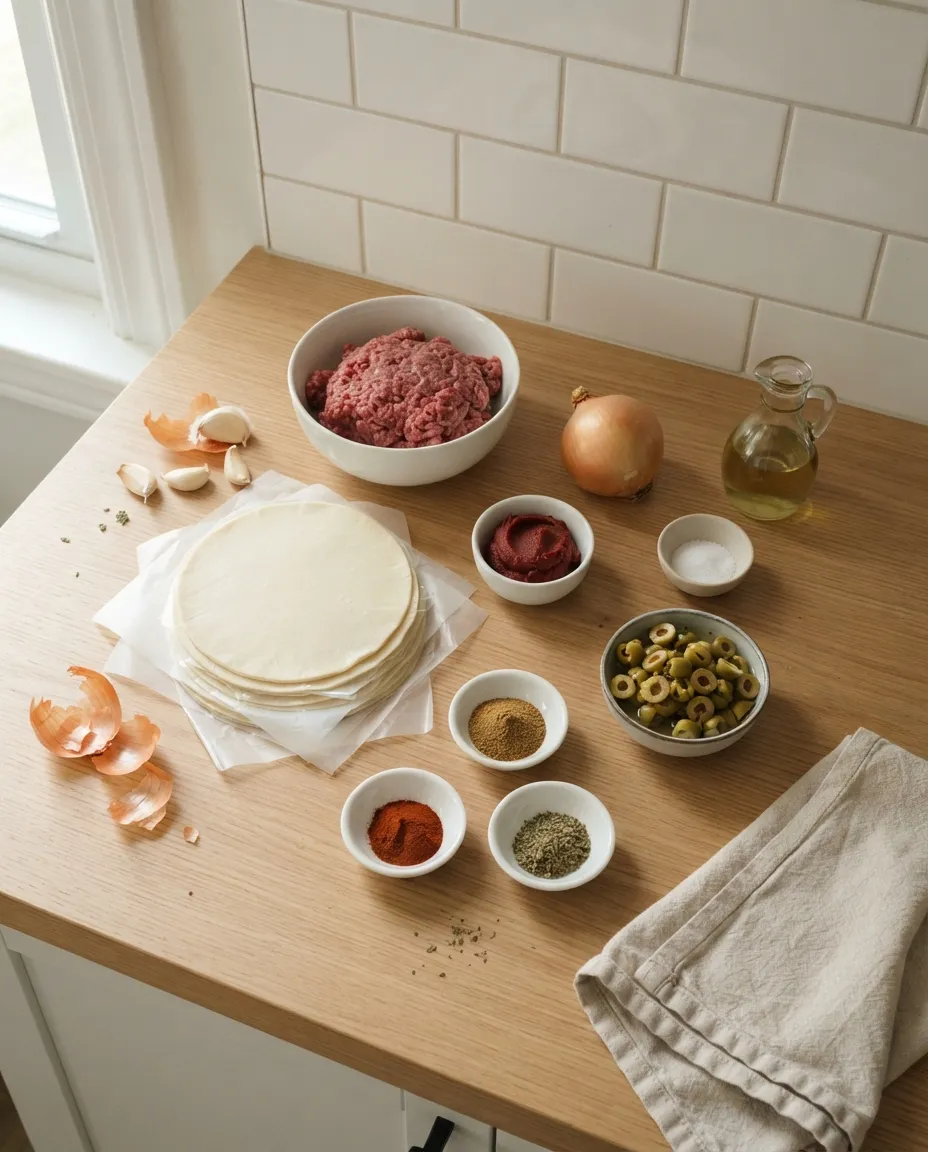
- Ingredients
- How to make them
- Store-bought frozen empanadas
- Beyond the beef
- Fixing what goes wrong
- Frequently asked questions
What frying gives, and how close this gets
Honesty first, because the title makes a claim. Frying does two things a basket cannot fully fake: it blisters the dough's surface into hundreds of tiny bubbles, and it seals flavor into the crust with hot fat on every square inch at once. What the basket does instead is drive hot air over an oiled surface, which browns deeply, crisps genuinely, and blisters modestly. The result lands at a confident ninety percent of fried, with none of the oil quart, the splatter zone, or the lingering fryer smell, and it beats an oven empanada, whose sheet pan steams the underside pale, without argument. This site has run this play before with funnel cake and air fried Oreos: fair food without the fryer, judged with open eyes.
The one decision that controls how close you get is the finish. A light brush of oil on both sides is the fried-style answer: it fries the surface where it touches, blisters the dough, and turns the crimp into the crackly ridge fried empanadas are loved for. Egg wash on top is the bakery answer: glossy, deep mahogany, slightly softer. Both are correct; they are different empanadas. The recipe card uses the oil, because the title made a promise. Any neutral, high-heat oil works, and the two bottles worth owning are in best oils for an air fryer.
Discos, pie crust, or homemade
Frozen empanada discs, the orange-label discos in the freezer aisle, are the right call and nothing to apologize for: real empanada dough, rolled thinner and rounder than you would manage on a weeknight, ten to a package. They must thaw before folding, overnight in the refrigerator or about 30 minutes on the counter, and the target is pliable but still cool: a cold disco cracks at the fold, a warm one goes sticky, tears, and refuses to crimp. Separate them while barely thawed and keep the stack under a towel as you work.
No discos in your store: refrigerated pie crust cut into 5 inch rounds makes a flakier, more American empanada that behaves well at the same numbers, the same crust our hand pies are built on, and the fully homemade dough is a project for a different day. What does not work is puff pastry, which inflates the parcel into a turnover with an identity crisis and pops its own seam doing it; that pastry belongs in our apple turnovers, where it is supposed to rise. Empanada dough is meant to be a thin, sturdy wrapper that crisps, not a pastry that rises.
Picadillo that stays put
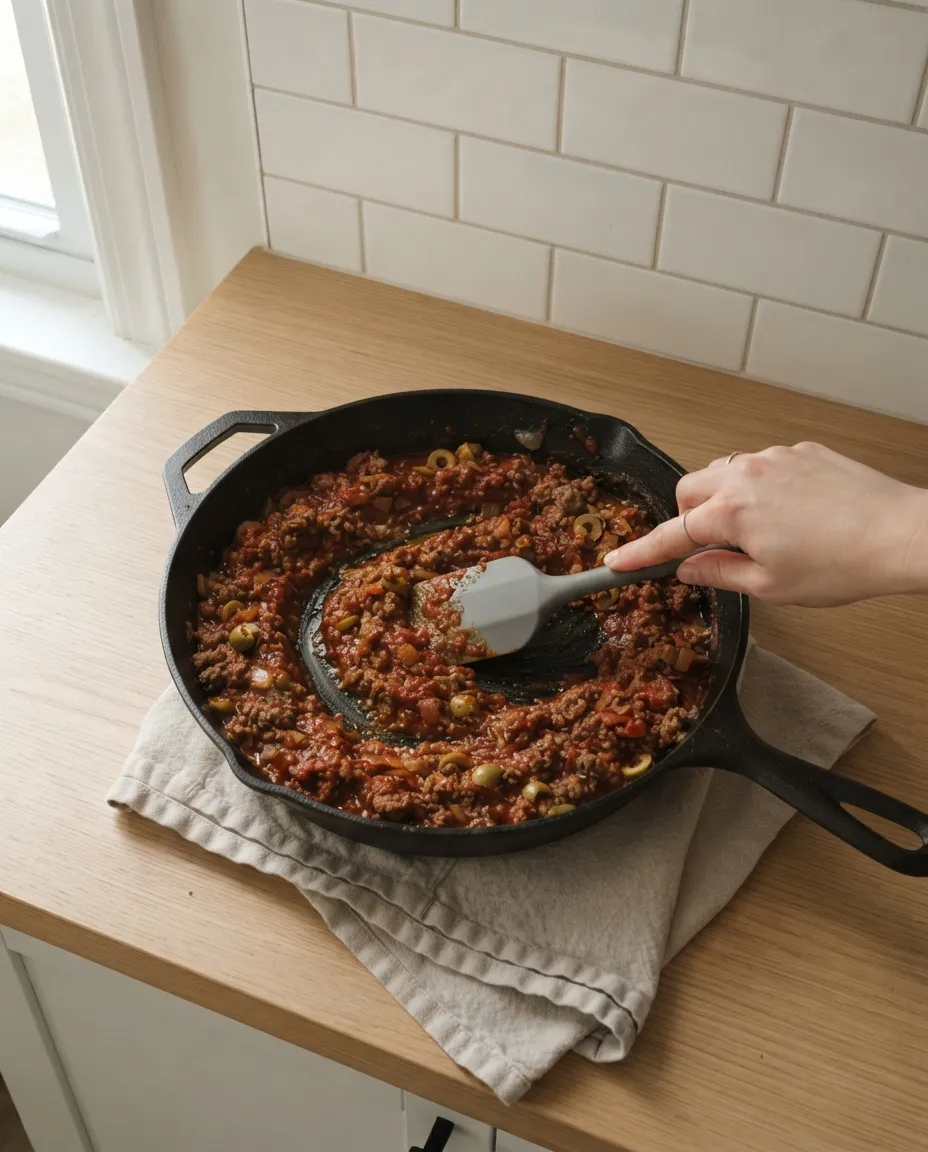
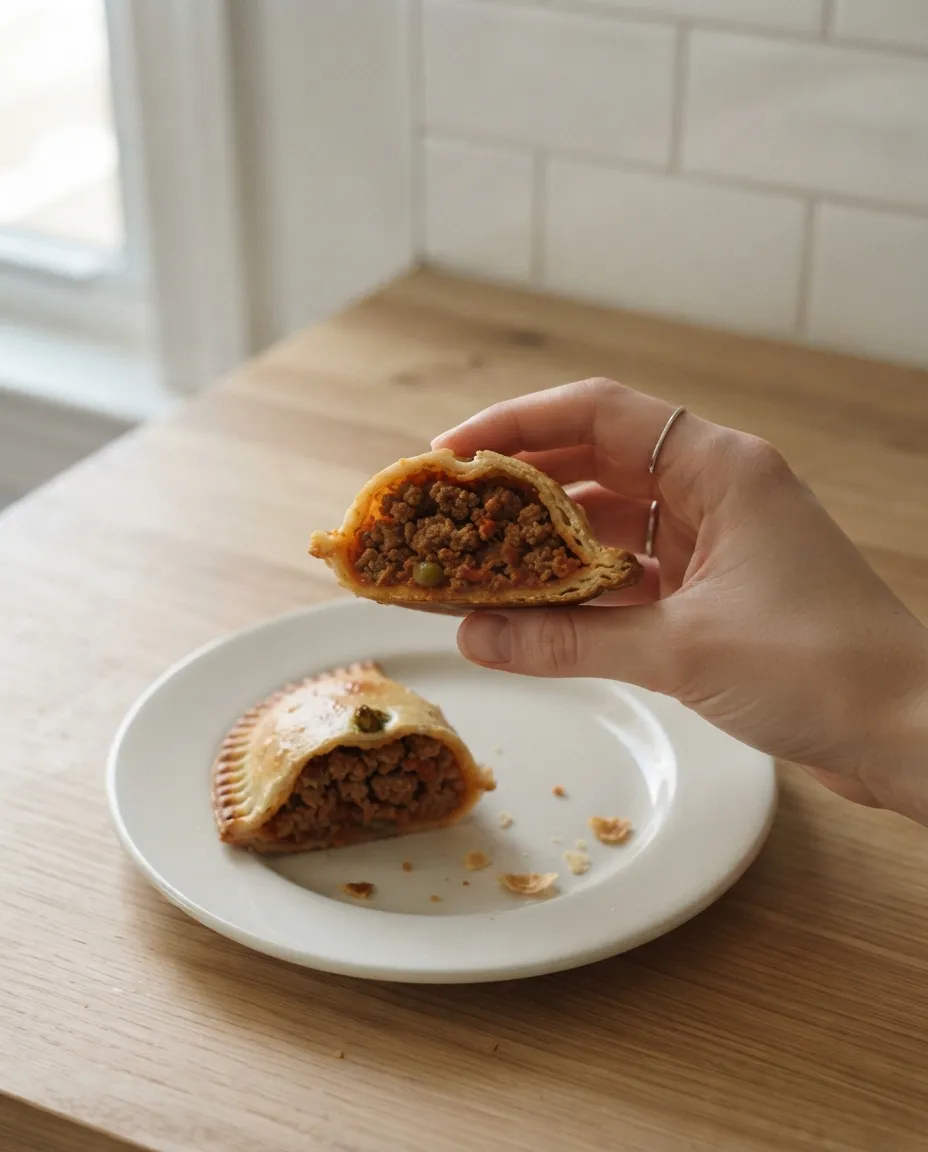
The house rule for every filled pastry on this site applies with extra force to meat: the filling goes in fully cooked, fully cooled, and thick enough to mound on a spoon. A 12 minute bake crisps dough; it does not cook raw beef, and it does not evaporate a watery filling, it just hands the water to the seam. So the picadillo gets built for thickness on purpose: beef browned and drained of its fat, tomato paste instead of sauce, and a few minutes uncovered at the end until a spoon dragged through it leaves a trail that holds. Chopped olives and a splash of their brine carry the classic salt and tang without adding real liquid. Then it cools completely, spread on a plate for speed, because warm filling softens the dough and loosens its own juices at exactly the wrong moment.
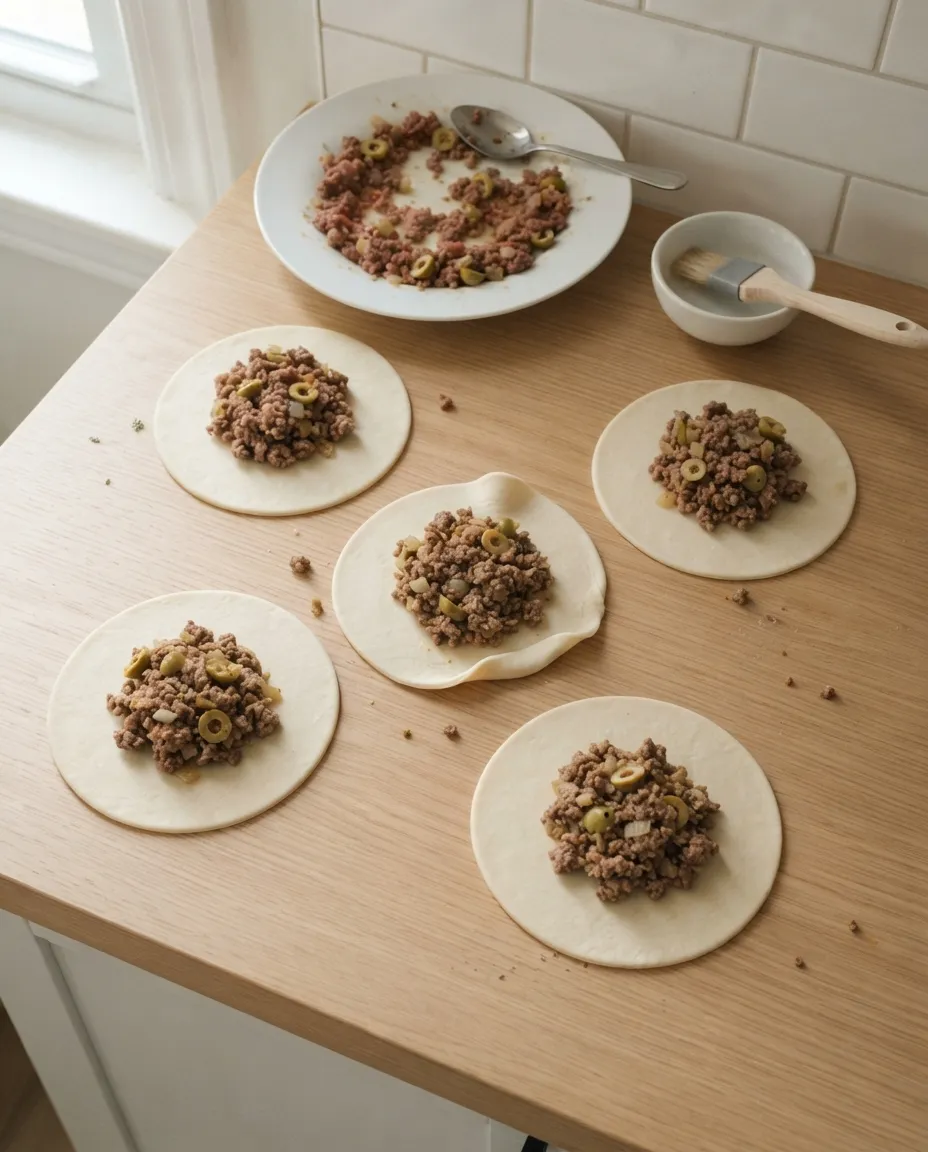
Two heaping tablespoons per disco. The discos are bigger than they look and the temptation is real, but every spoonful past that limit spends the bake prying at the crimp, and a burst empanada donates its filling to the basket floor.
The seal, and the repulgue question
The seal is four moves. Keep the border clean, a half inch of naked dough, wiping your fingers between empanadas because greasy borders cannot be glued. Brush the border with water. Fold and press the seam closed from the filling outward, pushing the air out ahead of the seal rather than trapping a steam pocket inside. Then crimp: a fork pressed firmly along the edge, dipped in flour when it sticks. Finish with one small vent slit on top. Traditional fried empanadas skip the vent because ninety seconds in oil is over before pressure builds; ten minutes of dry heat is a different physics, and the slit is what lets the crimp hold at a pressure it can actually win against.
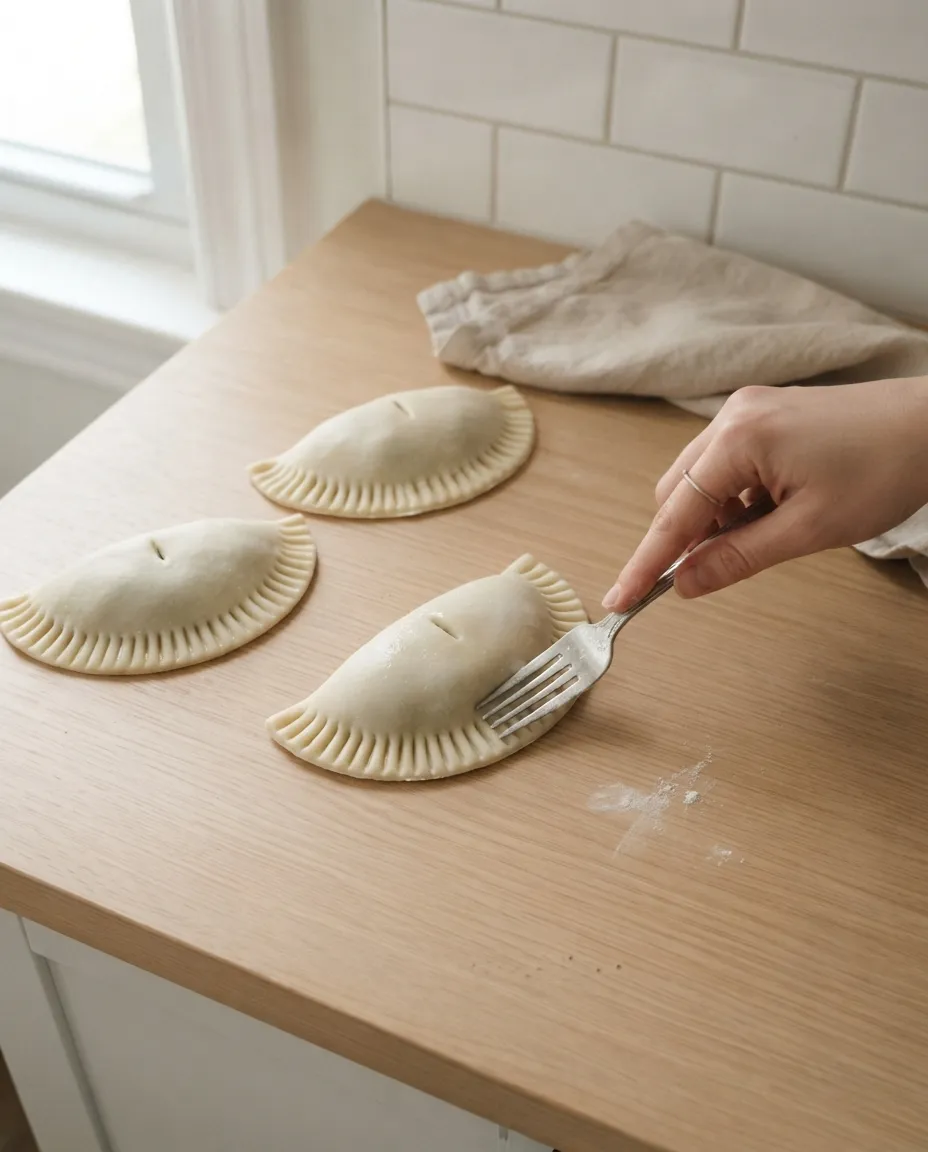
The repulgue, the braided rope fold that trims every proper empanaderia, deserves respect and its own honesty: it is beautiful, it is genuinely stronger than a fork crimp when done well, and it takes practice your first batch does not have. Make the first ten with the fork. Learn the braid on batch three, one empanada at a time, folding the edge over itself in overlapping pinches. The empanada does not taste of your crimp; it tastes of whether the seal held.
Temperature and timing
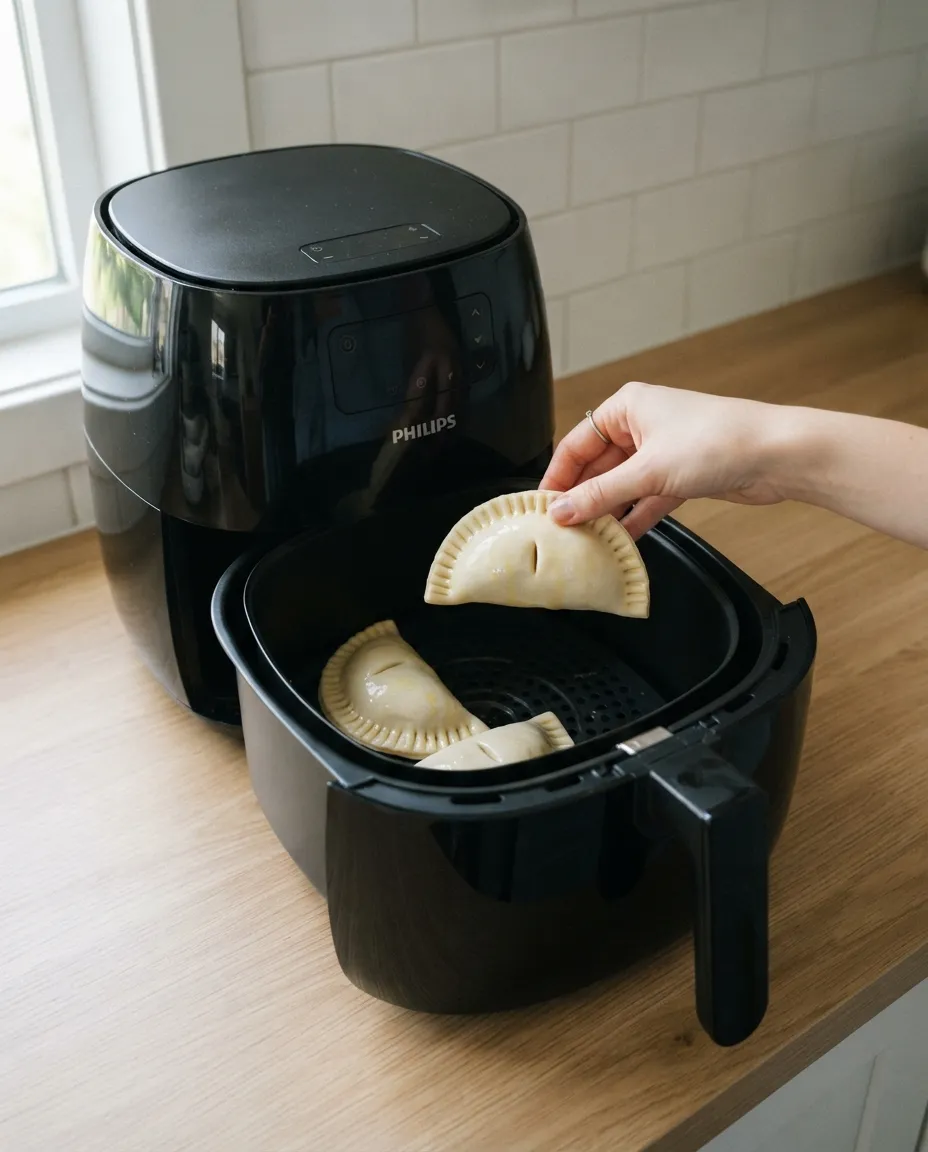
350°F for 10 to 12 minutes, preheated 3 minutes, no flip, no shake. The shake-the-basket-halfway advice in half the ranking recipes is muscle memory from french fries, where loose pieces need redistributing; an empanada is a sealed pastry, and rattling it against the basket wall mid-bake is how crimps crack. The perforated floor browns the underside without any of that, which is the standing advantage of a bare, unlined basket, and the case against liners lives in the foil and parchment guide. Batches of 3 or 4 with a finger of space, second batch about a minute faster.
On the number itself: fried empanadas cook at 350°F oil, oven recipes bake at 400°F to compensate for still air and a sheet pan, and a basket needs neither compensation. Dropping the oven number back down is the same conversion our air fryer calculator runs on any recipe, landing where the fryer already was. The preheat matters because a thin oiled dough wants its crisping to start immediately, not after a warm-up lap; the general rule is argued in do you need to preheat an air fryer for baking, and every tested setting on this site is collected on the baking chart.
What done looks like
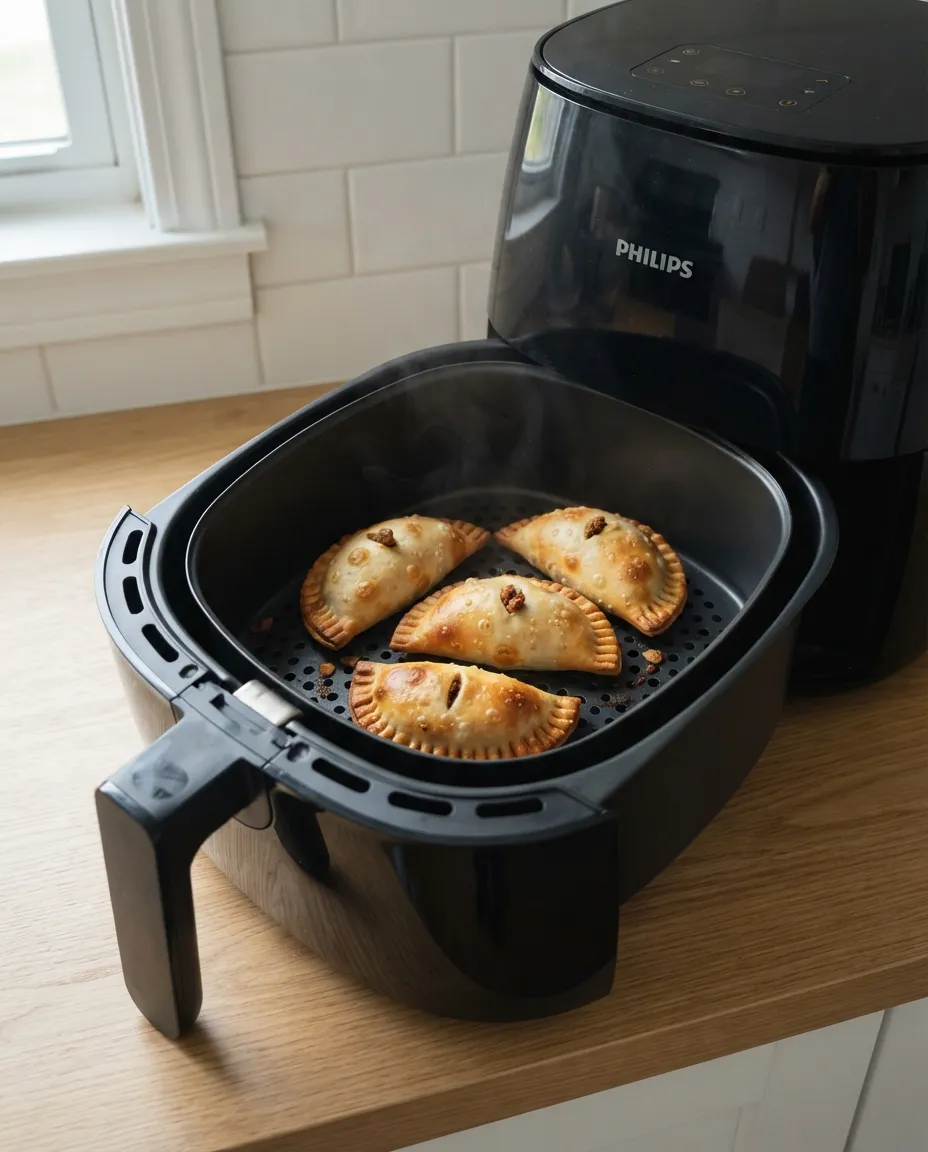
- Surface: deep gold shading to brown at the high points, with scattered small blisters if you took the oil route. Pale empanadas taste like dough; the flavor lives in the color.
- The crimp: the ridge should be the crispest part, browned and rigid, with no filling escaping anywhere along it. A bead of picadillo at the vent slit is fine and traditional-adjacent.
- The underside: golden and dry when you lift one, the bare floor's contribution.
- Sound: a done empanada knocked gently against a spatula gives a hollow tap, the sound of a crisp shell over a filling that has pulled slightly away as steam left through the vent.
Ingredients
For 10 beef empanadas
- 1 package (10) frozen empanada discos, thawed until pliable but cool
- 1 lb ground beef, 85/15
- 1 small onion, finely chopped
- 3 cloves garlic, minced
- 2 tablespoons tomato paste
- 1 1/2 teaspoons ground cumin, 1 teaspoon smoked paprika, 1/2 teaspoon dried oregano
- 1/3 cup chopped green olives plus a splash of their brine
- Salt to taste, going easy until the olives are in
- Neutral oil for brushing, about 2 tablespoons, or 1 egg beaten with 1 teaspoon water for the bakery finish
Raisins in picadillo are a regional civil war this page stays out of; a tablespoon, if your family is a yes, goes in with the olives.
How to make them
- Brown the beef with the onion over medium-high heat for 6 to 8 minutes, then drain off the excess fat.
- Stir in the garlic, tomato paste, cumin, paprika and oregano and cook 1 minute, until the paste darkens.
- Add the olives and a splash of brine, cook 2 to 3 minutes uncovered until a dragged spoon leaves a trail that holds, then season with salt.
- Spread the picadillo on a plate and cool it completely.
- Lay out the thawed discos, spoon 2 heaping tablespoons of filling onto the center of each, and keep a clean half inch border, wiping your fingers between empanadas.
- Brush each border with water, fold into a half-moon, and press the seam closed from the filling outward to push the air out.
- Crimp the seams firmly with a fork and cut one small vent slit in each top.
- Brush both sides lightly with oil for the fried-style finish, or egg wash the tops for the bakery look.
- Preheat the air fryer at 350F for 3 minutes, then air fry 3 or 4 at a time for 10 to 12 minutes, no flipping and no shaking, until deeply golden with a crisp crimp.
- Rest 5 minutes on a rack before serving; the shell cools fast and the picadillo does not.
Store-bought frozen empanadas
The fully assembled frozen empanadas from the freezer case, filling already inside, go straight from bag to basket: 330°F for 12 to 14 minutes from frozen, no thawing, brushed with a little oil if you want the fried look. The lower temperature is the freezer-shelf rule that runs everything from our frozen biscuits to the frozen garlic bread and the toaster strudel, which bakes from frozen at this same 330°F: a frozen center needs minutes more than it needs degrees, and hot-and-fast just paints a done color on an undone middle. Your own empanadas join this system happily: freeze them built and unbaked on a tray, bag them, and bake from frozen at the same 330°F for 12 to 14, which turns one Sunday skillet of picadillo into a month of 15 minute dinners.
Beyond the beef
- Chicken: shredded cooked chicken bound with a few spoonfuls of thick salsa or cream cheese, never loose broth. Rotisserie leftovers are the weeknight cheat code.
- Ham and cheese: diced ham and a melting cheese, the cheese doing double duty as binder. The kid empanada, and not only for kids.
- Cheese and corn: a spoon of corn, scallion, and enough cheese to hold it together, for the sweet-savory end of the tradition.
- Spiced potato and pea: essentially a samosa in an empanada jacket, and if you keep spiced vegetables like our aloo gobi or baingan bharta in weeknight rotation, a thick cupful folds in beautifully.
- Guava and cheese: the dessert classic, a slice of guava paste with cream cheese, and because guava paste barely melts, it is the easiest seal on this page. Same numbers, dusted with sugar out of the basket.
Every one of them obeys the same law: cooked or ready to eat, cold, thick, two heaping tablespoons, no exceptions for sentimental reasons. Everything this basket has been tested on lives in the recipe index, with the technique pages under guides.
Fixing what goes wrong
| Problem | Cause | Fix |
|---|---|---|
| Seam burst in the basket | No vent, trapped air, or wet filling | One slit per top, press air out before crimping, and the spoon-trail test on the picadillo |
| Dough cracked at the fold | Disco still half frozen | Thaw until pliable but cool; a cracked fold cannot be rescued by crimping |
| Sticky, torn discos | Thawed too far or too warm | Work from a cool stack under a towel, and refrigerate the discos 10 minutes if they drag |
| Pale and dry instead of fried-looking | No oil, or crowded basket | A real brush of oil on both sides, a finger of space, batches over crowding |
| Crimp cracked mid-bake | Basket shaken or empanadas flipped | Neither is needed; the floor browns the underside on its own |
| Filling wet and sliding out when cut | Sauce-heavy or warm filling at assembly | Tomato paste over sauce, drain the fat, cool completely; the rescues for scorching are in the burning guide |
Frequently asked questions
QWhat temperature do you cook empanadas in an air fryer?
350F for 10 to 12 minutes for fresh-built empanadas on thawed discos, with a 3 minute preheat, and 330F for 12 to 14 minutes for fully assembled frozen ones straight from the bag. Oven recipes run 400F to fight a sheet pan and still air, and fried versions cook in 350F oil; the basket needs no compensation, so it lands where the fryer already was. Recipes running 375F and up brown the surface ahead of the filling and trade crisp for chew at the crimp.
QDo you flip empanadas in the air fryer?
No, and do not shake the basket either. The shake-halfway advice is borrowed from french fries, where loose pieces need redistributing to cook evenly; an empanada is a sealed pastry, and rattling or flipping a half-baked one is the leading cause of cracked crimps. The perforated basket floor lets hot air reach the underside for the whole bake, so the bottom browns on its own. Lay them in with a finger of space, close the drawer, and open it when the timer says so.
QHow do you get air fryer empanadas crispy like fried?
Brush them, do not spray them: a light coat of neutral oil on both sides from an actual brush covers evenly and fries the surface where it touches, blistering the dough and turning the crimp into the crackly ridge fried empanadas are known for. Then give them the full 10 to 12 minutes at 350F and the courage to take the color deep, because pale dough reads baked no matter what you coated it with. Egg wash instead of oil gives a glossier, softer, bakery-style finish; it is a different and equally valid empanada.
QWhy did my empanadas burst open?
Sealed pastry in dry heat is a pressure vessel, and bursts trace to three causes: no vent slit, so steam leaned on the crimp until it gave; air folded in with the filling, which expands into a balloon, fixed by pressing the seam closed from the filling outward; or a wet filling whose liquid thinned in the heat and pried the seam open from inside, fixed by draining the beef, using tomato paste instead of sauce, and cooling the picadillo completely. Overfilling past two heaping tablespoons makes all three worse at once.
QHow long do frozen empanadas take in the air fryer?
Twelve to 14 minutes at 330F, straight from frozen with no thawing, whether they are store-bought or your own batch frozen unbaked on a tray. The lower temperature gives the frozen center the minutes it needs while the outside browns on schedule; running them hot and short paints a finished color on a cold middle. Brush with a little oil before baking for the fried-style surface. Note the difference from discos, which are just the dough: those must thaw before you can fold them, but a built empanada bakes best from solid.
QCan I use pie crust instead of empanada discos?
Yes: cut refrigerated pie crust into 5 inch rounds and everything else on this page applies unchanged, same filling limit, same seal, same 350F for 10 to 12 minutes. The result is flakier and more buttery than a disco empanada, closer to a savory hand pie than to what an empanaderia sells, which some households prefer and purists forgive. The one substitution that fails is puff pastry, which inflates the sealed parcel and pops its own seam; empanada dough is meant to crisp as a thin wrapper, not to rise.
Made it? Rate it.
It helps more people retire the oil pot without regrets.
Air Fryer Beef Empanadas
Ten empanadas on thawed discos with a thick olive picadillo, sealed, vented, oil-brushed and baked at 350°F for 10 to 12 minutes for a fried-style crisp with no pot of oil.
Ingredients
- 1 package (10) frozen empanada discos, thawed until pliable but cool
- 1 lb ground beef, 85/15
- 1 small onion, finely chopped
- 3 cloves garlic, minced
- 2 tablespoons tomato paste
- 1 1/2 teaspoons ground cumin, 1 teaspoon smoked paprika, 1/2 teaspoon dried oregano
- 1/3 cup chopped green olives plus a splash of their brine
- Salt to taste, going easy until the olives are in
- Neutral oil for brushing, about 2 tablespoons, or 1 egg beaten with 1 teaspoon water for the bakery finish
Instructions
- Brown the beef with the onion over medium-high heat for 6 to 8 minutes, then drain off the excess fat.
- Stir in the garlic, tomato paste, cumin, paprika and oregano and cook 1 minute, until the paste darkens.
- Add the olives and a splash of brine, cook 2 to 3 minutes uncovered until a dragged spoon leaves a trail that holds, then season with salt.
- Spread the picadillo on a plate and cool it completely.
- Lay out the thawed discos, spoon 2 heaping tablespoons of filling onto the center of each, and keep a clean half inch border, wiping your fingers between empanadas.
- Brush each border with water, fold into a half-moon, and press the seam closed from the filling outward to push the air out.
- Crimp the seams firmly with a fork and cut one small vent slit in each top.
- Brush both sides lightly with oil for the fried-style finish, or egg wash the tops for the bakery look.
- Preheat the air fryer at 350F for 3 minutes, then air fry 3 or 4 at a time for 10 to 12 minutes, no flipping and no shaking, until deeply golden with a crisp crimp.
- Rest 5 minutes on a rack before serving; the shell cools fast and the picadillo does not.

Sujata Thapa
Sujata bakes everything on this site in a 5.5 quart basket air fryer on a Kathmandu counter, then re-tests the keepers until the timings hold for anyone. The no-shake rule was learned from a batch whose crimps cracked in unison at minute six, a sound she describes as six tiny doors closing on dinner.