

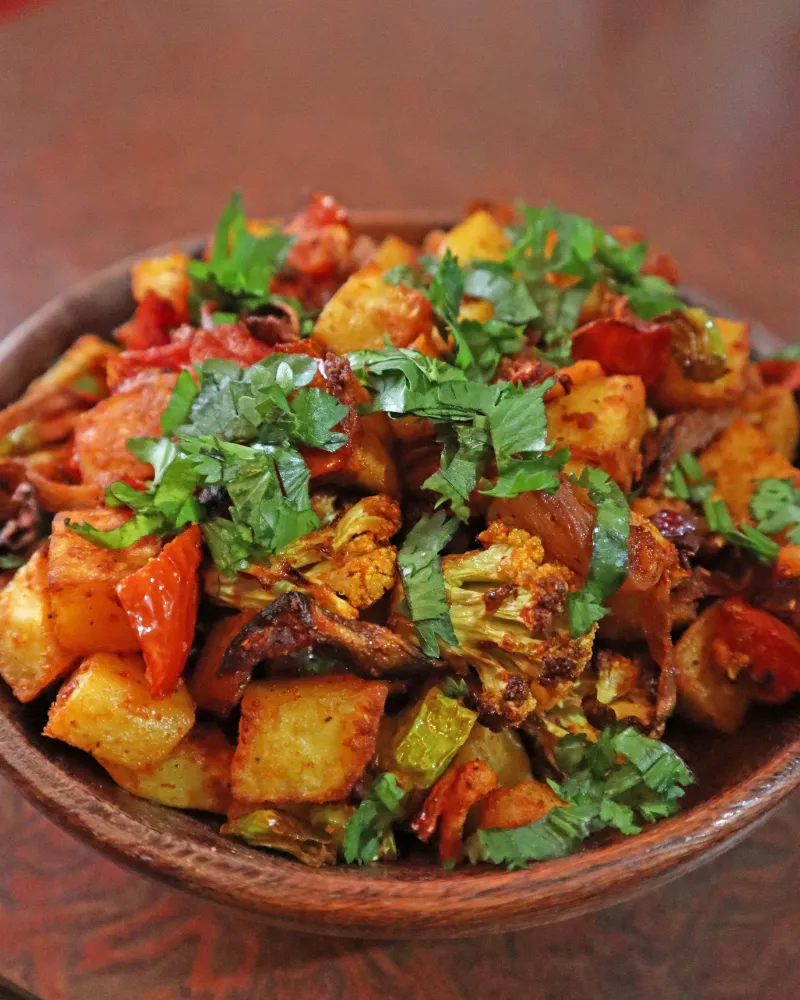
I have made aloo gobi in a pan more times than I can count, and it is a forgiving dish there. You can push things around, cover it for a minute when the potato needs help, take the lid off when it gets too wet. The pan gives you a hundred small corrections.
An air fryer gives you two decisions: a temperature and a timer. That is the whole interface. And it turns out that when you take away the corrections, aloo gobi has a structural problem that a pan was quietly hiding for you the entire time.
Quick answer: Put the diced potato in on its own at 375°F for 8 minutes. Add the cauliflower, onion and ginger-garlic, then cook another 12 minutes, shaking twice. The potato is done at 205°F inside, not when it looks right. Keep tomato and any wet paste out of the basket, and hold the garam masala, amchur and cilantro until it comes out.
Two vegetables, one basket
Here is the problem stated plainly. Aloo and gobi are not similar ingredients that happen to go together. They are close to opposites.
Dense and slow
A potato is solid starch. It has to get to about 205°F all the way through before the starch gelatinizes and the inside turns fluffy rather than waxy. That takes real time.
Porous and fast
Cauliflower is about 92 percent water in a loose, open structure with enormous surface area. It browns quickly, collapses quickly, and goes from tender to sad in a few minutes.
One of them loses
Cook until the potato is right and the cauliflower is mush. Cook until the cauliflower is right and the potato is waxy in the middle. There is no single time that serves both.
I read through the recipes ranking for this and, without exception, they put the potato and the cauliflower into the basket at the same moment. Most cook for 12 to 15 minutes at 380°F. A few give the sensible advice to cut the potato smaller than the florets, which does help, and one adds the ginger and garlic partway through, which is smart.
But cutting the potato smaller is a workaround, not a fix. You are shrinking one vegetable to make it finish at the same time as another, which means the potato pieces end up too small to develop the fluffy interior that is the entire point of aloo in this dish. You get little browned cubes instead of soft potato with a crisp edge.
The fix is not to change the size. It is to change the start time.
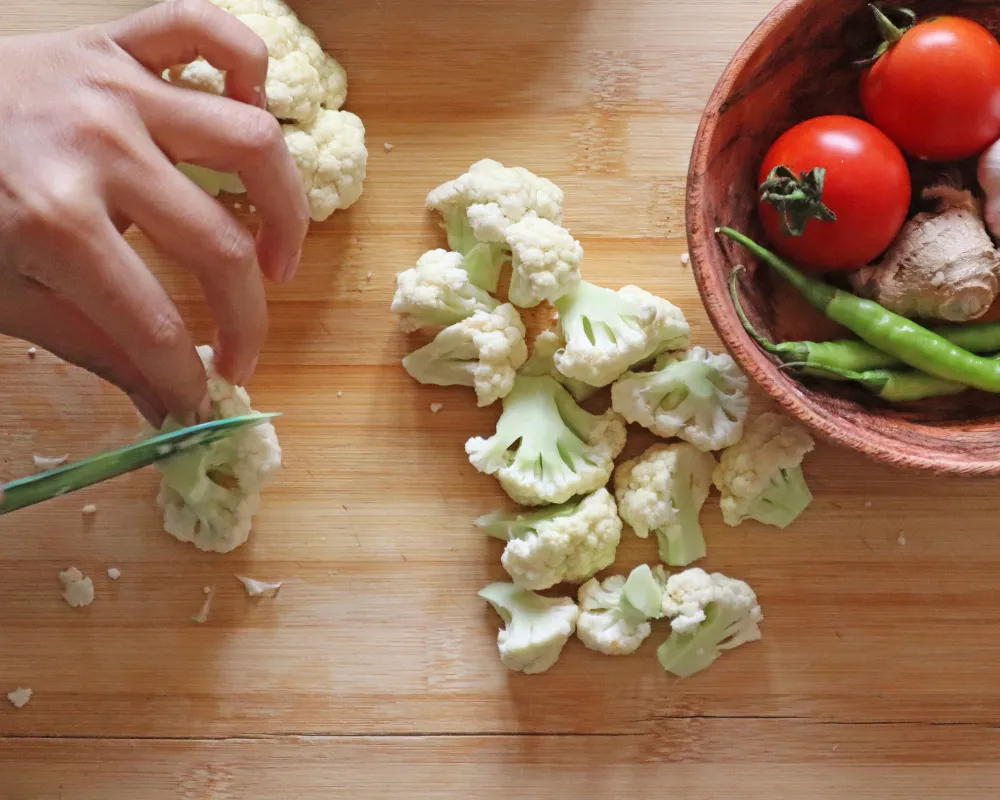
The eight minute head start
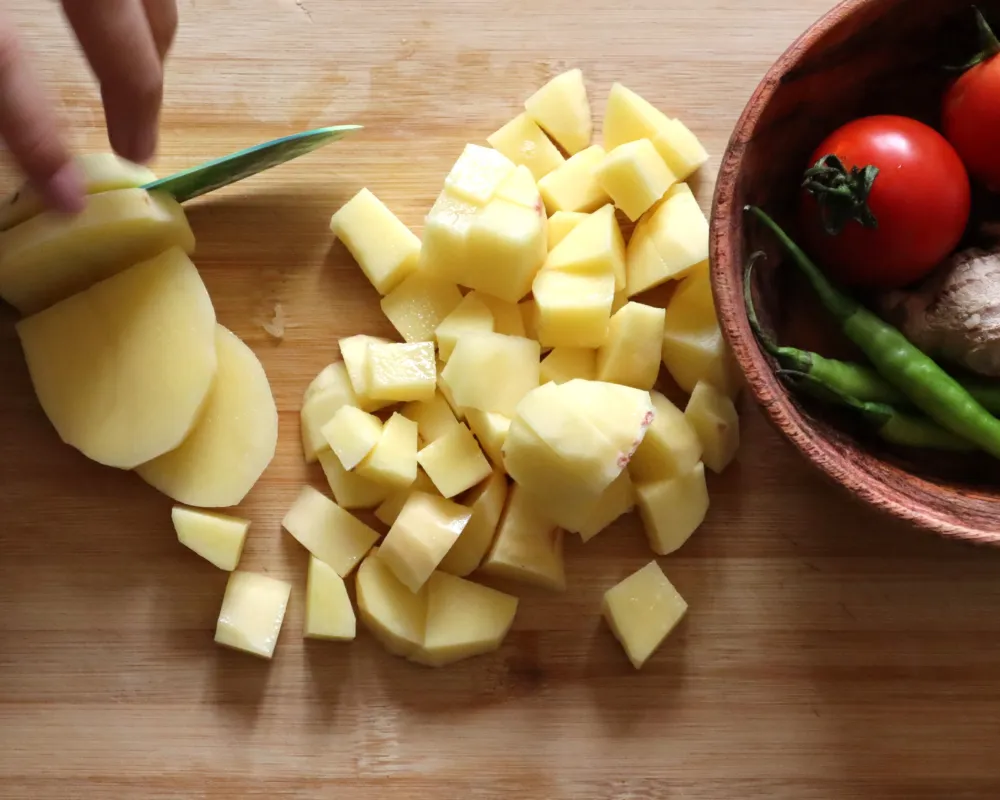
Give the potato eight minutes alone at 375°F, then add everything else and cook for another twelve. Total twenty minutes, with the potato getting all twenty and the cauliflower getting twelve.
That is the whole idea, and it takes no extra effort because those eight minutes are exactly when you would be cutting the cauliflower anyway.
| Minute | What goes in | What is happening |
|---|---|---|
| 0 | Potato, oil, base spices | Surface dries and starts to brown. The inside begins its slow climb. |
| 8 | Cauliflower, onion, ginger, garlic, chili | Cauliflower starts from a hot basket, so it browns rather than steams. |
| 12 | Shake | Turns the pieces that have been facing the element. |
| 16 | Shake again | Cauliflower edges are catching color by now. |
| 20 | Check the potato at 205°F, then out | Potato fluffy, cauliflower tender with browned edges, onion soft and sweet. |
Eight minutes is calibrated for a 1/2 inch dice. If you cut bigger, closer to 3/4 inch, give the potato 11 or 12 minutes alone instead and expect the whole thing to run a few minutes longer.
There is a second benefit that I did not expect. Adding the cauliflower to an already hot basket means its surface hits high heat immediately, which browns it instead of letting it sit and sweat. Cold cauliflower into a cold basket spends its first several minutes releasing water into a machine that is still warming up, and that water has to go somewhere.
Why yours tastes steamed
This is the second thing the popular recipes get wrong, and it is the reason people say air fryer aloo gobi tastes boiled rather than roasted.
Several of them have you toss chopped tomato and sliced onion into the basket along with the vegetables. One of them explicitly says it is fine to leave a little moisture on the cauliflower after rinsing, to stop it drying out.
A tomato is about 95 percent water. Put chopped tomato in a small sealed basket and it does not roast, it releases steam, and everything within a few inches of it stops browning. You have effectively put a lid on your own dish. Browning does not really begin until a surface gets past around 285°F, and a wet surface is stuck at 212°F until every drop has gone.
What to do instead:
- Tomato paste, not fresh tomato. A tablespoon of concentrated paste rubbed into the oil gives you the same savory depth and the same color with almost none of the water. It also coats the vegetables rather than sitting in a puddle underneath them.
- Dry the cauliflower properly. Wash it, then shake it hard and pat it between towels. Florets hold water in their crevices, and that is water your machine has to remove before it can start browning anything.
- Onion is fine, sliced. It has less water than tomato and it benefits from the browning. Slice rather than dice so the pieces are big enough to survive.
- No lemon or vinegar before cooking. Acid goes on at the end. Adding it early just gives the machine more liquid to drive off and dulls the spices.
The same logic runs through everything crisp we make here, and the general version is in how to get things crispy in an air fryer. The glossary entry on the 212 degree ceiling explains the physics in two sentences if you want the short version.
Spices burn, and which go on when
Ground spices sitting on the outside of food in fast moving 375°F air are in a much harsher position than they would be in a pan of oil. They are exposed, they are dry, and nothing is protecting them. Left there for twenty minutes, several of them turn bitter.
This is why aloo gobi from an air fryer can come out tasting faintly acrid even when the vegetables are cooked properly. It is not the vegetables. It is the spice on their surface.
So the spices get split into two groups, which is how they would be handled in a pan anyway. Most published air fryer versions put everything in at the start, and one of the better ones sprinkles garam masala at the end without saying why.
| Goes on at the start | Why it survives |
|---|---|
| Turmeric | Robust and needs heat and fat to lose its raw edge. Also does the coloring. |
| Ground coriander | Mild and heat stable. Toasting it in the basket is an improvement, not a risk. |
| Ground cumin | Wants heat to open up. Watch it if you go above 380°F. |
| Kashmiri chili powder | Mostly there for color, and the color is more heat stable than the heat is. |
| Salt | Does not burn, and it needs the whole cook to penetrate the potato. |
| Goes on at the end | Why it cannot wait in the basket |
|---|---|
| Garam masala | A finishing blend built on cardamom, cloves and cinnamon. Its whole character is volatile aromatics, and twenty minutes of hot moving air strips them out. Added at the end it is the smell of the dish. Added at the start it is nothing. |
| Amchur or lemon | Sourness is what lifts aloo gobi out of being heavy. Heat dulls it and the extra liquid works against browning. |
| Fresh cilantro | Will simply incinerate. It goes on the plate. |
| Chaat masala, optional | Same reasoning as garam masala, and its black salt note is destroyed by prolonged heat. |
Fresh ginger, garlic and green chili sit in between. They need some cooking but they are small and exposed, so they go in at the 8 minute mark with the cauliflower rather than at the start. Twenty minutes would leave you with burnt garlic, which is a flavor you cannot hide. Our guide on preventing burning in an air fryer covers the general pattern, since small dry things on the surface are always the first to go.
Ingredients
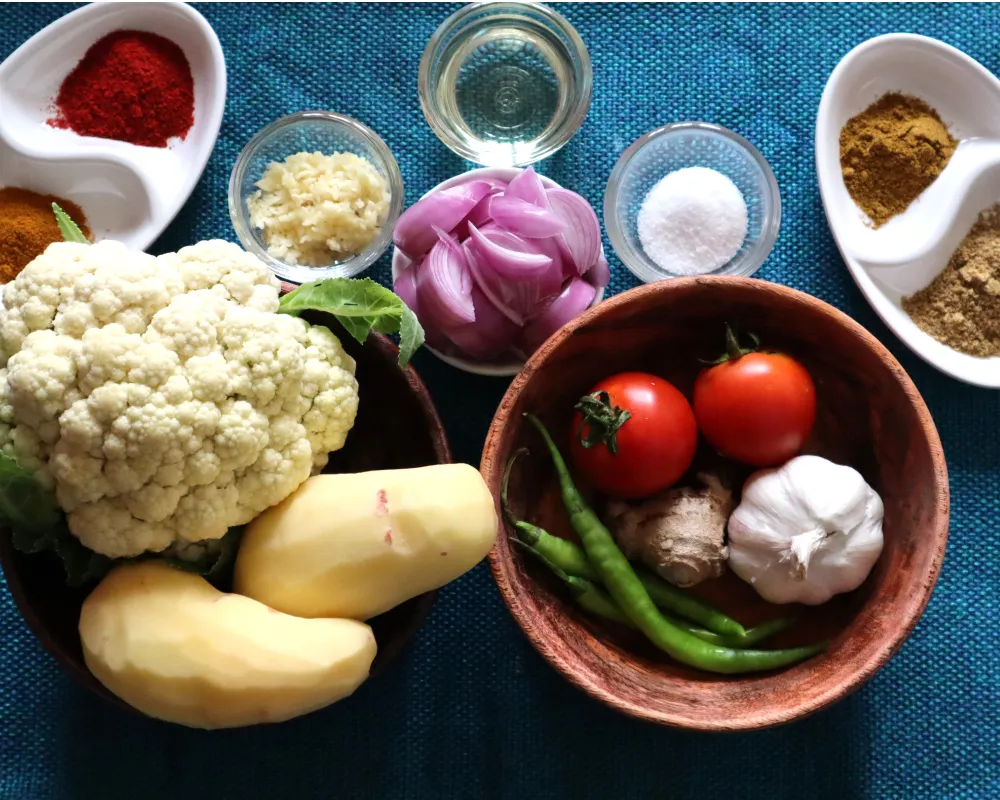
Serves 4 as a side, or 2 to 3 with rice or roti as the main thing on the table.
Vegetables
- 12 oz (340g) potatoes, about 2 medium, peeled and cut into 1/2 inch dice
- 1 lb (450g) cauliflower florets, from 1 small head, cut to about 1 1/2 inches
- 1 small red onion, sliced into half moons
- 1 tablespoon fresh ginger, minced
- 3 garlic cloves, minced
- 1 to 2 green chilies, slit lengthways
Goes on at the start
- 2 tablespoons neutral oil (avocado, canola or refined olive)
- 1 tablespoon tomato paste
- 1 1/2 teaspoons ground coriander
- 1 teaspoon ground cumin
- 1 teaspoon Kashmiri red chili powder
- 3/4 teaspoon turmeric
- 3/4 teaspoon salt
Goes on at the end
- 1/2 teaspoon garam masala
- 1/2 teaspoon amchur, or 1 tablespoon lemon juice
- 1/4 cup cilantro, chopped
A few notes
- Which potato. Yukon Gold or another all-rounder is ideal, since it holds its shape while still going fluffy inside. Russets go fluffier but crumble at the edges when you shake the basket. Waxy red potatoes keep their shape best but never get properly soft in the middle, which loses you the contrast that makes the dish.
- Kashmiri chili is for color. It gives that deep red without much heat. If you only have regular chili powder, use half as much and accept a paler dish. The heat in this recipe comes from the green chilies, where you can control it by leaving the seeds in or taking them out.
- Amchur if you can find it. Dried green mango powder, sour in a way lemon is not quite. Lemon juice works and is what I use when I have run out, but add it at the very end and off the heat.
- Two tablespoons of oil is not much for this quantity, and it is doing real work: carrying the fat-soluble spice compounds, conducting heat evenly, and giving the surfaces something to brown with. Cutting it further gives you dusty spices and pale vegetables.
How to make it
- Preheat to 375°F (190°C) for 3 minutes. Not optional here. The whole staggering idea depends on the cauliflower meeting a hot basket at the 8 minute mark, and that only works if the machine was hot to begin with.
- Cut the potato to 1/2 inch. Peeled or not, your choice, but keep the pieces even. Uneven dice is the most common reason one batch has both hard cubes and mush.
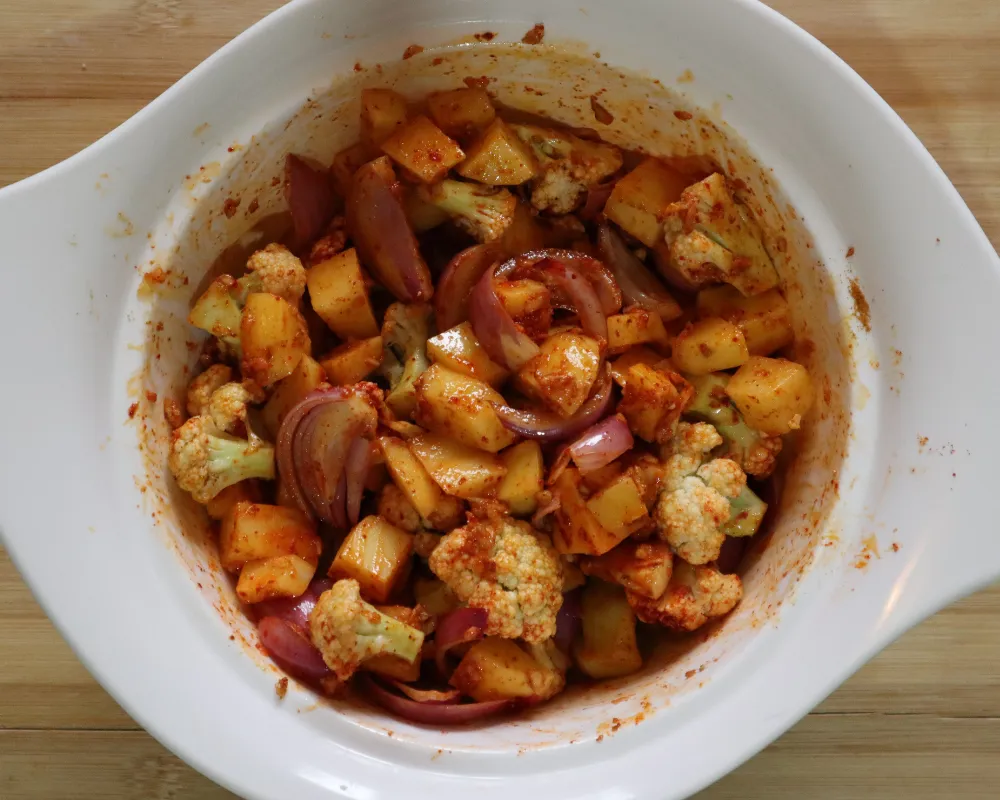
- Coat the potato. In a bowl, mix the oil and tomato paste into a smooth paste, then stir in the coriander, cumin, Kashmiri chili, turmeric and salt. Add the potato and toss until every piece is properly coated and looks red-orange rather than dusty.
- Potato in, 8 minutes. Spread it in a single layer and set the timer. Leave it alone.
- Cut the cauliflower while it cooks. Florets about 1 1/2 inches, so they are noticeably larger than the potato dice. Wash them, then dry them properly between towels. Slice the onion, mince the ginger and garlic, slit the chilies.
- Toss the cauliflower in whatever spice paste is left in the bowl. There will be some. If the bowl is completely clean, add another teaspoon of oil and a pinch of salt and toss the cauliflower in that.
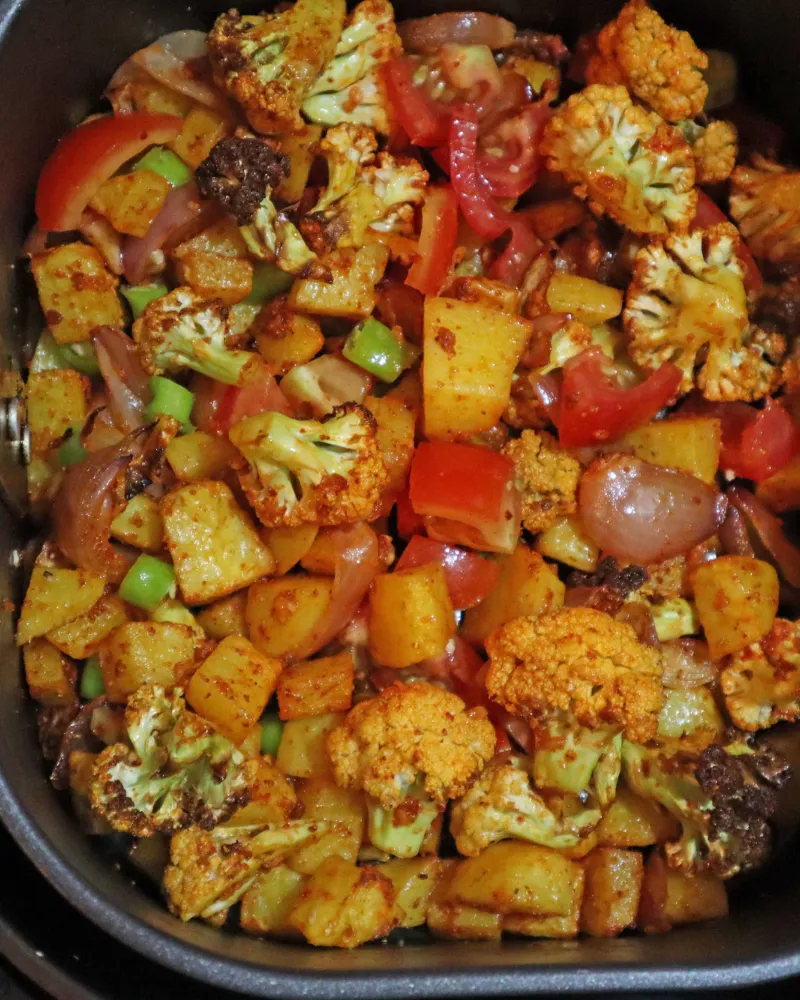
- At 8 minutes, add everything else. Cauliflower, onion, ginger, garlic and chilies straight on top of the potato. Shake the basket to mix rather than stirring with a spoon, which breaks the florets.
- Cook 12 more minutes, shaking at 12 and 16. Two shakes. Each one turns the pieces that have been facing the element.
- Check the potato. Push an instant-read thermometer into the largest piece you can find. You want 205°F. If it reads under 195, give it another 3 minutes.
- Tip it into a serving bowl while it is hot, then add the garam masala, the amchur or lemon juice, and the cilantro. Toss gently.
- Taste for salt and sourness before it goes to the table. This is the step that separates a decent aloo gobi from a good one, and it takes ten seconds.
Shake, do not stir. Once the cauliflower is in, a spoon will break the florets into rubble and you will end up with something closer to a hash. Pull the basket out, shake it side to side, put it back. If your machine is an oven-style unit with a tray rather than a basket, use tongs and turn the pieces rather than dragging a spatula through them.
When the potato is actually done
Every recipe for this ends with some version of until the vegetables are golden and tender. That is fine for the cauliflower, which you can see. It is not much use for the potato, which is the part that goes wrong.
A potato is done when the starch inside has gelatinized, and that happens at a specific temperature. The Idaho Potato Commission puts the target at 208 to 211°F for a baked potato. For diced potato in a basket I aim for 205°F, because small pieces carry over a few degrees after they come out and because past about 212°F the edges start to dry and collapse.
| Reading | What you have |
|---|---|
| Under 190°F | Waxy and firm in the middle. Not raw, but not pleasant. Needs more time. |
| 195 to 200°F | Nearly there. Two or three more minutes. |
| 205°F | Fluffy inside, crisp edge. Take it out. |
| Past 215°F | Edges drying out and crumbling when you shake. You went too far. |
If you have no thermometer, press a piece against the side of the basket with the back of a spoon. It should give completely with no resistance in the center. A piece that squashes but has a firm core in the middle is at about 190°F and wants more time. Internal targets for everything else on the site are in the air fryer baking chart.
Basket size and the single layer
This recipe makes roughly 2 pounds of vegetables before cooking, which is more than a small basket can roast properly.
| Machine | What it handles | What to do |
|---|---|---|
| 3 to 4 quart basket | About half this recipe | Halve it, or cook in two rounds and combine |
| 5 to 6 quart basket | Full recipe, snug | Shake three times instead of two |
| 8 quart or dual zone | Full recipe comfortably | As written |
| Oven-style air fryer | Full recipe on one tray | Add 3 to 4 minutes, airflow is gentler |
Scaling up or down is what the recipe scaler is for, and the pan size calculator will tell you what your basket actually takes if you have never measured it.
A crowded basket is the single biggest reason this dish comes out pale and soft. Vegetables piled two deep steam each other, and the pieces underneath never see moving air at all. The glossary entry on single layer puts it more briefly than I can. If you have to choose between one crowded batch and two quick ones, take the two, and hold the first batch in a warm bowl covered loosely with foil.
Machine format matters here more than for most things, because this dish depends on airflow reaching a lot of separate pieces. Our comparison of basket versus oven-style air fryers goes through the difference, and for this recipe the oven-style unit wins on capacity while the basket wins on browning.
Fixing what goes wrong
| What you got | Why | Fix |
|---|---|---|
| Cauliflower mushy, potato right | They went in together and you cooked to the potato. | Stagger. Potato alone for 8 minutes first. |
| Potato hard, cauliflower right | They went in together and you cooked to the cauliflower. | Same fix, from the other direction. And check 205°F. |
| Tastes steamed, nothing browned | Fresh tomato in the basket, wet cauliflower, or a crowded basket. | Tomato paste instead of tomato, dry the florets, single layer. |
| Bitter or acrid | Ground spices scorched over the full twenty minutes. | Only the robust spices at the start. Garam masala at the end. |
| Burnt garlic taste | Minced garlic went in at minute zero and cooked for twenty minutes on a dry surface. | Add ginger, garlic and chili at the 8 minute mark. |
| Flat, needs something | Almost always the sourness, not the salt. | Amchur or lemon at the end. Add it off the heat and taste again. |
| Florets broken into rubble | Stirred with a spoon instead of shaking. | Shake the basket. Tongs if you have a tray. |
| Spices dusty, not stuck | Not enough oil, or spices added dry rather than mixed into the oil first. | Make the oil, tomato paste and spices into a paste before the potato goes near it. |
| Smoking air fryer | Oil dripping onto the hot drawer, or spice fragments burning on the element. | Less oil, and clean the basket between batches. More in why your air fryer smokes. |
| Turmeric stained the basket | Expected. Turmeric stains almost everything it touches. | Bicarbonate paste, left on for ten minutes. Our cleaning guide covers it. |
Serving and variations
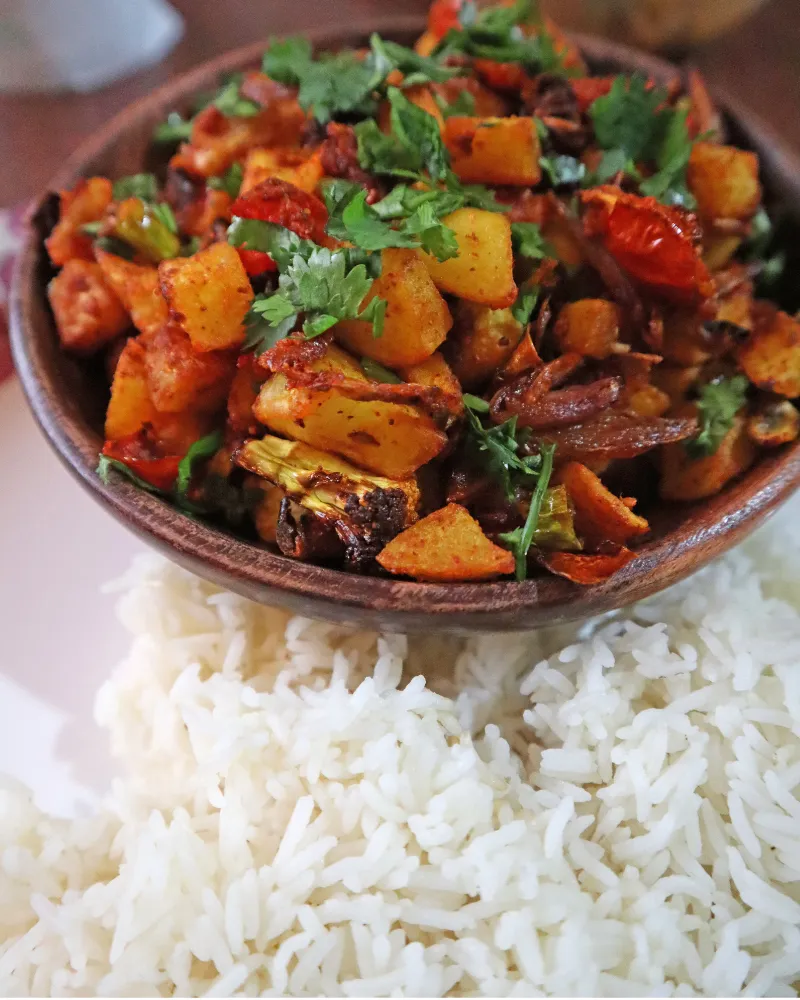
- The standard plate. Roti or paratha, a bowl of dal, and plain yogurt. The yogurt is not a garnish, it is the cooling counterweight to the chili, and the dish is noticeably better with it.
- As a side. Alongside rice and any dal, or next to a richer curry where its dryness is welcome against the sauce.
- Aloo gobi matar. Add half a cup of frozen peas in the last 4 minutes. No need to thaw them, and they bring a sweetness that works well against the amchur.
- With paneer. Cubed paneer added at the 8 minute mark with the cauliflower. It browns beautifully and turns this into a full meal.
- Punjabi style, drier and darker. Double the tomato paste and add 1/4 teaspoon of ajwain to the base spices. Ajwain is heat stable and it is what gives many restaurant versions their distinctive savory note.
- Milder for children. Leave out the green chilies entirely and halve the Kashmiri chili. The dish still works, because most of its character is coriander, cumin and the garam masala at the end.
- Make it a wrap. Leftovers in a warm roti with yogurt and pickle is genuinely better than the original, and it is what I do with the second half of the batch most times.
If you want more vegetables out of a basket, air fryer brussels sprouts follow the same single-layer logic, and for potatoes specifically there are accordion potatoes, hash browns and, for the peels you just took off these potatoes, air fryer potato peels.
Storage and reheating
- Refrigerated: 4 days in an airtight container, once completely cool. The flavor improves overnight as the spices settle, which is the opposite of what happens to the texture.
- Reheating: 4 minutes at 350°F in the air fryer, which brings back most of the crispness. A microwave will not, and it turns the cauliflower watery.
- Do not freeze it. Cauliflower turns to mush on thawing and potato goes grainy. This is one of the few dishes here where freezing genuinely ruins it.
- Refresh the finish. Reheated aloo gobi has lost most of its garam masala and all of its cilantro. A fresh pinch of each and a squeeze of lemon brings it most of the way back, and takes no time.
- Meal prep: you can cut and coat the potato the night before and keep it covered in the fridge. Do not cut the cauliflower ahead, since it goes limp and starts to smell strongly within a day.
Curious whether running the air fryer for twenty minutes beats heating the oven for this? The running cost calculator works it out for your electricity rate, and for a dish this size the air fryer wins comfortably. If you are converting a conventional oven aloo gobi recipe, run its numbers through the air fryer calculator first, then ignore its finish time and go by the 205°F reading instead. All four of our air fryer tools are in one place.
Frequently asked questions
QWhy does my air fryer aloo gobi come out soggy?
Almost always water you put in yourself. Chopped fresh tomato is about 95 percent water, and in a small sealed basket it releases steam that stops everything near it browning. Wet cauliflower does the same, because florets hold water in their crevices and a wet surface is stuck at 212°F until every drop has gone, while browning does not begin until around 285°F. Use a tablespoon of tomato paste instead of fresh tomato, dry the cauliflower properly between towels, and keep everything in a single layer so nothing steams its neighbor.
QWhy is my potato still hard when the cauliflower is done?
Because they went into the basket at the same time, which every popular recipe for this tells you to do. A potato has to reach about 205°F all the way through before its starch gelatinizes and the inside turns fluffy, and that takes roughly twenty minutes at 375°F. Cauliflower is done in twelve and starts collapsing after that. Give the diced potato an 8 minute head start on its own, then add the cauliflower and everything else for the remaining twelve. Cutting the potato smaller is the usual workaround but it costs you the soft interior that is the point of aloo in this dish.
QWhat temperature and time for aloo gobi in an air fryer?
375°F (190°C) for 20 minutes total, but split: potato alone for the first 8 minutes, then cauliflower, onion, ginger, garlic and chili added for the remaining 12, shaking twice. Most published recipes say 380°F for 12 to 15 minutes with everything in together, which is enough time for the cauliflower but not for the potato. The 5°F I take off is to give the ground spices a slightly easier time over a longer cook.
QWhen should I add garam masala?
At the very end, off the heat, once the dish is in the serving bowl. Garam masala is a finishing blend built on cardamom, cloves and cinnamon, and its entire character comes from volatile aromatic compounds. Twenty minutes in fast moving hot air strips those out and leaves you with very little. The same goes for amchur or lemon, chaat masala and fresh cilantro. Only the robust spices, turmeric, coriander, cumin, Kashmiri chili and salt, should go in at the start where they can bloom in the oil.
QHow do I know when the potato is done?
205°F in the middle of the largest piece, on an instant-read thermometer. That is where the starch has gelatinized and the inside is properly fluffy rather than waxy. The Idaho Potato Commission puts the baked potato target at 208 to 211°F, and I aim slightly lower for diced potato because small pieces carry over a few degrees after they come out. With no thermometer, press a piece against the side of the basket with the back of a spoon: it should give completely, with no firm core in the middle.
QWhich potatoes work best for aloo gobi?
Yukon Gold or another all-rounder. They hold their shape while you shake the basket but still go soft and fluffy inside, which is the contrast the dish needs. Russets go fluffier but crumble at the edges when shaken, so you lose whole pieces to the bottom of the basket. Waxy red potatoes hold their shape best but never get properly soft in the middle, and you end up with something closer to a salad. Cut whichever you use into an even 1/2 inch dice, because uneven pieces are the most common reason one batch has both hard cubes and mush.
QCan I make this without onion and garlic?
Yes, and it is a common way to cook it. Leave both out, add 1/4 teaspoon of asafoetida (hing) to the oil along with the base spices, and bump the ginger to a heaped tablespoon. Asafoetida is doing the savory job that onion and garlic would, and a small amount goes a long way. Everything else is unchanged, including the staggered timing, though the dish will finish a minute or two quicker without the onion in the basket.
QDo I need to preheat the air fryer?
Yes, three minutes at 375°F, and it matters more here than in most recipes. The staggering only works if the cauliflower meets an already hot basket when it goes in at the 8 minute mark, because that is what browns it instead of letting it sit and sweat. Starting cold also means the first several minutes happen at an unknown rising temperature, which makes the 8 and 12 minute marks meaningless.
QMy aloo gobi tastes bitter. What went wrong?
Scorched spices, not overcooked vegetables. Ground spices on the outside of food in fast moving 375°F air are exposed and dry, with nothing protecting them the way oil in a pan would, and over a full twenty minutes several of them turn acrid. Keep the start-of-cook spices to turmeric, coriander, cumin, Kashmiri chili and salt, make sure they are mixed into the oil into a paste rather than sprinkled on dry, and hold everything else back until the end. Burnt garlic is the other common culprit, which is why the garlic goes in at minute 8 rather than minute 0.
QCan I use frozen cauliflower?
You can, but it will not brown the same way. Frozen cauliflower has had its cell walls damaged by ice crystals, so it releases a lot of water as it thaws and it collapses more readily. Do not thaw it first, add it straight from frozen at the 8 minute mark, and expect to add 4 or 5 minutes. Accept that it will be tender rather than browned at the edges. Fresh is genuinely a lot better here, and cauliflower is cheap.
QHow do I stop turmeric staining my air fryer basket?
You mostly cannot, and it is worth knowing before you start rather than after. Turmeric stains plastic and light-colored nonstick almost immediately. A paste of bicarbonate of soda and a little water, left on the stained area for ten minutes and then wiped, lifts most of it. Sunlight fades the rest surprisingly well if you leave the basket outside for a few hours. The stain is cosmetic and does not affect how the machine works.
QCan I double the recipe?
Only if you have the space, and most baskets do not. This already makes about 2 pounds of vegetables, which is a snug fit in a 5 to 6 quart basket. Doubling it means piling them two deep, and the pieces underneath never see moving air at all, so they steam while the top layer browns. Cook two separate rounds and hold the first in a bowl covered loosely with foil, or use an oven-style air fryer where you can spread everything across a full tray. Doubling does not change any of the timings.
Never overbake again
Get our one-page times & temps cheat sheet, plus a new tested recipe each week.
No spam · unsubscribe anytime