


When electricity prices jumped a couple of winters ago, I put a cheap watt meter between my air fryer and the wall, mostly out of stubbornness. The results were almost boring: cooking dinner in the basket costs less than a dime most nights. But the question keeps trending, and most of the pages answering it are either UK articles quoting price caps in pence or spec-sheet math that ignores how the machine actually behaves. So here are real US numbers, with the math shown.
One thing the spec sheets hide, and the most useful fact on this page: an air fryer does not draw its rated wattage the whole time. The element cycles on and off to hold temperature, roaring for the preheat and then pulsing. Over a full cook, actual consumption typically lands around 60 to 75 percent of what the nameplate math predicts. Every number below tells you both versions.
Quick answer: most air fryers are rated 1,200 to 1,800 watts, with 1,500W typical. A normal 15 to 25 minute cook uses roughly 0.3 to 0.6 kWh, which costs about 5 to 10 cents at the US average rate of around 17¢ per kWh. Used once a day, that is roughly $2 to $4 a month, about a quarter to a third of what the same cooking costs in an electric oven.
The 2 minute math
The formula for any appliance: watts ÷ 1,000 × hours × your rate per kWh = cost.
Worked example: a 1,500W air fryer running 20 minutes at 17¢ per kWh. 1,500 ÷ 1,000 = 1.5 kW. Twenty minutes is 0.33 hours. 1.5 × 0.33 = 0.5 kWh. Times 17¢ gives 8.5 cents, and that is the ceiling: with the element cycling, the watt meter usually reads closer to 6 cents for that cook.
Your rate lives on your utility bill, and it varies a lot by state, from around 11¢ in the cheapest states to 30¢ and up in California and New England. Rather than redoing this arithmetic per meal, the running cost calculator does it for you: enter your machine's wattage, your cook time and your rate, and it compares the air fryer against your oven side by side.
What real foods cost to cook
Nameplate math at 17¢/kWh for a 1,500W machine, real-world cost in parentheses after cycling:
| Food | Settings | Cost per cook |
|---|---|---|
| Toast | 380°F, 4 min | ~1.7¢ (about 1¢) |
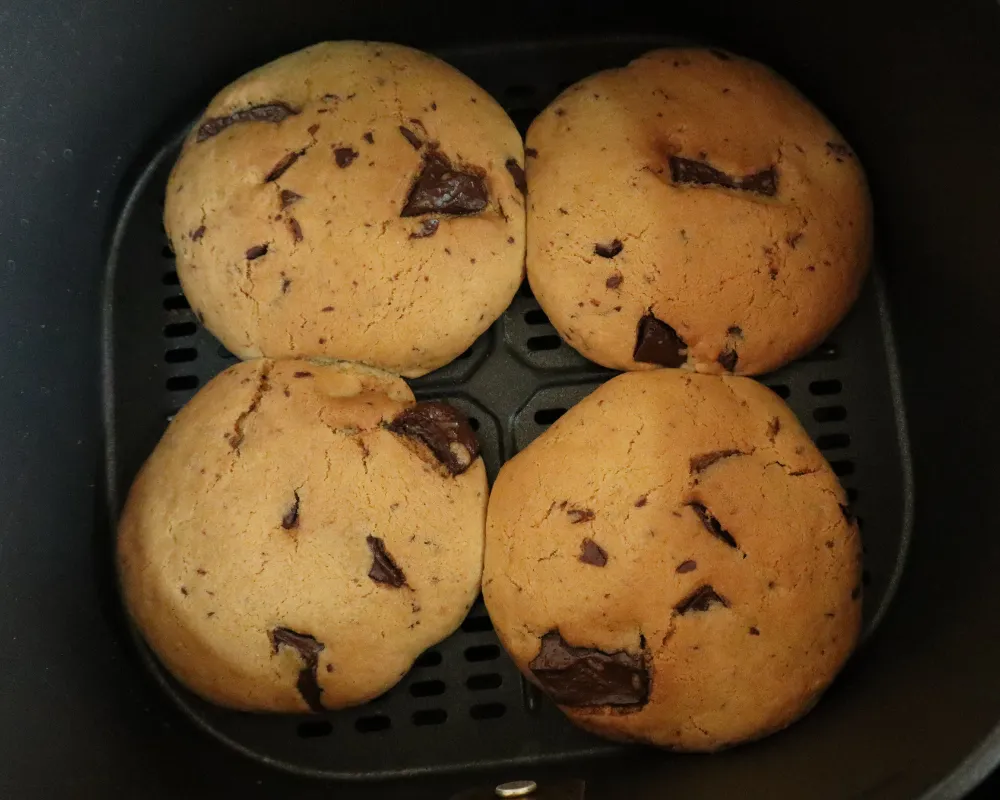
| Cookies, one batch | 300°F, 10 min | ~4¢ (about 3¢) |
| Roasted vegetables | 380°F, 12 min | ~5¢ (about 4¢) |
| Frozen fries | 400°F, 15 min | ~6¢ (about 5¢) |
| Chicken breast | 375°F, 18 min | ~8¢ (about 6¢) |
| Frozen wings | 400°F, 24 min | ~10¢ (about 8¢) |
| A full cake | 310°F, 35 min | ~15¢ (about 11¢) |
Even the longest bake on that list costs less than a postage stamp. The settings themselves come from the baking chart, and any oven recipe converts to basket settings with the air fryer calculator.
What a month of air frying costs
Say you use the machine generously: 30 minutes a day, every day, at 1,500W. Nameplate math says 0.75 kWh daily, about 22.5 kWh a month, which is $3.83 at 17¢. Cycling brings the realistic figure to $2.50 to $3.50 a month. Cook the same meals in a 3,000W electric oven with preheats and the month runs $12 to $17. Over a year, daily air frying instead of oven cooking saves a US household roughly $100 to $150, more in high-rate states.
Vs oven, toaster oven and microwave
| Appliance | Typical draw | Same meal costs | The catch |
|---|---|---|---|
| Air fryer | 1,200-1,800W | 5-10¢ | Small batches only |
| Electric oven | 2,500-5,000W | 25-40¢ with preheat | Heats a big box, and the kitchen, for one tray |
| Toaster oven | 1,200-1,800W | 10-18¢ | Longer preheat and cook than a basket; air fryer vs toaster oven covers the full matchup |
| Microwave | 900-1,200W | 2-4¢ | Cheapest of all, but nothing crisps; great for steaming, hopeless for fries |
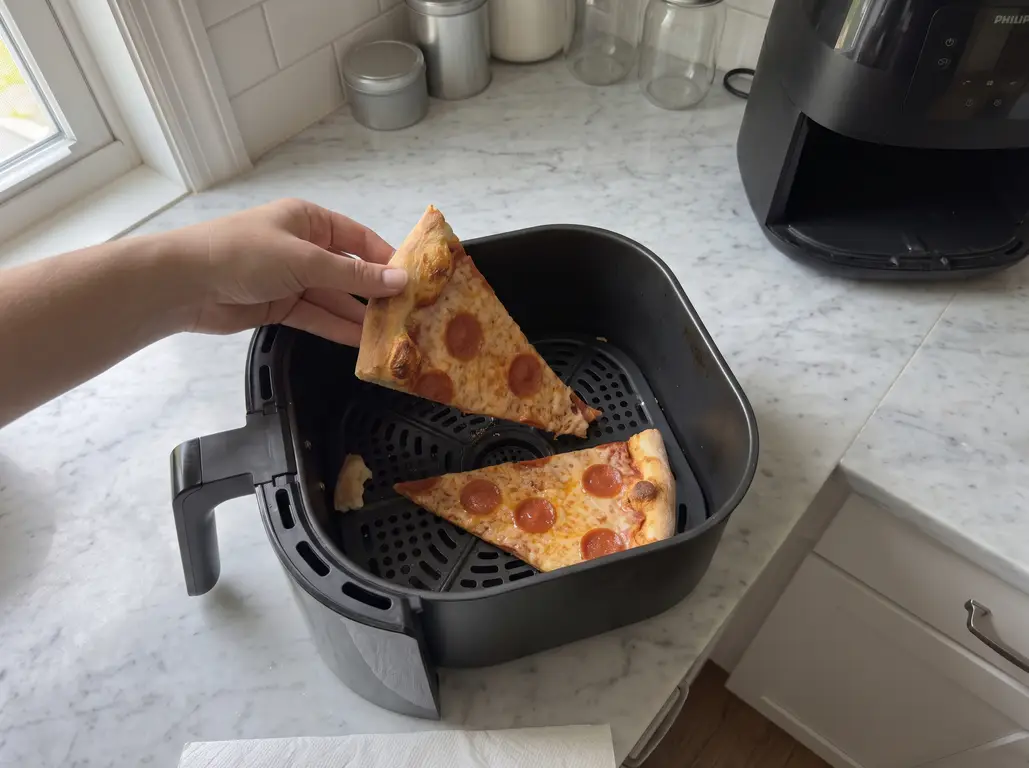
The fair summary: the microwave wins on raw cents, the air fryer wins on cents-per-crispy-result, and the full-size oven should be saved for what only it can hold. Reheating is the everyday example: two minutes of microwave makes soggy pizza, five minutes of air fryer makes last night's pizza worth eating again for about 3 cents.
Why it beats the oven so badly
- No real preheat. An electric oven spends 10 to 15 minutes and a quarter of a kWh just reaching temperature. The basket is there in 3 minutes, and the preheat guide covers when even that is skippable.
- It heats dinner, not a cabinet. A few quarts of air versus five cubic feet of oven box. Most of an oven's energy warms metal and air you are not eating.
- Shorter cooks. The same fries finish 30 to 40 percent sooner, so the meter simply runs less.
- Summer bonus. An oven dumps its heat into your kitchen and your air conditioner pays to remove it; the basket barely warms the room. Nobody puts that on a spec sheet, but July notices.
6 ways to shave it further
- 1. Batch back to back. The second round enters an already-hot chamber and skips the preheat entirely.
- 2. Skip preheating when the food doesn't need it. Reheats and long roasts genuinely do not care.
- 3. Fill the basket, in one layer. Cooking 4 fries costs the same as 40; single-layer capacity is free efficiency. The layer rule itself is in the beginner guide.
- 4. Keep it clean. Grease films on the element waste heat and make smoke; the routine in the cleaning guide takes 5 minutes.
- 5. Match machine size to your household. A 6 quart basket heating air for one person's snack is the one way to waste watts; the size guide helps you rightsize.
- 6. Check for time-of-use rates. Some utilities charge half price off-peak; a 9pm batch of cookies literally costs less than a 6pm one.
Frequently asked questions
QDoes an air fryer use a lot of electricity?
No. A typical 1,500 watt machine cooking a 20 minute meal uses about half a kilowatt-hour, which costs 8 or 9 cents at average US rates, and closer to 6 cents in practice because the element cycles on and off. Daily use adds roughly $2 to $4 a month to a bill. Among kitchen appliances, it is one of the cheapest per meal.
QIs an air fryer cheaper to run than an oven?
Much cheaper, typically 60 to 75 percent less for the same food. An electric oven draws 2,500 to 5,000 watts, spends 10 to 15 minutes preheating, and heats a large box around a single tray. The air fryer draws about 1,500 watts, preheats in 3 minutes, and cooks 30 to 40 percent faster. A meal that costs 25 to 40 cents of oven electricity runs 5 to 10 cents in the basket.
QIs an air fryer cheaper to run than a microwave?
No, the microwave is the cheapest cooker in the kitchen, using 2 to 4 cents for a typical task. But they do different jobs: a microwave heats through steaming and cannot crisp anything, while the air fryer makes food crunchy for a few cents more. The practical split: microwave for soups and steaming, air fryer for anything with a texture worth keeping.
QHow much does it cost to run an air fryer for 30 minutes?
A 1,500 watt machine running 30 minutes uses at most 0.75 kWh, which is about 13 cents at the US average rate of 17 cents per kWh, and more realistically 9 or 10 cents once the element starts cycling at temperature. In cheap-electricity states that half hour costs under 8 cents; at California rates it can reach 20 to 25 cents, still far below an oven.
QDoes a higher wattage air fryer cost more to run?
Barely, because higher wattage mostly means faster, not hungrier. A 1,700 watt machine reaches temperature sooner and recovers faster after you open the basket, then cycles just like a smaller one. Total energy per meal ends up similar. What raises consumption more is chamber size: a big basket has more air to keep hot, which is a reason to buy the size you need rather than the biggest one.
QDoes preheating an air fryer waste electricity?
Very little: 3 minutes at full draw is about 0.075 kWh, a bit over one cent. Skip it for reheats and long cooks, keep it for crispy food that benefits from a hot start. Compared with an oven preheat, which burns 10 to 20 times that, the air fryer preheat is a rounding error.
QWhy is my air fryer's actual power use lower than its rated wattage?
The rating is peak draw, pulled only while the heating element is on. Once the chamber reaches your set temperature, the thermostat cycles the element off and on to hold it, so the machine alternates between full draw and nearly nothing. Over a whole cook, a watt meter typically shows 60 to 75 percent of the nameplate figure. Spec-sheet math is a ceiling, not a bill.
QWill an air fryer noticeably raise my electric bill?
Used daily, it adds about $2 to $4 a month at average US rates, which most households never notice, and it usually replaces oven use, so many bills go down slightly. The swap works out to roughly $100 to $150 saved per year for a household that shifts most small-batch cooking from an electric oven to the basket.
QWhich uses less electricity, an air fryer or a toaster oven?
The air fryer, for the same plate of food. Their wattage ratings overlap, roughly 1,200 to 1,800 watts, but the basket preheats in 3 minutes instead of 8 and finishes most foods sooner, so it simply runs fewer minutes. A toaster oven earns its keep on toast and bigger pans; there is a full head-to-head comparison on this site.
QIs it cheaper to cook frozen fries in an air fryer or the oven?
The air fryer, by a wide margin. Fifteen minutes in the basket uses about 0.3 kWh, around 5 or 6 cents. The oven version needs a 12 minute preheat plus 25 minutes of baking in a 3,000 watt box, easily 25 to 35 cents. The fries also come out crispier, so the cheap option is also the better one, which is rare and worth celebrating.
Never overbake again
Get our one-page times & temps cheat sheet, plus a new tested recipe each week.
No spam · unsubscribe anytime
Cheap to run, in other words, and the savings compound if the basket replaces your oven for small meals. To get your own numbers instead of my averages, the running cost calculator takes your wattage and rate and does the comparison properly. New to the machine entirely? what is an air fryer explains what it is and the beginner guide gets you cooking. The recipes those cents pay for are all in the recipe index.
You can also follow me on Instagram and Pinterest for more easy air fryer recipes.