

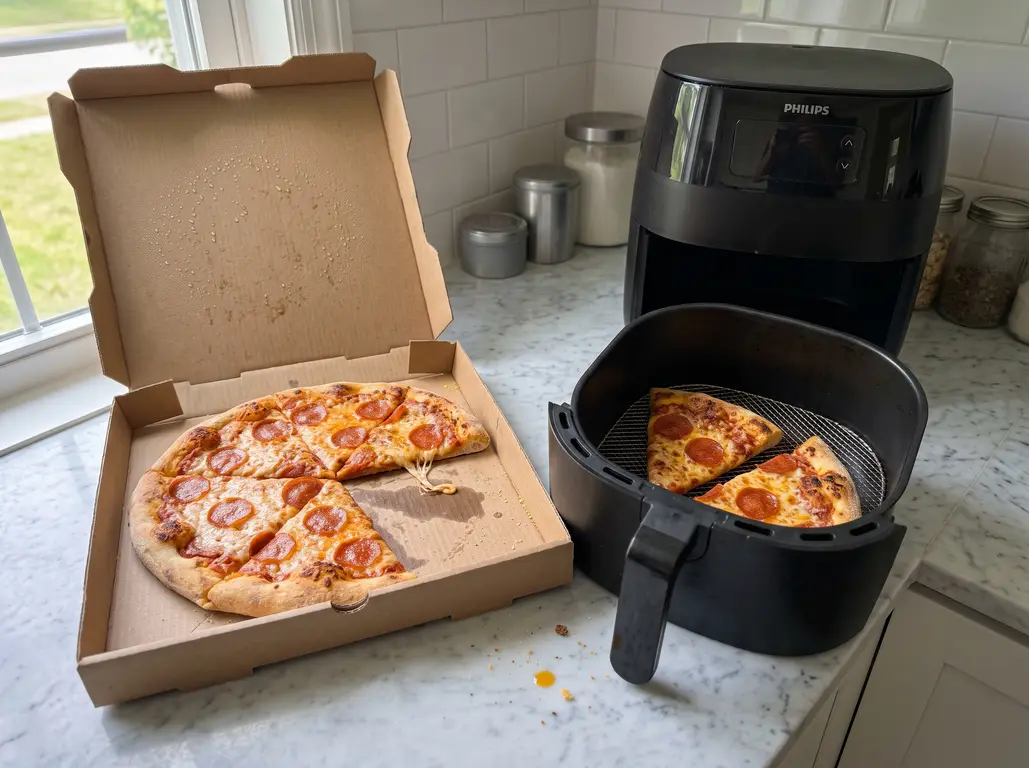
Why the slice comes back better than it went in
Cold pizza crust is not just cold, it is stale, and the distinction is the whole page. Overnight in the fridge, the gelatinized starch in the crust recrystallizes and squeezes its water out into the crumb, a process called starch retrogradation, and it is why a refrigerated slice turns leathery even inside an airtight container. Here is the useful part: retrogradation partially reverses when the starch is reheated past roughly 140°F. Warm the slice through and the crumb genuinely un-stales.
Every reheating method crosses 140°F. What separates them is what happens to the water on the way. A microwave excites that water where it sits, so the crust softens into steam-limp leather the moment it cools. An oven works, slowly, while the slice dries out waiting for the box to preheat. The air fryer crosses the line in about three minutes with dry moving air scrubbing moisture off the surface the entire time, so the crumb re-softens while the undercrust dries and crisps against the hot basket. That combination, warm crumb under dry crust, is a texture the slice did not have when it arrived, because it spent its delivery ride steaming in a closed box. The reheat is not a recovery. It is an upgrade.
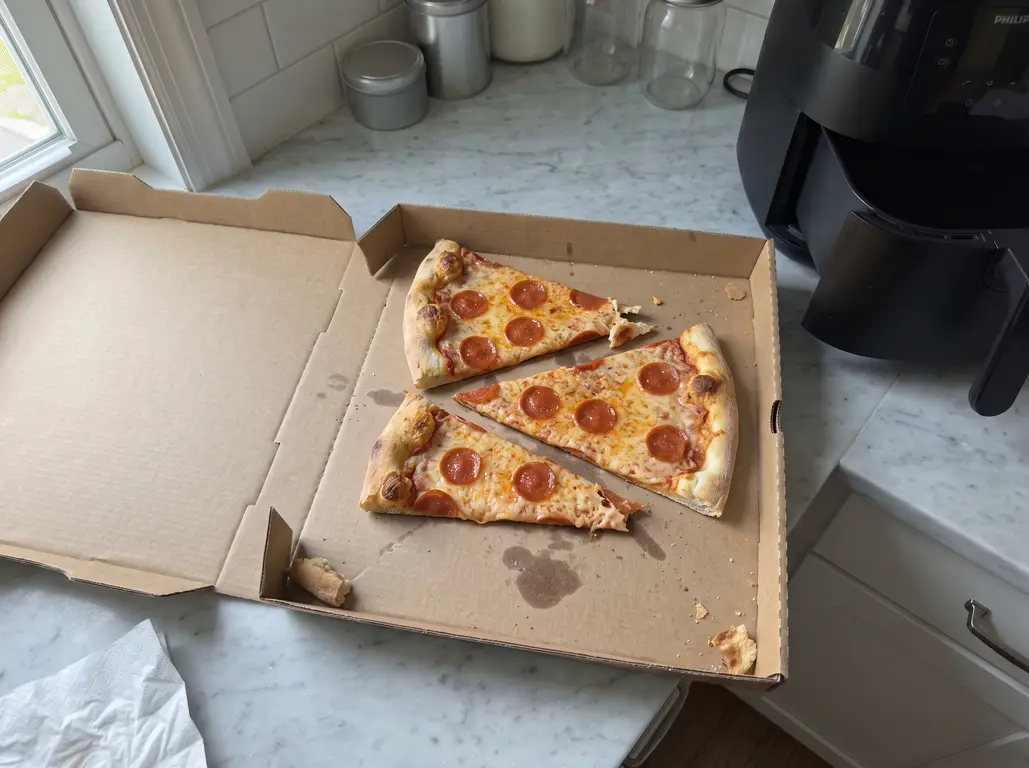
The method, four steps
- Preheat, 350°F, 3 minutes. Non-negotiable on a job this short. The whole run is barely 3 minutes, and a machine that spends those minutes warming up gives you a steamed slice, not a crisped one. The case for those three minutes is the same one the preheating guide makes for short bakes.
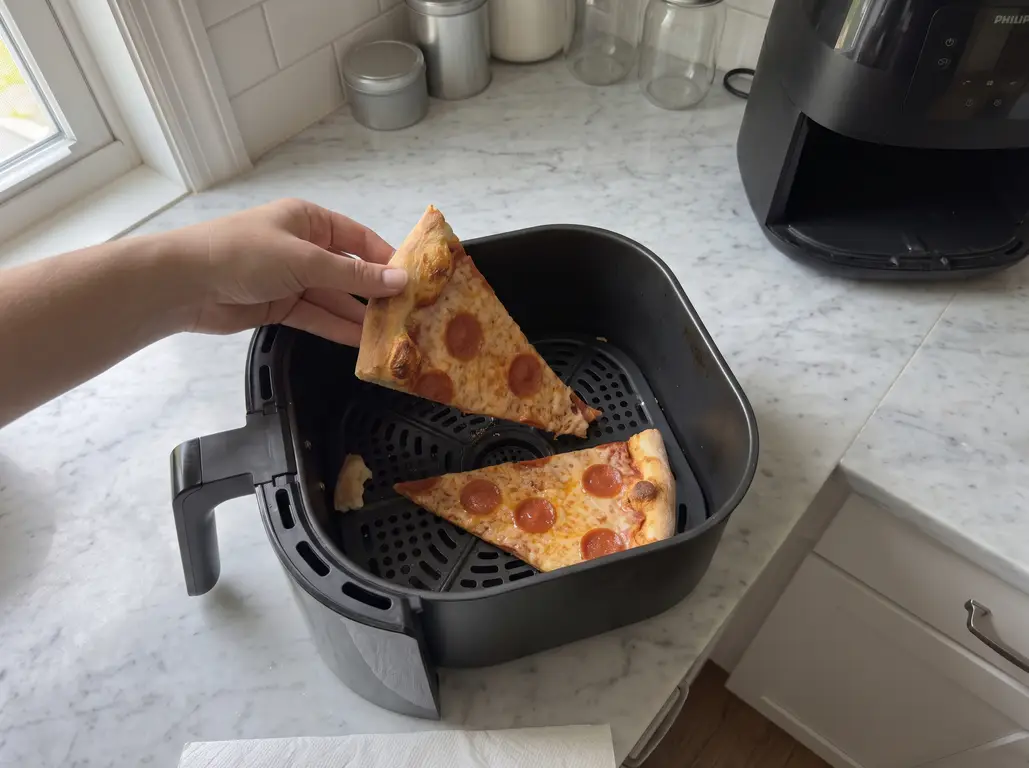
- Slice straight from the fridge, straight onto the basket. Cold is fine here. A pizza slice is thin, so it warms through long before the surface overbrowns; the room-temperature rest that reheating fried chicken rightly insists on is a thick-food rule, and a slice is not thick food. No plate, no liner, single layer with a finger of space between slices, so the perforations can feed hot air to the undercrust.
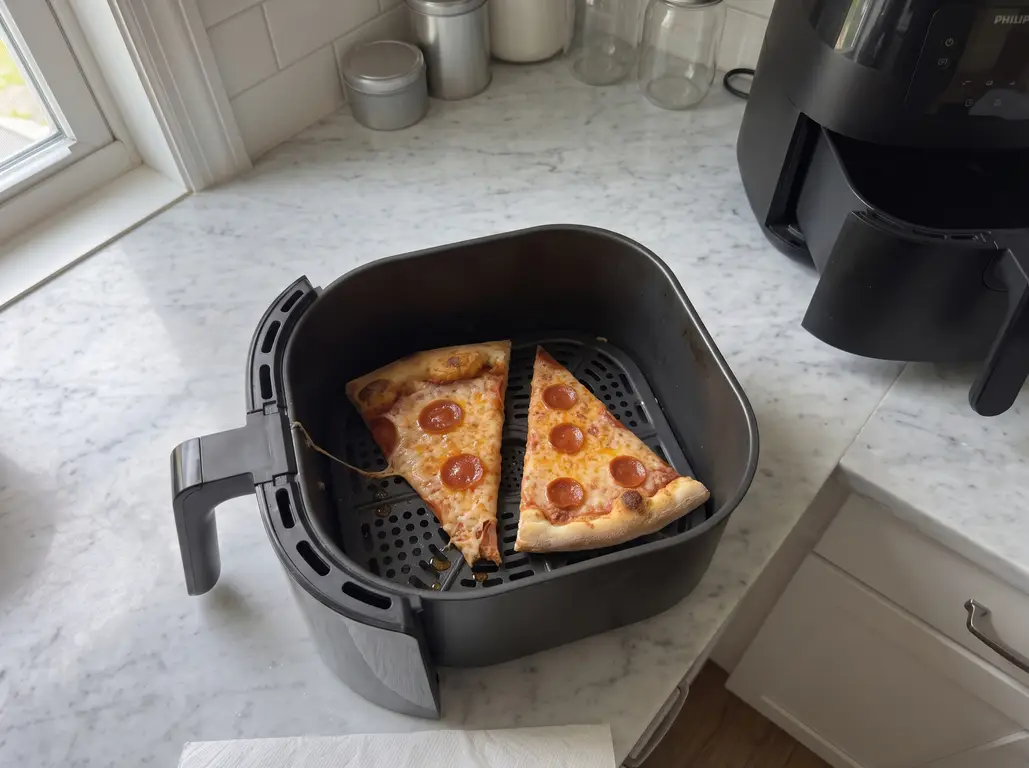
- 3 to 4 minutes at 350°F. Check at 3. Done is visible: the cheese has a fresh shine with the first bubbles at the edges, and a spatula slid under the slice meets a surface that scrapes rather than folds. If the edge is racing ahead of the middle, drop to 325°F and give it the extra minute.
- Rest 30 seconds before you lift it. Molten cheese slides off a moving slice. Half a minute sets it enough to survive the trip out of the basket, and the crust loses nothing.
The one-sentence version: preheated 350°F, cold slice straight on the bare basket, 3 to 4 minutes, 30 second rest. Everything below is the adjustment table for pizzas that are not a standard slice.
Time and temperature by pizza style
These are the settings from my own basket, a 5.5 quart, all preheated 3 minutes. Styles are ordered from fastest to slowest, which is also thinnest to thickest, because in a reheat the only variable that really matters is mass.
| Pizza | Setting | Time | What matters |
|---|---|---|---|
| Thin crust, tavern cut | 350°F | 2-3 min | Check at 2; there is no crumb to warm, only crust to crisp |
| New York or hand tossed slice | 350°F | 3-4 min | The standard. Foldable when it arrived, crisp when it comes back |
| Party slice at room temperature | 350°F | 2-3 min | Half the job is done; it only needs the crust rebuilt |
| Pan, Detroit or Sicilian square | 325°F | 4-5 min | Thick crumb needs the gentler ramp or the top dries first |
| French bread pizza | 350°F | 4-5 min | It is toast underneath; it reheats better than it bakes |
| Stuffed crust | 325°F | 5-6 min | The rim is a cheese pipe that must melt again, not just warm |
| Deep dish, Chicago style | 300°F | 6-8 min | A casserole in a crust. Tent the rim if it browns early; finish with 1 min at 375°F for the bottom |
| Leftover slice, frozen | 350°F | 5-6 min | Straight from the freezer, never thawed; thawing is where soggy starts |
| Calzone or stromboli | 325°F | 5-6 min | Sealed crumb heats like a loaf; give the middle time |
If your leftover came with oven reheating directions instead, the air fryer calculator converts any oven temperature and time to basket settings, and the browning logic behind every row here is laid out in how to make bakes crispy in an air fryer. Cooking a frozen pizza from the store is a different job with its own chart: air fryer frozen pizza covers it brand by brand.
The delivery box problem
The saddest pizza is not the three-day-old slice, it is the one that arrived twenty minutes ago. A closed cardboard box is a steam room: the pizza's own heat evaporates water that has nowhere to go, so it condenses back into the crust, and the slice that left the shop crisp arrives pliable. This is why the reheat can genuinely beat delivery condition, and it is also a fixable problem in real time. A box-softened, still-warm slice needs only 2 minutes at 350°F to shed the steam it absorbed in transit. Two slices in the basket while the plates come out, and the pizza tastes like you picked it up at the counter.
Two things stay out of the basket. The cardboard, always; it is kindling sitting under a heating element. And the whole unboxed pizza balanced across the basket rim: if it does not lie flat on the basket floor, cut it and run batches. A slice that blocks the airflow entirely just steams in a more expensive box.
Toppings triage
The crust rules never change, but toppings have opinions, and thirty seconds of triage before the basket saves most of the reheating failures that get blamed on the machine.
Fresh finishes
Basil, arugula, prosciutto, a ricotta dollop, hot honey. Lift them off, reheat the slice, put them back. Thirty seconds under a fan wilts what a wood oven was careful never to touch.
Wet vegetables
Fresh tomato, pineapple, mushrooms that have sat overnight. Blot with a paper towel first; they shed water while reheating and the puddle lands on the crust.
The cured and the melted
Pepperoni re-crisps into cups better than it managed the first time, sausage and bacon are unbothered, and the cheese itself only asks for the 30 second rest before you lift.
Extra-cheese slices deserve one honest sentence: the more cheese, the more the surface can slide, so give loaded slices the full rest and lift them with a spatula rather than fingers and hope. If a stray edge of cheese lands on the basket floor anyway, it smokes on the next run; a wipe between batches costs ten seconds, and the bakeware cleaning guide handles anything that welded on.
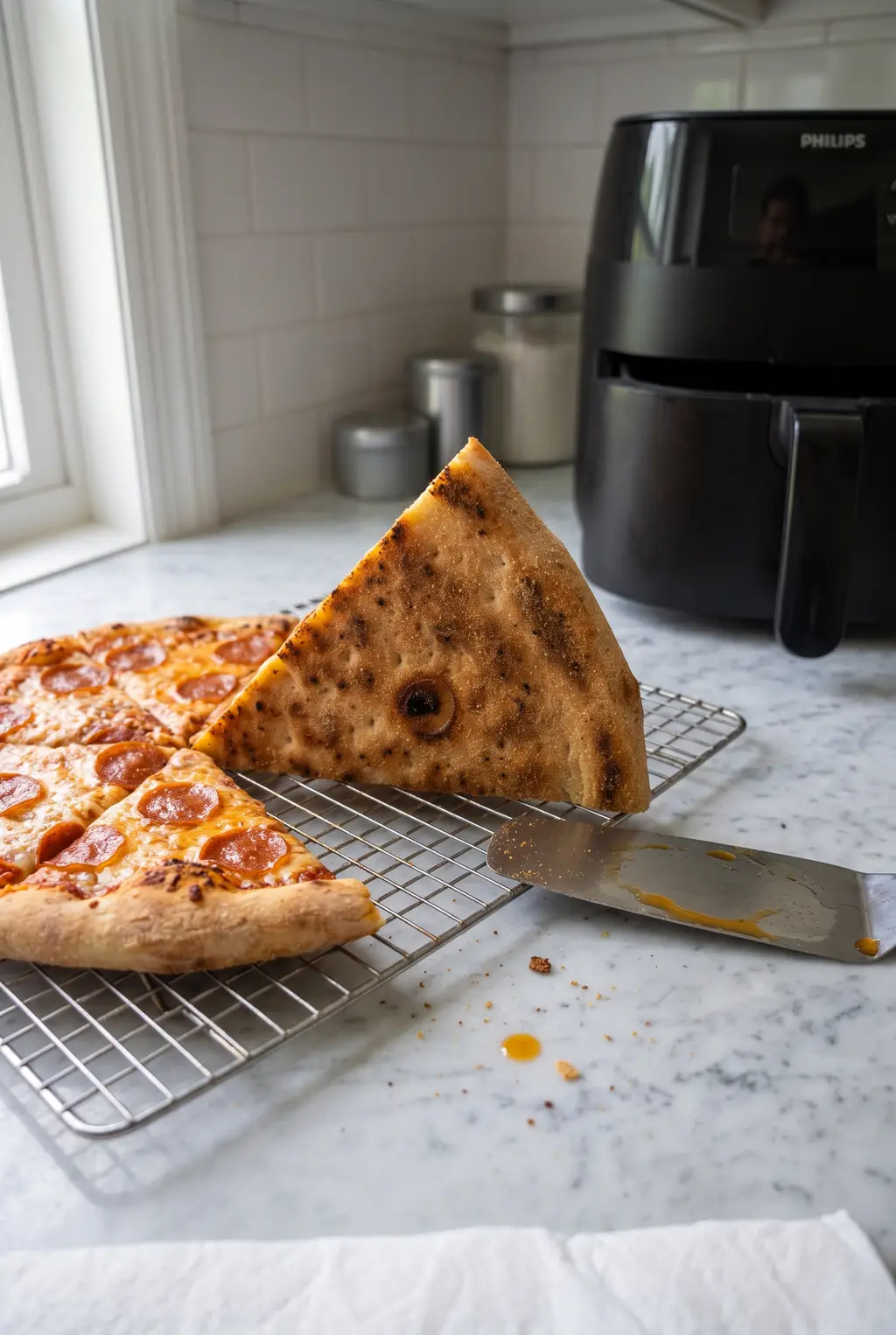
Against the oven, the skillet and the microwave
Honest scoring, because two of these methods have real cases.
| Method | Time, real | Result | When it wins |
|---|---|---|---|
| Air fryer | 6-7 min with preheat | Crisp bottom, melted top, warm crumb | One to six slices, which is almost every reheat that ever happens |
| Skillet, lidded | 8-10 min | Excellent bottom, top depends on the lid trapping enough heat | No air fryer in the house; the best of the stovetop options |
| Oven at 400°F | 18-20 min with preheat | Very good, slightly drier from the wait | A whole pizza or more, when batching would take longer |
| Microwave | 90 sec | Hot for two minutes, then leather | It does not. If it is the only option, 50 percent power with a mug of water beside the slice limits the damage |
The oven row also loses on the meter: heating a full-size oven for 20 minutes to warm two slices is the exact scenario the running cost calculator was built to price, and the number is not close. All four of the site's tools live on one page.
Reheating more than two slices
A 5 to 6 quart basket takes two full slices flat, three if the points meet in the middle. Past that, run batches back to back rather than stacking, and use the machine's own physics: the second batch runs 30 to 60 seconds faster than the first because the basket is fully heat-soaked, the effect our glossary files under recovery time. A whole large pizza is three quick batches, about 12 minutes end to end, which still beats the oven's preheat.
Two details make batching seamless. Park finished slices on a wire rack, not a plate; a hot slice on a cold plate sweats, and the sweat undoes the crisp you just built, the same soggy bottom mechanism that ruins cooling bakes. And if your machine is an oven-style with racks rather than a basket, you can run four to six slices in one pass, swapping racks halfway; the trade-offs between the two formats are the subject of basket versus oven-style.
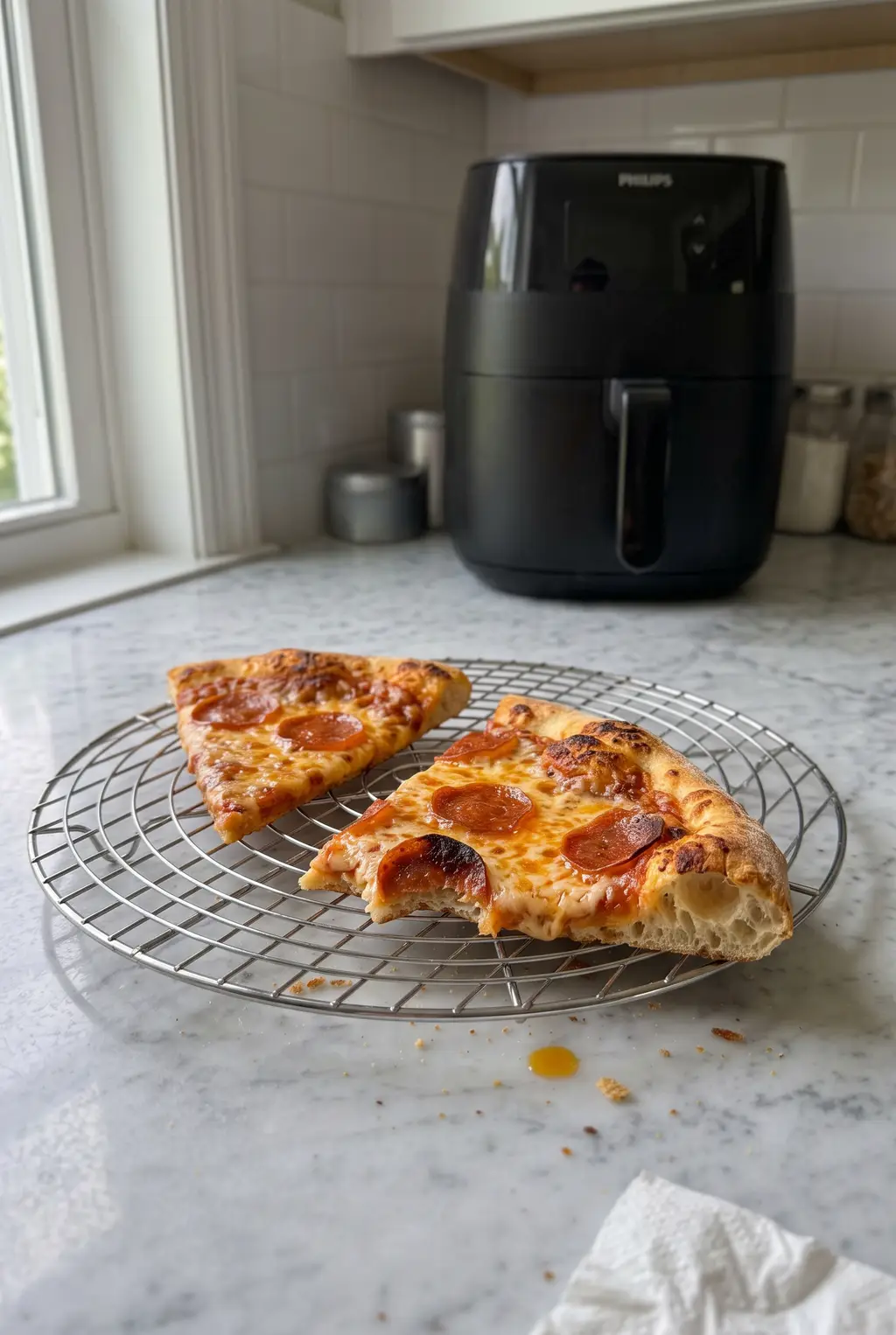
When it goes wrong
| What happened | Why | The fix |
|---|---|---|
| Edges burnt, center cold | Too hot for the slice's thickness | Drop to 325°F and add a minute; for deep dish, 300°F and patience |
| Bottom still soft | A liner or plate blocked the airflow | Bare basket. The undercrust crisps by contact with hot perforated metal |
| Slice dried out | Overshot the time, usually on thin crust | Thin crust is a 2 minute job; set the short timer and trust it |
| Cheese slid off | Lifted while molten | The 30 second rest; then a spatula, not tongs |
| Machine smoked | Old cheese or grease on the drawer floor | Wipe between batches; the full diagnosis is in why your air fryer smokes |
| Toppings scattered | Light toppings under a strong fan | Anything the fan can lift, it will; press loose toppings into the cheese or take them off |
One boundary worth stating: this page is about bringing cooked pizza back. If what you actually have is dough, that is a better problem to have, and air fryer pizza dough is its page. And if the slice needs a side, garlic bread runs at nearly the same setting while the second batch rests. The other takeout leftovers get the same preheated basket treatment: reheating fries and reheating rotisserie chicken, tenders and nuggets each have their own page.
Frequently asked questions
QHow long do you reheat pizza in an air fryer at 350?
3 to 4 minutes for a standard hand-tossed or New York style slice, in a preheated machine, single layer, straight on the basket. Thin crust runs 2 to 3 minutes, pan and Sicilian styles 4 to 5 at 325°F, and deep dish needs 6 to 8 minutes at 300°F so the middle warms before the edge browns. Start checking a minute early the first time; machines vary more than pizzas do.
QDo you need to preheat the air fryer to reheat pizza?
Yes, and it matters more here than on long cooks. A reheat is only 3 minutes, so a cold machine spends the entire run coming up to temperature and the slice steams instead of crisping. Three minutes at 350°F while you get the pizza out of the fridge is enough, and the slice goes into heat that starts working on the crust immediately.
QShould I put foil or parchment under the pizza?
For the crispest bottom, nothing. The slice sits directly on the basket, where the perforations let hot air reach the undercrust, and that contact is most of what this method does better than an oven rack. A liner is fine if your basket is prone to sticking or you hate cleanup, but expect a softer bottom; every liner blocks some airflow, paper more than perforated parchment.
QCan you reheat frozen leftover pizza without thawing it?
Yes, and you should. A slice frozen after cooking goes straight from freezer to basket at 350°F for 5 to 6 minutes. Thawing first only gives condensation time to soak the crust. Wrap slices individually before freezing so they do not weld together, and eat them within a month.
QWhy is an air fryer better than a microwave for pizza?
The microwave heats the water inside the slice, which turns the crust to steam-softened leather about ninety seconds after it stops. The air fryer heats the surface with dry moving air, so moisture leaves the crust instead of moving into it. One method makes the bread problem worse, the other reverses it. The microwave is faster by about two minutes and worse by any other measure.
QCan you reheat pizza twice?
Once is the honest limit for quality, and food safety agrees. Each pass through the fridge and the heat dries the crumb and gives bacteria another trip through the warm zone. Reheat only the slices you will eat, which is easy in an air fryer because it handles one slice as well as three.
QWhat is the best way to reheat deep dish pizza in an air fryer?
Low and patient: 300°F for 6 to 8 minutes, because a deep dish slice is a casserole wearing a crust and the middle needs time. If the top edge browns before the center warms, tent a small piece of foil over the exposed crust rim. A final minute at 375°F re-crisps the bottom once the middle is hot.
QHow long does leftover pizza last in the fridge?
3 to 4 days in an airtight container, with parchment between stacked slices so the cheese does not glue them together. Pizza with meat toppings should come back to 165°F inside when you reheat it, which a 350°F run hits comfortably. Past day four, the box is a science project and the answer is no.
QCan you stack pizza slices in the air fryer?
No. The top slice shields the bottom one, the bottom one steams the top one, and both come out worse than the microwave would have managed. A 5 to 6 quart basket takes two slices, maybe three points-to-the-middle. Run batches instead; the second batch is faster because the machine is fully hot.
Made it? Rate it.
Never overbake again
Get our one-page times & temps cheat sheet, plus a new tested recipe each week.
No spam · unsubscribe anytime