

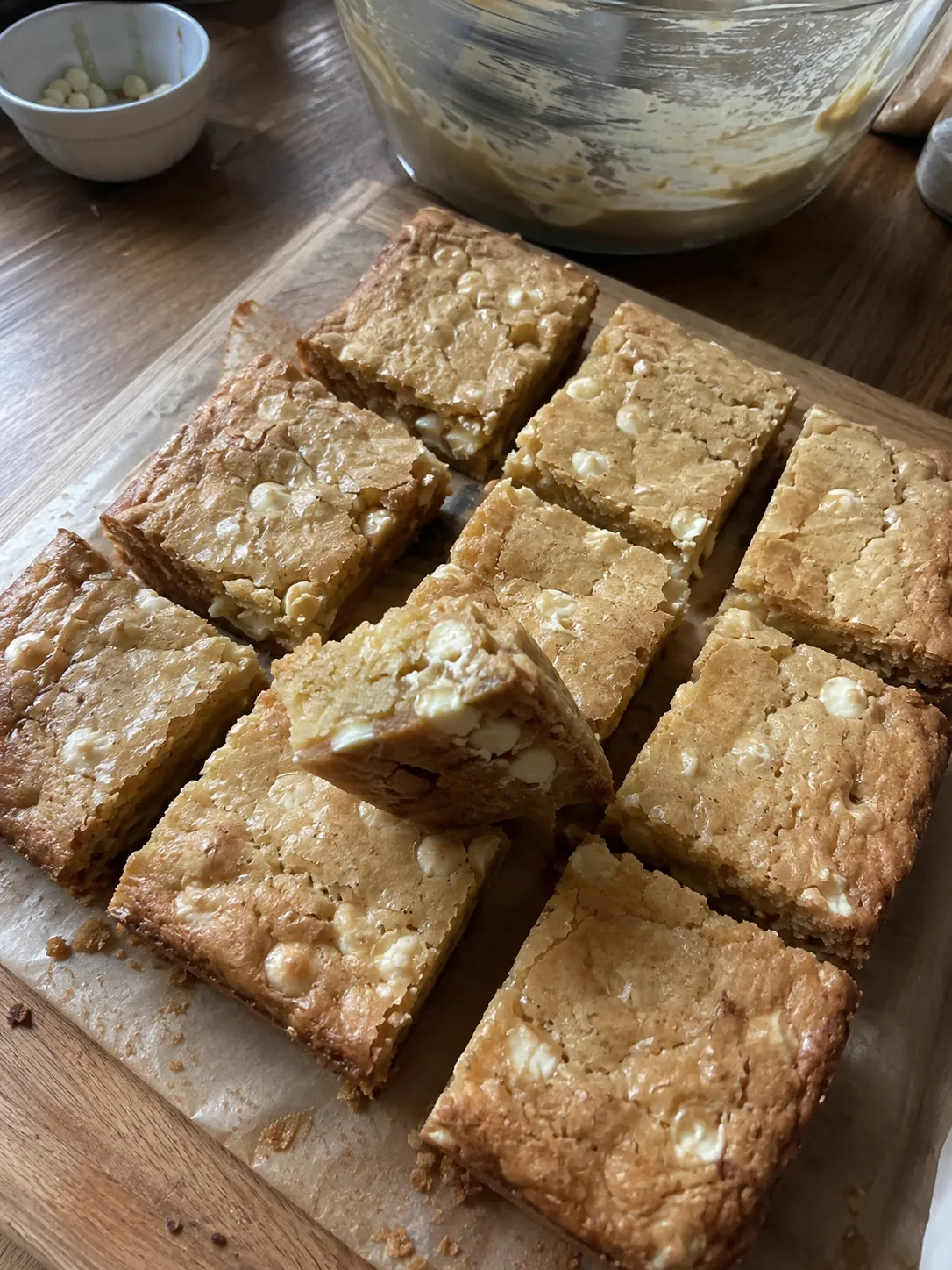
Search for this recipe and the results are a strange crowd: two British sites working in grams and Celsius, a candy company's social posts, and a diet site making blondies out of chickpeas. Nobody has written the actual page, which would be an American blondie, in cups, built for a basket, with an answer to the one question blondies actually pose.
That question is not the recipe. The batter is genuinely one bowl and ten minutes, closer to a cookie dough than a cake. The question is when to stop, because a blondie is the one bake in a basket where everything you normally trust tells you the wrong thing.
Quick answer: Melted butter and all brown sugar, one bowl, into a parchment-lined 6-inch pan. Bake at 320°F for 18 to 22 minutes, lay foil over the top once it turns golden around minute 12, and pull when the center reads 165 to 175°F on a thermometer, while it still looks underdone. It sets as it cools, and cutting before it is fully cool is how squares become spoonfuls. Oven recipes say 350°F; in a basket that number is how you get a dark lid over raw batter.
The doneness trap, and why it is worse in a basket
Every bake has a doneness test. The blondie is unusual because its two standard tests both fail, and they fail in the same direction.
- Your eyes fail because the top finishes first. This batter is a quarter brown sugar by weight, and surfaces that sweet start visibly coloring from around 250°F, a threshold the top crosses in the first third of the bake. Meanwhile the center, dense and wet, is barely moving. In an oven that gap exists; in a basket, with the element inches from the pan and air stripping moisture off the surface, it yawns. By minute 12 the top says done. It is not close.
- The toothpick fails because you are aiming for underdone. A fudgy center is the entire point of the bar, and a fudgy center clings to a toothpick forever. Bake until the toothpick comes out clean and you have baked the blondie out of the blondie: what is left is a pale, dry cake sheet. The toothpick has one honest use here, at the edge, where clean means the walls are set.
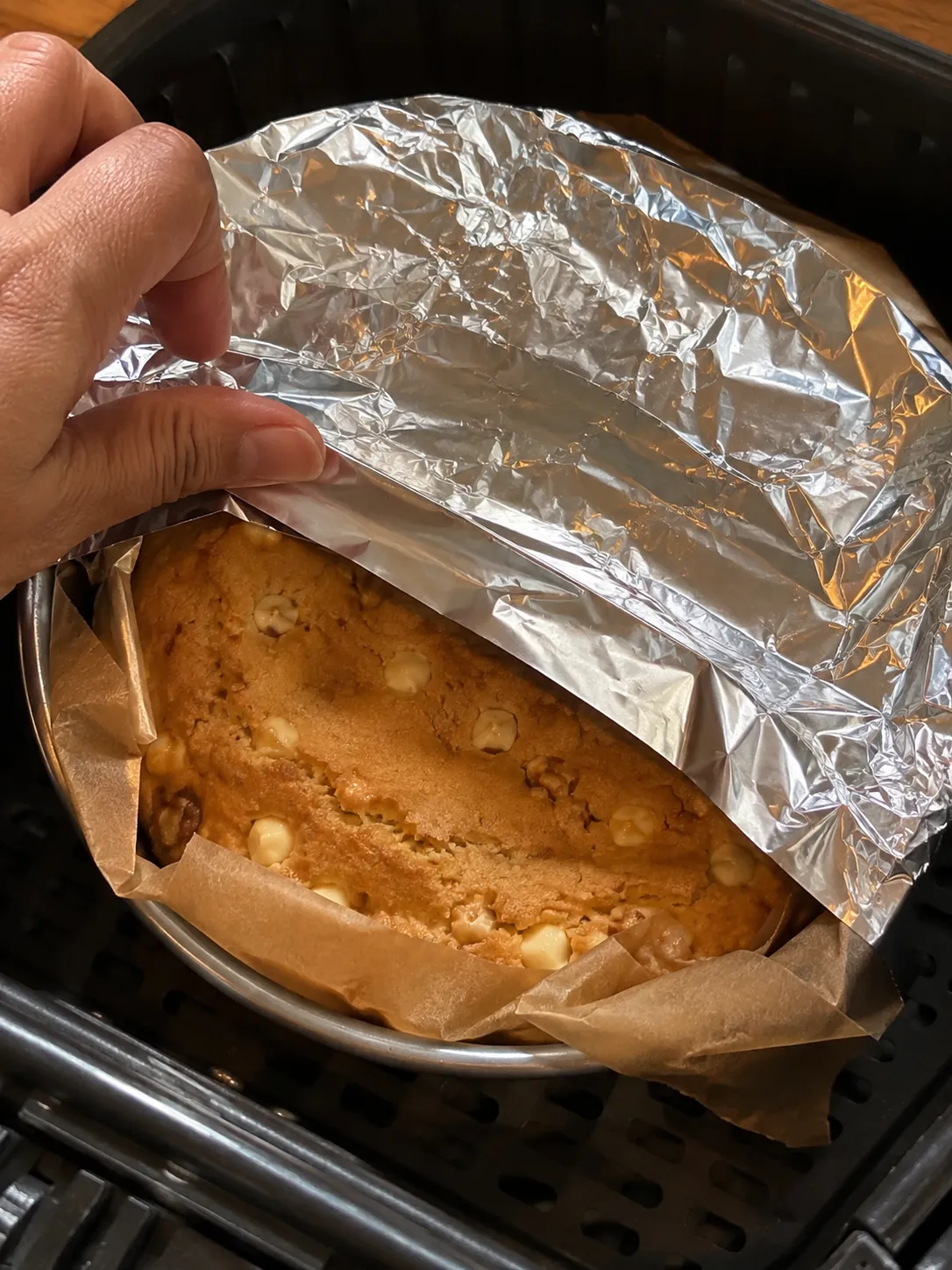
Two working defenses. The first is the foil tent at minute 12, which cuts the radiant heat to the top and lets the middle catch up under a lid that is already the right color, the same move our air fryer brownies lean on. The second is the number in the next section.
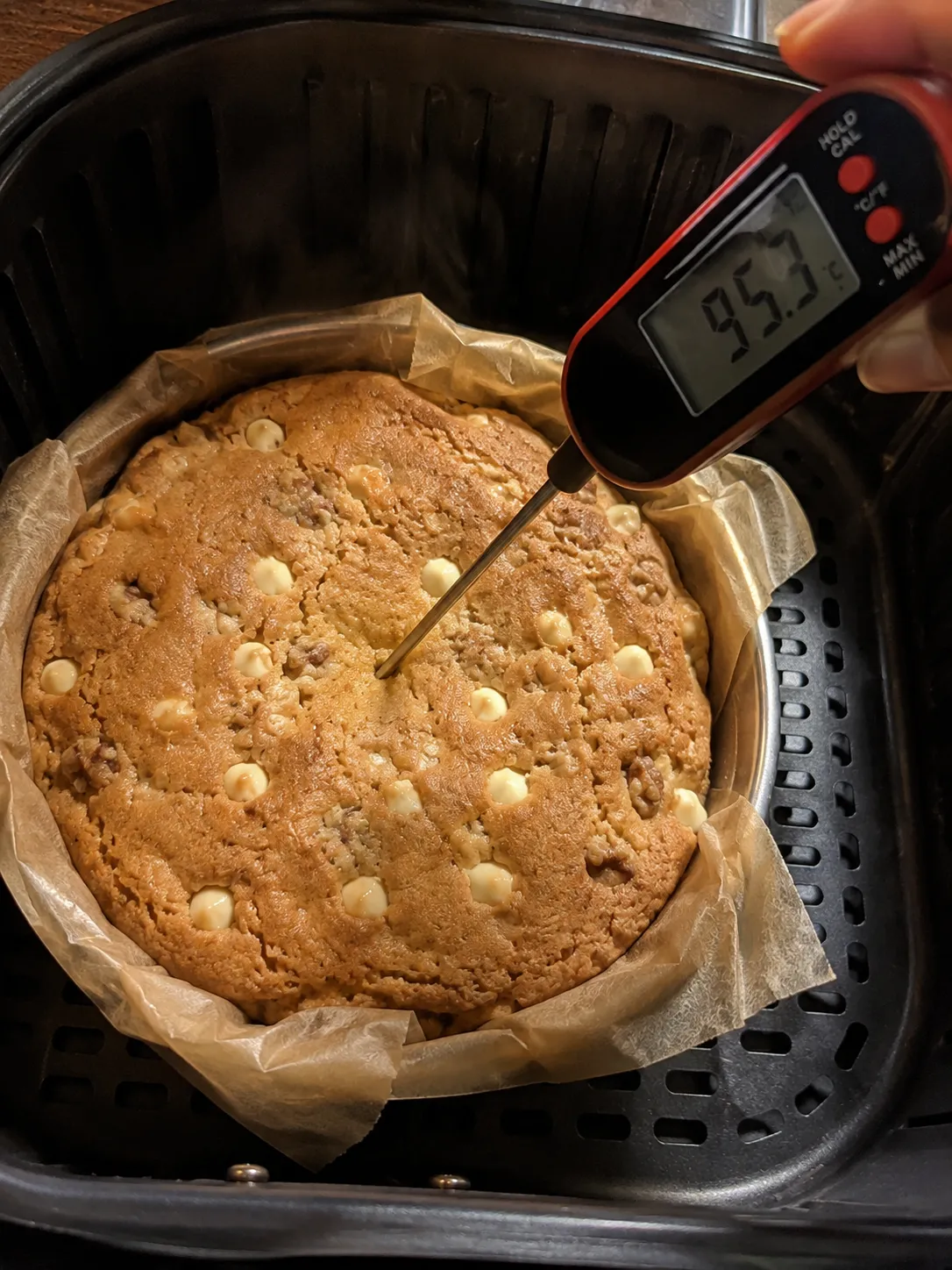
Chewy is a number: 165 to 175°F
Somewhere between raw batter and dry cake there is a window where the starch has set just enough to slice while the sugar is still dense and moist enough to chew. You cannot see that window from outside the bar, but a thermometer finds it in three seconds.
| Center reads | What you have |
|---|---|
| Under 160°F | Raw in the middle. It will not set even when cool. |
| 165 to 175°F | The window. Fudgy, chewy, slices clean once cool. Out. |
| 185°F | A soft cake bar. Pleasant, and no longer a blondie. |
| 200°F and past | Dry, pale, crumbly. This is where clean toothpicks lead. |
These are the same targets as our brownies, because the two bars are structural siblings, and they sit far below the 200°F we use for actual cakes, which is the whole difference between a bar and a cake in one number. The full set of internal targets for everything on this site is in the baking chart, and if a thermometer is not in your kitchen yet, this recipe and the brownies are the two strongest arguments for the ten dollars.
Melted butter, not creamed, and the five minute wait
If you have made our vanilla cake, forget its opening move here. Creaming softened butter with sugar whips in air, and air is the enemy: bubbles make the crumb rise and open, and an open crumb reads cakey. A blondie wants the opposite, so the butter goes in melted, stirred flat into the sugar with no air to speak of, which is most of why the batter takes one bowl and no mixer.
The wait matters as much as the melt. Butter straight off the heat is around 180°F, and three things go wrong when it meets the rest of the bowl at that temperature: the egg starts to cook into sweet scrambled flecks, the chips melt into smears instead of staying whole, and the emulsion breaks so the fat leaks out during the bake and settles into a greasy band at the base. Five minutes on the counter brings it to warm, and warm is safe for all three. Same principle as the cooled chocolate in our lava cake.
The egg follows the same anti-air logic: one whole egg plus a yolk, rather than two eggs. Whites are mostly water and they set into lift; yolks are fat and emulsifier. Trading a white for a yolk buys density and chew, the identical trade our coffee cake and bundt cake make for their own reasons.
All brown sugar, on purpose
Most blondie recipes split the sugar, some white for structure, some brown for flavor. This one goes all brown, a full packed cup, and the reasons are the recipe:
- Molasses is the flavor. A blondie has no cocoa to hide behind. Butter and brown sugar are the whole show, and diluting the molasses with white sugar dilutes the show.
- Molasses is the chew. Brown sugar is hygroscopic: it grabs moisture and holds it, which is what keeps the bar dense and bendy on day two instead of dry. White sugar sets crisp; brown sugar sets chewy. This is also why the bars genuinely improve overnight.
- Molasses is slightly acidic, which is why the quarter teaspoon of baking powder is there, a whisper of balance rather than lift. If a recipe calls for more leavening than that, it is quietly a cake.
- The price is a faster-browning top, because molasses colors earlier than plain sucrose. That is the trade that makes the minute 12 foil tent part of the recipe rather than a rescue.
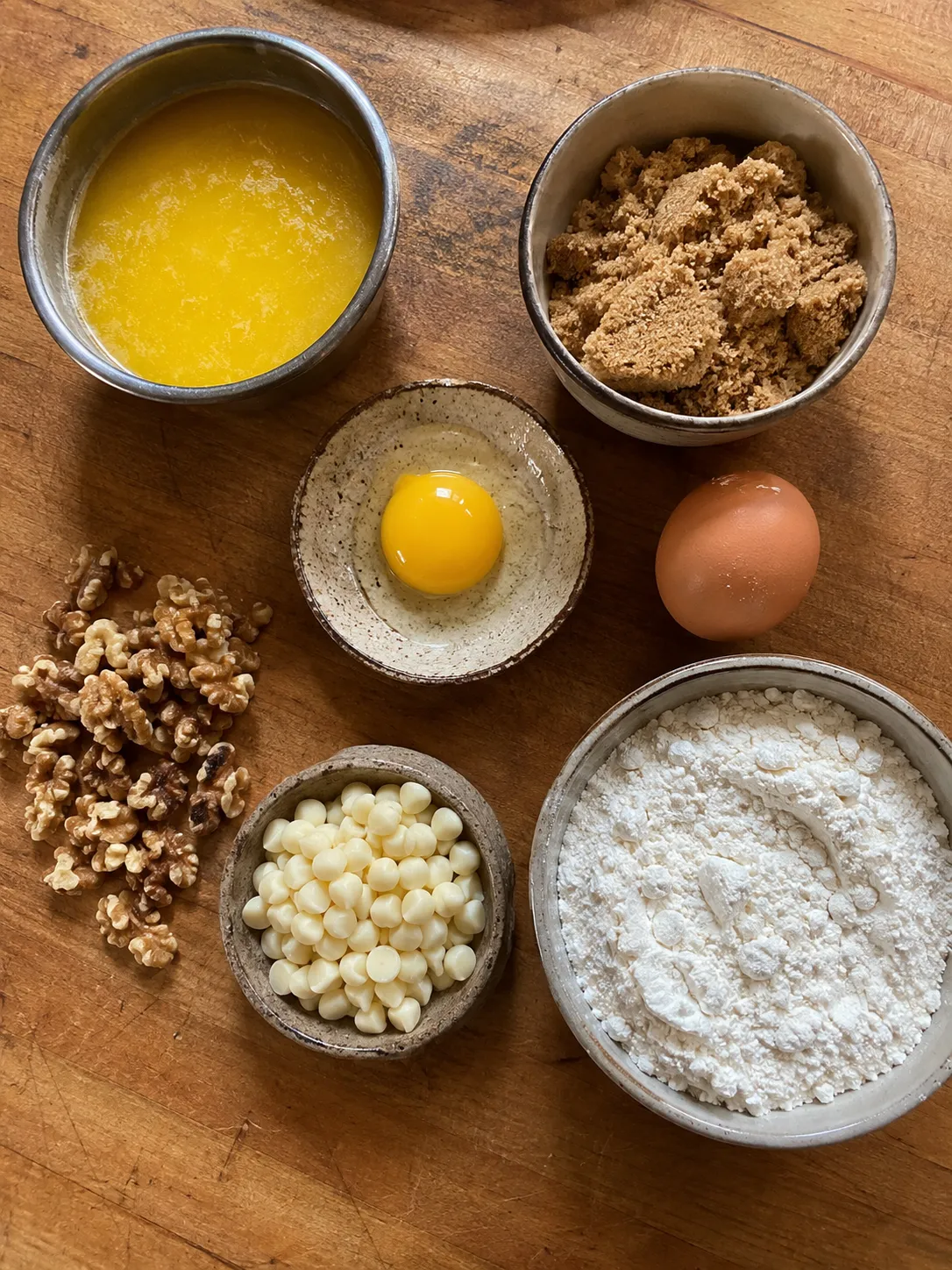
Ingredients
One 6-inch pan, nine squares. The butter is the only thing with a temperature requirement, and its requirement is patience, not planning.
- 1/2 cup (113g) unsalted butter, melted and cooled 5 minutes
- 1 cup (200g) light brown sugar, packed
- 1 large egg plus 1 yolk, room temperature
- 2 teaspoons vanilla extract
- 1 cup (125g) all-purpose flour
- 1/2 teaspoon salt
- 1/4 teaspoon baking powder
- 3/4 cup (130g) white chocolate or butterscotch chips
- Optional: 1/2 cup (60g) chopped walnuts or pecans
White chocolate chips are the classic and their sweetness suits the butterscotch base; butterscotch chips double down on it; chocolate chips turn the bar into what church cookbooks call a Congo bar, and no one has ever complained. The nuts are optional but they are doing real work, cutting the sweetness with bitterness and the chew with crunch. Toast them for 3 minutes in the air fryer first, the way our candied walnuts page toasts them, and they earn their place twice.
How to make them
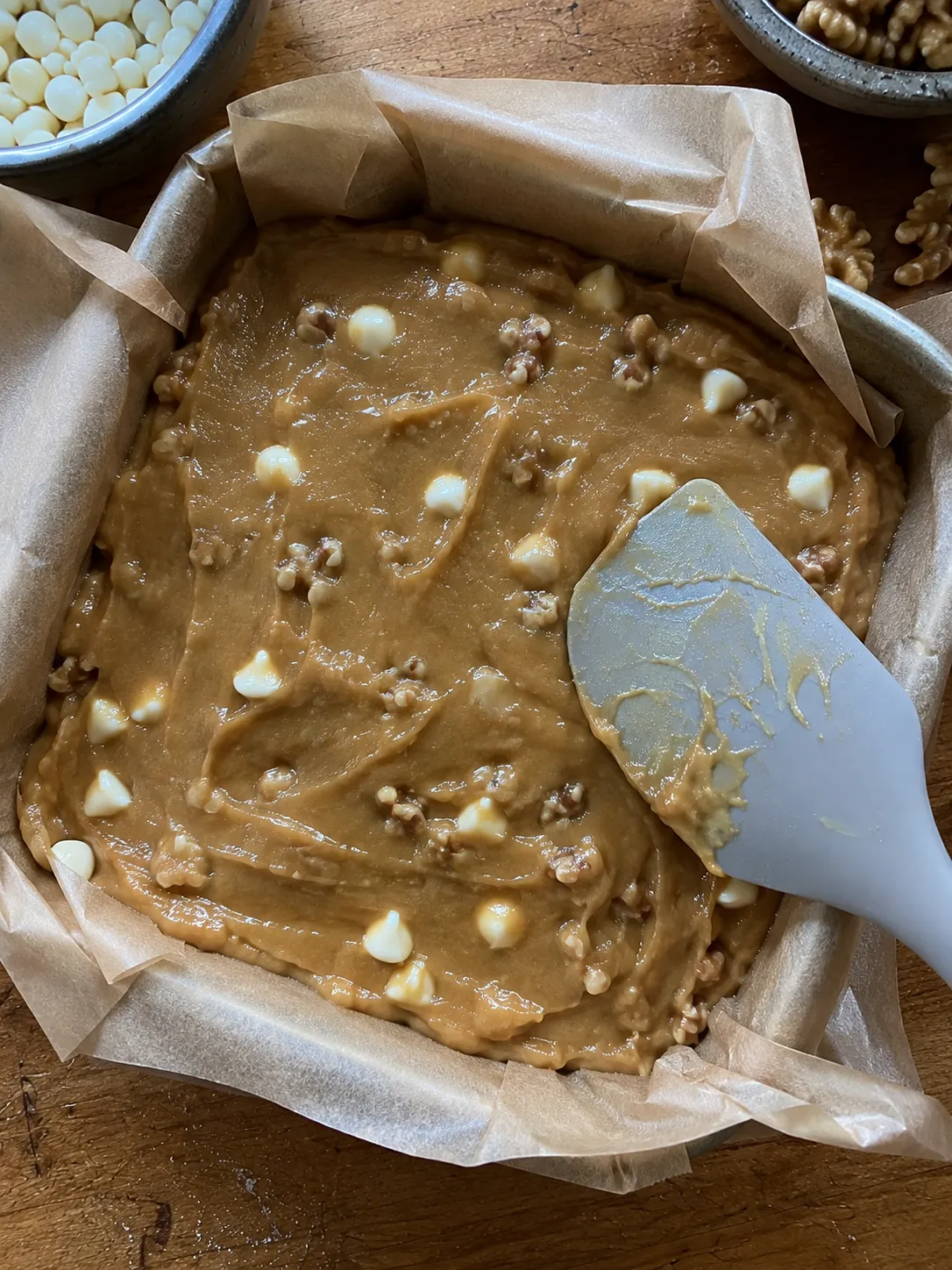
- Line the pan. A parchment sling overhanging two sides of a 6-inch pan, and a light grease on the exposed walls.
- Melt the butter, then wait 5 minutes. Hot butter scrambles the egg in step 4 and melts the chips in step 6. The wait is part of the recipe.
- Preheat to 320°F (160°C) for 3 minutes.
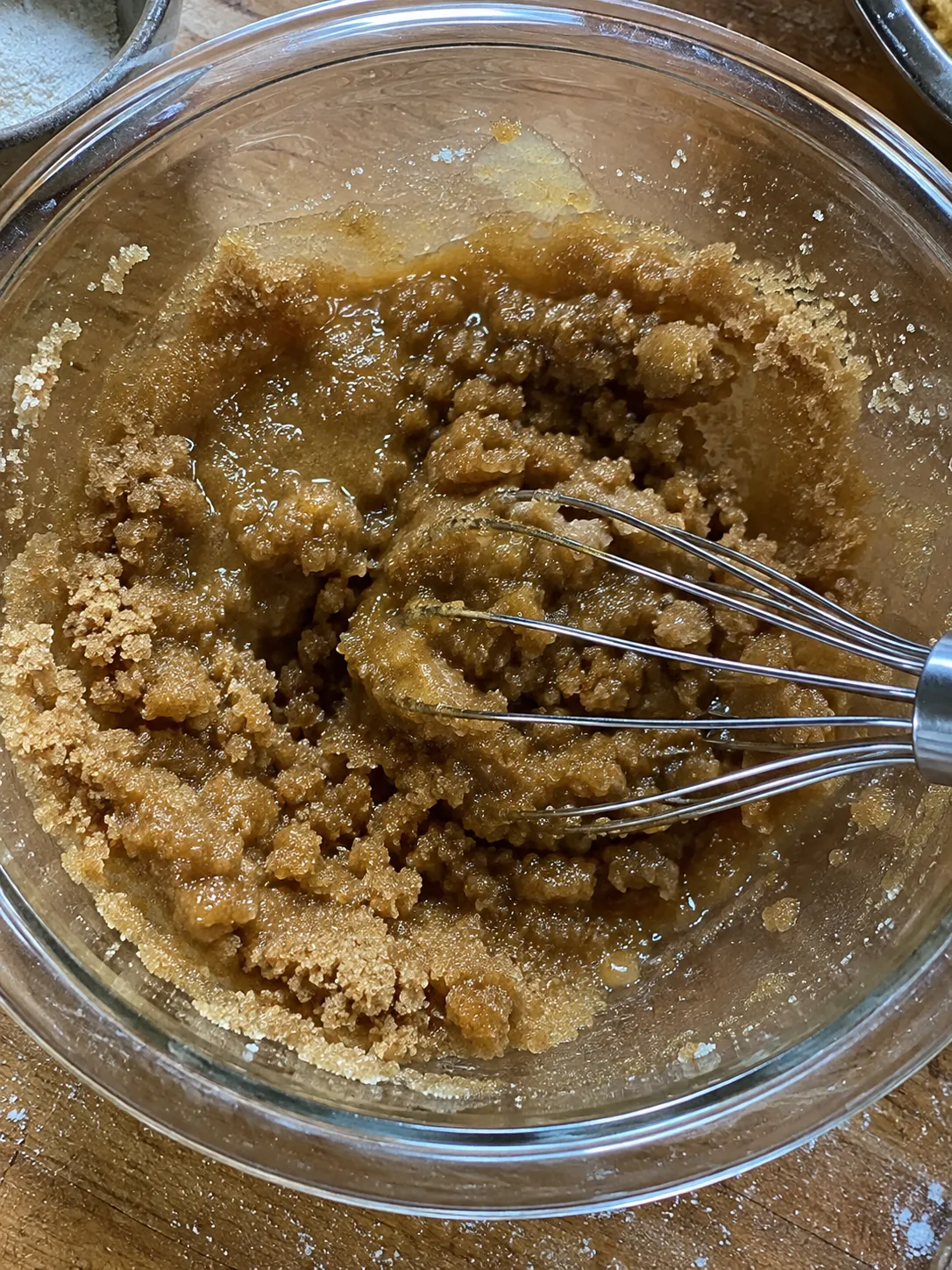
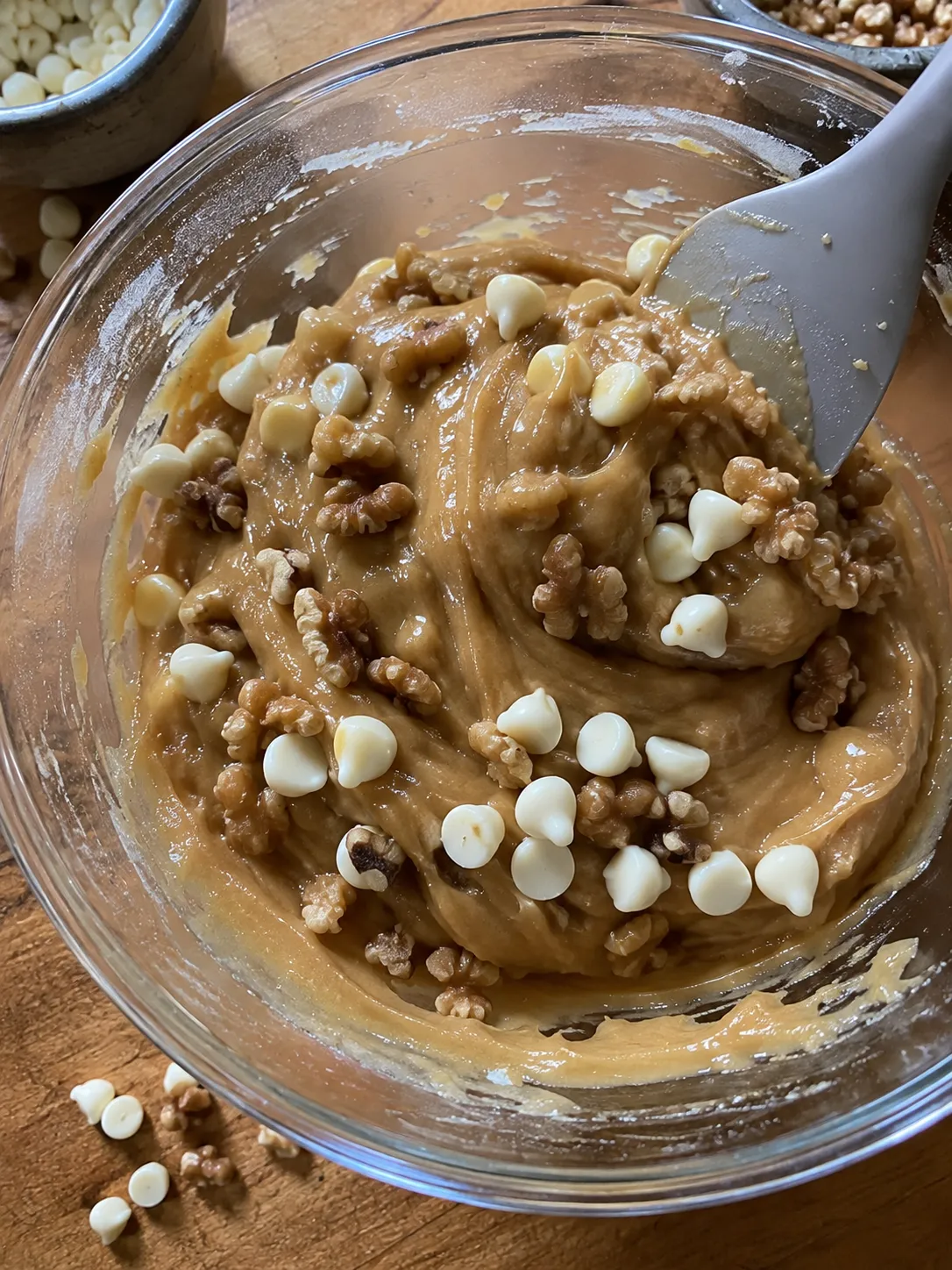
- Whisk the cooled butter and brown sugar for about 30 seconds, until glossy and combined. It will look like wet sand, not a fluffy cream, and that is the point.
- Whisk in the egg, the yolk and the vanilla until the batter turns smooth and slightly shiny.
- Fold in the flour, salt and baking powder with a spatula, stopping at the last streak of flour. Then fold in the chips and nuts.
- Scrape into the pan and level the top. The batter is thick and will not self-level, so push it into the corners.
- Bake 18 to 22 minutes at 320°F. Do not open the basket for the first 12.
- Check the top at 12 minutes. It should be golden already, and if it is heading past golden toward brown, lay foil loosely over the pan, pressed down at the rim.
- Start testing at 18 minutes. The center should read 165 to 175°F on a thermometer, and a toothpick two inches from the edge should come out with moist crumbs. The dead center will look and feel underdone. That is correct.
- Cool completely in the pan, at least 1 hour. Blondies finish setting on the counter, and cutting warm turns squares into spoonfuls.
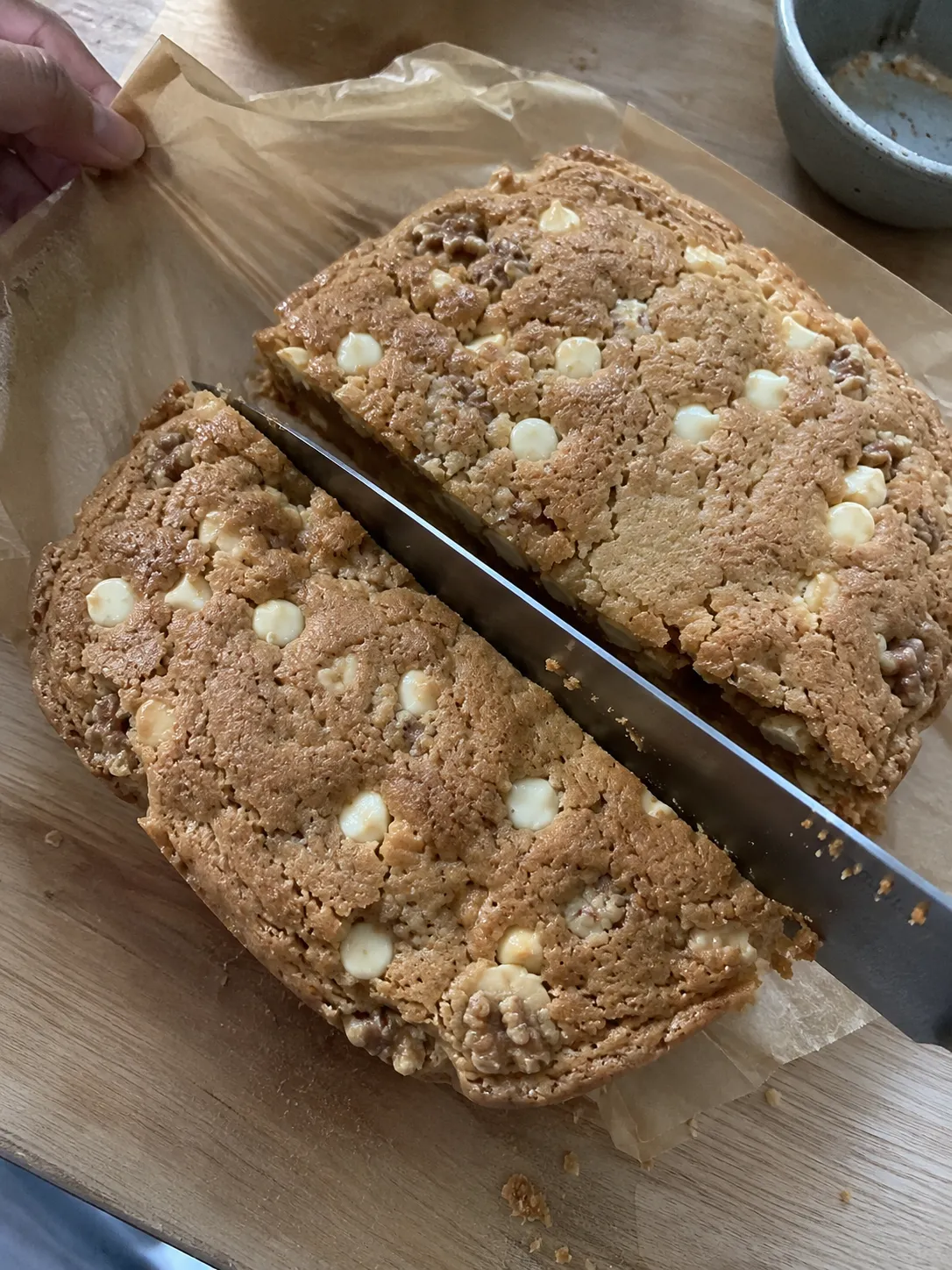
- Lift out with the sling and cut into 9 squares with a long knife, wiping the blade between cuts.
Why 320°F when every oven recipe says 350. The element in a basket sits inches above the pan, and moving air strips the insulating boundary layer that still oven air provides, so the same dial number cooks the surface a real 25 to 30 degrees harder. On most bakes that costs you evenness; on a bake whose entire failure mode is the top finishing early, it is the difference between a blondie and a lid of caramelized regret. If you are converting any oven bar recipe of your own, the air fryer calculator applies the drop automatically, and the conversion guide explains the rules it uses.
Pan size and scaling
| Pan | Batter | At 320°F | Notes |
|---|---|---|---|
| 6-inch square or round | The recipe as written | 18 to 22 min | Nine squares. The default |
| 7-inch round | As written, shallower | 15 to 19 min | Thinner bar, slightly more edge, earlier check |
| 8-inch square | Scale by 1.5 | 20 to 25 min | Only if your basket truly fits it with airflow |
| Doubled in a 6-inch | Do not | Never works | Depth grows, and conduction time grows with the square of depth |
The doubling row is the one that catches people. Twice the batter in the same pan is twice the depth, and the middle falls hopelessly behind a top that was already winning. Two batches back to back is the honest double, and the second batch runs a minute or two faster because the machine is heat-soaked. The recipe scaler resizes the quantities for any pan, and the pan size calculator tells you what your basket actually takes if you have never measured it.
Fixing what goes wrong
| What you got | Why | Fix |
|---|---|---|
| Dry, cakey, pale crumb | Overbaked, almost always while looking correct. | Pull at 165 to 175°F. The center should look underdone. |
| Dark top, raw middle | Oven temperature in a basket, or the tent never went on. | 320°F, foil at golden, and let the thermometer end the bake. |
| Greasy, dense bottom layer | Butter was too hot and the emulsion broke. | Five minute cooling rule, without exceptions. |
| Puffed up, then collapsed into a crater | Overmixed after the flour went in, or too much leavening. | Fold to the last streak and stop. A quarter teaspoon of powder, no more. |
| Fell apart at cutting | Cut warm. The set is not finished until the cool is. | One full hour in the pan. The sling makes the wait survivable. |
| Chips all sank to the bottom | Batter was warm and loose when they went in. | The same five minutes fixes this too. Thick batter holds chips in place. |
| Stuck to the pan walls | Sling covered two sides; the other two were bare. | Grease the exposed walls, or run a second parchment strip crosswise. |
A shallow settle in the middle as they cool is not on the list because it is not a fault: a fudgy center is heavy and it sits down as it sets. If failures like these follow you across bakes, the troubleshooting guide works symptom-first, and how to prevent burning covers the top-runs-hot family on its own.
Variations
- Brown butter blondies. The single best upgrade. Brown the butter to nutty and amber, then respect a longer cooling wait since it starts hotter. The nuttiness against the molasses is the grown-up version of the bar, and the same move our bundt cake pulls for the same reason.
- Congo bars. Chocolate chips instead of white, and suddenly it is 1955 in the best way. Load them further and you are in monster cookie territory.
- Maple walnut. Swap 2 tablespoons of the brown sugar for maple syrup and use toasted walnuts. The extra moisture buys a slightly longer bake, so trust the number, not the clock.
- Flaky salt top. A pinch scattered before baking. Costs nothing, improves everything, and makes the sweetness taste intentional. For the opposite move, a sugar coating rolled on before the bake, see snickerdoodles.
- Peanut butter swirl. Three spoonfuls dolloped and dragged once with a knife. Twice-swirled is mud, once-swirled is marbling.
- The half-batch question goes the other way here: this already is the small batch. For a true two-person portion, our mug cake is the five minute answer.
If bars are your genre, air fryer brownies are the chocolate sibling with the same internal targets, chocolate chip cookies are this flavor in cookie form at 325°F for 8 minutes, and air fried Oreos are what happens when the genre stops taking itself seriously. The full method behind all of it is how to bake in an air fryer.
The rest of the bar shelf splits by what sets the middle. Magic bars use condensed milk as the glue and need no batter at all, cheesecake bars set on a custard and finish in the fridge rather than the basket, and lemon bars pour a curd over a pressed base instead of mixing everything into one bowl. Brookies are the closest relative of all: the same pan, the same 320°F, two doughs stacked instead of one spread flat. Every one of them lives in the cookies and bars collection.
Storage and freezing
- Room temperature: 4 days airtight, and day two is the peak, once the molasses has finished pulling the crumb into full chew. This is a bake that rewards patience twice.
- Do not refrigerate. The fridge stales the crumb faster than the counter and mutes the butterscotch. The only refrigerator job here is none.
- Frozen: 3 months, cut into squares and wrapped individually. Thaw on the counter in an hour, or revive at 300°F for 2 minutes in the basket, which brings back the just-baked edge better than any microwave.
- Freeze the batter pressed into a parchment-lined pan, lift the frozen slab, wrap it, and bake from frozen in the same pan with 3 to 4 extra minutes. Fresh blondies on a weeknight for the cost of remembering you own them. The same make-ahead trade runs through refrigerated cookie dough.
- Day-old square, upgraded: 90 seconds at 300°F, then vanilla ice cream on top while it is warm. This outranks the fresh version and I will not be argued with.
Twenty minutes of basket time against heating a full oven for one small pan is exactly the kind of bake where the machine pays for itself, and the running cost calculator will put your own electricity rate on it. All four air fryer tools live in one place, and the full recipe index has everything else on the site.
Everything tested on this site is in the recipe index, and the technique pages behind the numbers, from dry bakes to preheating, are collected under guides.
Frequently asked questions
QCan you make blondies in an air fryer?
Yes, and a basket suits them unusually well, because a blondie is a small-batch bake by nature and a 6-inch pan is its right size. Bake at 320F for 18 to 22 minutes, which is lower than oven recipes because the element sits inches above the pan, and pull them when the center reads 165 to 175F on a thermometer. The one honest requirement is restraint: a blondie must come out looking underdone in the middle, and the machine makes the top look finished well before the middle is.
QWhat temperature and how long for air fryer blondies?
320F for 18 to 22 minutes in a 6-inch pan, checking the top at 12 minutes and tenting foil over it if it is browning past golden. Doneness is an internal number, not a look: 165 to 175F in the center for a fudgy, chewy bar. Oven blondie recipes run 350F, and that number carried into a basket is exactly how you get a dark top over a raw middle, since a basket cooks a real 25 to 30 degrees harder at the same setting.
QHow do I know when blondies are done in an air fryer?
Stop trusting your eyes and the toothpick, because both lie on this bake. The top looks done years before the middle is, since brown sugar surfaces color from about 250F while the center lags far behind. And a clean toothpick means overbaked, because you are aiming for a fudgy middle that will always cling crumbs. The reliable test is a thermometer in the center reading 165 to 175F. If you must use a toothpick, test two inches from the edge and look for moist crumbs, not clean.
QWhy are my blondies dry and cakey instead of chewy?
Almost always overbaking, and usually overbaking that looked correct at the time, because a blondie that looks done in the pan is past done on the plate. Pull at 165 to 175F internal and let carryover finish the set. The other cakey culprit is creaming softened butter with the sugar the way a cake recipe would: whipping air in builds a crumb that rises and dries. Blondies want melted butter stirred in flat, one egg plus a yolk rather than two whole eggs, and only a quarter teaspoon of baking powder.
QWhy did my blondies come out greasy or dense at the bottom?
The butter was too hot when the sugar and egg met it. Hot melted butter breaks the emulsion, and the fat separates out during the bake and settles into a greasy, dense band at the base. Melt the butter first thing and give it 5 minutes to cool to warm before anything touches it. The same 5 minutes protects the chips, which streak and smear through a hot batter, and the egg, which a truly hot butter will start to scramble outright.
QCan I use dark brown sugar instead of light?
Yes, and it pushes the bar deeper into butterscotch territory, since dark brown carries roughly twice the molasses. Two adjustments follow. The extra molasses browns faster, so expect to tent the top a minute or two earlier. And the flavor gets closer to gingerbread-adjacent richness, which is excellent with pecans and less flattering to white chocolate. Half light and half dark is a genuinely good middle path. What does not work is swapping in white sugar, which deletes the chew and most of the identity.
QDo I need to use a thermometer for blondies?
It is the difference between guessing and knowing, on the one bake where guessing fails most. The visual cues that work for cookies and cakes actively mislead here: the top finishes early and the correct center looks raw. A ten dollar instant-read settles it in three seconds at 165 to 175F for fudgy and chewy. Past 185F you have made a soft cake bar, and past 200F a dry one. If a thermometer is genuinely not happening, bake to 19 minutes, tent, trust moist crumbs at the edge, and accept the margin of error.
QCan I double this recipe in the air fryer?
Not in one pan. Doubled batter in a 6-inch pan is twice as deep, and conduction time grows with roughly the square of depth, so the surface is finished long before the middle sets, and no temperature adjustment rescues that geometry. Bake two 6-inch batches back to back instead: the second one runs a minute or two faster because the machine is fully heat-soaked. If you have an 8-inch pan and a basket that fits it, the recipe scales by about 1.5 times at the same temperature with a few extra minutes.
QWhy did the middle of my blondies sink?
A dip in the middle of a cooled blondie is normal and correct: a fudgy bar has a wet, heavy center that settles as it cools, and full-height middles belong to the cakey versions. A crater is different, and it means the center never set, either pulled well under 165F or baked in a pan bigger than the batter. Bake a few minutes longer next time, or check that the pan is genuinely 6 inches, because the same batter in an 8-inch pan runs shallow and behaves differently.
QCan I make these without the chips, or with different mix-ins?
The base is a true butterscotch bar on its own, and skipping the chips entirely makes what older cookbooks call a butterscotch brownie, which is the original article. Swaps that work: chopped pecans or walnuts toasted 3 minutes in the air fryer first, chocolate chips for a Congo bar, a swirl of peanut butter, or flaky salt on top before baking, which is the single best upgrade. Anything wet is riskier: berries and jam swirls add water to a batter whose chew depends on not having much.
QHow should I store air fryer blondies?
Airtight at room temperature for 4 days, and they are genuinely better on day two, once the sugars have fully settled into chew. Do not refrigerate, which stales the crumb faster and dulls the butterscotch. They freeze exceptionally well for 3 months, cut into squares and wrapped individually, and a frozen square thaws in an hour on the counter or revives in 2 minutes at 300F in the basket, which brings the edges back to just-baked. The batter also freezes, pressed into a parchment-lined pan, and bakes from frozen with 3 to 4 extra minutes.
QWhat is the difference between a blondie and a brownie?
Structurally they are siblings: melted fat, high sugar, low flour, minimal leavening, pulled underdone. The brownie's identity comes from cocoa, which adds starch and bitterness and hides overbaking behind a dark color. The blondie removes the cocoa and hands the flavor to brown sugar and butter, which is why it lives and dies by its molasses and why overbaking shows instantly as pale dryness. In the basket they are near-twins: our brownies run 320F for 15 to 18 minutes in the same class of pan, and the internal targets match.