

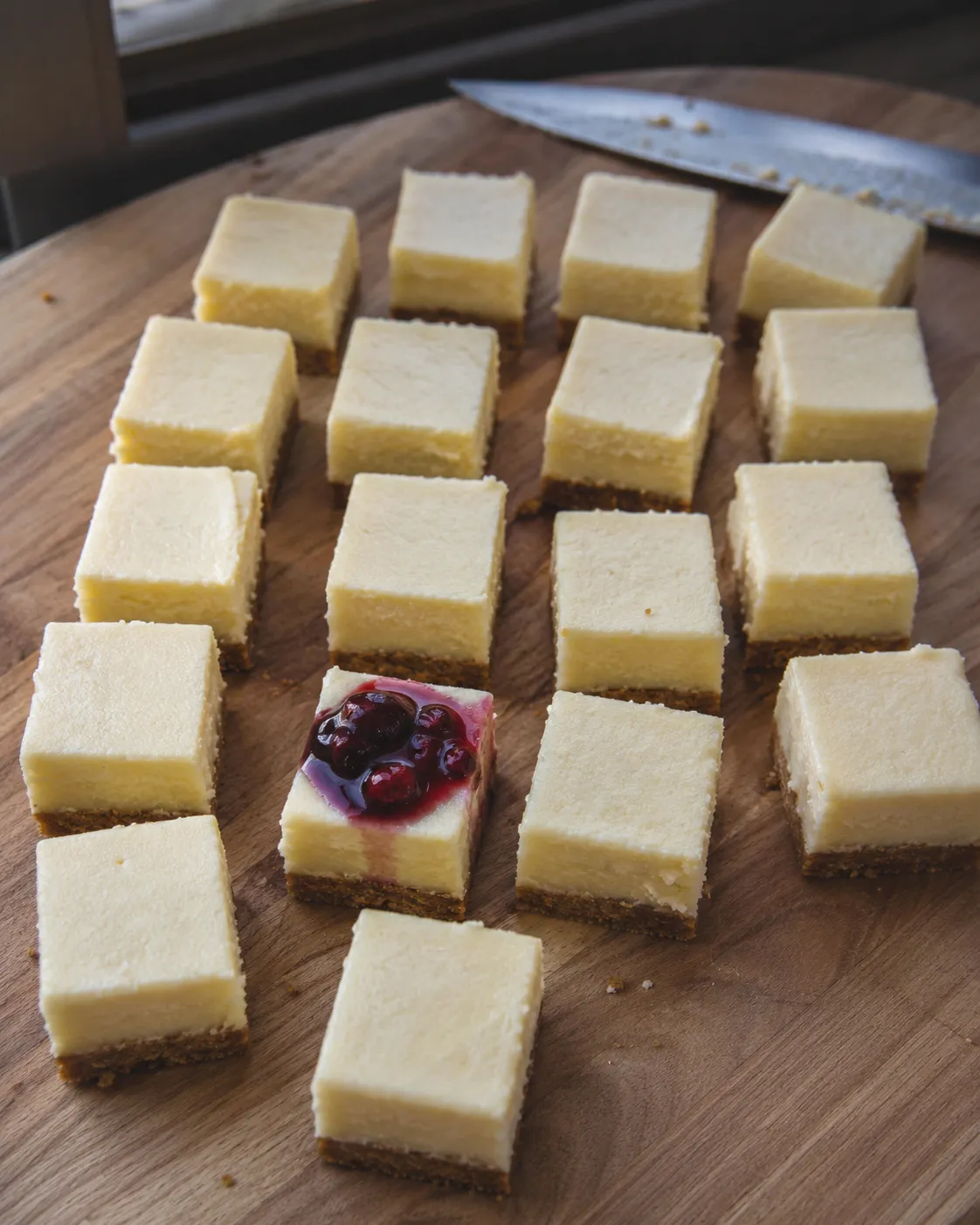
This site already has a full air fryer cheesecake, round and tall and worth its half hour, and mini cheesecakes for when portions should arrive pre-decided. The bars are the third format, and they exist because the other two answer different questions. The round answers a dinner party. The minis answer a bake sale. The bars answer the actual weeknight question, which is: can there be cheesecake in the refrigerator, in a form that cuts clean and gets eaten standing up, without any special equipment at all.
The answer is yes, and the bar format is genuinely easier than the round, not just smaller. Half the filling depth changes the physics of the whole bake in your favor.
Quick answer: Press a graham crust into a parchment-lined 7-inch pan and bake it alone at 300°F for 4 minutes. Beat the cream cheese smooth by itself before anything else joins it, add sugar, sour cream and vanilla, then the egg last on low speed. Pour over the crust and bake at 300°F for 16 to 20 minutes, until the edges are set and the center two inches wobble as one piece, around 145 to 150°F on a thermometer. Cool 30 minutes on the counter, chill at least 4 hours, and cut cold with a hot knife. No water bath, no springform, no crack.
Why bars beat the round version in a basket
A full cheesecake is a thick slab of dense custard, and thick custard has a heat problem: by the time the center sets, the outer ring has overcooked, which is why oven recipes wrap the pan in foil and stand it in a roasting pan of hot water. The bath slows the edges down so the middle can catch up. It works, and it is also the single most resented step in home baking.
Our round air fryer cheesecake escapes the bath through low temperature and patience. The bars escape it through geometry:
- The filling is about an inch deep, half the round version. Heat reaches the center of a thin layer before the edges have time to overshoot, so the entire equalizing job the water bath performs simply is not needed.
- The bake drops to 16 to 20 minutes from the round version's 32, for the same reason.
- No springform, because nothing needs unmolding. A parchment sling in an ordinary cake pan lifts the finished slab out in one motion, and the sides of a bar are supposed to be cut faces anyway. The springform's one job, presenting an intact circumference, is a job bars do not have.
- Cracks stop mattering even when they happen. A crack in a round cheesecake is a scar across the presentation. A crack in a slab disappears at the first knife stroke, because you were always going to cut it into sixteen pieces.
The trade is height. These are bars, two clean strata, crust and cream, and if you want the tall wedge with the fork-through, the round version remains the right page.
The jiggle, finally defined
Every cheesecake recipe ever printed says to pull it when the center has a slight jiggle, and almost none of them says what that means, which is how confident bakers end up with either cheesecake soup or a grainy overbaked slab. So, precisely:
| Nudge the pan and watch | What it means |
|---|---|
| Ripples move across the surface like a shaken drink | Raw. Keep baking |
| Edges hold still; the center two inches sway once, together, like set gelatin | Done. Out now |
| Nothing moves at all | Overbaked. Expect a drier, grainier bar |
| The surface has puffed and risen | Well past done, and a crack is coming as it falls |
The thermometer version of the same sentence: 145 to 150°F in the center, the same target as our round cheesecake and minis, because the custard does not care what shape it is in. Egg proteins set the filling through the 150s and squeeze out water past 160, which is the entire distance between creamy and grainy. Residual heat carries the bars the last few degrees on the counter. The full table of internal targets for everything on this site lives on the baking chart.
Cream cheese rules
The filling has five ingredients and one enemy, and the enemy is air. Every rule below is the same rule wearing different clothes:
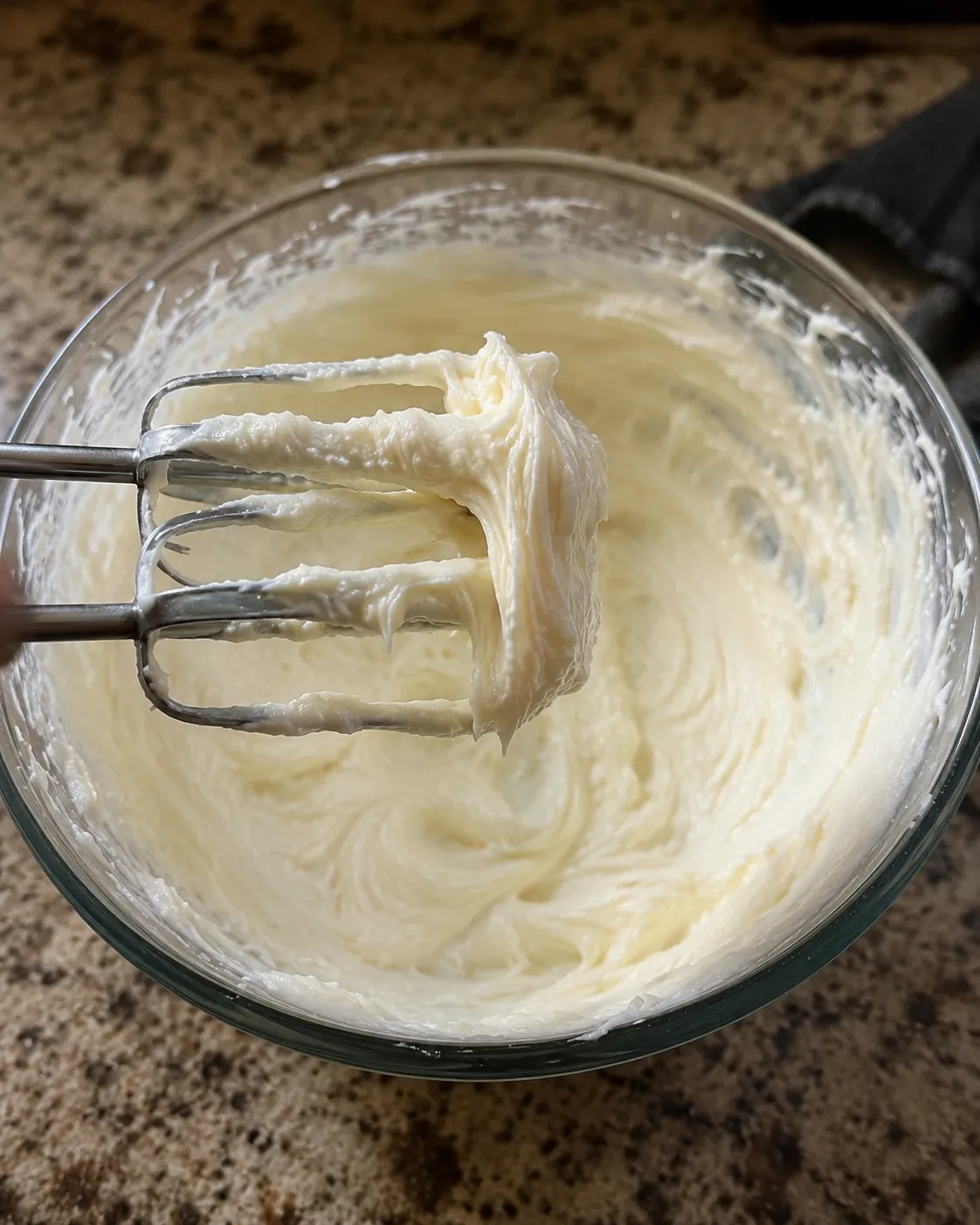
- Full room temperature, no shortcuts. Cold cream cheese does not blend; it breaks into pebbles that survive into the finished bar as white lumps. Two hours on the counter, or 45 minutes for blocks cut into cubes. The microwave shortcut works until the day it half-melts one corner, and then it does not.
- Beat the cheese alone first, a full minute, scraping the bowl twice, until it is a smooth paste with nothing else in it. Lumps that exist after the sugar goes in are lumps you will meet again in the finished bar. This is the one stage where beating hard is correct.
- Once the egg goes in, the mixer goes to low. Eggs are how air gets whipped into custard, whipped-in air is how cheesecake puffs in the basket, and puffed cheesecake falls as it cools, cracking on the way down. Low speed, just until the yellow streaks disappear, and stop.
- The sour cream is not optional. A third of a cup buys the slight tang that makes cheesecake taste like cheesecake instead of sweetened cream cheese, and its extra fat keeps the thin filling layer plush instead of rubbery.
- One egg plus one yolk, not two eggs. Whites are water and structure, and a bar this shallow needs less of both; the extra yolk pays it back in silkiness. It is the same trade our blondies make for density, applied to custard.
The four minute crust
The crust is graham crumbs, butter, sugar and salt, pressed flat and baked alone for 4 minutes before the filling touches it. Skipping the prebake is the most common shortcut and the most reliably punished one: filling poured over raw crumbs soaks in during the bake, and the bottom layer comes out as damp sand instead of a crisp floor. Four minutes sets the butter and toasts the crumbs just enough to waterproof them.
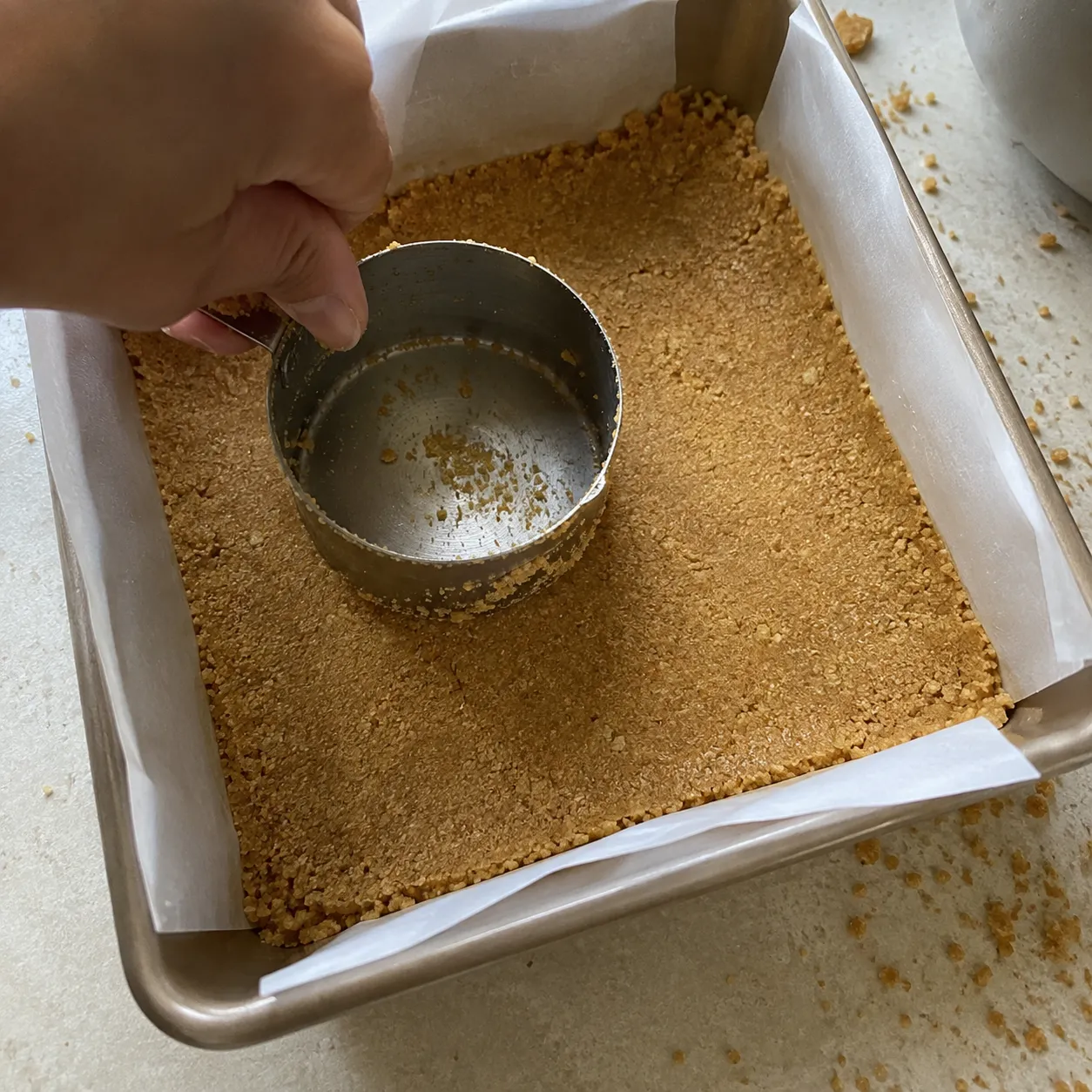
Press with the base of a flat measuring cup, hard, into the corners. A firmly packed crust cuts into clean strata under the finished bar; a loose one crumbles away from the filling at the first slice. There is no need to grease anything except the two pan walls the parchment sling does not cover, and if slings and liners are new territory, foil or parchment in an air fryer covers what belongs in a basket and how to keep it there.
Ingredients
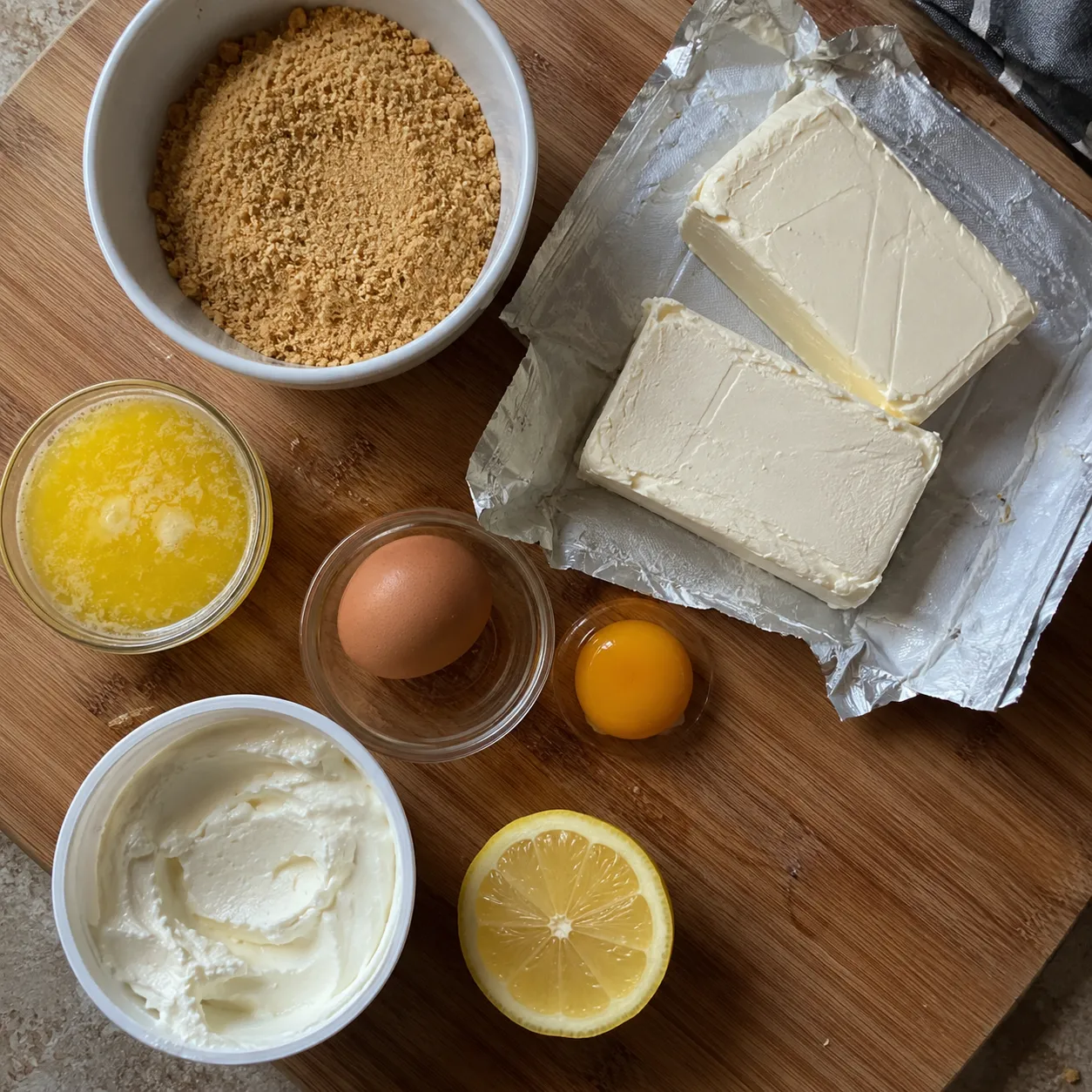
One 7-inch pan, sixteen bars. Everything dairy needs to be at real room temperature, which is the only planning this recipe asks of you.
Crust
- 1 cup (100g) graham cracker crumbs, about 7 full sheets
- 4 tablespoons (56g) unsalted butter, melted
- 1 tablespoon sugar
- 1/8 teaspoon salt
Filling
- 12 ounces (340g) full-fat cream cheese, room temperature
- 1/2 cup (100g) sugar
- 1/3 cup (75g) sour cream, room temperature
- 1 large egg plus 1 yolk, room temperature
- 1 1/2 teaspoons vanilla extract
- 1 teaspoon lemon juice
- 1/8 teaspoon salt
Full-fat brick cream cheese, not the spreadable tub, which carries extra water and gums the set. The lemon juice is not a flavor so much as a focuser; the bars do not taste of lemon, they just taste more like themselves. Greek yogurt substitutes for the sour cream in a pinch at the cost of a little richness.
How to make them
- Bring the dairy to room temperature. Cream cheese, sour cream and eggs, about 2 hours on the counter. This step is invisible and it decides the texture.
- Line the pan. A parchment sling overhanging two sides of a 7-inch square or round pan, with a light grease on the exposed walls.
- Preheat to 300°F (150°C) for 3 minutes. Custard is the least forgiving thing in a basket, so this is one of the bakes where the preheat genuinely counts. When preheating matters has the rest.
- Make and prebake the crust. Stir the melted butter, sugar and salt into the crumbs until it holds together when squeezed, press it flat and hard into the pan with the base of a measuring cup, and bake 4 minutes. Set it aside while you mix; it does not need to cool fully.
- Beat the cream cheese alone until completely smooth, about 1 minute, scraping the bowl twice. Every lump you can see now is permanent.
- Add the sugar, sour cream, vanilla, lemon juice and salt and beat until just combined and glossy.
- Add the egg and yolk on low speed, mixing only until the last yellow streak disappears. From here on, air is the enemy.
- Pour the filling over the crust and rap the pan firmly on the counter three or four times to pop the bubbles you could not avoid.
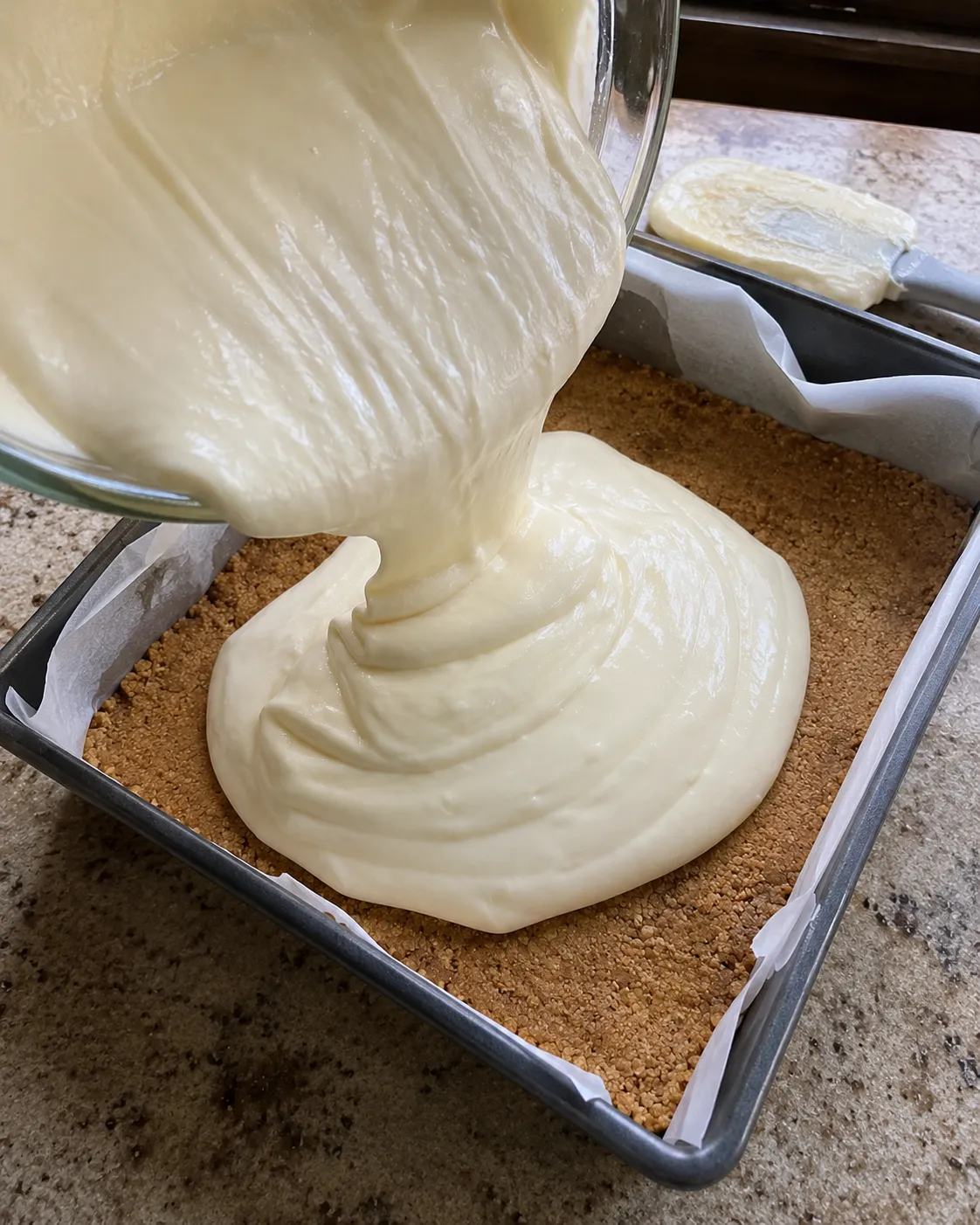
Pour into the middle and let it spread on its own. The crust is baked and firm, so nothing lifts or muddies. - Bake 16 to 20 minutes at 300°F. No peeking for the first 12.
- Check at 16 minutes: the edges should be set and matte, and the center two inches should sway once, as a single piece, when you nudge the pan. On a thermometer, 145 to 150°F in the middle. If the whole surface still ripples, give it 2 more minutes and look again.
- Cool 30 minutes on the counter, then refrigerate at least 4 hours, uncovered for the first hour so condensation cannot drip back onto the surface. Overnight is better and the bars know it.
- Lift out with the sling and cut into 16 bars with a large knife run under hot water and wiped dry between every cut. Cold filling plus a hot dry blade is what makes the word sliceable true.
Why 300°F. Oven cheesecake bars run 325°F, and a basket cooks a real 25 to 30 degrees harder at the same dial because the element is close and the fan strips away the still-air insulation an oven provides. The air fryer calculator makes exactly that drop for any oven recipe you want to convert, and the conversion guide explains the rule it applies. Custard is the least forgiving thing you can bake, so this is one recipe where the conversion is not a suggestion.
Pan size and the half-block question
| Pan | Batter | At 300°F | Notes |
|---|---|---|---|
| 7-inch square or round | The recipe as written | 16 to 20 min | Sixteen bars. The default |
| 6-inch square or round | As written, deeper | 20 to 24 min | Taller bars, closer to little cheesecakes |
| 8x8 square | Scale by 1.3 | 15 to 18 min | Only if your basket truly fits it; most do not |
| 9x13 in the oven | Scale by 2.5, 325°F | 30 to 35 min | The potluck slab, back in oven territory |
The 8x8 row deserves its warning: the pan every oven bar recipe assumes is the pan most baskets cannot hold. The pan size calculator settles what yours takes in thirty seconds, and the recipe scaler rewrites the quantities for whatever pan wins.
And the half block. Cream cheese comes in 8-ounce bricks and this recipe uses a brick and a half, which leaves half a brick in the refrigerator looking at you. It keeps for weeks sealed, it is bagels for two weekends, and it is also most of the way to a batch of mini cheesecakes, the frosting on a carrot cake, or the icing for a tray of cinnamon rolls, which this site regards as the responsible ways to close the loop.
Toppings that work, toppings that weep
Bars get topped after chilling, not before baking. The surface of a properly baked cheesecake bar is flat, matte and slightly tacky, which is an ideal foundation, and toppings added cold cannot sink, split or bake into leather. The distinction that matters is water:
- Cooked fruit works. A quick jammy compote, berries simmered 5 minutes with a spoonful of sugar and cooled completely, sits beautifully and stays put. Warm compote on cold cheesecake slides off and melts the surface; patience by way of the refrigerator.
- Raw berries work whole, arranged just before serving. Cut fruit weeps juice within the hour and the bars go glossy and wet.
- Caramel, chocolate ganache and lemon curd all work, spread thin over the chilled slab before it is cut, so each bar gets a clean layered edge.
- The classic sour cream finish works uncut: a half cup of sour cream whisked with a spoonful of sugar, spread over the slab, chilled another hour. It sets into the ivory top layer diner cheesecake has.
- Pie filling from a can technically works and drowns the tang you built. This site takes no position beyond raised eyebrows.
Fixing what goes wrong
| What you got | Why | Fix |
|---|---|---|
| Cracked surface | Overbaked, overbeaten after the egg, or shocked by fast cooling. | Pull at the single-sway jiggle, egg on low speed, 30 counter minutes before the fridge. |
| Grainy, curdled texture | The custard passed 160°F and the proteins wrung the water out. | 145 to 150°F and out. The center should still wobble. |
| White lumps in the filling | Cold cream cheese, or the beating happened after the sugar went in. | True room temperature, and beat the cheese smooth alone first. |
| Soggy, sandy crust | The prebake was skipped. | Four minutes at 300°F, every time. It is not decorative. |
| Puffed like a souffle, then sank | Air whipped in with the egg, or the temperature ran high. | Low speed after the egg, 300°F, and check that your machine is not running hot. |
| Browned top | Cheesecake should stay pale; the element was too close or too hot. | Drop 10 degrees next time, or shield with a loose foil tent for the final minutes. |
| Smeared, ragged cuts | Warm bars or a cold dry knife. | Fully chilled slab, hot knife, wiped dry between every single cut. |
If the same failures follow you across recipes, the troubleshooting guide works symptom-first, and a top that browns on everything you bake is covered in how to prevent burning.
Storage and freezing
- Refrigerated: 5 days, covered after the first hour. Day two is the peak; the texture settles denser and the tang blooms. Cheesecake is a make-ahead dessert pretending to be a project.
- Room temperature: two hours maximum on the counter, because this is custard and custard keeps dairy rules, not cookie rules.
- Frozen: 2 months, bars wrapped individually and topped after thawing, not before. Thaw overnight in the refrigerator; a counter thaw sweats. Frozen-then-thawed bars cut the cleanest of all, which caterers have known forever.
- Half-frozen, 20 minutes out of the freezer, a cheesecake bar is functionally an ice cream sandwich with references. Reported for completeness.
Two other bars on this site solve the same 7-inch pan in different ways, and both are worth a look if this one worked for you. Lemon bars are the closest relative: a pressed base, a poured filling, and a chill that does the setting rather than the bake. Magic bars go the opposite direction, no mixing bowl at all, just seven layers stacked and bound with condensed milk. Brookies are the third in the set, two doughs baked as one bar. For something tall instead of sliceable, the cake collection has eighteen.
Twenty minutes of basket time against heating a full oven for one small pan is the math this machine wins every time, and the running cost calculator can put your own electricity rate on it. All four air fryer tools live in one place, the bar shelf continues with brownies and blondies, and the cookies and bars collection has all twenty in one place. The guides index covers the technique behind every number here, and the full recipe index has the rest of the site.
Frequently asked questions
QCan you make cheesecake bars in an air fryer?
Yes, and the bar format is actually the easiest cheesecake a basket can make. The filling runs about an inch deep, half the depth of a round cheesecake, so heat reaches the center before the edges overcook and no water bath is needed. A parchment sling in an ordinary 7-inch pan replaces the springform entirely. Bake the crust alone 4 minutes at 300F, then the filled pan 16 to 20 minutes, until the edges set and the center two inches wobble as one piece, then chill at least 4 hours.
QWhat temperature and how long for air fryer cheesecake bars?
300F throughout: 4 minutes for the crust alone, then 16 to 20 minutes for the filled pan in a 7-inch pan. Oven versions run 325F, and a basket cooks a real 25 to 30 degrees harder at the same setting, so carrying the oven number into the machine overbakes the custard. Doneness is the jiggle or the thermometer: edges set and matte with the center two inches swaying once as a single piece, or 145 to 150F in the middle. The bars finish setting during the chill.
QDo cheesecake bars need a water bath?
No, and this is the honest advantage of the format rather than a shortcut. A water bath exists to slow down the edges of a thick custard so the center can catch up; in a filling only an inch deep, the center keeps pace on its own and there is nothing for the bath to fix. Between the shallow layer and the 300F temperature, the bars bake evenly in a dry basket. The same logic is why our mini cheesecakes skip the bath too, while thick oven cheesecakes genuinely need it.
QWhat does a slight jiggle actually look like?
Nudge the pan and watch the center. Raw filling ripples, with waves moving across the surface like a shaken drink. Done filling holds still at the edges while the center two inches sway once, together, as a single piece, like set gelatin. If nothing moves at all, it is overbaked and will eat drier and grainier. If the surface has puffed and risen, it is well past done and will likely crack as it falls. The thermometer translation is 145 to 150F in the center, and residual heat finishes the job on the counter.
QWhy did my cheesecake bars crack?
Three causes, often teaming up. Overbaking is first: custard pushed past 160F shrinks and tears itself as it cools. Air is second: beating fast after the egg goes in whips in bubbles that puff in the basket and collapse in the fridge, cracking on the way down. Thermal shock is third: moving the pan straight from basket to refrigerator cools the surface faster than the middle. The fixes are the recipe: pull at the single-sway jiggle, mix the egg on low, and give it 30 counter minutes first. And a cracked bar slab is cut into sixteen pieces anyway; the scar vanishes at the first slice.
QDo I have to prebake the crust?
Yes, and it is only 4 minutes. Raw pressed crumbs are a sponge, and cheesecake filling is mostly moisture; pour one over the other and the bake soaks the crust into damp sand. Four minutes at 300F sets the butter and toasts the crumbs enough to waterproof the floor, which is what lets the finished bar cut into two clean strata instead of smearing. The crust does not need to cool completely before the filling goes on; warm is fine, hot from the basket is fine too.
QCan I use low-fat or whipped cream cheese?
Brick-style full-fat cream cheese is the recipe; the substitutes fail in different ways. Low-fat bricks carry more water and gums, and the bars set softer and slightly slick. Whipped tub cream cheese is pre-aerated, which injects exactly the air this method spends three steps avoiding, and it usually contains added water on top of that. Neufchatel, the one-third-less-fat brick, is the only swap that behaves, costing a little richness but setting properly. The sour cream should stay full-fat for the same reasons.
QWhy did my bars puff up like a souffle?
Air got in, heat drove it up, and physics did the rest. Cheesecake batter should go into the pan dense and nearly flat, which is why the cheese is beaten smooth alone at the start, when beating is safe, and why the mixer drops to low the moment the egg arrives, when beating whips air into the one ingredient that traps it. A too-hot machine does the same thing by boiling the custard's own moisture. Puffed bars always fall as they cool, and the fall is where cracks and dense gummy layers come from.
QHow long do cheesecake bars need to chill?
Four hours minimum, overnight for the version worth photographing. The bake sets the custard's structure, but the chill is where cheesecake texture actually forms, as the fats recrystallize and the slab firms from soft custard into something a knife can cut clean. Bars cut at two hours smear; the same bars the next morning cut like cold butter. Keep them uncovered for the first hour in the refrigerator so condensation does not drip back onto the surface, then cover.
QCan I double this recipe or use an 8x8 pan?
Not by deepening. Doubled filling in the same 7-inch pan rebuilds the thick-custard problem the bar format exists to escape, and you would be back to water-bath physics without the water bath. The 8x8 pan every oven recipe assumes is wider than most baskets can take, so measure before assuming; if yours genuinely fits one with airflow around the rim, scale the recipe by 1.3 and start checking at 15 minutes. For a crowd, two 7-inch batches back to back, or scale by 2.5 into a 9x13 and use the oven at 325F.
QWhat toppings work on cheesecake bars?
Top after chilling, never before baking, and judge every candidate by its water. Cooked and fully cooled berry compote holds beautifully; warm compote slides off and melts the surface. Whole raw berries work arranged at serving time, while cut fruit weeps within the hour. Caramel, ganache and lemon curd spread thin over the chilled slab before cutting, so every bar gets a layered edge. The diner classic is a sour cream finish: half a cup whisked with a spoonful of sugar, spread on, and chilled one more hour.
QShould I make bars, minis, or the full round cheesecake?
Same custard, three formats, three jobs. The bars are the everyday version: fastest bake, no special pan, sixteen pieces that cut clean and travel well. The minis are portion control and bake-sale logistics, done in about 13 minutes with zero cutting. The round is the occasion piece, tall enough for the classic wedge, and it costs a 32 minute bake plus more patience in the chill. Temperature and doneness barely change across all three, 300F and a 145 to 150F center, so learning one teaches the other two.