

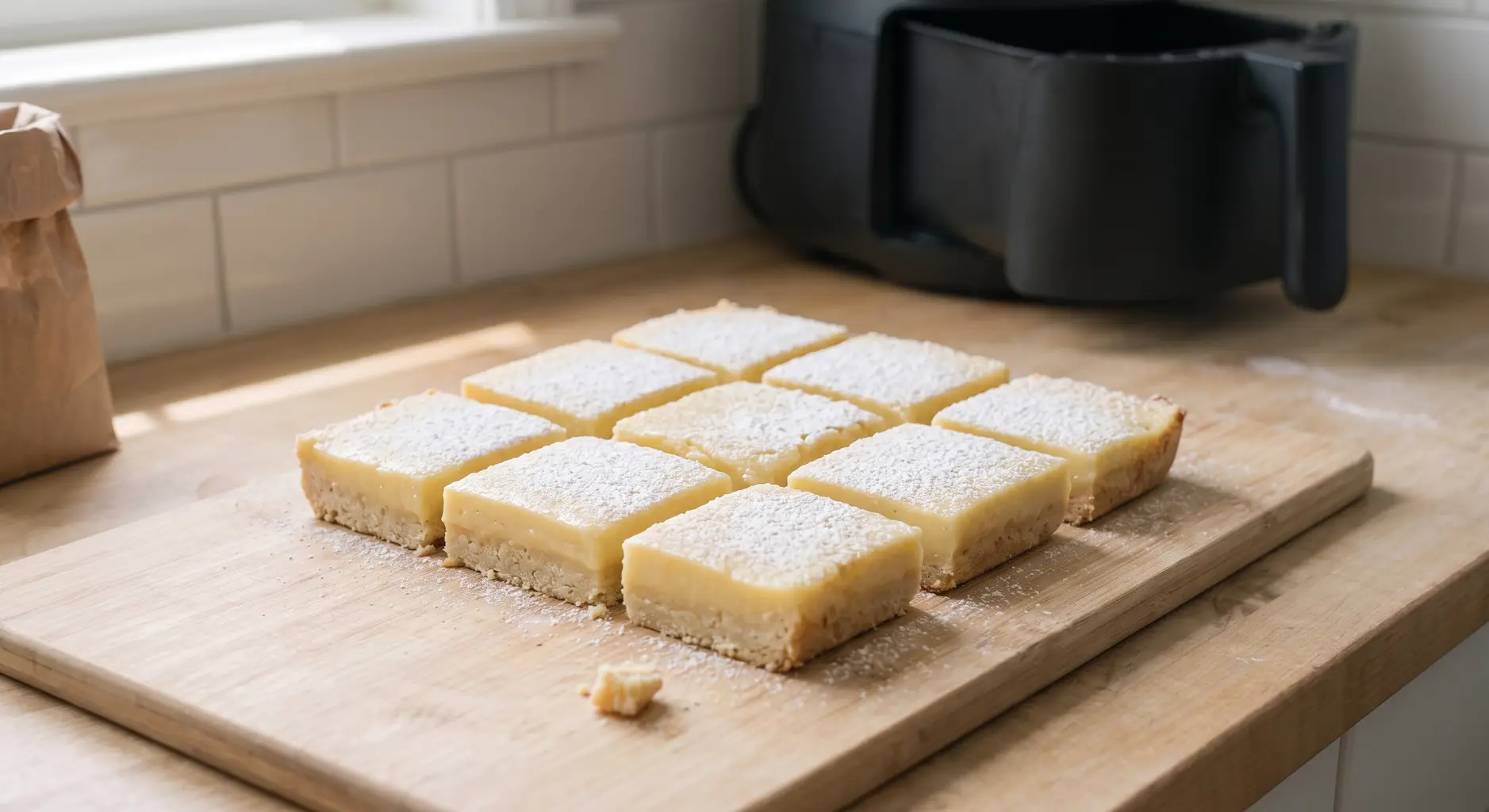
The first lemon bars I baked in a basket came out wearing a tan. A proper browned skin across the top, like a crème brûlée that had given up on subtlety, and underneath it the curd had gone grainy at the edges. Lemon bars are supposed to be pale yellow and silk-smooth, and I had baked them at the temperature the crust wanted instead of the temperature the custard could survive.
Because that is what a lemon bar is, once you look straight at it: a shortbread cookie wearing a custard. Two components, two sets of rules, one pan. The crust wants heat and browning. The filling is eggs and acid, and it wants gentleness and a pale finish. Every failed batch of lemon bars comes from letting one layer's rules run the other layer's bake.
Quick answer: Bake the shortbread crust alone at 320°F for 10 to 12 minutes, pour the filling onto the hot crust, and drop to 300°F for 12 to 15 minutes, until the edges are set and the center jiggles like set gelatin. Then the step that actually finishes them: 2 hours in the fridge. The chill is the set. Dust with powdered sugar just before serving, never before storing.
Why this custard needs no water bath
Baked custards are famously nervous. Cheesecake gets wrapped in foil and lowered into a water bath. Flan bakes in a bain-marie. Crème brûlée gets a moat. The water holds the temperature near boiling so the eggs set gently instead of curdling, and none of that is possible in an air fryer basket, which is presumably why so few custard desserts have made the jump.
Lemon bars never needed the bath, and the reason is one humble ingredient: the spoonful of flour whisked into the filling. Starch physically gets between the egg proteins as they heat, so they cannot seize into curds the way a naked custard's can. Food scientists use starch this way in pastry cream for the same reason. Add the shallowness of the layer, barely half an inch deep, which heats evenly on its own, and you have a custard that was accidentally engineered for a machine that cannot offer it a water bath.
So the promise in the title is not a trick, it is the dish. What the air fryer does demand in exchange is respect for temperature, which is the next section, because starch protects the custard from curdling and protects it from nothing else.
Two bakes, two temperatures
The recipes ranking for this bake both stages at 320°F and then tell you to tent with foil when the top browns. Tenting works, and I keep it as the backup below, but it is treating a symptom. The top browns because 320°F is a crust temperature being applied to a custard.
Crust at 320°F
Shortbread wants real heat: butter melting into flour, edges going golden, a base sturdy enough to hold a wet filling. 10 to 12 minutes, alone, until the edges color.
Filling at 300°F
Egg proteins set fully by around 180°F. The filling never needs to see fierce heat, and every degree beyond gentle shows up as browning on a surface that should stay pale yellow. Drop the dial between stages.
The tent
If the top starts coloring anyway, lay foil loosely over the pan with the edges tucked against the rim so the fan cannot lift it. At 300°F most machines never need it.
The tucked-foil rule matters in a basket: a loose sheet and a fan are a bad pair, covered in can you use foil or parchment paper in an air fryer. And if your machine browns everything regardless of dial, start with how to prevent burning in an air fryer.
The crust here is a true shortbread, the same 1:2:3 family as the air fryer shortbread cookies, just pressed instead of rolled. If you have made those, you already know this dough.
The crust float, and the hot-pour fix
The strangest lemon bar failure, and one nobody warns you about: you pull the pan out and the crust is on top. A pale slab of shortbread floating on the filling like a raft.
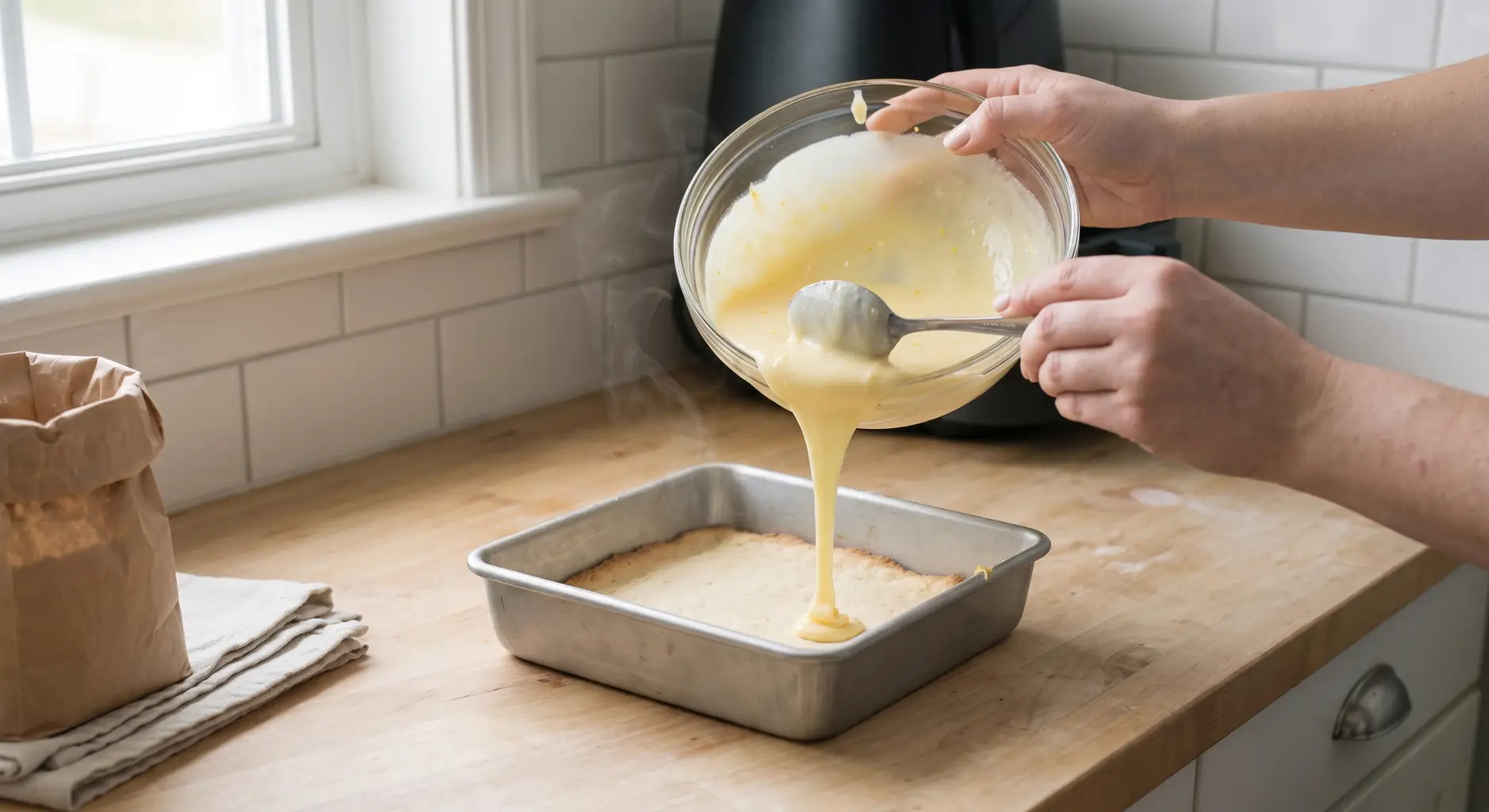
It happens when thin filling finds a gap, a crack, or an unpressed corner and runs underneath the par-baked crust, which is lighter than the custard and lifts. Two habits prevent it completely:
- Press the crust gap-free. Use the flat bottom of a measuring cup to press the dough into an even, sealed layer, paying attention to the corners and the seam where base meets wall. Cracks after par-baking get pressed closed with the back of a spoon while hot.
- Pour the filling onto the hot crust. Do not let the crust cool between stages. Hot shortbread starts setting the custard layer it touches on contact, gluing the two layers together before the filling has time to go exploring. It also shaves minutes off the second bake. This is the single best habit in the recipe and it costs nothing: the crust comes out, the filling goes in, the pan goes back.
The lemons
The filling is sugar, eggs, and lemon. There is nowhere for a shortcut to hide.
- Fresh lemons only. Bottled juice is pasteurized, and the cooking that keeps it shelf-stable is exactly what strips the aromatics. Bars made with it taste sour without tasting like lemon. Two to three lemons cover this recipe.
- The zest carries the perfume. Lemon oil lives in the yellow skin, not the juice. A tablespoon of zest does more for the flavor than an extra squeeze of juice ever could. Zest before you juice, always, because nobody has ever successfully zested a squeezed lemon half.
- Rub the zest into the sugar for thirty seconds before whisking anything else in. It is the same move that carries our lemon bread and lemon cake, and it is the cheapest flavor upgrade in this kitchen. The sugar crystals tear open the oil cells and the whole filling turns fragrant. It is a one-minute upgrade that reads as a different recipe.
- Roll the lemons hard under your palm before juicing. It bursts the internal membranes and gets you noticeably more juice per fruit.
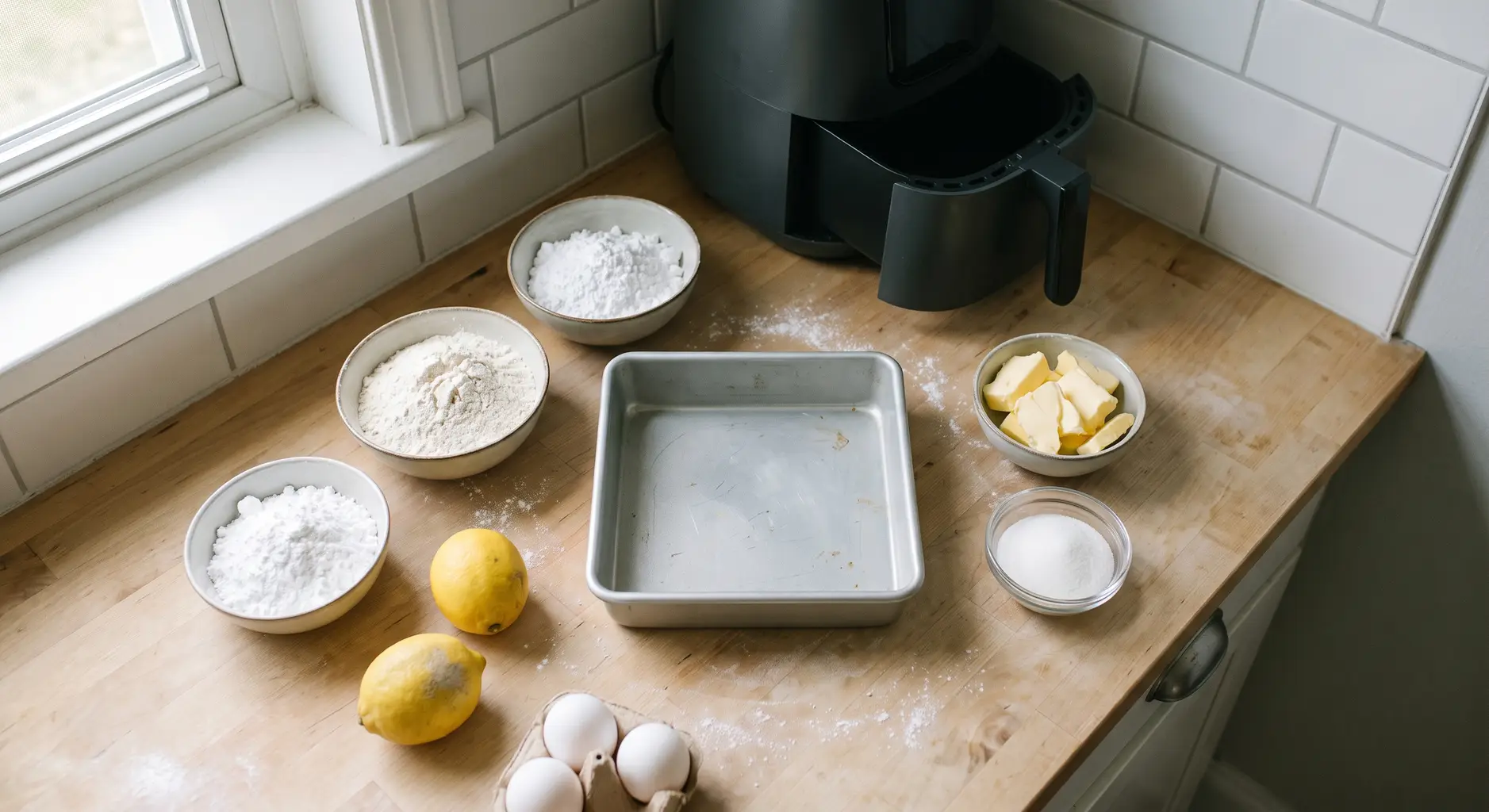
Ingredients
The crust
- 3/4 cup (94g) all-purpose flour
- 3 tablespoons (23g) powdered sugar
- 1/4 teaspoon fine salt
- 6 tablespoons (85g) unsalted butter, softened
The filling
- 2 large eggs, room temperature
- 3/4 cup (150g) granulated sugar
- 1 tablespoon lemon zest, from 2 lemons
- 3 tablespoons (23g) all-purpose flour
- 1/3 cup (80ml) fresh lemon juice, 2 to 3 lemons
- Pinch of fine salt
- Powdered sugar for dusting, just before serving
Sized for a 6-inch square pan, which fits 5 quart baskets and up, or a 7-inch round with slightly thinner bars. Not sure what your basket takes? The pan size calculator answers it in ten seconds. Scaling up for an 8-inch pan in an oven-style machine is one and a half times the recipe, and the recipe scaler does that math.
How to make them
- Build a parchment sling. Two strips of parchment crossed in the pan, edges hanging over the sides, lightly greased between layers. This is not optional in an air fryer: you cannot cut bars in a nonstick pan without wrecking it, and you cannot invert a custard. The sling is how the finished slab leaves the pan in one piece.
- Make the crust. Stir the flour, powdered sugar and salt, then work in the soft butter with your fingers until it forms damp clumps. Press it into the pan in an even, gap-free layer using the flat bottom of a measuring cup, sealing the corners.
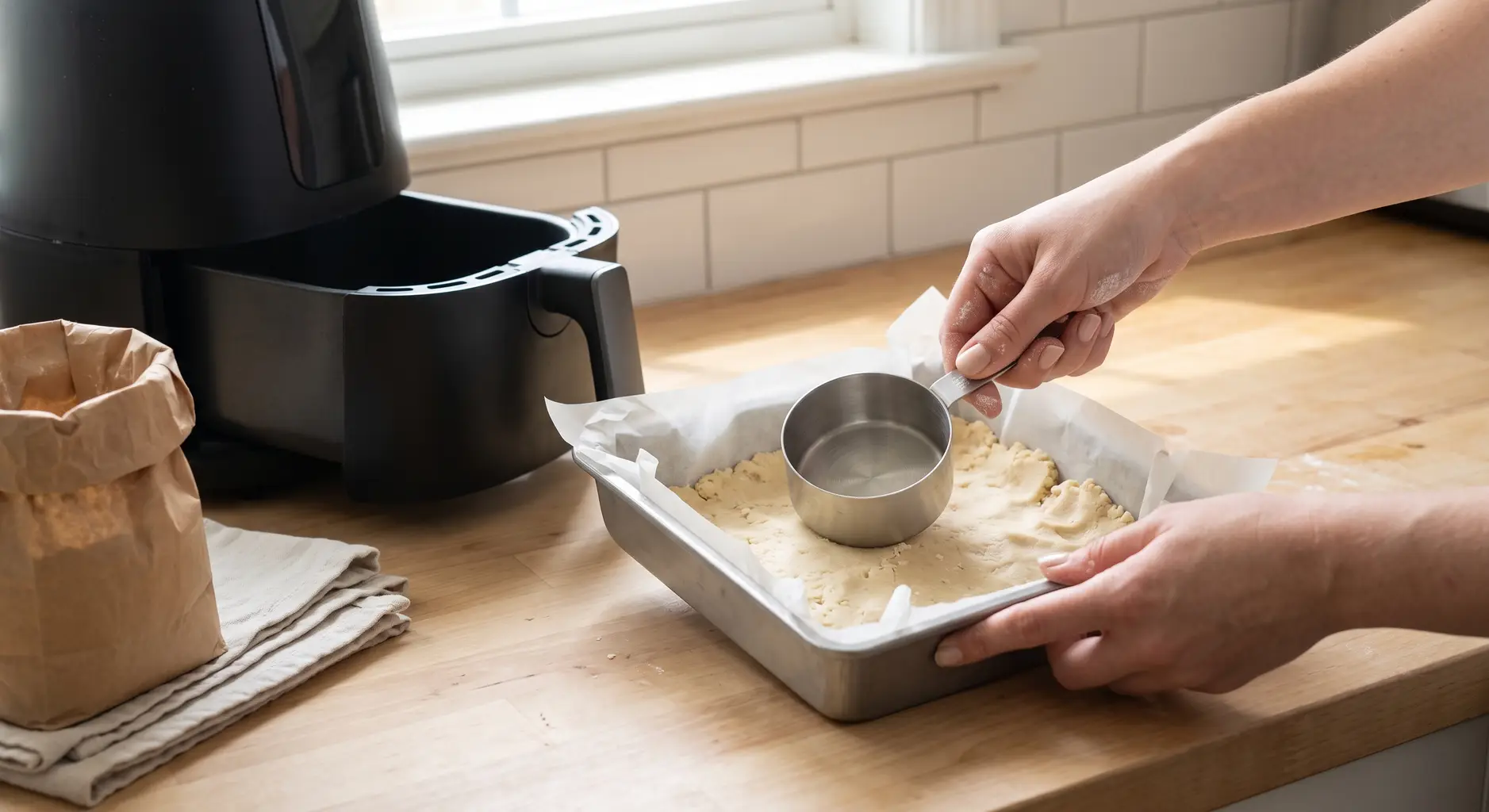
Press to a gap-free, even floor. Thin corners bake dark before the middle sets. - Preheat to 320°F for 3 minutes, then bake the crust 10 to 12 minutes, until the edges are golden and the surface looks dry. The preheat rules for short bakes are in do you need to preheat an air fryer for baking.
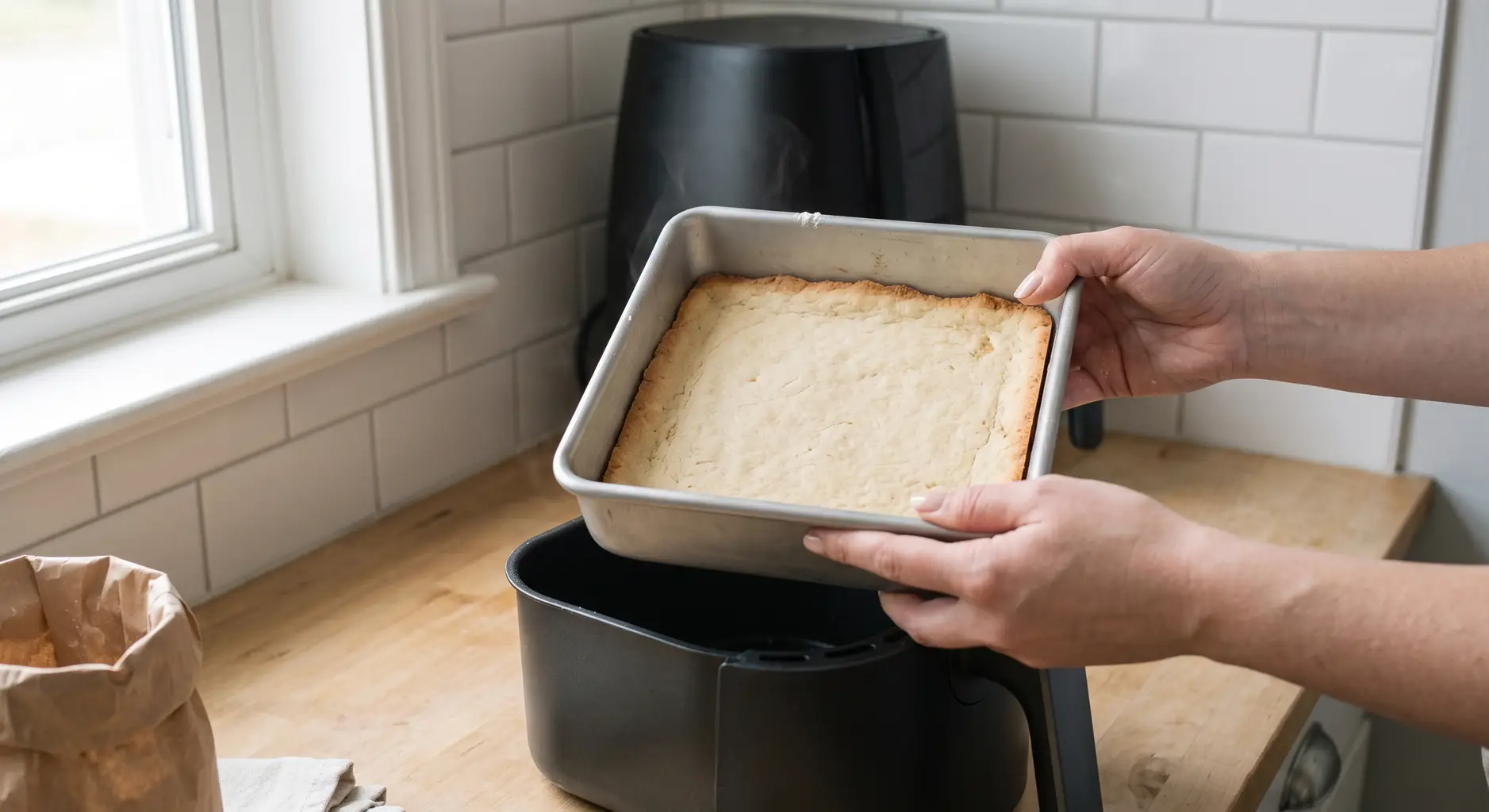
Golden at the edges, pale in the middle. That is a par-baked crust, not an underdone one. - Whisk the filling while the crust bakes. Rub the zest into the sugar first, then whisk in the eggs until smooth, then the flour and salt until no lumps remain, then the lemon juice last. Whisk to combine, not to foam: bubbles whipped in now become a foamy skin on the baked bars.
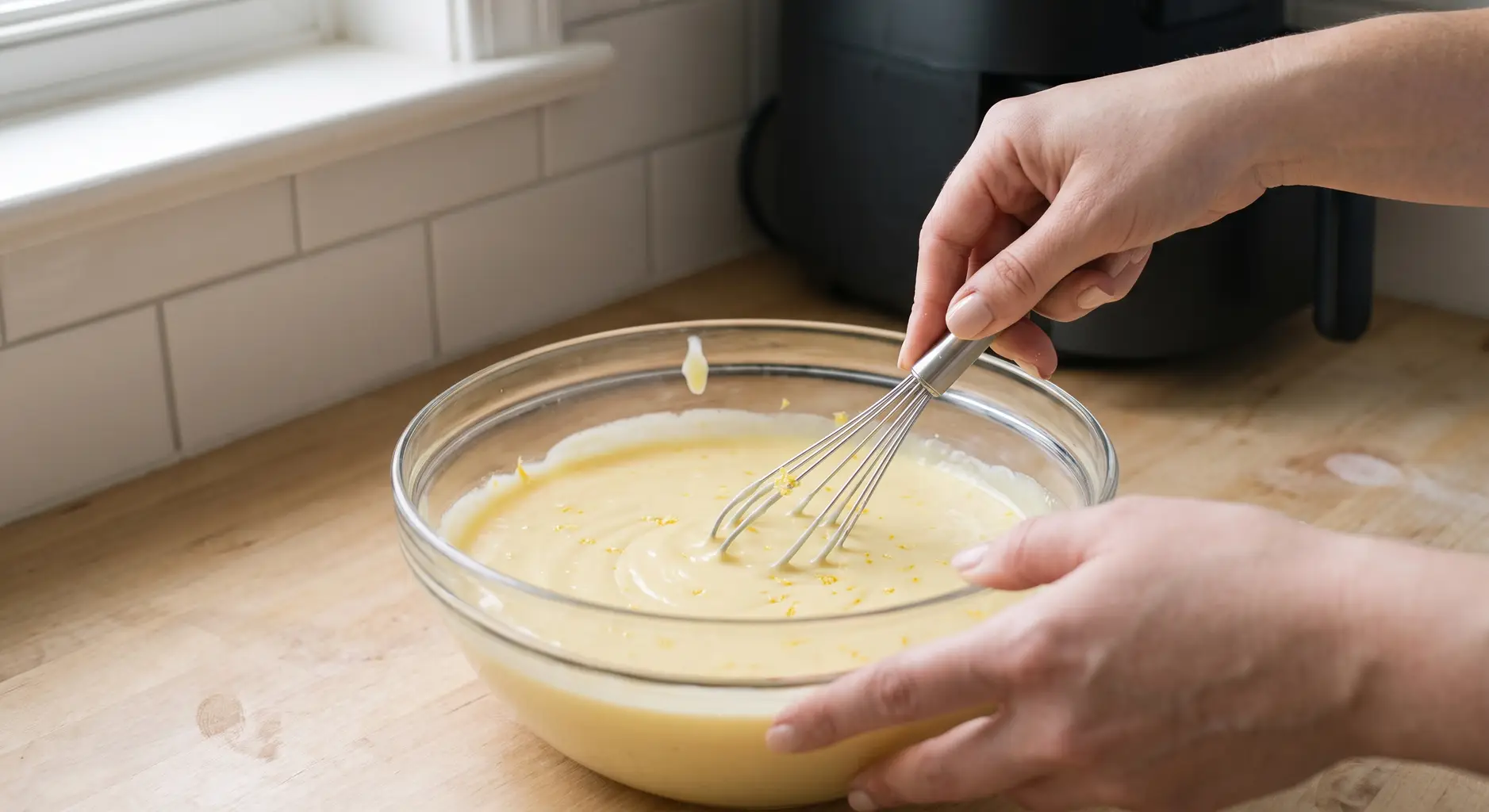
Whisk it while the crust bakes so the filling is ready the moment the pan comes out. - Pour the filling onto the hot crust the moment it comes out. Pour slowly over the back of a spoon held close to the crust so the stream does not dig a hole in the shortbread.
- Drop to 300°F and bake 12 to 15 minutes. The edges should look set and matte while the center still moves as one piece when you nudge the pan. If the top shows any color by minute 8, tent with tucked foil.
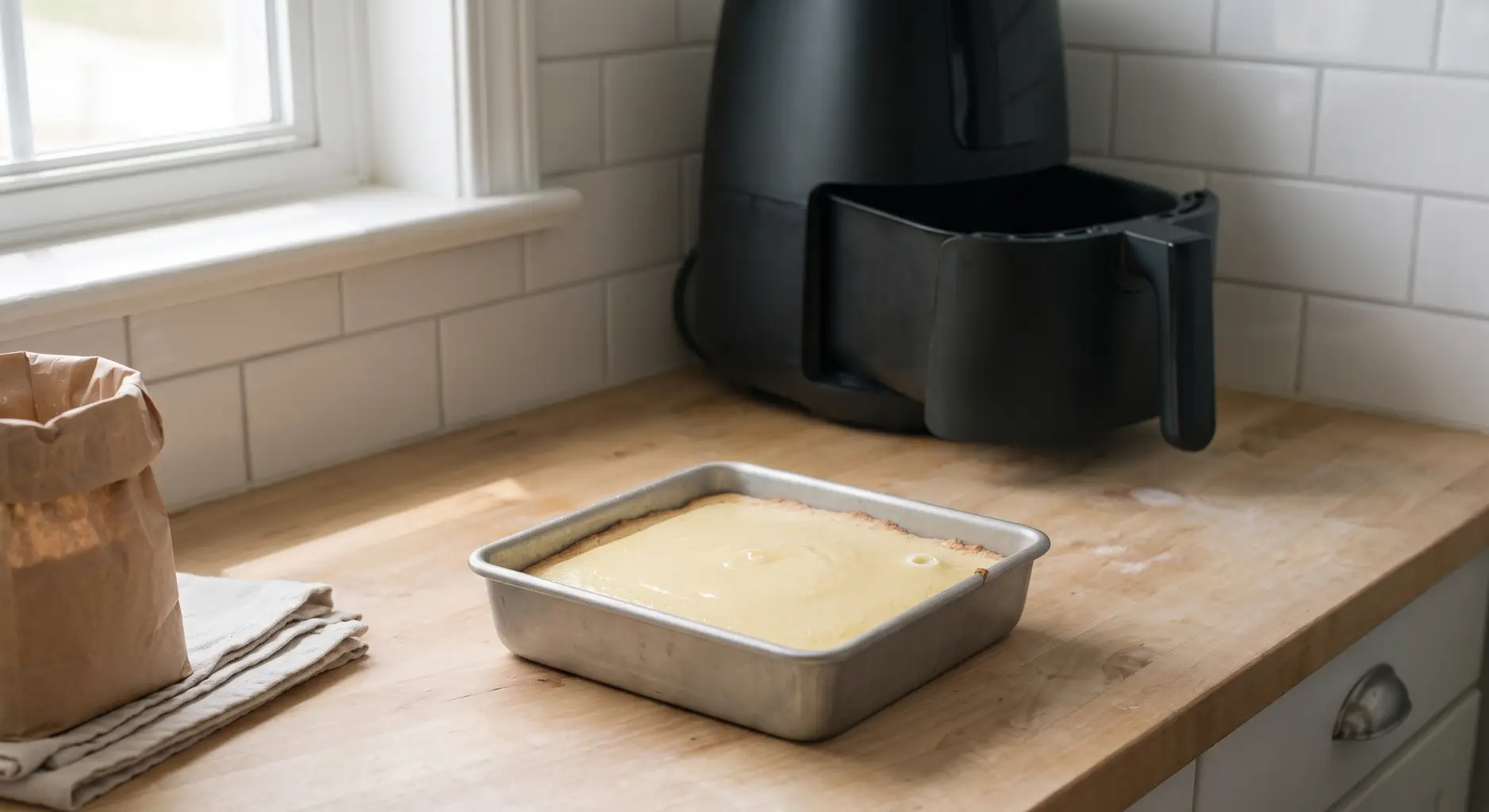
Matte edges, and a center that moves as one piece rather than rippling. That is the jiggle you want. - Cool 30 minutes on the counter, then refrigerate 2 hours minimum. Do not negotiate with this step, it is the second half of the recipe. The starch finishes thickening and the curd firms from wobbly to sliceable as it chills. Bars cut warm are lemon soup on cookies.
- Lift the slab out by the sling, onto a cutting board.
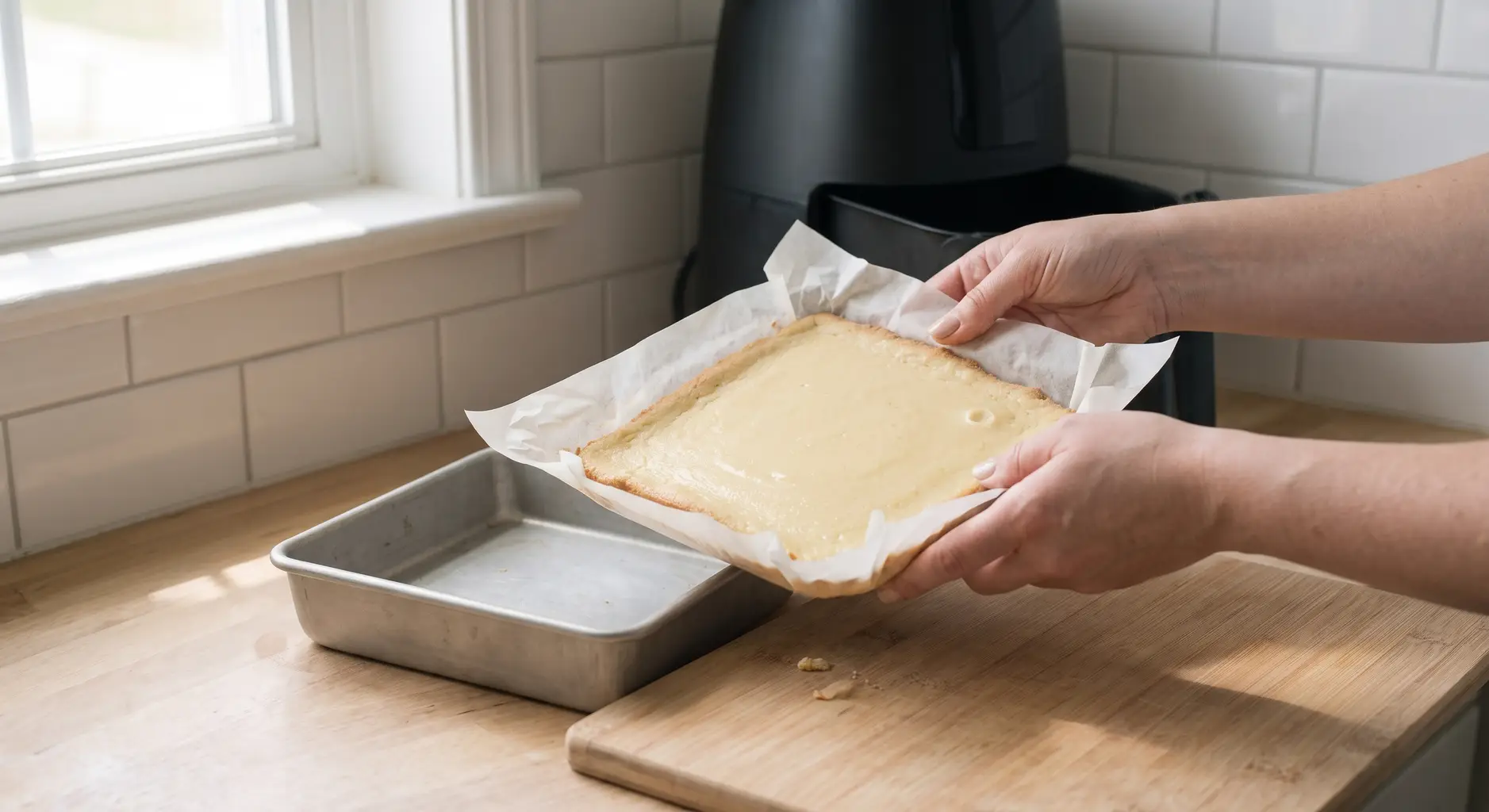
The sling is why this works. Chilled and lifted whole, the slab cuts clean instead of tearing in the pan. - Cut with a hot, clean knife: run the blade under hot water, wipe it dry, cut once, wipe again. Nine bars, four cuts, glass-clean edges. A cold sticky knife drags curd across every cut.
- Dust with powdered sugar just before serving. The reason it cannot happen earlier is its own section below.
The jiggle test, and the chill that finishes the job
Custard doneness confuses people because done does not look done. Here is the whole scale:
| Nudge the pan and watch the center | What it means |
|---|---|
| Ripples like liquid, sloshes | Not set. 3 more minutes. |
| Jiggles as one piece, like set gelatin, edges matte | Done. Out now, chill ahead. |
| No movement at all, surface domed | Overbaked. Expect a rubbery edge and possible cracks as it cools. |
The custard keeps cooking after it leaves the basket, standard carryover, and then the fridge does the rest: chilling firms the starch and the set eggs from wobble to clean slice. A bar that seems underdone at hour zero is usually perfect at hour two. If you like certainty over jiggles, an instant-read thermometer reading 170°F at the center is the same answer in numbers.
Powdered sugar, and why yours vanished
Everyone who has made lemon bars has opened the container the next day to find the snowy top gone, dissolved into a blotchy glaze. It is not your sugar. Lemon curd is a moist surface, and powdered sugar is hygroscopic: it drinks the surface moisture and melts into it, every time, within hours.
So the rule is simple and absolute: store the bars naked, dust just before serving. A small sieve, a quick shake, thirty seconds before the plate hits the table. If you are gifting them, pack the sugar separately in a little bag with instructions, which reads as charming rather than lazy. For a topping that survives storage, a thin lemon glaze, powdered sugar loosened with a few drops of juice, sets into a sheet that stays put for days.
Troubleshooting
| What you got | Why | Fix |
|---|---|---|
| Browned top | Filling baked at crust temperature. | 300°F for stage two, foil tent at the first sign of color. |
| Runny bars that will not slice | Cut warm. The chill is the set. | Two hours in the fridge, minimum. Underbaked centers show as ripples at the nudge test, so catch them there. |
| Crust floated to the top | Filling ran through a gap under the par-baked crust. | Press gap-free with a measuring cup, seal cracks while hot, and pour onto the hot crust. |
| Grainy, curdled edges | Overbaked, or the flour was left out of the filling. | The flour is the water bath. Keep it, and pull at the gelatin jiggle. |
| Foamy white skin on top | Filling whisked to a froth. | Whisk to combine only. Let a bubbly filling stand 5 minutes and pop the surface before pouring. |
| Powdered sugar melted away | Dusted before storing. | Dust at serving time, or use a set lemon glaze for storage. |
| Soggy crust by day two | Normal drift as the curd moistens the shortbread, faster if the crust was pale. | Par-bake to genuinely golden edges, and eat lemon bars inside three days, which has never been difficult. |
| Bars stuck in the pan | No sling. | The parchment sling, every time. Freed bars, unscratched pan. |
| Sour but flavorless | Bottled juice, or no zest. | Fresh lemons, and rub the zest into the sugar. |
Problems that repeat across every recipe point at the machine, not the bars: the air fryer baking troubleshooting guide is the checklist. Converting a family oven lemon bar recipe instead? The air fryer calculator gives you the crust stage numbers, then hold the filling at 300°F regardless of what it says, because the calculator converts bakes and stage two is barely one. Every temperature on the site is gathered in the air fryer baking chart.
Variations
- Lime or grapefruit bars. Swap the citrus one for one. Lime runs sharper, so add a tablespoon of sugar. Grapefruit wants a squeeze of lemon alongside to keep its edge.
- Lemon lavender. A quarter teaspoon of dried culinary lavender rubbed into the sugar with the zest. Tea party material.
- Berry swirl. Dot a tablespoon of seedless raspberry jam over the poured filling and drag a skewer through once. The same thick jam rules as the thumbprint cookies apply: preserves, not jelly.
- Coconut crust. Swap 3 tablespoons of the crust flour for finely shredded coconut, toasted first per the coconut macaroons rule that raw coconut buried in dough never toasts.
- Gluten free. A one-to-one gluten free flour blend works in both layers, because neither layer depends on gluten: the crust wants crumble and the filling wants starch, and the blend provides both.
On the bars-and-squares shelf, these sit beside the air fryer brownies as the two pan desserts every basket should learn, and the lava cake covers the nights that cannot wait two hours for a chill. The pressed crust technique transfers straight to the air fryer cheesecake, which is the custard that does want gentler handling, and this page's flour trick is the reason lemon bars never joined it in the fussy column.
For the other chilled bar that lives on a pressed crust, the cheesecake bars use the same sling and the same patience.
Storage
- Fridge: 4 days, in a single layer, airtight, undusted. Lemon bars are a refrigerator dessert, and they are genuinely better on day one and two.
- Room temperature: two hours on a serving plate is fine. Longer is not, this is a custard.
- Freezer: 2 months. Freeze the cut bars solid on a tray, then layer with parchment in a container. Thaw overnight in the fridge, still undusted, and dust after thawing.
- Make ahead: they are better made a day early. The chill deepens overnight and the flavor settles. Bake the day before, cut and dust the day of.
- Gifting: glaze instead of dusting, or bag the sugar separately. A dusted bar in a sealed box arrives blotchy every time.
Frequently asked questions
QHow long do you cook lemon bars in an air fryer?
Two stages: the shortbread crust bakes alone at 320°F for 10 to 12 minutes, then the filling goes onto the hot crust and bakes at 300°F for 12 to 15 minutes, until the edges are matte and the center jiggles as one piece. Then 2 hours in the fridge, which is not resting time but the second half of the set. Total hands-on time is about 20 minutes.
QDo lemon bars need a water bath?
No, and that is what makes them the custard an air fryer can handle. The tablespoons of flour whisked into the filling put starch between the egg proteins, which stops them curdling the way starch protects pastry cream, and the shallow half-inch layer heats gently on its own. Cheesecake and flan need the bath because they have no starch shield. Lemon bars carry theirs in the recipe.
QWhy did my lemon bars brown on top?
The filling baked at the crust's temperature. Most air fryer recipes run both stages at 320°F, and under a close element that browns a surface that should stay pale yellow. Drop to 300°F for the filling stage, and if color appears anyway, lay foil loosely over the pan with the edges tucked against the rim so the fan cannot lift it. Browned bars still taste fine, but the top goes eggy rather than tangy.
QHow do I know when lemon bars are done?
Nudge the pan. The edges should look set and matte while the center jiggles as one connected piece, like set gelatin. Sloshing ripples mean more time, and total stillness means overbaked. They firm substantially during the 2 hour chill, so a slight wobble at the pull is correct, not a failure. For a number instead of a jiggle, 170°F at the center on an instant-read thermometer is done.
QWhy are my lemon bars runny?
Nine times out of ten they were cut too soon. The filling leaves the basket as a soft custard and only becomes sliceable after 2 full hours in the fridge, when the starch and set eggs firm up. The tenth time, the center was still rippling at the pull and needed 3 more minutes. Warm lemon bars are lemon soup on shortbread, and patience is the entire fix.
QCan I use bottled lemon juice for lemon bars?
You can, and the bars will taste sour without tasting like lemon. Bottled juice is pasteurized, and the heat treatment strips the volatile aromatics that make lemon taste bright. Fresh juice plus zest is the whole flavor of this dessert, and two to three lemons cover the recipe. Rub the zest into the sugar before mixing and the difference doubles.
QWhy did my lemon bar crust float to the top?
Thin filling found a gap or crack and ran underneath the par-baked crust, which is lighter than custard and lifted off the base. Press the raw dough into a sealed, gap-free layer with the flat bottom of a measuring cup, close any cracks with a spoon while the crust is hot, and pour the filling onto the hot crust so the layers glue together on contact.
QWhy did the powdered sugar disappear off my lemon bars?
Powdered sugar is hygroscopic and lemon curd is a moist surface, so the sugar drinks the moisture and dissolves into a blotchy glaze within hours. It happens to everyone. Store the bars undusted and dust just before serving, or top with a thin lemon glaze instead, which sets into a sheet that survives storage.
QCan I freeze lemon bars?
Yes, for 2 months. Freeze the cut, undusted bars solid on a tray first, then layer them with parchment in a container. Thaw overnight in the fridge and dust after thawing. The crust softens slightly compared to fresh, which is the only tax, and they are also simply better made a day ahead, which covers most of the reasons people freeze them.
Never overbake again
Get our one-page times & temps cheat sheet, plus a new tested recipe each week.
No spam · unsubscribe anytime