

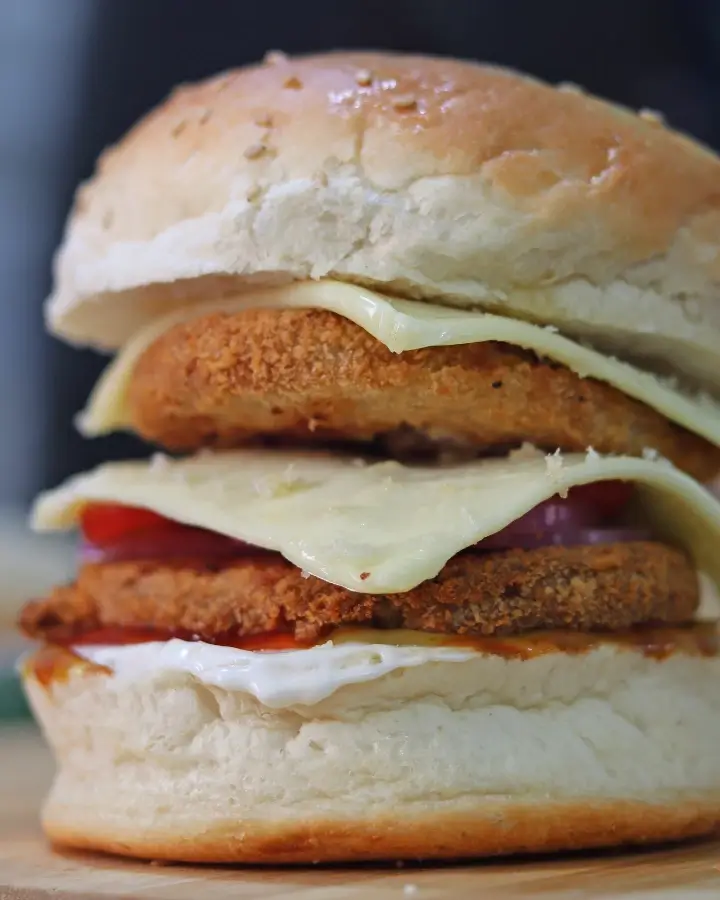
The first frozen chicken patties I cooked in the air fryer looked perfect and were not done. I had run them hot, 400°F, because the crumb browned so fast it seemed like the machine agreed with me. Ten minutes in, the breading was the deep gold of a fast food ad, and the thermometer read 138°F in the center. For chicken, that number is not a texture opinion. It is a safety problem, and it is invisible from the outside, because a breaded patty looks exactly as done at 138 as it does at 165.
The breading is what makes chicken burgers both the easiest and the most misleading thing in the freezer aisle. That par-fried crumb browns on schedule no matter what the middle is doing, so color tells you nothing. Two changes made every batch since come out right: 360°F instead of 400, which lets the center catch up to the crust, and a cheap instant-read thermometer, which replaces guessing with knowing. Get those two right and the air fryer turns a frozen chicken patty into something genuinely better than the deep fryer version: crackling crumb, juicy middle, and no oil to deal with afterward.
Quick answer: Cook frozen breaded chicken patties at 360°F (180°C) for 10 to 12 minutes, straight from frozen with no thawing and no preheat, flipping at the 6 minute mark. They are safe when an instant-read thermometer reads 165°F (74°C) in the center. For cheese, turn the machine off, lay the slice on, and close the drawer for one minute.
Why 400°F fails a frozen chicken patty
A frozen breaded patty is two foods stacked in one puck. The outside is a par-fried crumb coating that only needs reheating and browning, which happens fast. The inside is chicken that has to climb from 0°F to a safe 165°F, which takes time. Run the machine hot and the fast job finishes long before the slow one, leaving you a patty that photographs beautifully at an interior temperature you do not want to read about.
- 360°F closes the gap. The crumb still crisps completely, just on the same schedule the center needs. This is a few clicks below what most boxes and most recipes say, and it is deliberate.
- No preheat, on purpose. A cold start gives the frozen center a head start while the machine ramps up. Preheating is right for most air fryer food; solidly frozen meat is the standing exception.
- The thermometer is not optional. Every breaded patty looks done. A $15 instant-read pushed into the side of the patty is the only test that means anything, and it settles the question in three seconds.
One honest note on smoke: chicken patties rarely cause it, because they render far less fat than beef. If your machine has smoked on burgers before, or you are cooking fattier ground chicken patties, pour a quarter cup of water into the drawer under the basket first. Fat dripping into water cannot vaporize, and the trick costs nothing.
What you need
- 4 frozen breaded chicken patties
- 4 slices American, cheddar, or pepper jack (optional)
- 4 burger buns
- Shredded lettuce, tomato, pickles
- Mayo, or mayo mixed with hot sauce
- Oil spray, only for unbreaded patties
About the patties: the chart below covers every common type, but know which one you are holding. Breaded patties are usually fully cooked or par-cooked and mostly need safe reheating with a crisped crumb. Ground chicken burger patties, breaded or not, are typically raw inside and act like burgers, not nuggets. The box says which, in small print, and it changes nothing about the method; everything cooks to the same 165°F either way.
How to cook frozen chicken burgers in the air fryer
- Patties in cold, single layer. No preheat. Separate any patties frozen together (a butter knife twisted in the seam splits them cleanly) and lay them flat with space between. Two fit a 4 quart basket, four fit most 6 quart models. Never stack; stacked patties steam gray where they touch.
- Optional smoke insurance. A quarter cup of water in the drawer under the basket, if your machine tends to smoke or your patties are ground chicken rather than breaded.
- Cook at 360°F for 6 minutes. Hands off. The crumb dries and starts taking color while the center begins its climb.
- Flip. Tongs, one confident turn. The flip is not cosmetic: the underside sits against the basket and crisps by contact, and each face needs its turn down there or one side ends up pale and soft. Unbreaded patties get their light oil spray on the now-exposed side.
- Cook 4 to 6 minutes more, then check the middle. Instant-read into the side of the patty, aimed at the center: 165°F, no exceptions, whether the patty started fully cooked or raw. Under temperature but browning fast? Drop to 330°F and give it 2 to 3 more minutes; low heat finishes the middle without darkening the crust.
- Cheese with the machine off. Power off, cheese on, drawer closed for one minute. Residual heat melts it into a clean drape. With the fan running, the slice's corners lift and it occasionally deals itself into the back of the basket.
- Rest the patties, toast the buns. Three minutes on a plate for the patties while the buns toast cut side up at 360°F for 1 to 2 minutes. The rest keeps the juices in the chicken instead of in the bun.
- Build and eat. Mayo on the toasted bun, patty, pickles, shredded lettuce, top bun. A crispy chicken burger is at its peak for about ten minutes; it does not hold, and it does not need to.
Time and temperature by patty type
All times from frozen, no preheat, in a 5 to 6 quart basket, flipped halfway. Everything finishes at 165°F in the center; thickness varies between brands, so let the thermometer overrule the clock.
| Patty | Temp | Time | Notes |
|---|---|---|---|
| Breaded chicken patty (standard, ~3 oz) | 360°F | 10 to 12 min | The default this recipe is written for. |
| Spicy breaded patty | 360°F | 10 to 12 min | Same puck, hotter crumb. |
| Chicken patty sliders / minis | 360°F | 7 to 9 min | Check at 7; thin means fast. |
| Ground chicken burger, ¼ lb, unbreaded | 360°F | 11 to 13 min | Raw inside; light oil spray each side. |
| Grilled (unbreaded, pre-cooked) patties | 350°F | 8 to 10 min | Reheating job; do not overrun it. |
| Turkey burger patties | 360°F | 12 to 14 min | Also 165°F, also no exceptions. |
| Plant-based chik'n patties | 350°F | 8 to 10 min | Thin and quick; hot through is done. |
Time and temp by brand
Starting points for the freezer-aisle regulars, same conditions as above. Brands quietly change patty sizes, so trust the thermometer over the row.
| Brand | Temp | Time | Notes |
|---|---|---|---|
| Tyson breaded chicken patties | 360°F | 10 to 12 min | The benchmark. Fully cooked; crisp and verify 165°F. |
| Tyson spicy patties | 360°F | 10 to 12 min | Identical timing to the original. |
| Perdue breaded patties | 360°F | 10 to 11 min | Slightly thinner; check at 10. |
| Foster Farms breast patties | 360°F | 11 to 13 min | Thicker cut; needs the long end. |
| Applegate Naturals patties | 360°F | 9 to 11 min | Thin and clean-label; check early. |
| Great Value / store brand | 360°F | 10 to 12 min | The chart default. |
| Butterball turkey patties | 360°F | 12 to 14 min | Raw inside; thermometer mandatory. |
| Morningstar Chik Patties | 350°F | 8 to 10 min | Veggie; done when hot through. |
Never overcook again
Get our one-page times & temps cheat sheet, plus a new tested recipe each week.
No spam · unsubscribe anytime
Cheese, buns, and assembly, in the right order
The last three minutes decide whether this eats like a chicken sandwich from a good drive-through or a school cafeteria, and the order of operations is the whole game:
- Cheese melts on residual heat, not fan heat. Machine off, cheese on, drawer closed, one minute. The fan is how cheese slices end up folded against the basket wall, and it dries the slice's surface before the middle melts.
- Buns toast while the patties rest. Cut side up, 360°F, 1 to 2 minutes. The rest is not dead time; an unrested patty steams the bun soggy from below within a minute of assembly.
- Sauce goes on the bun, not the patty. Mayo on a hot crumb slides off and takes the crunch with it. Mayo on the toasted bun stays put and meets the patty at the bite.
- Pickles against the patty, lettuce against the bun. Pickle brine on hot crumb is the classic chicken sandwich move, and shredded lettuce belongs against the mayo where it stays cold. Blot wet toppings for two seconds; the crumb you worked to keep crisp deserves it.
Fixing the four problems people actually hit
The crumb browned but the middle read under 165
The signature failure, and it means the temperature was too high for the patty's thickness. Color is no evidence with breaded chicken; the crust browns identically at any interior temperature. Cook at 360°F, and if a patty is browning ahead of its middle, drop the machine to 330°F for the last stretch. Never eat a chicken patty that has not hit 165°F in the center, however finished it looks.
The bottom side stayed pale and soft
Skipped or lazy flip, or a liner in the basket. The underside of the patty crisps by contact with the hot basket, and each face needs its turn down there. Flip at 6 minutes with intent, and never put parchment or a silicone mat under breaded patties; the liner insulates exactly the surface you are trying to crisp. Chicken patties drip so little that the liner has no job to do anyway.
The patty came out dry
Cooked past temperature, almost always because a clock got trusted over a thermometer. Chicken breast in moving hot air goes from juicy at 165 to sawdust in the 180s, and the crumb hides the transition completely. Pull at 165°F, rest 3 minutes, done. Ground chicken and turkey patties dry even faster than breaded breast, which is why their rows on the chart deserve the thermometer most.
The breading blistered or scorched in spots
Hot spots, usually in smaller baskets where the patty edges sit close to the walls, sometimes aggravated by old oil in the crumb catching. Keep patties a finger's width off the walls, rotate them front-to-back at the flip, and drop to 350°F if your model runs hot. If dark specks keep appearing, they are usually crumbs from the last cook burning on the element; a wipe-down between batches ends it.
What to serve with them
Fries from the same machine, sequenced right: run tater tots or sweet potato fries first, hold them in a warm oven, then cook the patties; potatoes forgive holding and a crispy chicken burger does not. In summer, corn on the cob runs alongside in a dual-basket model. And for the rest of the freezer-aisle rotation, this page's siblings are the frozen pizza and frozen chicken wings guides, built on the same no-thaw logic.
Storage and reheating
- Refrigerator: cooked patties keep 4 days in an airtight container. Store patties and buns separately, always; a stored assembled sandwich is a soggy one.
- Reheating: 350°F for 3 to 4 minutes in the air fryer brings the crumb fully back. The microwave heats the patty and destroys the crust; use it only when the crust is already gone.
- Freezing cooked patties: pointless in this case. The uncooked frozen patty in the bag is already the ideal storage format; cook them as needed instead of cooking ahead.
- Refreezing thawed raw patties: no. If a patty thawed in the fridge, cook it now (2 to 3 minutes faster than the chart) rather than refreezing it.
Frequently asked questions
QHow long do frozen chicken patties take in the air fryer?
10 to 12 minutes at 360°F for a standard breaded patty, flipped at 6 minutes. Sliders run 7 to 9 minutes, quarter-pound ground chicken burgers 11 to 13, and turkey patties 12 to 14. In every case the finish line is 165°F in the center on an instant-read thermometer, not a color or a clock.
QDo I need to thaw frozen chicken patties first?
No, and frozen is the better starting point. A frozen patty holds its shape, the crumb crisps evenly, and the cold center gives the crust time to brown without overshooting. If a patty happens to be thawed, cook it 2 to 3 minutes shorter and check the temperature early.
QAren't breaded chicken patties already fully cooked?
Many are, some are not, and the box tells you in small print. It changes nothing about the method: fully cooked patties still need to reach 165°F for safe reheating from frozen, and raw ones need 165°F, period. Cook every frozen chicken patty to the same number and the question stops mattering.
QWhat temperature should chicken burgers reach inside?
165°F (74°C) in the center, measured with an instant-read thermometer pushed in from the side. Chicken gets no medium option and no eyeball test, especially breaded, where the crust browns identically whether the middle is 130 or 165. The thermometer costs about $15 and settles it in three seconds.
QShould I preheat the air fryer for frozen chicken patties?
No. A cold start lets the frozen center begin warming while the machine ramps up, which narrows the gap between a browned crumb and an undercooked middle. Preheating suits most air fryer food; solidly frozen meat is the exception.
QWhy is my chicken patty brown outside but cold inside?
Too hot, almost always 400°F from the box or an older recipe. The par-fried crumb browns on its own schedule regardless of the center, so high heat finishes the outside first and lies about the inside. Cook at 360°F, and if the crust is ahead of the middle, drop to 330°F for the last few minutes.
QHow do I add cheese without it blowing around?
Turn the machine off first. Lay the cheese on the finished patty, close the drawer, and let residual heat work for one minute; the slice melts into an even drape. With the fan running, the corners of the slice lift, dry out, and sometimes fold the cheese off the patty entirely.
QDo I need oil spray on frozen chicken patties?
Not on breaded ones; the crumb is par-fried and carries its own oil, which is why it crisps so well in dry moving air. Unbreaded patties, ground chicken, and turkey burgers do benefit from a light spray on each side, since they lack both the coating and beef's internal fat.
QHow many chicken patties can I cook at once?
A single layer with space between: usually 2 in a 4 quart basket, 4 in a 5 to 6 quart, and 4 to 6 on an oven-style tray. Stacked or overlapping patties steam soft where they touch. For a crowd, run batches; the second batch cooks about a minute faster in the hot machine.
QCan I toast the buns in the air fryer too?
Yes, and the timing writes itself: while the patties rest for 3 minutes, the buns go in cut side up at 360°F for 1 to 2 minutes. Watch them after the first minute; buns move from golden to crouton quickly.
QWhy did my air fryer smoke?
Rarely a chicken patty problem, since they render little fat. If it happens, it is usually old grease in the drawer from a previous cook, or fattier ground patties dripping onto hot metal. Clean the drawer, and pour a quarter cup of water into it before cooking; fat dripping into water cannot vaporize into smoke.
QHow do I reheat a cooked chicken burger in the air fryer?
350°F for 3 to 4 minutes straight in the basket brings the crumb back to crisp without drying the middle. Reheat the patty alone and rebuild with a fresh toasted bun and cold toppings; a reheated assembled sandwich comes out uniformly warm and uniformly soggy.
If you cook these, report back on one thing: what your thermometer read the first time you checked at the 10 minute mark, and which brand you cooked. Those two data points are how the brand chart above keeps getting more accurate. For more from-frozen wins, try our frozen pizza, frozen chicken wings, or frozen salmon. New to the machine? Start with how to bake in an air fryer, keep the times and temps chart handy, and use the air fryer calculator to convert any oven recipe.
You can also follow me on Instagram and Pinterest for more easy air fryer recipes.
Made this? Rate the recipe