

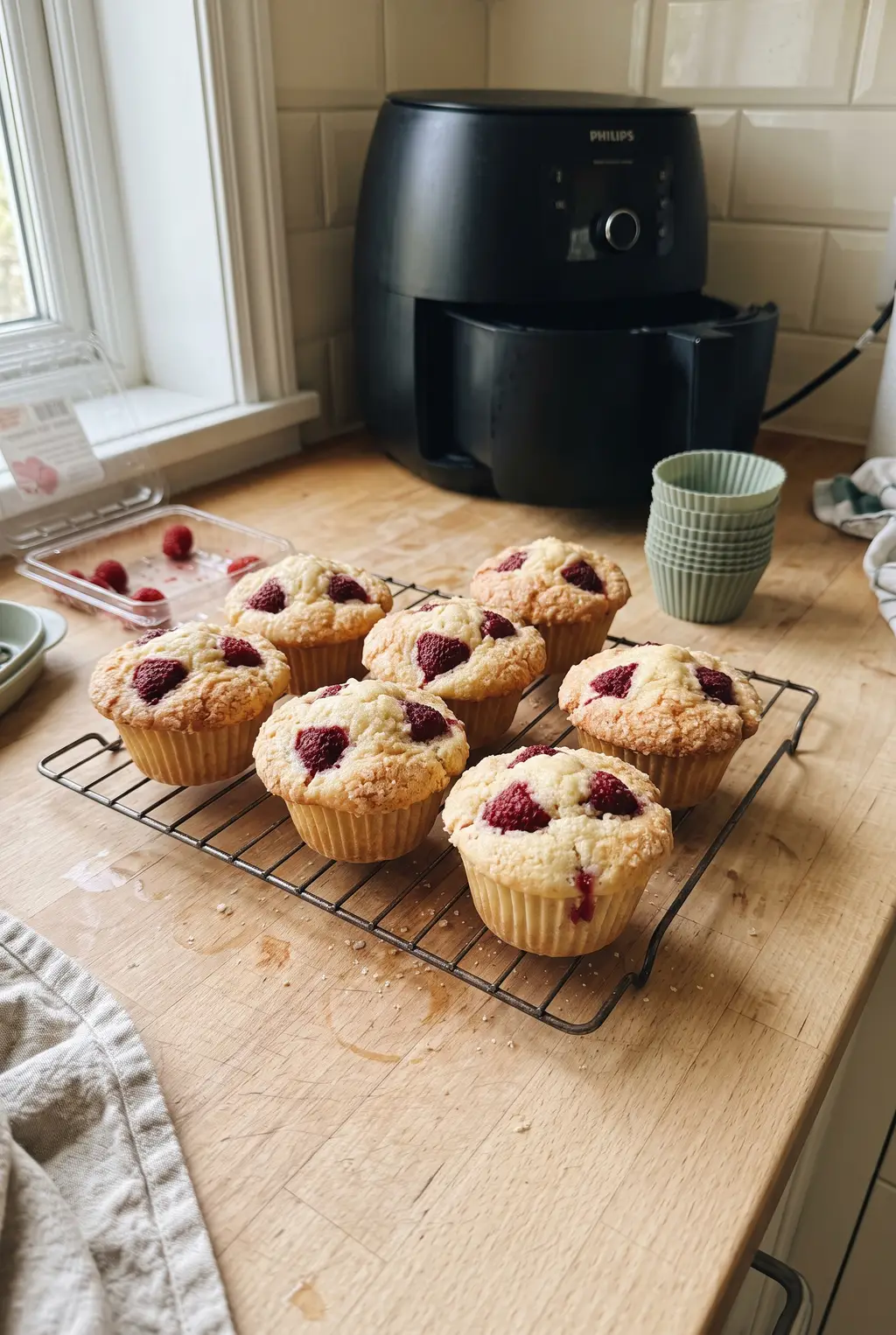
A raspberry is not a blueberry
Muffin recipes treat berries as interchangeable, and raspberries pay for it. A blueberry is a sturdy little pressure vessel: taut skin, dense flesh, built to survive a few folds of a spatula. A raspberry is the opposite of that, a hollow thimble of juice-filled cells held together by wishful thinking, picked ripe because it does not ripen after, and already at the edge of collapse when it leaves the clamshell. Fold raspberries into batter the way every recipe instructs, gently, last, just a few strokes, and some of them break anyway, because for a raspberry, a fold is a crush. Every broken berry bleeds, and the bleed is not pretty pink; it is a bruised pink-gray that spreads through the crumb and takes the whole muffin's looks with it.
The recipes ranking for this keyword either ignore the problem or make it worse; the most complete one recommends defrosted frozen berries, which arrive pre-collapsed. Our blueberry muffins can afford their fold because their berry can take it. This page starts from the admission that its berry cannot, and builds the recipe around never touching it.
Layer them, never fold them
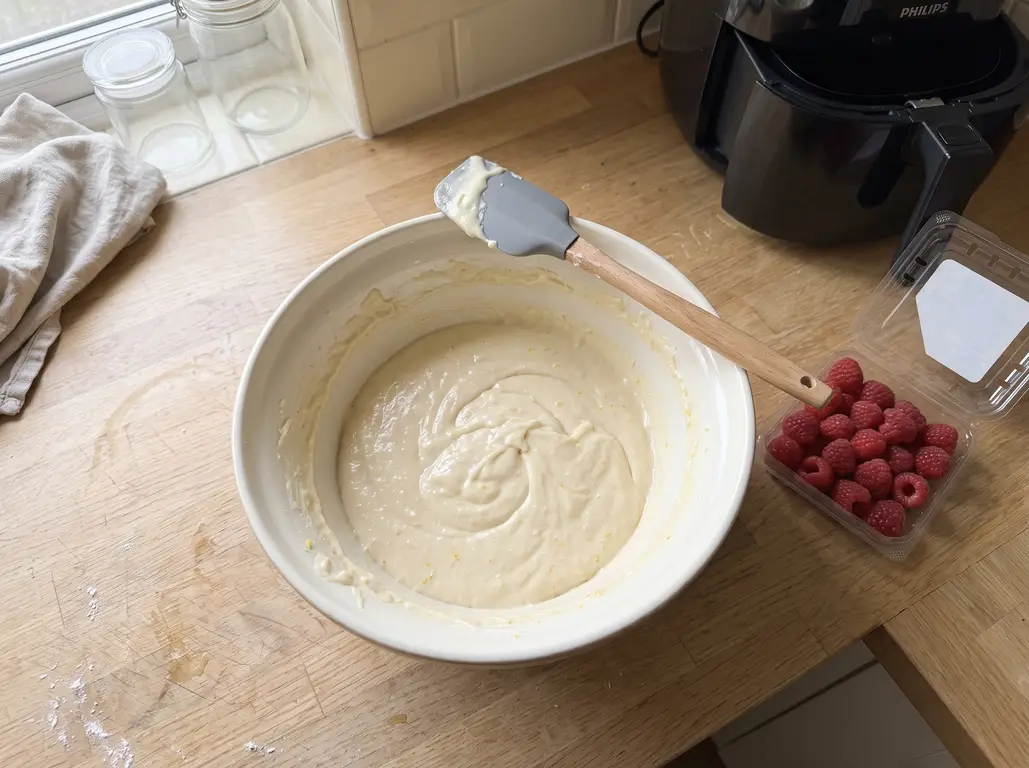
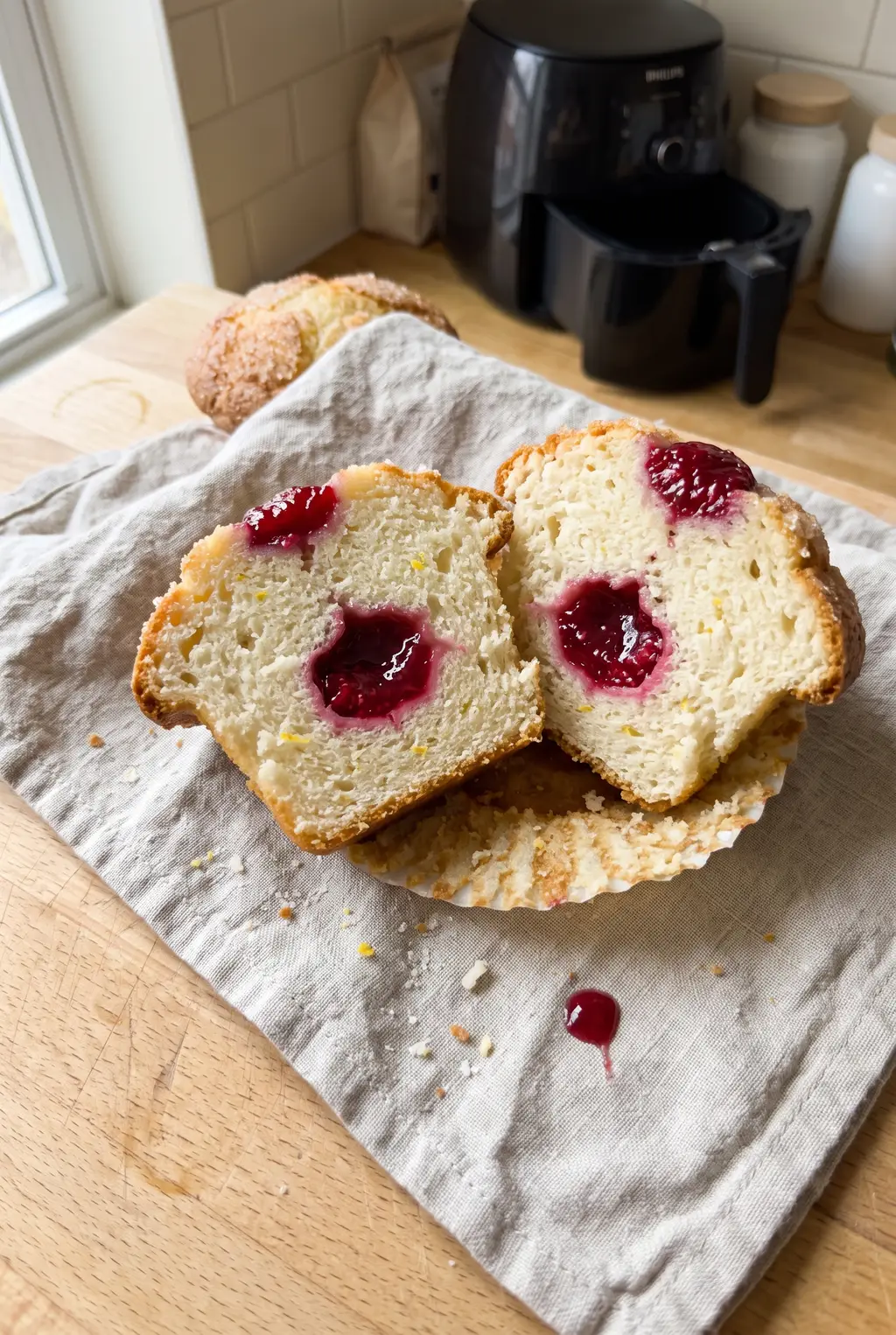
The move that makes this page: the raspberries never meet the spatula. The batter is mixed and rested completely berry-free, then the muffins are assembled in layers: half the batter spooned into the cups, half the raspberries dropped on whole, spaced apart like you are setting stones, the rest of the batter over them, and the last berries pressed lightly into the tops with a sprinkle of coarse sugar. Nothing gets stirred, so nothing bleeds. The muffin bakes with clean pale crumb around intact berries that turn into pockets of hot jam, and the tops carry whole fruit where you can see it.
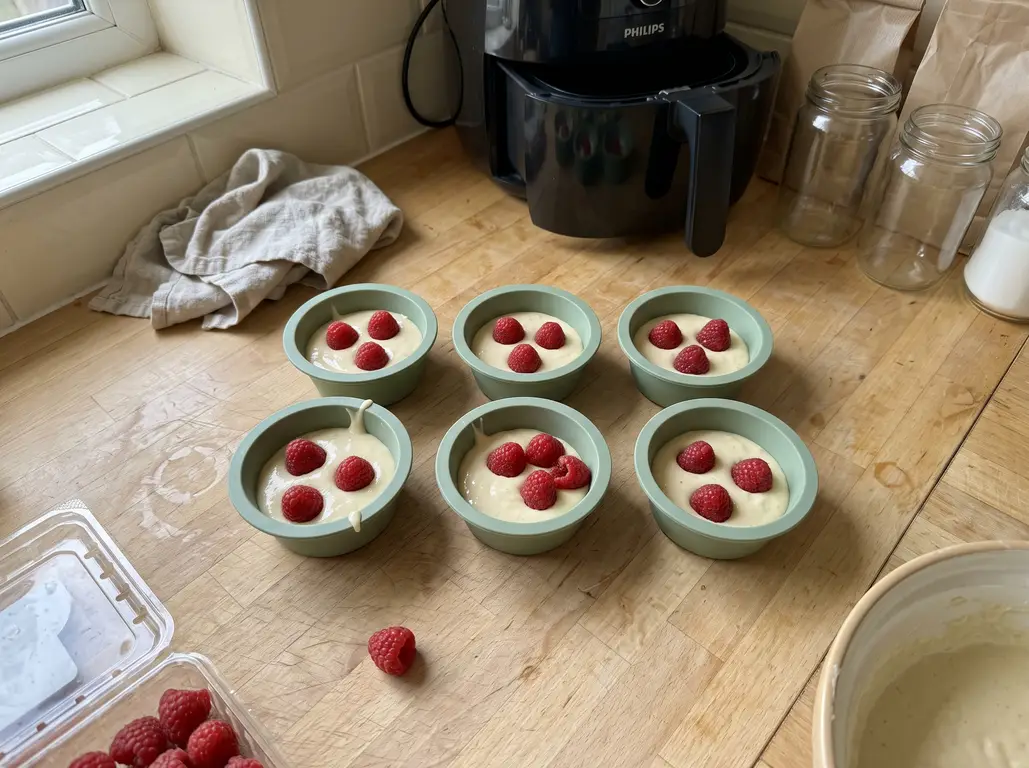
The layering solves the other raspberry complaint too. Berries folded through a batter sink when the batter is thin, and raspberries, heavy with juice, sink first. Layered berries sit on a bed of batter with nowhere to go, and the 15 minute rest thickens everything around them into place. One rule inside the rule: keep that bottom layer of batter at least a third of the cup deep, because a berry sitting on bare silicone bakes into a wet patch that glues the muffin to the cup. That is the entire technique. It costs one extra minute of assembly and repays it in every muffin.
Fresh, frozen, never thawed
Fresh raspberries are the recipe's namesake, and one standard 6 ounce clamshell is exactly one batch, which is not a coincidence; the recipe was sized to the container the fruit actually comes in. Look for berries that are matte and deeply colored, and use them within a day or two of buying, because raspberries keep a schedule of their own.
Frozen raspberries work all year on one strict condition: into the batter rock hard, straight from the freezer. Freezing ruptures some cells no matter what, but a frozen-solid berry holds its shape through layering and most of the bake, then softens into the same jammy pocket as fresh. A thawed raspberry has already collapsed in the bag; it layers in as a smear and brings melt-water the batter did not budget for. The bake gains about a minute with frozen fruit, so trust the 200°F reading over the clock. And skip the flour-toss ritual here entirely: tossing is for berries that get folded, and these never do.
Lemon sugar, the quiet second flavor
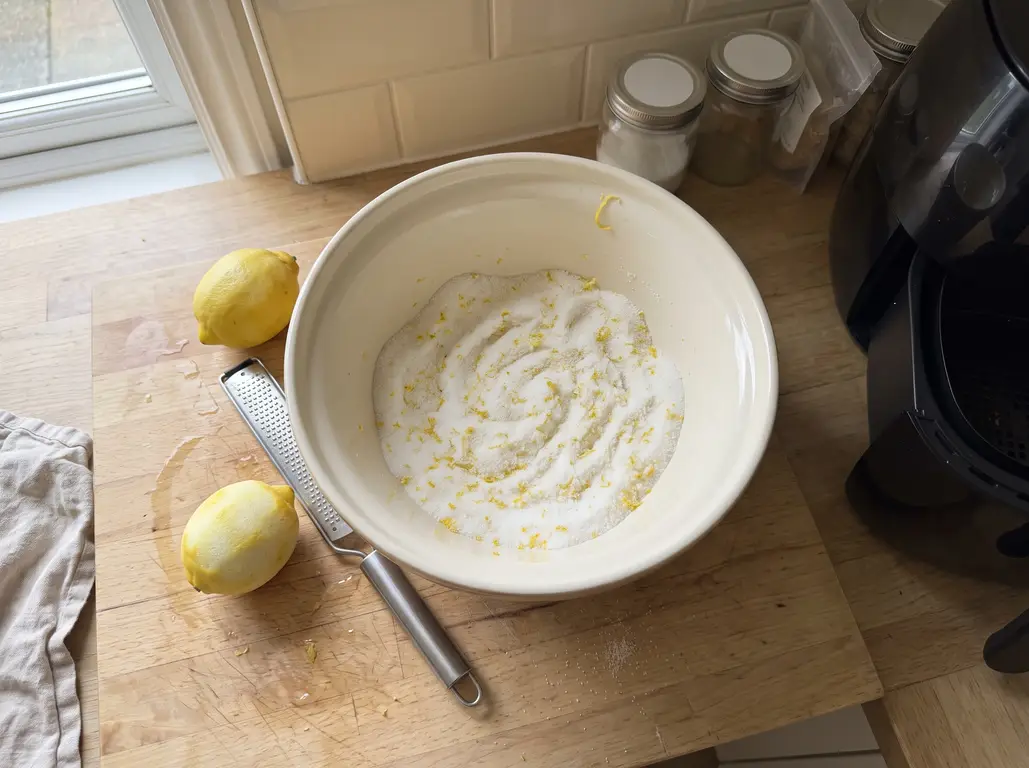
Raspberry and lemon is one of baking's old married couples, and the way to officiate it without turning this into a lemon muffin is the trick the lemon poppy seed muffins run at full volume: rub the zest into the granulated sugar until it is damp and fragrant, and stop there. One lemon's zest, no juice in the batter. The zest oils coat the sugar and travel through the whole crumb as brightness rather than as lemon flavor, and the raspberries read riper for it. The sour cream in the batter does its usual quiet work, moisture and a soft, close crumb sturdy enough to hold layered fruit, and the coarse sugar on top bakes into the crunch that makes the crowns read bakery instead of homemade.
370 for the dome, 310 for the finish
The few real air fryer recipes for this muffin bake at a flat 350°F and describe their own results honestly: pale sides, lopsided crowns, check it with a toothpick and hope. The house schedule does better, the same one the blueberry muffins built their domes on: 370°F for 4 minutes to set the crown while the batter is still climbing, then down to 310°F for 10 to 12 minutes to bake the middle through without pushing the sugared tops past golden. An oven raspberry muffin at 375°F converts to about 350°F through the air fryer calculator, and the step down from there is the wet-fruit tax every berry bake on the baking chart pays.
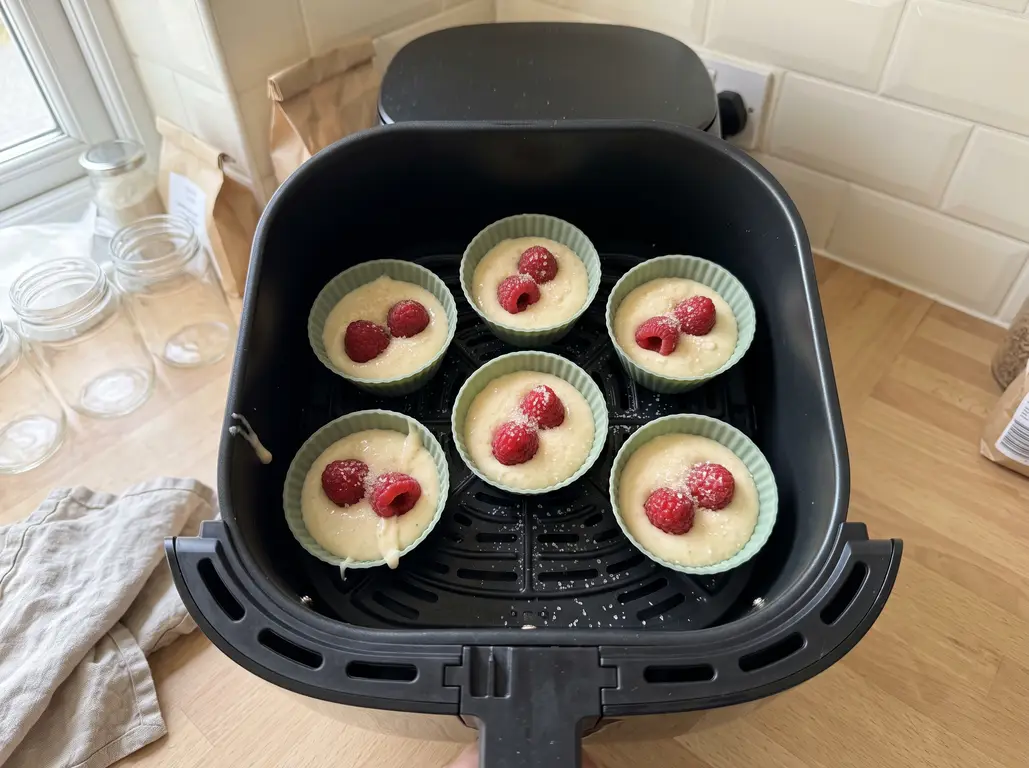
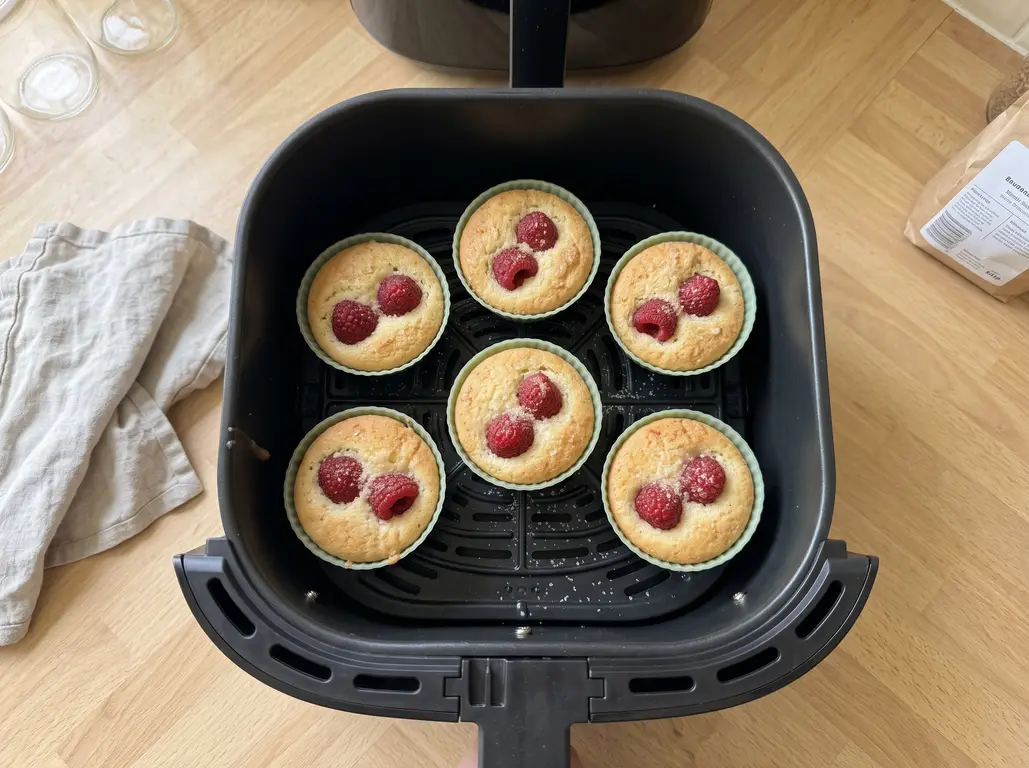
Doneness is a number, because the toothpick has a new way to lie here: push it through a muffin and sooner or later it lands in a molten raspberry pocket and comes out looking like raw batter on a fully baked crumb. 200 to 205°F on a thermometer in the center of the middle muffin, the same figure the banana muffins and the rest of the wet-batter shelf finish at, plus the spring test on a dome. The cups themselves follow house rules, six freestanding silicone cups straight on the basket floor with real air between them; crowding is what steams crowns pale and crooked, and the deeper physics live in the silicone molds guide.
Ingredients
For 6 bakery-size muffins
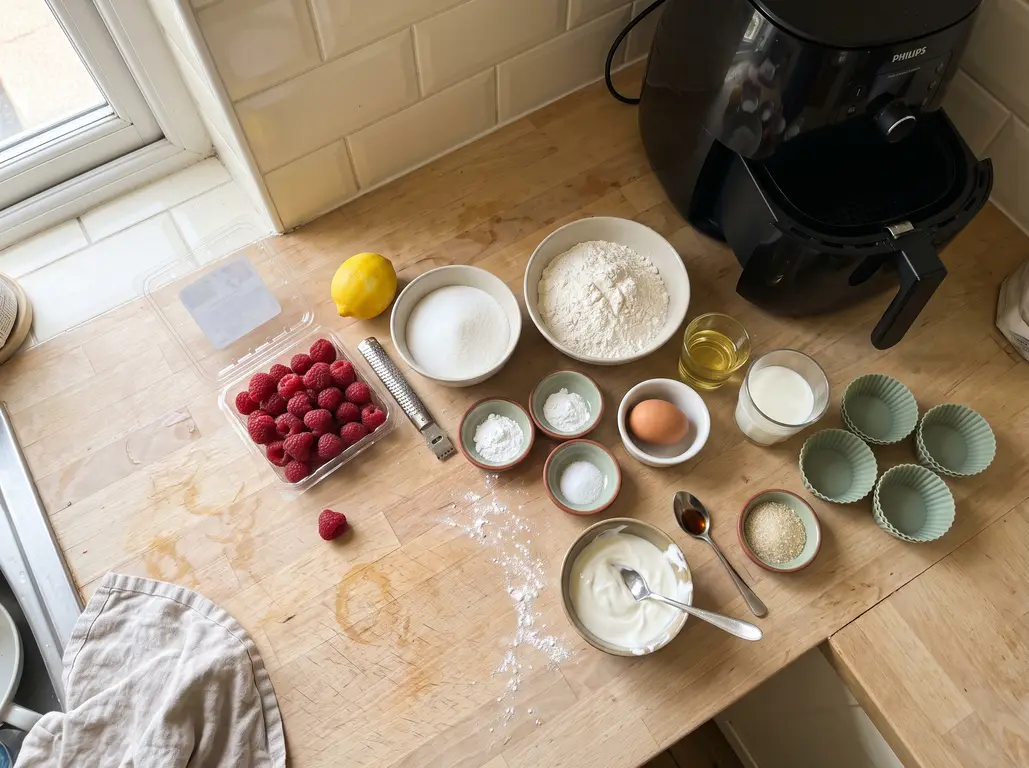
- 2/3 cup (133g) granulated sugar and the zest of 1 lemon
- 1 1/2 cups (188g) all-purpose flour
- 2 teaspoons baking powder and 1/4 teaspoon baking soda
- 1/2 teaspoon fine salt
- 1 large egg
- 1/2 cup (120g) sour cream, full fat
- 1/4 cup (60ml) neutral oil
- 1/4 cup (60ml) whole milk
- 1 1/2 teaspoons vanilla extract
- One 6 ounce clamshell fresh raspberries, about 1 1/3 cups, or frozen straight from the bag
- Coarse sugar for the tops
- 6 silicone baking cups
One clamshell, one lemon, one batch. If your berries are enormous, halve the very biggest ones for the inner layer with a sharp knife, cut side up so the juice stays put, and leave the top berries whole for looks.
How to make them
- Zest the lemon straight into the sugar in a large bowl and rub them together with your fingertips until the sugar is damp and fragrant. The lemon stays in the background; its job is to make the raspberries taste more like themselves.
- Whisk the flour, baking powder, baking soda and salt in a second bowl.
- Whisk the egg, sour cream, oil, milk and vanilla into the lemon sugar until smooth and glossy.
- Fold the dry into the wet just until the last streak of flour disappears. The raspberries do not go in; that is the point of this recipe. Rest the batter 15 minutes, and preheat the air fryer at 370F for 3 minutes near the end of the rest.
- Spoon half the batter into the 6 cups, drop half the raspberries on whole, spacing them apart, cover with the remaining batter, then press the last berries lightly into the tops and sprinkle with coarse sugar.
- Set the cups on the basket floor with air between them and air fry at 370F for 4 minutes to set the domes, then drop to 310F for 10 to 12 minutes more. Frozen berries add about a minute.
- Confirm 200 to 205F on a thermometer in the center of the middle muffin; a toothpick that finds a hot raspberry will read wet on a fully baked crumb.
- Cool the cups 5 minutes and push the muffins out from underneath. The berry pockets are molten jam straight from the basket and settle as they cool; day-one muffins are best eaten just barely warm.
Variations
- White chocolate raspberry: 1/2 cup of chopped white chocolate folded into the batter, which is legal because chocolate can take a fold even though raspberries cannot. The bakery-case pairing for a reason.
- Raspberry almond: 1/2 teaspoon almond extract in the wet bowl and sliced almonds pressed on with the top berries, where they toast in place.
- Lemon glaze: the zested lemon still has its juice; whisk 2 tablespoons of it into 3/4 cup powdered sugar and drizzle over fully cooled muffins only, and they move from breakfast to dessert, the way the lemon cake leans.
- Mixed berry: raspberries in the middle layer, blueberries folded into the batter proper, or a handful of the tart-sweet fruit from the cranberry orange muffins. Each berry handled the way its structure deserves.
- Minis and jumbos: minis at 310°F for 7 to 9 minutes, jumbos at 300°F for 19 to 23, per mini vs jumbo muffins; keep the layering at every size.
- Doubling: the recipe scaler handles the math, two clamshells handle the fruit, and batch two bakes about a minute faster in the warm machine.
Fixing what goes wrong
| Problem | Cause | Fix |
|---|---|---|
| Pink-gray streaked crumb | Berries folded in, or thawed frozen berries | Layer whole berries, and frozen ones go in rock hard |
| Berries all at the bottom | Fruit folded through a thin batter | The layering plus the 15 minute rest; the bottom batter layer is the floor |
| Muffin glued to the cup | Berries sitting on bare silicone | Keep the first batter layer a third of the cup deep before any fruit lands |
| Wet toothpick forever | It keeps finding jam pockets | That is the recipe working; verify 200°F on a thermometer instead |
| Pale, lopsided crowns | One flat temperature and crowded cups | The 370°F start, and real air between the six cups; hot-running machines live in the burning guide |
| Dry crumb around the fruit | Overbaked chasing a clean toothpick | Pull at 200 to 205°F; the wider rules are in the dry bakes guide |
| Soggy by day two | Raspberries exhale more than any berry | Paper towel in the container, 2 day counter limit, freezer after; deeper mysteries live in the troubleshooting guide |
Storage and freezing
Here is the honest schedule: these are the shortest-lived muffins on this site, because a raspberry never stops surrendering moisture to the crumb around it. Day one, barely warm, is the peak. Airtight at room temperature with a paper towel under and over them, they hold 2 good days, one less than the rest of the muffin shelf gets. After that, the freezer beats the counter: wrapped individually they keep 3 months, and 2 to 3 minutes at 300°F in the basket revives them with the berry pockets warm and jammy again, which a microwave manages only at the cost of a gummy top.
When the clamshell habit outgrows one recipe, the berry shelf continues with the strawberry muffins and the berry cobbler, which takes raspberries by the cup with its own sugar and starch math, and the whole muffin and pastry lineup lives on the pastries and morning bakes page. When raspberry season runs into the holidays, the same basket handles the Thanksgiving lineup and the Christmas cookies, where a bowl of these on the table earns its keep at either brunch.
Frequently asked questions
QWhat temperature do you bake raspberry muffins in an air fryer?
Two temperatures: 370°F for the first 4 minutes to set the dome, then down to 310°F for 10 to 12 more, until a thermometer reads 200 to 205°F in the center muffin. A single mid-level temperature the whole way, which is what most air fryer muffin recipes run, gives you a flatter top and pale, uneven crowns. The short hot start does the dome work while the batter is still rising, and the low finish bakes the middle through without browning the sugared tops past golden. The second batch, if you double, runs about a minute faster.
QHow do you keep raspberries from bleeding into muffin batter?
Stop stirring them. Raspberry bleed is almost never the berry's fault; it is the spatula's. A raspberry is a hollow cluster of juice-filled cells that collapses under the gentlest folding, and every broken berry dyes the batter around it pinkish gray. So this recipe never folds them at all: the batter is mixed and rested berry-free, then the berries are layered in whole, half dropped onto a first layer of batter, the rest pressed onto the tops. Zero folding means zero crushing, and the berries bake into intact jammy pockets instead of a smear.
QCan I use frozen raspberries?
Yes, on one strict condition: straight from the freezer to the batter, still rock hard, never thawed. A thawed raspberry is not a berry anymore, it is jam with a memory, and it will streak the crumb gray and add water the recipe did not budget for. Frozen-solid berries layer in exactly like fresh ones, hold their shape better than fresh during baking, and cost about one extra minute in the basket. Lean on the 200°F thermometer reading rather than the clock and the swap is seamless.
QWhy layer the raspberries instead of folding them in?
Because folding is a crush test that raspberries fail. Blueberries are sturdy little spheres and survive a few strokes; raspberries are hollow and soft-walled, and the standard fold-them-in-last instruction is exactly how the batter turns pink-gray and the fruit disappears into streaks. Layering, batter, whole berries, batter, berries on top, gets even fruit distribution with zero contact between spatula and berry. It also solves sinking, since the bottom layer of batter holds the fruit up, and it puts whole berries on display on the crowns.
QWhy did my raspberries sink to the bottom?
In a folded recipe, two reasons: the batter was too thin to hold the fruit, or the berries went in coated with nothing. This recipe sidesteps both by construction. The 15 minute rest thickens the batter until it holds a spoon line, and the layering puts a bed of batter underneath the fruit, so there is nowhere to sink to. If you adapt the layering trick to another recipe, keep the bottom layer at least a third of the cup's depth; berries dropped straight onto the cup floor bake into a wet pocket that glues the muffin to the silicone.
QCan I use paper liners in the air fryer for these?
Not alone. Paper cases slump sideways under a wet batter in the fan and bake soggy sides, and a metal muffin tin blocks the under-basket airflow the machine cooks with. Freestanding silicone cups, six at a time directly on the basket floor with air between them, are the answer, and the spacing matters more here than most muffins: crowded cups steam each other's crowns pale and lopsided. If you want the bakery look, seat a paper liner inside each silicone cup and it rides along safely.
QHow do you store raspberry muffins?
For less time than any other muffin on this shelf, because raspberries never stop giving up moisture. Airtight at room temperature with a paper towel under and over them for 2 days, not the usual 3; after that the berry pockets start softening their surroundings. They are best on day one, barely warm. For longer, freeze: wrapped individually they hold 3 months, and 2 to 3 minutes at 300°F in the basket brings them back with the pockets warm and jammy. The freezer beats the third day on the counter every time.
Made it? Rate it.
Never overbake again
Get our one-page times & temps cheat sheet, plus a new tested recipe each week.
No spam · unsubscribe anytime