
Air Fryer Lemon Poppy Seed Muffins: Bright and Not Too Sweet
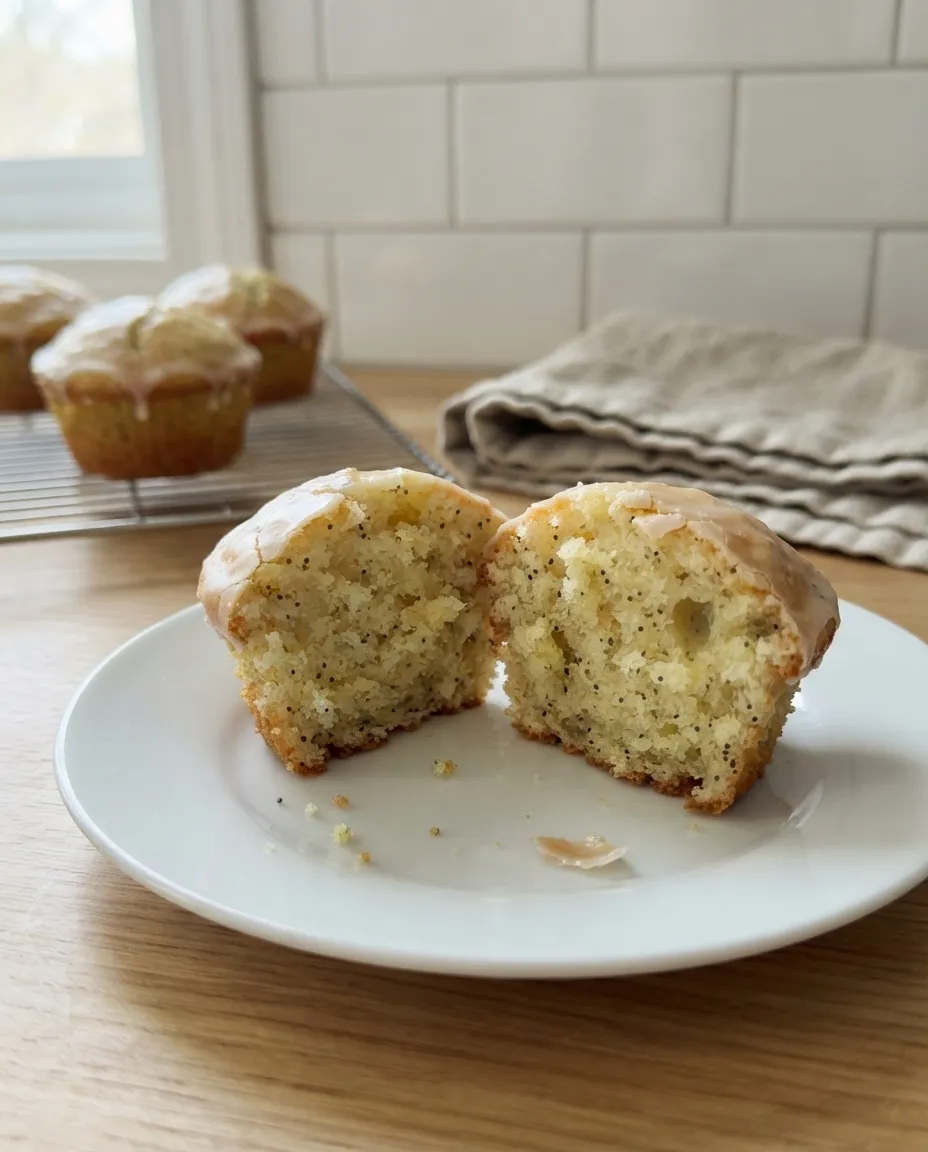
The lemon poppy seed muffin has been kidnapped by the warehouse store: a half-pound of sweet yellow crumb where the lemon is a rumor and the poppy seeds are decoration. This is the rescue. The zest of two lemons gets rubbed into the sugar until the whole bowl smells like the title, because zest is where lemon lives and juice is what it leaves behind in the oven. The seeds soak in the buttermilk so they arrive soft and nutty instead of gritty. The sugar stays at two-thirds of a cup for a dozen, because the glaze, thin, tart, and applied only to a cool muffin, is carrying the sweetness so the crumb does not have to. Baked at 320 degrees, the lane every muffin in this kitchen drives in, to a center that reads 200 and means it.
What’s on this page
Where the bright actually comes from
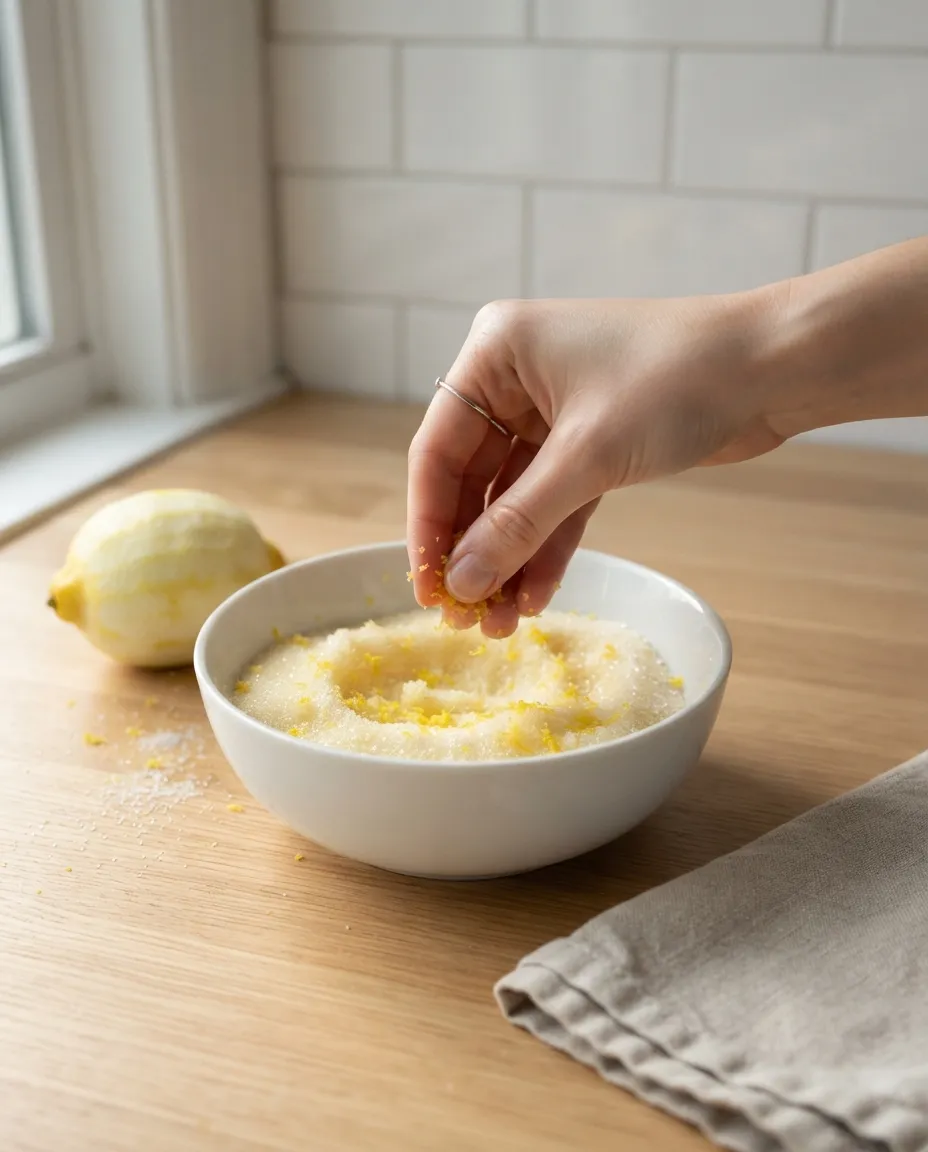
Lemon flavor lives in the zest, in the oils of the peel, and it dies in the juice the moment juice meets heat: the aromatics boil off and leave behind a vague acidity that reads as sour, not as lemon. This is the founding law of this site's whole lemon shelf, argued at length on the lemon bread and applied to the lemon cake and the lemon bars, and the muffins obey it too, as do the lemon variations of the pound cake and the blueberry muffins. So the batter gets no juice at all. Instead, rub the zest of two lemons into the sugar with your fingertips for a full minute, until the sugar turns pale yellow, clumps slightly, and smells louder than seems reasonable. Sugar is an oil sponge; the rubbing tears open the zest's oil cells and locks the aromatics where the heat cannot take them. The juice waits for the glaze, where it never gets baked and stays sharp. One fruit, two jobs, nothing wasted.
The not-too-sweet audit
The title promises restraint, so here is the arithmetic. Two-thirds of a cup of sugar across twelve muffins is about nine grams each, half of what the warehouse-store version carries per equivalent bite, and the crumb tastes like lemon and butter-adjacent richness instead of frosting's understudy. The trick that makes restraint work is relocation, not deprivation: the tart glaze delivers its sweetness directly to your tongue at full strength, un-baked and un-dulled, so a thin drizzle does the perceived work of a quarter cup of batter sugar. Add the tang of sour cream and buttermilk pulling in the other direction and the muffin lands where a good one should: bright, balanced, and finishable, the kind you eat with coffee instead of instead of coffee.
Poppy seeds, honestly
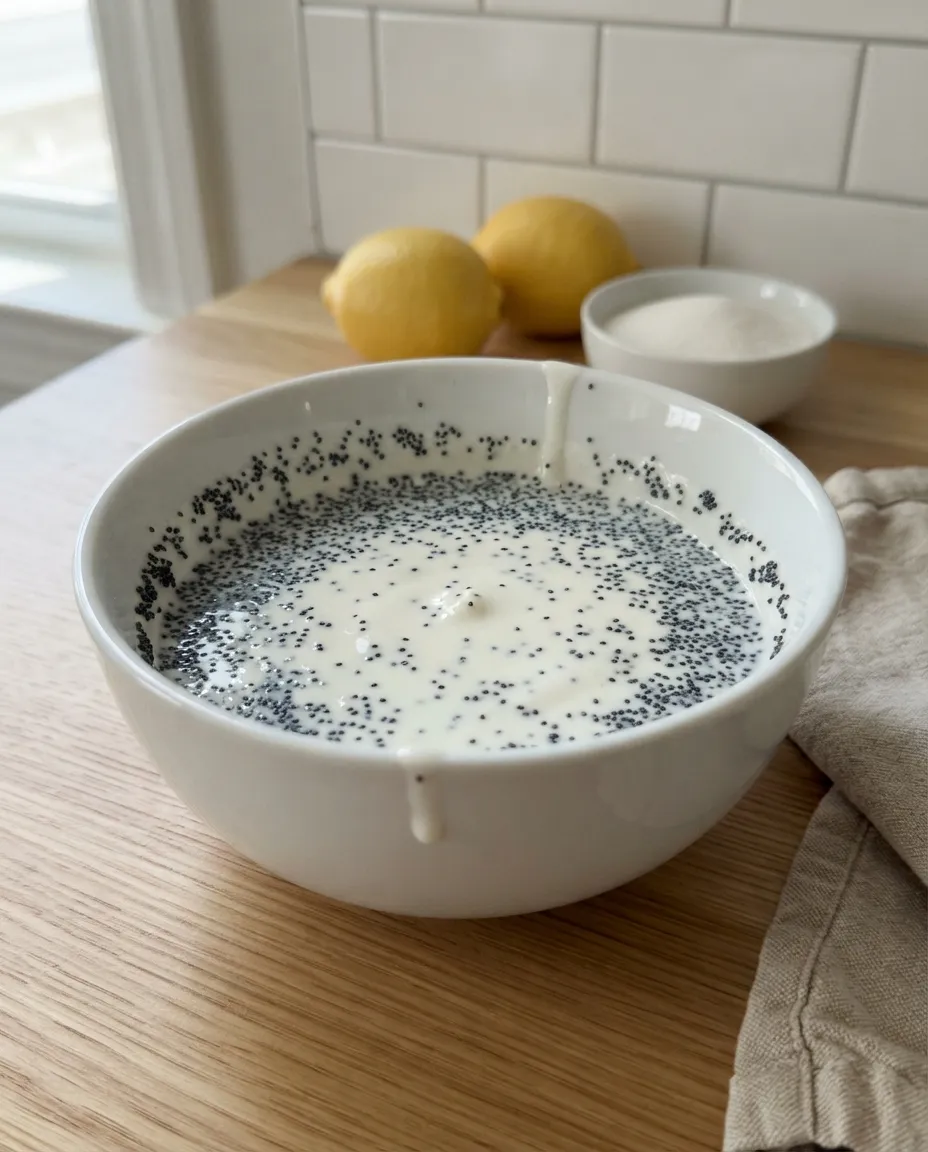
Three truths the ranking pages skip. First, the amount: 3 tablespoons for a dozen is the line between speckled and gravelly; the seeds are punctuation, not the sentence. Second, the soak: poppy seeds are tiny and hard, and folded in dry they stay faintly crunchy through the bake. Soak them in the buttermilk for 15 minutes while you rub the zest and measure the dry ingredients, and they soften into the gentle pop and nutty undertone that old-world bakers soaked them for; the wait doubles as the batter's schedule, so it costs nothing. Third, the one nobody says out loud: poppy seeds go rancid, faster than any spice in your cabinet, because they are oil-rich and small. Smell the jar before you bake; fresh seeds smell faintly nutty, stale ones smell like old paint. Store them in the freezer, where they keep for a year instead of a season, and a bitter muffin will never get wrongly blamed on the lemon.
The sour cream crumb
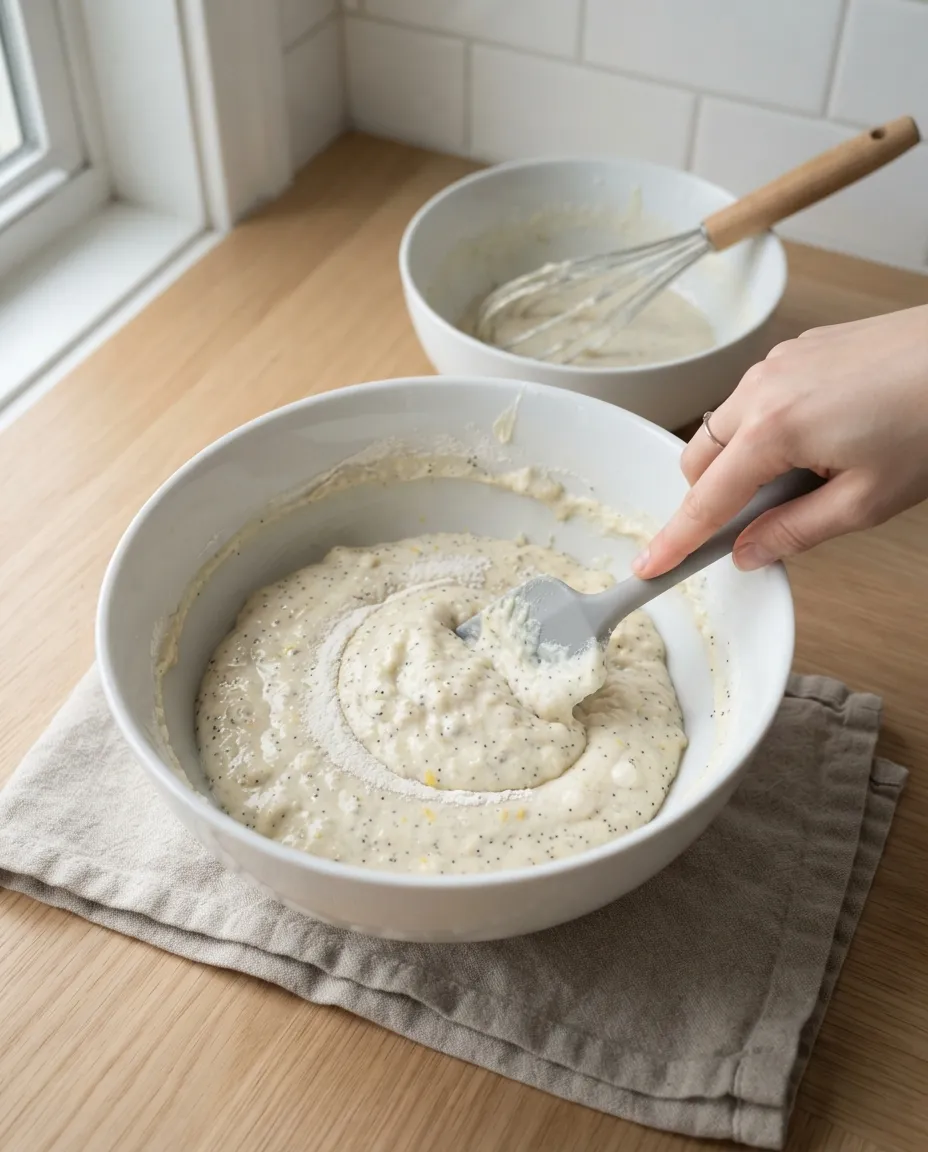
The crumb runs on the same tenderness levers as the rest of this kitchen's muffin shelf: acidity and a light hand. Sour cream and buttermilk together keep the crumb plush and lend the tang that makes the lemon read brighter, oil rather than butter keeps it moist into day two, the same reason the chocolate chip muffins carry oil, and the folding stops at the last streak of flour, because a batter stirred smooth is a muffin with a grudge. If you have ever wondered why bakery lemon muffins eat fluffier than homemade, it is rarely the recipe and usually the final thirty seconds of stirring that homemade did and the bakery, mixing by weight and timer, did not.
A glaze that stays tart
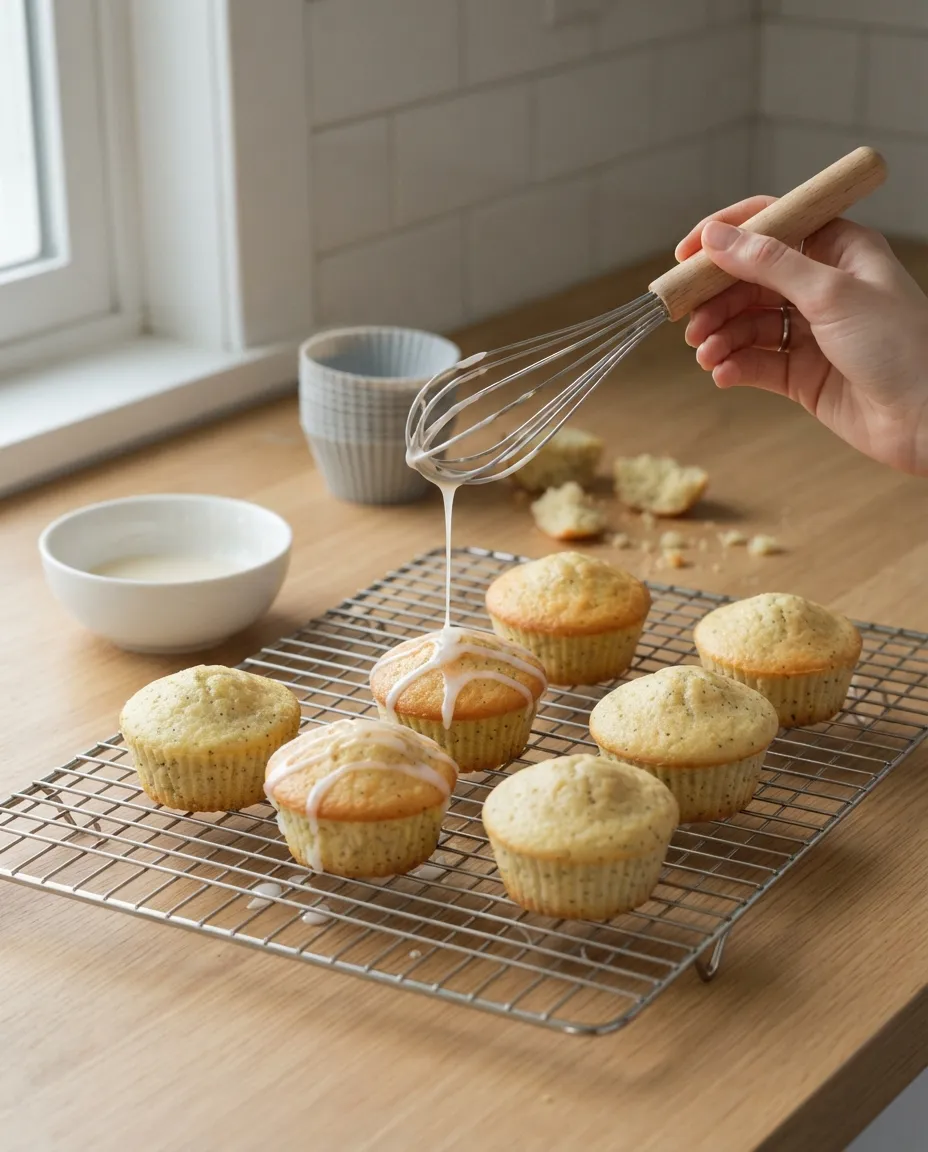
The glaze is powdered sugar, fresh lemon juice and a pinch of salt, whisked thin enough to fall from the whisk in a ribbon, and it obeys the cold law that governs every glaze on this site: it goes on a cool muffin, never a warm one. Drizzled over warm crumb, the sugar melts, the glaze turns invisible, and all that sharp juice you protected from the oven soaks in and vanishes; over a cool muffin it stays on the surface and dries in twenty minutes to a translucent, sharply lemon shell with a faint crackle. Thin is correct here, more wash than icing: this muffin wants a tart glaze you can see through, not the opaque cap a lemon loaf wears. Patience, as usual, is the only skilled ingredient.
Temperature and timing
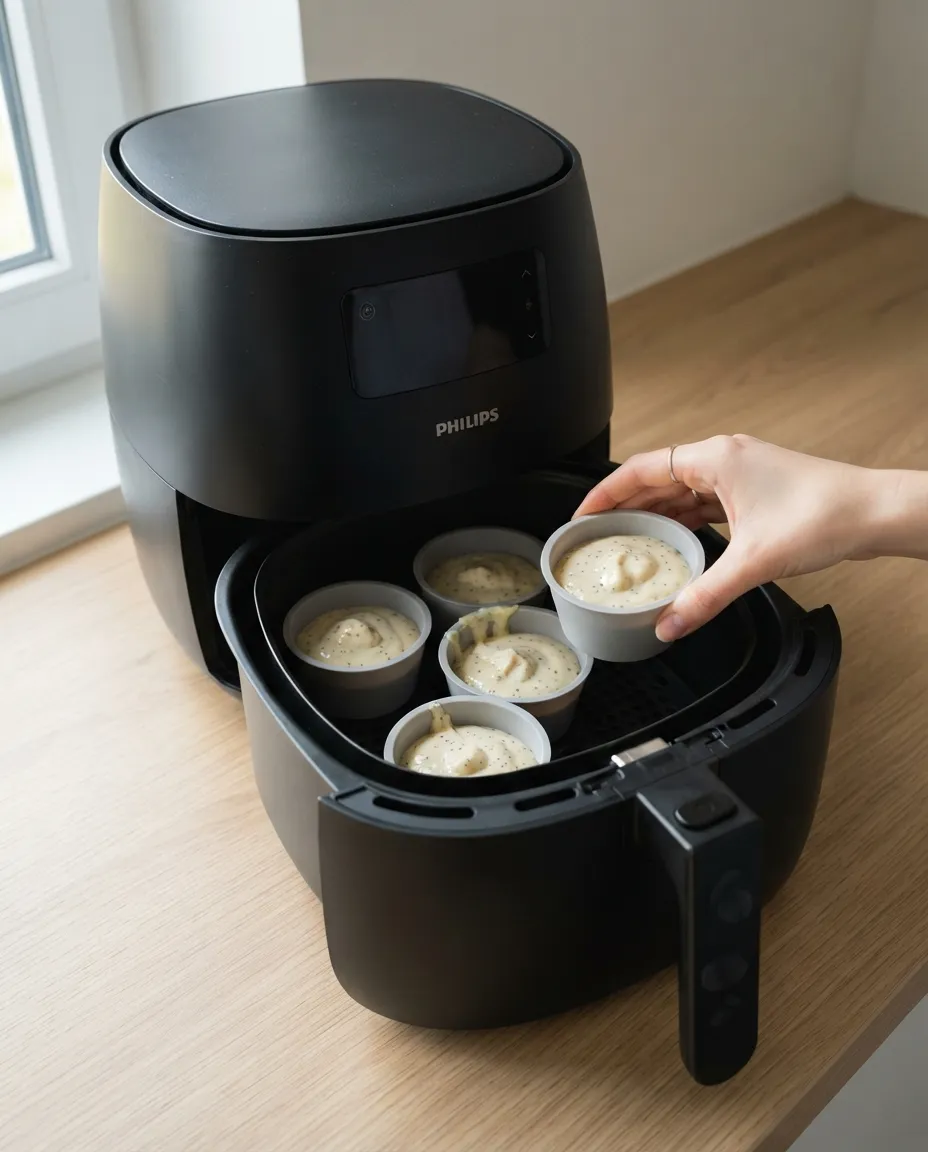
320°F for 12 to 14 minutes, six silicone cups at a time, basket preheated 3 minutes. The oven versions of this muffin run hot on purpose, 375 to 425, chasing tall bakery domes with an initial blast; a basket cannot borrow that trick, because at those settings the fan browns the sugared surface minutes before the middle sets, and lemon crumb scorched even slightly turns bitter. 320°F is the house muffin lane, the same one the banana muffins and carrot muffins run in, and the honest trade is a gentler dome for a moist, even crumb, which the glaze then makes nobody miss. Fill the cups two-thirds, leave air between them on the basket floor, run batch two a minute shorter. The standard oven-to-basket drop from 400 lands at 375 by way of our air fryer calculator, and the rest of the descent is the sweet-batter tax recorded across the baking chart; the preheat case is filed under do you need to preheat an air fryer for baking, and the silicone-slows-the-clock physics under using silicone molds in an air fryer.
Done is a number
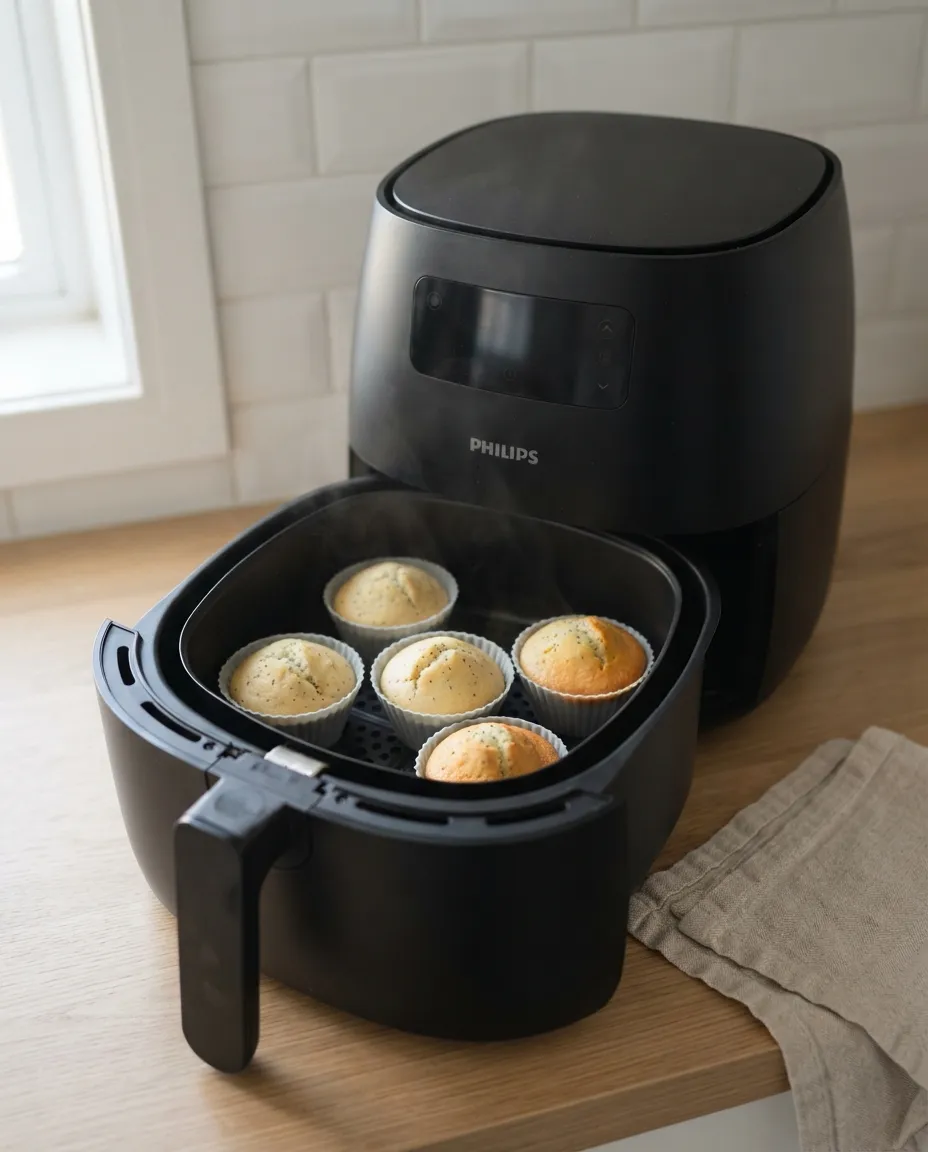
200 to 205°F in the center of the middle muffin. The toothpick is nearly honest with this crumb but errs a minute early, reading clean while the center is still settling, and that stolen minute is day two's moisture; the thermometer does not round in either direction. Corroborate with the spring test, a dome that refills immediately after a gentle press, and with the edges just releasing from the silicone. The tops should be gold with pale sides, which is what silicone cups produce at a civilized temperature and exactly what the glaze was hired to dress.
Ingredients
For 12 muffins
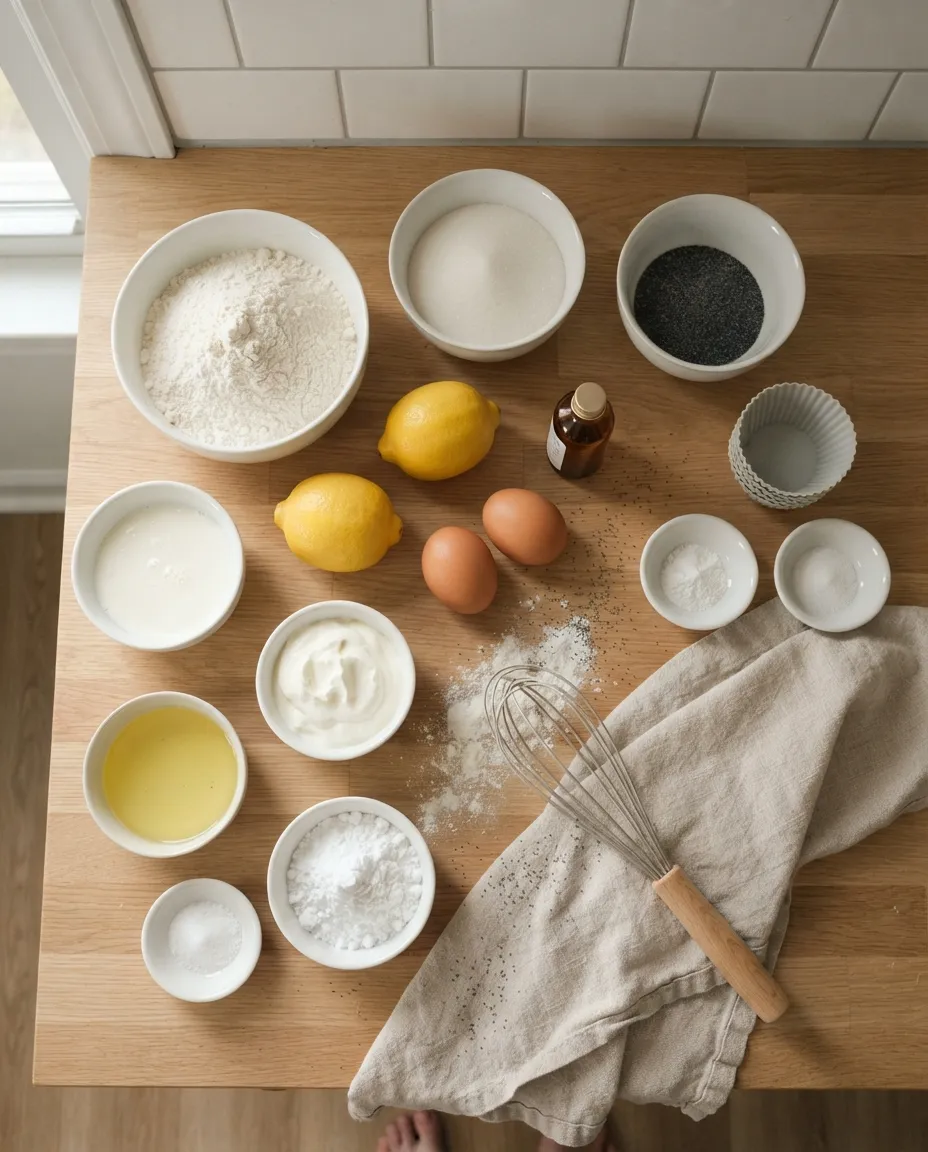
- 2 cups all-purpose flour
- 2 teaspoons baking powder and 1/4 teaspoon baking soda
- 1/2 teaspoon fine salt
- 2/3 cup granulated sugar
- Zest of 2 lemons, rubbed into the sugar; their juice reserved for the glaze
- 3 tablespoons poppy seeds
- 3/4 cup buttermilk, with the seeds soaking in it
- 1/2 cup sour cream
- 2 large eggs
- 1/2 cup neutral oil
- 1 teaspoon vanilla extract
- Glaze: 3/4 cup powdered sugar, 2 tablespoons of the reserved lemon juice, pinch of salt
- 12 silicone baking cups
Zest the lemons before juicing them, always, and smell the poppy seeds before they go in. Fresh seeds smell nutty; stale ones smell like old paint and will bake bitter.
How to make them
- Stir the poppy seeds into the buttermilk and let them soak while you work, at least 15 minutes.
- Rub the lemon zest into the sugar with your fingertips for a full minute, until the sugar is pale yellow, slightly clumped, and loudly fragrant.
- Whisk the flour, baking powder, baking soda and salt in a large bowl, then whisk in the lemon sugar.
- In a second bowl, whisk the eggs, sour cream, oil and vanilla until smooth, then whisk in the buttermilk with its seeds.
- Fold the wet into the dry until the last streak of flour disappears, and not one turn further.
- Preheat the air fryer at 320F for 3 minutes.
- Fill 6 silicone cups two-thirds full and set them on the basket floor with air between them.
- Air fry at 320F for 12 to 14 minutes, until the domes are gold and spring back from a gentle press.
- Confirm 200 to 205F on a thermometer in the center muffin, cool the cups 5 minutes, push the muffins out, and bake the second batch a minute shorter.
- Cool the muffins completely on a rack, then whisk the glaze and drizzle it thin; it dries to a tart shell in about 20 minutes.
Serving and storage
These are morning muffins in the old sense, built for coffee and a newspaper you are only pretending to read, and they hold their own on a brunch table next to the bacon and eggs. Storage rewards the glaze discipline: unglazed muffins keep 3 days airtight at room temperature with a paper towel above and below, and freeze wrapped for 3 months, coming back at 300°F for 2 to 3 minutes in the basket, 4 to 5 from frozen. Glaze only what today will eat; a glazed muffin stored airtight weeps by morning, while a bare one glazed fresh takes two minutes and tastes new. If your crumb trends dry before day two, the machine-side suspects are in how to avoid dry air fryer bakes, and everything this basket has been tested on is indexed at the recipe index, with the technique pages under guides.
Fixing what goes wrong
| Problem | Cause | Fix |
|---|---|---|
| No lemon flavor | Juice in the batter, zest skipped or merely stirred in | Rub the zest into the sugar for a full minute; the batter gets zest, the glaze gets juice |
| Glaze disappeared into the muffin | Drizzled warm | Cool completely first; the glaze belongs on the surface, not in the crumb |
| Crunchy, gritty seeds | Folded in dry | The 15 minute buttermilk soak; it runs while you do everything else |
| Bitter aftertaste | Rancid poppy seeds, or scorched tops | Smell the jar, store seeds in the freezer, and hold the line at 320°F |
| Dense, tunneled crumb | Stirred smooth after the flour went in | Fold to the last streak and stop; the lumps resolve in the bake |
| Flat domes | Overfilled cups, or tired baking powder | Two-thirds full, and powder less than 6 months open; more rescues in troubleshooting air fryer baking |
Frequently asked questions
QWhat temperature do you bake lemon poppy seed muffins in an air fryer?
320F for 12 to 14 minutes, six silicone cups at a time in a basket preheated 3 minutes, until a thermometer reads 200 to 205F in the center muffin. Oven recipes run 375 to 425 chasing tall domes with an initial heat blast, but a basket's fan browns the sugared tops minutes before the middle sets at those temperatures, and scorched lemon crumb turns bitter. At 320F the dome is gentler and the crumb is moist and even, and the tart glaze finishes the argument. Batch two runs about a minute faster.
QWhy do my lemon muffins have no lemon flavor?
Because the lemon went in as juice, and juice loses its aromatics to the heat, leaving vague sourness instead of lemon. The flavor lives in the zest's oils, and the way to keep them is to rub the zest of two lemons into the granulated sugar with your fingertips for a full minute before mixing; the sugar absorbs the oils and shields them through the bake. Save every drop of juice for the glaze, which never sees heat and stays sharp. Zest in the batter, juice in the glaze is the whole rule, and it never misses.
QDo poppy seeds need to be soaked before baking?
They do not need it, and they are better for it. Poppy seeds are small and hard, and folded in dry they keep a faint grit through a 14 minute bake. Fifteen minutes in the buttermilk softens them into the gentle pop and light nuttiness that traditional bakers soaked them overnight for, and since the soak runs while you zest, measure and mix, it adds zero minutes to the recipe. Three tablespoons is the right load for a dozen muffins: enough to speckle every bite, not enough to read as gravel.
QWhy did my glaze soak in and disappear?
The muffins were warm. Warm crumb melts the powdered sugar the moment the drizzle lands, and the glaze liquefies and wicks inward, taking its tartness somewhere you cannot taste it and leaving a faintly sticky top as the only evidence. Cool the muffins completely on a rack, then drizzle, and the glaze stays on the surface and dries in about 20 minutes into a translucent, sharply lemon shell. It is the same cold rule every glazed bake on this site follows, and the twenty minute wait is the entire technique.
QWhy do my muffins taste slightly bitter?
Two suspects, and the lemon is rarely the guilty one. First, stale poppy seeds: they are oil-rich and go rancid faster than any spice on the shelf, and rancid seeds bake in a low, paint-like bitterness. Smell the jar before using; store seeds in the freezer, where they hold a year. Second, scorching: lemon zest and sugared crumb both turn bitter with even light burning, which is what running the oven temperatures in a basket produces. Fresh seeds and 320F clear both suspects, and the muffin tastes like the title again.
QHow do you store lemon poppy seed muffins?
Unglazed, 3 days airtight at room temperature with a paper towel under and over them, or 3 months in the freezer wrapped individually; revive at 300F for 2 to 3 minutes in the basket, 4 to 5 from frozen. The glaze is the scheduling decision: glaze only what will be eaten today, because a glazed muffin sealed in a container turns sticky and weeps overnight, while a bare muffin takes fresh glaze in two minutes and tastes just-made. The glaze itself keeps covered in the refrigerator for a week and loosens with three seconds of stirring.
Made it? Rate it.
It helps more people find the muffin where the lemon survived.
Air Fryer Lemon Poppy Seed Muffins
A dozen bright, restrained muffins: zest rubbed into the sugar, seeds soaked in the buttermilk, baked at 320°F in silicone cups to a 200°F center, and glazed tart on a cool crumb.
Ingredients
- 2 cups all-purpose flour
- 2 teaspoons baking powder and 1/4 teaspoon baking soda
- 1/2 teaspoon fine salt
- 2/3 cup granulated sugar
- Zest of 2 lemons, rubbed into the sugar; their juice reserved for the glaze
- 3 tablespoons poppy seeds
- 3/4 cup buttermilk, with the seeds soaking in it
- 1/2 cup sour cream
- 2 large eggs
- 1/2 cup neutral oil
- 1 teaspoon vanilla extract
- Glaze: 3/4 cup powdered sugar, 2 tablespoons of the reserved lemon juice, pinch of salt
- 12 silicone baking cups
Instructions
- Stir the poppy seeds into the buttermilk and let them soak while you work, at least 15 minutes.
- Rub the lemon zest into the sugar with your fingertips for a full minute, until the sugar is pale yellow, slightly clumped, and loudly fragrant.
- Whisk the flour, baking powder, baking soda and salt in a large bowl, then whisk in the lemon sugar.
- In a second bowl, whisk the eggs, sour cream, oil and vanilla until smooth, then whisk in the buttermilk with its seeds.
- Fold the wet into the dry until the last streak of flour disappears, and not one turn further.
- Preheat the air fryer at 320F for 3 minutes.
- Fill 6 silicone cups two-thirds full and set them on the basket floor with air between them.
- Air fry at 320F for 12 to 14 minutes, until the domes are gold and spring back from a gentle press.
- Confirm 200 to 205F on a thermometer in the center muffin, cool the cups 5 minutes, push the muffins out, and bake the second batch a minute shorter.
- Cool the muffins completely on a rack, then whisk the glaze and drizzle it thin; it dries to a tart shell in about 20 minutes.

Sujata Thapa
Sujata bakes everything on this site in a 5.5 quart basket air fryer on a Kathmandu counter, then re-tests the keepers until the timings hold for anyone. The smell-the-jar rule dates to a batch whose mystery bitterness she blamed on the lemons, the flour and the machine, in that order, before the poppy seeds confessed.