

Roast the potatoes, never boil them
Every disappointing sweet potato pie starts at the stove, where the potatoes boil. Boiling does two kinds of damage at once: the flesh drinks water it will later release into the custard, and the flavor leaches the other way, into the pot. What comes out is a filling that is paler, wetter and blander than the vegetable that went in, and no quantity of spice recovers it.
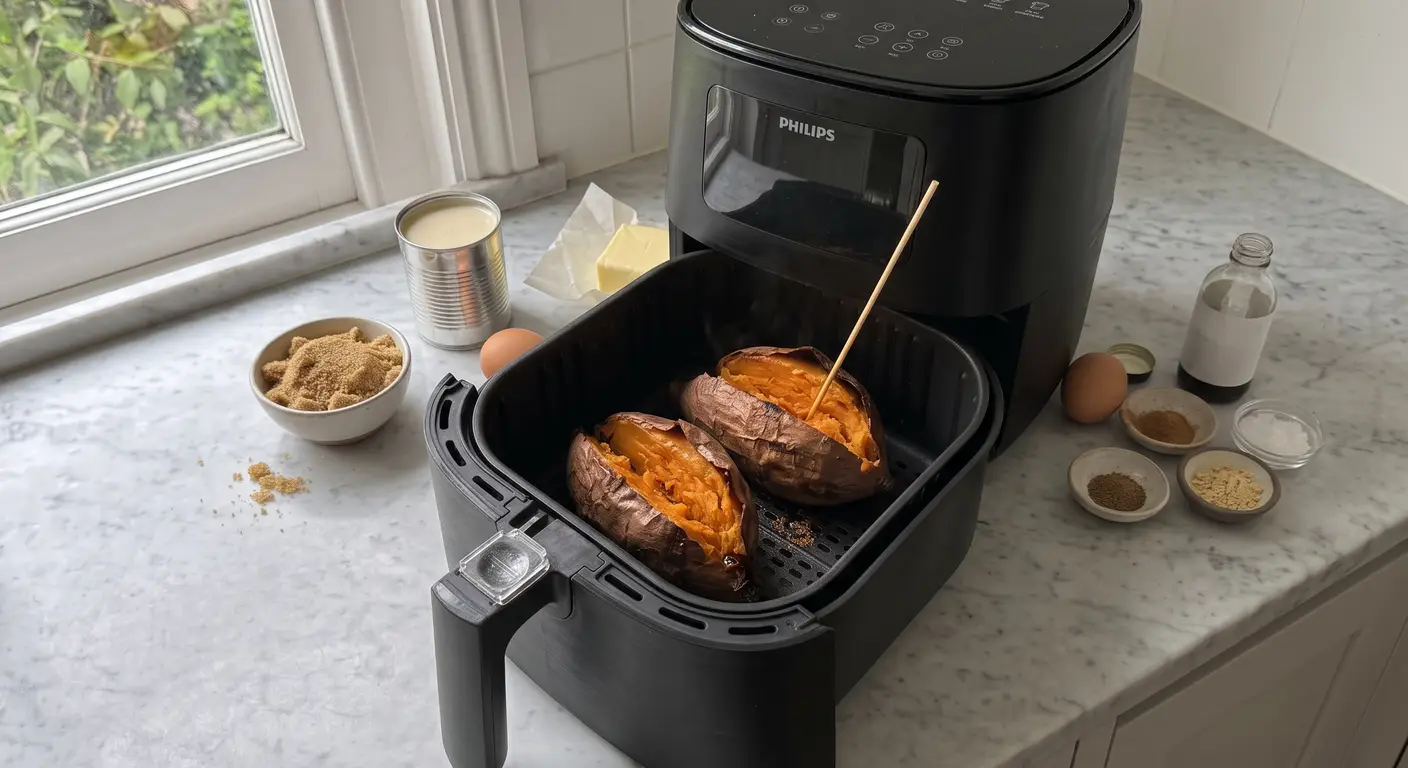
Roasting runs the exchange in reverse. Dry heat drives moisture out and concentrates the sugars, and the long bake pushes the flesh through the temperature range where its own enzymes convert starch to maltose, which is why a roasted sweet potato tastes candied and a boiled one tastes like a root. The machine you are already using does this perfectly: whole, unpeeled potatoes at 380°F for 40 to 45 minutes, until a skewer meets no resistance and the inside reads 205°F or beyond, the same whole-potato method from our sweet potatoes page, cooked one notch below the usual 400 because their sugars scorch early. Roast them the night before if the day is busy; cold roasted flesh blends just as smooth.
Canned honesty: plain sweet potato puree can stand in at 1 1/4 cups with the same blending step, at a real cost in flavor. The can marked candied yams, packed in syrup, cannot; it makes a filling that is both too sweet and too wet, and there is no adjusting your way out of it.
The string problem
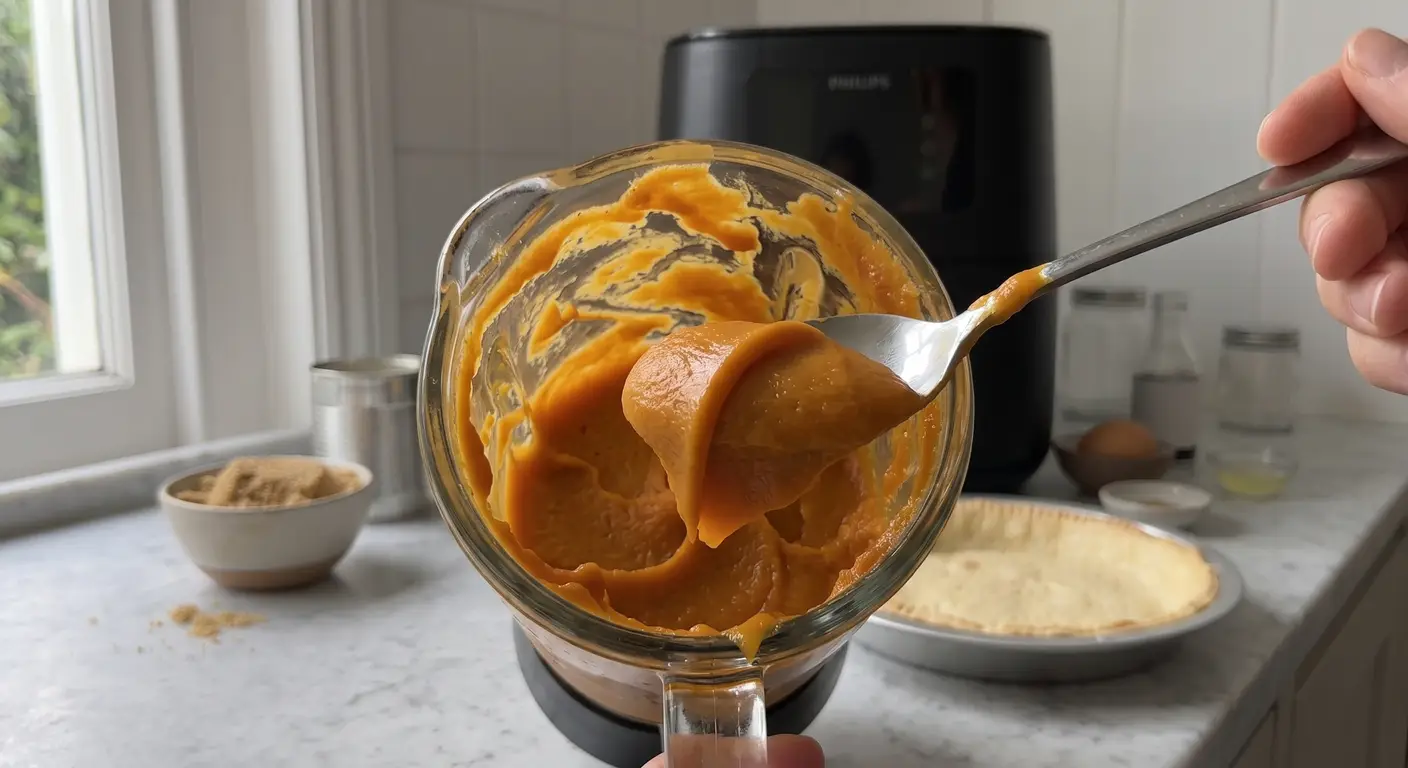
Here is the flaw the ranking recipes never mention. Sweet potatoes grow long cellulose fibers, the strings you notice when you cut a raw one, and cooking softens everything around them while leaving the strings themselves intact. Mash the roasted flesh with a fork and the strings simply lie down in the mash, waiting to reappear across your dessert like thread through the tines of every fork at the table.
The fix is one deliberate minute: blend the roasted flesh with the evaporated milk for a full 60 seconds, until the mixture is glossy and completely smooth. A blender or food processor shears the fibers into nothing; a ricer followed by a firm press through a sieve does the same job by hand. This is also why the milk joins the potato first, before the eggs: liquid makes the blend move, and once the eggs are in, long blending would whip in air, and air is a different enemy the next section deals with.
Sweet potato is not pumpkin
The two pies look like siblings and bake like siblings, but the fillings want different recipes, and using a pumpkin formula on sweet potato is how the too-sweet, over-spiced version happens. Sweet potato arrives drier and considerably sweeter than pumpkin puree, so the sugar drops to a restrained half cup of brown, and the flavoring leans where the South has always leaned it: melted butter, vanilla, a moderate hand of cinnamon, ginger and nutmeg, and an optional teaspoon of lemon juice that sharpens everything without announcing itself. Pumpkin's heavy spice blanket exists partly to flavor a bland vegetable; a roasted sweet potato does not need the rescue.
The custard mechanics, on the other hand, transfer whole from our pumpkin pie, and one rule transfers word for word: evaporated milk, never sweetened condensed. The cans live side by side at the store and are not related; evaporated is concentrated milk, condensed is milk candy, and the swap has ruined more holiday pies than any oven ever did.
The shell bakes alone first
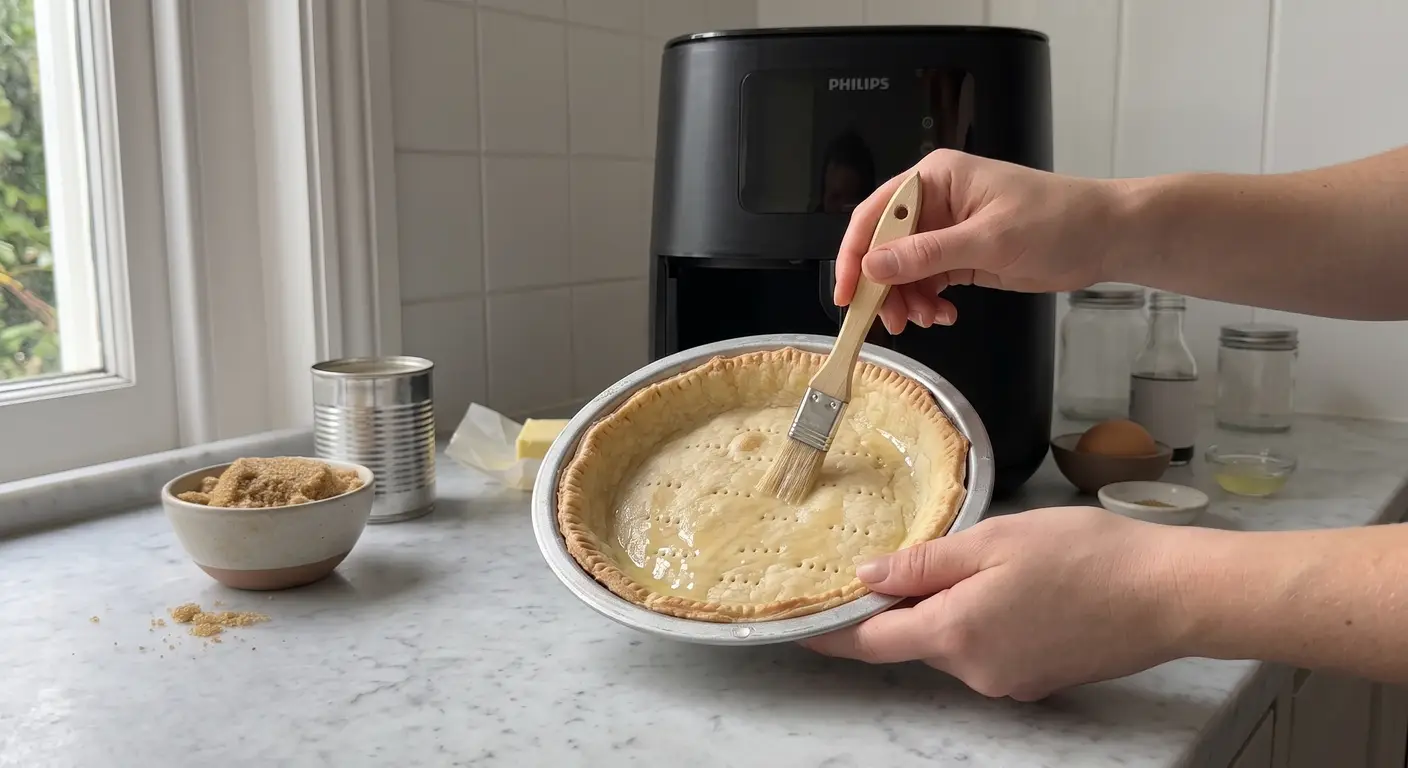
A custard filling is mostly water, and raw dough underneath it steams instead of baking. That is the entire story of the soggy-bottomed holiday pie, and the air fryer, which bakes from above, makes it worse rather than better. So the shell earns its crispness alone: fitted into a 7 inch metal pan, frozen 15 minutes, docked, and blind baked exactly by the numbers in the blind baking guide: 300°F for 15 minutes under weights, 6 to 8 more uncovered, with the floor brushed in egg white for the final 2 minutes. The egg white bakes into a waterproof glaze, and the custard poured onto it meets a sealed surface instead of a sponge. This pie is one of the two on this site that the guide was written for; the pecan pie is the other.
Seven inches is the honest pan for a 5 to 6 quart basket, with airflow to spare; the pan size calculator confirms your own machine's fit before the dough comes out of the fridge. An 8 inch pan in an oven-style unit takes the same recipe with about a quarter more of everything, scaled cleanly by the recipe scaler.
300°F, and the 175 pull
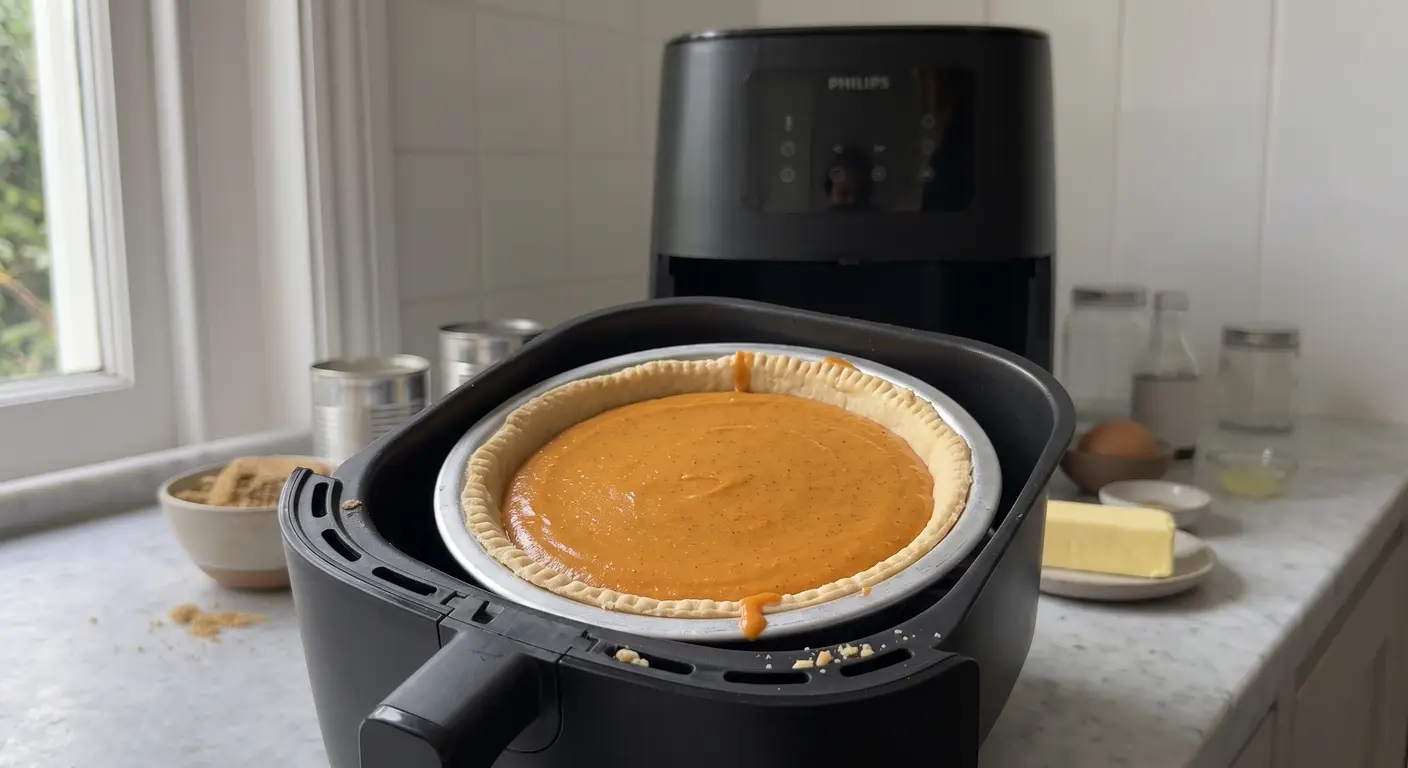
The ranking recipes bake this pie anywhere from 300 to 350°F, and the disagreement dissolves the moment you treat the filling as what it is: an egg custard. Eggs set around 160°F and begin curdling not far past it, so the job is raising a dish of custard to its setting point as evenly as possible, and hot, fast air is the wrong tool. At 350 in a basket, the outer ring sets while the center lags, and the gap between them becomes the crack. At 300°F, low and steady for 32 to 40 minutes, the whole pie climbs together. Oven recipes at 375 would convert to about 350 by the air fryer calculator; custard is the category where you deliberately undercut the conversion, the same exception the cheesecake claims, and the rest of the site's settled numbers live on the baking chart.
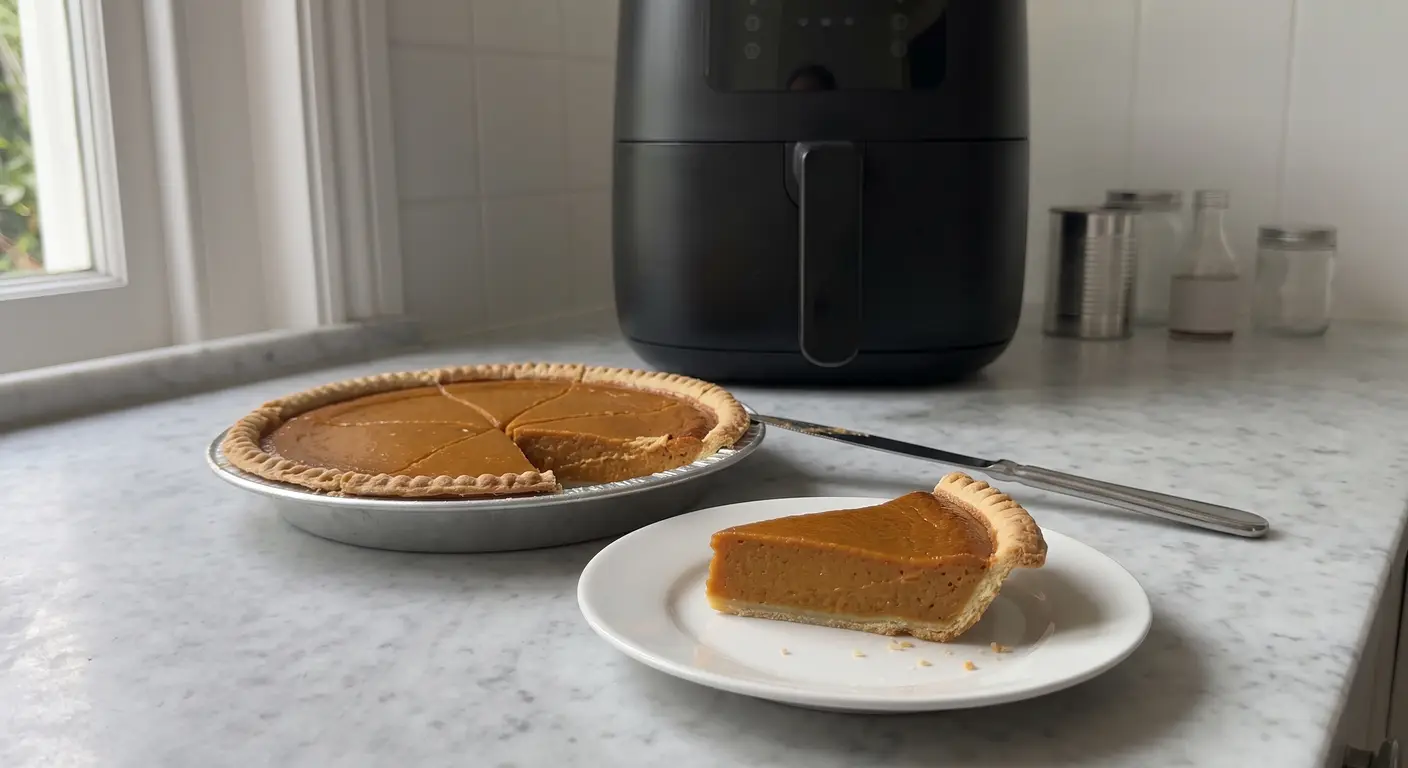
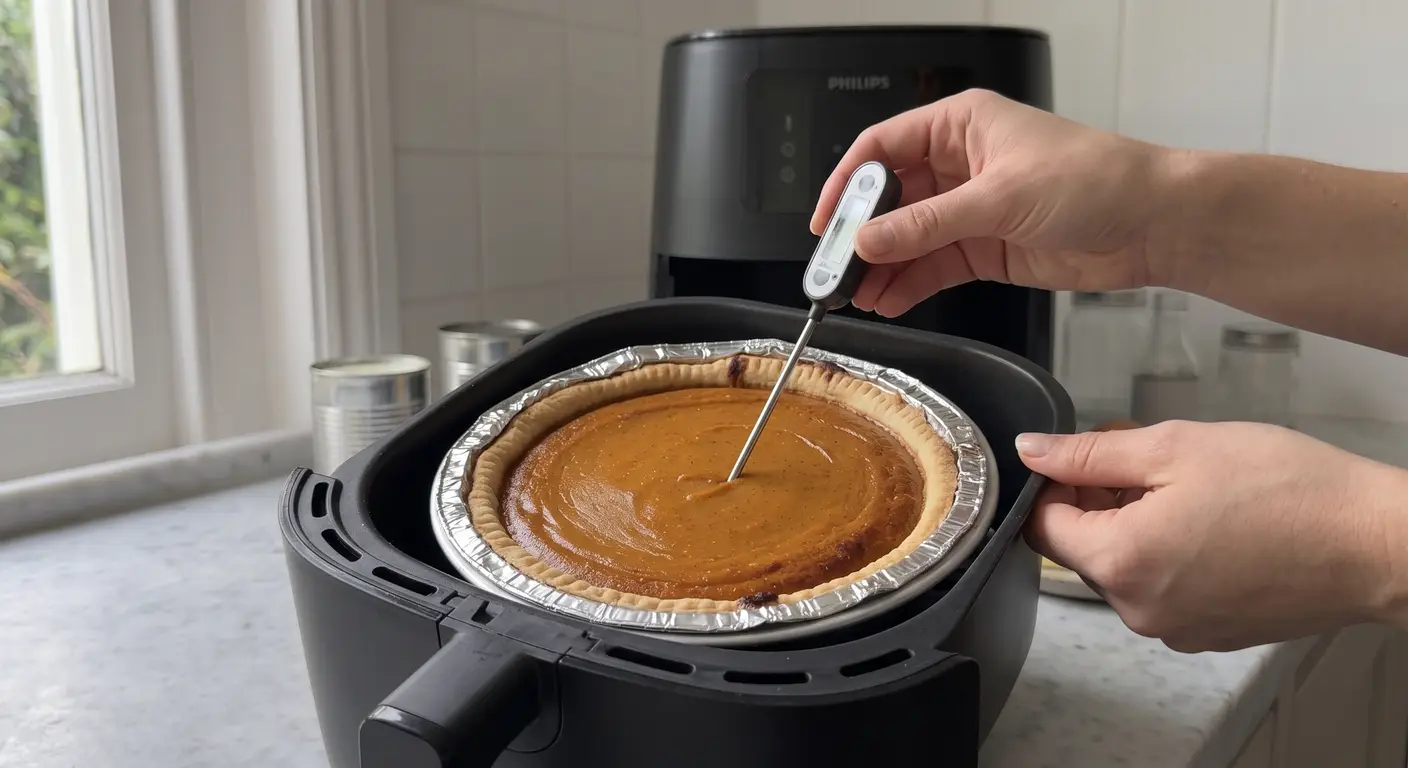
Doneness is a number, not a look: 175°F on a thermometer about an inch off center, while the middle still wobbles like set gelatin. This site's custards form a tidy ladder, 150 for the cheesecake, 170 for the pumpkin cheesecake, 175 for pumpkin and this pie, 200 for the sugar-dense pecan, and every number is a pull point, not a target to exceed, because carryover coasts the center several degrees higher on the counter. The probe hole disappears under the first spoon of whipped cream. If the rim races ahead to golden before the middle is close, a flat foil ring over the crust edge stops it cold, the same crust armor the frozen pie guide keeps on standby.
Cooling is part of the bake
A custard pulled at 175°F is not done cooking; it is done being heated. The set finishes during cooling, and how fast that cooling happens decides whether the surface stays whole. Rushed from hot machine to cold counter to refrigerator, the surface contracts faster than the interior and tears; stepped down gently, it settles as one piece. The schedule costs nothing but patience: 10 minutes in the switched-off machine, 2 hours on a rack at room temperature, then the refrigerator. Slicing warm is the one temptation to refuse entirely, because a warm custard has not finished setting and will slump off the knife; this pie slices cleanest chilled and tastes best just under room temperature, which makes it the rare holiday dessert that prefers to be made yesterday.
Ingredients
For one 7 inch pie, 6 slices
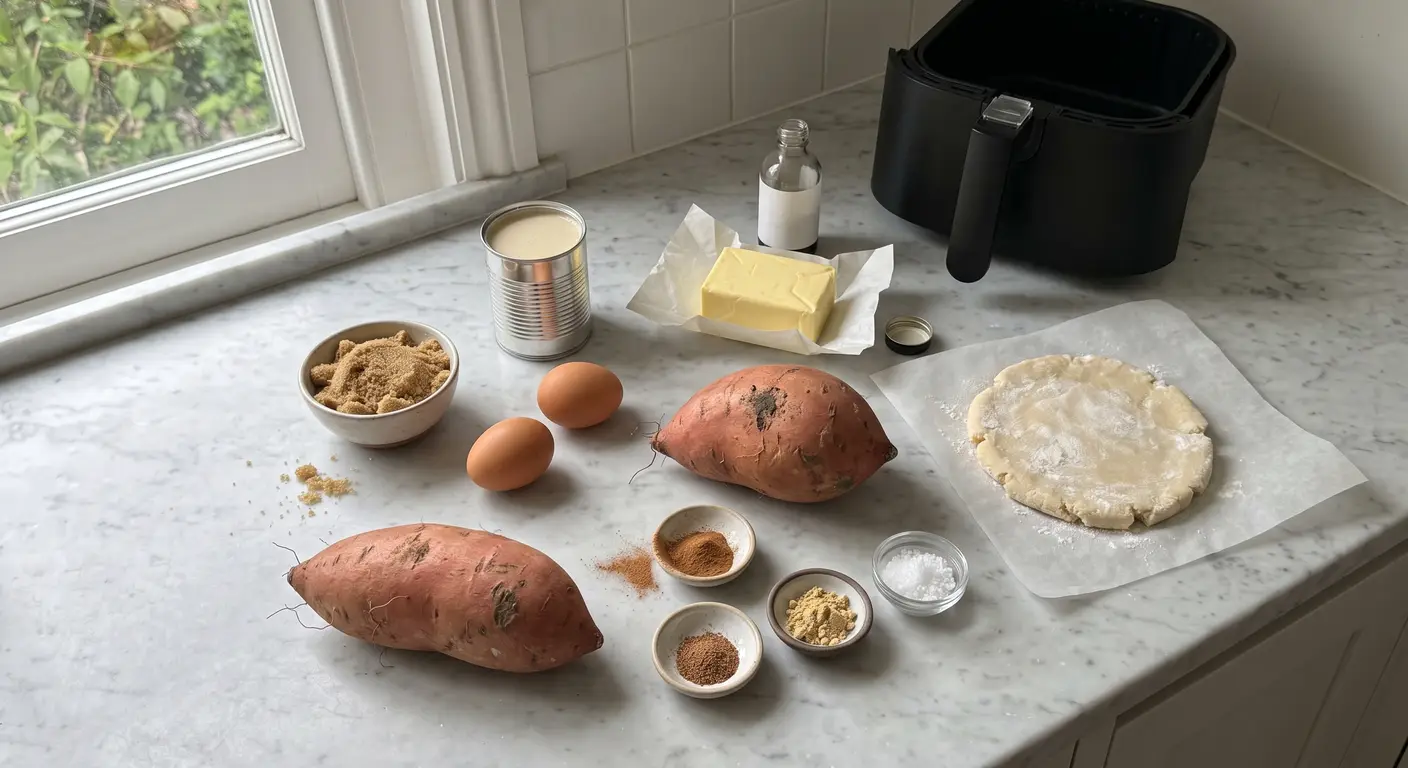
- 1 lb sweet potatoes (2 medium), roasted whole and peeled, for 1 1/4 cups mash
- One 7 inch pie shell, homemade or refrigerated dough, par-baked and egg-white sealed
- 2 large eggs
- 1/2 cup packed brown sugar
- 1/2 cup evaporated milk
- 3 tablespoons butter, melted
- 1 teaspoon vanilla extract
- 3/4 teaspoon cinnamon, 1/4 teaspoon ground ginger, 1/4 teaspoon nutmeg
- 1/4 teaspoon fine salt
- Optional: 1 teaspoon lemon juice, the quiet Southern brightener
Choose orange-fleshed sweet potatoes of similar size so they roast in the same time. The white and purple varieties are wonderful roasted and wrong here; they bake into a drier, starchier custard.
How to make it
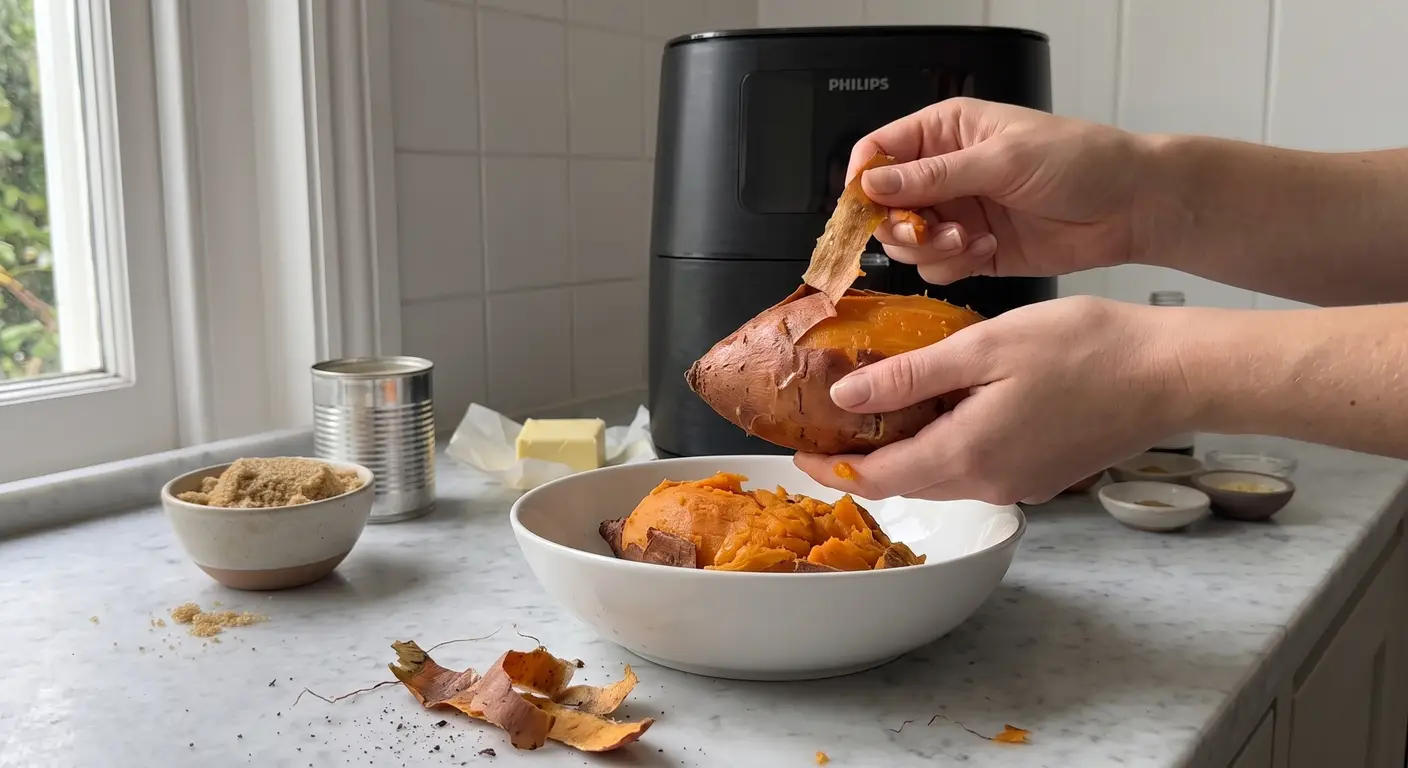
- Roast the whole, unpeeled sweet potatoes at 380F for 40 to 45 minutes, until a skewer slides in with no resistance and the flesh reads 205F or beyond. Cool, then peel; this step happily happens a day ahead.
- Fit the crust into a 7 inch metal pan, freeze 15 minutes, dock, and blind bake at 300F: 15 minutes under weights, then 6 to 8 uncovered, brushing the floor with egg white for the last 2 minutes.
- Blend 1 1/4 cups of the roasted flesh with the evaporated milk for a full 60 seconds, until completely smooth. This is the step that removes the strings; a hand masher cannot do it.
- Add the eggs, brown sugar, melted butter, vanilla, spices, salt and the lemon juice if using, and pulse just until combined. Do not whip air into it; foam bakes into a cracked top.
- Pour the filling into the still-warm par-baked shell, right in the basket, and smooth the top.
- Bake at 300F for 32 to 40 minutes. When the rim turns golden, usually near halfway, lay a foil ring over it and keep baking.
- Pull the pie when a thermometer reads 175F about an inch off center. The middle should still wobble like set gelatin; a firm center at the pull is an overbaked pie by serving time.
- Rest the pie 10 minutes in the switched-off machine, then 2 hours on a rack on the counter, then refrigerate. Slice at room temperature or chilled, never warm.
Variations, and the marshmallow question
- Brown butter: brown the 3 tablespoons in a small pan until nutty before they join the blend. The single upgrade most worth its five minutes.
- Bourbon: a tablespoon in with the vanilla, the classic Southern loosener. It reads as warmth, not whiskey.
- Maple: swap 2 tablespoons of the brown sugar for maple syrup and accept a bake at the long end of the range.
- Hand pie route: a thick, chilled spoonful of this filling, minus one egg, works in the hand pies formula for a lunchbox version of the same flavor.
- The marshmallow top, honestly: not in the basket. A fan lifts marshmallows onto the element, where they burn in seconds. If your family expects the toasted cap, add it after baking under an oven broiler for one watched minute, or with a kitchen torch; the machine that baked the pie is the wrong tool for this one flourish.
Fixing what goes wrong
| Problem | Cause | Fix |
|---|---|---|
| Surface cracked | Overbaked past 175°F, or cooled too fast | Pull at the number while the center wobbles, and cool in the three stages. Whipped cream forgives the rest |
| Stringy texture | Mashed by hand | The 60 second blend with the milk, or a ricer plus sieve. There is no baking-time fix |
| Soggy, pale bottom | Skipped the par-bake or the egg-white seal | The shell bakes alone first, sealed. Twenty minutes that decide the whole pie |
| Watery slice, weeping edges | Boiled or unsieved canned potato, or overcooked eggs | Roast the potatoes dry, and treat 175°F as a ceiling |
| Rim burnt before the middle set | An element inches above an exposed crust edge | The foil ring, on from the moment the rim turns golden; the burning guide covers hot-running machines |
| Filling tastes flat | Boiled potatoes, or the candied-yam can | Roasting is the flavor; the salt and optional lemon juice are the seasoning |
Storage and make-ahead
This pie is built for the make-ahead holiday. The roasted mash freezes for a month and thaws overnight in the refrigerator, which turns pie day into a 25 minute assembly. The baked pie keeps 4 days, covered, in the refrigerator, and its texture on day two, fully settled, chilled and sliced clean, is arguably the best of its life; bring slices toward room temperature for serving. An egg custard never lives on the counter beyond its 2 hour cooling window, and freezing the finished pie is legal but costs some silkiness at the thaw, so freeze the mash rather than the pie when there is a choice. The rest of the holiday basket schedule, and where a make-ahead pie slots into it, is the department of the apple pie and the pies that share its shelf. For a second make-ahead dessert, the pumpkin cheesecake needs a 4 hour chill anyway, and the pecan bars slice cleanly after an hour in the fridge.
Frequently asked questions
QWhat temperature do you bake sweet potato pie in an air fryer?
300°F, low and steady, for 32 to 40 minutes in a 7 inch pan on a par-baked shell, with the potatoes roasted beforehand at 380°F. The recipes running 350°F are treating a custard like a casserole: eggs set at low temperatures and curdle not far past them, and a hot fast bake sets the edges solid while the center lags, which is where cracks and weeping come from. The clock is only a suggestion here; the real finish line is 175°F on a thermometer an inch off center.
QCan I use canned sweet potatoes or canned yams?
Plain canned sweet potato puree works in a pinch: use 1 1/4 cups, and press it through a sieve or give it the same 60 second blend, because canned puree carries extra water and the occasional string. What does not work is the can labeled candied yams, which is sweet potatoes packed in syrup; drained and mashed, they make a filling that is both too sweet and too wet. Roasting fresh potatoes takes 45 unattended minutes and repays every one of them in flavor.
QWhy is my sweet potato pie stringy?
Because sweet potatoes grow long fibrous strands that survive cooking and mashing, and a fork or potato masher just rearranges them. The fix is mechanical: blend the roasted flesh with the evaporated milk for a full minute, or press it through a ricer and then a sieve. One minute in a blender is the difference between a filling with the texture of yarn and the silk the pie is named for, and no amount of extra baking can do it later.
QWhat is the difference between sweet potato pie and pumpkin pie?
The filling vegetable, and everything that follows from it. Sweet potato is drier, sweeter and more fibrous than pumpkin puree, so the pie takes less sugar, needs the blending step pumpkin never asks for, and leans on butter and vanilla where pumpkin leans on heavy spice. The custard mechanics are identical: both are egg custards that bake at 300F, finish at 175F, and crack when rushed. If you can bake one, you can bake the other, and this site has both.
QWhy did my sweet potato pie crack?
Overcooked eggs, almost every time. A custard sets around 160F and starts squeezing out its moisture not far past 175F; bake until the center looks fully firm and the eggs keep cooking on the counter, shrink, and tear the surface as they cool. Pull at 175F while the middle still wobbles, then cool in stages, machine, counter, fridge, so the surface never gets a temperature shock. A crack is also strictly cosmetic: whipped cream was invented for exactly this square inch.
QDo I have to blind bake the crust first?
For a crisp bottom, yes. Custard is mostly water, and raw dough sitting under it steams instead of baking; the result is the pale, damp floor everyone politely eats around at the holidays. The shell bakes alone at 300F, 15 minutes weighted and 6 to 8 more uncovered, and a brushed coat of egg white in the last 2 minutes waterproofs it against the filling. It adds 20 minutes and is the single biggest quality difference between this pie and the ones that skip it.
QCan I make sweet potato pie ahead for Thanksgiving?
It is genuinely better made ahead. The custard needs 2 hours of cooling plus a chill before it slices cleanly, so a pie baked the day before, refrigerated overnight and brought toward room temperature while dinner is served is the schedule this recipe wants anyway. The roasted mash also freezes for a month, and the fully baked pie keeps 4 days covered in the refrigerator. What it should not do is sit out: an egg custard is fridge food.
Made it? Rate it.
Never overbake again
Get our one-page times & temps cheat sheet, plus a new tested recipe each week.
No spam · unsubscribe anytime