

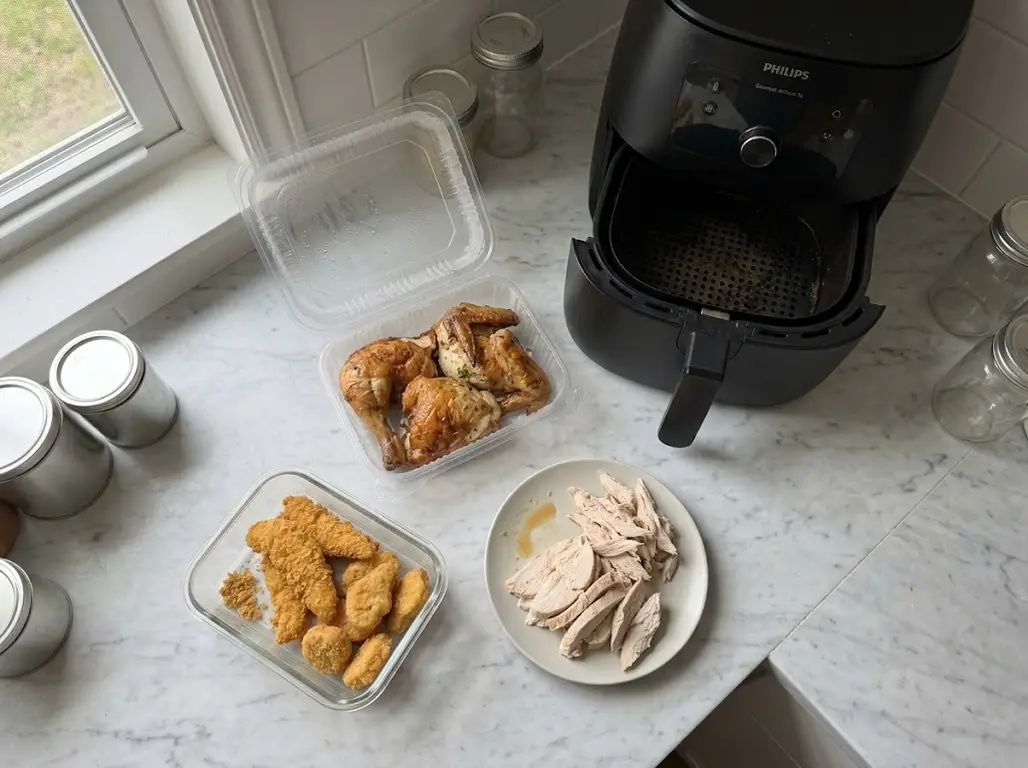
Somewhere in your refrigerator right now, I would bet money, there is chicken. Half a rotisserie bird from the weekend, a clamshell of tenders a child refused to finish, nuggets that seemed like a good idea at midnight. And the reason you are here is that the microwave has betrayed you before: rubbery meat, soggy breading, that particular sadness of a nugget gone soft. The betrayal was never random, and neither is the fix.
What the dozen thin pages on this subject will not tell you is that reheating chicken is one problem with three costumes. The meat itself always wants the same thing: gentle heat, a little protection, and an exit at 165F. What changes is the surface. A crumb coating, a sheet of skin, and bare meat are three different materials with three different enemies, and once you match the treatment to the surface instead of to the marketing name on the box, every format from a whole bird to a single tender becomes the same easy job. The machine for that job, it happens, is the one this site is named after, because an air fryer is a small convection oven that preheats in three minutes and treats surfaces exactly the way leftovers need.
Quick answer: Reheat almost all chicken in an air fryer at 350F: crumb-coated pieces like tenders and nuggets go in dry, uncovered, 3 to 6 minutes; skin-on rotisserie pieces get a two-stage treatment, covered with foil and a spoonful of broth at 320F to warm through, then uncovered at 380F for 2 to 3 minutes to recrisp the skin; naked meat like sliced breast warms covered with broth the whole time and never sees the crisping stage. Every format is done at 165F internal, checked with a thermometer, not guessed from the clock.
Why reheated chicken dries out
Chicken dries when you reheat it because reheating is a second cook, applied to meat that already spent its budget on the first one. Cooking works by tightening muscle proteins until they squeeze water out, and your chicken did that once already, at the rotisserie counter or in the fryer at the restaurant. It arrived at your refrigerator with no moisture to spare. Run it hot a second time and the proteins tighten further, wring out what little is left, and hand you the rubber you remember.
So the whole game is this: raise the interior to a safe 165F while spending as little of the remaining moisture as possible. That means moderate temperatures, because high heat wrings before it warms. It means short times, because every extra minute is extra squeezing. It means protection for surfaces that cannot defend themselves. And it means measuring the exit instead of guessing it, because the single most common way to ruin leftovers is to keep heating chicken that was done three minutes ago. An instant-read thermometer costs less than two rotisserie chickens and ends the guessing forever, and carryover works here the same way it works in baking: pull at 165F and the residual heat keeps things moving while the chicken rests a minute on the plate.
The three surfaces, and why the internet contradicts itself
Every reheating argument you have ever read, add broth, never add broth, cover it, never cover it, comes from people describing different surfaces without realizing it.
- The crumb coat, on tenders, nuggets, and fried chicken, is a dry breading whose entire value is crispness. Its enemy is moisture: steam from a cover, broth in the pan, the damp paper towel of microwave folklore. Crumb-coated chicken gets dry heat, open air, and nothing else. The people who say never add liquid are these people, and for their chicken they are right.
- The skin, on rotisserie birds, wings, and roasted thighs, is a layer of rendered fat and protein that was crisp once and went limp in the refrigerator. Skin is more forgiving than crumbs: it tolerates a covered, steamy warm-up and then recrisps beautifully under direct heat, because the fat in it re-renders. Skin-on chicken can have both moisture and crispness, as long as they happen in that order.
- Naked meat, sliced breast, plain thighs, shredded chicken for tacos, has no armor at all. Its enemy is the air itself: the same moving hot air that blesses a crumb coat strips bare meat mercilessly. Naked chicken wants a cover, a splash of liquid, and no crisping stage whatsoever. The people who swear by broth and foil are these people, and for their chicken they are also right.
Three surfaces, three treatments, zero contradictions. Now the formats, one by one.
Rotisserie chicken: the two-stage revival
The rotisserie specialists send you to a full oven: broth in a dish, foil over the top, 25 minutes at 350F, then a broil. The advice is sound and the appliance is wrong. That method is a moisture-protected warm-up followed by a skin-crisping blast, and an air fryer performs both stages faster, in a chamber that barely needs preheating.
First, break the bird down: legs, thighs, wings, and the breasts off the bone, because a whole carcass is mostly air and bone that slows the warm-up and crowds the basket. Arrange the pieces in a foil boat or a shallow pan that fits your machine, skin side up, add two tablespoons of broth or water to the bottom, and cover loosely with foil. The boat matters twice over: it holds the steam that protects the meat, and it catches the fat a rotisserie bird sheds, which otherwise lands in the drawer and becomes the smoke story. Run 320F for 8 to 10 minutes until the thickest piece reads about 160F.
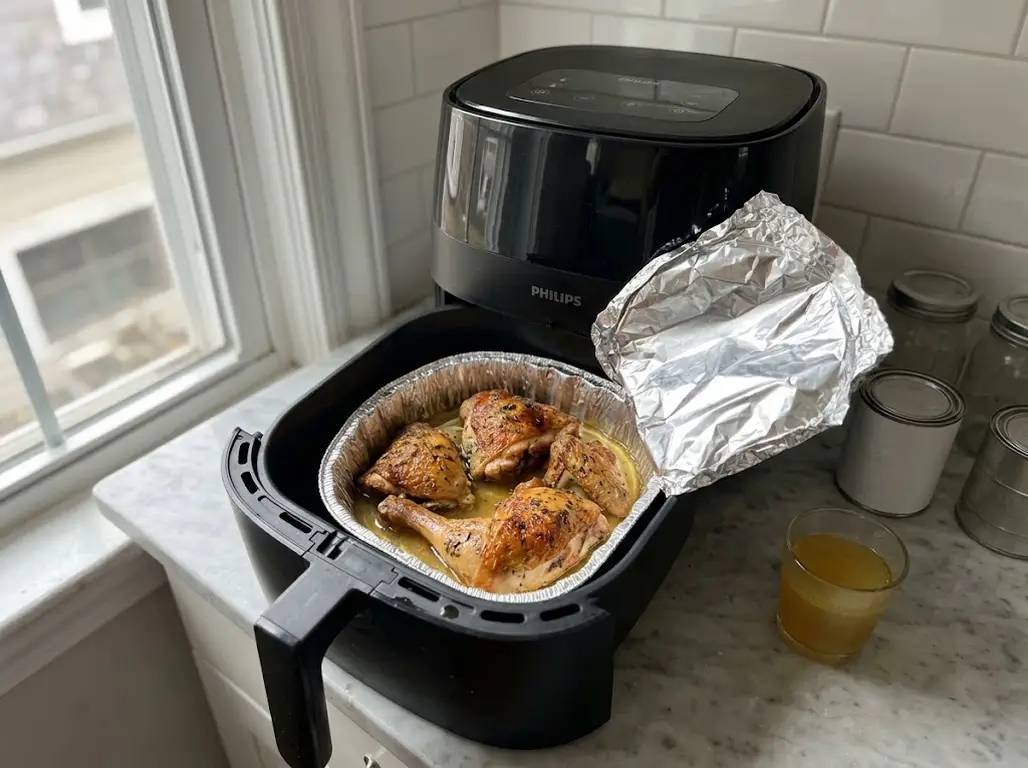
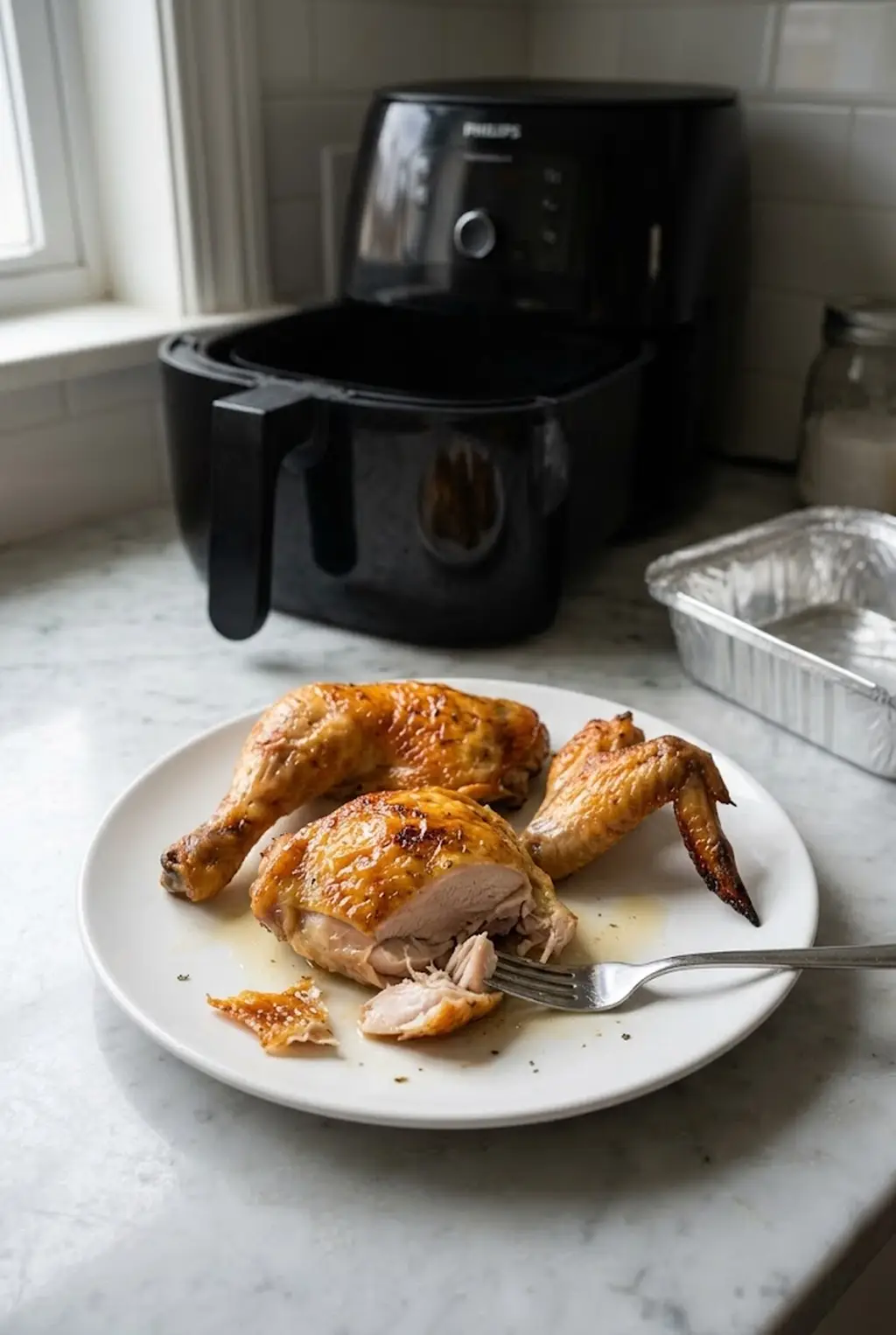
Then the payoff the oven method saves for the broiler: pull the foil cover off, raise to 380F, and give the skin 2 to 3 minutes naked in the wind. The surface moisture flashes off, the fat re-renders, and the skin comes back crackling in a way the microwave could not achieve with a hundred attempts. Pull at 165F in the thickest piece, rest two minutes, and you have a bird that eats like it just came off the spit. The foil rules for boats and covers, including which machines want the foil weighted, are in the foil and parchment guide.
Tenders, nuggets, and fried chicken: dry heat only
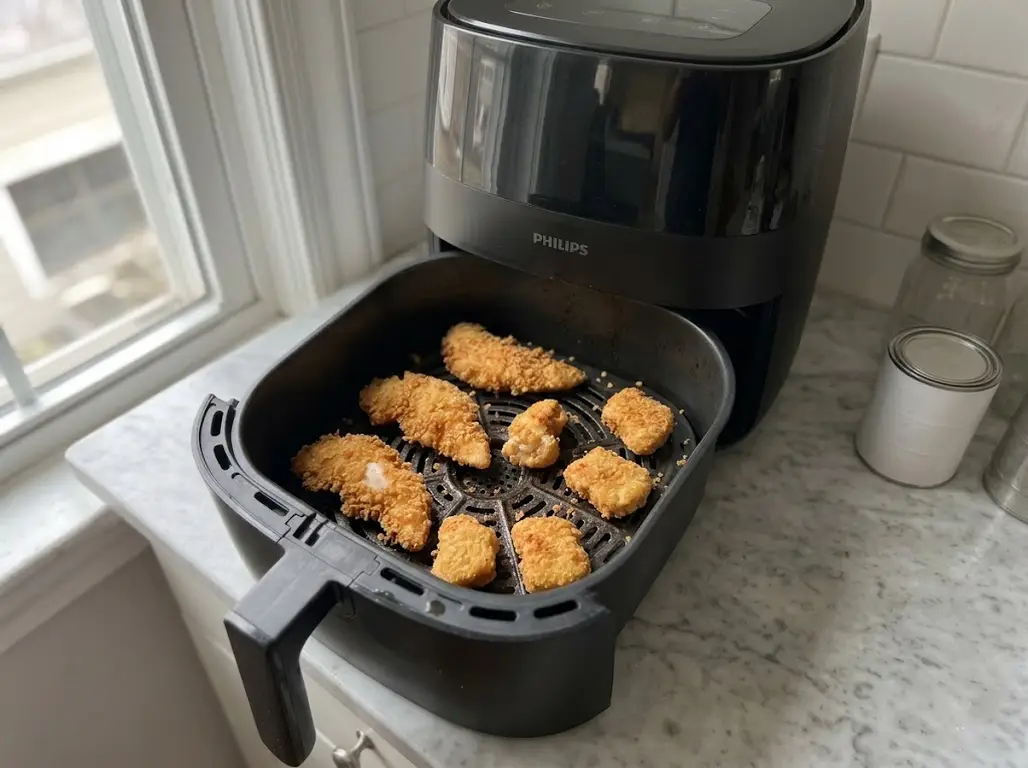
Crumb-coated chicken is the easiest revival in the machine, and the one the microwave ruins hardest, because a microwave heats by exciting water, and water is precisely what a breading cannot survive. The air fryer does the opposite: it removes surface moisture, which is the definition of recrisping.
The protocol is almost insultingly simple. Single layer, pieces not touching, no oil needed if the coating was fried in the first place, though a light spray from an oil that can take the heat revives a coating that has gone truly dull. Then 350F: about 3 to 4 minutes for nuggets, 4 to 5 for tenders, 6 to 8 for bone-in fried chicken flipped once at the halfway mark. Refrigerated pieces should lose their deep chill on the counter for ten minutes first, so the coating does not finish before the center warms. Frozen nuggets and tenders skip the thaw entirely and just take a few extra minutes at the same temperature. Leftover homemade chicken strips follow the tender line exactly.
Two cautions, both borrowed from this site's baking rules because they are the same physics. Crowding is the killer: pieces that touch steam each other where they meet, and steamed breading is the exact failure you came here to avoid, the same crowding error the common mistakes guide ranks first for everything. And batches run hot: the small chamber recovers fast, so the second tray finishes about a minute sooner than the first. If crispness is a subject you want to master beyond chicken, the crispness guide is the full playbook.
Plain breast, thighs, and shredded chicken: the broth-and-cover move
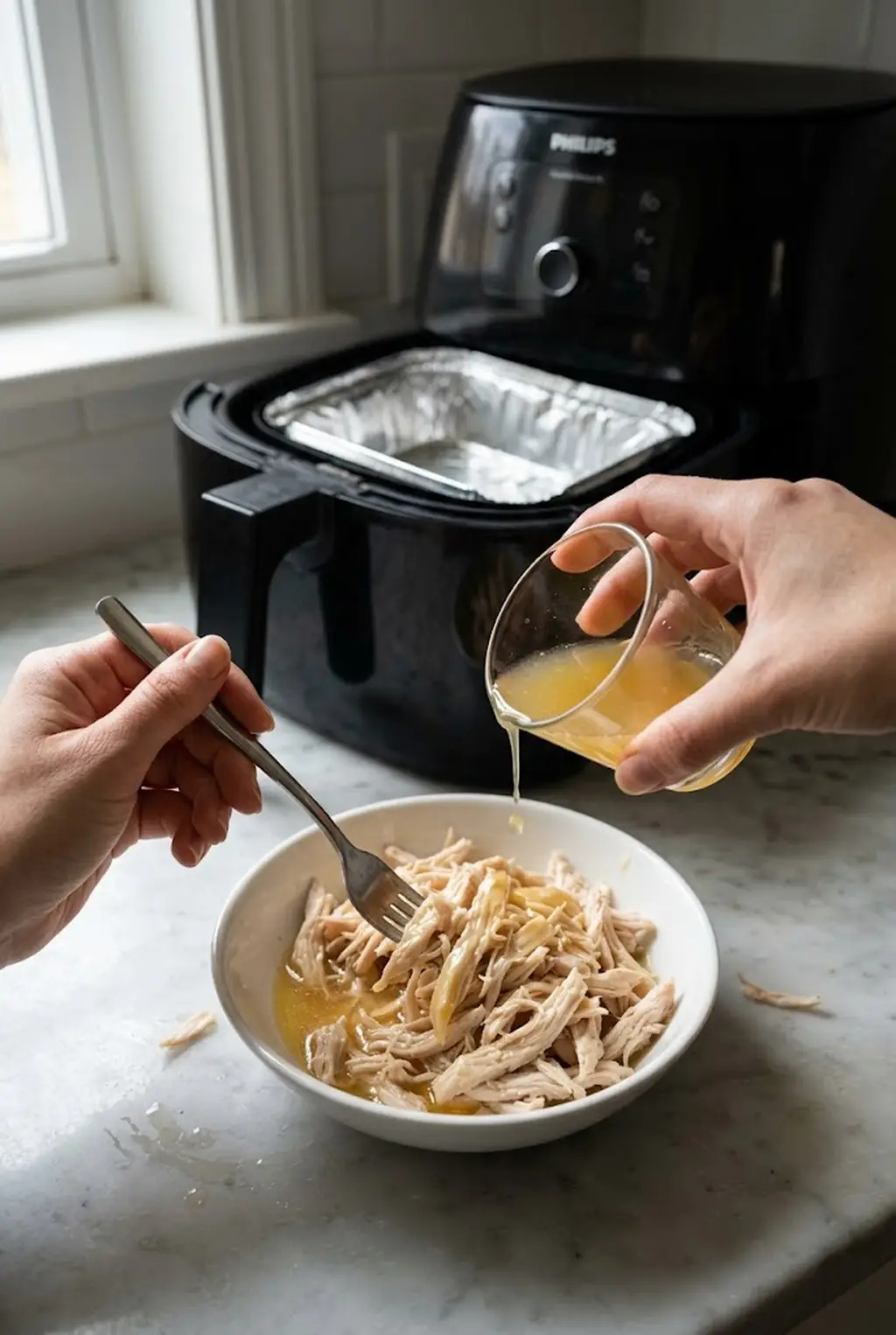
Bare meat is where the air fryer needs to be told to behave, because its natural talent, drying surfaces, is exactly wrong for a naked chicken breast. So you take the talent away: shallow pan or foil boat, a splash of broth, a cover that stays on the whole time, 320F, and 6 to 8 minutes for sliced breast or shredded meat, a couple more for whole pieces. The cover turns the basket into a tiny steam oven, the broth replaces what the first cook spent, and the meat comes out closer to fresh than any open-air method can manage. There is no crisping stage. Naked meat has nothing to crisp, and the two extra minutes of wind would only start the wringing.
Shredded chicken deserves one extra sentence, because it is the format with the most surface area and therefore the fastest to dry: toss it with broth before it goes in, not after, so every strand is coated where the air would find it. If your bakes and dinners keep coming out parched despite good settings, the moisture playbook in the dry bakes guide applies to savory leftovers more than its title admits.
The master table
| Format | Surface | Setting | Time | The move |
|---|---|---|---|---|
| Rotisserie, pieces | Skin | 320F covered, then 380F open | 8 to 10 min + 2 to 3 min | Foil boat, broth splash, uncover to crisp |
| Rotisserie, shredded | Naked | 320F covered | 5 to 7 min | Toss with broth first, no crisp stage |
| Fried chicken, bone-in | Crumb | 350F open | 6 to 8 min | Flip halfway, never cover |
| Tenders | Crumb | 350F open | 4 to 5 min | Single layer, 10 min off the chill first |
| Nuggets | Crumb | 350F open | 3 to 4 min | Shake once, minute less for batch two |
| Nuggets, from frozen | Crumb | 350F open | 6 to 8 min | No thaw, straight in |
| Wings | Skin | 350F open, 380F last 2 min | 6 to 8 min | Sauced wings reheat dry, resauce after |
| Breast, sliced | Naked | 320F covered | 6 to 8 min | Broth and cover, start to finish |
| Thighs, plain | Naked or skin | 320F covered, skin gets 380F finish | 8 to 10 min | Treat by surface, not by cut |
All times assume refrigerator-cold chicken and end at 165F internal, verified with a thermometer. Machines vary more than recipes admit: an oven-style unit runs a shade gentler than a basket, a difference the basket versus oven-style guide maps, and if a recipe you are working from gives oven reheat instructions instead, the air fryer calculator converts any oven time and temperature to air fryer settings in one step. The rest of the takeout bag has its own pages: reheating fries and reheating pizza.
Five mistakes that ruin leftover chicken
- Defaulting to the microwave. A microwave excites water throughout the meat, which steams the breading soggy from underneath while heating unevenly enough to leave cold pockets. It is the right tool for shredded chicken in a sauce and the wrong tool for every surface that was ever crisp. Two extra minutes in the basket buys back everything the microwave takes.
- Blasting at 400F to save time. High heat wrings moisture out faster than it warms the center, which is how you get a scorched coat on a cold nugget. The 350F sweet spot exists because reheating is a race between warming and drying, and moderate heat lets warming win.
- Crowding the basket. Touching pieces steam each other and block the airflow that does the crisping. Two batches of five beat one batch of ten every single time, especially when the chamber's fast recovery makes the second batch a minute quicker anyway.
- Trusting the clock over the thermometer. Times in any table, including mine, are estimates for average pieces in an average machine. The thermometer is the truth. Chicken pulled at 165F is safe and juicy; chicken run two minutes past it for confidence is safe and dry, and confidence was free at 165F.
- Reheating twice. Each pass through the heat spends moisture you cannot replace and walks the food through the temperature zone bacteria enjoy. Reheat only what you will eat, and portion the rest cold. Anything still going wrong after all five fixes has a diagnosis waiting in the troubleshooting guide.
The safety rules, quickly and completely
Cooked chicken keeps 3 to 4 days in the refrigerator and about 3 months in the freezer before quality falls off. It should never sit more than 2 hours at room temperature, which counts the ride home from the store for a hot rotisserie bird as well as the after-dinner lingering on the counter. Reheat to 165F internal every time, measured in the thickest piece, and treat one reheat as the budget: cook once, reheat once, and portion accordingly. None of these numbers are the fussy ones; they are the load-bearing ones, and they take less effort than one bout of regret.
Frequently asked questions
QWhat is the best way to reheat chicken?
An air fryer at 350F is the best all-around method, with the treatment matched to the chicken's surface: breaded pieces like tenders and nuggets reheat dry and uncovered for 3 to 6 minutes, skin-on rotisserie pieces warm covered with a splash of broth at 320F and then crisp uncovered at 380F for 2 to 3 minutes, and plain meat stays covered with broth the whole time. Every format is done at 165F internal, measured with a thermometer.
QHow do you reheat rotisserie chicken without drying it out?
Break the bird into pieces, set them skin side up in a foil boat with two tablespoons of broth, cover loosely, and run 320F for 8 to 10 minutes until the thickest piece reads about 160F. Then uncover, raise to 380F, and give the skin 2 to 3 minutes to recrisp. The covered stage protects the meat with steam while it warms, and the open stage re-renders the skin, which is the same logic as the oven-and-broiler method at a quarter of the time.
QHow long do you reheat chicken tenders in an air fryer?
About 4 to 5 minutes at 350F for refrigerated tenders in a single layer, flipped or shaken once. Let them lose their deep chill on the counter for ten minutes first so the coating does not finish before the center warms, skip any cover or added liquid because moisture is the breading's enemy, and pull when the thickest tender reads 165F. Frozen tenders go straight in with no thaw and take roughly 6 to 8 minutes at the same temperature.
QHow do you reheat chicken nuggets so they stay crispy?
Dry heat, open air, and space: 350F for 3 to 4 minutes in a single layer with the nuggets not touching, shaken once at the halfway point. No cover, no damp paper towel, no added liquid, because the coating recrisps by losing surface moisture and every source of steam works against it. If a second batch follows the first, take about a minute off, since the small chamber runs hot once it is fully saturated with heat.
QWhy does reheated chicken get rubbery?
Because reheating is a second cook applied to meat that already gave up its spare moisture during the first one. Heat tightens muscle proteins, tightened proteins squeeze out water, and a second aggressive heating wrings an already-wrung towel. The fixes all serve one goal: moderate temperature so warming outpaces drying, protection like foil and broth for unarmored meat, the shortest time that reaches 165F, and a thermometer so you stop exactly there.
QCan you reheat chicken in the microwave?
You can, and for exactly one category you should: shredded or diced chicken in a sauce, where even heating matters more than texture. For everything else the microwave is the worst option, because it heats by exciting water, which steams breading soggy from underneath and leaves bare meat rubbery at the edges before the center is warm. Anything that was ever crisp, tenders, nuggets, fried chicken, rotisserie skin, belongs in dry moving air instead.
QIs it safe to reheat chicken twice?
Food safety authorities technically allow it if the chicken hits 165F each time and was chilled promptly in between, but it is a bad practice on both safety margin and quality grounds. Every reheat walks the meat back through the temperature range bacteria prefer and spends moisture that cannot be replaced, so the second revival is dry even when it is safe. The better habit costs nothing: reheat only the portion you will eat and leave the rest cold.
QHow long is cooked chicken good for in the fridge?
Three to four days, counting from when it was cooked, not from when you got around to worrying about it, and that includes store-bought rotisserie birds. Cooked chicken should never sit out longer than 2 hours at room temperature. For longer storage, freeze it: quality holds about 3 months, and frozen breaded pieces like nuggets and tenders reheat straight from frozen at 350F with no thaw, which makes the freezer the best home for the second half of any big batch.
QWhat temperature should reheated chicken reach?
165F in the thickest part, measured with an instant-read thermometer, for every format from a whole rotisserie thigh to a single nugget. That number is the food-safety line, and it is also the quality line, because meat pushed well past it dries for no benefit. The practical rhythm: check early, at the low end of any time range, pull the moment the probe reads 165F, and let the chicken rest a minute so the heat evens out before you eat.
Never overbake again
Get our one-page times & temps cheat sheet, plus a new tested recipe each week.
No spam · unsubscribe anytime