

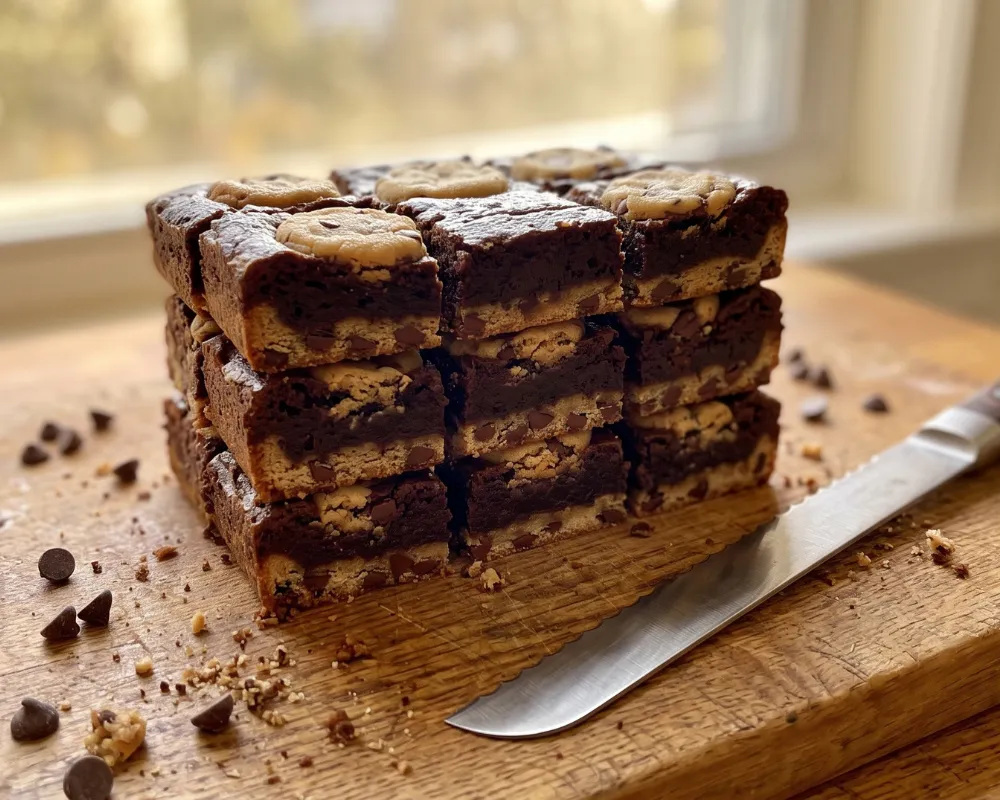
Search for air fryer brookies and the results are mostly people avoiding the actual question. There is a protein-powder brand's mug version, a Crumbl copycat that presses two doughs into individual cookies, a TikTok discovery page, and a couple of sites that read like nobody baked anything. The real thing, a layered brookie bar baked from scratch in a basket, does not exist in print, and having now made a dozen pans of them, I can report why: the naive version fails, and it fails in an interesting way.
Stack two doughs in one pan and you have created a bake with a split personality. Our brownies come out of the basket at 15 to 18 minutes, deliberately underdone in the middle. Our chocolate chip cookies are done in 8. Put them in the same pan and neither schedule survives; the pan needs one temperature, one time, and one test that respects both layers at once. That is what this page is for.
Quick answer: Press the cookie dough into a parchment-lined 6-inch pan, pour the brownie batter over it, and scatter five or six flattened coins of reserved cookie dough on top. Bake at 320°F for 22 to 26 minutes, laying foil loosely over the pan when the coins turn golden, usually around minute 12 to 14. Pull when a thermometer in the brownie layer between the coins reads 165 to 175°F, while the center still looks underdone. Cool 90 minutes in the pan before cutting into 9 squares. Both layers from scratch take about 20 minutes of mixing, one bowl each.
Two bakes, one clock
The reason brookies go wrong is worth thirty seconds, because it explains every decision below.
- The two doughs finish at different internal temperatures. A fudgy brownie is done in the 160s and 170s, when the starch has barely set and the sugar is still dense and moist. A cookie wants the low 180s to hold its chew without gumminess. Ten to fifteen degrees does not sound like much, but at the end of a bake the interior climbs slowly, and that gap is 4 to 6 minutes of real time.
- The brownie layer is wetter, so it bakes slower. Brownie batter pours; cookie dough holds its shape. More free moisture means more energy spent boiling water before the layer can set, which is why an equal-thickness brownie stratum always finishes behind its cookie neighbor.
- The basket punishes the top layer. The element sits inches above the pan and the fan strips off the insulating air layer, so whatever is on top browns 25 to 30 degrees harder than an oven would manage at the same number, the same physics that shapes every bake on this site.
An oven papers over these mismatches with distance and still air. A basket does not, which means the recipe has to solve them on purpose: with the stacking order, with the temperature, and with a thermometer instead of your eyes.
Which layer goes where, and why
Most oven brookie recipes pour brownie batter in first and drop cookie dough on top, because that is the order you would guess. Bake that arrangement in a basket and the cookie dough browns to finished-looking in 10 minutes, then keeps going toward bitter while the brownie underneath is still batter. The order here is upside down from the guess, and every position is doing a job:
Cookie dough, pressed flat
The layer that wants more doneness sits against the pan floor, the gentlest and steadiest heat in the basket. It bakes like a bar cookie: set, chewy, structural.
Brownie batter, poured over
The layer that must stay fudgy is shielded from the element by what sits above it, and from the floor by the cookie base. Insulated on both sides, it cooks slow, which is the only speed it wants.
Cookie coins, five or six
Small flattened rounds of reserved dough. They give every slice both flavors in the first bite, and they are the built-in timer: when the coins are golden, the foil tent goes on. They also take the browning the brownie cannot afford.
The scattered-coins move also solves a structural problem: a full cookie slab on top of wet brownie batter squashes it and bakes into a dense flat lid, while coins let steam escape between them and keep the brownie layer tall. If you have made our blondies, the tent-at-golden reflex here is the same one, promoted from rescue to schedule.
One temperature for two doughs: 320°F
The cookies on this site bake at 325°F and the brownies at 320°F, so the shared pan takes the brownie's number, and the reasoning is not a coin flip. The cookie layer tolerates being baked slightly cool; it just chews a little softer, which in a brookie is a feature. The brownie layer does not tolerate being baked hot; it sets cakey from the outside in, and a cakey brookie is just cake with commitment issues.
The number to distrust is the one oven brookie recipes print. They run 325 to 350°F for 33 to 38 minutes in an 8x8, and both figures collapse in a basket, where the same dial cooks a real 25 to 30 degrees harder and the pan is smaller besides. If you ever want to run a favorite oven bar recipe of your own in the machine, the air fryer calculator applies the temperature drop and time cut automatically, and the conversion guide shows the rules behind it.
Done is a number: 165 to 175°F
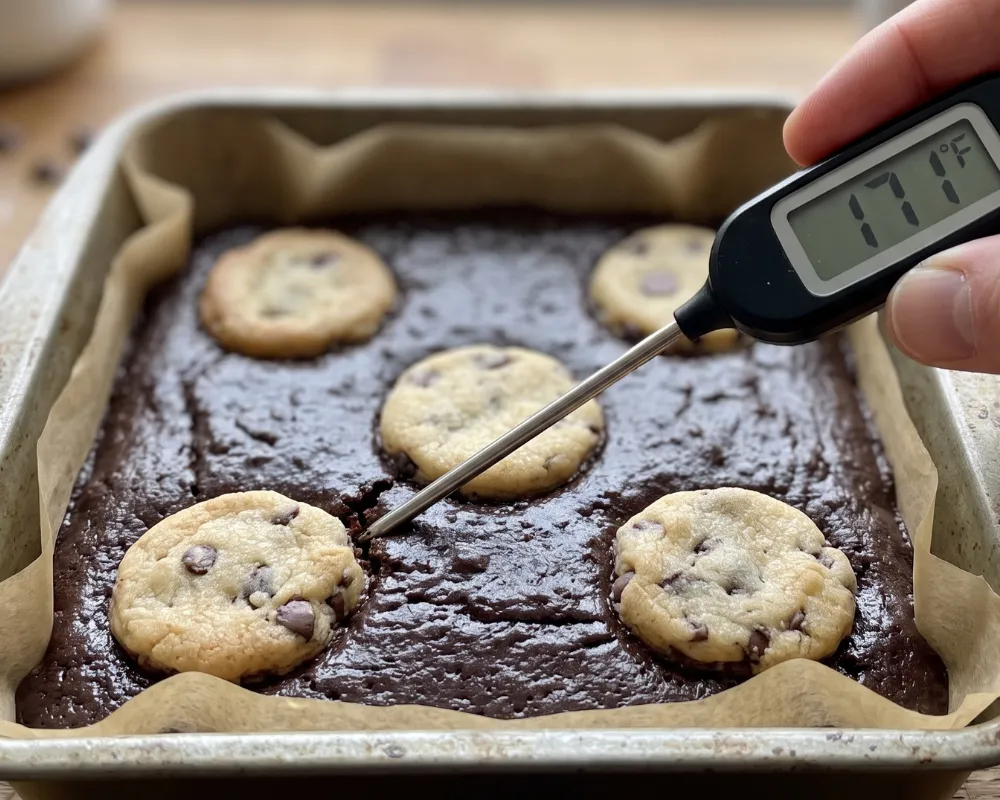
A brookie defeats every visual test twice over. The brownie layer's shiny top says done while it is raw underneath, the cookie coins say done ten minutes early, and the toothpick drags through two different textures and reports nonsense. The test that works is the one our brownies and blondies already use: an instant-read thermometer, pushed into the brownie layer between the coins, at an angle so the tip sits in the middle of the pan's depth.
| Brownie layer reads | What you have |
|---|---|
| Under 160°F | Raw brownie over done cookie. Keep going |
| 165 to 175°F | The window. Fudgy top, chewy base, slices clean once cool. Out |
| 185°F | Cakey brownie over firm cookie. Pleasant, and not the point |
| 200°F and past | A dry chocolate bar with a biscuit floor. The toothpick's fault |
The window is the brownie target on purpose: the cookie layer, thinner and drier and seated on the pan floor, runs a few degrees ahead of the brownie all bake long, so when the brownie hits 170°F the base is in the low 180s, which is exactly where a bar cookie wants to be. One number, both layers accounted for. The full set of internal targets for everything on this site lives on the baking chart.
Ingredients
Two short bowls, no mixer, one 6-inch pan. Both doughs use melted butter, and both butters want the same 5 minute cooling wait before anything else touches them.
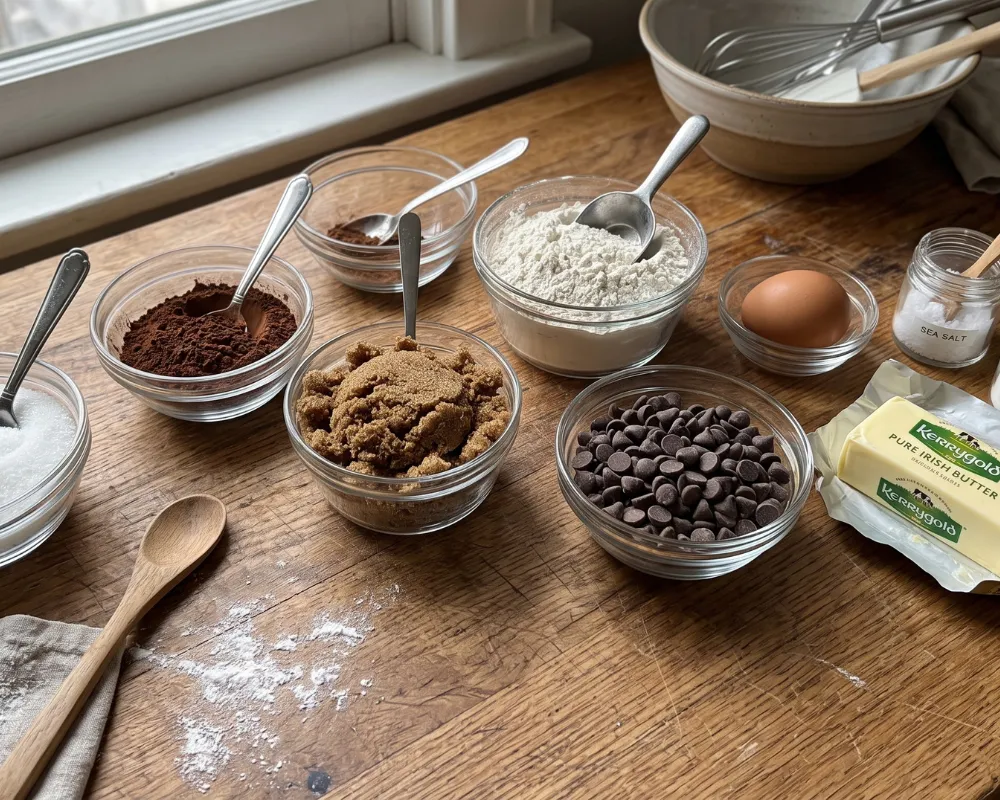
Cookie layer
- 5 tablespoons (70g) unsalted butter, melted and cooled 5 minutes
- 1/3 cup (65g) light brown sugar, packed
- 2 tablespoons (25g) granulated sugar
- 1 large egg yolk, room temperature
- 1 teaspoon vanilla extract
- 3/4 cup (94g) all-purpose flour
- 1/4 teaspoon salt
- 1/4 teaspoon baking powder
- 1/2 cup (85g) semisweet chocolate chips
Brownie layer
- 4 tablespoons (56g) unsalted butter, melted and cooled 5 minutes
- 1/2 cup (100g) granulated sugar
- 1 large egg, room temperature
- 1/2 teaspoon vanilla extract
- 1/3 cup (28g) unsweetened cocoa powder
- 1/4 cup (31g) all-purpose flour
- 1/8 teaspoon salt
The cookie layer takes a yolk rather than a whole egg, the same density trade our blondies make: whites are water and lift, and a base layer wants neither. The leftover white goes in tomorrow's scramble and owes you nothing. Natural or Dutch cocoa both work in the brownie half; Dutch bakes a shade darker and smoother.
How to make them
- Line the pan. A parchment sling overhanging two sides of a 6-inch square or round pan, and a light grease on the exposed walls.
- Melt both butters, then wait 5 minutes. Hot butter scrambles yolks and melts chips on contact. One mug in the microwave, two bowls after.
- Preheat to 320°F (160°C) for 3 minutes. When preheating matters covers the bakes where you can skip it. This is not one of them.
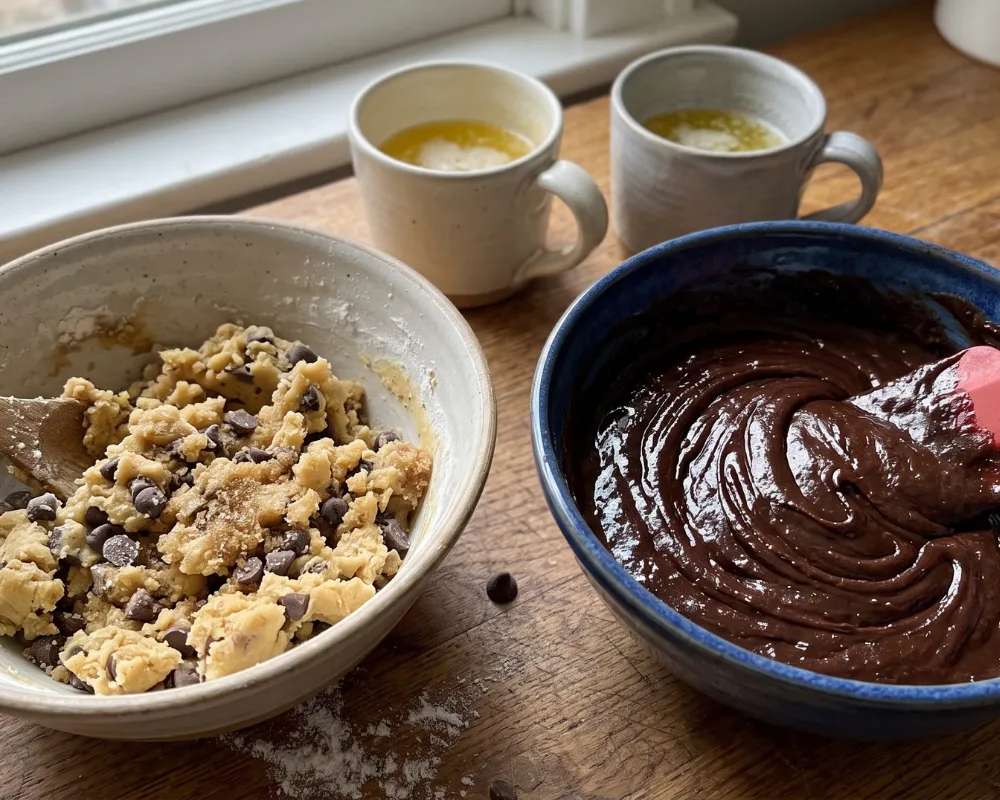
- Make the cookie dough: whisk the cooled butter with both sugars until glossy, whisk in the yolk and vanilla, then fold in the flour, salt and baking powder to the last streak. Fold in the chips.
- Reserve about a fifth of the cookie dough and press the rest evenly into the pan floor with damp fingertips.
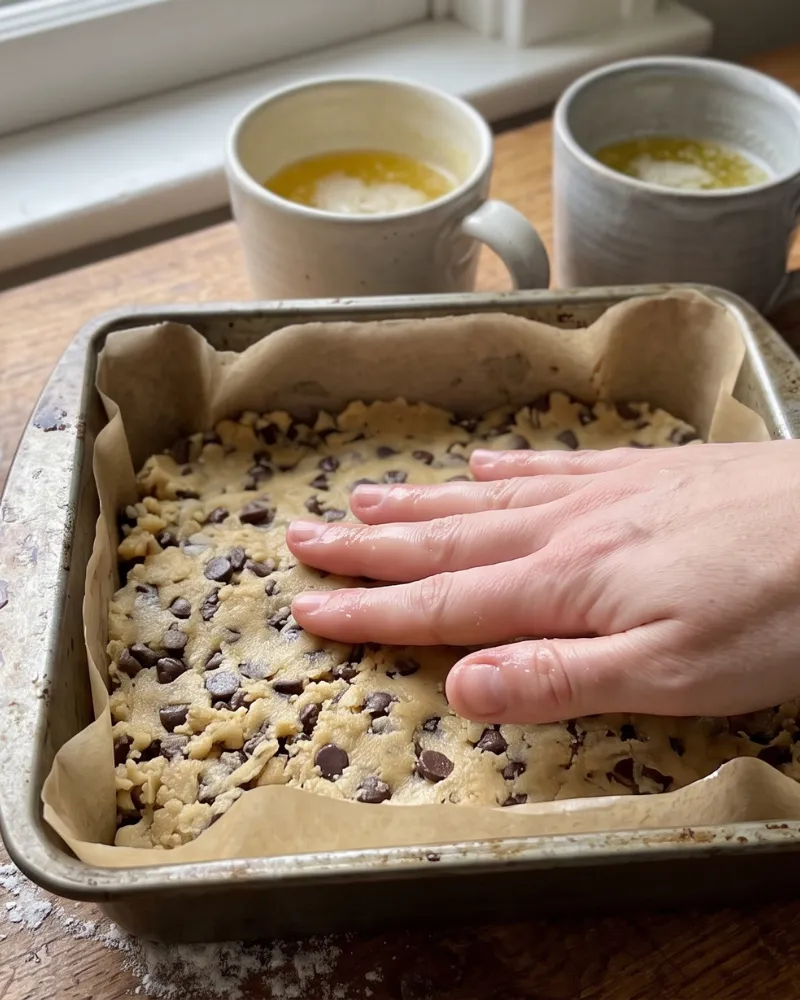
Damp fingertips, even pressure, all the way into the corners. This layer is the floor everything else stands on. - Make the brownie batter: whisk the second butter with the sugar, whisk in the egg and vanilla until smooth and slightly shiny, then fold in the cocoa, flour and salt until no dry pockets remain.
- Pour the brownie batter over the cookie base and spread it gently to the edges without pressing down.
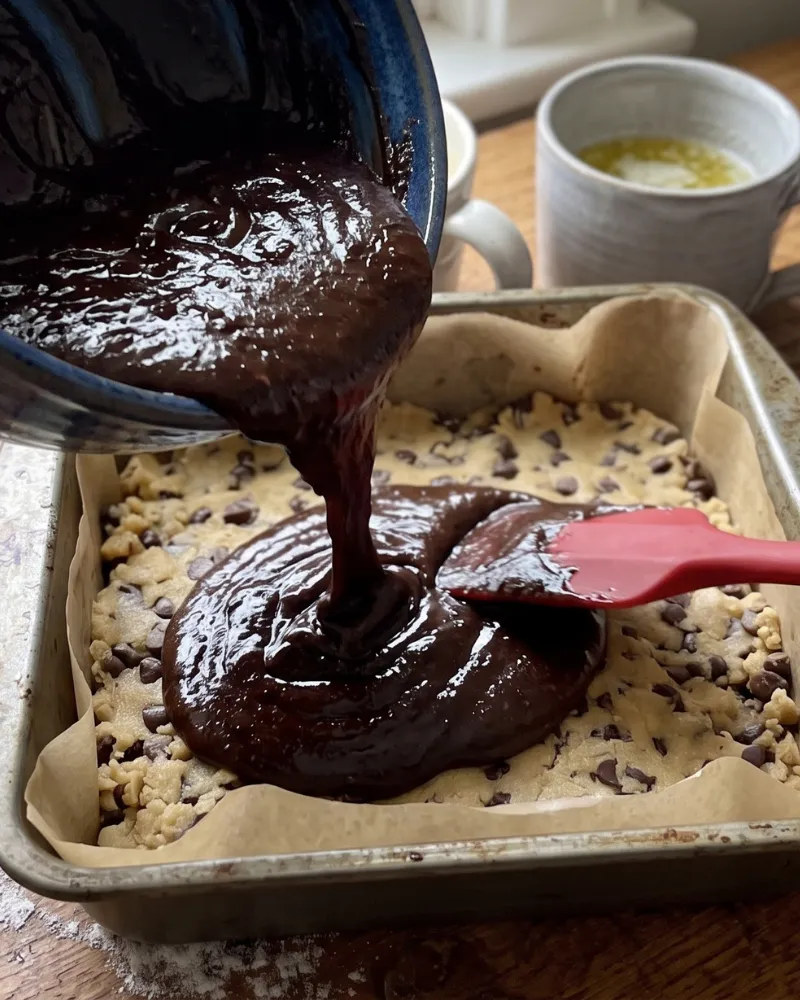
Pour at the edges first and let it find its own level. Spreading hard here drags the cookie base up into the batter. - Flatten the reserved dough into 5 or 6 thin coins and lay them on the batter, spaced apart, pressing each in only enough to stick.
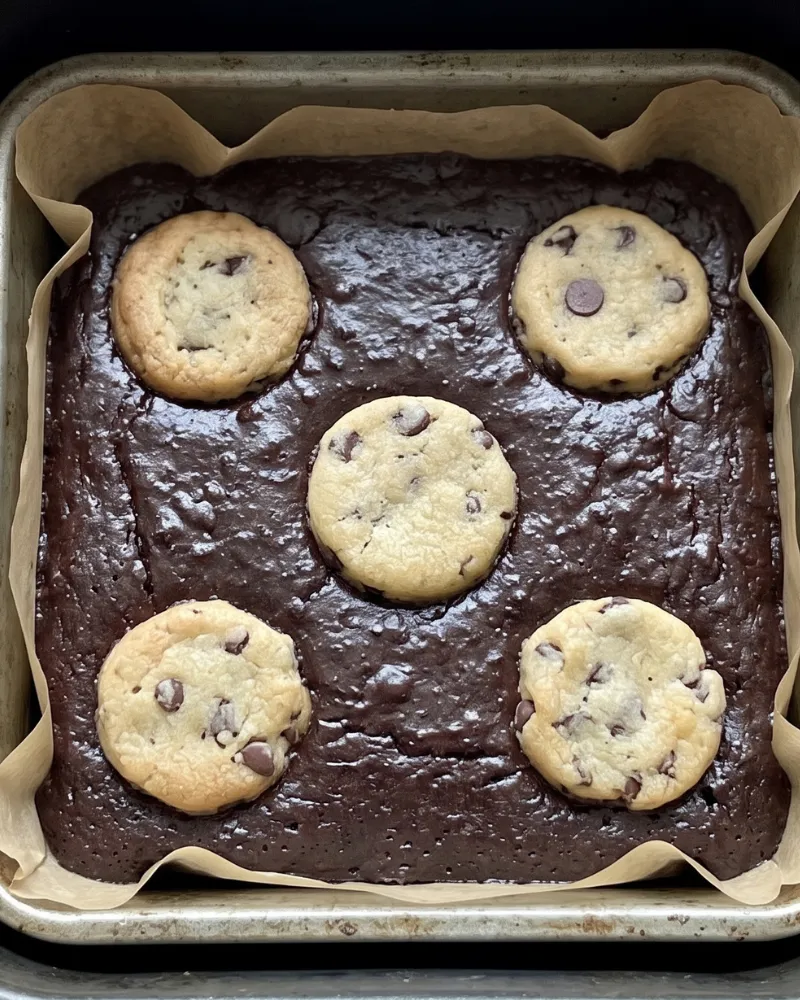
Five coins, spaced so every square gets one. Press them in only enough to stick. - Bake 22 to 26 minutes at 320°F. Do not open the basket for the first 12.
- Tent at golden, usually minute 12 to 14. When the coins turn golden, lay foil loosely over the pan, pressed at the rim so the fan cannot lift it. The coins are the timer; obey them.
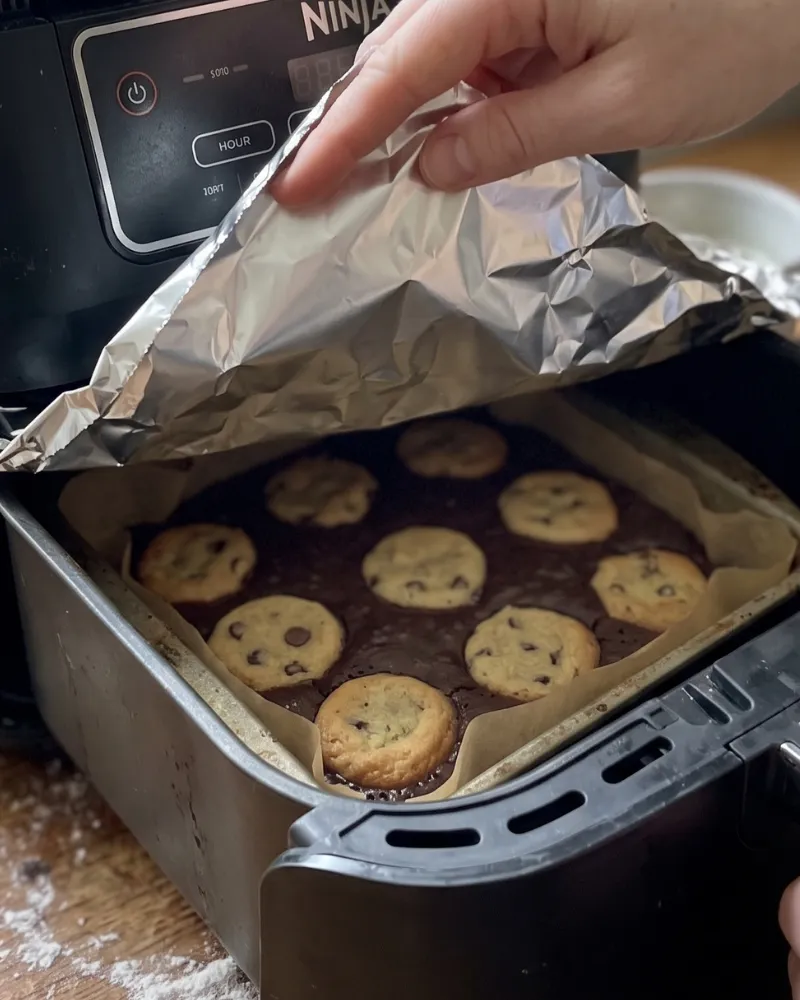
The foil goes on when the coins turn gold, usually minute 12 to 14, pressed down at the rim so the fan cannot lift it. - Start testing at 22 minutes. A thermometer angled into the brownie layer between the coins should read 165 to 175°F. The center will look underdone. That is correct, and it is the whole recipe.
- Cool 90 minutes in the pan, lift out with the sling, and cut into 9 squares with a long knife, wiping the blade between cuts. The brownie layer finishes setting on the counter, and warm cuts smear both strata into one.
The one way to truly ruin these: baking until the middle looks done. A brookie whose center looks finished in the pan has a brownie layer in the 190s, and it will eat like chocolate cake glued to a biscuit. Every failed pan in the testing for this page failed in that direction, and not one failed from pulling too early, because an underdone brookie sets up in the fridge and an overdone one is forever. When in doubt, out.
Pan size and scaling
| Pan | Batter | At 320°F | Notes |
|---|---|---|---|
| 6-inch square or round | The recipe as written | 22 to 26 min | Nine squares. The default |
| 7-inch square or round | Scale by 1.3 | 20 to 24 min | Thinner strata, earlier tent |
| 8x8 square | Scale by 1.75 | 24 to 28 min | Only if your basket genuinely fits it with airflow |
| Doubled in a 6-inch | Do not | Never works | Two deep layers is four arguments in one pan |
The recipe scaler resizes both bowls at once for whatever pan you land on, and the pan size calculator settles what your basket actually holds. Doubling in place fails here even harder than usual, because the brownie stratum doubles in depth and its finish line moves while the cookie base's does not; the two layers drift apart and no clock reconciles them. Two batches back to back is the honest double.
The honest shortcut version
Both doughs from scratch is about 20 minutes of mixing. There is a 5 minute version, and this site sees no reason to pretend otherwise: half a box of brownie mix prepared by its directions, poured over a base of store-bought refrigerated cookie dough, same pan, same 320°F, same layer order, same 165 to 175°F finish line. It works because the architecture and the thermometer are doing the hard parts, not the doughs.
Two notes from testing it. Store-bought cookie dough is wetter than the scratch dough, so the base bakes a touch softer; our refrigerated cookie dough page covers how the tube doughs behave in a basket on their own, and the scratch base here is the same dough that carries our chocolate chip cookies and snickerdoodles. And boxed brownie batter is looser than the scratch batter, so pour slowly at the edges first or it will slide the coins around. The same timing-first logic behind our boxed cake mix page applies: the box is fine, the settings on the box are not.
Fixing what goes wrong
| What you got | Why | Fix |
|---|---|---|
| Cakey brownie over hard cookie | Overbaked, while looking exactly right. | Pull at 165 to 175°F in the brownie layer. The center should look wet. |
| Raw brownie over done cookie | Pulled on the coins' color instead of the thermometer. | The coins are the tent signal, not the finish line. Bake to the number. |
| Dark, bitter coins | The tent never went on, or went on loose and blew off. | Foil at golden, pressed firmly at the rim. Prevent burning covers the family. |
| Layers swapped and swirled | Brownie batter poured hard into the middle, or the base pressed too soft. | Press the base firm, pour gently at the edges, spread without pushing down. |
| Dense flat lid instead of fudgy top | A full cookie slab on top instead of spaced coins. | Coins with gaps. Steam needs exits and the brownie needs headroom. |
| Greasy band at the base | Hot butter broke one of the doughs. | The 5 minute wait, both bowls, no exceptions. |
| Smeared, marbled cuts | Cut warm, when the brownie stratum was still molten. | 90 minutes minimum. The fridge for 20 makes the cuts photographic. |
Failures that do not match a row are usually machine quirks, and the troubleshooting guide works symptom-first across every bake on the site. Foil questions, including which machines dislike it, live in foil or parchment in an air fryer.
Storage and freezing
- Room temperature: 4 days airtight. Day two is the peak, once the brownie stratum has settled into full fudge and the cookie base has gone uniformly chewy. The two layers taste more like one thing after a night together, which is the whole idea.
- Do not refrigerate for storage. The fridge stales the cookie base faster than the counter. The fridge's only job here is 20 pre-cutting minutes for clean edges.
- Frozen: 3 months, cut and wrapped individually. Thaw an hour on the counter, or revive at 300°F for 2 minutes in the basket, which re-melts the chips and restores the fresh-baked seam between the layers.
- Warm on purpose: 90 seconds at 300°F, vanilla ice cream on top, spoon required. A brookie sundae outranks both parent desserts and this page stands by that, and it is the same trick that rescues a pan of rice krispie treats two days later.
Twenty-five minutes of basket time against heating a full oven for one small pan is the exact math this machine wins, and the running cost calculator will price it against your own electricity rate. All four air fryer tools live in one place. If two-desserts-in-one is your genre, monster cookies are the kitchen-sink cousin, magic bars stack seven layers instead of two, and cheesecake bars are the one bar here that is set by chilling rather than baking. The parents of this one live at brownies and chocolate chip cookies, all twenty bars and cookies are in the collection, the guides index covers the technique, and the full recipe index has the rest.
Frequently asked questions
QCan you make brookies in an air fryer?
Yes, as a proper layered bar, not just a mug hack, but the standard oven arrangement has to flip. Cookie dough goes on the bottom, where the pan floor bakes it gently into a chewy base; brownie batter goes over it, insulated from the close element; and a few flattened coins of reserved cookie dough sit on top, where their color tells you when to tent with foil. Bake at 320F for 22 to 26 minutes in a 6-inch pan and pull when the brownie layer reads 165 to 175F on a thermometer.
QWhat temperature and how long for air fryer brookies?
320F for 22 to 26 minutes in a 6-inch pan, tenting foil over the top once the cookie coins turn golden, usually minute 12 to 14. The temperature is the brownie half's number on purpose: a slightly cool bake softens the cookie layer harmlessly, while a hot bake sets the brownie cakey, which is unfixable. Oven brookie recipes run 325 to 350F for over 30 minutes in an 8x8, and neither figure survives a basket, which cooks a real 25 to 30 degrees harder at the same dial.
QDoes the cookie layer go on top or bottom?
Bottom, in a basket, and the reason is the heating element sitting inches above the pan. Cookie dough on top browns to finished-looking in 10 minutes and then heads for bitter while the brownie below is still batter. On the pan floor, the layer that wants more doneness gets steady conducted heat, and the brownie above it stays shielded. The top is not bare, though: five or six thin coins of reserved cookie dough go on the batter, giving every slice both flavors and giving you a built-in color signal for the foil tent.
QHow do I know when brookies are done?
A thermometer, angled into the brownie layer between the cookie coins, reading 165 to 175F. Every visual test fails twice here: the brownie's shiny top says done while raw, the coins say done ten minutes early, and a toothpick drags through two textures and reports nonsense. The window is deliberately the brownie's target, because the cookie base runs a few degrees ahead of it all bake long, so one number accounts for both layers. The center should still look underdone when you pull the pan; it sets as it cools.
QWhy did my brownie layer come out cakey?
Overbaking, almost always while the pan looked exactly right, because a brookie whose center appears finished has a brownie layer in the 190s. Past about 185F the brownie's structure sets fully and it eats like chocolate cake; past 200F it dries outright. Pull at 165 to 175F and trust the ugly wet look of the center. The other cakey culprit is temperature: a machine running hot sets the brownie from the outside in before the middle arrives. If everything you bake finishes early, check your machine against an oven thermometer once.
QCan I use boxed brownie mix and store-bought cookie dough?
Yes, and it genuinely works, because the architecture and the thermometer are doing the hard parts rather than the doughs. Half a box of brownie mix prepared to its directions, poured over a base of refrigerated cookie dough, same 6-inch pan, same 320F, same layer order, same 165 to 175F finish. Two adjustments: tube cookie dough is wetter, so the base bakes softer, and boxed batter is looser, so pour it slowly at the edges or it will float the coins around. Ignore the box's oven settings entirely.
QDo I need to chill either dough first?
No, and chilling actively works against the bar format. Chilled cookie dough resists spreading, which matters for freestanding cookies and is irrelevant for dough pressed into a pan; cold dough is just harder to press evenly. A cold base under room-temperature batter also widens the finishing gap between the layers, since the cookie stratum starts the bake further behind. Mix, press, pour, bake. The only mandatory wait in this recipe is the 5 minutes both butters spend cooling after the melt, and the 90 minutes at the end.
QWhy did my cookie coins burn before the middle was done?
The foil tent went on late, loose, or never. In a basket the exposed coins reach golden around minute 12 to 14 with roughly 10 minutes still to run, and from golden they will keep darkening unless shielded. Lay foil loosely over the pan the moment they hit the right color and press it down at the rim so the fan cannot lift it into the element. If your coins are darkening well before minute 10, the machine is running hot or the coins were rolled too thin; make them a quarter inch and check the dial against reality.
QCan I double the recipe in the air fryer?
Not in one pan, and brookies punish the attempt worse than most bars. Doubling deepens the brownie stratum, which moves its finish line later, while the cookie base's finish line barely moves; the two layers drift apart and no single bake time serves both. Bake two 6-inch batches back to back instead, with the second running a minute or two faster in the heat-soaked machine. If your basket honestly fits an 8x8 with airflow around the rim, scale both bowls by 1.75 and start checking at 24 minutes.
QCan I make brookies as individual cookies instead of bars?
That is a real format, the half-and-half pressed cookie that Crumbl popularized, and a basket handles it at 320F for 8 to 10 minutes on perforated parchment. It is a different dessert, though: two doughs side by side rather than two strata, so every bite is either-or instead of both-at-once, and the fudgy brownie layer that defines the bar version cannot exist in a freestanding cookie, which must bake firm enough to hold its own shape. If the gooey middle is what you are here for, the bar is the format that can deliver it.
QHow should I store brookies?
Airtight at room temperature for 4 days, and day two is the peak, once the layers have settled into each other overnight. Skip the refrigerator for storage, which stales the cookie base faster than the counter; its only job is 20 minutes before cutting, when a chilled slab cuts photographically clean. They freeze well for 3 months, cut and wrapped individually, and revive from frozen or day-old at 300F for about 2 minutes in the basket, which re-melts the chips and brings back the seam between the layers.
QWhat exactly is a brookie?
A portmanteau bake: brownie plus cookie in one dessert, usually as a layered bar with chocolate chip cookie dough and brownie batter sharing a pan, occasionally as a half-and-half cookie or a stuffed cupcake-tin version. The bar is the original and the best argument for the idea, because the two textures actually meet in every bite instead of alternating. It is a cousin of the blondie rather than a sibling: a blondie removes the cocoa from one batter, while a brookie keeps both batters and makes them live together.