
Air Fryer Frozen Croissants: Freezer to Flaky in Minutes
Search this exact question and you will find one site telling you 12 minutes straight from frozen, another insisting on an overnight rise first, and a third waving you through in 5. None of them are wrong and none of them are talking about the same croissant, because three different products live in the freezer aisle under one name. This page sorts that out in the first minute: identify which box you actually bought, and I will give you the right numbers for it, from the 3 minute revival to the 15 minute bake to the one kind that genuinely needs to sit out overnight and rewards you for letting it.
What’s on this page
- Which frozen croissant do you have?
- The honest minutes math
- Ready-to-bake: straight from frozen
- The proof-overnight kind
- Already baked: the 3 minute revival
- Temperature and timing
- What done looks like
- Ingredients
- How to make them
- Fixing what goes wrong
- Serving and second lives
- Frequently asked questions
Which frozen croissant do you have?
The freezer aisle sells three completely different things under the word croissant, and every disappointing result I hear about starts with someone using the right instructions for the wrong box. Thirty seconds with the package sorts it out.
- Ready-to-bake. The box says bake from frozen, no thawing, and the croissants inside are pale, firm, fully shaped dough. This is the common kind in most supermarkets, it is the kind this page's recipe card covers, and it really is freezer to flaky in about 15 minutes.
- Proof-and-bake. The box says let rise overnight, or 6 to 9 hours; Trader Joe's croissants and chocolate croissants are the famous ones. The dough inside is alive, and the wait is the price of the best croissant a home freezer can produce. No air fryer setting substitutes for the rise. Skipping it does not make a faster croissant, it makes a dense little comma.
- Pre-baked. The croissants inside are already golden and just need heat: bagged bakery croissants people freeze, or boxes labeled fully baked. These want 3 minutes, not 15, and running them 15 makes croutons.
A fourth product sits in the refrigerator case rather than the freezer: canned croissant dough, which bakes on its own schedule at air fryer croissants. If the box is gone and you are staring at a bag of mystery croissants: pale and heavy means unbaked, golden and light means baked, and unbaked ones with no rise instructions are almost always the ready-to-bake kind.
The honest minutes math
The title says minutes, so here is where that claim stands for each box, audited the way this site audits its own headlines. Pre-baked: about 3 minutes, plus nothing, an honest 3. Ready-to-bake: 12 to 15 minutes in the basket with zero prep, no thawing and no preheat worth arguing about, so call it an honest 15, which still beats preheating an oven for one tray. Proof-and-bake: 9 to 11 minutes of baking after 6 to 9 hours of rising, so the minutes claim is true only the way it is true that a marathon ends with a sprint. Two out of three boxes keep the title's promise, and the third one was never trying to be fast. It is trying to be a bakery.
Ready-to-bake: straight from frozen
320°F for 12 to 15 minutes, frozen, spaced, never flipped. This is the same freezer-shelf logic as our frozen biscuits, which run the same temperature for the same reason: a frozen center needs time to thaw and then bake, and any temperature high enough to look impressive at minute 5 will have the outside mahogany while the middle is still cold dough. The boxes themselves usually say around 350 to 375°F for an oven; drop that through the standard oven-to-basket conversion, the one our air fryer calculator runs for any package instruction, then take one step further down because laminated dough carries its butter at the surface and browns faster than the lean doughs the conversion assumes. That lands at 320°F, and it holds.
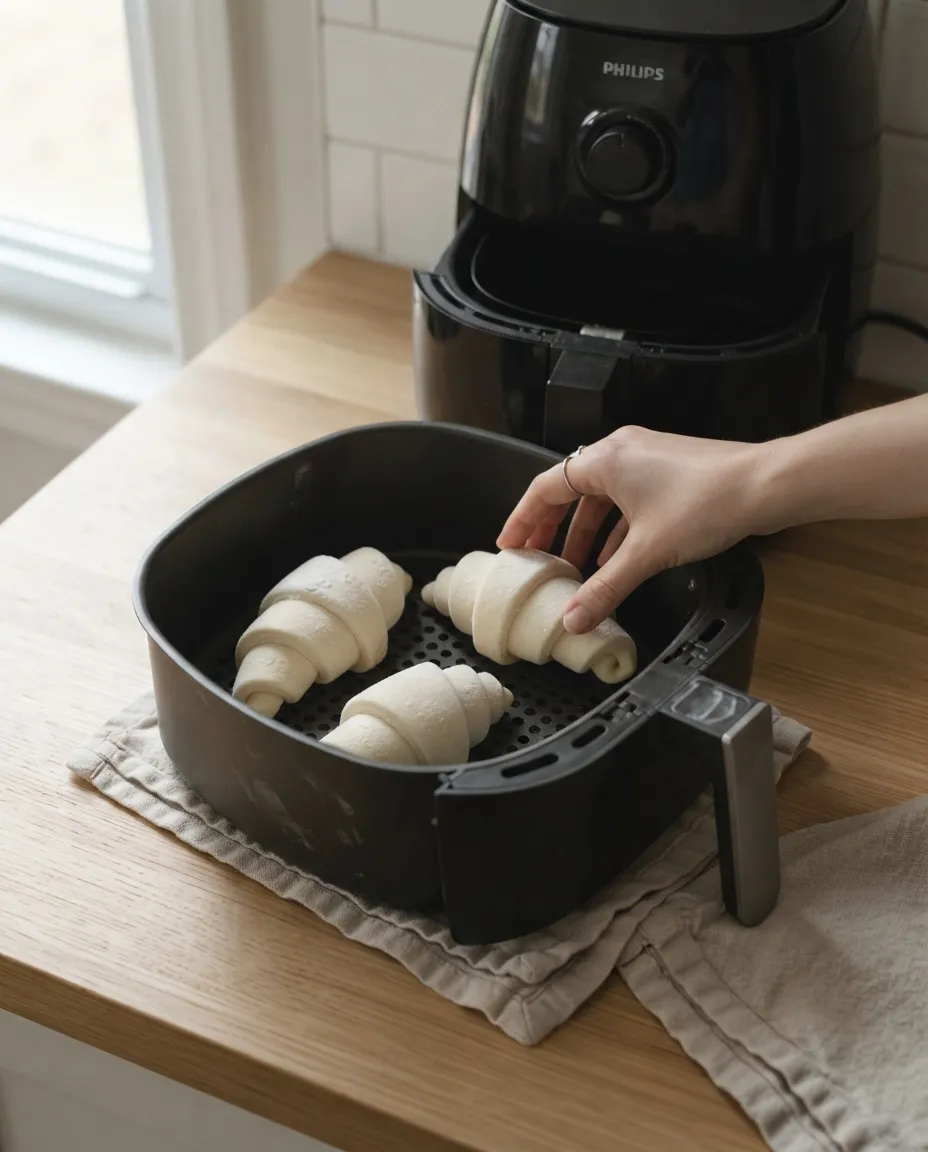
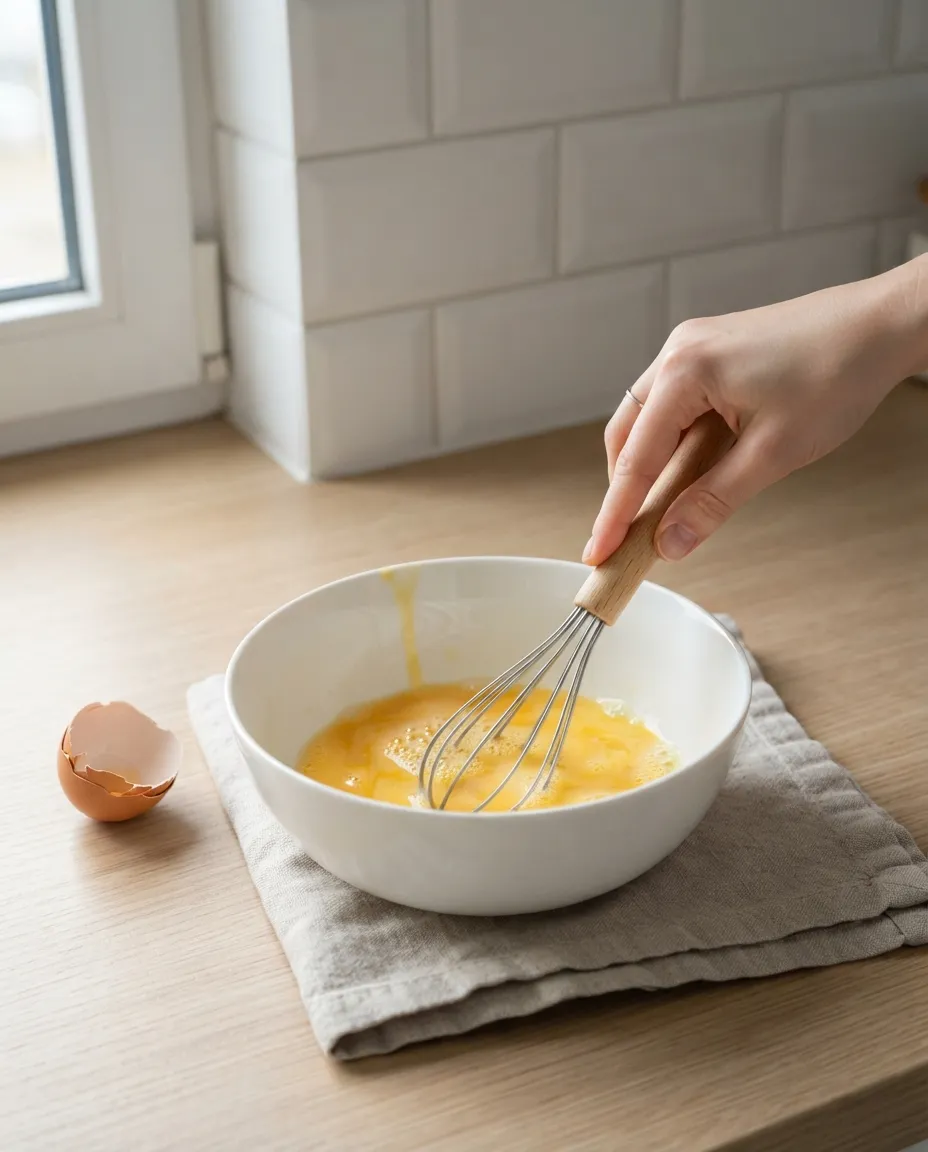
Do not thaw them first. A thawed ready-to-bake croissant slumps and bakes flatter, because the slow warm-up melts the butter layers before the heat can flash them into steam. Frozen into the basket is not a compromise here, it is the design. Thawed puff pastry sheets play by different rules, because a folded sheet is not engineered to skip the thaw; that side of the laminated family lives in the puff pastry guide. An egg wash brushed on at the start is optional and makes them glossy; the naked version browns fine on its own butter.
The proof-overnight kind
Trader Joe's croissants, and their chocolate cousins, are real laminated croissant dough sold mid-process, and they are the best thing in this article by a distance, on one condition: the overnight rise happens. Set them on a plate the night before, 4 inches apart because they double and then some, cover loosely, and leave them at room temperature 6 to 9 hours until they are puffed, wobbly, and visibly bigger. Then 330°F for 9 to 11 minutes, watching the tops from minute 8, because proofed laminated dough browns in a hurry. For the chocolate ones, drop to 320°F for 9 to 11; the exposed chocolate ends scorch before the pastry finishes at anything hotter, and the other rescues for early browning live in the burning guide.
The internet is full of hacks for baking these straight from frozen, and I have tested enough of them to report back: every one produces a smaller, denser, bready croissant that tastes fine and is not the thing on the box. The yeast needs its hours. Plan them like the overnight schedule for our glazed donuts: the waiting happens tonight while you sleep, and the bakery happens tomorrow.
Already baked: the 3 minute revival
300°F for 2 to 3 minutes for a thawed or day-old croissant, and about 4 minutes straight from frozen. The dry moving heat re-crisps the shell while the inside steams itself soft, and a croissant that seemed past it comes back closer to fresh than an oven manages and infinitely closer than a microwave, which dissolves the layers into damp bread in 30 seconds. This is also the answer for the giant warehouse-store bag: freeze them the day they come home, then revive by the piece all month. No preheat, no foil, straight on the basket floor.
Temperature and timing
One table, since the whole point of this page is knowing which line you are on.
| What is in the freezer | Prep | Temp | Time |
|---|---|---|---|
| Ready-to-bake croissants | None, bake frozen | 320°F | 12 to 15 min |
| Proof-and-bake (Trader Joe's) | Rise 6 to 9 hours | 330°F | 9 to 11 min |
| Proof-and-bake chocolate croissants | Rise 6 to 9 hours | 320°F | 9 to 11 min |
| Pre-baked, thawed or day-old | None | 300°F | 2 to 3 min |
| Pre-baked, frozen | None | 300°F | About 4 min |
No flipping on any line. A croissant's structure is in its top layers, and turning it mid-bake presses the lamination you paid for into the basket floor. Space them so air can move; a crowded basket steams, and steam is the enemy of every number above. Batch two runs about a minute faster in the warm machine. These settings join the rest of the site's tested numbers on the baking chart, and the question of preheating, which matters so little for a 15 minute frozen bake that I skip it, gets its full hearing in do you need to preheat an air fryer for baking.
What done looks like
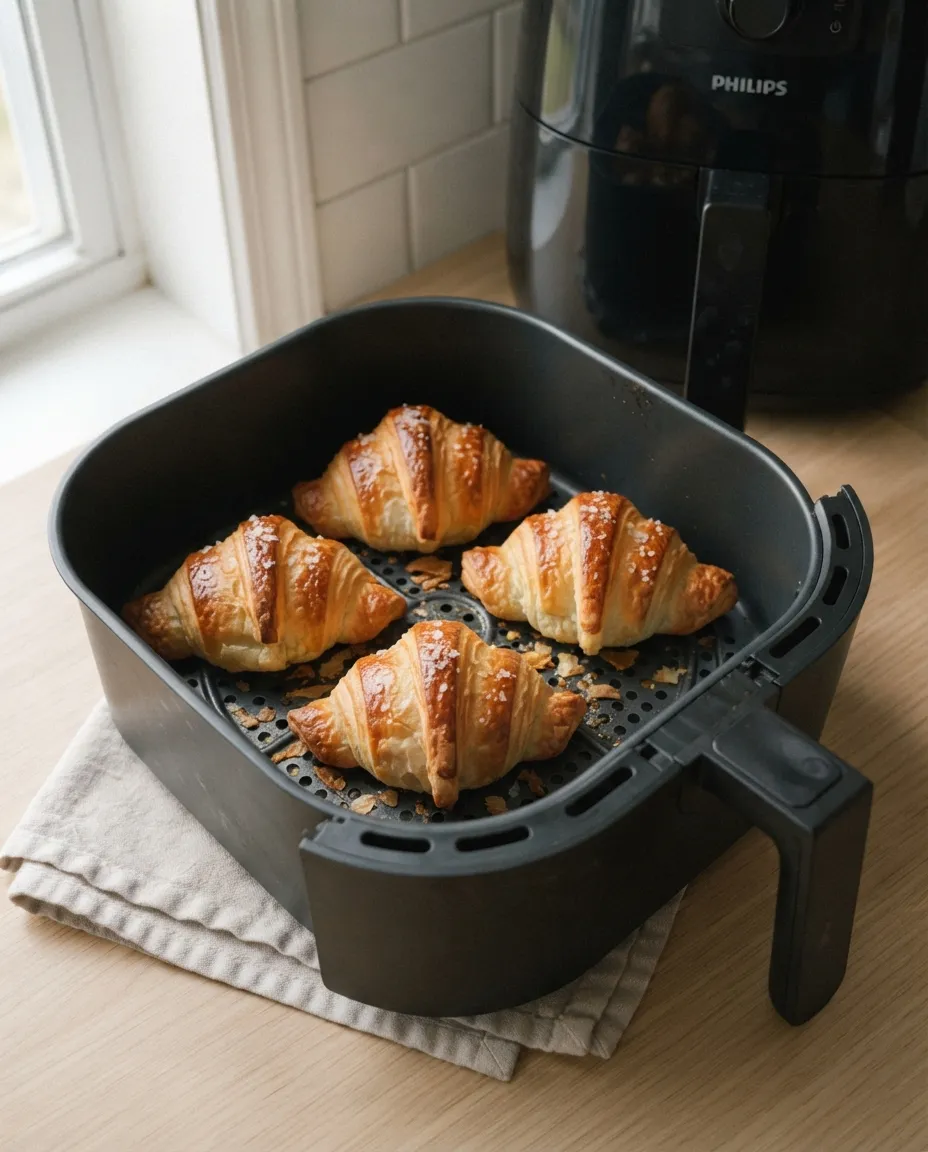
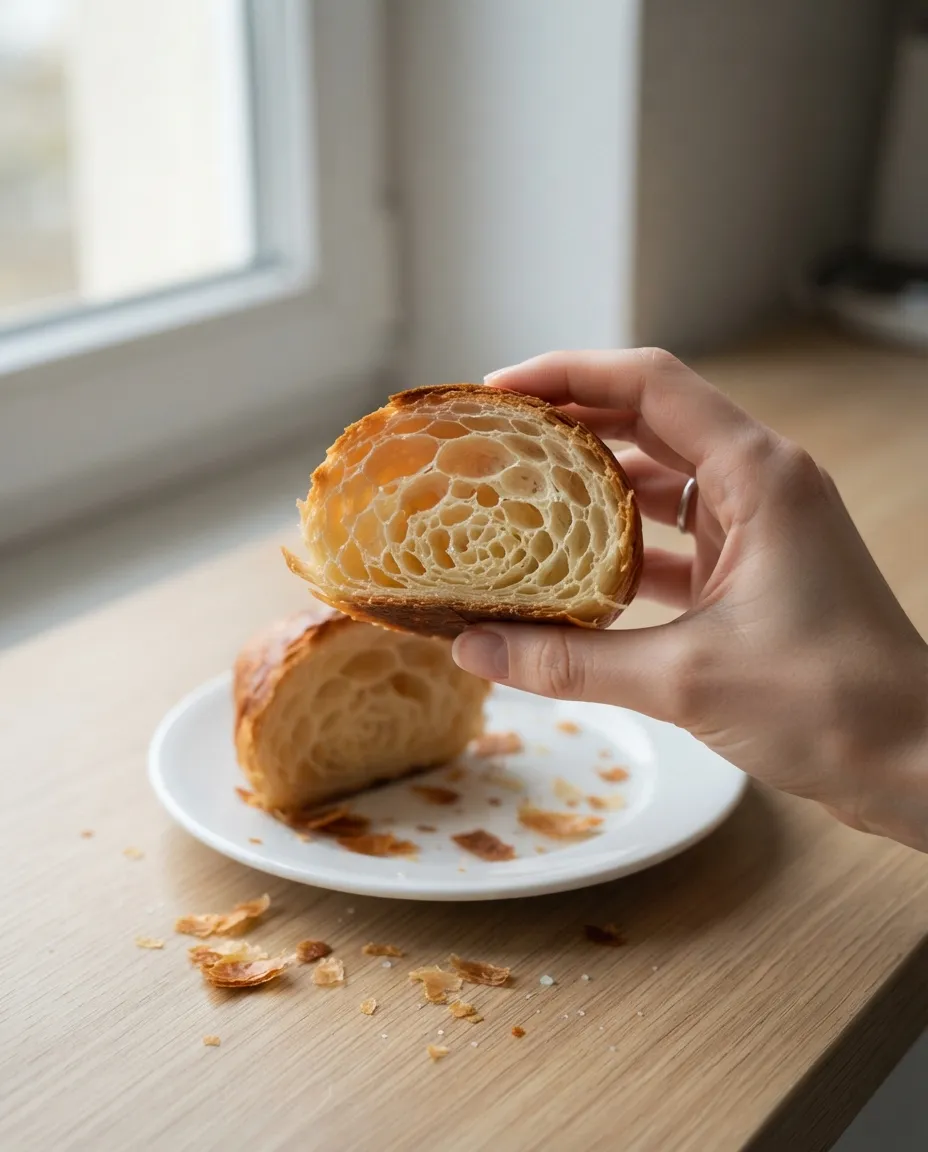
- Color: deep gold shading to bronze on the ridges, richer than seems polite. Laminated dough is meant to go past golden; pale croissants taste like flour.
- Weight: a done croissant lifts light for its size. Heavy means the center is still catching up, so give it 2 more minutes at the same temperature.
- The base: tip one with tongs; the underside should be golden and dry, not pale and greasy. Butter pooling under pale bottoms means the temperature was too high and the outside outran the middle.
- The listen: a fresh-baked one crackles faintly as it cools on the rack. It is the sound of the layers setting, and it is the only doneness test on this site you can run with your eyes closed.
Ingredients
For one basket
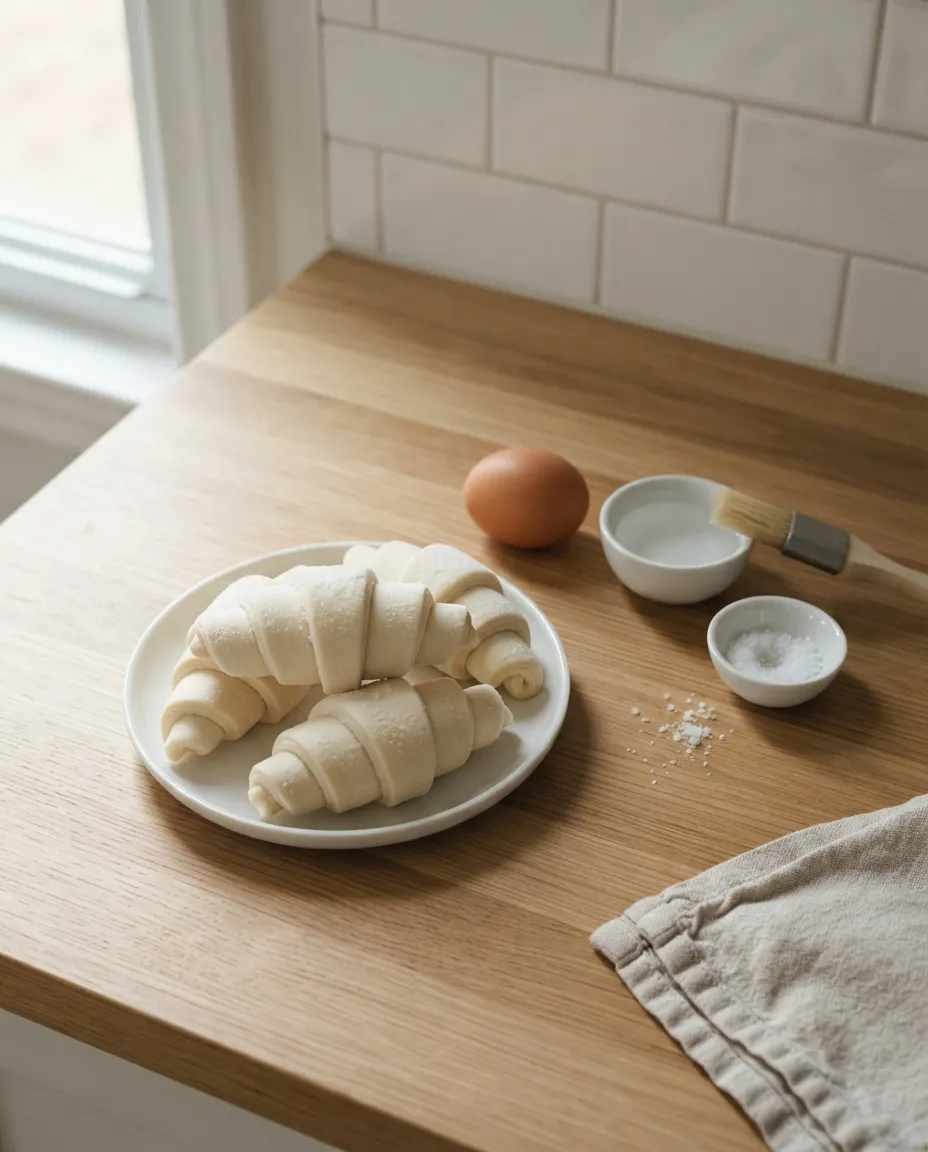
- 4 frozen ready-to-bake croissants (or as many as fit with a finger of space between)
- 1 egg beaten with 1 teaspoon water, optional, for gloss
- Pinch of flaky salt, optional, over the egg wash
That is genuinely the whole list. The croissant maker did the laminating; your job is heat management and restraint with the timer.
How to make them
- Check the box first: this method is for ready-to-bake croissants. Proof-and-bake kinds need their overnight rise and the settings in the table above.
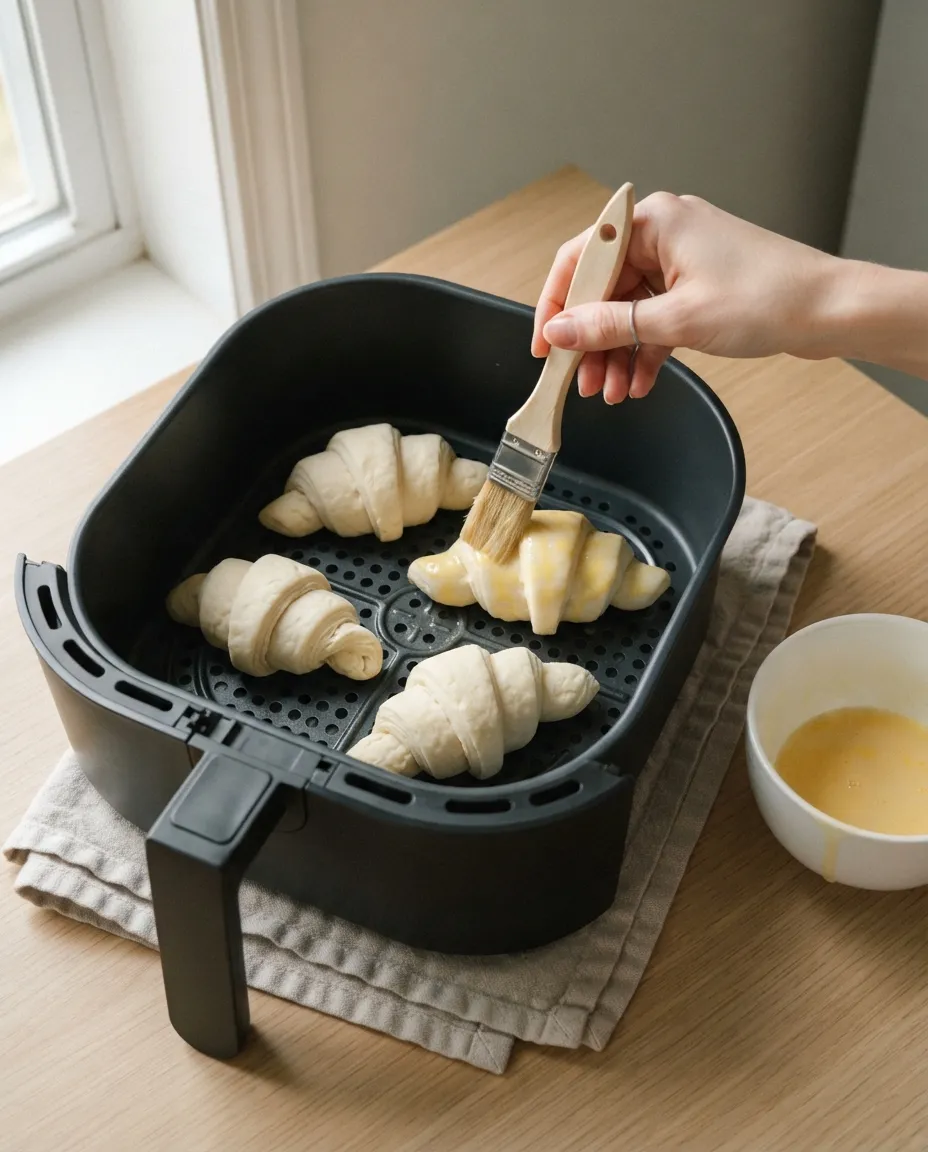
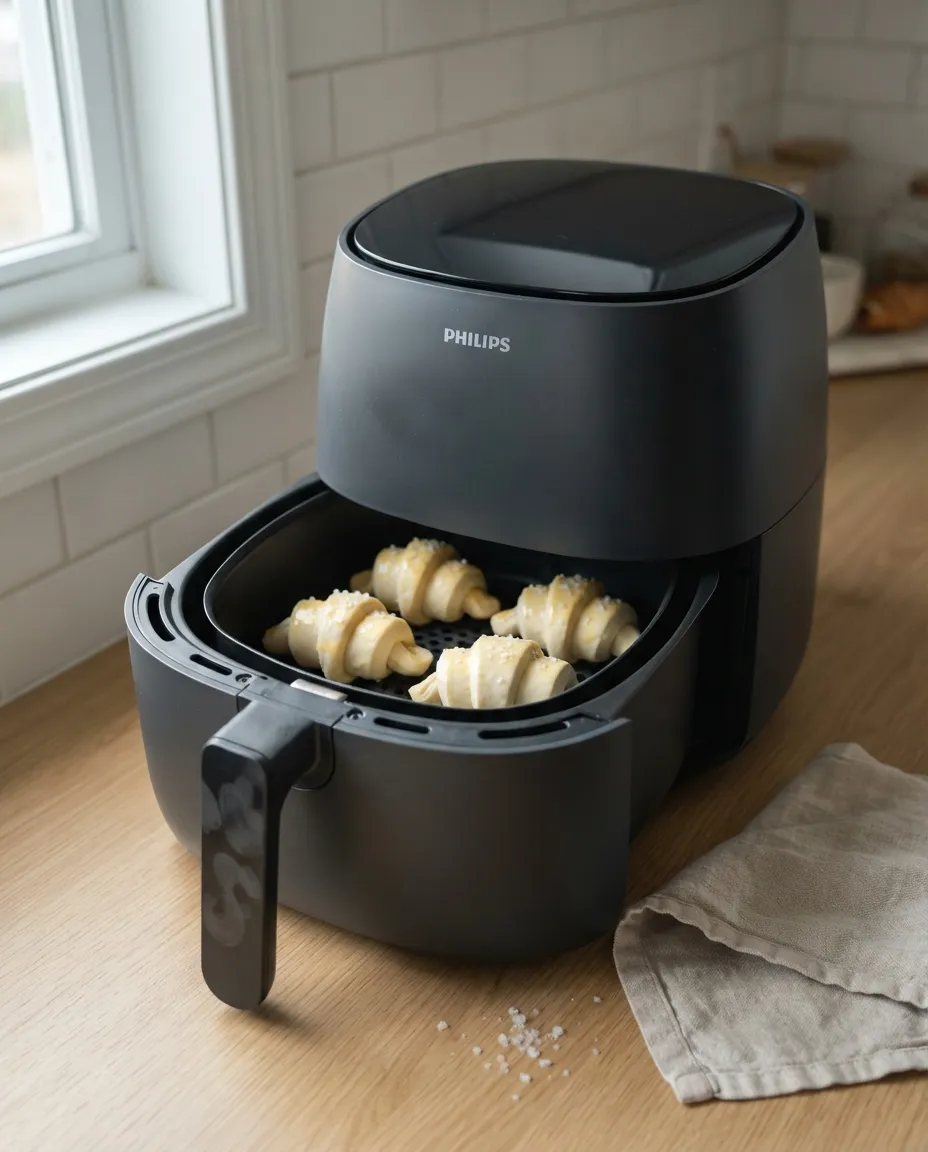
- Arrange the frozen croissants in the basket with at least a finger of space between them, flat side down.
- Brush the tops with egg wash if using, and keep it off the cut ends where the layers show.
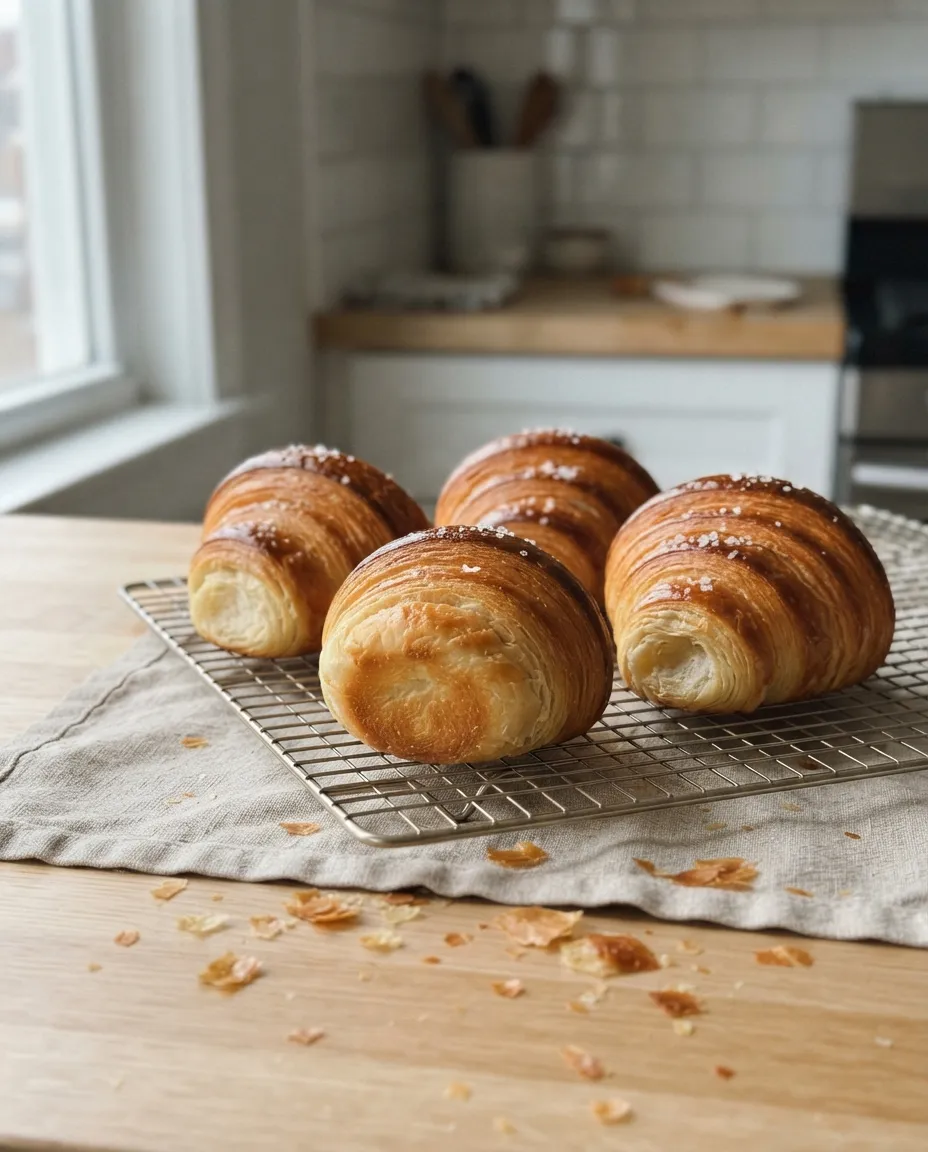
- Air fry at 320F for 12 to 15 minutes, no thawing, no flipping, until deep gold with bronze ridges.
- Check the base of one with tongs at minute 12: golden and dry means done, pale means 2 to 3 more minutes.
- If the tops race ahead of the bake, resist turning the temperature up to finish faster; patience at 320F is what keeps the middle from staying doughy.
- Cool on a rack for 5 minutes, listening for the crackle, and bake any second batch about a minute shorter.
- Serve warm, the day they are baked; a croissant's clock starts at the rack.
Fixing what goes wrong
| Problem | Cause | Fix |
|---|---|---|
| Dark outside, doughy middle | Temperature too high for a frozen center | 320°F and the full 15 minutes; from frozen, speed is the one thing the basket cannot give |
| Small, dense, bready result | A proof-and-bake croissant baked without its rise | The overnight proof is non-negotiable; 6 to 9 hours on the counter, then 330°F |
| Flat and greasy | Ready-to-bake croissants thawed before baking | Straight from frozen, always; thawing melts the butter layers before the heat can lift them |
| Chocolate ends burned | Pain au chocolat run at croissant temperature | 320°F for the chocolate ones, and check from minute 8 |
| Rubbery, layerless reheat | Microwave | 300°F in the basket for 2 to 3 minutes; the microwave undoes lamination for a living |
| Pale, steamed sides | Crowded basket | A finger of space minimum between croissants; bake in batches and shorten batch two by a minute |
Serving and second lives
A warm croissant with jam needs no help, but the basket earns its keep on day two. Split a revived croissant and it becomes the best fast sandwich bread in the house: ham and cheese given 2 more minutes at 300°F until the cheese runs, or a fried egg from the bacon and eggs playbook folded in on a weekday morning that deserves better than toast. Day-old croissants sliced and rewarmed also outclass bread under anything you would put on avocado toast. If the freezer aisle has you in the mood to upgrade a humbler can, the from-scratch-adjacent version of this whole idea lives at crescent rolls, with the rest of the frozen shelf at frozen garlic bread and toaster strudel, which also bakes from frozen with no flip, and canned biscuits nearby. For flaky pastry you shape yourself from a store sheet, the cheese danish and palmiers are the easy wins. Everything tested on this site is indexed at the recipe index, with the technique pages under guides.
Storage runs one direction: baked croissants keep airtight at room temperature for 2 days, revived at 300°F before serving, and freeze well for a month, back to life in about 4 minutes. Unbaked ready-to-bake croissants stay in the freezer until the moment they bake, and proof-and-bake dough, once risen, does not go back; proof only what tomorrow will eat.
Frequently asked questions
QHow long do frozen croissants take in an air fryer?
It depends entirely on which of the three freezer products you have. Ready-to-bake croissants go straight from frozen at 320F for 12 to 15 minutes. Proof-and-bake croissants, like Trader Joe's, must rise at room temperature 6 to 9 hours first and then bake at 330F for 9 to 11 minutes. Pre-baked croissants only need reviving: 300F for 2 to 3 minutes thawed, or about 4 minutes from frozen. The box tells you which you have; instructions that mention rising mean the second kind.
QCan you cook Trader Joe's croissants in an air fryer?
Yes, and they are excellent in it, but the overnight rise still happens on the counter first. Set them on a plate 4 inches apart the night before, cover loosely, and leave them 6 to 9 hours until doubled and wobbly, then air fry at 330F for 9 to 11 minutes, watching the tops from minute 8. The chocolate croissants run 320F for the same time so the exposed chocolate ends do not scorch. Baked straight from frozen they come out small, dense and bready at any setting, because no temperature substitutes for yeast.
QShould I thaw frozen croissants before air frying?
Not the ready-to-bake kind. Thawing lets the butter layers melt slowly into the dough, and the croissant bakes up flatter and greasier than one that went in frozen, where the heat flashes the cold butter to steam and the steam lifts the layers. The one product that needs counter time is the proof-and-bake kind, and that is a rise, not a thaw: living dough doubling over 6 to 9 hours. Pre-baked croissants reheat fine from either state, with about a minute's difference.
QWhat temperature is best for frozen croissants?
320F for ready-to-bake croissants from frozen, and it is lower than the box's oven number on purpose. The standard oven-to-air-fryer conversion drops the temperature, and laminated dough earns one step more because its butter sits at the surface and browns faster than plain dough. Hotter settings look great at minute 5 and hide a cold, doughy center at minute 12. Proofed croissants take 330F for 9 to 11 minutes, since the risen dough no longer has a frozen core to wait for.
QHow do you reheat a croissant in an air fryer?
300F for 2 to 3 minutes, straight on the basket floor, no foil. The moving dry heat re-crisps the shell while the inside warms soft, and a day-old croissant comes back very close to fresh. From frozen, a baked croissant takes about 4 minutes. Skip the microwave entirely; it steams the lamination into soft bread in seconds and nothing brings that back. For a croissant sandwich, split it first and give the filled halves 2 extra minutes so the middle heats through.
QWhy did my frozen croissants come out dense?
Almost always because a proof-and-bake croissant was baked without its rise. That dough is sold mid-process and the overnight proof is where the airy interior comes from; heat alone turns unrisen dough into a heavy, bready version of itself, no matter the setting. If the croissants were the ready-to-bake kind and still came out dense, the usual culprits are a thaw before baking, which flattens the layers, or a crowded basket, which steams the croissants instead of baking them. Frozen, spaced, 320F, full time.
Made it? Rate it.
It helps more people match the right minutes to the right box.
Air Fryer Frozen Croissants
Ready-to-bake croissants straight from the freezer at 320°F for 12 to 15 minutes: no thawing, no flipping, deep gold with a crackle at the rack.
Ingredients
- 4 frozen ready-to-bake croissants (or as many as fit with a finger of space between)
- 1 egg beaten with 1 teaspoon water, optional, for gloss
- Pinch of flaky salt, optional, over the egg wash
Instructions
- Check the box first: this method is for ready-to-bake croissants. Proof-and-bake kinds need their overnight rise and the settings in the table above.
- Arrange the frozen croissants in the basket with at least a finger of space between them, flat side down.
- Brush the tops with egg wash if using, and keep it off the cut ends where the layers show.
- Air fry at 320F for 12 to 15 minutes, no thawing, no flipping, until deep gold with bronze ridges.
- Check the base of one with tongs at minute 12: golden and dry means done, pale means 2 to 3 more minutes.
- If the tops race ahead of the bake, resist turning the temperature up to finish faster; patience at 320F is what keeps the middle from staying doughy.
- Cool on a rack for 5 minutes, listening for the crackle, and bake any second batch about a minute shorter.
- Serve warm, the day they are baked; a croissant's clock starts at the rack.

Sujata Thapa
Sujata bakes everything on this site in a 5.5 quart basket air fryer on a Kathmandu counter, then re-tests the keepers until the timings hold for anyone. The three-boxes triage exists because she once gave a proof-and-bake croissant the ready-to-bake treatment and served a guest something best described as a warm fist.