
Air Fryer Hand Pies: Any Filling, Sealed Edges That Hold
Every hand pie recipe on the internet is secretly the same recipe wearing a different fruit, and every one of them gives the same two-word sealing advice: crimp firmly. Then the comments fill up with photographs of split seams and jam baked onto basket floors, because crimping was never the problem. A hand pie seam fails for exactly three reasons, steam with no exit, filling thin enough to hydraulically pry the crimp apart, and a greasy border that water cannot glue. Fix all three and the seal holds with almost insulting reliability, for cherry, for apple, for ham and cheese, for anything that passes one spoon test. This page is the formula, not the flavor: one dough method, one sealing system, one timing, and a set of rules that turns whatever is in your refrigerator into a legal filling.
What’s on this page
Why hand pie seams actually fail
A sealed hand pie in a hot basket is a small pressure vessel, and its seam is the weakest wall. Three forces attack it. Steam: the filling boils, the water in it becomes vapor, and vapor wants two thousand times the space; with no vent in the roof, all of that pressure leans on the crimp. Thin filling: jam and fruit juices thin dramatically when hot, and a hot, thin liquid is a hydraulic fluid, wicking into the seam and prying it open from inside. A greasy border: pie dough is half fat, and if your fingers spread filling or butter across the border, the water you brush on cannot glue fat to fat, so the crimp was never really closed, just decorated.
Crimping harder fixes none of these. Venting fixes the first, thickening the filling fixes the second, and a clean, dry border fixes the third. Every rule on this page is one of those three fixes wearing work clothes.
Three doughs, one method
Refrigerated pie crust is the default and what the recipe card uses: it tastes like pie, folds without cracking, holds a crimp, and comes two to a box, the same box our air fryer apple pie is built on. Cut it into 4 1/2 inch rounds, fill, and fold into half-moons. Canned biscuit dough makes the soft, doughy diner version: flatten each biscuit to a 4 inch round with your palm, fill, fold, and run it at biscuit temperature, 330°F for 9 to 11 minutes, the same numbers that govern everything on the canned biscuits page. Puff pastry makes the flaky bakery version in square parcels, the shape our apple turnovers use, at 350°F for 12 to 14; the handling rules for store sheets live in the puff pastry guide. All three take the same fillings, the same seal, and the same vents; only the clock and the character change. Whatever the dough, work it cold and put it back in the refrigerator the moment it turns soft, because a warm border is a greasy border.
The any-filling formula
Here is the entire law, and then the table. A filling is legal when it is cold, fully cooked or ready to eat, and thick enough to mound on a spoon without slumping flat, and it goes in at 2 level tablespoons per pie, never more. The spoon test is the whole gate: turn a spoonful sideways for three seconds, and if it holds its shape, it bakes; if it drips, it leaks. Two tablespoons feels stingy at assembly and correct at the first bite, because filling expands and dough does not.
| Filling | The prep that makes it legal |
|---|---|
| Fresh or frozen fruit | Cook it down with sugar, thicken with a cornstarch slurry until glossy, cool completely; the rule our apple pie is named for |
| Jam or preserves | Stir in 1/4 teaspoon cornstarch per tablespoon; it thickens exactly when the heat tries to thin it |
| Canned pie filling | Drain the loose syrup, chop the fruit pieces small, treat what remains as jam |
| Sweetened cream cheese | Beat stiff with sugar and a spoon of cornstarch, chill until firm; no whole eggs, which puff and split, the same yolk-only logic our cheese danish runs on |
| Chocolate hazelnut spread | Straight from the jar but a scant 1 1/2 tablespoons, since it thins to liquid at temperature |
| Savory (ham, cheese, leftovers) | Everything cooked, cold, diced small, and bound with something thick: cheese, thick gravy, cream cheese, never loose sauce |
| Not legal at any dose | Raw meat, raw vegetables, watery fruit like fresh strawberries, anything soupy; the pie bakes faster than they cook or dry |
The seal that holds
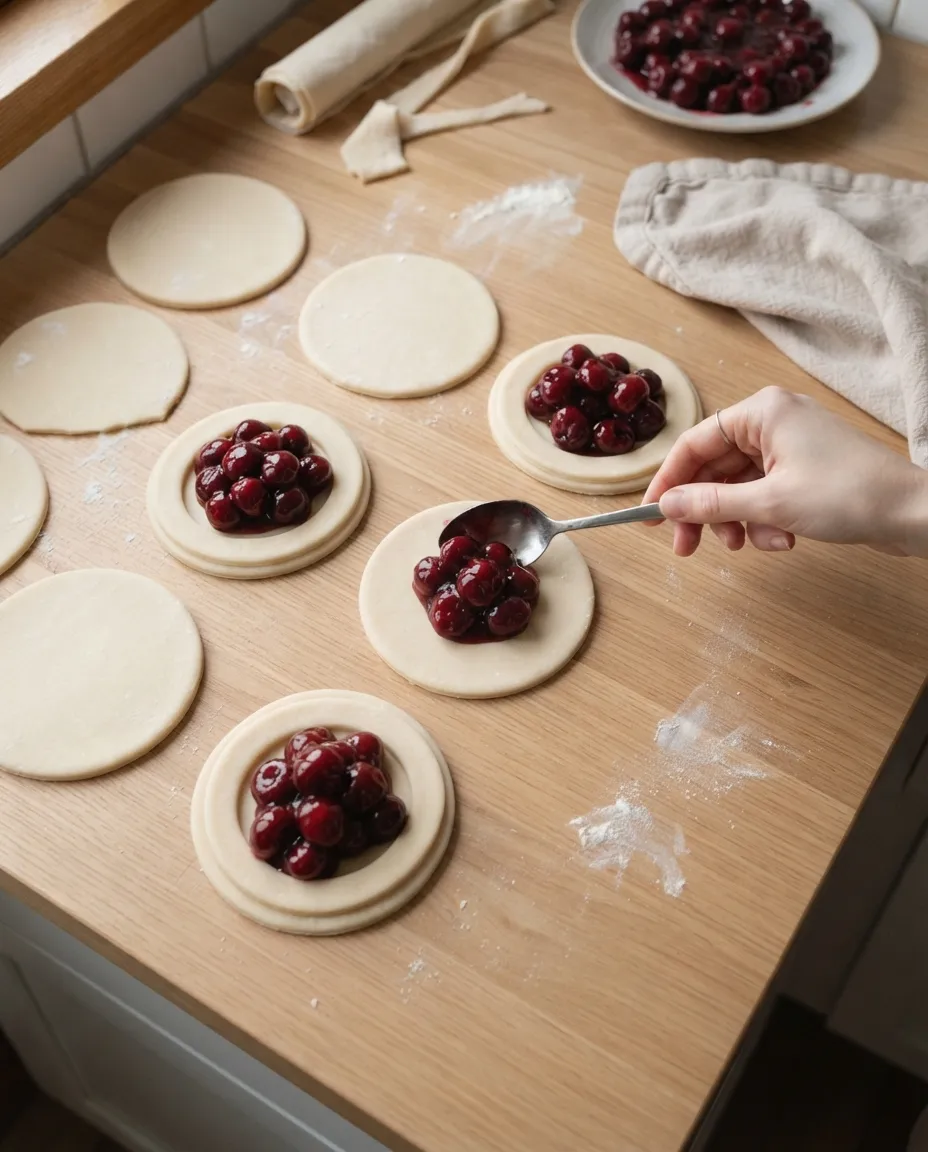
Five moves, in order, and the order matters. One, keep the border clean: spoon the filling onto one half of the round leaving a half inch of naked dough all around, and wipe your fingers on a towel between pies, because the third pie is where greasy borders start. Two, water on the border: a fingertip or brush of plain water all the way around; water dissolves the surface starch and makes real glue. Three, press before you crimp: fold the dough over and press the seam closed with your fingers, working from the filling outward so you push the air out instead of sealing it in; trapped air is a steam balloon with a head start. Four, crimp: now the fork, firmly, all along the seam, and dip the fork in flour if it starts sticking. Five, vent the roof: two small slits in the top of every pie. The vents are not optional and never were; they are the pressure release that lets the crimp do its job at a pressure it can actually hold.
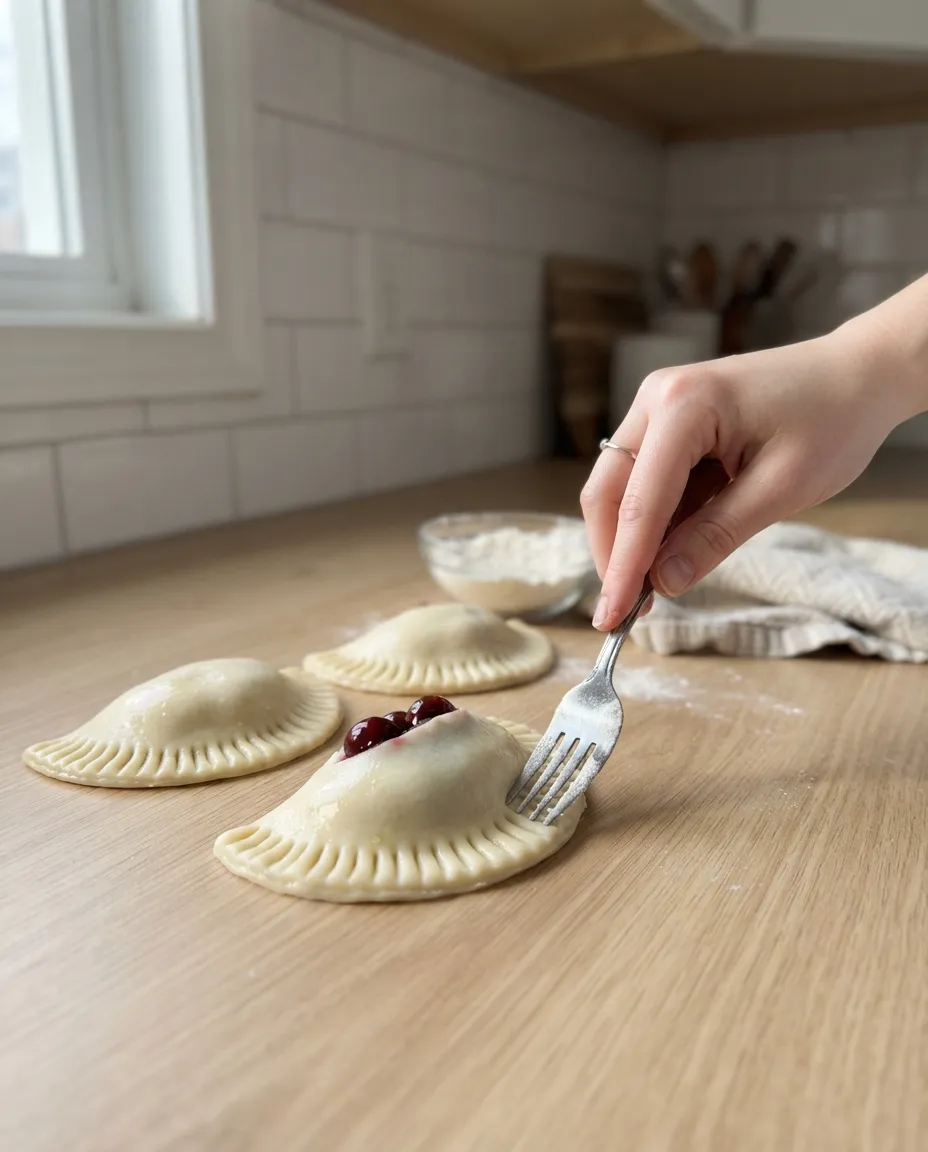
Egg wash goes on last, tops only, for color and gloss. Keep it off the crimped edge, where it would bake the fork marks shut and glue the seam shut too late to matter, and where drips make the pie weld itself to the basket.
Temperature and timing
350°F for 11 to 13 minutes for pie crust, preheated 3 minutes, no flipping. The ranking recipes run everywhere from 350 to 400, and the hot end is a trap: pie dough is thick, and at 400°F the egg-washed top bronzes minutes before the dough under the filling has baked, which is how a hand pie manages to look perfect and eat like putty. The oven versions of these recipes run 400 and change, and the drop to a basket is the standard conversion our air fryer calculator makes for any recipe. Three or four pies per batch, a finger of space apart, on a bare, lightly oiled floor, and the second batch runs about a minute faster. The preheat earns its place for the same cold-fat reasons as every flaky dough on this site, argued in full in do you need to preheat an air fryer for baking, and every tested number lands on the baking chart.
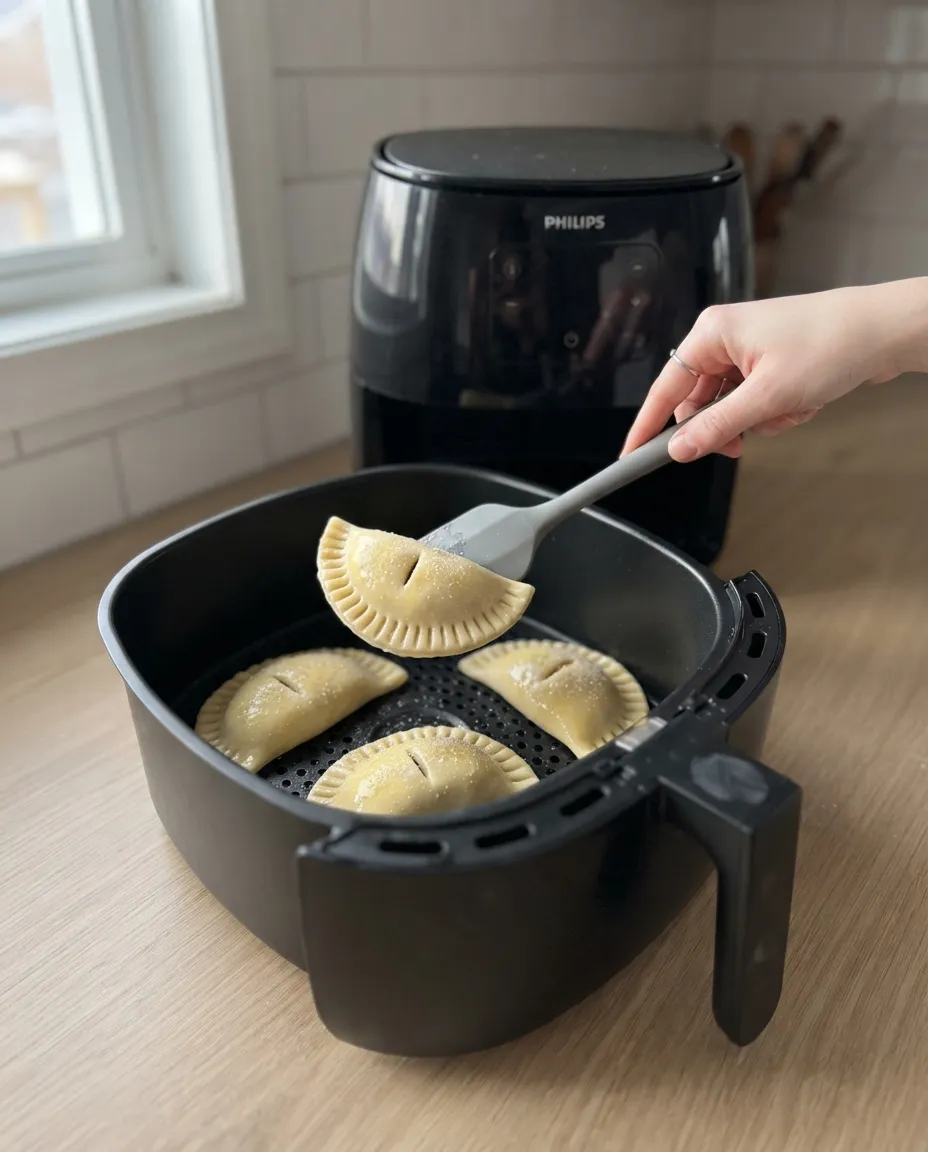
What done looks like
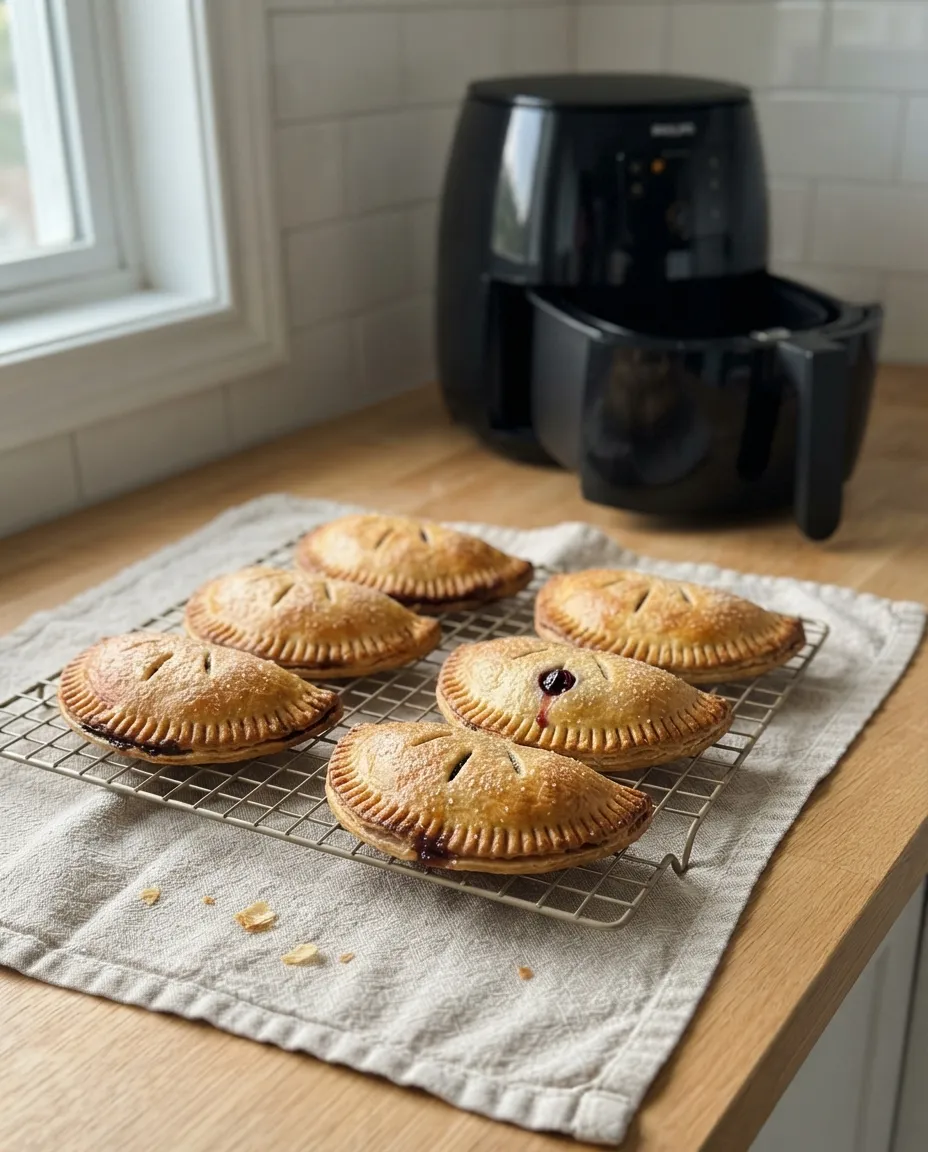
- Top: deep gold with darker fork marks and vent edges, the egg wash pulling its weight.
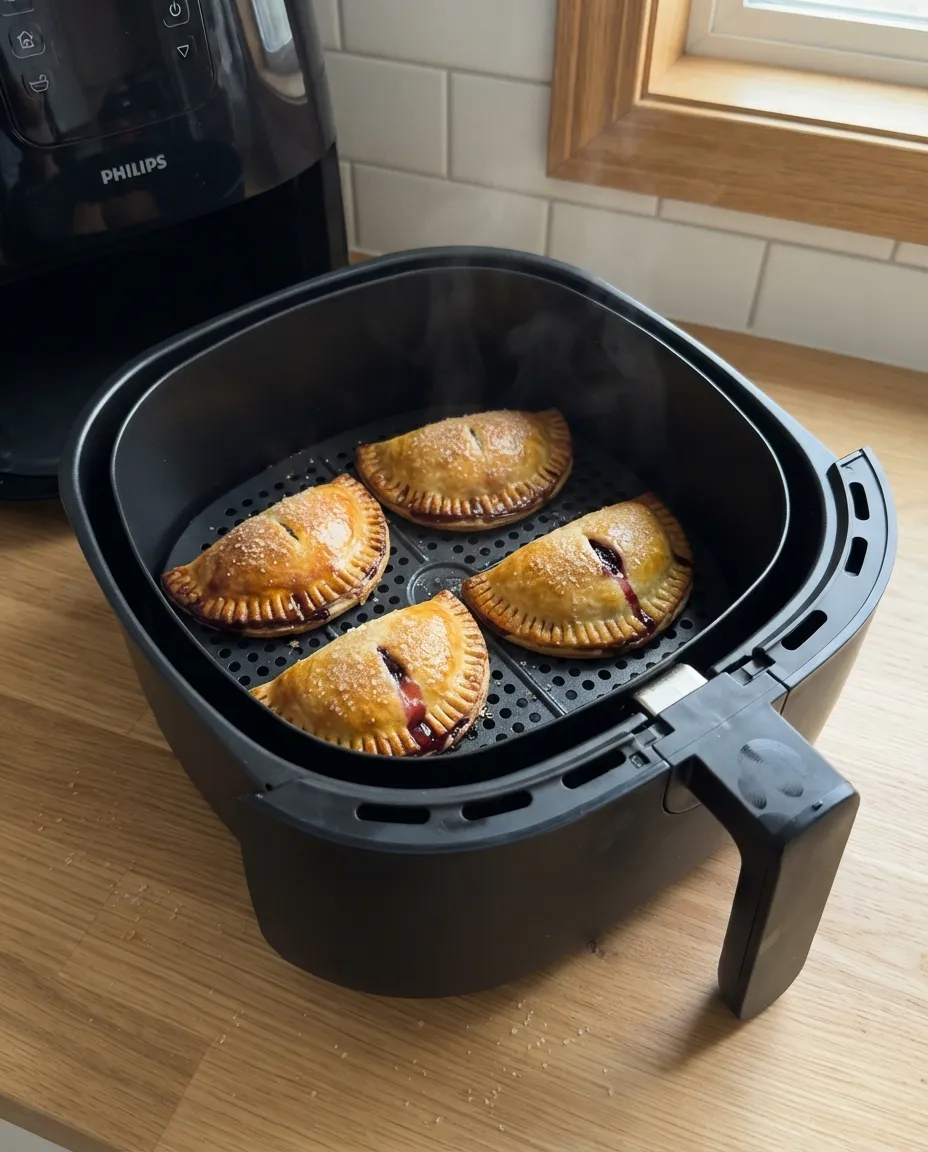
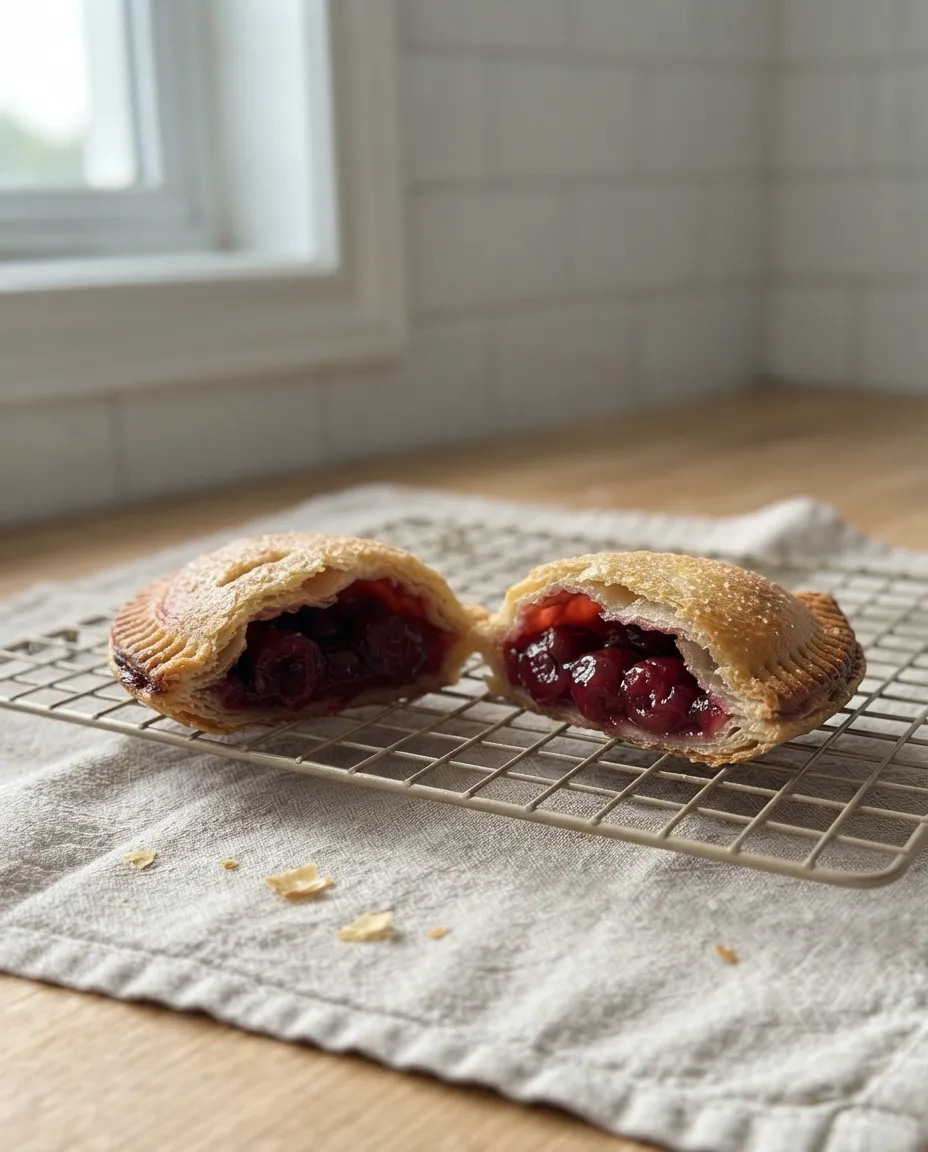
- Seam: dry and set. A slow bubble of filling at one vent is victory; filling at the crimp is a border that was greasy or crowded.
- Underside: golden and rigid when you lift one with a spatula, courtesy of the perforated floor and the absence of a liner.
- Weight and sound: a done pie feels light and taps dull, not hollow. The filling went in cooked, so pastry color is the only question the bake has to answer.
Ingredients
For 8 cherry hand pies, or any filling by the formula
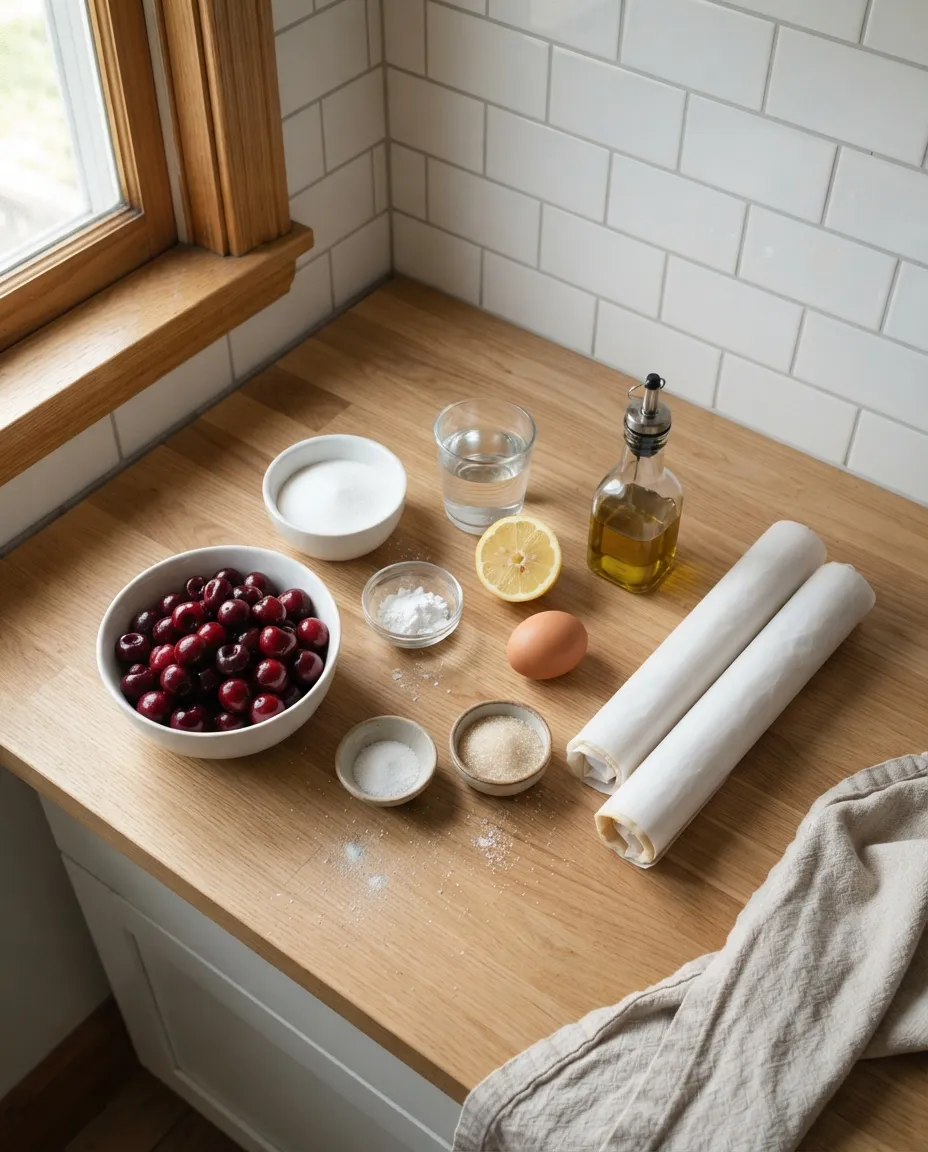
- 1 box (2 rolls) refrigerated pie crust, cold
- 2 cups pitted sweet cherries, fresh or frozen
- 3 tablespoons sugar
- 2 teaspoons cornstarch stirred into 1 tablespoon cold water and 1 teaspoon lemon juice
- Pinch of fine salt
- 1 egg beaten with 1 teaspoon water, for the wash
- Coarse sugar for the tops, optional
- Neutral oil for the basket floor
Swapping fillings changes nothing below: any 1 cup of filling that passes the spoon test, cold and thick, follows the same steps at the same numbers.
How to make them
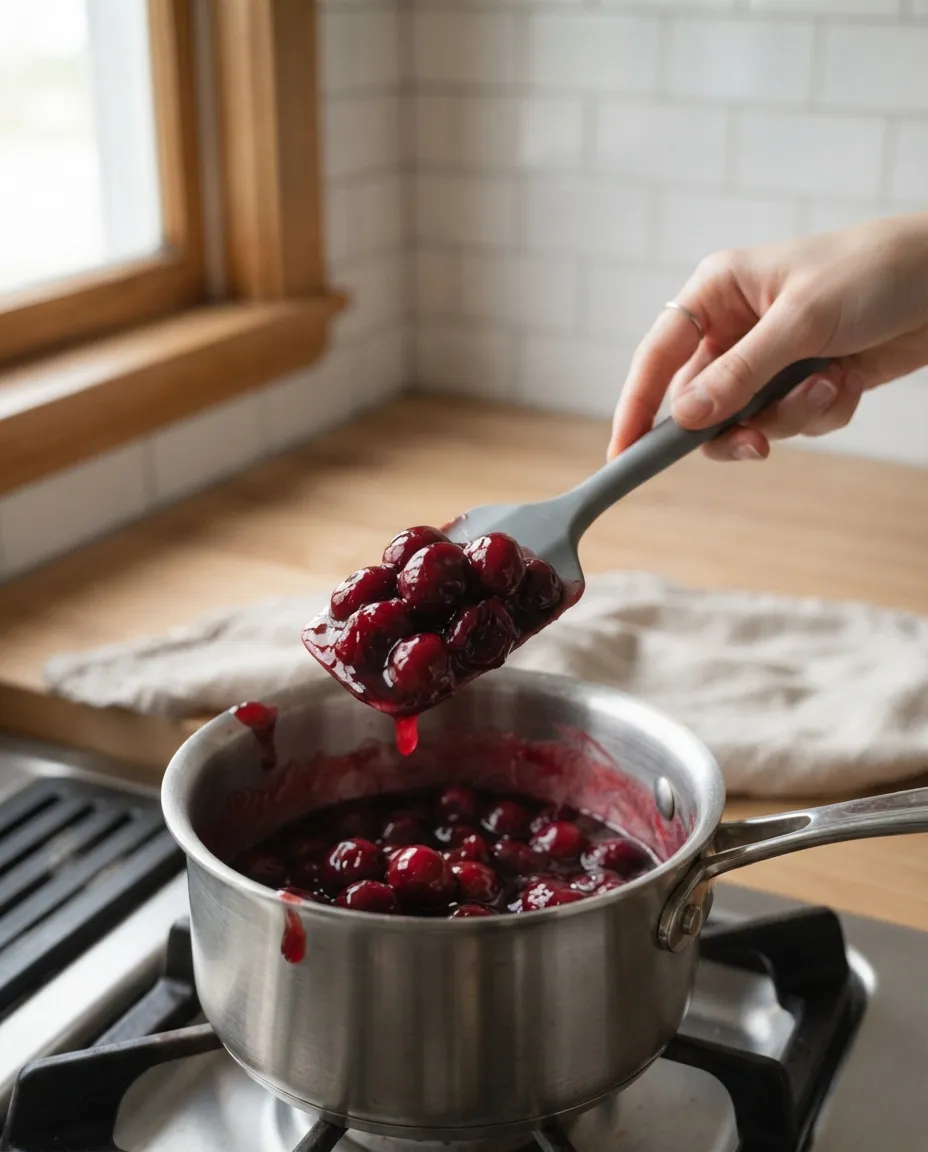
- Cook the cherries, sugar and salt in a small pan over medium heat for 6 to 8 minutes, until the cherries slump and the juice runs.
- Stir the cornstarch mixture and pour it in, cook 1 more minute until glossy and thick, then spread the filling on a plate and cool it completely.
- Unroll the cold pie crusts and cut 4 1/2 inch rounds, rerolling the scraps once, for 8 rounds total.
- Spoon 2 level tablespoons of filling onto one half of each round, leaving a half inch border, and wipe your fingers between pies.
- Brush the border with water, fold into a half-moon, and press the seam closed from the filling outward to push the air out.
- Crimp the seam firmly with a fork, dipping the fork in flour if it sticks.
- Cut two small vent slits in the top of each pie, then brush the tops with egg wash, keeping it off the crimp, and sprinkle with coarse sugar.
- Preheat the air fryer at 350F for 3 minutes and lightly oil the basket floor; chill the built pies while it heats.
- Air fry 3 or 4 at a time at 350F for 11 to 13 minutes, no flip, until deep gold on top and bottom.
- Cool on a rack for 10 minutes; the seal held the filling in, and now the filling holds the heat.
The freezer stash play
This is where the any-filling formula turns into a household system. Built, vented, unbaked hand pies freeze perfectly: tray them until solid, bag them by flavor, and they keep a month. Bake straight from frozen at 350°F, adding 2 to 3 minutes, no thawing, and they emerge indistinguishable from same-day pies, because the filling was cooked before it ever met the dough. One Sunday of assembly with two fillings, one sweet and one savory, stocks a freezer with two weeks of 15 minute desserts and lunches. The same doctrine runs the rest of this site's freezer shelf, where frozen biscuits prove daily that the freezer-to-basket pipeline is the most underrated route in baking, and the rectangular cousins run the same logic: homemade pop tarts on the same pie crust, and store-bought toaster strudel straight from frozen. Already-baked pies keep airtight 2 days at room temperature and revive at 330°F for 3 to 4 minutes; the microwave turns pastry to flannel here as everywhere. Everything this formula has produced lives in the recipe index, with the technique pages under guides.
The savory turn
Half of what makes this page a formula instead of a dessert is that the seal does not care what it is holding, and the savory end of the family has a page of its own in our empanadas. Ham and sharp cheddar with a teaspoon of mustard is the gateway, essentially a breakfast worthy of the bacon and eggs table in a jacket. Taco-night leftovers work when the meat is drained and bound with cheese; so does leftover curry thickened until it mounds, or mashed potato with cheese and scallions for the pierogi-adjacent experience. The rules tighten in one place: savory fillings carry more water than they admit, so bind them with something that sets, cheese, cream cheese, thick gravy, and dice everything smaller than feels necessary. Same 2 tablespoons, same vents, same 350°F for 11 to 13. If the top browns ahead of schedule on a cheese-heavy filling, the rescues live in the burning guide.
Fixing what goes wrong
| Problem | Cause | Fix |
|---|---|---|
| Seam split in the basket | No vents, or air sealed inside | Two slits in every roof, and press from the filling outward before crimping |
| Filling wicked through the crimp | Thin filling | The spoon test, cornstarch in fruit and jam, and cold filling at assembly |
| Crimp opened like a book | Greasy or floury border, or dry dough glued without water | Clean fingers, naked border, real water, then the fork |
| Perfect color, doughy inside | 375°F and up | 350°F for the full 11 to 13; pie dough needs the clock more than the heat |
| Pale, soft bottoms | Liner in the basket, or cooled on a plate | Bare oiled floor and a rack; the argument in full is in the foil and parchment guide |
| Burst on the frozen batch | Baked frozen at a raised temperature to hurry | Same 350°F, just 2 to 3 minutes longer; hurrying frozen pastry is how seams die |
Frequently asked questions
QWhat temperature do you cook hand pies in an air fryer?
350F for 11 to 13 minutes for pie crust hand pies, with a 3 minute preheat and no flipping. Biscuit-dough versions run 330F for 9 to 11 minutes, and puff pastry parcels take 350F for 12 to 14. Recipes calling for 375F or 400F are importing oven numbers into a small machine, and they brown the egg-washed top minutes before the dough under the filling bakes through, which is why those pies look right and eat doughy. From frozen, keep 350F and add 2 to 3 minutes rather than raising the heat.
QWhy do my hand pies leak or burst open?
Three causes, usually in combination. Steam with no exit builds pressure until the seam gives, so cut two vent slits in every top. Thin filling turns hydraulic when hot and pries the crimp open from inside, so cook and thicken fruit, add cornstarch to jam, and reject anything that will not mound on a spoon. And a border smeared with filling or butter cannot be glued by water, so keep a clean half inch of naked dough, wipe your fingers between pies, and press the seam before you crimp it. Crimping harder fixes none of these; the three fixes do.
QHow much filling goes in a hand pie?
Two level tablespoons for a 4 1/2 inch round, and a scant 1 1/2 for thin-when-hot fillings like chocolate hazelnut spread. It looks stingy at assembly and correct at the table, because filling expands in the heat and dough does not, and every quarter teaspoon past the limit gets spent prying at the seam. The filling itself must be cold, fully cooked or ready to eat, and thick enough to hold its shape on a sideways spoon for three seconds. Pass that test and nearly anything in the refrigerator qualifies.
QCan I use canned pie filling for hand pies?
Yes, with three adjustments. Drain off the loose syrup, which is the part that turns hydraulic in the heat; chop the fruit pieces small, since canned slices are cut for a 9 inch pie and will tent a small pastry open; and hold the line at 2 tablespoons even though the can suggests abundance. Treated that way, canned filling behaves like thick jam and seals fine. Straight from the can, unchopped and undrained, it is the single most common cause of the leaky hand pie photographs that haunt recipe comment sections.
QCan you cook hand pies from frozen in the air fryer?
Yes, and it is the best make-ahead system this method has. Freeze built, vented, unbaked pies solid on a tray, bag them, and bake straight from frozen at the same 350F, adding 2 to 3 minutes; no thawing, which would soften the dough and loosen the filling before the heat could set them. Because every legal filling was fully cooked before assembly, there is no food-safety clock running inside, just pastry doing its job a little longer. Baked pies also freeze for a month and revive at 330F for 3 to 4 minutes.
QShould I use pie crust or biscuit dough for hand pies?
Pie crust for the classic: crisp, flaky, tastes like pie, holds a sharp crimp, and folds into half-moons without cracking. Biscuit dough for the soft diner-style pie: flatten each canned biscuit to a 4 inch round, fill and seal the same way, and bake at 330F for 9 to 11 minutes, since biscuit dough scorches at pie crust temperatures. Puff pastry makes the flakiest, most bakery-styled version in square parcels at 350F for 12 to 14. The fillings, the 2 tablespoon limit, the vents and the sealing system are identical across all three.
Made it? Rate it.
It helps more people find the seal that finally holds.
Air Fryer Hand Pies
Eight half-moon hand pies on refrigerated pie crust, shown with cherry filling and open to any filling that passes the spoon test: 2 tablespoons each, sealed, vented, and baked at 350°F for 11 to 13 minutes.
Ingredients
- 1 box (2 rolls) refrigerated pie crust, cold
- 2 cups pitted sweet cherries, fresh or frozen
- 3 tablespoons sugar
- 2 teaspoons cornstarch stirred into 1 tablespoon cold water and 1 teaspoon lemon juice
- Pinch of fine salt
- 1 egg beaten with 1 teaspoon water, for the wash
- Coarse sugar for the tops, optional
- Neutral oil for the basket floor
Instructions
- Cook the cherries, sugar and salt in a small pan over medium heat for 6 to 8 minutes, until the cherries slump and the juice runs.
- Stir the cornstarch mixture and pour it in, cook 1 more minute until glossy and thick, then spread the filling on a plate and cool it completely.
- Unroll the cold pie crusts and cut 4 1/2 inch rounds, rerolling the scraps once, for 8 rounds total.
- Spoon 2 level tablespoons of filling onto one half of each round, leaving a half inch border, and wipe your fingers between pies.
- Brush the border with water, fold into a half-moon, and press the seam closed from the filling outward to push the air out.
- Crimp the seam firmly with a fork, dipping the fork in flour if it sticks.
- Cut two small vent slits in the top of each pie, then brush the tops with egg wash, keeping it off the crimp, and sprinkle with coarse sugar.
- Preheat the air fryer at 350F for 3 minutes and lightly oil the basket floor; chill the built pies while it heats.
- Air fry 3 or 4 at a time at 350F for 11 to 13 minutes, no flip, until deep gold on top and bottom.
- Cool on a rack for 10 minutes; the seal held the filling in, and now the filling holds the heat.

Sujata Thapa
Sujata bakes everything on this site in a 5.5 quart basket air fryer on a Kathmandu counter, then re-tests the keepers until the timings hold for anyone. The press-before-crimp rule arrived the day a trapped air pocket blew a cherry pie's seam and painted the basket ceiling, a crime scene she photographed and then ate.