
Air Fryer Focaccia: Dimpled, Olive-Oiled, Surprisingly Doable
Focaccia has a reputation for needing a baker and a real oven, and it deserves neither. It is the most forgiving bread there is: a wet dough you stir together in one minute, time doing the kneading, and a pan with enough olive oil in it that the base practically fries. A 7 inch round of it fits a basket exactly, bakes at 340°F in under 20 minutes, and never gets flipped, whatever the other recipes for this say. The dimples stay up, the oil stays in them, and the bottom gets its color a smarter way.
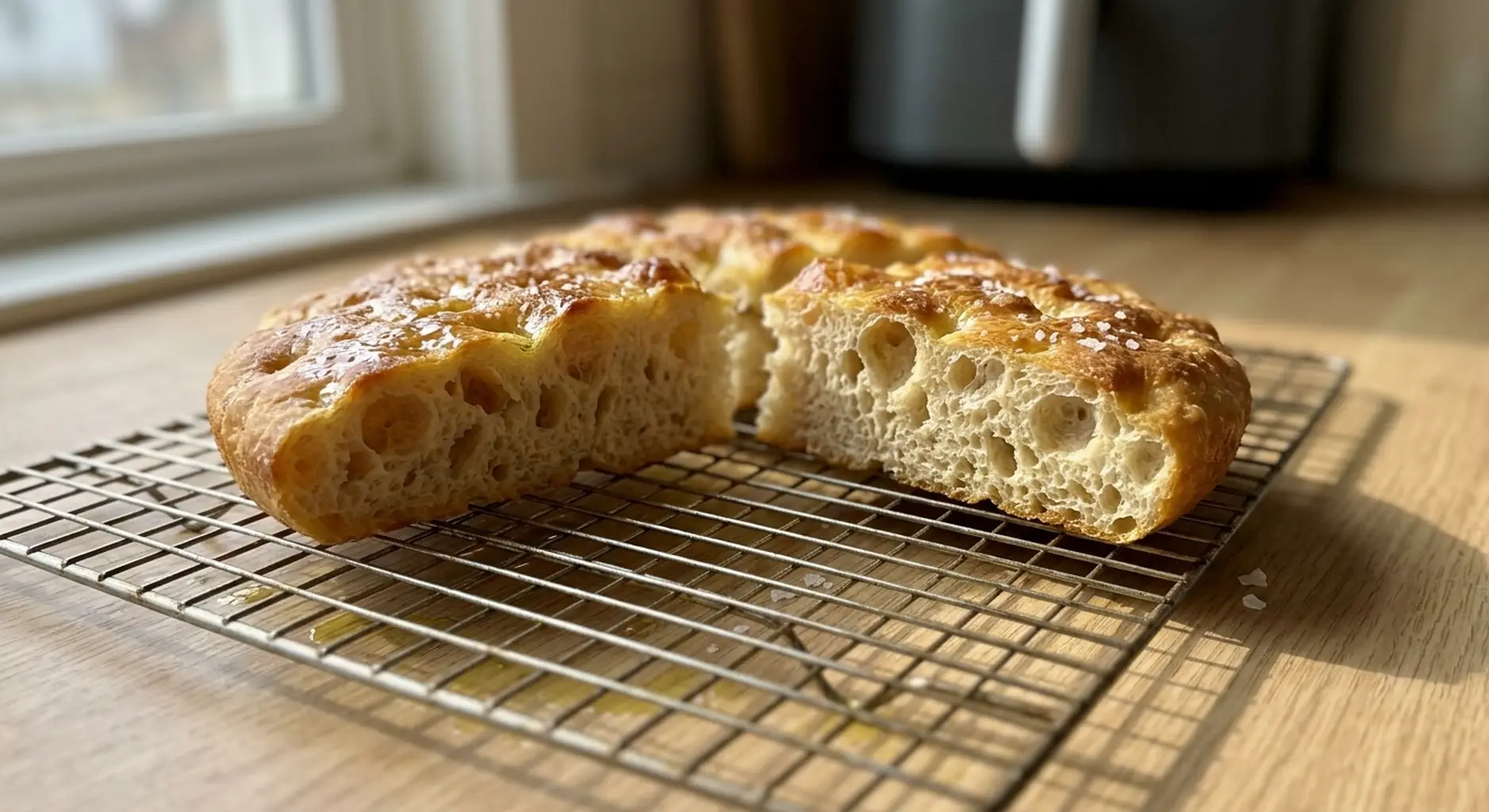
What’s on this page
Never flip a focaccia
Read the pages that rank for this recipe and you will find a strange instruction repeated across them: flip the focaccia halfway through the bake. Turn it dimple side down, oil against the metal, toppings pressed into the basket floor, and finish it upside down.
They are not doing it for fun. They are doing it because a bread baked in a basket has a pale bottom problem: the perforated floor bakes by moving air, and moving air browns a wet dough base slowly and badly. The flip is a patch for that. It also flattens the dimples you just made, pours the olive oil out of them, and grinds your rosemary into the crisper plate. It solves the wrong end of the problem. If the basket itself is new to you, how to bake in an air fryer covers the ground rules this page assumes.
The right end is under the bread. Bake the focaccia in a solid metal pan with the oil already in it, and the base browns by conduction, the way it does in a pizzeria pan. The dimples stay up the entire bake. And if your machine still leaves the base paler than you like, the fix at minute 16 is to lift the bread out of the pan and give it two minutes directly on the basket floor, right side up. The top never turns over at any point. This is the same solid-pan logic that gives cornbread its crisp edge, pointed at a bread that needs it even more.
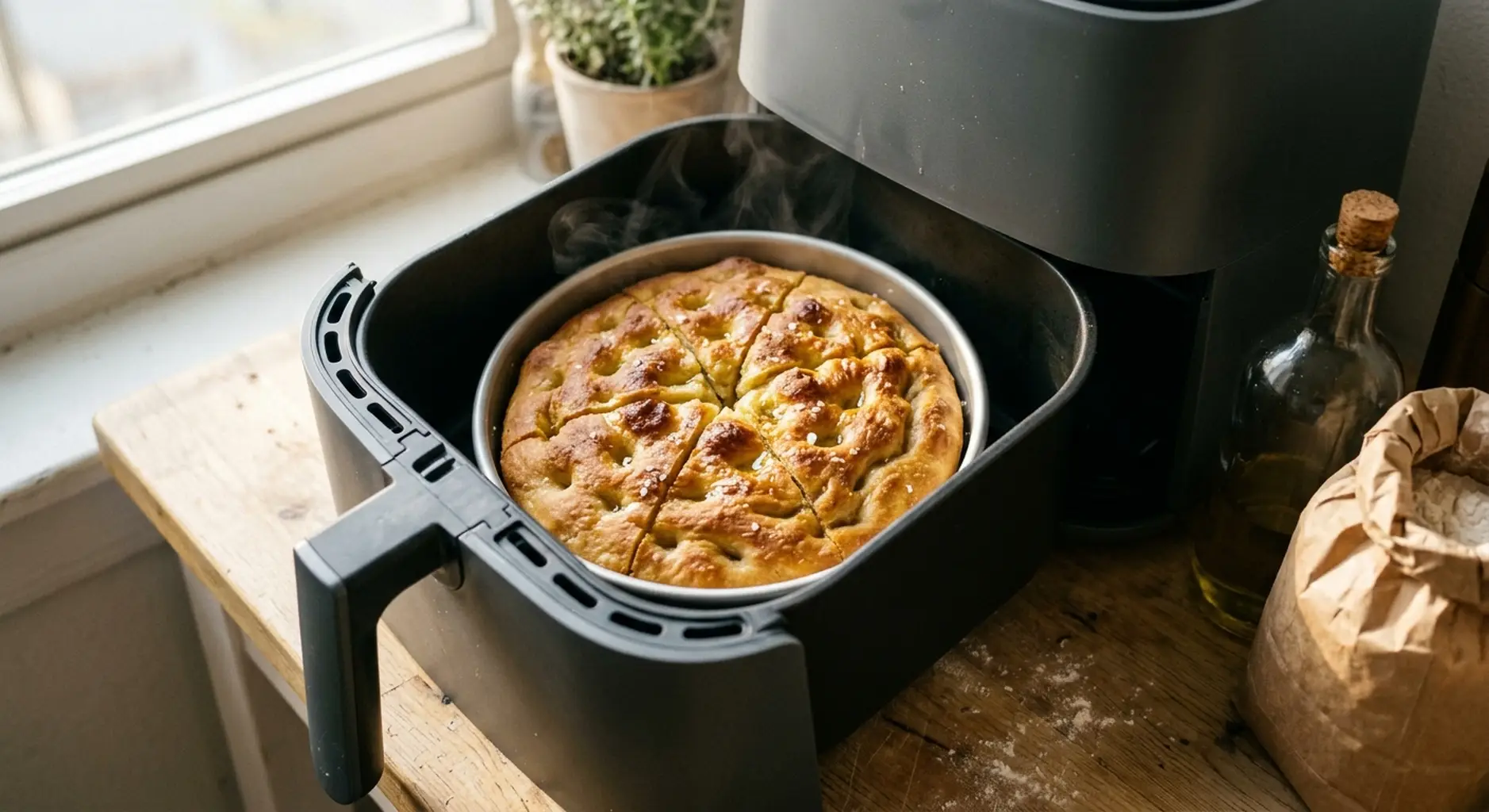
Dimples are not decoration
The dimples in a focaccia have two jobs, and in an air fryer they pick up a third.
First, they are oil wells. Pressed to the pan floor, they hold pools of olive oil that half-fry their own little patch of crumb, which is where the crackly, salty pockets in a good focaccia come from. Shallow dents hold nothing and bake out flat.
Second, they are dome control. An undimpled slab of wet dough inflates in the middle as it bakes. In a full-size oven that gives you a puffy loaf; in an air fryer, where the heating element sits inches above the surface, the highest point of the dome bakes closest to the element and scorches first. Deep dimples degas the middle and keep the surface at one height, so the whole top browns at one speed.
So dimple like you mean it: oiled fingers, straight down until you feel the pan, over the entire surface. The dough will look assaulted. Ten minutes later it will look like focaccia.
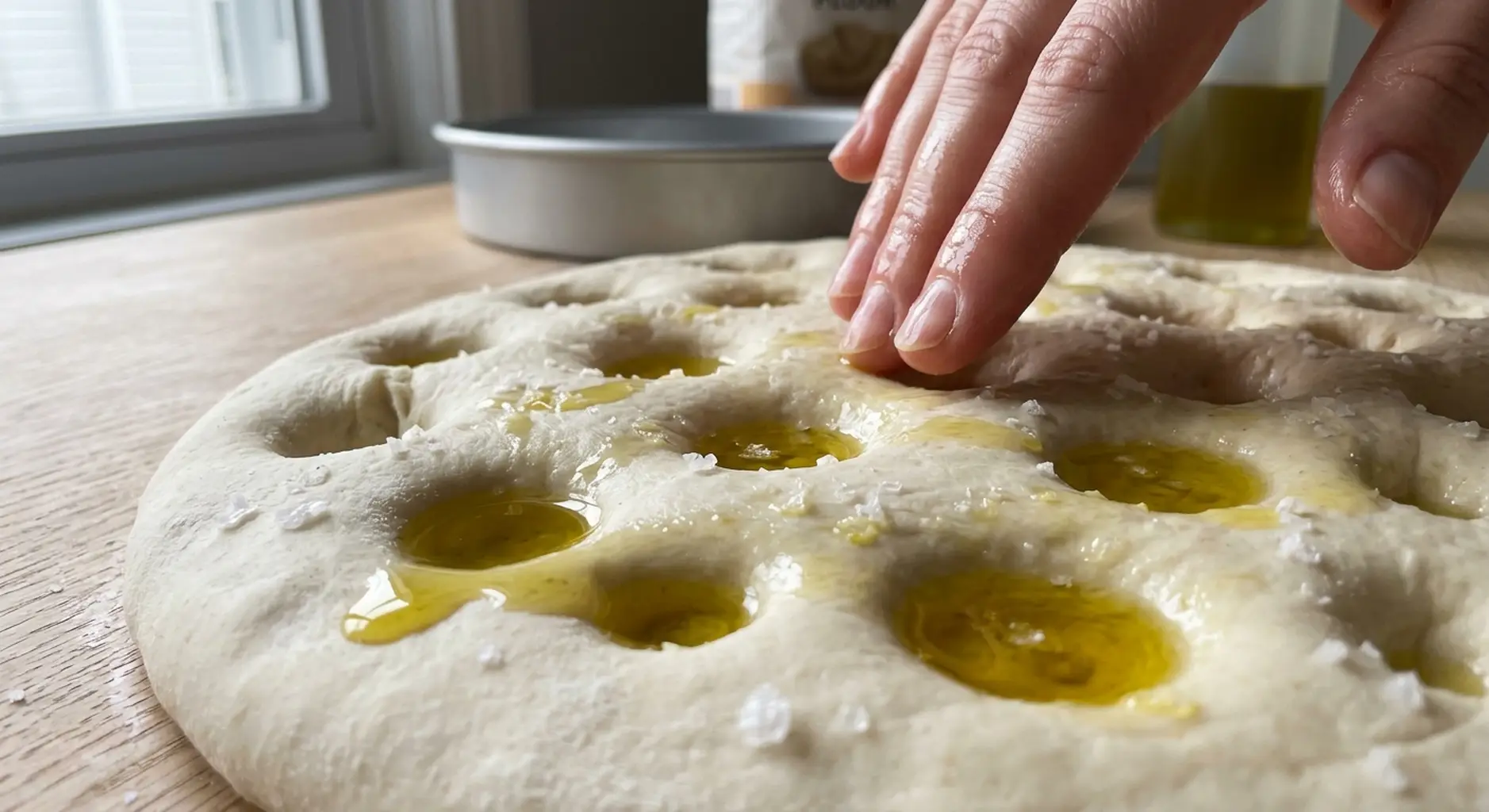
The oil is an ingredient
Most recipes treat olive oil as a drizzle. Focaccia treats it as a cooking medium, and the quantity is not negotiable: this small pan takes 4 tablespoons, divided. One goes into the dough for tenderness. Two go into the pan before the dough does, which is what fries the base into the crust this bread is named for. The last one goes over the top after dimpling, where it pools in the wells and bastes the surface as it bakes.
Use an olive oil you would eat from a spoon, because you are going to taste it. This is also why the pan needs no parchment: two tablespoons of hot oil is the release, and paper between the dough and the oil would defeat the whole crust. The general liner rules live in the foil and parchment guide, but this page is the exception that proves them: bare metal, well oiled, on purpose.
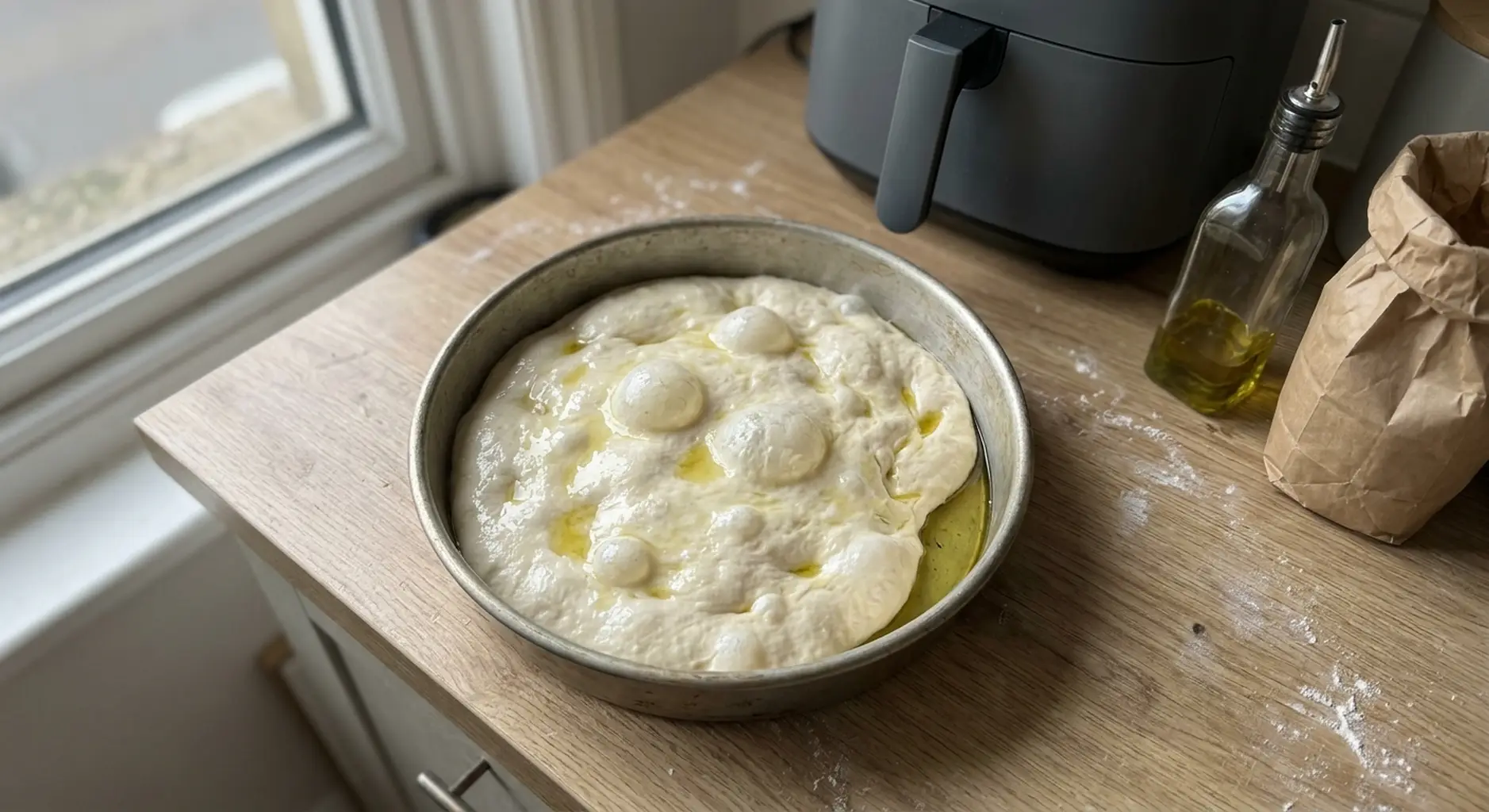
A wet dough and no kneading
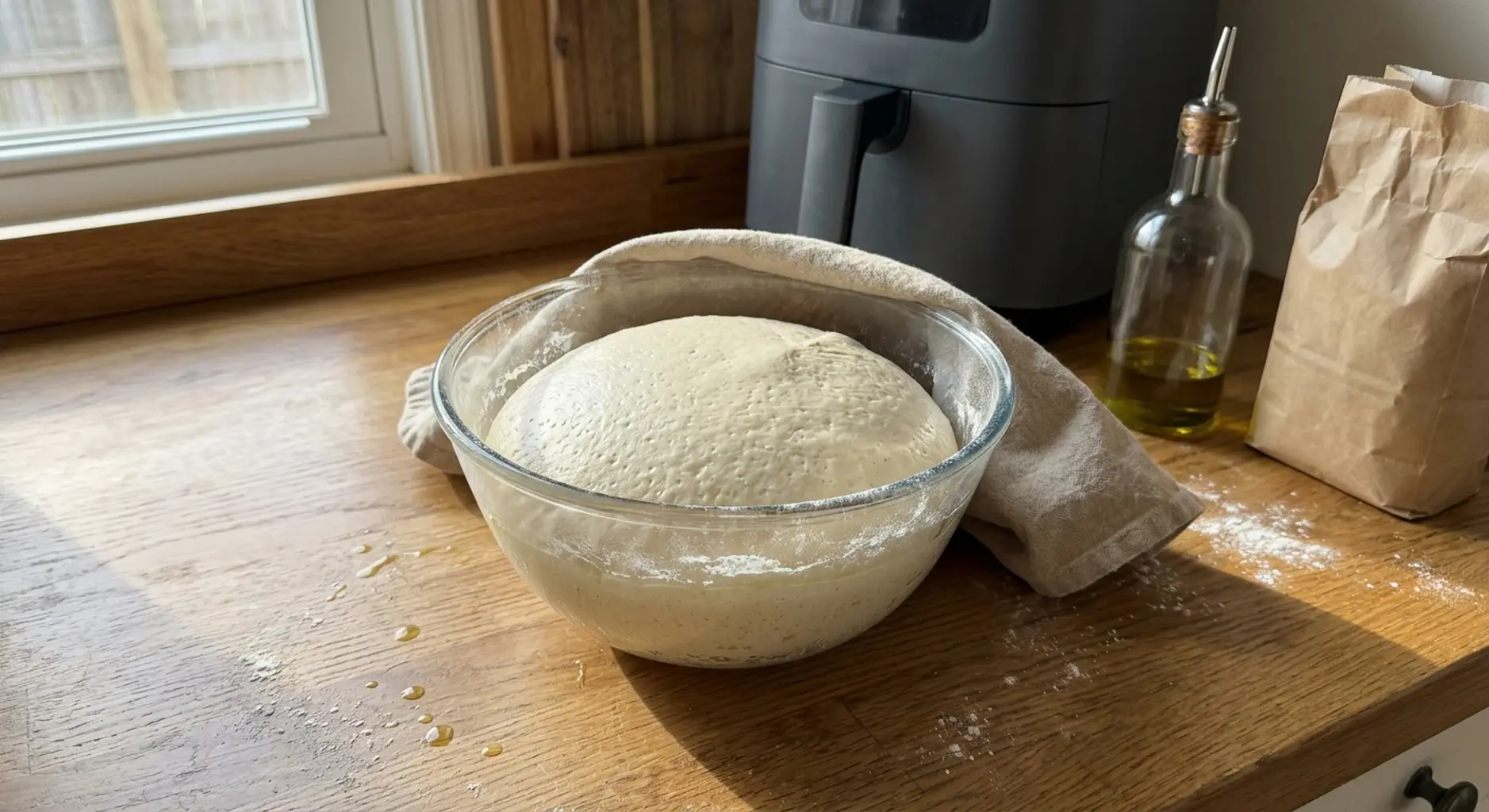
Focaccia dough is wetter than any dough a beginner has met, and that wetness is the entire trick. This one runs at about 79 percent hydration: 190 grams of flour to 150 of water. You cannot knead a dough that wet by hand without regretting it, so you do not knead it at all. You stir it into a shaggy mess, cover it, and let time build the gluten for you while the yeast works. One fold session with an oiled hand after the rise, four folds and done, gives it all the structure it needs.
The schedule bends to your day. A 60 to 90 minute rise on the counter makes an honest weeknight focaccia. The same dough held overnight in the refrigerator makes a noticeably better one, with a tang and open holes the fast version cannot fake, and cold dough is easier to fold besides. Both routes are in the card; the only rule is that the second rise, the one in the oiled pan, does not get skipped. That 45 minutes of puffing is where the airy crumb comes from, and the turned-off machine makes a good proofing box for it, the same trick that speeds up cinnamon rolls.
If wet doughs are new territory, this is the friendliest possible introduction, and the natural next step is no-knead bread, which runs the same time-instead-of-kneading trick at loaf scale. It is gentler than a standard loaf and far gentler than pretzels, because there is no shaping to get right. The pan is the shape.
Temperature and timing
Oven focaccia bakes hot, 425 to 450°F, because a home oven needs that much to brown an oiled top a foot from the element. Run 425°F through our oven-to-air-fryer calculator and you get about 400°F, and for most bakes that is where you would start. Focaccia is not most bakes: the surface is coated in oil, and oil browns dramatically faster than dry dough under an element that is inches away rather than a foot. At 400°F the top is mahogany before the middle of a wet, inch-thick crumb has set.
340°F for 16 to 20 minutes is the window. Hot enough for real oven spring and a deep gold top, slow enough that an inch of 79 percent hydration crumb bakes through underneath it. The drawer stays shut for the first 10 minutes, because the spring happens early and an opened drawer dumps the heat that powers it. The site-wide settings for everything else are on the baking chart.
Pan size decides the bake. This dough is portioned for a 7 inch round or 6 inch square pan, which is what a 5 to 6 quart basket actually takes; the 8 or 9 inch pans that oven recipes assume mostly do not clear the drawer. The pan size calculator settles what fits your machine, and if you upsize the pan, scale the dough with the recipe scaler or your focaccia will be a cracker.
What done looks like
- The top is deep golden with darker ridges between the dimples and oil still visibly glistening in the wells.
- The center reads 205 to 210°F on a probe. A wet dough needs the top of the bread doneness range; at 195°F this crumb is still gummy. Not one page ranking for this recipe gives you a number, and the number is the whole game with a dough this wet.
- The base, lifted gently with a spatula, is browned and crisp from its oil bath. Pale base, finished top: two minutes out of the pan, directly on the basket floor.
Then get it out of the pan and onto a rack immediately. Focaccia left to cool in its hot oily pan steams its own crust soft from below, and ten minutes of patience on the rack is the difference between crackling and chewing.
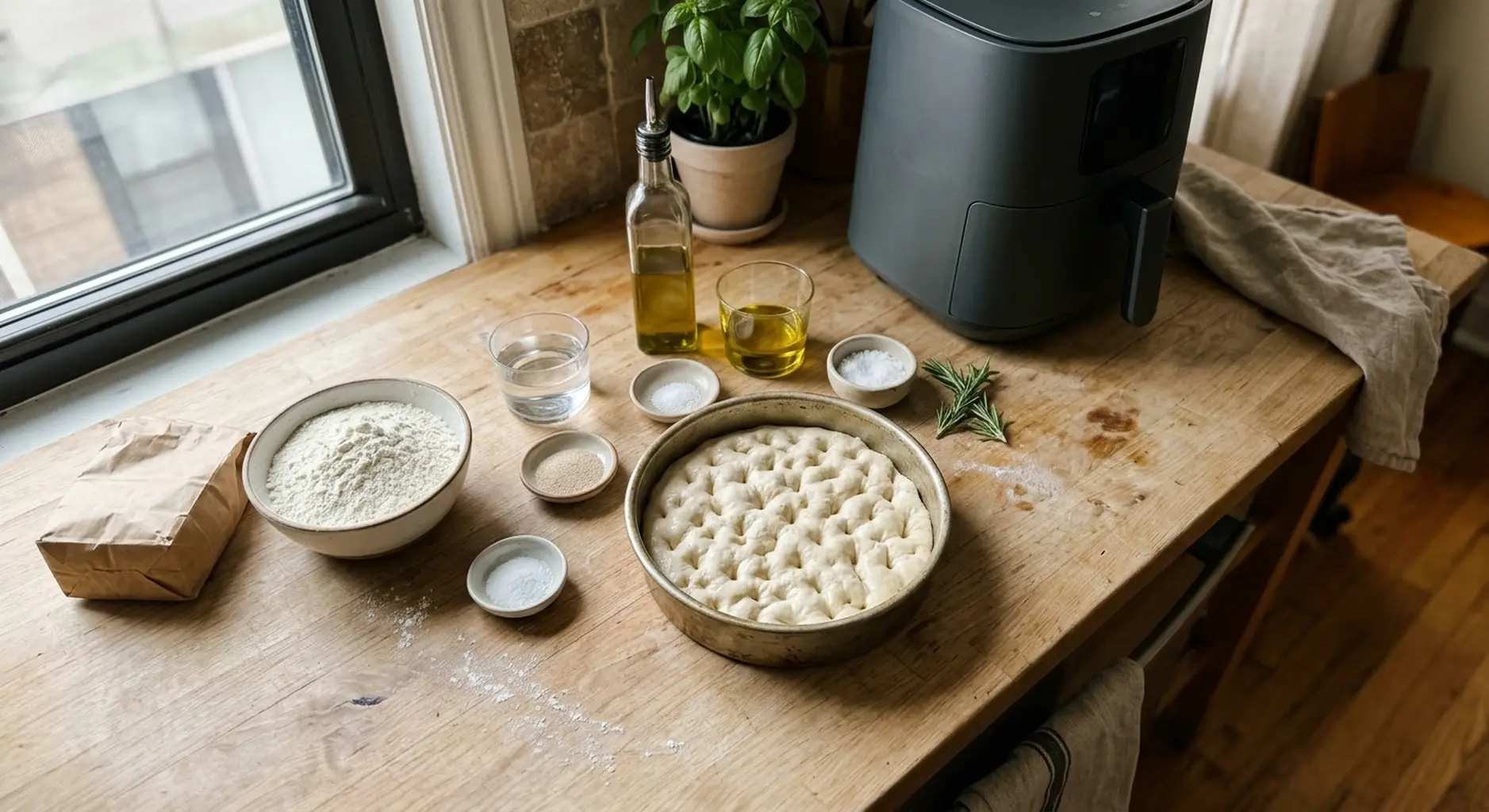
Ingredients
For one 7 inch focaccia, 6 pieces
- 1½ cups (190g) bread flour or all-purpose flour
- ⅔ cup (150ml) warm water, about 105°F
- 1 teaspoon instant yeast
- ¾ teaspoon fine salt
- 4 tablespoons olive oil, divided
- Flaky salt for the top
- Optional: 1 sprig rosemary, leaves stripped
Bread flour gives a chewier crumb and handles the hydration a little better; all-purpose works and bakes slightly softer. Instant yeast stirs straight into the flour. Active dry works too: dissolve it in the warm water for 5 minutes first.
How to make it
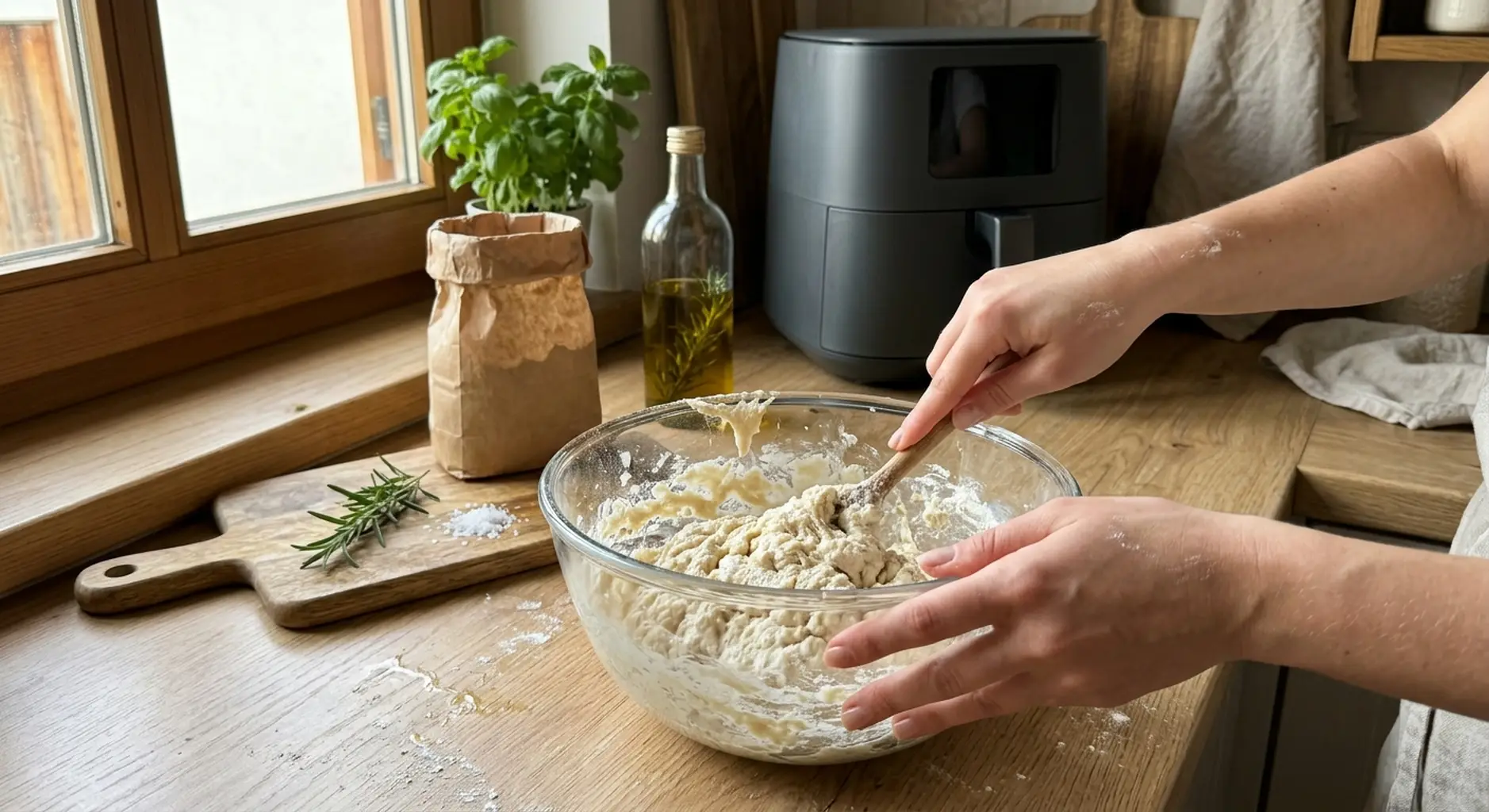
- Stir the flour, yeast, and fine salt together, then add the warm water and 1 tablespoon of the olive oil. Mix for one minute into a wet, shaggy dough. No kneading.
- Cover the bowl and let it rise 60 to 90 minutes at room temperature until doubled, or refrigerate it overnight for deeper flavor.
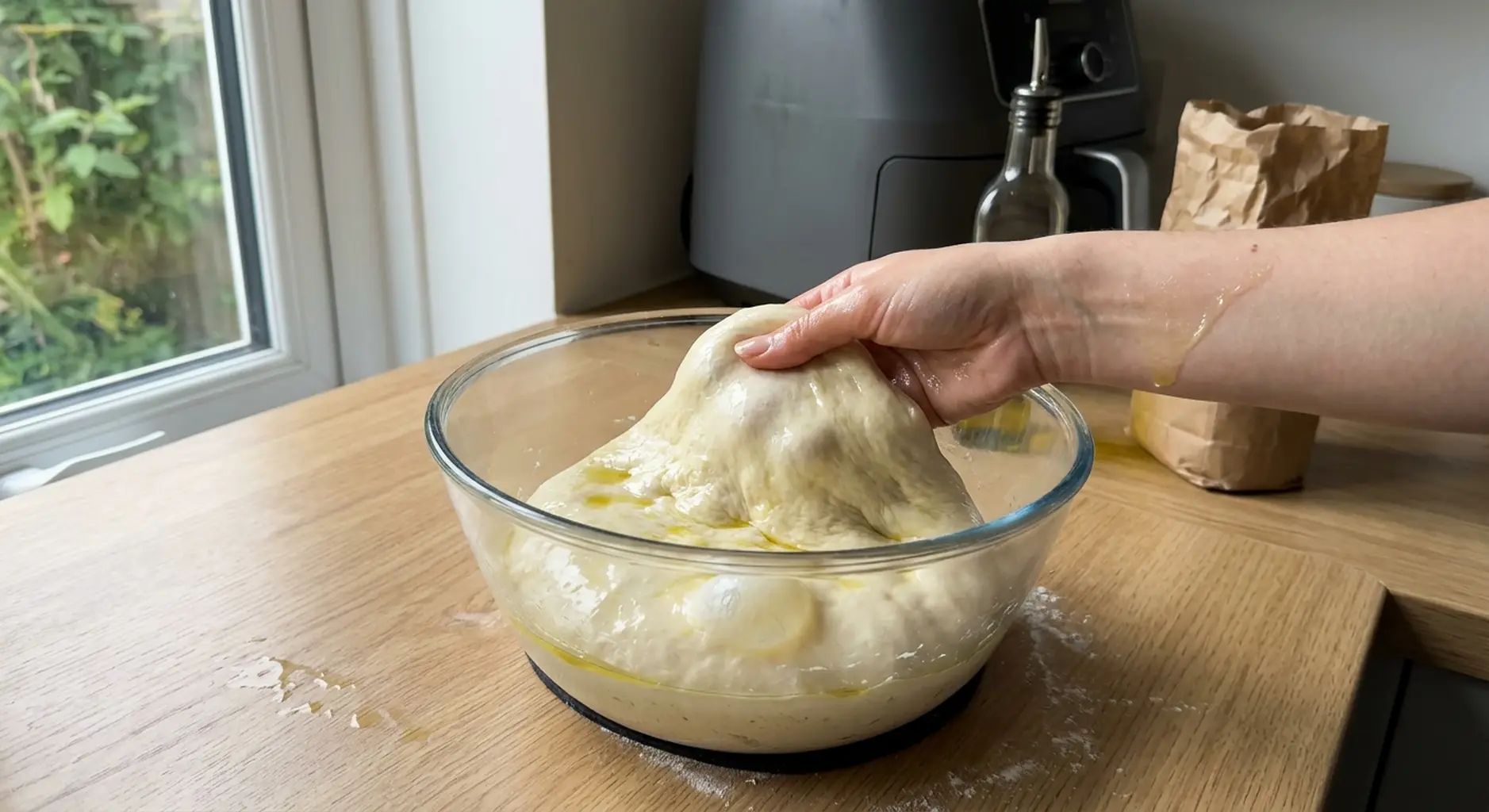
- With an oiled hand, fold the dough over itself four times in the bowl, giving the bowl a quarter turn between folds.
- Pour 2 tablespoons of olive oil into a 7 inch cake pan, set the dough in, and turn it once to coat both sides. Nudge it toward the edges without forcing it.
- Let it rise in the pan 45 minutes, until puffy and bubbly. A turned-off air fryer that ran 2 minutes on low makes a good proofing box.
- Oil your fingertips and dimple straight down to the pan floor across the whole surface. Drizzle the last tablespoon of oil and scatter flaky salt, pressing any rosemary into the dimples.
- Air fry at 340F for 16 to 20 minutes, until the top is deep golden. Do not flip, and do not open the drawer for the first 10 minutes.
- Check the base with a spatula. If it is pale, lift the bread out of the pan and give it 2 to 3 minutes directly on the basket floor.
- Move the focaccia to a rack straight away so it does not sit in hot oil, rest 10 minutes, and cut.
Fixing what goes wrong
| Problem | Cause | Fix |
|---|---|---|
| Dense, tight crumb | Second rise skipped or cut short | The 45 minutes in the pan is not optional; puffy and bubbly before dimpling |
| Domed and scorched in the middle | Dimples too shallow | Oiled fingers, straight down to the pan floor, the whole surface |
| Pale, soft bottom | Perforated floor, or too little pan oil | 2 full tablespoons in the pan; if still pale, finish 2 minutes out of the pan on the basket floor |
| Mahogany top, gummy middle | Temperature above 350°F | 340°F, and trust the 205°F probe over the color |
| Burnt rosemary flecks | Dry leaves riding on top in the airstream | Press the leaves into the oil-filled dimples so they confit instead of scorch |
| Soggy base an hour later | Cooled in the pan | Out of the pan and onto a rack the moment it is done |
The rosemary rule generalizes: anything small, dry, and exposed cooks far faster than the food under it. The mechanism, and the rest of its victims, are covered in how to prevent burning in an air fryer.
Toppings that survive the fan
- Rosemary and flaky salt. The classic, with the confit-in-the-dimples rule above. This is the version the recipe card assumes.
- Cherry tomatoes. Halved, cut side up, pressed deep into the dough before the bake. They roast in place and their juice has nowhere to run but in.
- Olives. Pitted, halved, buried to their waists. Whole olives sitting proud of the surface blister and leap around the pan.
- Thin-sliced garlic. Only in the dimples, under oil, for the same reason the fresh garlic on our garlic knots goes on after the bake: exposed garlic in the airstream turns bitter before the bread is done.
- Grated hard cheese. Last 4 minutes only, or it browns past salty into acrid.
- Red onion. Soaked in cold water for 10 minutes first so the slices soften and sweeten instead of charring at the edges.
Serving, storage, leftovers
Warm focaccia wants almost nothing: a saucer of olive oil, a bowl of soup, or a sandwich built while the crumb is still tender. Split horizontally it is the best sandwich bread this site makes, and a square of it next to anything saucy does the job garlic bread usually gets drafted for.
Storage: airtight at room temperature for 2 days; the refrigerator stales bread faster and dulls the olive oil, so keep it on the counter. Reheat at 330°F for 3 to 4 minutes, cut side down on the basket floor, which re-crisps the base and wakes the oil back up. Freeze pieces wrapped for up to 2 months and reheat from frozen at 340°F for 5 to 6 minutes.
Day-three focaccia is a gift disguised as stale bread: cube it and follow the croutons method for the best croutons you will ever put on a soup, already seasoned and full of olive oil. And if the dough habit sticks, the same one-bowl confidence runs through the rest of the bread shelf, from canned biscuits at the fast end to dinner rolls, flatbread and a proper loaf at the slow one. Everything tested here is in the recipe index, and the technique pages are under guides.
Frequently asked questions
QCan I make air fryer focaccia with store-bought pizza dough?
Yes, and it is a legitimate shortcut rather than a compromise. Use about 12 ounces of dough, let it come fully to room temperature for 45 minutes so it relaxes, then pick the method up at the oiled-pan step: 2 tablespoons of oil in the pan, second rise, dimple, top, and bake as written. Pizza dough runs drier than this recipe, so the crumb is a little tighter, but the crust and dimples work exactly the same way. Making your own is a short detour: the air fryer pizza dough recipe scales down to this pan neatly.
QWhy is my air fryer focaccia pale on the bottom?
Because the base bakes by conduction and the top bakes by moving air, and in an air fryer the air side always wins. Two things fix it: a solid metal pan with 2 full tablespoons of oil in it, so the base fries while it bakes, and the finishing move if it still needs help, which is lifting the bread out of the pan for 2 to 3 minutes directly on the basket floor. Flipping the focaccia also works, and ruins the dimples, the oil pools, and the toppings while it does. Do not flip it.
QDo I really need two rises for focaccia?
You need the second one more than the first. The bowl rise builds flavor and gluten, and it can happen fast on the counter or slow in the refrigerator. The pan rise is what puts air back into the dough after you moved it, and it is the difference between an open, holey crumb and a dense slab. If you only have patience for one shortcut, shorten the bowl rise, never the pan rise.
QWhy is my focaccia dense instead of airy?
Usually one of three things. The dough was too dry, because wet dough feels wrong and beginners add flour until it stops sticking; resist, the stickiness is the recipe. The second rise was skipped or rushed, which is the most common cause. Or the dimpling happened with heavy hands after a weak rise, pressing out air the dough could not afford to lose. Wet dough, full pan rise, confident dimples into a well-risen dough: airy focaccia.
QCan I bake focaccia directly in the air fryer basket without a pan?
Some recipes do, and it costs them the best part of the bread. On a perforated floor the olive oil drains away instead of frying the base, the wet dough slumps through the holes, and the crust comes out dry rather than crisp. The pan is not an inconvenience here; it is the cooking vessel that makes focaccia focaccia. If your basket takes no pan at all, a small sheet of heavy foil turned up at the edges will hold the oil, though a metal pan browns the base better.
QHow do I store and reheat focaccia?
Airtight at room temperature for 2 days, never the refrigerator, which stales the crumb and dulls the oil. Reheat pieces at 330F for 3 to 4 minutes cut side down on the basket floor so the base re-crisps. Frozen pieces keep 2 months well wrapped and go straight from freezer to basket at 340F for 5 to 6 minutes. Properly stale focaccia makes exceptional croutons, so the end of the loaf is a beginning.
Made it? Rate it.
It helps more people find the bread that never gets flipped.
Air Fryer Focaccia
A no-knead, 79 percent hydration focaccia baked in an oiled 7 inch pan at 340°F. Deep dimples, olive oil doing the frying, and no flipping at any point.
Ingredients
- 1½ cups (190g) bread flour or all-purpose flour
- ⅔ cup (150ml) warm water, about 105°F
- 1 teaspoon instant yeast
- ¾ teaspoon fine salt
- 4 tablespoons olive oil, divided
- Flaky salt for the top
- Optional: 1 sprig rosemary, leaves stripped
Instructions
- Stir the flour, yeast, and fine salt together, then add the warm water and 1 tablespoon of the olive oil. Mix for one minute into a wet, shaggy dough. No kneading.
- Cover the bowl and let it rise 60 to 90 minutes at room temperature until doubled, or refrigerate it overnight for deeper flavor.
- With an oiled hand, fold the dough over itself four times in the bowl, giving the bowl a quarter turn between folds.
- Pour 2 tablespoons of olive oil into a 7 inch cake pan, set the dough in, and turn it once to coat both sides. Nudge it toward the edges without forcing it.
- Let it rise in the pan 45 minutes, until puffy and bubbly. A turned-off air fryer that ran 2 minutes on low makes a good proofing box.
- Oil your fingertips and dimple straight down to the pan floor across the whole surface. Drizzle the last tablespoon of oil and scatter flaky salt, pressing any rosemary into the dimples.
- Air fry at 340F for 16 to 20 minutes, until the top is deep golden. Do not flip, and do not open the drawer for the first 10 minutes.
- Check the base with a spatula. If it is pale, lift the bread out of the pan and give it 2 to 3 minutes directly on the basket floor.
- Move the focaccia to a rack straight away so it does not sit in hot oil, rest 10 minutes, and cut.

Sujata Thapa
Sujata bakes everything on this site in a 5.5 quart basket air fryer on a Kathmandu counter, then re-tests the keepers until the timings hold for anyone. The focaccia earned its no-flip rule the hard way, with a pan of rosemary ground into the crisper plate.