

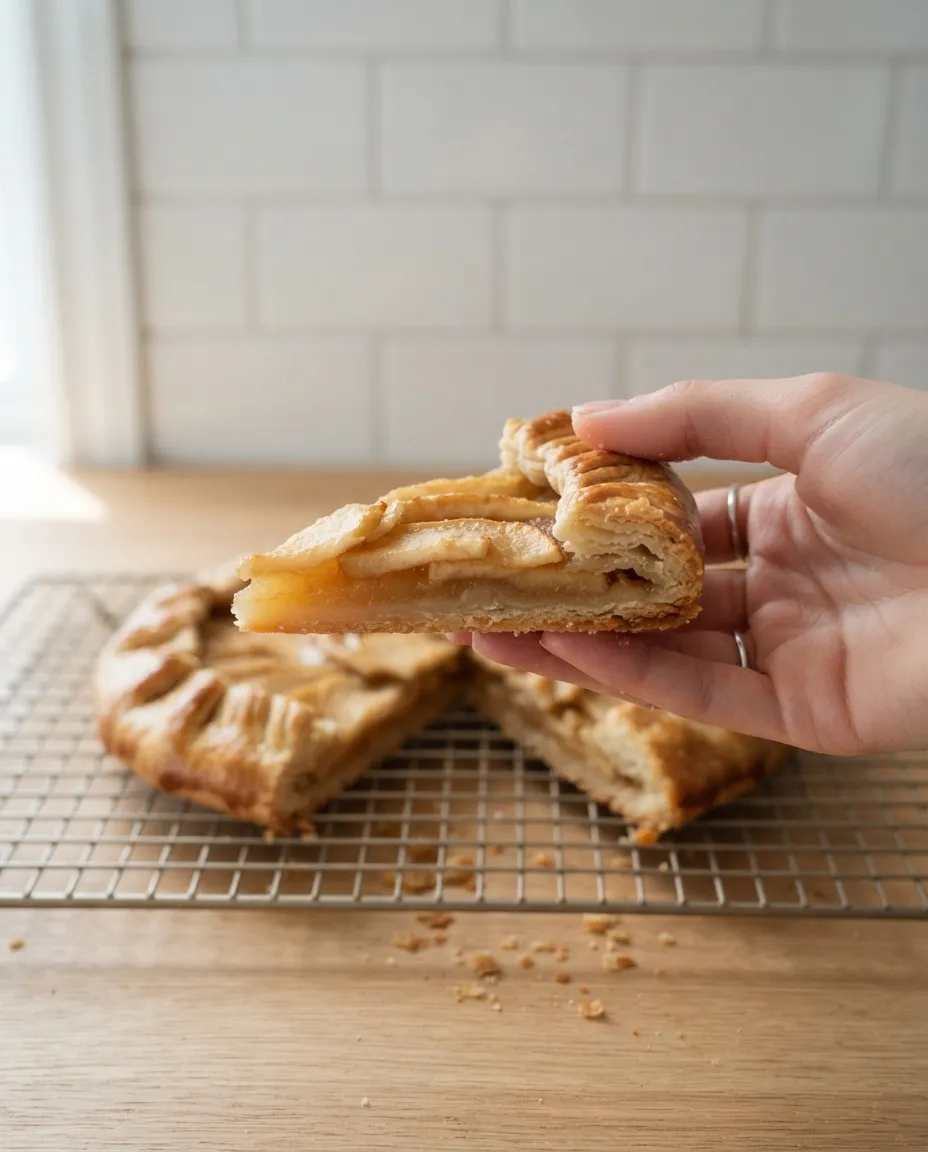
I came to the galette the way most people do: with a pie's worth of fruit on the counter and no appetite for a pie's worth of ceremony. A galette is the answer to that mood. Roll dough into a circle that does not need to be a good circle, pile fruit in the middle, fold the edge over like you are tucking it in, and bake. French bakers have been calling this rustic for two centuries, which is their word for allowed to look how it looks.
What nobody told me is that the galette is not just the lazy pie. In an air fryer, it is the correct pie. Every headache this site has spent whole pages solving for pie in a basket, the hoarding pan, the deep cold center, the rim that burns while the middle lags, exists because of the pan and the depth. The galette deletes both. What is left is a thin, open bake sitting directly on parchment in the path of the fan, which is to say: the exact food an air fryer is best at.
Quick answer: Roll one crust round to 11 inches on parchment, scatter a crumb mattress in the center, pile on 2 cups of fruit tossed with sugar and cornstarch from the matrix below, and fold a 2 inch pleated border over the edge, pinching every pleat. Freeze the built galette 10 minutes, then bake at 340°F for 22 to 26 minutes until the pleats are chestnut and the juices bubble thick. Rest 30 minutes. Same method, any fruit, all year.
The pie the air fryer was built for
No pan, no cold spot
A pie pan is a heat tax the basket's gentle floor can barely pay. A galette's dough sits on bare parchment with hot air circulating underneath, so the bottom browns instead of steaming, without any of the defenses deeper pies need.
Shallow fruit cooks fast
The filling is one fruit layer deep. It softens and bubbles in the same window the pastry browns, which is why this bake takes 25 minutes instead of the covered pie's negotiation.
The fold is the crust's armor
Pleated dough is doubled dough. The border that would burn first on a crimped pie rim is the thickest pastry on a galette, and it shrugs off the top element for the whole bake.
The one thing the galette does demand is respect for its juices, because there is no pan to catch a leak. That is the dry-floor rule below, and it is the difference between never fails and smoked out the kitchen.
Size it to the basket, not the recipe
Most galette recipes tell you to roll a 12 to 14 inch circle, which produces a finished galette of 10 inches or more. Measure your basket before you admire that advice; most baskets are 8 or 9 inches across the floor, and a galette that touches the walls bakes its own pleats onto them. The sizing runs backward from the machine:
- Finished galette = basket floor minus 1 inch. For the common 8 to 9 inch basket, that means a 7 to 8 inch galette. The pan size calculator knows the true floor dimensions of most machines, which are always smaller than the marketing quart number implies.
- Rolled circle = finished galette plus 4 inches, because a 2 inch border folds in from each side. So the target is an 11 inch circle, and here is the quiet convenience: a standard refrigerated crust round unrolls at 11 inches exactly. The store-bought round is accidentally a precision instrument for this job.
- Oval machines, oval galettes. Free-form means the dough will happily be an oval for a 9 by 6 basket. This is the only pie on the site that adapts to the weird baskets instead of arguing with them.
One formula, any fruit
Single-fruit galette recipes are the same recipe wearing different hats. What actually changes between fruits is water content and sweetness, which means only two numbers move: the sugar and the cornstarch. Two cups of prepared fruit fills a 7 to 8 inch galette, and the matrix handles the rest:
| Fruit (2 cups) | Sugar | Cornstarch | Notes |
|---|---|---|---|
| Apples or pears, 1/4 inch slices | 3 tablespoons | 1 tablespoon | The forgiving one; add cinnamon and start here if it is your first |
| Peaches, nectarines, plums, thick wedges, skin on | 1/4 cup | 4 teaspoons | Skin holds the wedges together and the color is half the point |
| Blueberries or blackberries, whole | 1/4 cup | 5 teaspoons | The juiciest row; the dry-floor rule below is not optional here |
| Cherries, pitted and halved | 1/4 cup | 4 teaspoons | Plus 1/4 teaspoon almond extract, the same pairing the cherry pie runs |
| Strawberry rhubarb, 1/2 inch pieces | 1/4 cup + 2 tablespoons | 2 tablespoons | The wettest thing you can legally put in pastry; macerate and drain, always |
Every row also gets a pinch of salt and a teaspoon of lemon juice. Frozen fruit works in any row: thaw it fully, drain what melts off, and move one starch step up.
The dry-floor rule
A pie leaks into its pan and nobody knows. A galette leaks onto the parchment, where the juice spreads, caramelizes past sweetness into carbon, glues the pastry down, and sets off the smoke complaints. Since there is no pan, the recipe has to be the pan. Three layers of defense, in order of the juice's journey:
- Take the water out first. For the juicy rows of the matrix, toss the fruit with its sugar and let it sit 10 minutes, then drain off the puddle before the cornstarch goes in. This is the oldest rule on this site wearing a new apron: measure the water out of the bake before the bake, the same logic as wringing zucchini. The drained syrup is excellent over yogurt, and it is no longer your galette's problem.
- The crumb mattress. Two tablespoons of crushed graham cracker, almond flour or plain dry breadcrumbs scattered where the fruit will sit. It vanishes into the fruit layer during the bake and absorbs the first wave of juice before it can reach dough. Bakers have smuggled this layer under fruit for generations because it works.
- The pleat is a dam. Every fold in the border overlaps the last one, and every overlap gets a firm pinch. An unpinched pleat is a spillway; the juice always finds it. The full fold protocol is next.
The six-fold wall
Some air fryer galette recipes par-bake the flat dough first to fight sogginess, then have you fold pleats into it. Try that once and you will learn that half-baked dough pleats like a poppadom: it cracks, the cracks leak, and the leak meets the bare floor. No par-baking here; the dry-floor rule already did that job, and raw, cold dough folds like fabric. The wall goes up like this:
- Leave a true 2 inch border around the fruit. Skimpy borders make short walls, and short walls lose to bubbling fruit.
- Fold in sections, 6 or 7 of them. Lift a section of border up and over the fruit's edge, then the next, letting each fold overlap the last by an inch. The overlaps are the pleats, and the pleats are structural, not decorative.
- Pinch every overlap flat against the fruit below it. You are laminating two layers of dough into one seam, and a pinched seam survives the boil.
- Egg wash the wall, then coarse sugar. The wash browns the pleats evenly and glues the seams; the sugar turns the border into the crunchiest part of the bake, which is correct galette politics.
- Freeze the built galette 10 minutes, on its parchment, while the machine preheats. Cold fat bakes flakier, and a firm galette slides into the basket without a wobble. The lattice on the cherry pie gets frozen for the fan's sake; this freeze is for the fat and the transfer, and it costs the same nothing.
- Trim the parchment to the galette plus 1 inch, and round the corners. Exposed parchment corners are sails, and the fan will find them; the rules for paper in a moving airstream live in the foil and parchment guide.
On temperature: oven galettes bake at 400°F, and the air fryer calculator translates that honestly to about 375°F. This page bakes at 340°F anyway, because the calculator cannot see how close those sugared pleats sit to the element; gentler and four minutes longer lets the fruit bubble before the wall darkens, the same judgment call the whole pie shelf makes. The complete ledger of the site's numbers lives in the air fryer baking chart.
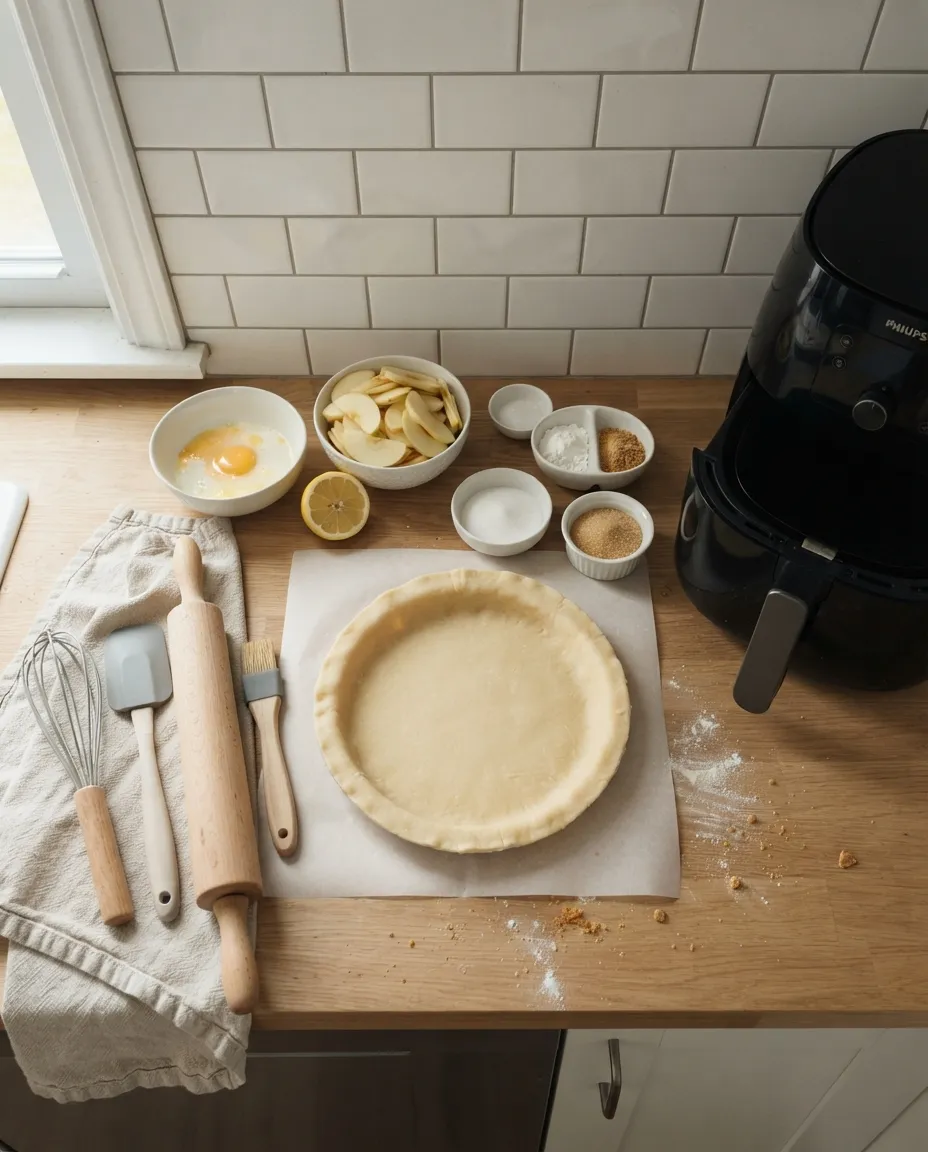
How to make it
- Measure the basket floor and set your two numbers: galette is floor minus 1 inch, rolled circle is galette plus 4. For most machines: 7 to 8 and 11.
- Roll the dough to 11 inches directly on parchment, trim the parchment to an inch beyond the dough with rounded corners, and slide the whole sheet onto the counter's coldest corner.
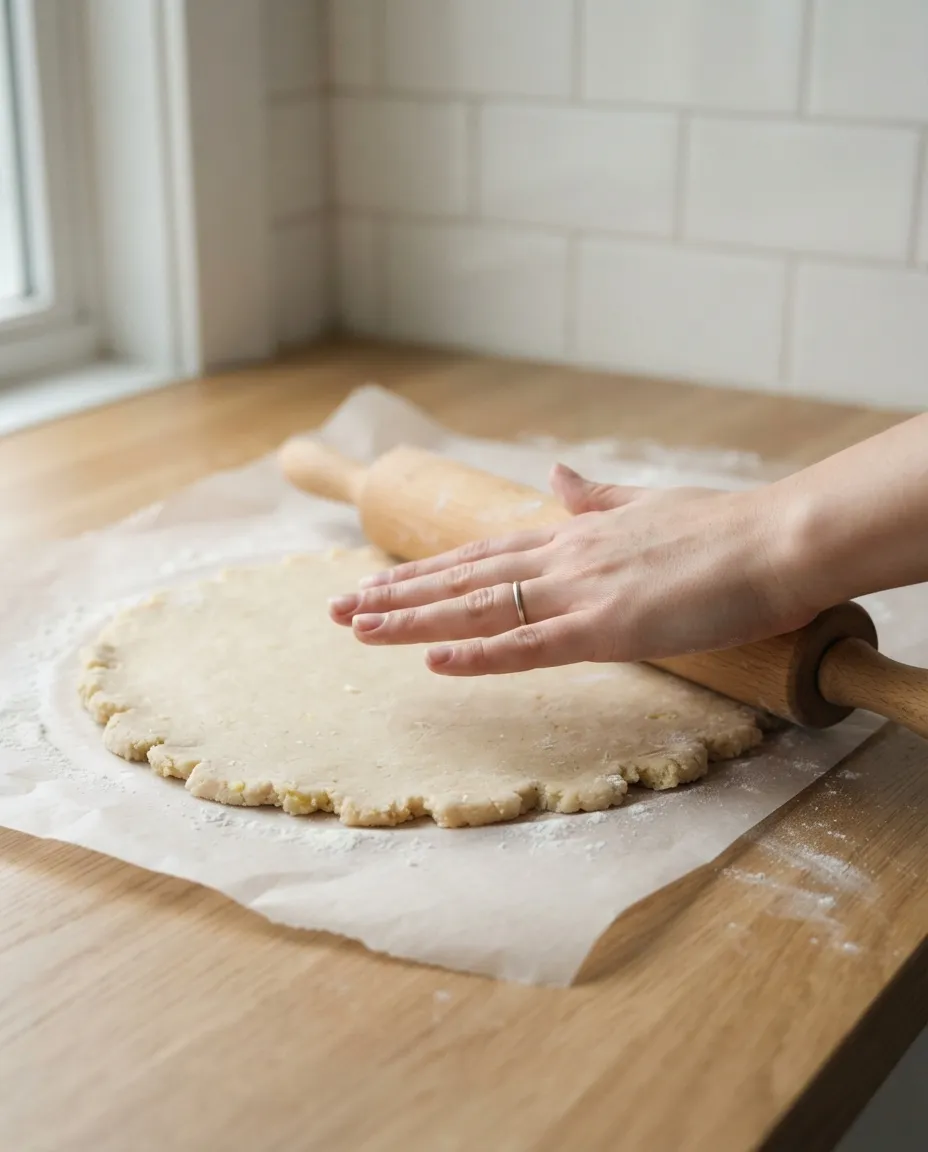
Rolled straight on the parchment it will bake on, out to 11 inches. - Run the matrix: toss 2 cups of fruit with its sugar row. Juicy fruit sits 10 minutes and gets drained; then the cornstarch, salt and lemon go in.
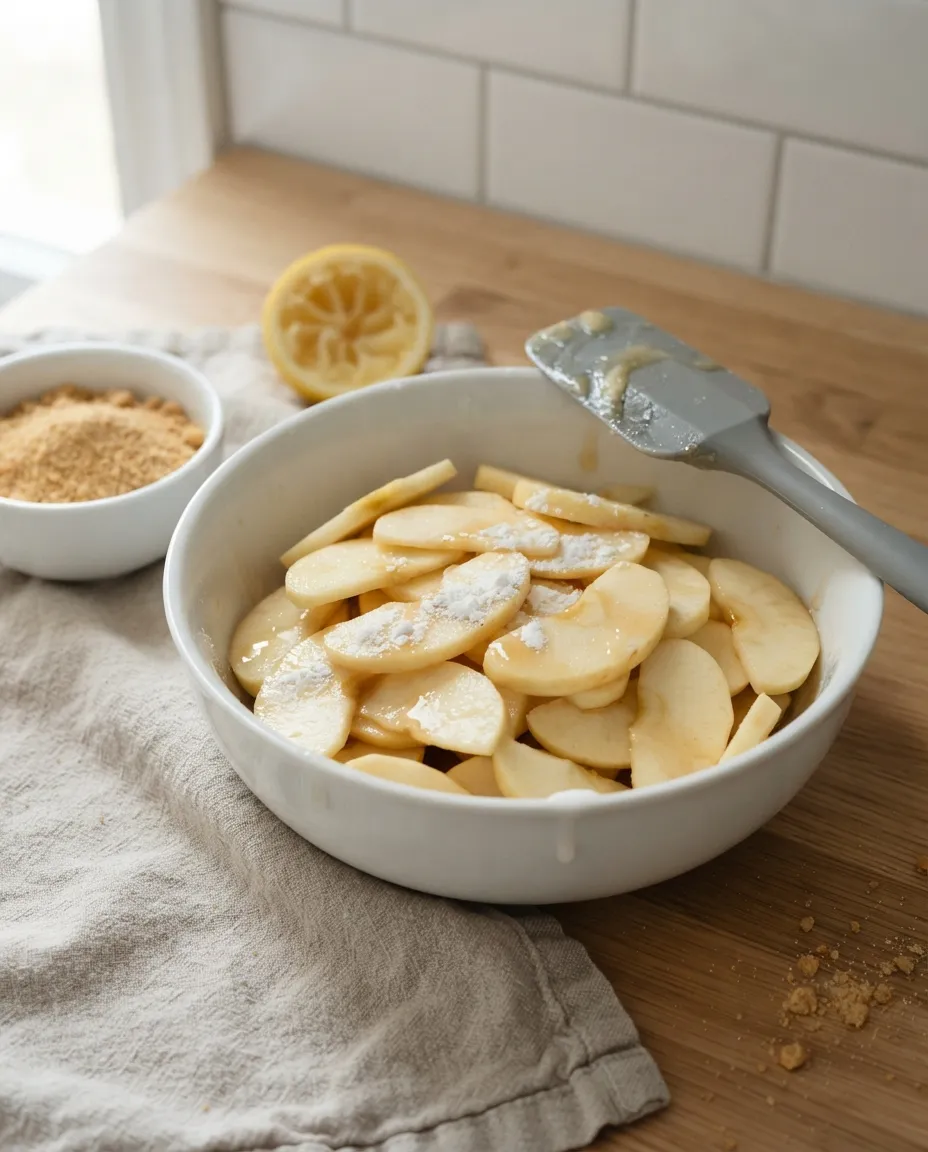
The first row of the matrix: apple slices tossed with their sugar, then the cornstarch, lemon and salt. - Scatter the crumb mattress over the center of the dough, leaving the 2 inch border bare.
- Pile the fruit on the mattress, shingled flat for slices, tumbled for berries, and no more than one layer deep at the edges.
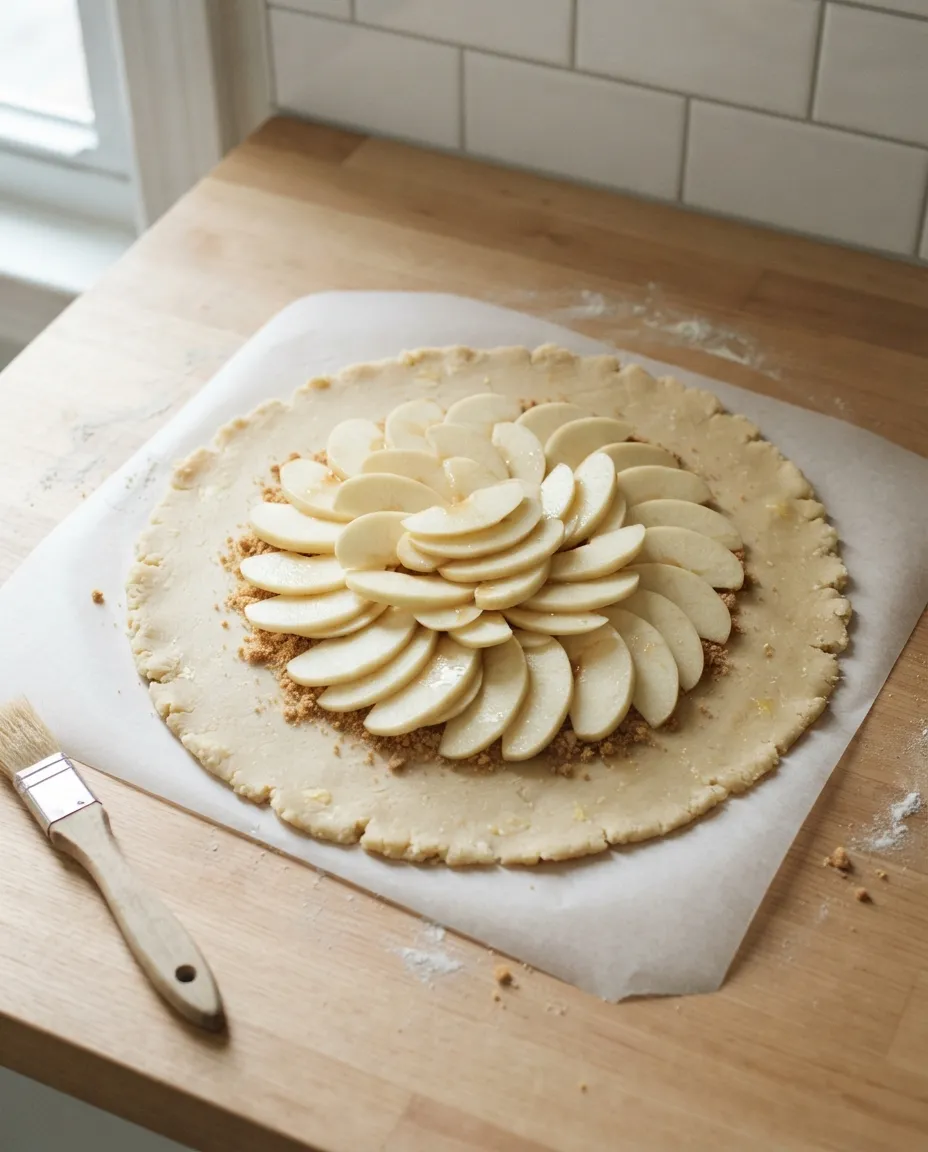
Apples shingled over the crumb mattress, with the 2 inch border left bare for the wall. - Raise the wall: 6 or 7 overlapping folds, every overlap pinched. Egg wash the pleats, then coarse sugar.
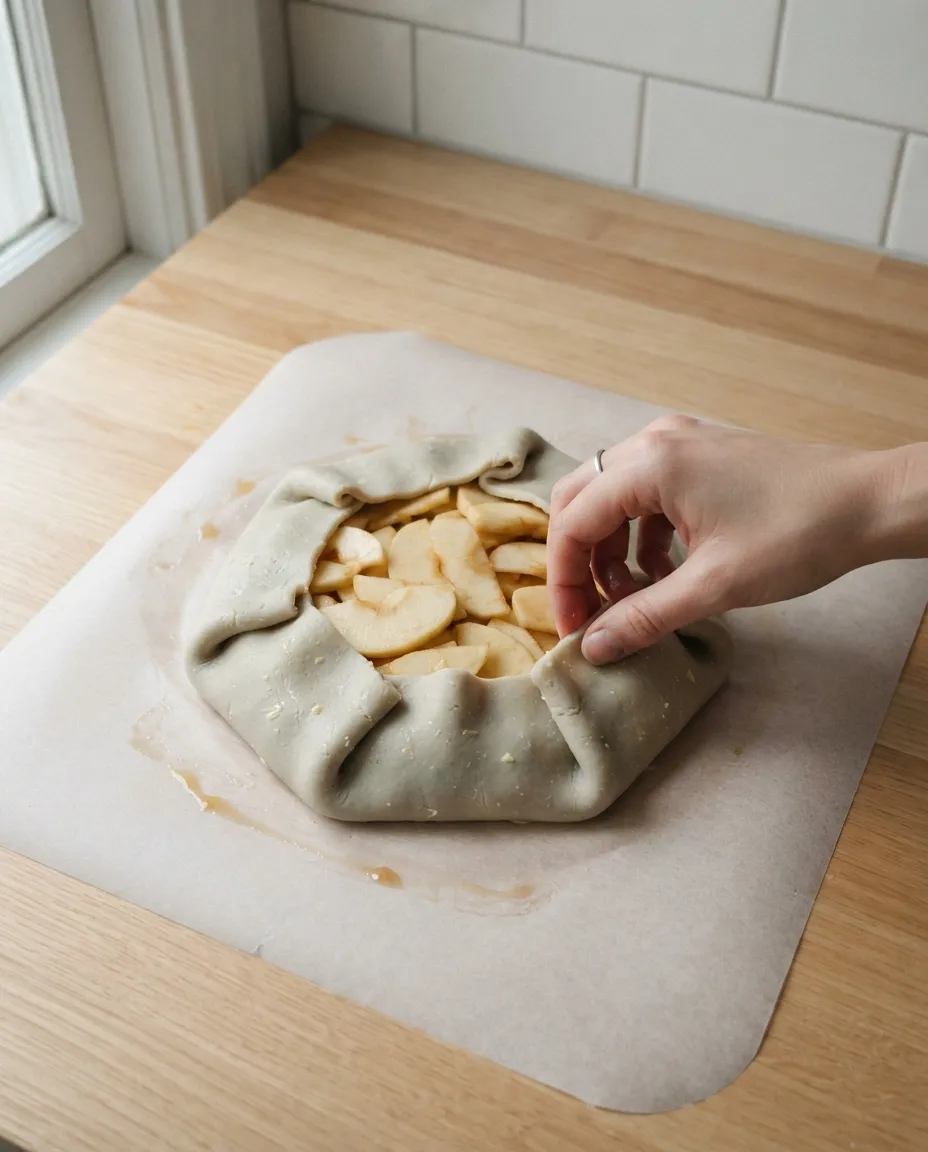
Folding the wall in overlapping sections and pinching every overlap. Each pinch closes a seam the juice would find. - Freeze the galette 10 minutes while the machine preheats 3 minutes at 340°F, a hot start this thin bake actually uses, per the preheat guide.
- Lower it in by the parchment and bake 22 to 26 minutes. If the pleats are deep chestnut before minute 16, lay a flat foil shield on loosely and let the fruit finish under it.
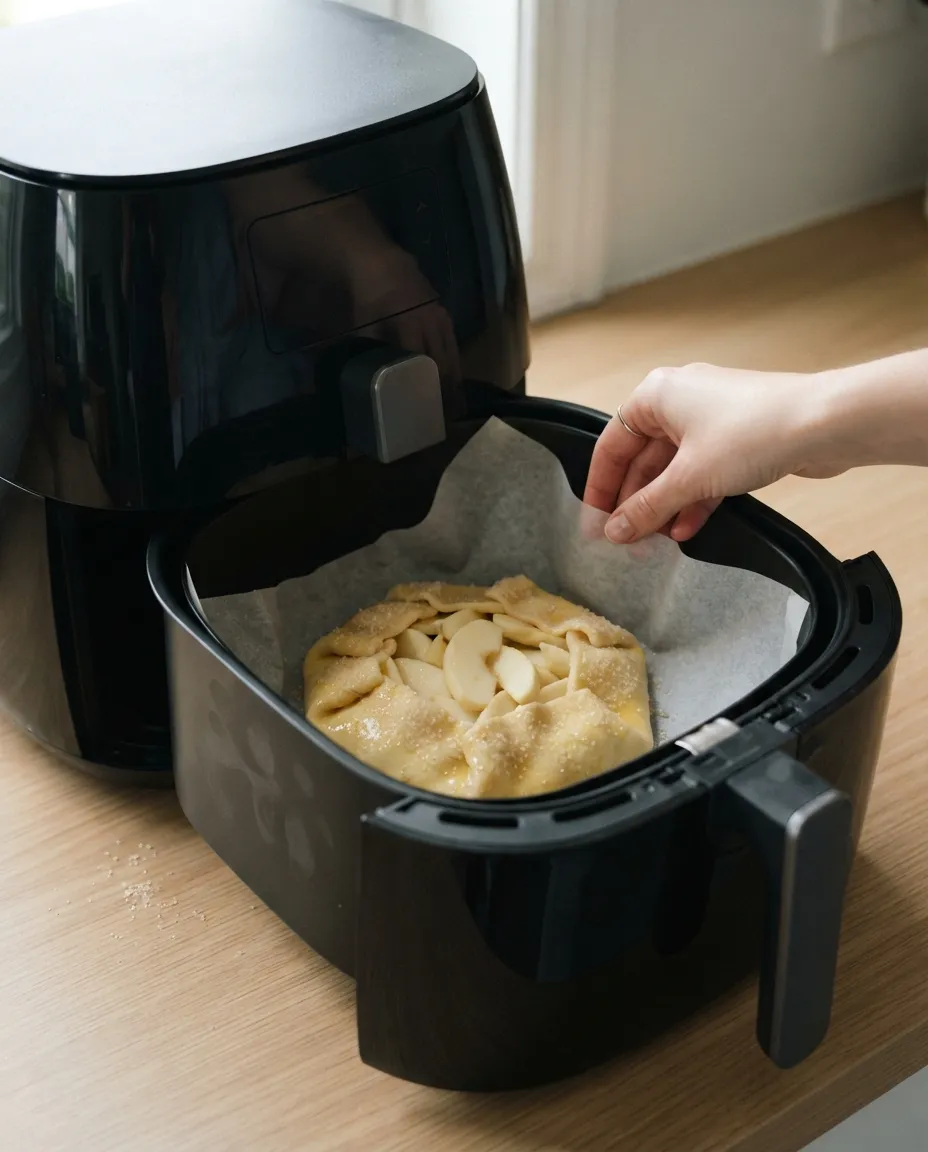
Straight from the freezer into the preheated basket, carried by its parchment. - Pull when the pleats are chestnut, the juices bubble thick at the fruit line, and a parchment-lift peek shows a golden bottom. Rest 30 minutes on a rack, parchment peeled off at minute 10 before the last steam can soften the base.
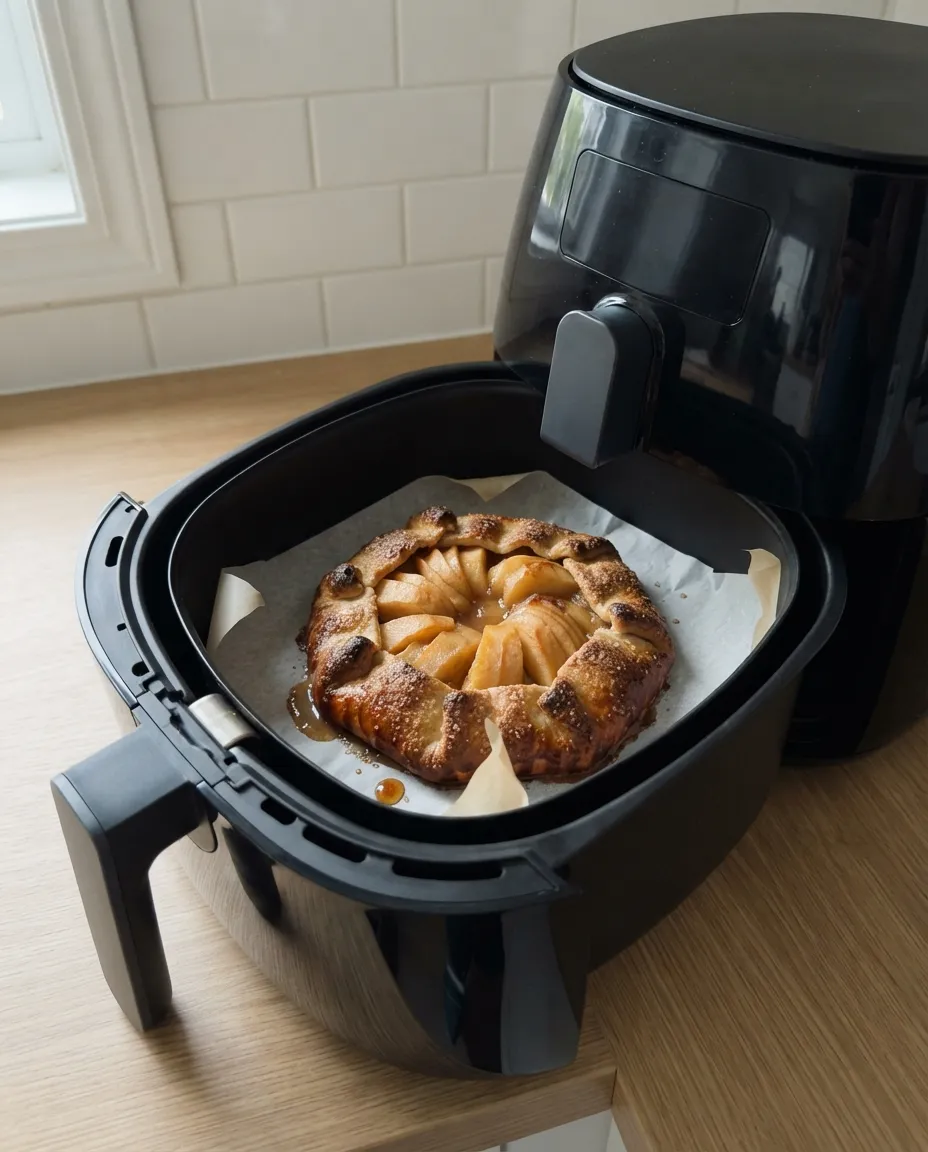
Done: pleats a shade past golden and the juices bubbling thick at the fruit line.
Doneness: the pie you can pick up
The deep pies on this shelf end in a number: 175°F for the pumpkin, 200°F for the pecan and for the frozen pie's fruit filling, because a deep pie hides its center and a thermometer is the only honest witness. The galette is the exception the doctrine allows: the filling is one layer deep and fully visible, so your eyes get to make the call for once. Three checks, all surface-level:
- The pleats are chestnut, a shade past golden, because pale pastry is underdone pastry no matter what the fruit says.
- The juice at the fruit line bubbles thick and slow, the visible proof the cornstarch reached its boil. Watery simmering means more time; this is the same bubble read as the cherry pie's lattice gaps, just easier to see.
- The bottom peek: lift one edge of the parchment and look underneath. Golden floor, done; blond floor, 3 more minutes. A galette is the only pie that lets you check its bottom mid-bake, and it feels like cheating because it is.
Then 30 minutes on a rack. The shallow filling sets in a fraction of a deep pie's cooldown, which makes this the only pie on the site you can reasonably bake and eat inside the same hour, still warm, with ice cream losing its argument on top.
Troubleshooting
| What you got | Why | Fix |
|---|---|---|
| Juice flooded the parchment | Undrained juicy fruit, or an unpinched pleat opened a spillway. | All three floor defenses: drain the maceration, lay the mattress, pinch every seam. |
| Soggy center under the fruit | Fruit went on wet and deep, and no mattress caught the first wave. | One layer deep at the edges, crumbs underneath, and juicy rows get the 10 minute drain. |
| Pleats scorched, fruit undercooked | Temperature above 340°F, or sugared pleats too close to the element. | 340°F, and the flat foil shield at minute 16. The wall can be protected; carbon cannot be undone. |
| Wall slumped open in the bake | Warm, soft dough went in and the fat melted before the structure set. | The 10 minute freeze. Cold walls hold their posture while the crust firms. |
| Bottom pale at the end | No preheat, or a pan or rack under the parchment stealing floor contact. | 3 minute preheat, parchment straight on the basket, and the bottom peek before pulling. |
| Parchment corner blew into the fruit | Excess paper gave the fan a sail. | Trim to 1 inch beyond the dough, corners rounded. Paper flies; paper under weight does not. |
| Cracked border, leaking seams | Dough was too cold to fold, or someone par-baked it flat first. | Fold at cool-but-flexible, straight from the counter, and never pleat pre-baked dough. |
| One side browner | A machine hot spot. | Half turn of the parchment at minute 15; free-form pies turn easier than any pan. |
Failures that repeat across bakes belong to the troubleshooting guide.
Variations
- Frangipane floor: swap the crumb mattress for 3 tablespoons of almond paste mashed with a teaspoon of egg, spread thin. It bakes into a marzipan cushion under stone fruit and looks like you studied in France.
- Savory supper galette: drop the sugar, keep everything else. Sliced tomatoes salted and drained 20 minutes on paper towels, goat cheese on the mattress layer (breadcrumbs, not grahams), thyme, the same wall, the same 340°F. The drain rule matters double for tomatoes.
- Apple cheddar: a thin layer of sharp cheddar under apples from the matrix's first row. Sweet-salty, and structurally the cheese is another mattress.
- Puff pastry galette: works, but fold no wall; puff rises into its own border. That bake follows different physics, and the puff pastry guide owns them.
- Two galettes, one evening: the recipe scaler doubles the fruit math honestly, and the second galette waits happily in the freezer while the first bakes; back-to-back is this format's version of a double batch.
- The handheld end of the spectrum: fold the same fillings into sealed half-moons and you have crossed into hand pies territory, where the portable rules live.
Where this sits on the pie shelf: the galette is the weeknight pie, the one you assemble in 15 minutes because the fruit was about to go over the edge. The apple pie is the deep, covered Sunday version of the same instinct, the cherry pie is the lattice showpiece, and the blind baking guide underwrites the custard pies. The galette is the only member of the family that needs none of their infrastructure, which is exactly why it never fails. And when even a crust feels like too much, the same fruit goes under a topping instead in the apple crisp, the peach cobbler or the berry cobbler.
Storage and reheating
- Day one: counter, uncovered or under a loose towel. Sealing a warm galette softens the wall you built.
- Days two and three: fridge, loosely wrapped. The border dulls; see the next line.
- The revival: 3 to 4 minutes at 330°F, straight on the basket, and the pleats crackle again. A microwave does the opposite of this.
- Freeze built and unbaked, on its parchment, up to 2 months. Bake from frozen at 340°F plus about 6 minutes, no thawing, which makes a stashed galette the fastest scratch dessert this site owns.
Frequently asked questions
QHow long does a galette take in an air fryer?
22 to 26 minutes at 340°F after a 3 minute preheat, for a 7 to 8 inch galette carrying 2 cups of fruit. Add 10 minutes for the pre-bake freeze and 30 minutes of resting, and it is still comfortably the fastest scratch pie in the machine, because there is no pan to heat and only one shallow layer of fruit to cook.
QCan I use store-bought pie crust for a galette?
Yes, and for once the store-bought option is dimensionally perfect: a standard refrigerated crust round unrolls at 11 inches, which is exactly the rolled size a 7 to 8 inch finished galette needs. Homemade all-butter dough tastes better and pleats prettier, but the refrigerated round plus the fruit matrix is a legitimate 15 minute dessert, and this page respects it.
QWhat fruit works best in an air fryer galette?
Apples and pears are the most forgiving start, because they carry the least water. Stone fruit, blueberries, blackberries, cherries and strawberry rhubarb all work through the same formula; only the sugar and cornstarch amounts change with the fruit's juiciness. Frozen fruit is fine in any case: thaw it completely, drain everything that melts off, and use the next starch level up.
QHow do I keep the galette bottom from getting soggy?
Three defenses, stacked: macerate juicy fruit with its sugar for 10 minutes and drain the released liquid before adding cornstarch; scatter a crumb mattress of graham crumbs, almond flour or breadcrumbs under the fruit to absorb the first wave of juice; and bake on parchment directly on a preheated basket floor so the pastry browns from minute one. No blind baking needed, and no pan in the way.
QHow do I stop the filling from leaking out?
Leaks come from short walls and open seams. Leave a full 2 inch border so the folded wall stands tall, fold it in 6 or 7 overlapping sections, and pinch every overlap flat; an unpinched pleat is the spillway the juice will find. Egg wash helps glue the seams shut. In a pan-free bake, contained juice is the whole game, because whatever escapes lands on parchment and burns.
QDo I need to pre-bake the dough first?
No, and do not let another recipe talk you into it: dough that has been par-baked flat cracks when you try to pleat it, and cracked pleats leak. Raw, cold dough folds cleanly, and the sogginess a pre-bake tries to prevent is already handled by draining the fruit and laying the crumb mattress. The only chilling this galette needs is 10 minutes in the freezer after it is built.
QWhat size galette fits my air fryer?
Work backward from the basket floor: the finished galette should be an inch smaller than the floor, and the rolled dough circle 4 inches bigger than the finished galette, since the border folds in from both sides. For the common 8 to 9 inch basket, that is a 7 to 8 inch galette from an 11 inch circle. Oval basket? Roll an oval; free-form dough does not mind.
QCan I make a galette with puff pastry?
You can, but treat it as a different bake, not a substitution. Puff pastry should not be pleated into a wall; it rises into its own raised border, wants a higher temperature, and follows the timing rules of the puff pastry guide rather than this page. Fold-wall galettes belong to pie dough, whose fat stays put and whose pleats hold their shape.
QHow do I know when the galette is done?
Three visual checks, no thermometer required for once: the pleated border has gone chestnut rather than merely golden, the juices at the fruit line are bubbling thick and slow instead of watery, and a peek under one lifted parchment edge shows a golden bottom. If any of the three is not there, give it 3 more minutes with a foil shield over the pleats.
Never overbake again
Get our one-page times & temps cheat sheet, plus a new tested recipe each week.
No spam · unsubscribe anytime