

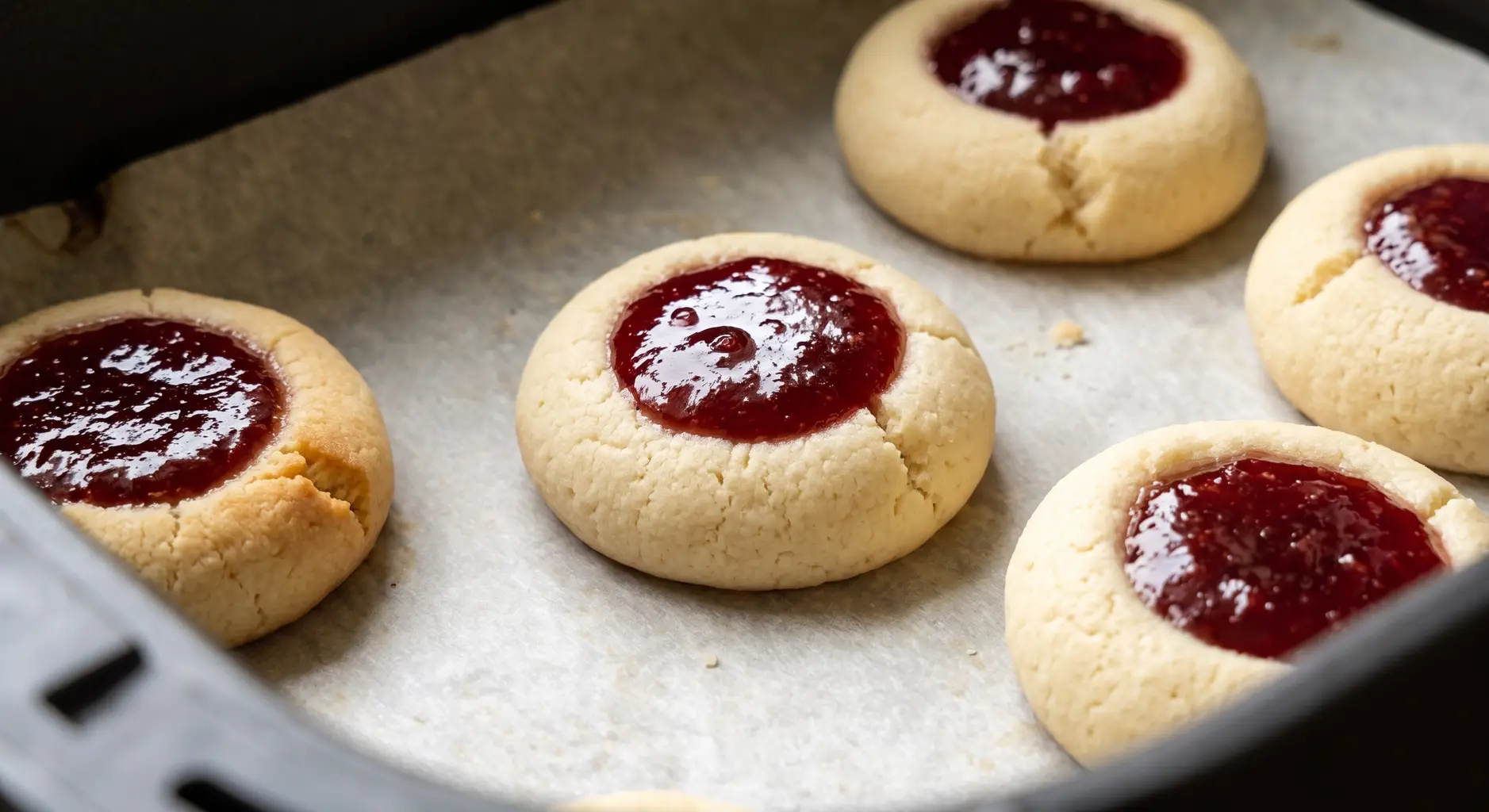
My first air fryer thumbprints looked like a crime scene. Twelve cookies went in with tidy red centers, and eight minutes later the jam had climbed out of every well, run down the sides, and welded itself to the parchment in blackened rings. The cookies were fine. The jam was archaeology. If the basket is new to you, how to bake in an air fryer covers the ground rules this recipe assumes.
I did what everyone does next, which is fill the cookies after baking instead. That fixes the boiling and creates a different problem nobody warns you about: the jam never cooks, so it never sets. It sits on the cookie like a condiment, smears in the container, and slides off the moment anyone stacks them.
The trick that finally worked came from splitting the difference, and it is the whole reason this page exists.
Quick answer: Bake the unfilled cookies at 320°F for 4 minutes, pull the basket, re-press the wells and fill each with 1/2 teaspoon of cold jam, then bake 4 to 5 more minutes. The jam heats enough to set glossy but never spends long enough at temperature to boil over. Use thick jam or preserves, never jelly, and keep the fill just below the rim of the well.
Why jam boils over
Jam is roughly two-thirds sugar. That makes it a concentrated syrup, and concentrated syrups do not behave like the water they are mostly made from. A 65 percent sugar solution boils around 220°F rather than 212°F, and once it boils it does not simmer politely. It foams, expands, and climbs, which is exactly what you watch it do out of a thumbprint well.
In a regular oven this is already a known nuisance. An air fryer makes it worse in two specific ways:
- The heat comes from directly above. The element sits inches over the exposed jam, so the surface of the filling takes more direct radiation than it would mid-oven. The jam reaches boiling before the cookie around it is even halfway done.
- The fan feeds the foam. Moving air strips moisture off the jam surface, concentrating the sugar further and pushing the boil harder. The same airflow that makes the machine brilliant at crisping is aimed straight at the one ingredient that should stay quiet.
So a filling that survives 12 minutes in an oven at 350°F can overflow in 8 at 320°F in a basket. It is not your jam, and it is not your recipe. It is geometry, and the fix is to shorten the time the jam spends under the element.
Fill before, after, or halfway: the three camps
The recipes ranking for this cookie split into two camps and never acknowledge each other. Both are half right.
Fill before baking
The traditional way. The jam bakes into the cookie, sets glossy, and holds firm in a cookie tin. The cost: it spends the entire bake under the element, which in an air fryer is how you get overflow and burnt sugar rings.
Fill after baking
Nothing can boil over, which is why cautious recipes suggest it. But unbaked jam never sets. It stays wet and sticky, smears when stacked, and tastes like jam sitting on a cookie instead of belonging to it.
Fill at halfway
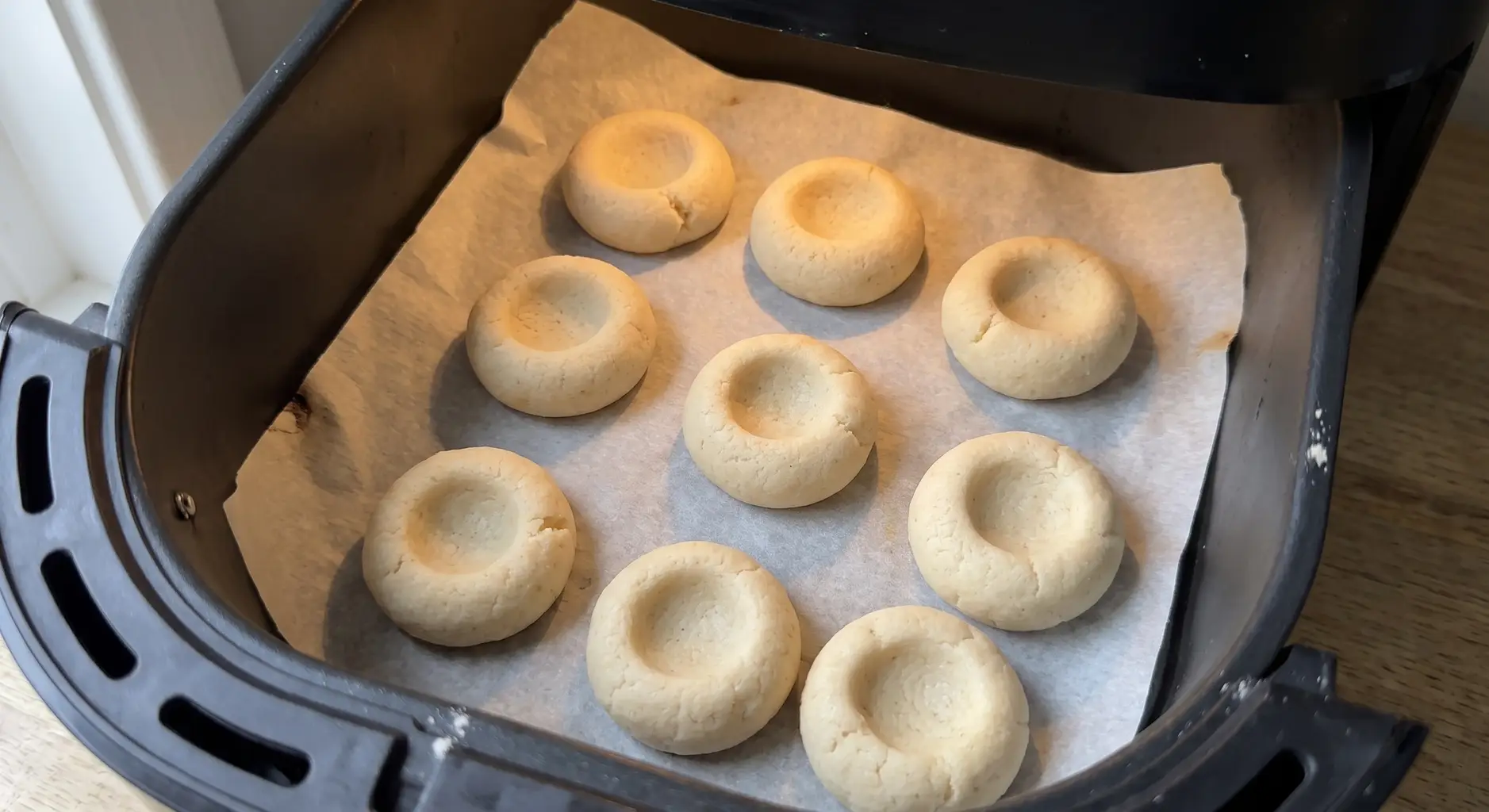
Bake 4 minutes empty, re-press the wells, fill, bake 4 to 5 more. The jam gets enough heat to thicken and gloss, but only half the exposure. Set centers, zero overflow, one extra pull of the basket.
The halfway fill has a second benefit that has nothing to do with jam. Thumbprint dough puffs in the first minutes of baking, and puffing closes the wells. Fill a deep well before baking and it becomes a shallow dimple with jam sliding off it by minute four. Pulling the basket at halfway lets you re-press the wells at exactly the moment the dough has finished rising, so the crater you fill is the crater you keep.
Which jam survives the basket
The jar you pick matters as much as the timing. The rule: the thicker and seedier it pours, the better it bakes.
| Filling | In the air fryer | Verdict |
|---|---|---|
| Preserves | Thick, chunky, high fruit content. Barely moves in the well. | Best choice |
| Jam | Thick enough if used cold from the fridge. Seedless raspberry is the classic. | Very good |
| Jelly | Pure strained gel, liquefies fast, boils first and climbs highest. | Avoid |
| Pie filling | Chunks too big for a 1 inch well, and the syrup around them runs. | Avoid |
| Lemon curd | Egg based, so it scrambles under direct heat. | After baking only |
| Chocolate hazelnut spread | Melts thin at temperature, then re-sets fine as it cools. | After baking only |
Two small rules that punch above their weight. Use the jam cold, straight from the fridge: cold jam starts further from its boiling point and thickens the fill. And do not stir or microwave it first. Stirring breaks the pectin gel and thins the jam, which is the opposite of what the well needs.
The well: cork beats thumb
Thumbprints are named for the thumb, and the thumb is honestly the worst tool for the job. Thumbs are wedge shaped, different sizes on every baker, and they crack the edges of the dough ball as they press. Three upgrades:
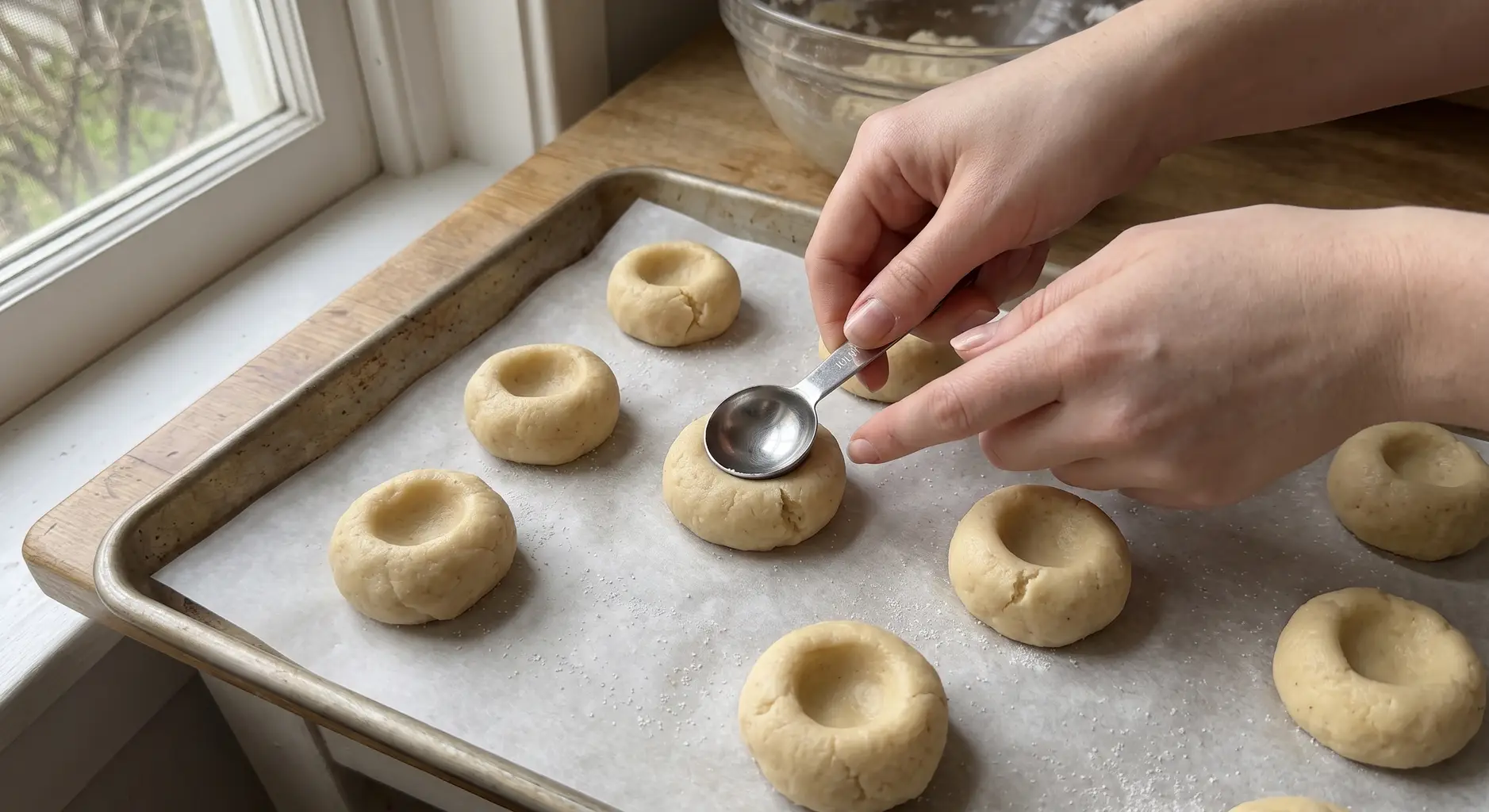
- The back of a rounded half-teaspoon measure makes a smooth, deep, identical well in every cookie, and its bowl holds exactly the amount of jam the well should take.
- A wine cork does the same job with a flat bottom, which suits preserves with fruit pieces.
- Press immediately after rolling, while the dough ball is soft from your hands. If the edges crack anyway, pinch them smooth before chilling. Cracks pressed into cold dough stay cracks in the baked cookie, and a cracked wall is where jam escapes sideways.
Depth matters more than width. A shallow dimple holds a smear of jam that dries out. You want a well about halfway through the ball, walls thick enough to hold, filled to just below the rim. Jam level with the rim has nowhere to go but over.
Ingredients
The dough
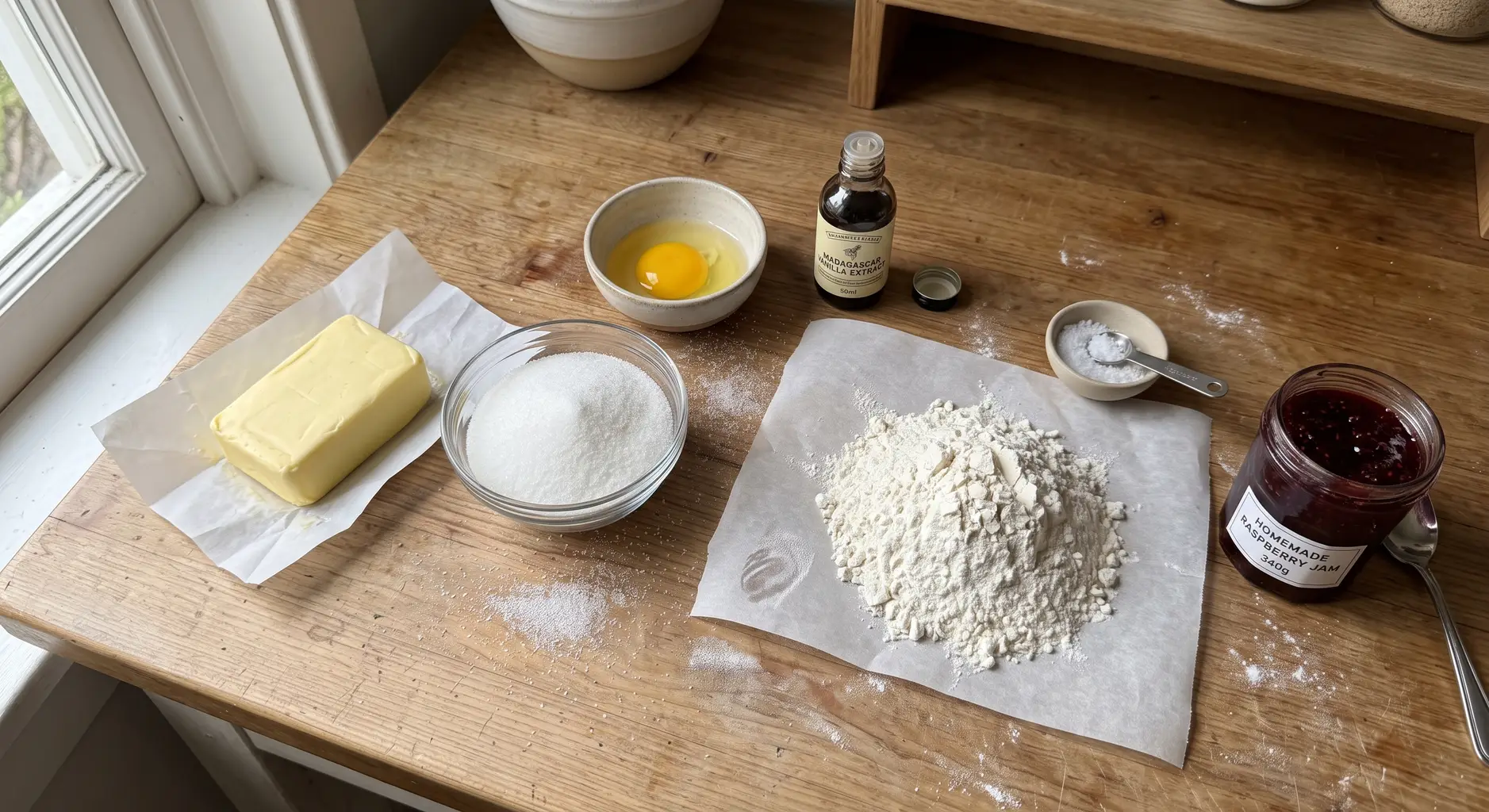
- 1/2 cup (113g, 1 stick) unsalted butter, softened
- 1/3 cup (67g) granulated sugar
- 1 large egg yolk
- 1 teaspoon vanilla extract
- 1 1/4 cups (156g) all-purpose flour
- 1/4 teaspoon fine salt
The filling
- 1/3 cup thick jam or preserves, cold: seedless raspberry, strawberry, or apricot
- Optional: powdered sugar for dusting the finished cookies
The yolk is doing quiet, important work. Several air fryer thumbprint recipes go egg free, which bakes fine but presses badly: without the yolk's fat and emulsifiers, the dough is short and brittle, and brittle dough cracks around the well. One yolk makes the dough pliable enough to take a deep press with clean walls, and richer besides. The whites can go into tomorrow's egg toast.
How to make them
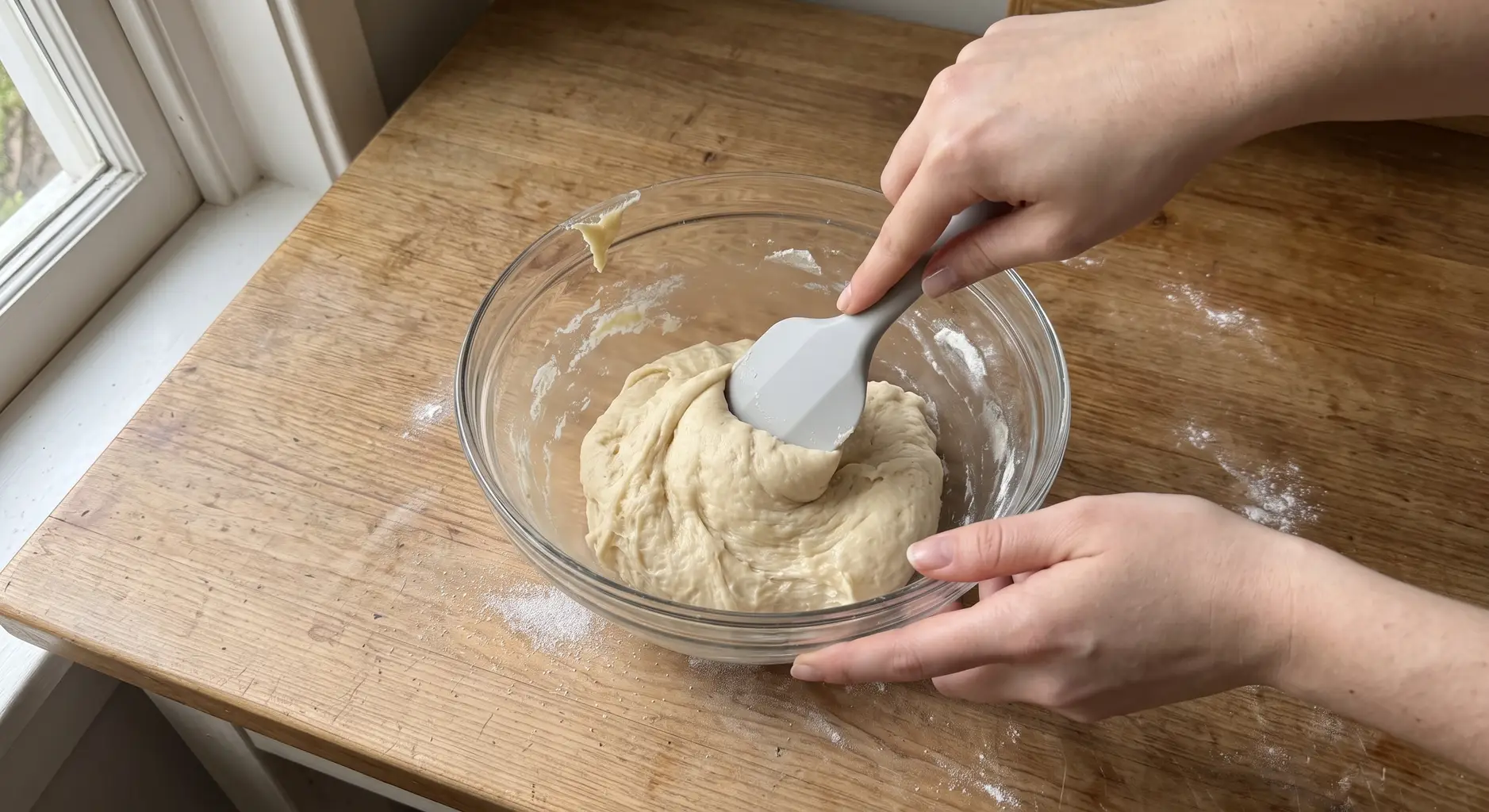
- Cream the butter and sugar for about 2 minutes until light. Proper creaming gives the dough enough structure to hold a well without collapsing.
- Beat in the yolk and vanilla, then mix in the flour and salt on low just until the dough comes together. It should be soft but not sticky.
- Roll 16 balls, a level tablespoon each, about 1 inch across. Uniform size matters more here than in most cookies, because the fill amount is fixed.
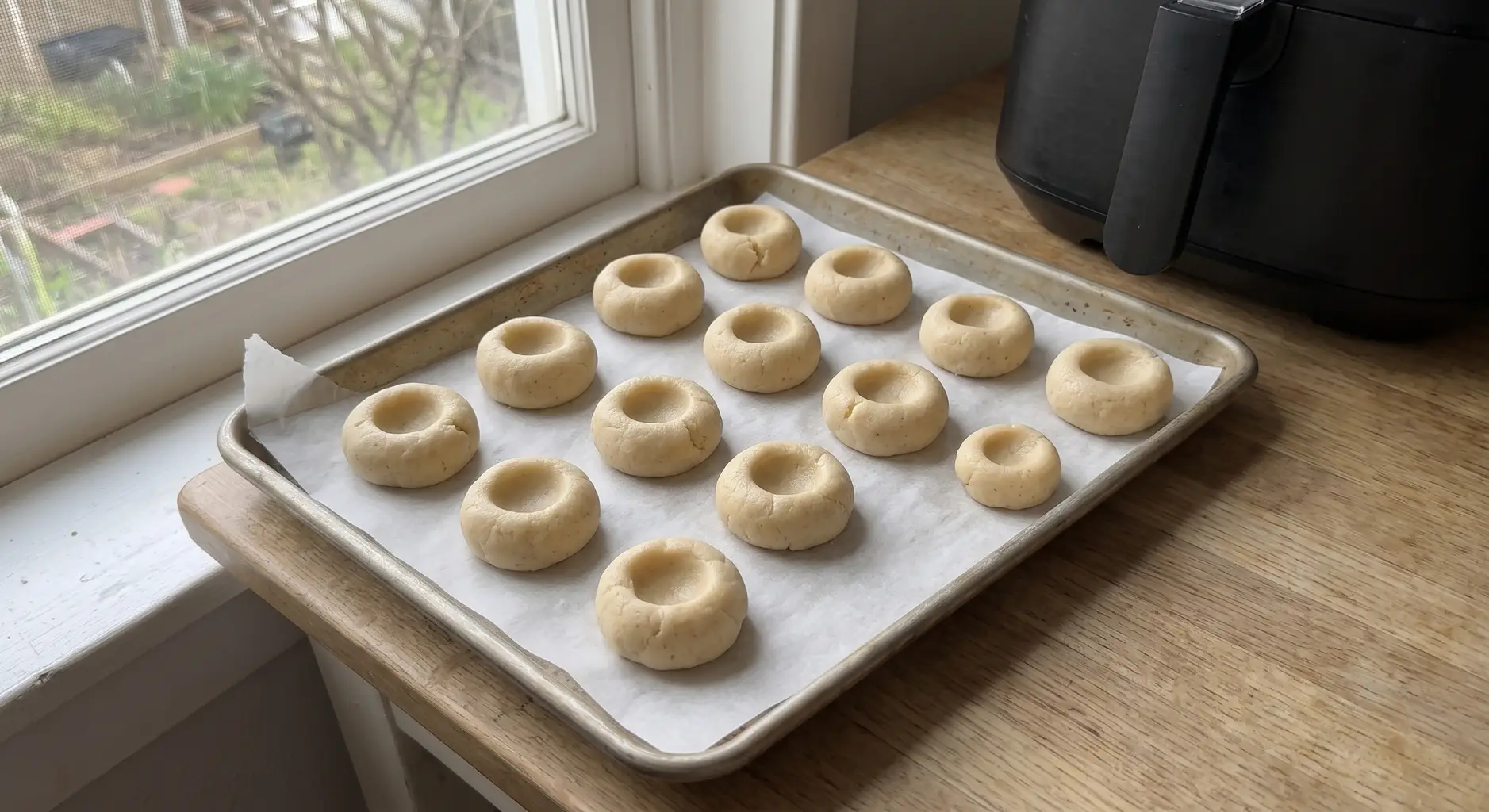
- Press the wells now, while the dough is soft: the back of a rounded half-teaspoon measure, about halfway down into each ball. Pinch any cracked edges smooth.
- Chill the shaped, empty cookies for 15 minutes. Cold dough holds the well shape through the first bake. Same logic as every cutout on this site: warm butter dough slumps under the fan.
- Preheat the air fryer to 320°F for 3 minutes. Short bakes need the machine already at temperature, covered in do you need to preheat an air fryer for baking.
- Bake the empty cookies for 4 minutes, 6 to 8 at a time, an inch apart on parchment cut smaller than the basket floor. The parchment rules, including why a loose sheet and a fan are a bad pair, are in can you use foil or parchment paper in an air fryer.
- Pull the basket and re-press every well. They will have puffed half shut. The spoon goes back in, gently, and the crater returns. This is also your moment to nudge any cookie that slid.
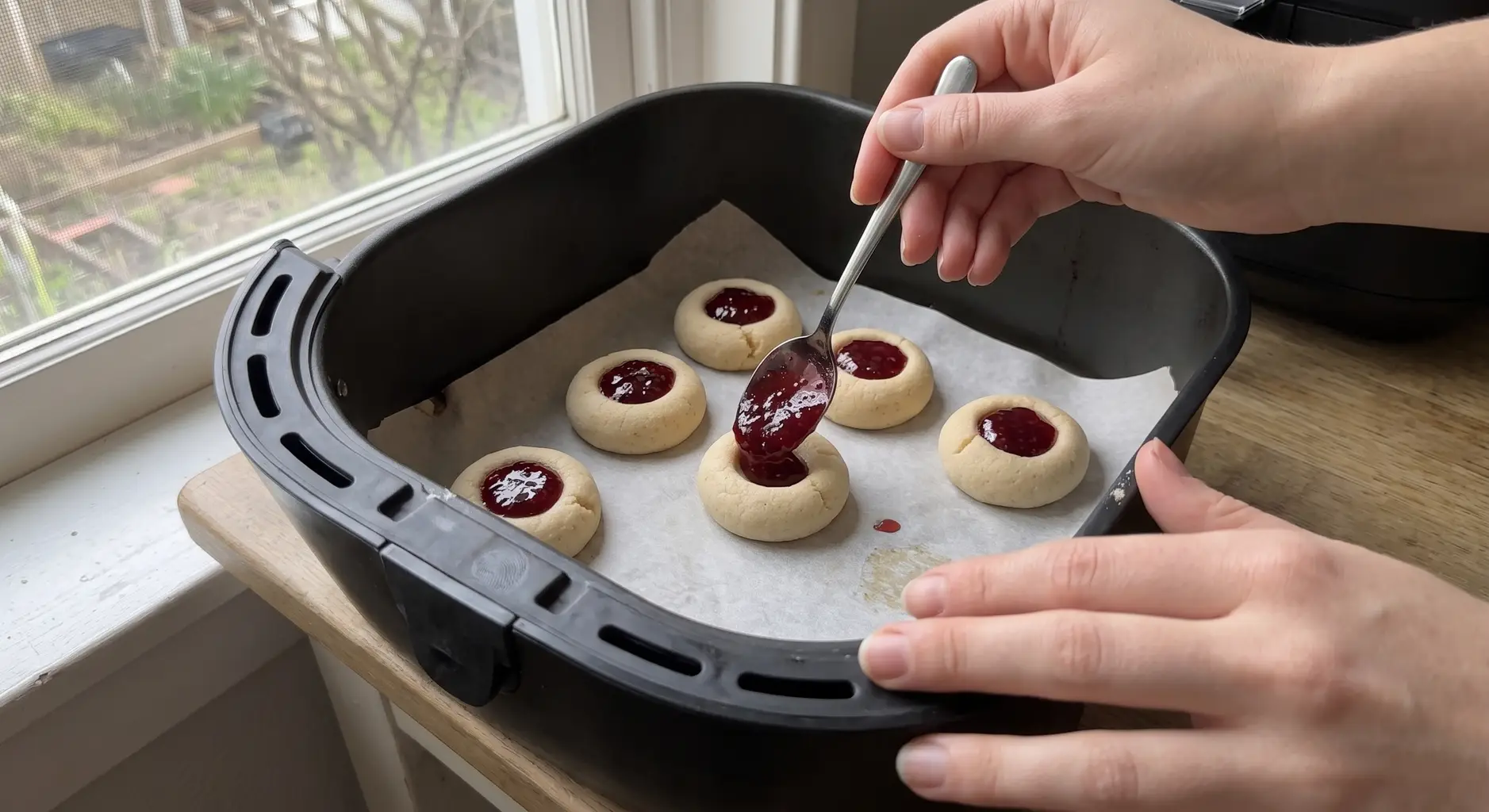
- Fill each well with 1/2 teaspoon of cold jam, just below the rim. Not level with it, and never heaped.
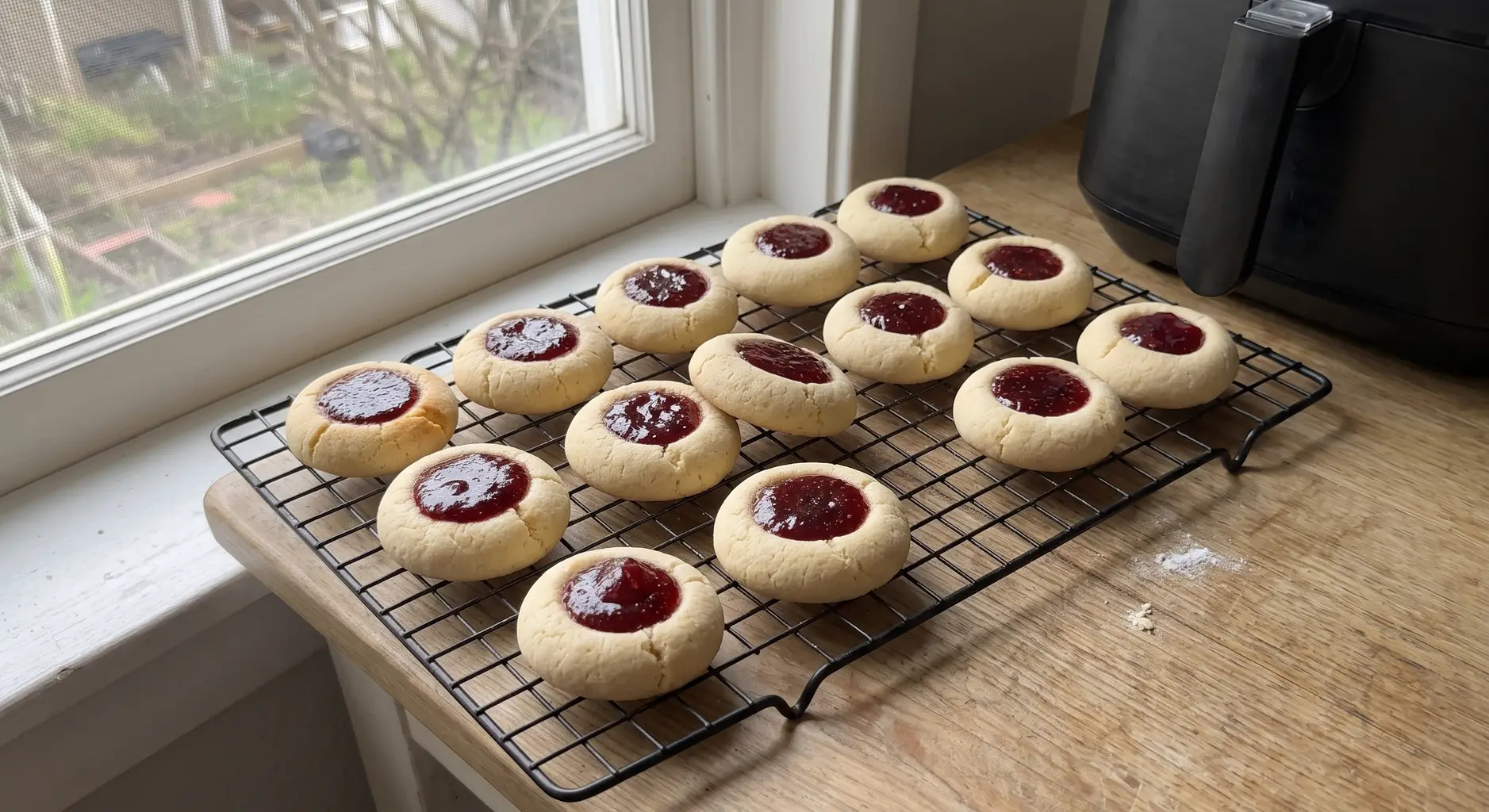
- Bake 4 to 5 more minutes, until the cookie edges are barely golden and the jam is glossy and slack but not bubbling hard. A few lazy bubbles at the jam edge is perfect. Rolling foam means out, now.
- Rest 5 minutes on the parchment before moving. The jam is molten sugar and dangerous straight out of the basket, and the cookies are fragile until carryover finishes them. Cool fully on a rack, then dust with powdered sugar if you like, keeping it off the jam.
Troubleshooting
| What you got | Why | Fix |
|---|---|---|
| Jam boiled over anyway | Overfilled, or jelly instead of jam, or it went in at the start. | Half a teaspoon, below the rim, cold thick jam, in at the halfway pull. |
| Jam sank into the cookie | Well pressed too deep, through to the parchment. | Halfway down the ball is the floor. The cookie needs a base under the jam. |
| Wells closed up in the bake | Dough puff. It happens to everyone. | That is what the re-press at minute 4 is for. Do not skip the pull. |
| Edges cracked around the well | Pressed cold or dry dough, or an egg free recipe. | Press right after rolling while soft, pinch cracks smooth, and keep the yolk in the dough. |
| Cookies spread into each other | Skipped the chill. | 15 minutes, shaped, before the basket. Warm butter dough slumps under the fan. |
| Pale tops, doughy middle | Pulled too early or crowded the basket. | 6 to 8 per batch with an inch between, and bake to barely golden edges. |
| Burnt jam rings on the basket | Overflow from a previous batch, carbonizing on reheat. | Burnt sugar needs a soak, not a scrape. The bakeware cleaning guide covers it without wrecking the coating. |
| First batch fine, later batches dark | The basket floor holds heat batch to batch. | Rest the open basket 2 minutes between rounds, and trust color over the clock. |
| Jam smears when stored | Filled after baking, so it never set. | The halfway fill exists for exactly this. Baked jam sets, raw jam smears. |
Cookies browning unevenly across the basket is a hot spot, fixed by turning the parchment at the fill stop. A machine that scorches everything regardless has a different problem: start with how to prevent burning in an air fryer, then the full troubleshooting guide.
Variations
- Classic nut-rolled. Roll the balls in beaten egg white, then finely chopped walnuts or pecans before pressing. The original American thumbprint. Chopped candied walnuts are the upgrade version.
- Lemon curd or chocolate hazelnut. Bake the cookies fully empty, re-pressing at halfway, and fill in the last 60 seconds so the filling slumps glossy without cooking, or fill completely after. These two never go in early.
- Apricot and almond. Apricot preserves plus a quarter teaspoon of almond extract in the dough. The bakery combination for a reason.
- Holiday plate. Half raspberry, half apricot, dusted edges, and they sit next to shortbread and gingerbread like they planned it. These three doughs are all make-ahead, which is the whole December trick, and biscotti keeps longest of the lot.
- Doubling. The dough doubles cleanly for a cookie swap. The recipe scaler does the math, and use one whole egg instead of two yolks at double size.
The rest of the cookie shelf works the same batch-on-parchment way: chocolate chip, sugar cookies, peanut butter, oatmeal, snickerdoodles and the loaded monster cookies, all of them gathered in the air fryer cookies and bars collection. Every temperature on the site lives in the air fryer baking chart, and if you are converting your own oven thumbprint recipe, the air fryer calculator gets you the starting numbers, then apply the halfway fill on top, because the calculator can fix your temperature but not your jam.
Make ahead and storage
- Room temperature: 4 days in an airtight container, in single layers with parchment between, because even set jam dislikes being stacked naked.
- Fridge: up to a week, and the jam firms further. Bring to room temperature before serving.
- Freeze baked: 2 months. Thaw uncovered so condensation does not sit on the jam.
- Freeze the dough: shape the balls, press the wells, freeze on a tray, then bag. Bake from frozen at 320°F, adding 2 minutes to the first stage, then re-press and fill as normal. The wells hold even better from frozen, and the general rules are in air fryer frozen cookie dough. For dough resting in the fridge rather than the freezer, see refrigerated cookie dough.
- Do not freeze filled unbaked cookies. Jam ice crystals wreck the pectin, and the thawed filling boils over at the slightest excuse.
Frequently asked questions
QHow long do you cook thumbprint cookies in an air fryer?
8 to 10 minutes total at 320°F, split by the fill: 4 minutes empty, then a pull to re-press the wells and add the jam, then 4 to 5 more minutes until the edges are barely golden. Published recipes run from 320°F to 350°F with the jam in from the start, and the hotter and longer the jam sits under the element, the more likely it boils out of the well.
QWhy does the jam boil over in thumbprint cookies?
Jam is about two-thirds sugar, which makes it a syrup that boils around 220°F and foams upward when it does. In an air fryer the exposed jam sits inches under the heating element with a fan concentrating it further, so it reaches a rolling boil faster than in an oven. The fixes are exposure and volume: fill at the halfway point instead of the start, use half a teaspoon of cold thick jam per cookie, and keep the fill below the rim of the well.
QDo you put the jam in before or after baking thumbprint cookies?
Neither, ideally. Jam in from the start spends the whole bake under the element and tends to overflow. Jam added after baking never cooks, so it never sets, and it smears the moment the cookies are stacked. Fill at the halfway pull: the jam gets enough heat to thicken and gloss into the cookie but only half the exposure. The one exception is egg based or chocolate fillings like lemon curd and hazelnut spread, which always go in after.
QWhat is the best jam for thumbprint cookies?
Thick preserves or a good jam, used cold and unstirred. Seedless raspberry is the classic, strawberry and apricot close behind. Avoid jelly, which is a strained gel that liquefies and boils first, and avoid pie filling, whose fruit chunks do not fit a one inch well. Stirring or microwaving jam breaks its pectin gel and thins it, so spoon it straight from the cold jar.
QWhy do my cookies crack when I press the thumbprint?
The dough was too cold, too dry, or made without egg. Press the wells immediately after rolling, while the balls are still soft from your hands, and pinch any small cracks smooth before chilling. The egg yolk in this dough is there largely for pliability: egg free thumbprint doughs are shorter and more brittle, and brittle walls crack, which gives escaping jam a side exit.
QWhy did the thumbprint wells close up during baking?
All butter cookie doughs puff slightly in the first minutes of baking, and the puff fills shallow wells from the inside. It is normal, and it is why this method pulls the basket at minute 4 to re-press every well before the jam goes in. Pressing deeper at the start does not prevent it, it just risks pressing through to the base.
QCan I bake thumbprint cookies from frozen?
Yes. Shape the balls, press the wells, and freeze them empty on a tray before bagging. Bake straight from frozen at 320°F, adding about 2 minutes to the first stage, then re-press and fill at the pull as normal. Frozen wells actually hold their shape better than chilled ones. Do not freeze cookies that already have jam in them unbaked, because thawed jam boils over almost immediately.
QHow much jam goes in each thumbprint cookie?
Half a teaspoon, sitting just below the rim of the well. It looks slightly stingy going in and correct coming out, because jam slackens and levels as it heats. Filled level with the rim, it has nowhere to go but over the edge, and every extra quarter teaspoon is future basket cleaning.
QHow do you store thumbprint cookies without the jam smearing?
Bake the jam rather than adding it after, cool the cookies completely, and store them in single layers with parchment between. Baked jam sets into a gloss that tolerates a lid. They keep 4 days at room temperature, a week in the fridge, and 2 months frozen, thawed uncovered so condensation does not pool on the filling.
Never overbake again
Get our one-page times & temps cheat sheet, plus a new tested recipe each week.
No spam · unsubscribe anytime