

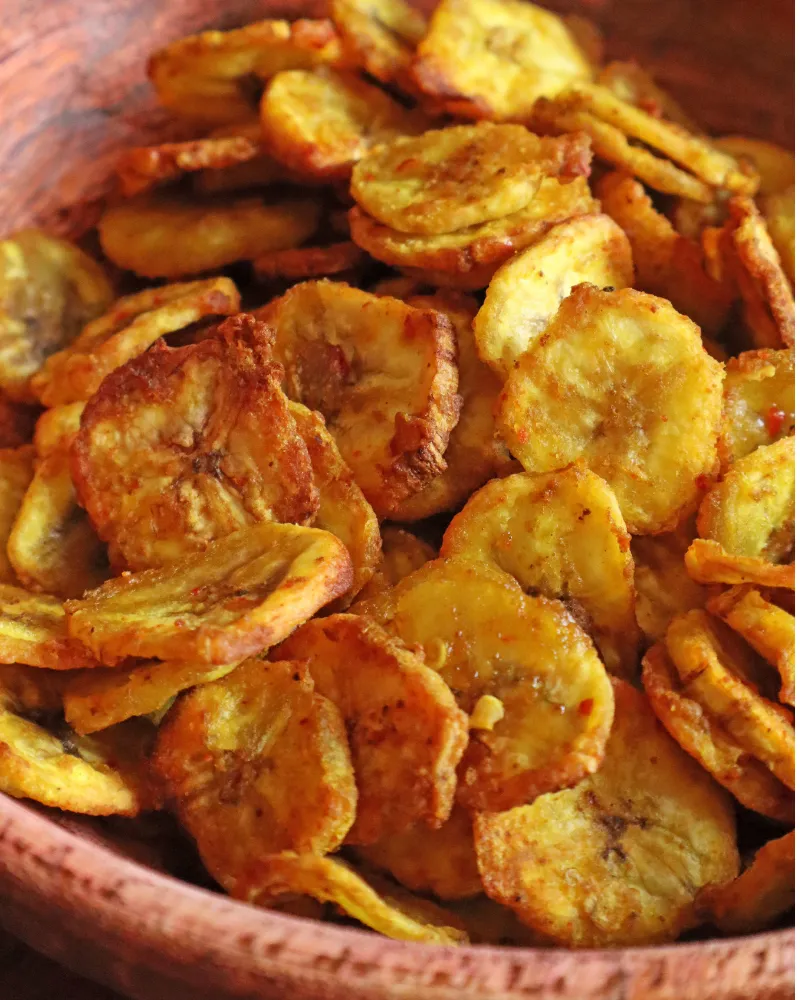
I made these to use up bananas, which turns out to be exactly the wrong reason to make them.
The ones I had were nicely spotted and sweet, the kind you would be pleased to find in the bowl, and after fifty minutes at a low temperature they were dark, sticky, and bendy. Not burnt. Just permanently chewy, like fruit leather that had been cut into circles. I gave them another ten minutes, which made them darker and no crisper.
The problem was not the machine or the time. It was that a spotty banana physically cannot make a crisp chip, and I had picked the worst possible fruit in the house for the job.
Quick answer: Use bananas that are firm and yellow with green at the tips, not soft and not spotted. Slice 1/8 inch thick, dip briefly in lemon water, pat dry, and dry at 225°F for 30 to 40 minutes, turning them once. They are not crisp until they are completely cold, so cool them spread out for fifteen minutes before you judge anything. Spotty bananas make excellent banana bread and terrible chips.
Starch crisps. Sugar chews.
This is the whole page, and I have not found it stated anywhere in the recipes ranking for this term.
A banana changes composition dramatically as it ripens, and it is not a small drift. A green banana is roughly 20 percent starch and 1 or 2 percent sugar. Enzymes inside the fruit spend the ripening period converting one into the other, and by the time it is covered in brown spots those numbers have essentially swapped: about 1 percent starch and 15 to 20 percent sugar.
Those two things behave completely differently when you dry them.
Dries into something rigid
Starch granules swell in heat and moisture and then set as the water leaves, forming a hard glassy network. That network is what you are biting through when a chip snaps. See gelatinization.
Dries into something chewy
Concentrated sugar does not form a rigid structure. It goes soft and pliable, and it is hygroscopic, so it actively pulls water back out of the room.
Sugar browns early
The sugars a ripening banana produces are largely reducing sugars, which darken at much lower temperatures than table sugar does.
Which is why the recipes for this contradict each other. One tells you overripe bananas will not crisp. Another tells you ripe bananas come out crispier. They are both describing something they saw, and neither has the mechanism, so there is no way to tell which advice applies to the fruit currently sitting in your kitchen.
| Banana | Roughly | Dry at | Time | What you get |
|---|---|---|---|---|
| Green, no yellow | 20% starch, 2% sugar | 300 to 325°F | 12 to 16 min | A savory crisp chip, close to a plantain chip |
| Yellow with green tips, firm | Mixed | 225°F | 30 to 40 min | The proper sweet chip. Snaps, tastes of banana |
| Evenly yellow, soft | 15% sugar | 200°F | 45 to 60 min | Sweet, chewy, leathery. Pleasant, not a chip |
| Spotted or brown | 20% sugar | Do not | Not applicable | It will not crisp at any temperature. Make bread |
Notice that the temperature goes down as the fruit ripens. That is not a coincidence. The more sugar in the slice, the lower the heat it can take before browning, so the riper the banana the gentler and longer the dry has to be, and the less likely you are to get a snap at the end of it anyway.
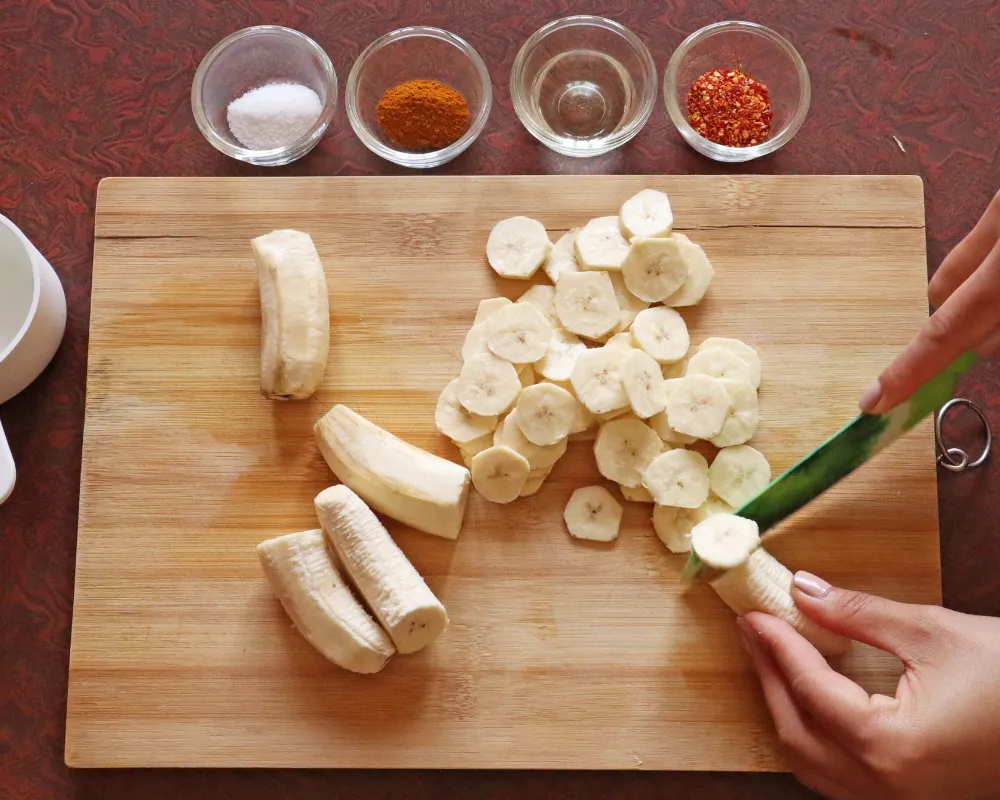
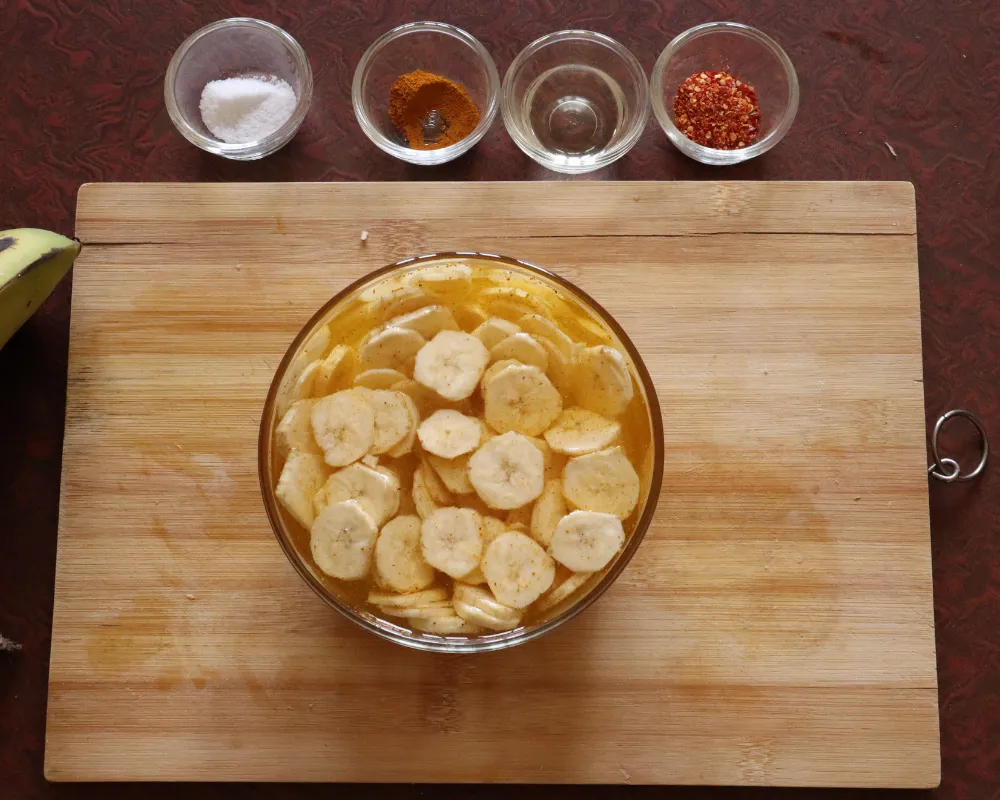
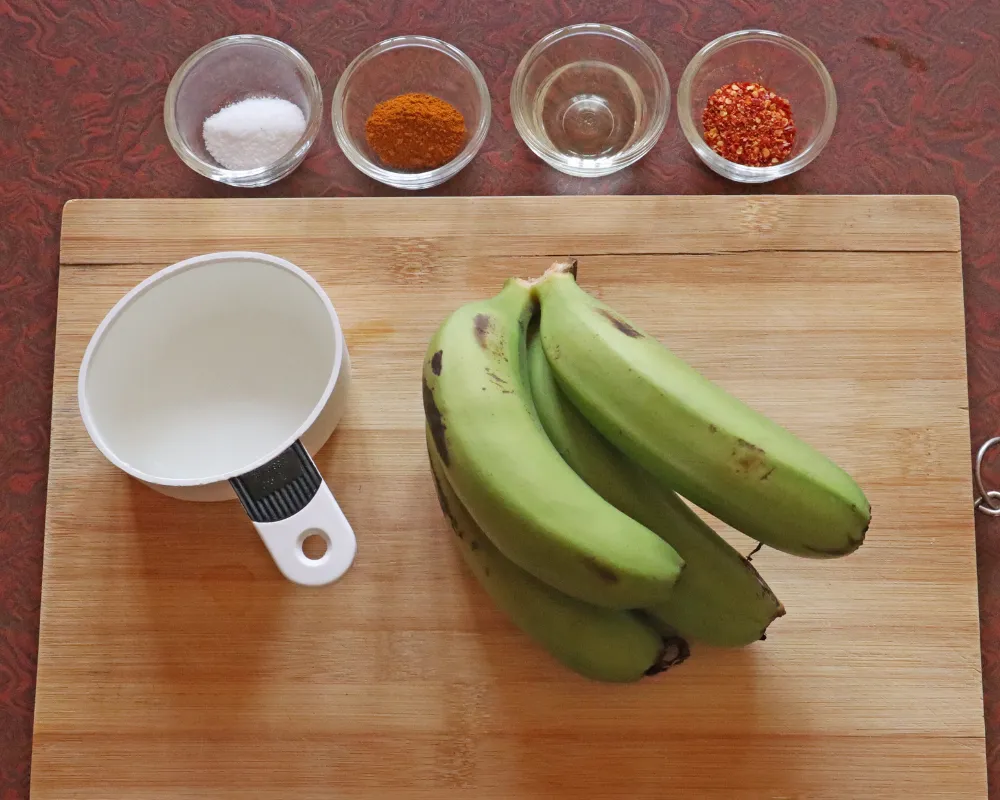
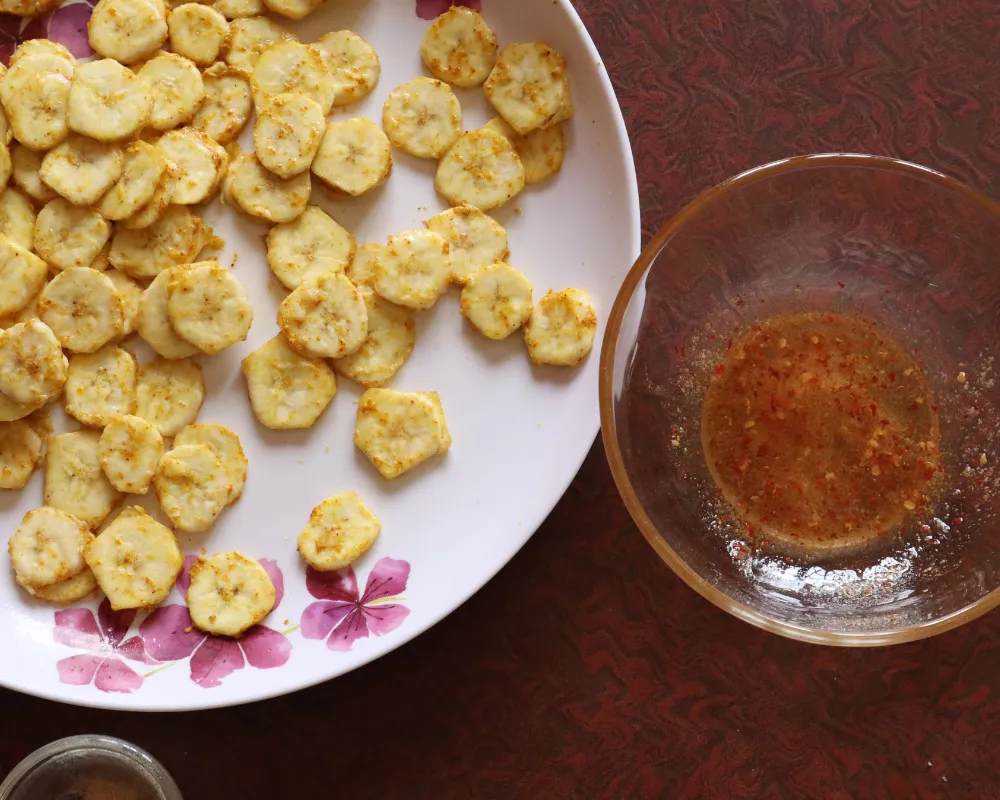
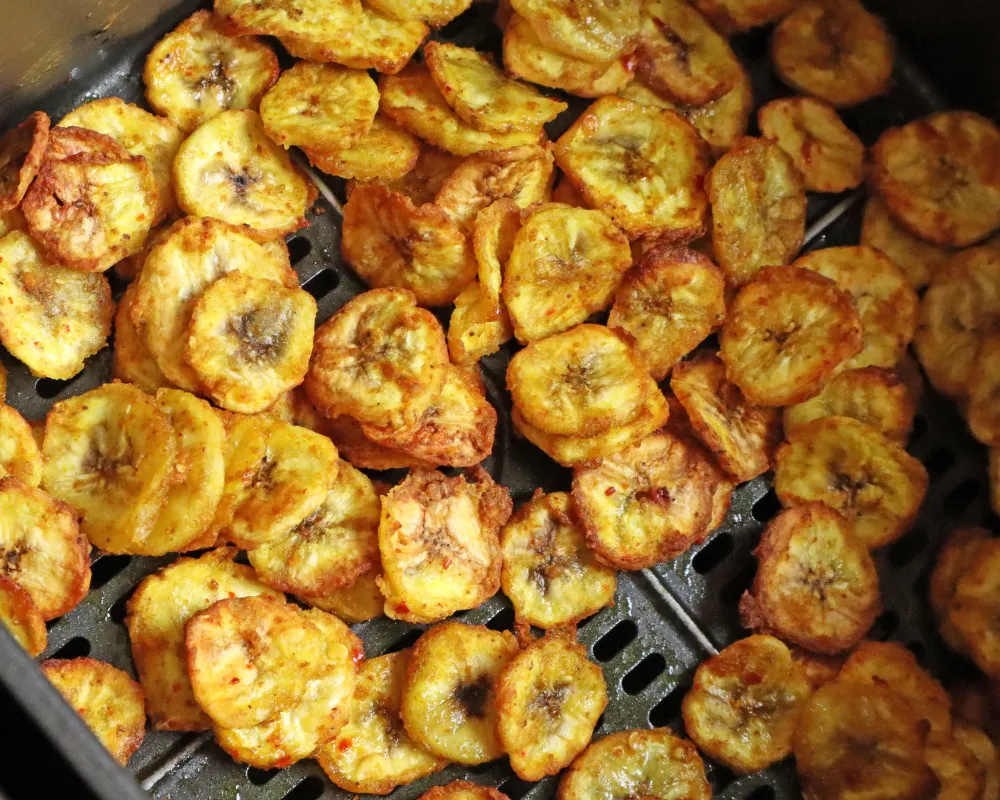
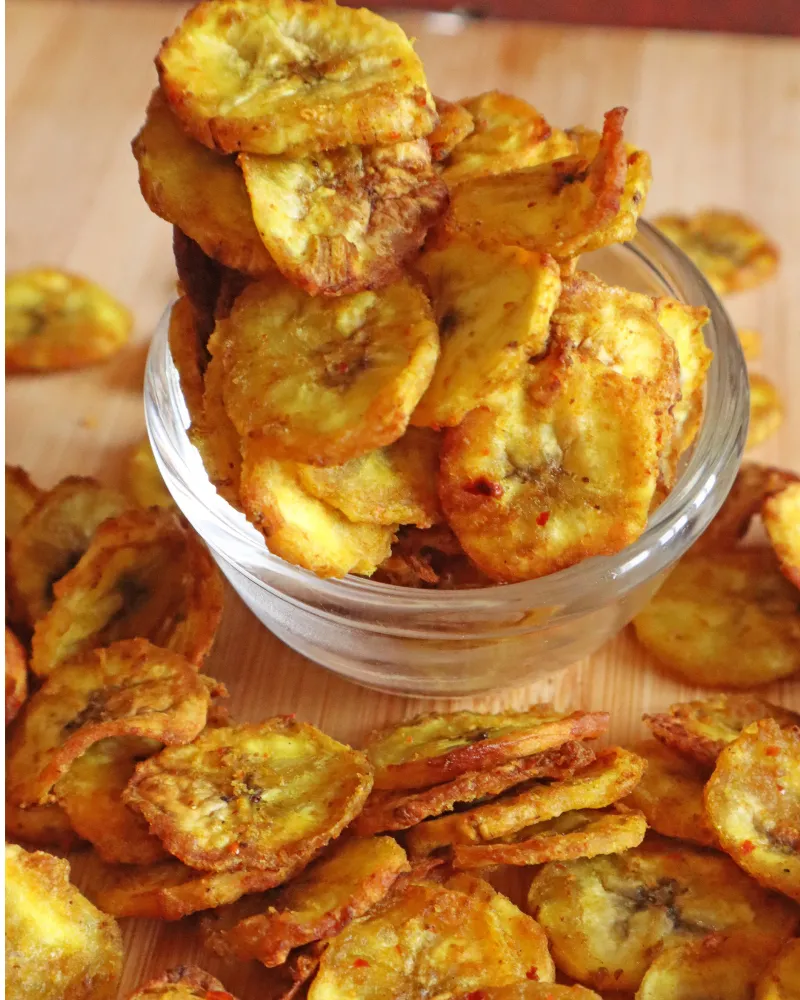
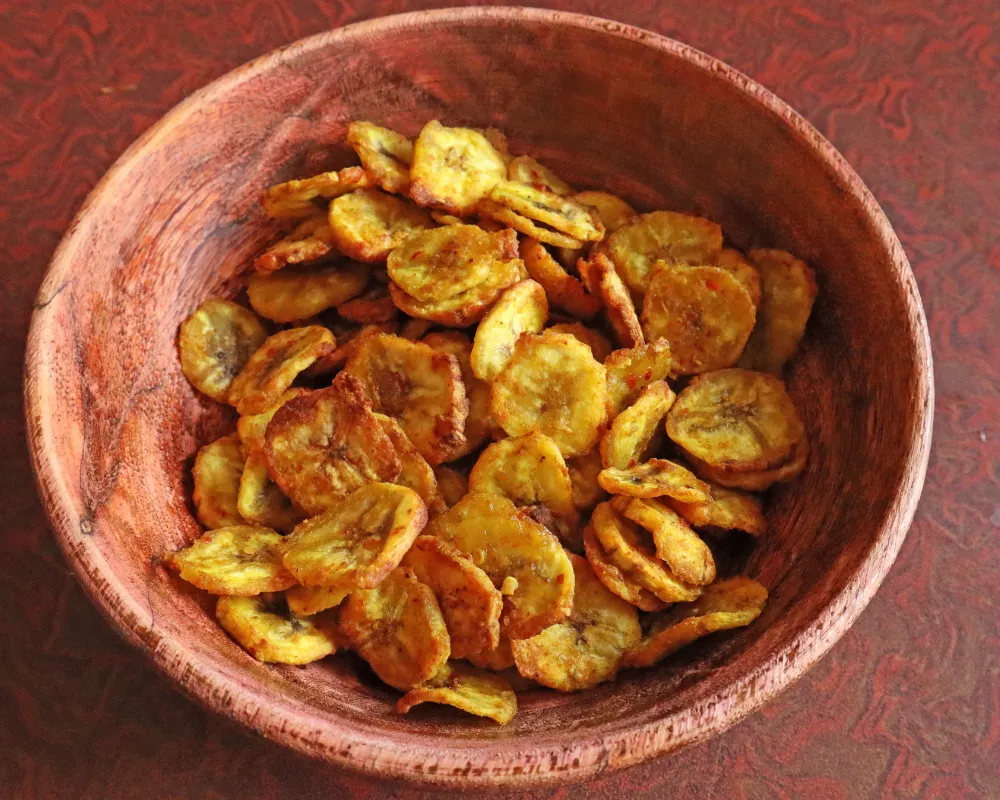
A note on the photographs here. They follow the top row rather than the middle one: fully green bananas, sliced and salted, dried hot and fast into the savory chip that eats closest to a plantain crisp. That is the version worth photographing, because green bananas are the ones you can actually buy on purpose. The written method below is the middle row, the sweet chip, and the two differ in three places: the fruit, the soak, and the temperature. Both are on the table above.
The middle row is what this recipe is written for. It is also the row nobody has in the fruit bowl when they decide to make banana chips, which is the small tragedy of this dish.
There is a useful parallel here with our air fryer apple chips, and a real difference worth understanding. With apples the problem is temperature: apple sugar is mostly fructose and it starts browning around 230°F, so you dry low and slow whatever apple you use. With bananas the temperature matters too, but the raw material matters more, because an apple does not convert its own starch to sugar while it sits on the counter and a banana does.
Three snacks wearing one name
Search this and the results are quietly describing three different foods.
- Plantain chips. Made from green plantains, which are a different fruit that stays starchy far longer than a dessert banana does. Sliced thin, usually fried, salted, savory. Genuinely crisp, and the reason they work is the same starch argument above.
- Dried banana chips. Firm dessert bananas dried slowly until the water is almost gone. Sweet, and crisp if you started with the right fruit. This page.
- Roasted banana slices. Ripe bananas at 350°F for ten minutes. Caramelized, soft, delicious on oatmeal, and not a chip in any sense. Several of the top recipes are actually this, described as chips.
The commercial banana chips in a bag, incidentally, are the first kind rather than the second. They are made from underripe fruit, deep fried rather than dried, and often sweetened with syrup afterwards. That is why they snap so hard, and it is why a homemade dried chip will never be quite that brittle. Worth knowing before you compare yours to the packet.
Why a ripe banana cannot be sliced thin
There is a second, more practical reason ripeness decides this, and you find it out the moment you pick up a knife.
A firm banana slices cleanly into rounds that hold their shape. A ripe one squashes under the blade, so the slices come out uneven and thicker than you wanted, and the thick ones are the ones that stay bendy. A soft banana also tears when you try to lift the slices into the basket, so half of them arrive as fragments.
1/8 inch is the target and it is thinner than it sounds. Thickness matters more than any other number here, because the time it takes heat and moisture to travel through a slice goes roughly with the square of how thick it is. A slice twice as thick does not take twice as long, it takes about four times as long, so a basket of mixed thicknesses gives you burnt thin ones and bendy thick ones at the same moment.
Use a knife rather than a mandoline. This is the opposite of what I say about apple chips, where a mandoline is genuinely necessary, and the reason is that a banana is soft enough that a mandoline compresses it as it cuts and you get squashed ovals rather than rounds. A sharp thin knife and a firm banana will give you better slices than a mandoline will.
Slice on a slight diagonal if you want bigger chips. It gives you more surface per slice and they look better, though they also dry a little faster at the tapered ends.
They glue themselves to the basket
Banana slices stick harder than almost anything else you will dry in an air fryer, and it is worse the riper the fruit is. Sugar that comes to the surface as the water leaves turns tacky, and then it sets against hot metal. Apple slices barely do this. Bananas do it every time.
Three things fix it, and you want all three.
- A light film of oil on the slices, not on the basket. Half a teaspoon tossed through the whole batch. This is one of the few dried fruit recipes on the site where I do use oil, and it is for release rather than for crisping.
- Perforated parchment underneath. Not a solid sheet, which would stop air reaching the underside and leave that face damp. Perforated rounds let air through and stop the sugar meeting metal.
- Turn them at the halfway point, which also breaks any bond that has started to form before it becomes permanent.
Never put a bare sheet of parchment into a preheating basket. An empty sheet weighs almost nothing and the fan will lift it into the heating element, where it scorches and can catch. Preheat the machine empty, then put the parchment in with the banana slices already sitting on it so the weight holds it down. Foil and parchment in an air fryer covers what is safe.
The same weight problem applies to the chips themselves near the end of the dry. A banana slice that has lost most of its water weighs very little, and the fan can lift it. A metal rack or trivet resting on top solves it.
225°F, and why the published times run from 12 to 60 minutes
The recipes for this call for anything from 212°F for forty minutes to 360°F for twelve. That is a spread of nearly 150 degrees for what is supposedly the same snack.
Most of it is the three-different-foods problem above. The 350°F recipes are roasting ripe banana slices and the 212°F ones are dehydrating firm ones, and those are not competing methods, they are separate dishes.
Some of it is the ripeness ladder in the first table, where the correct temperature genuinely moves with the fruit.
Why 225°F for a firm banana. Low enough that the sugars present do not brown before the water has left, high enough that you are not standing there for an hour. A wet surface cannot climb above 212°F while there is still water in it, so for most of the dry the slices sit near boiling regardless of the dial. The dial only starts to matter at the end, once they are nearly dry and the surface is free to climb, and 225°F is a gentle enough setting that the last few minutes cannot run away from you.
If your air fryer will not go below 250°F, and plenty will not, use its lowest setting, cut the time to about 20 minutes, and check every three minutes from minute 15. You will get more color than you want. Some machines have a dehydrate mode running around 130 to 170°F, and if yours does, that is the best tool for this: 3 to 4 hours, and the result is better than anything a normal setting produces.
Converting an oven or dehydrator recipe rather than starting here? Our air fryer calculator does the standard conversion, though for a low-temperature dry like this I would keep the temperature exactly as written and only adjust the time, since the usual drop-25-degrees rule assumes you are cooking rather than dehydrating.
Ingredients
Two bananas, and that really is most of it.
- 2 medium bananas, firm and yellow with green at the tips
- 1/2 teaspoon neutral oil, for release
- A bowl of cold water with 1 tablespoon lemon juice
- Optional: a pinch of salt, or cinnamon, or both
Two notes
- The lemon dip is not optional here the way it is with apples. Cut banana browns faster than almost any fruit, because it has a lot of the enzyme responsible and because the flesh is soft enough that slicing damages a lot of cells at once. Thirty seconds in acidulated water makes a real visible difference. The cost is that you have added water to something whose entire purpose is losing water, so pat both sides properly dry afterwards.
- Salt genuinely helps, even on a sweet chip. A pinch does the same thing it does to caramel, which is make the sweetness read as flavor rather than just sugar. Add it after they come out, while there is still a trace of oil for it to stick to.
How to make them
- Pick the right bananas. Firm, yellow, green at the tips, no spots. If all you have is spotty, stop here and make banana muffins or banana fritters instead, both of which want exactly the fruit this recipe cannot use. This is not a preference, it is the whole recipe.
- Preheat to 225°F for 3 minutes, empty. This is one of the bakes where it genuinely counts, and when preheating matters explains why. No parchment in the basket while it preheats, for the reason in the warning above.
- Peel and slice 1/8 inch thick with a sharp thin knife. Not a mandoline. Aim for even thickness rather than perfect rounds.
- Dip for 30 seconds in the cold lemon water, then lay them on a towel, press another towel on top, and pat firmly dry on both sides.
- Toss with the half teaspoon of oil, gently, so every slice has a film on it. Use your hands.
- Lay them on perforated parchment in a single layer, not touching. Two or three batches in most baskets. Crowding is the fastest way to a chewy tray.
- Weigh them down with a metal rack or trivet, so the fan cannot lift them into the element once they get light. Single layer and held down.
- Dry at 225°F for 30 to 40 minutes, turning them over at the halfway point. They will curl at the edges, which is normal and a good sign.
- Start checking at 30 minutes. A finished slice looks matte rather than glossy, feels dry and stiff on both sides, and has no cool damp patch in the middle. It will still bend a little while hot.
- Cool completely on a rack, spread out and not touching, for at least 15 minutes. They are not crisp until they are cold, exactly as on the apple chips page, and this is the step people skip.
- Test one cold. It should snap. If it bends, everything goes back in for another 5 to 8 minutes, not just that one.
- Season now if you are seasoning. Salt or cinnamon goes on while there is still a trace of oil on the surface for it to stick to. On a completely cold dry chip it slides straight off.
Do not raise the temperature to speed this up. It is the most tempting thing on this page and it does not work. The sugars in a banana brown well below the point where table sugar would, so a hotter setting darkens the outside of the slice while the middle is still wet, and you cannot undo that. If you are short on time, slice thinner or start with a greener banana.
Fixing what goes wrong
| What you got | Why | Fix |
|---|---|---|
| Chewy however long you leave them | The banana was too ripe. There is not enough starch left to build a rigid structure. | Firm and green-tipped. This is the whole page. |
| Bendy, but they were the right bananas | Either not dry enough, or you tested one while it was hot. | Cool one completely and try again before adding time. |
| Dark and bitter at the edges | Temperature too high for the amount of sugar in the fruit. | 225°F for a firm banana, 200°F for a softer one. |
| Some burnt, some raw | Uneven slices. Thickness drives the time more than anything else. | Sharp knife, even 1/8 inch, and no overlapping. |
| Welded to the basket | Surface sugar set against hot metal. | Oil the slices, perforated parchment underneath, turn at halfway. |
| Torn and mangled going in | The bananas were too soft to handle. | Firmer fruit. A ripe banana tears no matter how careful you are. |
| Slices flew up and stuck to the element | They get lighter as they dry and nothing was holding them down. | A rack or trivet on top for the whole time. |
| Crisp at first, soft an hour later | Stored before completely cool, so trapped steam softened them. | Cool fully on a rack, then airtight with the lid on tight. |
| Brown and unappetizing | Enzymatic browning from cut banana meeting air. It happens fast. | A 30 second lemon water dip, then pat very dry. |
If burning is a pattern across different foods rather than just here, thin light items are always the first to go: how to prevent burning in an air fryer covers it, and the troubleshooting guide has the rest. If crispness in general is the thing you are chasing, how to get things crispy in an air fryer is the broader argument.
Uses and variations
- Cinnamon. A quarter teaspoon dusted on before drying. It sticks to a damp slice without any help and it does not burn at 225°F.
- Salted. A pinch of flaky salt as they come out, while the oil film is still there to catch it.
- Chili and lime. Chili powder before, lime zest after. Closer to a plantain chip and very good.
- Chocolate dipped. Half of each cold chip into melted dark chocolate, set on parchment. They have to be properly crisp first or the moisture will seize the chocolate.
- Green plantain chips. The savory version. Green plantain sliced thin, oiled, salted, 325°F for 12 to 16 minutes, tossed once. A genuinely different snack and easier to get crisp than a dessert banana, for all the reasons above.
- Blitzed into powder. A few chips in a spice grinder gives you banana powder, which is lovely stirred into oatmeal or a smoothie.
- On top of things. Yogurt, granola, overnight oats. They soften within a couple of minutes on anything wet, so scatter them at the table rather than in the kitchen.
If crisp things from a basket are the general idea, the same cool-to-crisp and single-layer logic runs through air fryer potato chips, which are the purest version of the starch argument on this site, plus tortilla chips, pasta chips and potato peels. For fruit treated the other way, soft and warm rather than dry, there are air fryer baked apples and air fryer apple fries.
Storage, and why they go soft
Banana chips have one enemy and it is humidity, and they are worse for it than apple chips are, for the reason this page has been about all along. Concentrated sugar is hygroscopic, which means it actively pulls moisture back out of the air, and a banana chip carries more sugar than almost anything else you would dry.
- Cool completely first. Not almost. A chip that goes into a container even slightly warm releases steam into a sealed box and softens the whole batch overnight. This is the single most common storage mistake.
- Airtight, at room temperature: 4 to 5 days. Less than the two weeks you get from apple chips, and the sugar is why.
- Do not refrigerate. A fridge is cold and humid, which is exactly wrong. They will be soft in a day.
- A silica gel packet from a vitamin jar, dropped into the container, genuinely extends their life. Not essential, but it works.
- Re-crisp if they soften: 8 minutes at 225°F, then cool completely again. This works well and you can repeat it.
- Freezing: not worth it. They come out of the freezer damp and they never recover.
Half an hour of air fryer time is more than most snacks here, so it is fair to ask whether this is worth running the machine for. The running cost calculator will give you the number for your electricity rate, and against an oven held at 225°F for the same half hour the air fryer wins comfortably on a small batch. If you are scaling up for a crowd, the recipe scaler handles it, though the honest answer is that more bananas means more batches rather than a fuller basket. The pan size calculator will tell you what your basket floor actually measures if you have never checked, and all four air fryer tools are in one place.
Every temperature on this page sits in the site-wide reference at the air fryer baking chart, and the guides index covers the technique behind all of it. For the wider question of which foods a basket can dry, roast or bake at all, there is what you can and cannot bake in an air fryer.
Frequently asked questions
QWhy are my air fryer banana chips not crispy?
Most likely the bananas were too ripe, and no amount of extra time will fix that. A green banana is about 20 percent starch and 1 or 2 percent sugar, and by the time it is covered in spots those numbers have essentially swapped. Starch dries into a rigid glassy structure that snaps. Concentrated sugar does not, it goes soft and pliable and it pulls moisture back out of the air. So a spotty banana cannot make a crisp chip whatever you do. Use fruit that is firm and yellow with green at the tips. The other possibility is that you tested one while it was still hot, since these only turn crisp as they cool.
QWhat ripeness of banana should I use for banana chips?
Firm and yellow with a little green still at the tips, and no brown spots at all. That is the point where there is still enough starch left to set into something rigid, and enough sugar for it to taste like a banana. Green bananas make an excellent savory chip closer to a plantain chip, and they will take a much higher temperature because there is little sugar to burn. Fully yellow soft bananas make a sweet chewy strip rather than a chip. Spotted bananas will not crisp at any temperature, so use those for banana bread or muffins instead.
QWhat temperature and how long for banana chips in an air fryer?
225F for 30 to 40 minutes for 1/8 inch slices of firm banana, turning them once, then cooling completely. Published recipes range from 212F for 40 minutes up to 360F for 12, which sounds like chaos and mostly is not: the hot fast ones are roasting ripe banana slices, which is a soft caramelized topping rather than a chip, and the low slow ones are dehydrating. The correct temperature also shifts with ripeness, because a riper banana has more sugar and browns sooner. Green bananas take 300 to 325F, firm ones 225F, soft ones 200F.
QWhy do my banana chips stick to the air fryer basket?
Because sugar comes to the surface as the water leaves, turns tacky, and sets against hot metal. Banana does this far more than apple does, and the riper the fruit the worse it gets. Three things together solve it. Toss the slices in about half a teaspoon of neutral oil so every one has a film on it, which is for release rather than for crisping. Lay them on perforated parchment rather than straight on the crisper plate, since perforated lets air reach the underside while a solid sheet would leave that face damp. And turn them at the halfway point, which breaks any bond that has started to form.
QAre banana chips and plantain chips the same thing?
No, and a lot of the confusion in the search results comes from treating them as one recipe. Plantains are a different fruit that stays starchy far longer than a dessert banana, so they are used green and they crisp readily, which is exactly the starch argument this page is built on. Plantain chips are savory, salty and usually fried. Dried banana chips are sweet and made from firm dessert bananas. Both work in an air fryer, but at different temperatures: plantains around 325F for 12 to 16 minutes, dessert bananas at 225F for 30 to 40.
QDo I need to soak banana slices in lemon juice?
It helps more here than it does with apples, and it is worth the thirty seconds. Cut banana browns extremely fast, both because it carries a lot of the enzyme responsible and because the flesh is soft enough that slicing damages a great many cells at once. A brief dip in cold water with a tablespoon of lemon juice makes a visible difference to the finished color. The honest cost is that you have just added water to something whose whole purpose is losing water, so pat both sides properly dry afterwards and expect a couple of extra minutes of drying time.
QShould I use a mandoline to slice bananas?
No, which is the opposite of what I would tell you for apple chips. A mandoline works by pressing food against a blade, and a banana is soft enough that the pressure squashes it as it cuts, so you get compressed ovals rather than clean rounds. A sharp thin knife and a firm banana will give you better and more even slices. Aim for 1/8 inch. Thickness matters more than any other variable, because the time heat takes to travel through a slice goes roughly with the square of how thick it is, so a mixed basket gives you burnt thin ones and bendy thick ones at the same moment.
QCan I use the dehydrate setting on my air fryer?
If you have one, use it, and it will give you the best result on this page. A dehydrate mode is usually a low temperature, often around 130 to 170F, with the fan running continuously, and it will produce excellent banana chips in 3 to 4 hours. It is much slower than 225F but far gentler on the sugar, so there is essentially no risk of browning and you get a paler, cleaner tasting chip. If your machine does not have one, 225F on the normal setting does the same job in well under an hour, which is why the recipe here is written that way.
QWhy did my banana chips go soft after a day?
Two usual causes. Either they went into the container before they were completely cool, in which case trapped steam softened the whole batch overnight, or the container is not properly airtight. Concentrated sugar is hygroscopic, meaning it actively pulls moisture out of the air, and a banana chip carries more sugar than most things you would dry, so it goes soft faster than an apple chip does. Expect 4 to 5 days at room temperature in a jar with a good seal, rather than the couple of weeks apple chips manage. A silica gel packet from a vitamin jar genuinely helps.
QCan I make banana chips without oil?
You can, and they will dry perfectly well, but they will stick badly. The half teaspoon of oil in this recipe is not there for crispness, which is unusual for an air fryer recipe: the crisp comes from removing water, and oil actually slows evaporation slightly. It is there purely so the sugar coming to the surface has something between it and the hot basket. If you want to skip it, use perforated parchment underneath and accept that you will lose a few chips to the tray. Do not substitute a heavy coating of oil for the parchment, because that does slow the drying noticeably.
QMy slices flew up and stuck to the heating element. How do I stop that?
Put a metal rack or trivet on top of them. A banana slice that has lost most of its water weighs almost nothing, and an air fryer fan moves a lot of air, so the risk goes up over the drying time rather than down. Anything oven safe and heavy enough works as long as it is not solid, since air still needs to reach the slices, which makes a small cooling rack ideal. Do not remove it partway through because they seem settled. The same rule applies to the parchment underneath: never put a bare sheet into a preheating basket, because the fan will lift it into the element.
QAre homemade banana chips as crunchy as the ones in a bag?
Not quite, and it is worth saying so rather than pretending. Commercial banana chips are made from underripe fruit and deep fried rather than dried, and many are coated in syrup afterwards, which is why they snap so hard and taste so sweet. A dried chip made at home from a firm banana will snap cleanly and taste much more of actual banana, but it will be a little less brittle and a lot less sweet. If you want something closer to the packet, use a greener banana and slice it as thin as you can manage.
Never overbake again
Get our one-page times & temps cheat sheet, plus a new tested recipe each week.
No spam · unsubscribe anytime