
Air Fryer Bagels: Chewy Crust Without Boiling First
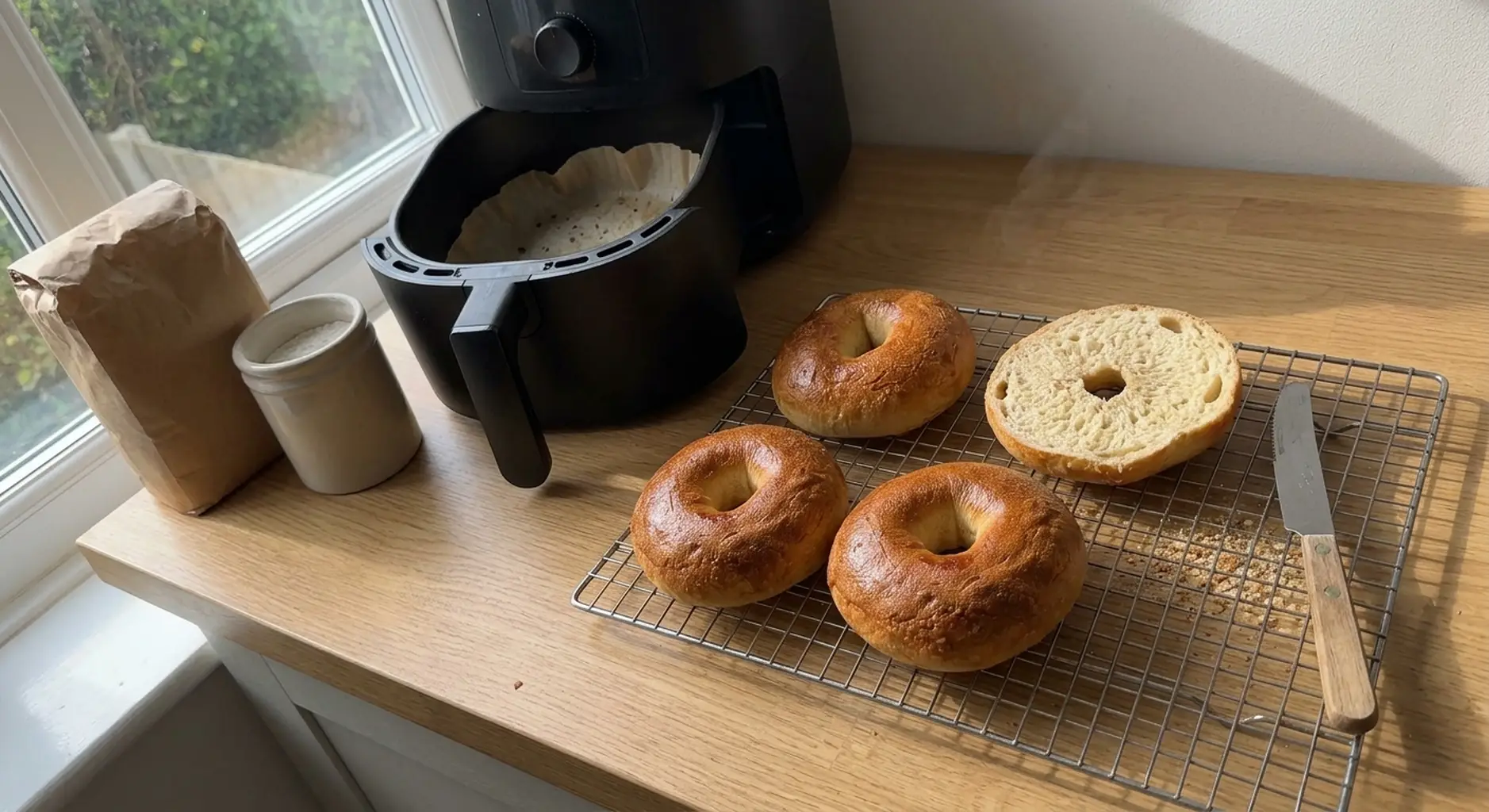
Almost every air fryer bagel recipe on the internet is Greek yogurt and self-rising flour shaped into a ring, and not one of them mentions the word boiling, which is strange, because boiling is the entire reason a real bagel chews. This page takes the question seriously. The chew gets built in a stiff yeast dough that takes six minutes of honest kneading, and the boil gets replaced by the one part of it that matters at this scale: a honey glaze that sets the crust glossy and tight. Four bagels, 330°F, 11 to 13 minutes, no pot of water anywhere.
What’s on this page
What boiling does, and what replaces it
A bagel shop boils its bagels for thirty to sixty seconds before baking, and that dunk does three jobs at once. It gelatinizes the starch on the surface, which dries into the tight, glossy skin that makes a bagel chew instead of tear. It sets the outside early so the bagel cannot puff into a dinner roll in the oven. And the malt syrup in the water paints on color and a faint sweetness.
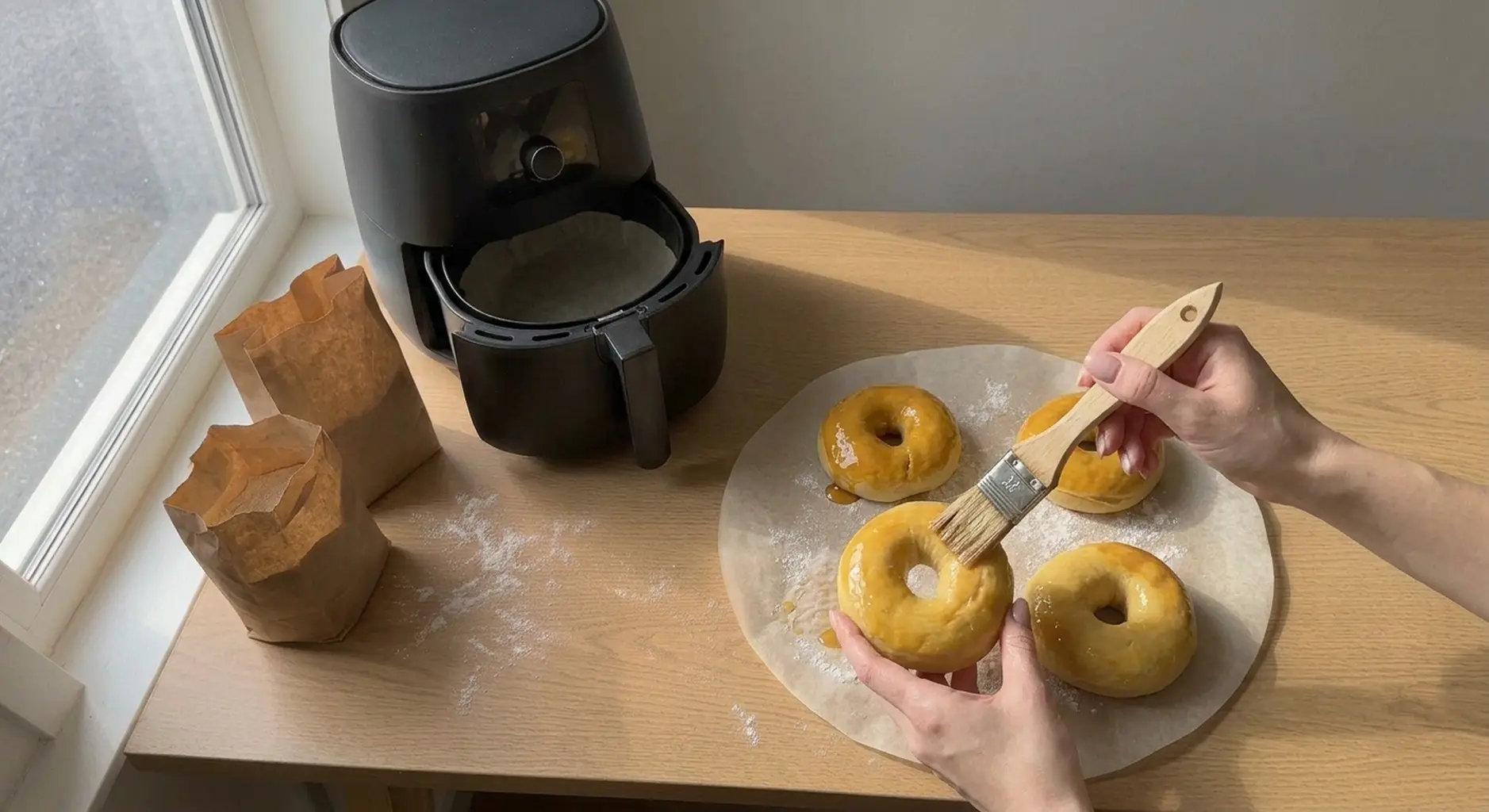
Skip the boil and do nothing else, and you get exactly what you would expect: bread in a ring. If the basket itself is new to you, how to bake in an air fryer covers the ground rules this page assumes. So this recipe does not skip it and do nothing else. It replaces each job. The tight skin comes from a honey glaze brushed over every surface just before baking, a thin coat of sugared water that gelatinizes and sets the same way the boil's does, only thinner. The early set comes from the air fryer itself, whose close element crusts a surface faster than any home oven. And the color and sweetness come from the honey, standing in for malt the way it does in most home bagel recipes anyway.
Honesty requires one sentence here: a boiled bagel is still the better bagel, and the day you feel like managing a pot of simmering water, boil these very rings for 30 seconds a side and bake them the same way. This page exists for the other 51 weeks of the year. The glaze gets you most of the chew and all of the shine for none of the fuss, and it beats every unboiled, unglazed recipe currently ranking for this by the width of an actual crust.
Chew is built in the dough
The crust is only half a bagel. The other half is the interior chew, and that is decided before the machine ever turns on, by three choices the yogurt-dough recipes cannot make.
Bread flour, not all-purpose. Chew is gluten, gluten is protein, and bread flour carries 2 to 3 percent more of it. In a cake that difference would be a flaw. In a bagel it is the point.
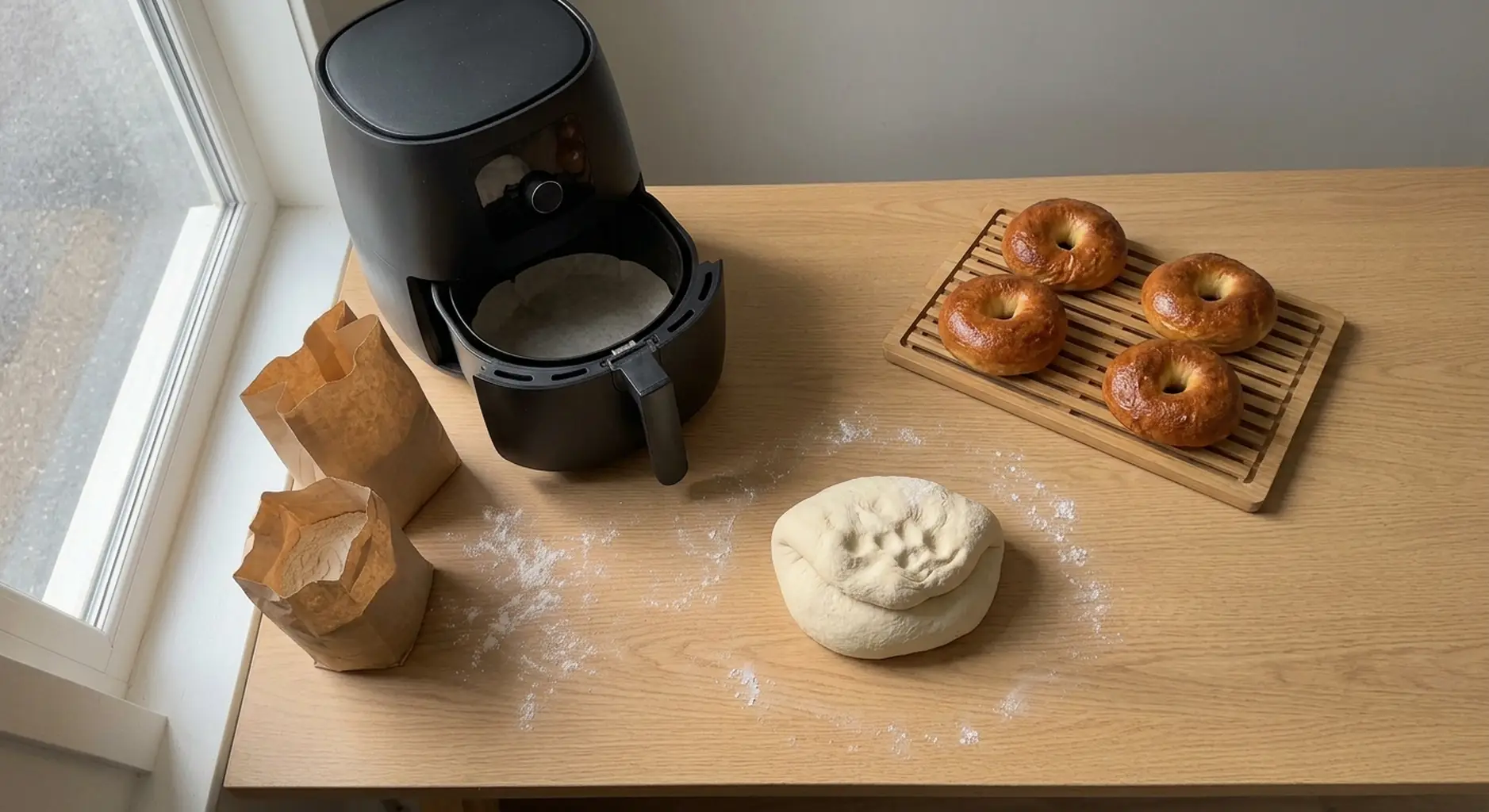
A stiff dough. This recipe runs at 58 percent hydration, which is the opposite end of the dough spectrum from the wet, slack breads that need no kneading, like focaccia at 79 percent or our no-knead loaf. Stiff dough resists the teeth; that resistance is what your jaw registers as bagel. If the dough feels firmer than any bread dough you have handled, it is right.
Real kneading. Wet doughs let time build their gluten. A 58 percent dough gives time nothing to work with, so the six minutes of kneading in this recipe cannot be skipped or shortened. It is the only bread on this site that makes you earn it; our loaf and garlic knots both ask less of your forearms. Six minutes, smooth and tight, and the dough should fight back when you press it.
The two ingredient bagel, honestly
Nearly everything that ranks for air fryer bagels is the two ingredient dough: Greek yogurt and self-rising flour, shaped into rings, brushed with egg, baked. It deserves a fair description rather than a dismissal. It is fast, it is genuinely useful when there is no time for a rise, the protein numbers please a lot of people, and it makes a pleasant, tender, slightly tangy roll with a hole in it.
What it does not make is a bagel. There is no yeast, so there is no fermentation flavor. There is no gluten development, because baking powder doughs are mixed gently and baked immediately, so there is nothing for your teeth to argue with. The crust is soft because nothing set it. One of the ranking pages describes its own result as soft and biscuit-like, which is the honest phrase for the whole genre. If that is what you want this morning, it is a fine thing to want. If the word that brought you here was chewy, the yogurt dough cannot get you there, and no topping or egg wash will change that. The recipe below costs you a rise and six minutes of kneading, and it pays you back in the only currency a bagel deals in.
Rope or poke
Bagel shops roll each portion into a rope and seal it into a ring around the palm. It is the professional method because it builds a fine, even spiral of tension through the whole ring. It is also the method where beginners produce four rings with four different holes, seams that open in the bake, and one bagel that is secretly a knot.
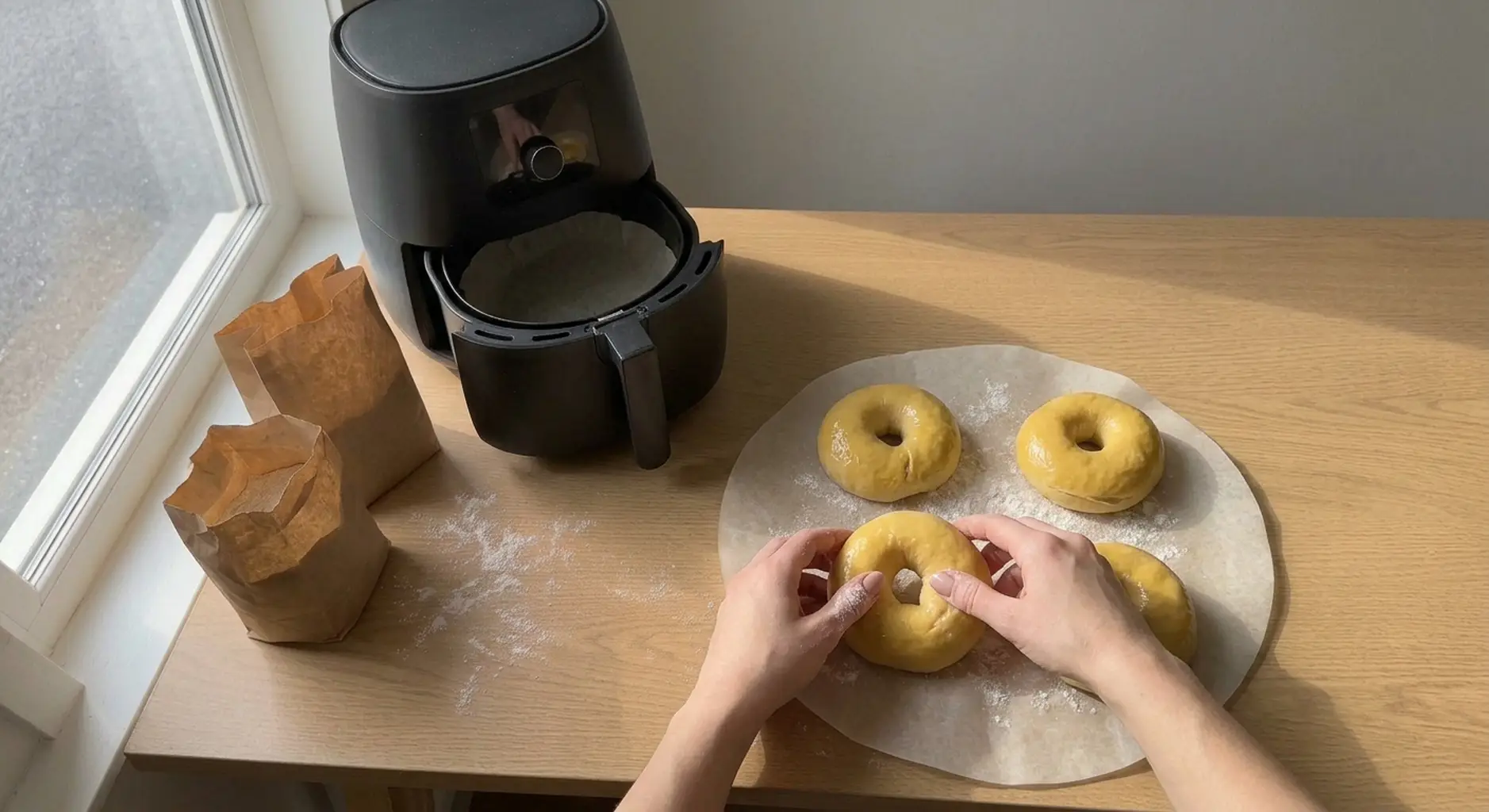
Use the poke. Roll each portion into a tight, smooth ball, rest it five minutes so the surface relaxes, then push a floured thumb straight through the center and stretch the hole to about 2 inches, turning the ring like a steering wheel. The hole looks comically large; it is supposed to. Proofing and oven spring will close it to half that, and a bagel that goes in with a modest hole comes out with a dimple. The ring shape is also quietly the reason bagels suit a basket so well: like a tube pan, a ring has no center to stay raw, so a dense dough that would sulk in the middle as a bun bakes through evenly as a bagel.
Temperature and timing
Bagels bake hot in an oven, 425 to 450°F, and our oven-to-air-fryer calculator would convert that to roughly 400°F. This recipe runs far below the conversion, at 330°F for 11 to 13 minutes, for a reason the calculator cannot see: the glaze. A honeyed surface inches from the element browns at nearly twice the pace of plain dough, and at 400°F the crust is mahogany by minute six while the dense interior is still climbing through the 160s. At 330°F the glaze reaches deep gold in the same window the crumb needs to finish, and the two arrive together.
The rings bake on a parchment round cut smaller than the basket floor, no flip at any point, because a flip would land the seeds face down and sand them off against the plate. Bottoms brown fine through parchment on a ring this lean; the liner rules are in the foil and parchment guide. Preheat 3 minutes at 330°F, which matters more than usual here, because a dense dough hitting a cold basket spends its oven spring warming the machine instead of rising; the general rules are in do you need to preheat an air fryer for baking. Four bagels fit a 5 to 6 quart basket in one round. The full settings library lives on the baking chart.
What done looks like
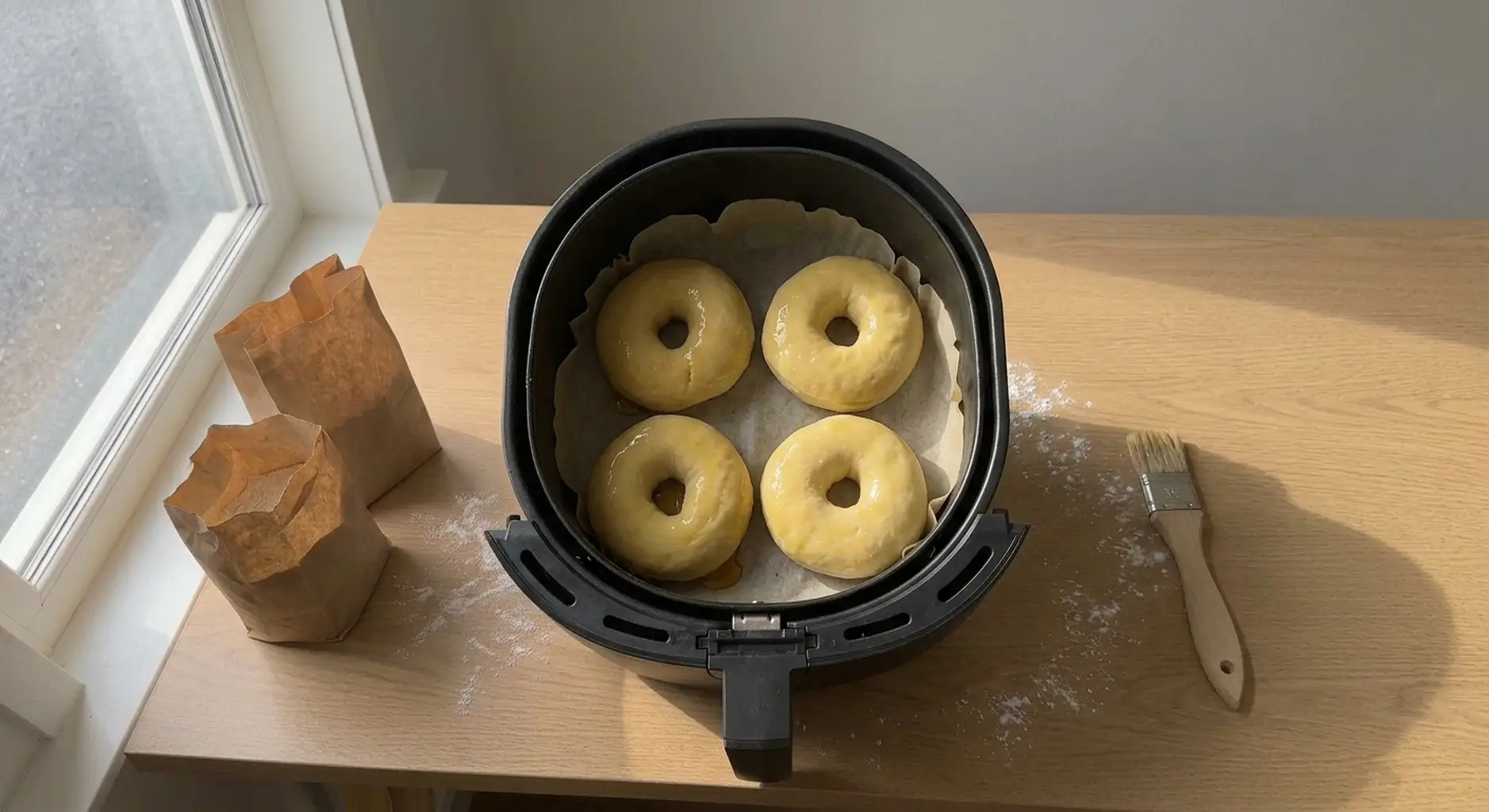
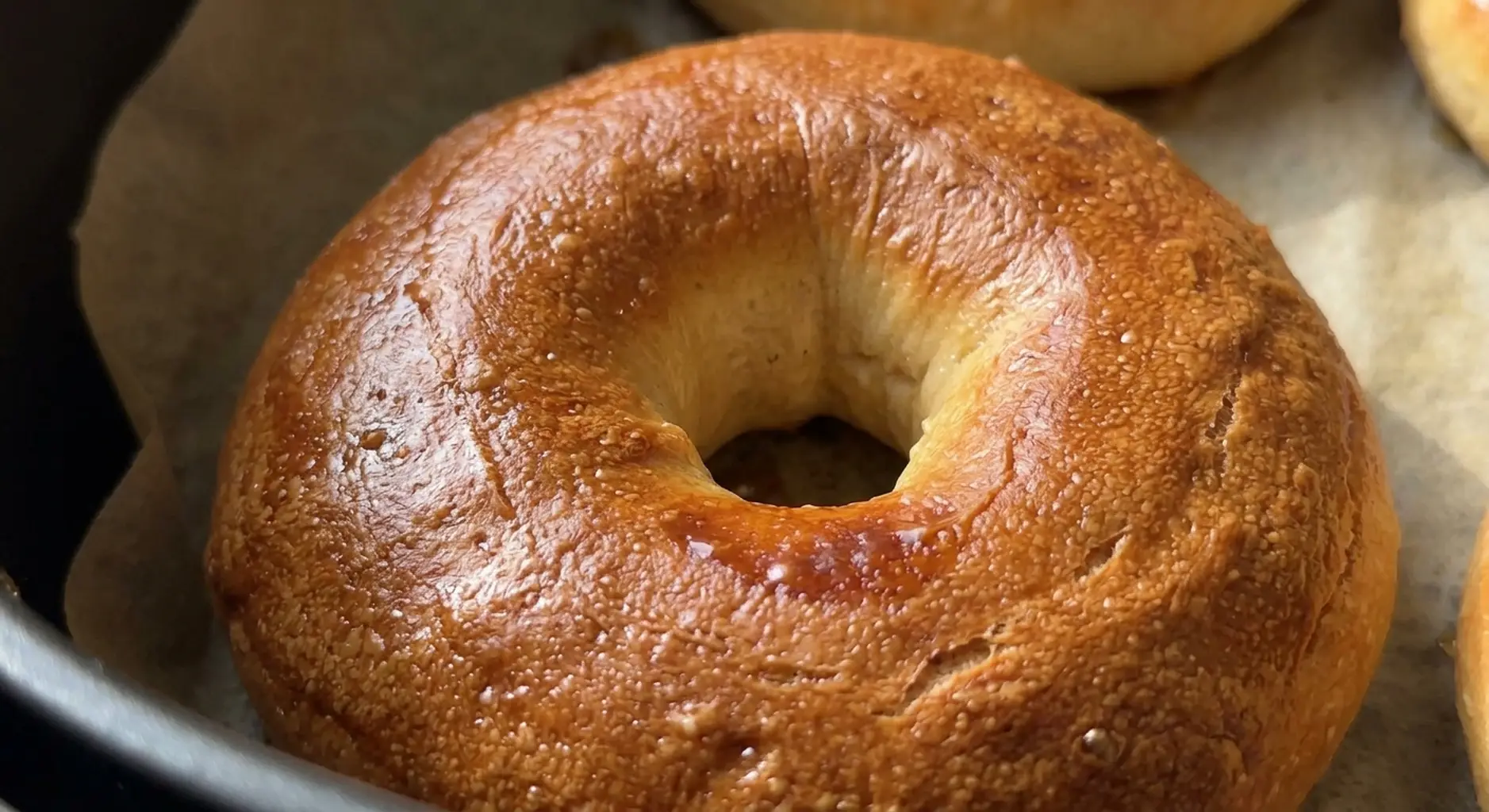
- The crust is deep golden with a gloss to it, noticeably darker where the glaze pooled at the base of the hole.
- The center reads 195 to 200°F on a probe pushed in through the side. Dense doughs finish high, and not one page ranking for this recipe offers a number; below 190°F the crumb inside is gummy no matter how finished the outside looks.
- The weight is right when a bagel feels solid but not heavy for its size, and the base knocks hollow-ish rather than thudding.
Then the hard part: 15 minutes on a rack before slicing. A bagel cut hot smears instead of slicing and reads gummy even when it is perfectly baked. The crumb sets as it cools, and the chew you built over the last two hours arrives in the last fifteen minutes.
Ingredients
For 4 bagels
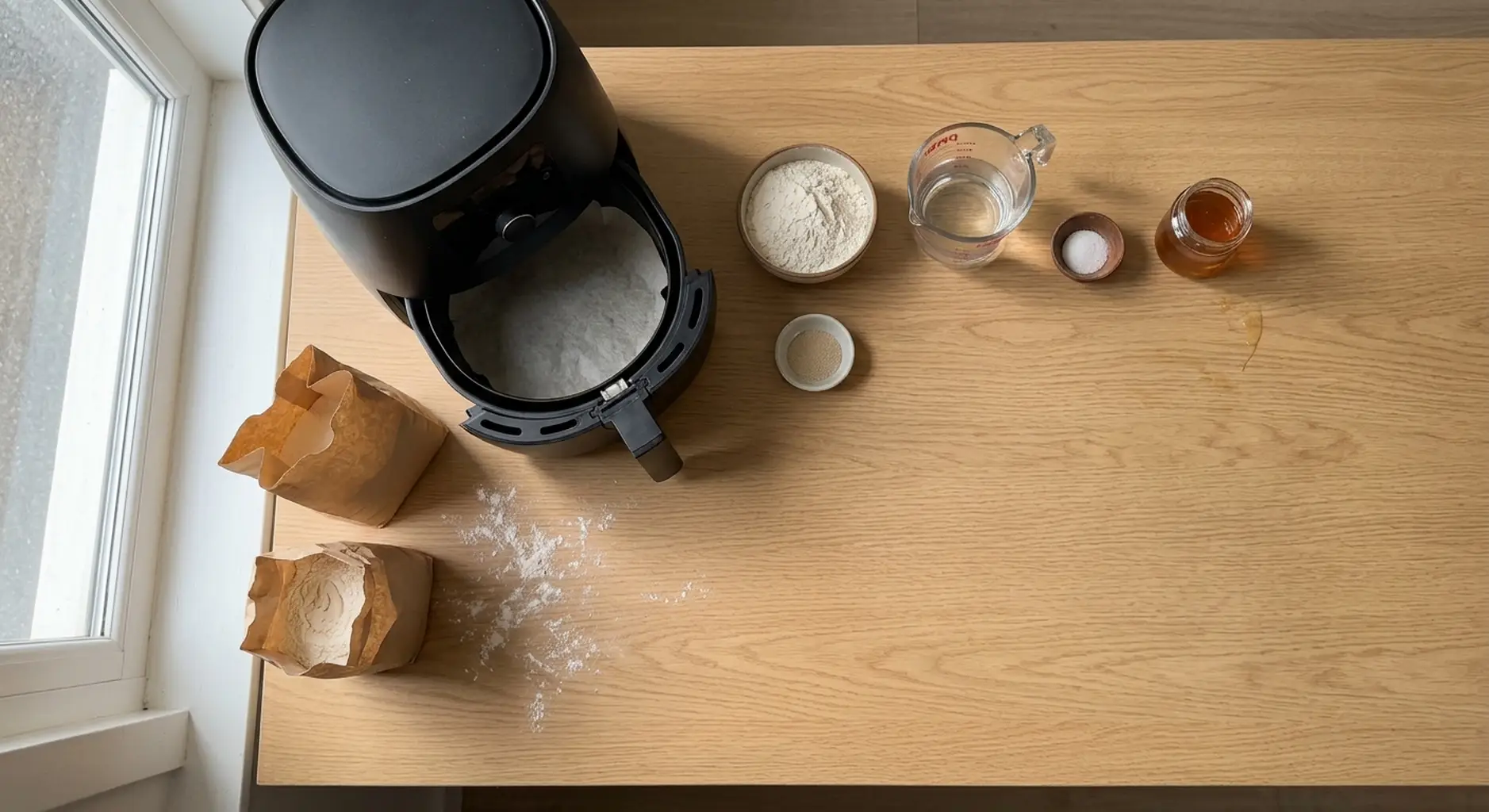
- 2 cups (250g) bread flour
- ½ cup plus 2 tablespoons (145ml) warm water, about 105°F
- 1 teaspoon instant yeast
- 1 teaspoon fine salt
- 1 tablespoon honey, for the dough
- Glaze: 1 tablespoon honey dissolved in 2 tablespoons hot water
- Optional: 2 tablespoons everything seasoning, sesame, or poppy seeds
Bread flour is the one ingredient with no good substitute here; all-purpose bakes a softer, breadier ring. Active dry yeast works in place of instant: dissolve it in the warm water for 5 minutes first.
How to make them
- Stir the flour, yeast, and salt together, then add the warm water and honey and bring it together into a stiff, shaggy dough.
- Knead 6 minutes until smooth and tight. This dough is meant to feel firmer than any bread dough you have made; do not add water to make it friendlier.
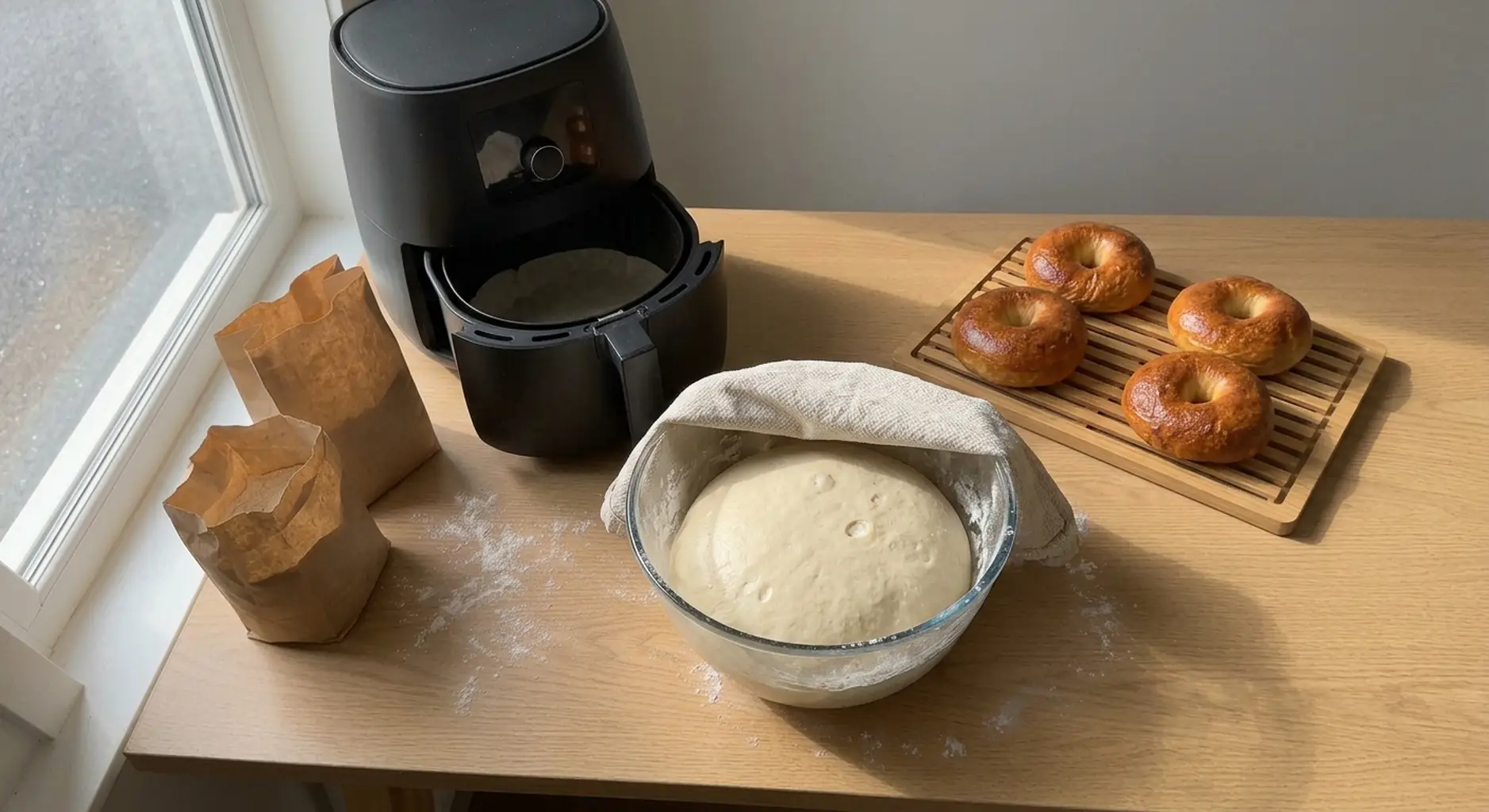
- Cover and let it rise 60 to 90 minutes, until nearly doubled.
- Divide into 4 pieces, roll each into a tight ball, and rest the balls 5 minutes under the towel.
- Push a floured thumb through the center of each ball and stretch the hole to about 2 inches, turning the ring as you go.
- Set the rings on a parchment round and rest 15 minutes while the air fryer preheats at 330F for 3 minutes.
- Stir the honey into the hot water and brush every surface of every ring, then press on seeds if using.
- Air fry on the parchment at 330F for 11 to 13 minutes, no flipping, until deep glossy gold and 195 to 200F in the center.
- Cool 15 minutes on a rack before slicing. A hot bagel cuts gummy; a rested one chews.
Fixing what goes wrong
| Problem | Cause | Fix |
|---|---|---|
| Soft, bready, no chew | All-purpose flour, wet dough, or shorted kneading | Bread flour, resist the urge to add water, and the full 6 minutes |
| Holes closed completely | Stretched too timidly | 2 inches at shaping; it should look like too much |
| Dull, matte crust | Glaze skipped or applied only to the tops | Every surface, including the inside of the hole; the glaze is the boil's stand-in |
| Dark crust, gummy center | Temperature too high for a honeyed surface | 330°F, and verify 195°F inside before pulling them |
| Seeds scorched or blown loose | Loose seeds in a fast airstream | Press them into the wet glaze firmly; the mechanism is in how to prevent burning |
| Flat rings that spread | Overproofed at the second rest | 15 minutes on the parchment, not 45; a stiff dough proofs slower than it looks |
Toppings that survive the fan
- Everything seasoning. The classic, and the riskiest, because dried garlic and onion sit right at the edge of scorching. Press it firmly into the glaze and hold to the 330°F ceiling and it lands toasted, not burnt.
- Sesame or poppy. The most forgiving. Glaze, press, bake.
- Flaky salt. A pinch over the glaze for the pretzel-adjacent version. Speaking of which, the true alkaline-crust project in a basket is soft pretzels, this bagel's older cousin, and worth making the same weekend.
- Cheese. Grated hard cheese in the last 4 minutes only. Earlier, it browns past savory.
- Cinnamon raisin. Knead 1/3 cup raisins and 1 teaspoon cinnamon in at the end of the kneading, and skip the seeds. Glaze as usual.
Serving, storage, leftovers
A warm bagel needs nothing but cream cheese and the restraint to stop at two. Beyond that it is a sandwich platform without equal: air fryer bacon and a fried egg from the bacon and eggs method make the breakfast version out of one machine in two rounds, and half a smashed avocado turns it into the bagel edition of avocado toast. For the softer end of the breakfast bread shelf there are english muffins and dinner rolls.
Storage: airtight at room temperature for 2 days. Bagels stale fast and honestly; that is the price of a lean, chewy crumb. Freeze them the day they are made, pre-sliced, up to 3 months, and toast from frozen; a frozen-then-toasted bagel beats a day-two counter bagel every time. Revive a staling whole bagel at 330°F for 2 to 3 minutes, and it comes back close to fresh once.
Doubling the batch is two rounds of four, not eight crowded rings; the recipe scaler resizes the dough if you want a bigger or smaller run. Everything tested on this site is in the recipe index, and the technique pages are under guides.
Frequently asked questions
QDo you really not need to boil bagels before air frying?
You do not need to, and you should know what the trade is. Boiling gelatinizes the surface starch into the tight, glossy skin that defines a bagel's chew, and the honey glaze in this recipe does the same job in a thinner layer, while the air fryer's close element handles the early crust-set that boiling also provides. The result is most of the chew and all of the shine for none of the pot. If you ever want the last few percent, boil these exact rings 30 seconds per side in water with a spoonful of honey, then glaze and bake exactly as written.
QCan I use the two ingredient Greek yogurt dough instead?
You can, and it will be ready an hour and a half sooner, and it will not be chewy. Yogurt dough is leavened with baking powder and mixed gently, so it develops no gluten and no fermentation flavor; it bakes into a tender, slightly tangy roll with a hole in it, which is a fine breakfast and a different food. This page exists specifically for the chew, and the chew requires yeast, bread flour, and the six minutes of kneading. Choose by the morning you are having.
QWhy are my air fryer bagels dense instead of chewy?
Dense and chewy are neighbors, and the line between them is fermentation. If the crumb is tight, heavy, and dull, the first rise was cut short or the kitchen was cold; give the dough the full 60 to 90 minutes and judge by size, nearly doubled, not by the clock. Old yeast does the same thing quietly, so if a packet has been open for months, test it in the warm water first: no foam in ten minutes means it is retired. Chewy fights back and then yields. Dense just fights back.
QWhy did my bagels come out like bread rolls?
Softness is a hydration and flour story. All-purpose flour, extra water kneaded in because the dough felt too stiff, or a glaze that got skipped all push the result from bagel toward roll. The stiffness that feels wrong while you knead is the recipe working; a proper bagel dough at 58 percent hydration should feel like modeling clay, not like bread dough. Keep the flour strong, keep the water at the measured amount, and glaze every surface, and the ring that comes out will resist your teeth the way it is supposed to.
QCan I double the recipe in one batch?
Double the dough, not the batch. Eight rings crowded into one basket touch, fuse, and steam each other's crusts soft, which undoes the entire point of the glaze. Make the doubled dough in one bowl, shape all eight, and bake four at a time; the second round runs about a minute faster because the machine is fully heat-soaked. The waiting rings hold happily on their parchment, and if anything the extra few minutes of proofing improves them.
QHow do I store and reheat air fryer bagels?
Airtight at room temperature for 2 days, and freeze anything you will not eat by then, pre-sliced, on the day they are made. Frozen halves go straight into a toaster or a 330F basket for 3 to 4 minutes and come back nearly fresh, which is more than a two day old counter bagel can say. A whole staling bagel revives once at 330F for 2 to 3 minutes. And a truly stale one is not garbage; split, cubed, and toasted, it is croutons with a bagel's chew.
Made it? Rate it.
It helps more people find the bagel that actually chews.
Air Fryer Bagels
Four chewy bagels from a stiff yeast dough, with a honey glaze standing in for the boil. 330°F on parchment, never flipped.
Ingredients
- 2 cups (250g) bread flour
- ½ cup plus 2 tablespoons (145ml) warm water, about 105°F
- 1 teaspoon instant yeast
- 1 teaspoon fine salt
- 1 tablespoon honey, for the dough
- Glaze: 1 tablespoon honey dissolved in 2 tablespoons hot water
- Optional: 2 tablespoons everything seasoning, sesame, or poppy seeds
Instructions
- Stir the flour, yeast, and salt together, then add the warm water and honey and bring it together into a stiff, shaggy dough.
- Knead 6 minutes until smooth and tight. This dough is meant to feel firmer than any bread dough you have made; do not add water to make it friendlier.
- Cover and let it rise 60 to 90 minutes, until nearly doubled.
- Divide into 4 pieces, roll each into a tight ball, and rest the balls 5 minutes under the towel.
- Push a floured thumb through the center of each ball and stretch the hole to about 2 inches, turning the ring as you go.
- Set the rings on a parchment round and rest 15 minutes while the air fryer preheats at 330F for 3 minutes.
- Stir the honey into the hot water and brush every surface of every ring, then press on seeds if using.
- Air fry on the parchment at 330F for 11 to 13 minutes, no flipping, until deep glossy gold and 195 to 200F in the center.
- Cool 15 minutes on a rack before slicing. A hot bagel cuts gummy; a rested one chews.

Sujata Thapa
Sujata bakes everything on this site in a 5.5 quart basket air fryer on a Kathmandu counter, then re-tests the keepers until the timings hold for anyone. The bagels went through a boiled batch, an unboiled batch, and a glazed batch side by side before the glaze earned its place on this page.