

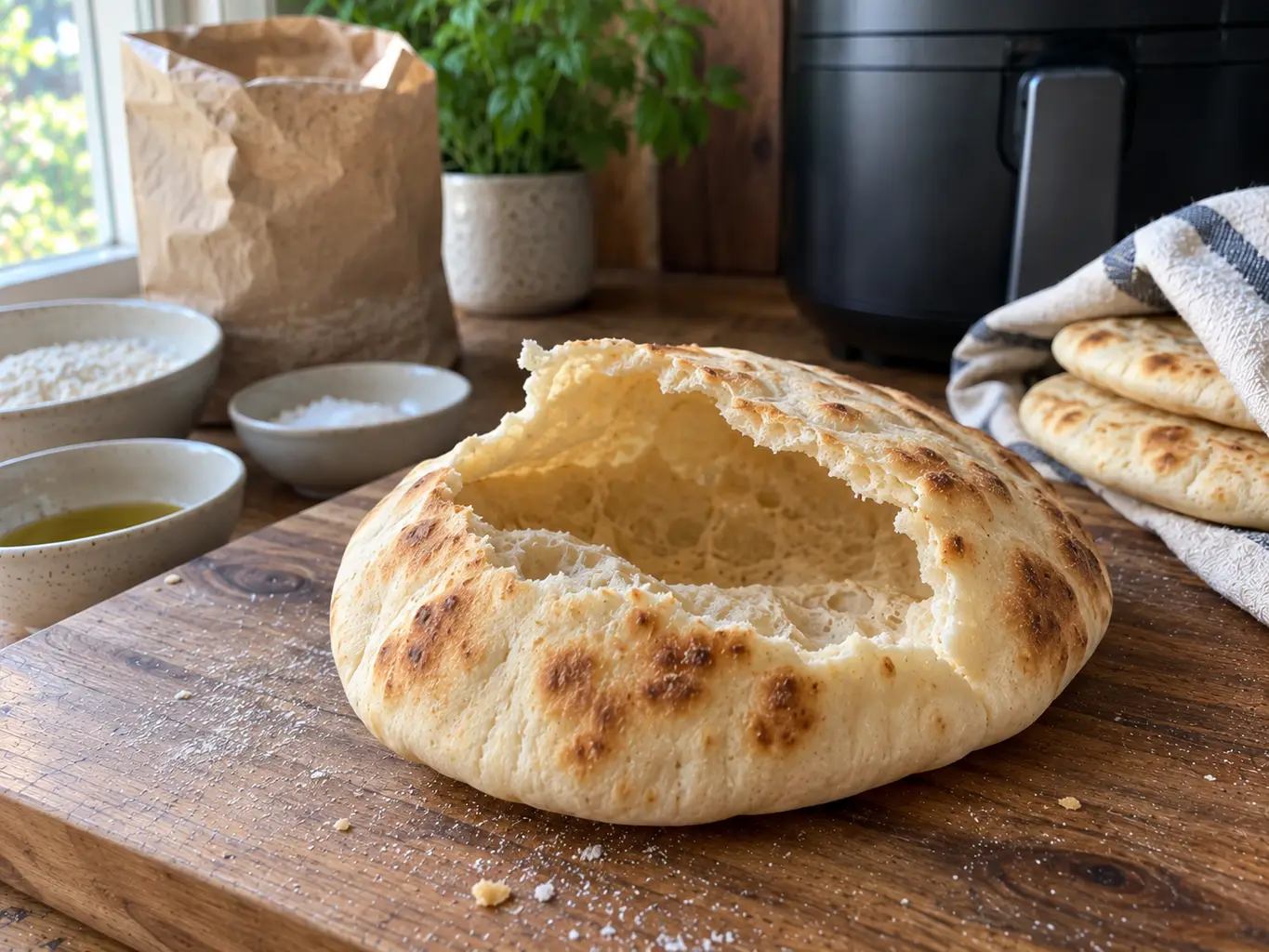
The first pita I watched inflate through the air fryer window remains one of my favorite kitchen moments, and I say that as someone who has turned out wedding cakes. A flat disc of dough sat there for ninety seconds doing nothing, then swelled into a perfect ball like something breathing, and my son yelled for the whole house to come look.
The third pita of that same batch stayed flat as a coaster. Same dough, same machine, same me. That gap between pita one and pita three is what this page is about, because the difference was never luck. It was a thick patch the size of a thumbprint where my rolling got lazy, and once you know the small list of things a pocket demands, you can get most of them to balloon on purpose.
Quick answer: Yes, pita puffs in an air fryer, reliably but not perfectly. Make a wet, tacky dough, rest it fully, roll each round evenly to a scant 1/8 inch and no wider than 5 inches, and launch it onto a basket preheated at 400°F for a full 5 minutes. It inflates in 2 to 3 minutes, no flipping. Expect 7 or 8 pockets in 10. The flat ones are soft flatbread and get eaten first anyway.
Does it actually puff?
The honest version, since the question deserves one: a commercial pita oven runs 475°F to 700°F, and home oven recipes call for 475°F to 500°F with a preheated stone. Your air fryer stops at 400°F. That missing hundred degrees is real, and it is why so many first attempts come out as sad discs and why the machine gets accused of not being able to do this at all.
It can. The physics do not care where the heat comes from, only that the dough surface sets fast while the inside flashes to steam. An air fryer compensates for its lower ceiling in three ways: the element sits inches from the dough instead of feet, the fan transfers heat harder than still oven air, and the preheated basket floor delivers contact heat the way a baking stone does. Stack those three and a 400°F basket behaves like a much hotter oven at the scale of one small flatbread. The catch is that the margin for error shrinks with the temperature, which is why the trick below stops being optional.
What a pocket actually is
A pita pocket is not folded, cut, or shaped into the bread. It is a steam explosion with good manners.
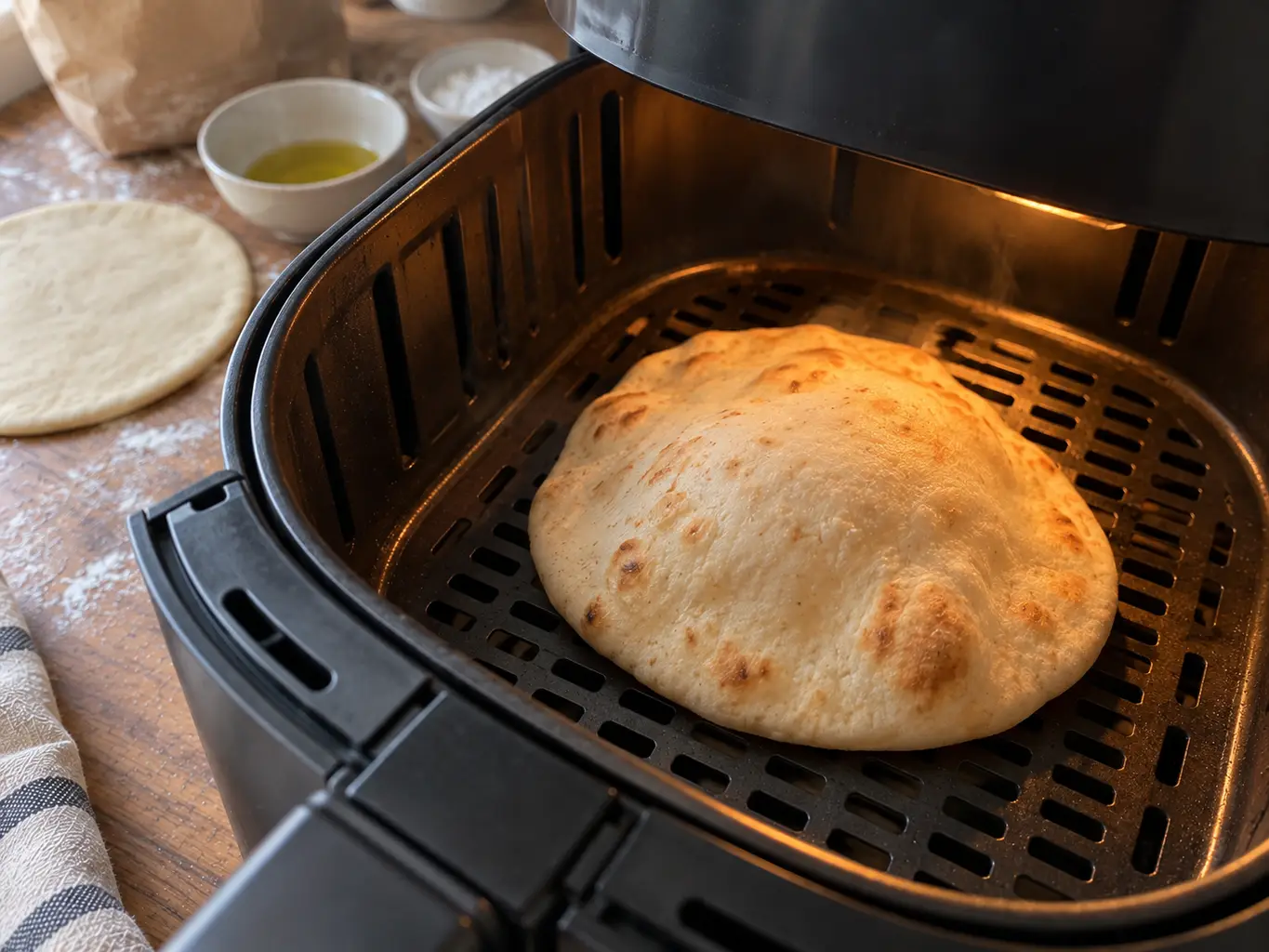
When thin dough hits fierce heat, the surfaces set into a skin within seconds. The water inside has nowhere to go as it boils, so it becomes steam, and steam wants two thousand times the space. It shoves the top and bottom skins apart, the whole bread inflates like a balloon, and the middle, which never got to set because it became the inside walls of the balloon, stays soft. The bread deflates as it cools, but the separation remains: that is the pocket. This is radiant heat and steam doing all the work in about ninety seconds.
Every pocket failure is one of three interruptions to that story: not enough water in the dough to make the steam, a hole or thin patch that vents the steam instead of trapping it, or heat too gentle to set the skins before the steam leaks away. Which is the whole trick, in reverse.
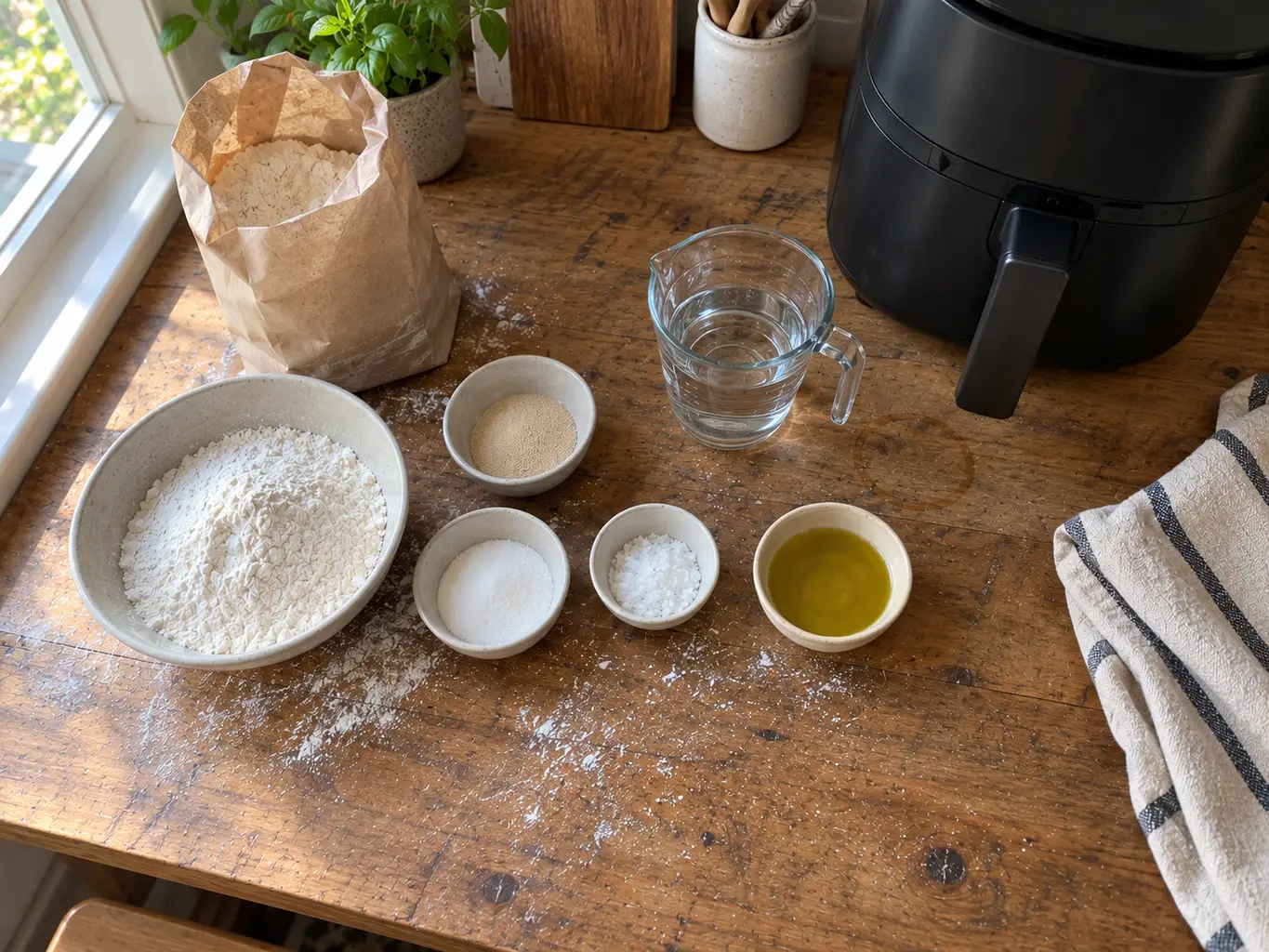
The trick, in three parts
Wet dough, fully rested
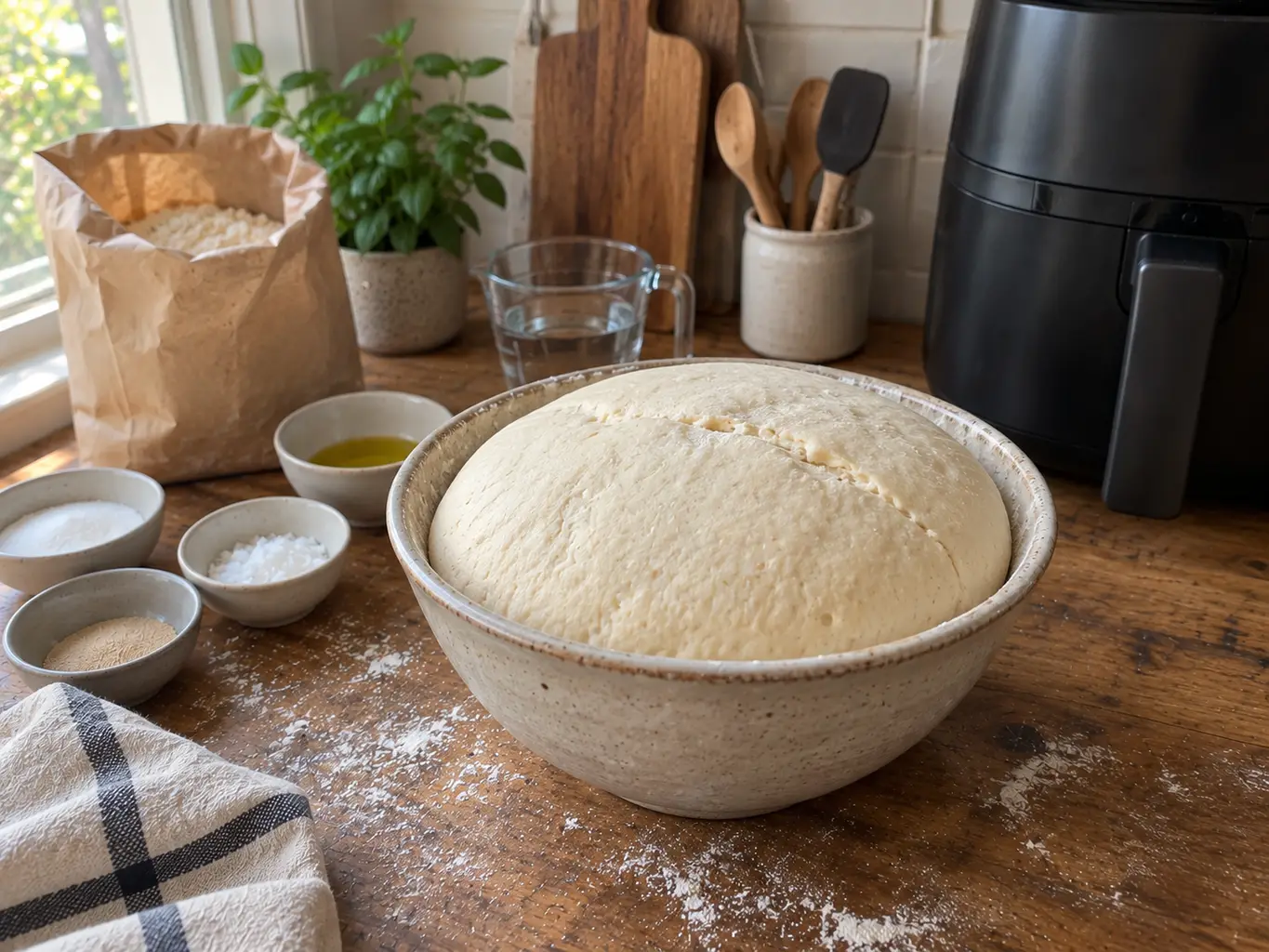
The steam has to come from somewhere. This dough runs wetter than a loaf dough, tacky to the touch, and resists the urge to flour it dry. The rests matter equally: relaxed gluten rolls evenly, and springy under-rested dough snaps back thin in patches, and patches are leaks.
Evenly thin, honestly small
A scant 1/8 inch, checked with your fingertips, no thumbprint-thick spots and no torn thin ones. Thick anchors, thin vents. And keep the rounds at 5 inches, because small rounds puff far more reliably at 400°F, explained below.
The hot-floor launch
Preheat the empty basket at 400°F for a full 5 minutes, then lay the round straight onto the hot metal. The floor sears the bottom skin on contact and the element sets the top, and the steam is trapped before it can leak. A lukewarm basket is the single most common reason air fryer pita stays flat.
Readers of the naan page will recognize part 3: the preheated basket is the tandoor wall, and pita is the same wall trick chasing a balloon instead of blisters. These two breads are the site's only screaming-hot, long-preheat recipes, the standing exceptions to the gentle rules everywhere else, and do you need to preheat an air fryer for baking explains when each approach applies. This is also the rare page where the air fryer calculator gets overruled rather than followed: it would convert a 500°F oven pita recipe to about 475°F, your machine cannot go there, so you run the ceiling you have and let the three-part trick close the gap.
Why small rounds win in a basket
Restaurant pita runs 8 inches. Air fryer pita should not, and the reason is worth understanding because it saves the batch.
The puff needs the whole round to heat almost simultaneously, so the skins set everywhere before the steam finds a weak point. In a 700°F bakery oven, an 8 inch round heats all at once. At 400°F under a single element, the middle of a big round and its edges heat on noticeably different schedules, the set happens unevenly, and the steam vents at the coolest seam instead of lifting the roof. A 5 inch round sits entirely inside the element's strong zone, heats as one piece, and balloons as one piece.
Small also means the fan cannot bully it. A wide thin round is a sail, and machines with aggressive fans can lift and flip a big floppy disc mid-cook. Five inch rounds pressed onto a properly hot floor grip instantly and stay put, the same self-anchoring that keeps the naan in place, and the same reason pizza dough gets a real preheat on this site when almost nothing else does. If a round does skate before it grips, the basket was not hot enough, which is part 3 telling on itself.
How to make it
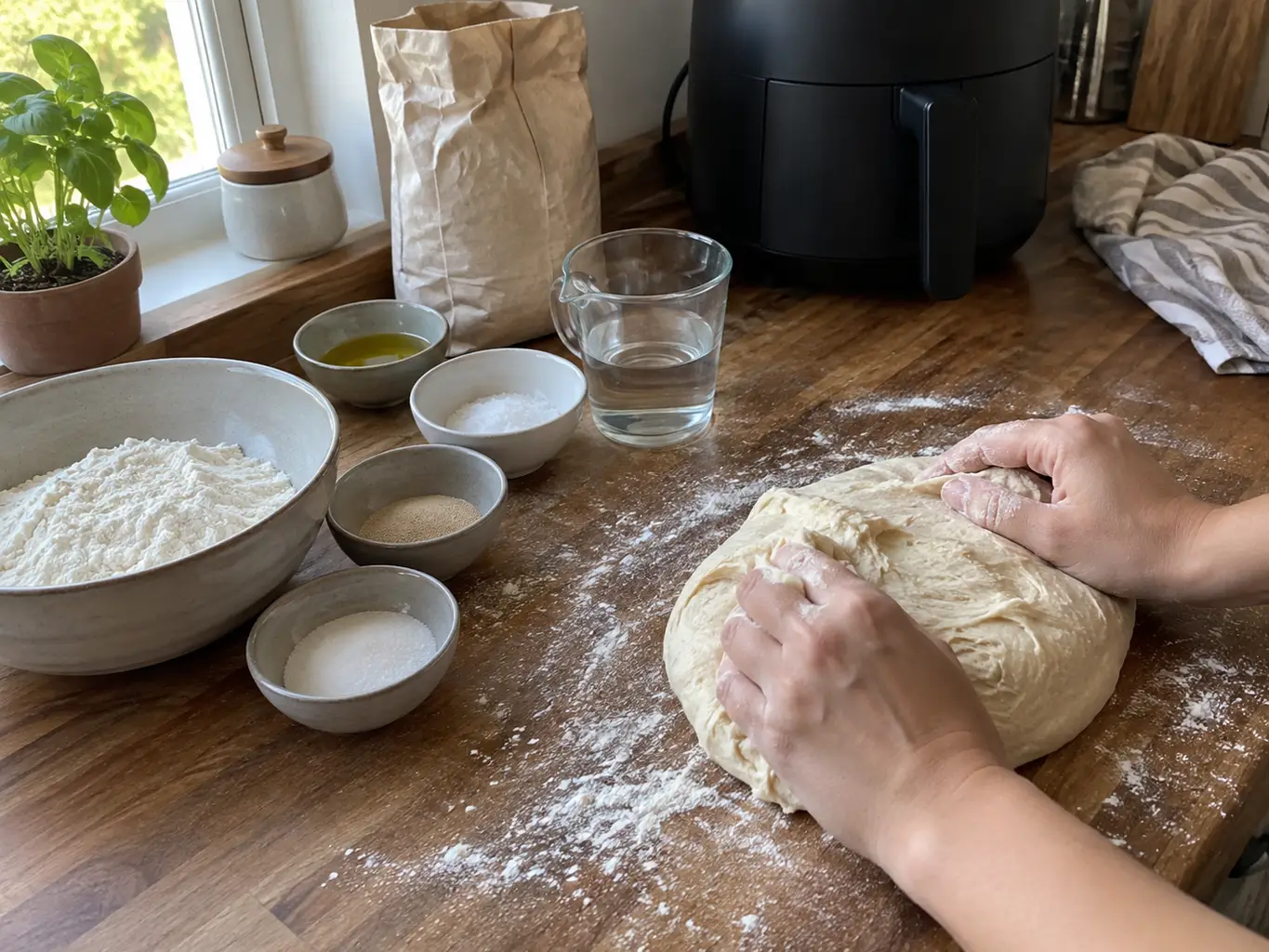
- Make the dough. Stir 1 3/4 cups flour, 1 teaspoon instant yeast, 1 teaspoon sugar and 3/4 teaspoon salt, then add 2/3 cup warm water and 1 tablespoon olive oil. Knead 8 minutes to a smooth, tacky dough. It should stick faintly to a fingertip and pull away clean. Resist extra flour: the tack is tomorrow's steam.
- Rise 1 hour, covered, until doubled. The switched-off machine with a mug of just-boiled water beside the bowl cuts this toward 40 minutes, the proof box trick from the dinner rolls.
- Divide into 6 balls, then rest them 15 minutes under the bowl. This second rest is not optional and skipping it is the most common shortcut that kills pockets: tense dough springs back unevenly under the pin, and uneven is the enemy.
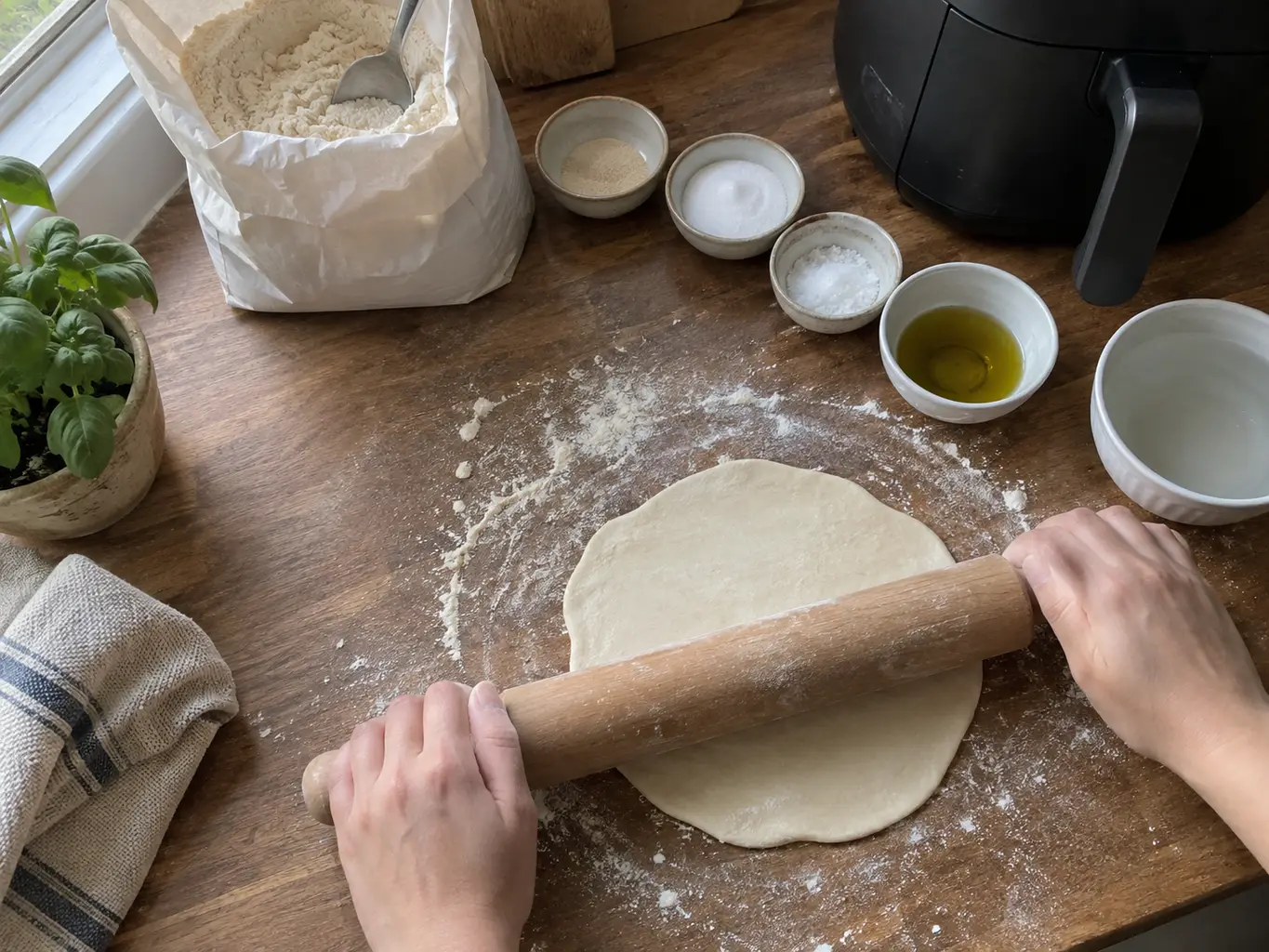
- Roll each ball to a scant 1/8 inch, 5 inches across, on a lightly floured counter. Roll from the center outward, rotate often, and sweep your fingertips across the surface feeling for thick patches. Even beats thin: a uniform slightly-thicker round puffs better than a mostly-thin one with a fat stripe.
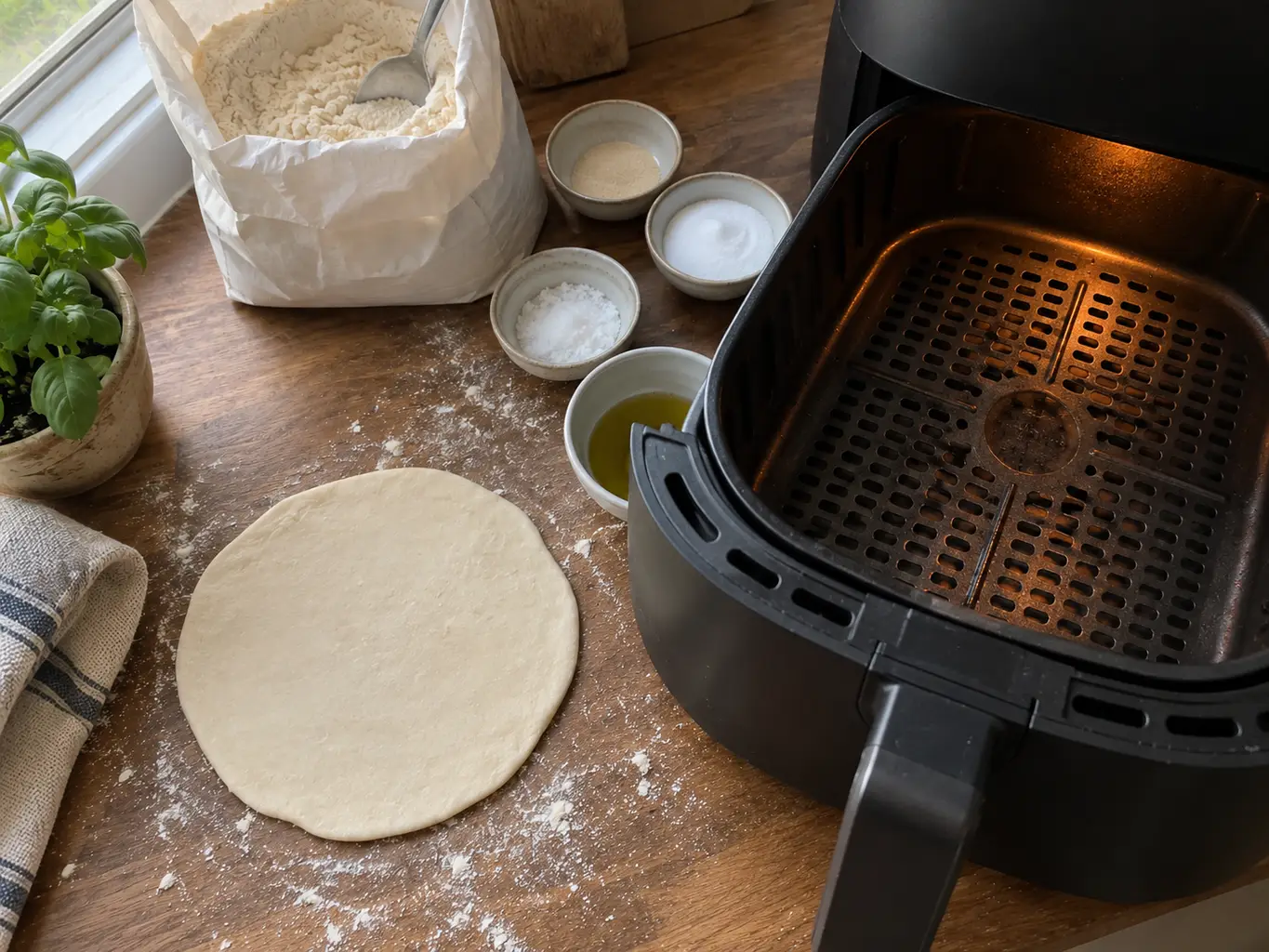
- Rest the rolled rounds 10 minutes while the machine preheats: empty basket, 400°F, a full 5 minutes. The rounds relax one last time, the floor gets stone-hot, and both timers end together.
- Launch one round onto the hot basket floor. Lay it flat, close the drawer, and do not open it for 2 minutes. It sets, shivers, and inflates somewhere in the second minute. Give it 30 to 60 seconds more for pale gold patches, then out with tongs. No flipping, ever: a flip vents the steam that is doing the work.
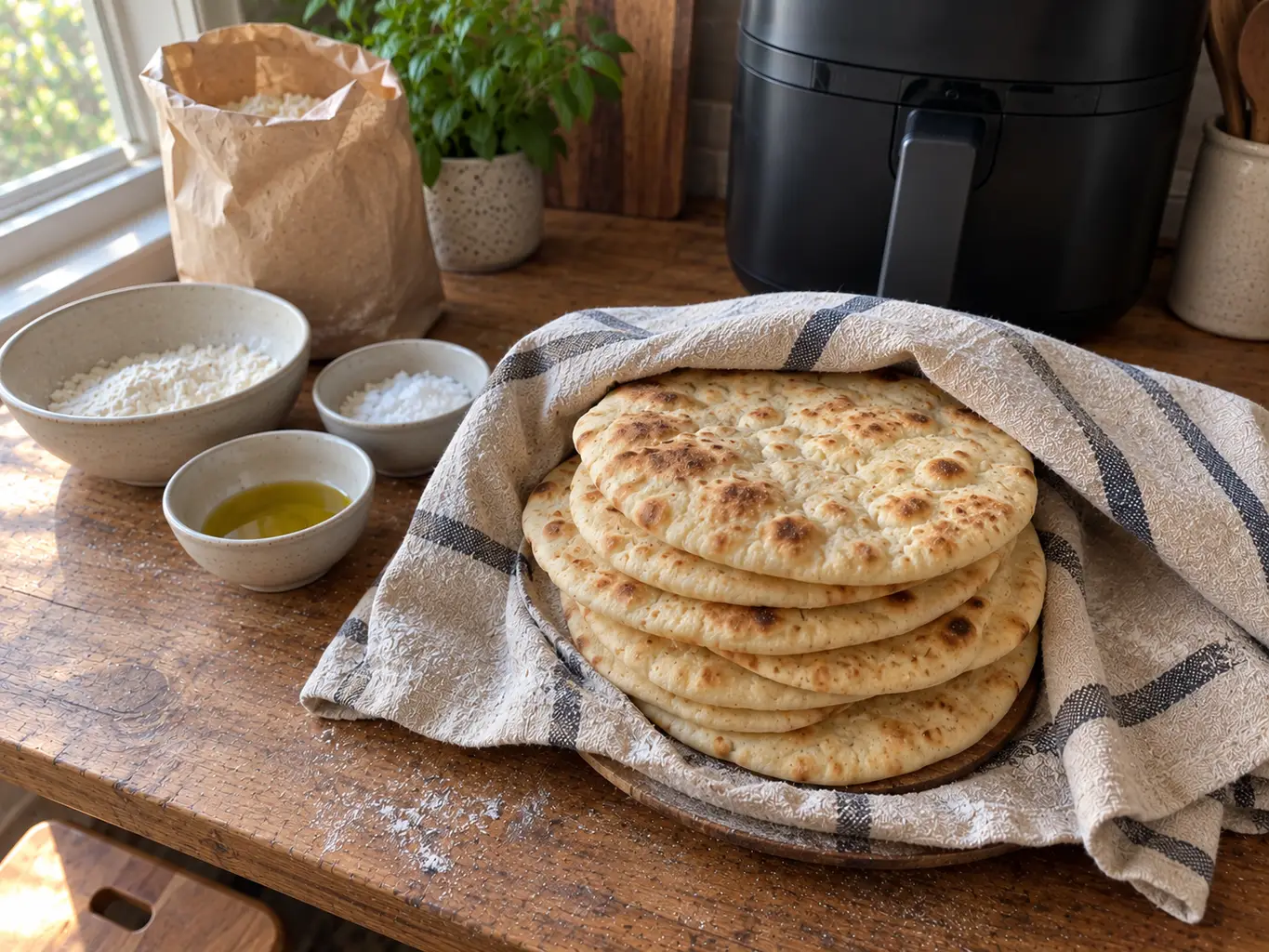
- Stack the finished pitas under a folded towel immediately. The trapped steam softens the skins as they deflate, which keeps the pocket walls pliable instead of crackery. Cook the rest one at a time, and expect each successive pita to run about 15 seconds faster on the ever-hotter floor.
- Open them warm. Cut the top third off with scissors or a knife and the pocket unseals itself. Tearing a cold pita open is how pockets rip, so if they have cooled, ten seconds back in the machine first.
When one refuses to puff
Even at a bakery, some do not. Here is the field guide to the moment itself:
| What you see through the window | What it means | Do this |
|---|---|---|
| Half-puffed, one big blister | A thick patch anchored part of the round. | Let it finish as is. It will have a partial pocket, fine for half-sandwiches. |
| No movement at all by minute 2 | Basket not hot enough, or the round sat rolled too long and dried. | Let it cook through as flatbread, then preheat 3 more minutes before the next launch. |
| Puffed, then hissed flat mid-cook | A tear or bubble burst and vented. | Nothing to fix mid-flight. Roll the next one with gentler hands and check for tears before launching. |
| Puffed on one side of the basket only, scorched there too | A hot spot. | Lay the next round in a different position. Chronic scorch maps belong to how to prevent burning in an air fryer. |
And the standing rule of pita morale: a flat pita is not a failed pita, it is flatbread. Soft, spotted, excellent with everything the pocketed ones eat. Bakeries sell the flat ones too, they just call them something else. If you find yourself wanting the flat outcome on purpose with no yeast and no rise, that recipe already exists here as the air fryer flatbread, whose quick yogurt dough can chase a pocket in a pinch but mostly should not have to.
Store-bought pita, revived
The machine is also the best thing that ever happened to the bag of pita in your freezer:
| Job | Temp | Time | Note |
|---|---|---|---|
| Revive shelf pita | 330°F | 2 min | Damp fingers over both faces first. The steam re-softens the pocket walls |
| From frozen | 350°F | 3 min | Straight from the bag, no thawing, same no-thaw law as every frozen bread here |
| Re-puff for stuffing | 350°F | 90 sec | A revived pita opens cleanly; a cold one tears |
| Pita chips | 350°F | 5 to 6 min, shaken twice | Split into single layers, cut into wedges, toss with oil and salt |
The chips row absorbs the other half of this search on purpose: stale pita cut and crisped joins the tortilla chips on permanent dip duty, and homemade pita that survived to day three is the best chip stock there is. Every temperature on this site lives in the air fryer baking chart.
Troubleshooting
| What you got | Why | Fix |
|---|---|---|
| Flat discs, batch after batch | The basket was never truly hot. This is the big one. | Five full minutes of empty preheat at 400°F, timed, not guessed. |
| Puffed but no usable pocket inside | Rolled too thick, so the walls fused as they cooled. | Scant 1/8 inch, and open them warm, top third cut off. |
| Some puff, some do not, randomly | Uneven rolling, the thumbprint problem. | Fingertip-sweep every round before it launches. Even beats thin. |
| Dry dough that fights the pin | Too much flour worked in during kneading. | The dough should be tacky. Knead on an oiled counter instead of a floured one next batch. |
| Springs back while rolling, ends up patchy | Skipped or shorted the 15 minute ball rest. | Rest tense dough, always. Time fixes what force cannot. |
| Round flipped or skated in the fan | Launched onto a floor too cool to grip it. | Hotter floor, smaller round, and lay it flat rather than dropping it. |
| Tough, crackery pitas | Cooked too long chasing color, or cooled in open air. | Pale gold patches are done. Towel stack, straight away, every time. |
| Scorched bottoms by pita four | The floor keeps banking heat batch to batch. | Knock 15 seconds off each successive pita, and trust the puff over the clock. |
Never line the basket for pita: paper blocks the hot-floor sear that makes part 3 work, and a loose sheet under featherweight dough is a kite, per can you use foil or parchment paper in an air fryer. Machine problems that follow you across recipes belong to the troubleshooting guide.
Variations
- Whole wheat. Swap half the flour for whole wheat and add 1 tablespoon more water. Whole wheat cuts gluten strength, so expect one fewer pocket per batch and a nuttier bread worth the trade.
- Za'atar pita. Brush the warm pitas with olive oil and shower with za'atar. The flat ones especially, which become instant manakish-style bread.
- Garlic butter pita. The grated-garlic butter from the garlic bread page, brushed on warm. Sweet garlic, no bitterness, and the pocket holds the drips.
- Mini pockets. Divide into 10 balls instead of 6 for 3 inch pitas that puff almost every time, the small-round advantage taken to its logical end. Lunchbox size, and the highest pocket rate this recipe produces.
- The curry night double. Pita and baingan bharta share an evening the way the naan does: bharta first, pitas launched one at a time while it rests. The pocket holds bharta like it was designed for it, because it was, several centuries ago and one region over.
- Doubling. The dough scales cleanly through the recipe scaler, and the cooking stays one at a time regardless, so a double batch is mostly a commitment to twenty minutes at the basket. Worth it before a party.
Storage
- Room temperature: 2 days in a sealed bag, once fully cool. Seal them warm and the trapped steam goes from softening to sogging.
- Freezer: 3 months, bagged flat with parchment between. Revive from frozen at 350°F for 3 minutes and the pocket opens like day one.
- The dough holds overnight in the fridge after its first rise, and cold dough rolls beautifully evenly, which makes morning pita genuinely practical. Bring the balls to room temperature during the 15 minute rest.
- Day three pita is chip stock, not a loss. Five minutes at 350°F and the bag ends its life as the best part of a mezze plate.
Frequently asked questions
QDoes pita bread actually puff in an air fryer?
Yes, reliably but not perfectly. An air fryer tops out at 400°F while pita ovens run 475°F and up, so the machine compensates with a close element, a hard-working fan, and a preheated basket floor that acts like a baking stone. With a wet dough, evenly thin 5 inch rounds, and a full 5 minute preheat, expect 7 or 8 of 10 to inflate completely. The flat ones are soft flatbread, not failures.
QWhy did my pita not puff in the air fryer?
One of three interruptions to the steam: the dough was too dry to make enough of it, a thick patch or tear let it vent instead of trapping it, or the basket was not hot enough to set the surfaces before the steam leaked away. The underheated basket is the most common culprit by far, because a courtesy 2 minute preheat feels hot and is not. Five timed minutes at 400°F, empty, before the first launch.
QDo you flip pita bread in the air fryer?
No, never. The pocket is a steam balloon held up by two set skins, and flipping mid-cook vents the steam doing the lifting. The preheated basket floor cooks the bottom by contact while the element handles the top, both faces at once, exactly the division of labor a pita oven uses. This is the same one-precious-process logic that keeps the naan unflipped, while plain flatbread with nothing to protect flips freely.
QWhat temperature and how long for pita bread in an air fryer?
400°F, your machine's true maximum, with the empty basket preheated a full 5 minutes, then 3 to 4 minutes per pita with no flipping: it inflates in the second minute and wants 30 to 60 seconds of pale gold after that. Each successive pita runs about 15 seconds faster as the basket floor banks heat. Cooler or shorter preheats produce flat discs more than any dough problem does.
QCan I make pita with two-ingredient yogurt dough?
You can chase a pocket with it, rolled scant and launched hot, and it inflates a little less reliably and less dramatically than yeasted dough because baking powder builds less gas pressure than yeast-conditioned gluten holds. It is the 20 minute compromise, covered on the flatbread page. When the pocket is the point, the yeasted dough here is worth its hour.
QHow do I open a pita pocket without tearing it?
Open them warm, when the walls are soft and the seam releases cleanly: cut the top third off with scissors and the pocket unseals itself. Cold pita tears because the walls have stiffened and stuck. Ten seconds back in the machine, or a damp-fingers wipe and 90 seconds at 350°F from the fridge, and even a day-old pita opens politely.
QWhy are small pitas better in an air fryer?
Because the puff requires the whole round to heat nearly simultaneously, and at 400°F under a single element, only a small round manages it. A 5 inch pita sits entirely in the element's strong zone and balloons as one piece, while an 8 inch round heats unevenly and vents its steam at the coolest seam. Smaller also resists the fan: a wide thin round is a sail, a small one grips the hot floor and stays put.
QCan you cook store-bought pita in an air fryer?
It is the best revival the bag will ever get: 330°F for 2 minutes with a damp-fingers wipe brings shelf pita back soft, frozen pita goes straight in at 350°F for 3 minutes with no thawing, and 90 seconds at 350°F re-puffs a pita enough to open cleanly for stuffing. Stale pita cut into wedges makes chips in 5 to 6 minutes at 350°F, which is not a consolation prize but a destination.
QCan I make pita dough ahead?
Yes, and it improves the pita: after the first rise, the covered dough holds overnight in the fridge, where the slow fermentation deepens flavor and the cold firms the dough into its most even-rolling state. Divide and give the balls their 15 minute rest at room temperature while the basket preheats, then proceed as written. Baked pitas also freeze for 3 months and revive from frozen in 3 minutes.
Never overbake again
Get our one-page times & temps cheat sheet, plus a new tested recipe each week.
No spam · unsubscribe anytime