

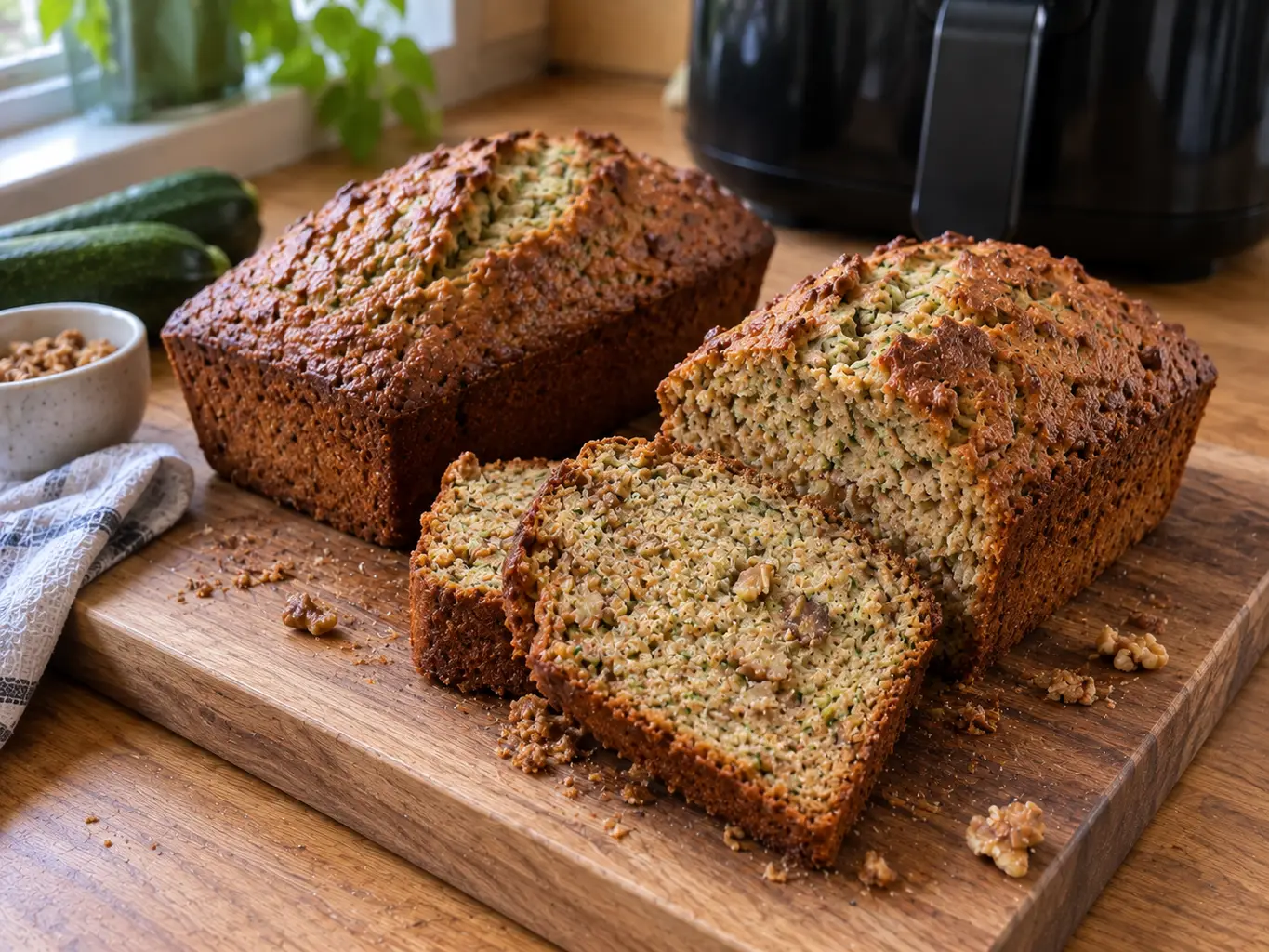
Every August my counter fills with zucchini I did not exactly ask for, from my own two plants and from neighbors who leave them on porches like foundlings. Zucchini bread is the honorable way through the pile, and the air fryer turned out to be the right tool for it, in half the time of the oven and without heating the kitchen in the exact month the kitchen least needs heating.
But my first air fryer loaf had the flaw the keyword above is about: a beautiful top, a moist middle, and a dense, wet, gummy stripe along the bottom half inch. I blamed the machine. The machine was innocent. The water was guilty, and once I started measuring the water instead of guessing, the stripe never came back.
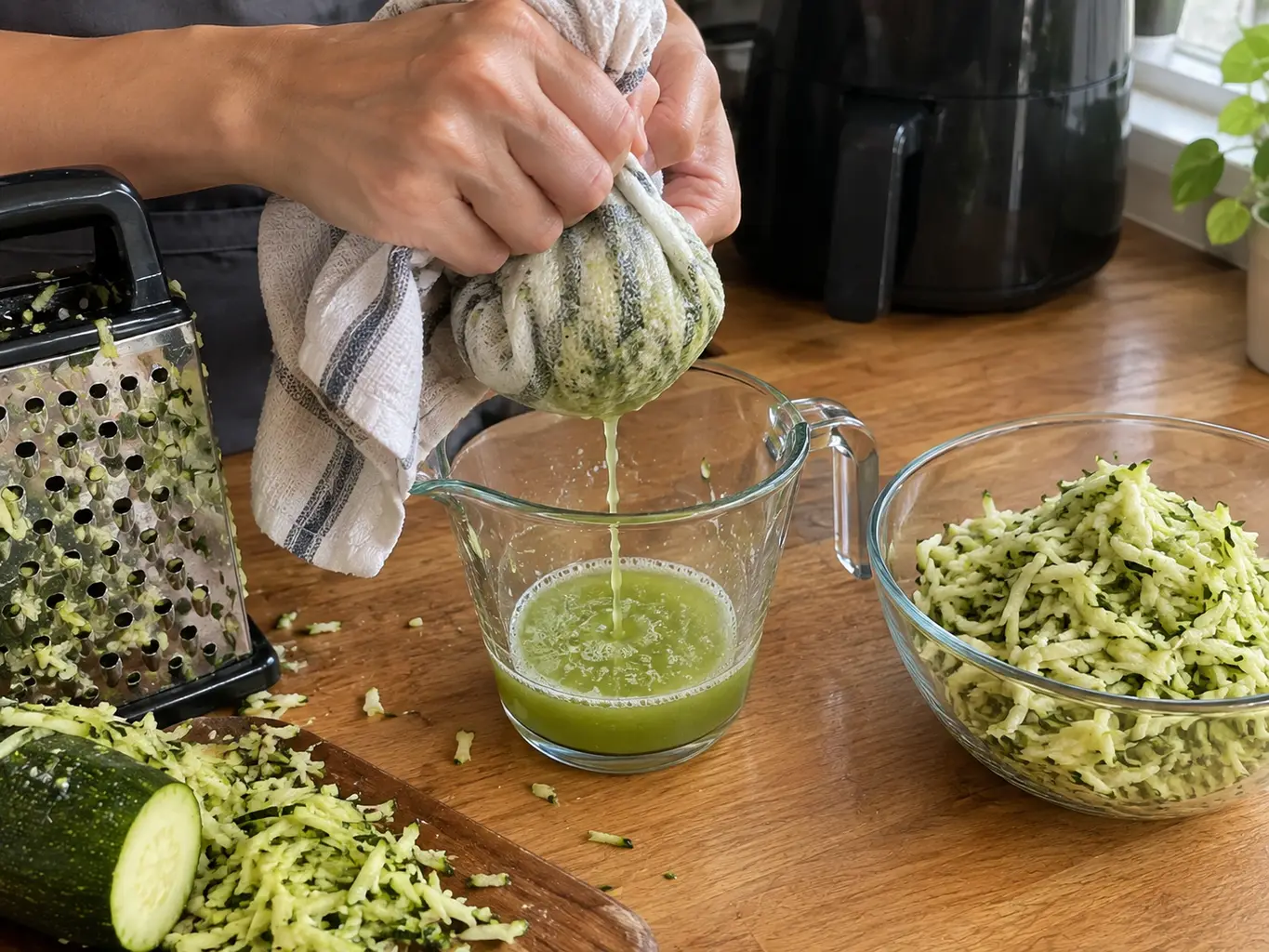
Quick answer: Grate the zucchini coarse, unpeeled, and squeeze it in a towel until you have collected about 1/2 cup of liquid from one medium zucchini, a number you can see instead of a firmness you have to guess. Split the batter between two mini loaf pans, bake at 310°F tented with foil for 25 minutes, then uncovered 8 to 12 minutes, and pull at 205°F in the center. Out of the pans at minute 10 of cooling, or the bottoms steam themselves soggy on the way down.
The water ledger
Recipes tell you to squeeze the grated zucchini "firmly" or "well," and two bakers reading the same word will remove wildly different amounts of water. That vagueness is the whole reason zucchini bread is inconsistent. So run it as a ledger instead:
- One medium zucchini, about 200g, holds roughly 3/4 cup of free water. The batter below is balanced to get about 1/2 cup of it back out.
- Squeeze over a measuring cup, not the sink. Wrap the shreds in a clean towel and wring, watching the cup. When it reads about 1/2 cup from a medium zucchini, stop. You now know, rather than hope, that the batter is getting the zucchini this recipe was written for.
- Do not squeeze to bone dry. The last few tablespoons of moisture are the moist crumb. A strangled zucchini gives you a loaf that tastes like cinnamon sawdust, which is the opposite failure and just as common among nervous squeezers.
- The squeezed-out liquid is dishwater, flavorless and faintly green. Nothing of value is lost; pour it out without guilt.
Where the soggy bottom actually comes from
The gummy stripe has three parents, and the machine is none of them:
Unsqueezed water sinks
Free water released during the bake migrates down through the crumb and pools at the pan floor, where an air fryer's mostly top-down heat is weakest. The ledger above removes this parent entirely.
The underbaked pull
A loaf pulled when the top looks done can still be 15 degrees short at the bottom center. Wet crumb that never finished setting reads as sogginess even with perfectly squeezed zucchini. The thermometer, below, removes this one.
The cooling steam trap
A hot loaf left in its pan keeps steaming, and the steam has nowhere to go but into the bottom crust. Ten minutes in the pan to firm up, then onto a rack, is the law. An hour in the pan undoes a perfect bake.
The pan question: think small
The standard 9x5 loaf pan does not fit most baskets, and this is a blessing wearing a disguise. A full-size zucchini loaf is a deep, wet mass whose center takes so long to set that the top would scorch waiting for it, tent or no tent. Small formats are not the compromise; they are the correct engineering:
| Format | Bake at 310°F | Notes |
|---|---|---|
| Two mini loaf pans, about 6x3 | 33 to 37 min total | The default. Shallow batter sets fast, and you get two crowns, two end slices, and one loaf to give away |
| One 7 inch round cake pan | 35 to 40 min | Zucchini "cake" in shape, same crumb; slice in wedges |
| Silicone muffin cups | 14 to 17 min, untented | Zucchini muffins from the same batter, no tent needed at this size |
Measure your basket against the pan before pouring batter, not after; the pan size calculator settles what actually fits your machine, and it is the two minute check that saves the 40 minute mistake. Metal pans give better bottom color than silicone here, which matters on a bread whose whole reputation problem is its bottom.
The tent, and the temperature under it
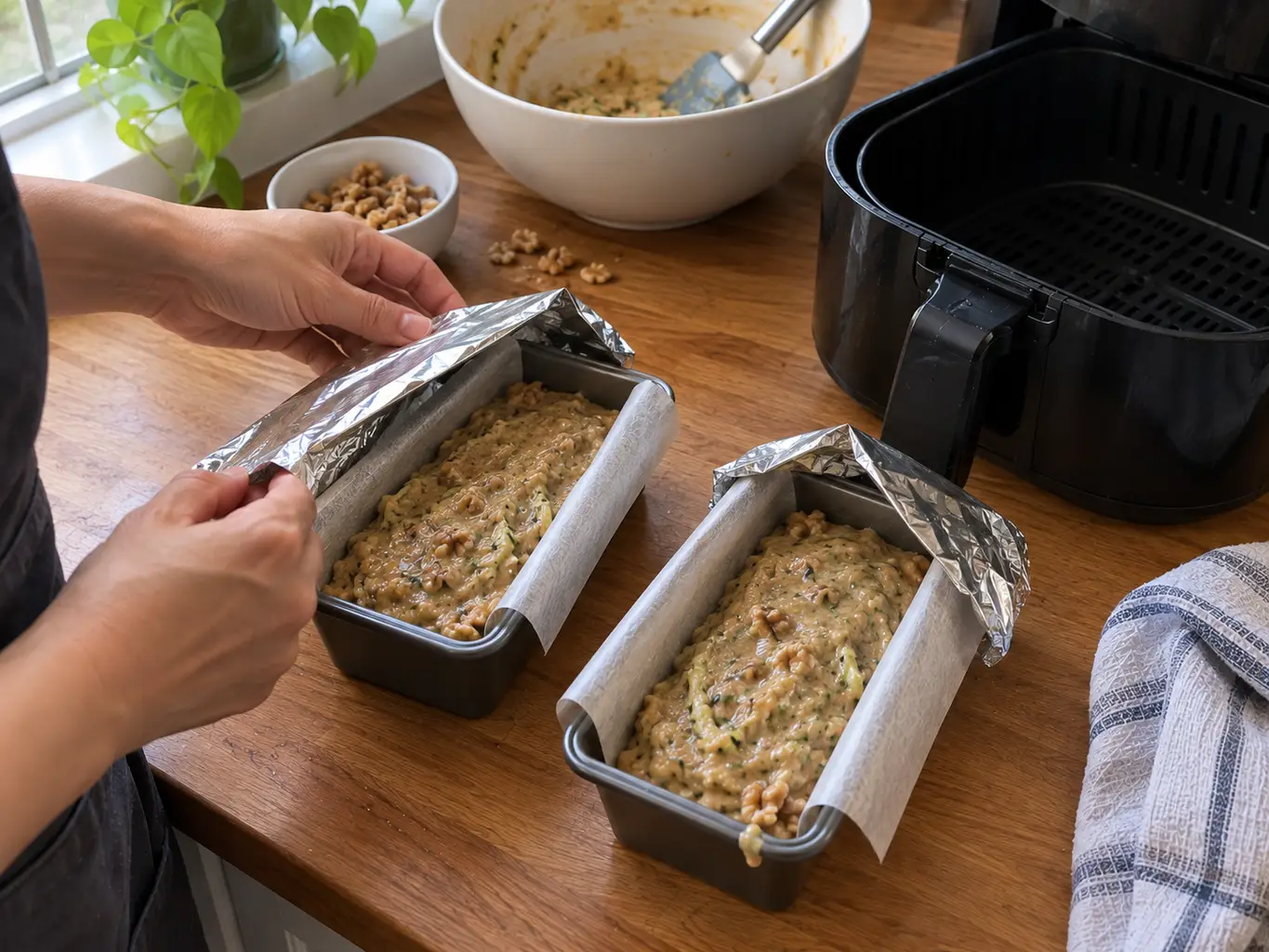
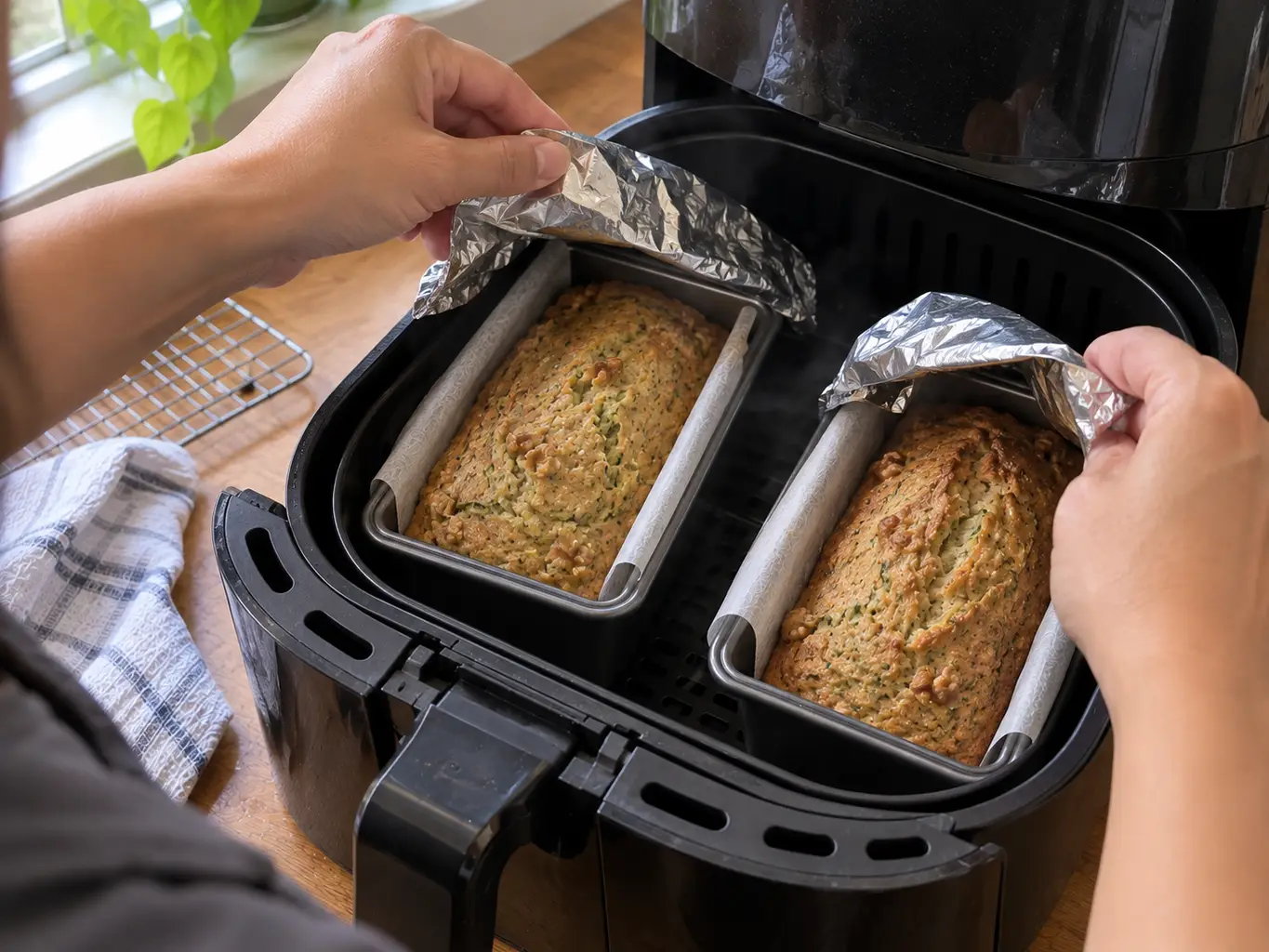
Air fryer heat comes mostly from above, and a 35 minute bake gives the top element half an hour to overwork the crown while the center catches up. The answer is the same foil tent that saved the red velvet cake: a loose foil cap over each pan for the first 25 minutes, then off for the last 8 to 12 so the crown takes its color. Loose is the operative word; crimp it lightly to the rim so the fan cannot steal it, but leave air space above the batter, because the loaf will rise into it. The full liner and foil rules live in the foil and parchment guide.
As for the number: oven zucchini bread bakes at 350°F, and the air fryer calculator converts that faithfully to about 325°F. This recipe goes 15 degrees below the conversion, to 310°F, on purpose. The calculator translates heat honestly, but it cannot know it is baking a deep, wet batter under a top element, and the dense quick breads are where that extra gentleness pays. It is the same conversion-plus-judgment move as the soft breadsticks, in the other direction from naan. The whole site's numbers live in the air fryer baking chart.
Handling the zucchini
- Do not peel. The skin is where the color flecks come from, it softens to nothing in the bake, and peeling throws away the evidence that there is a vegetable in the bread at all.
- Coarse side of the box grater. Fine shreds surrender too much water into the batter after squeezing and vanish entirely; coarse shreds keep a little identity and a better crumb, the same grate that carries the carrot muffins.
- Giant baseball-bat zucchini are for bread, with one edit: halve them and spoon out the seedy core, which is watery foam, then grate the walls. The monsters your garden hides until Labor Day were born for this page.
- Frozen grated zucchini works. Thaw it fully, then run the same ledger; it collapses in the freezer and gives up its water even more willingly than fresh. This matters because the freezer is the glut plan, below.
- Grate, then squeeze, then measure. The recipe wants 1.5 cups of squeezed shreds, measured after wringing, which one medium zucchini reliably provides.
How to make it
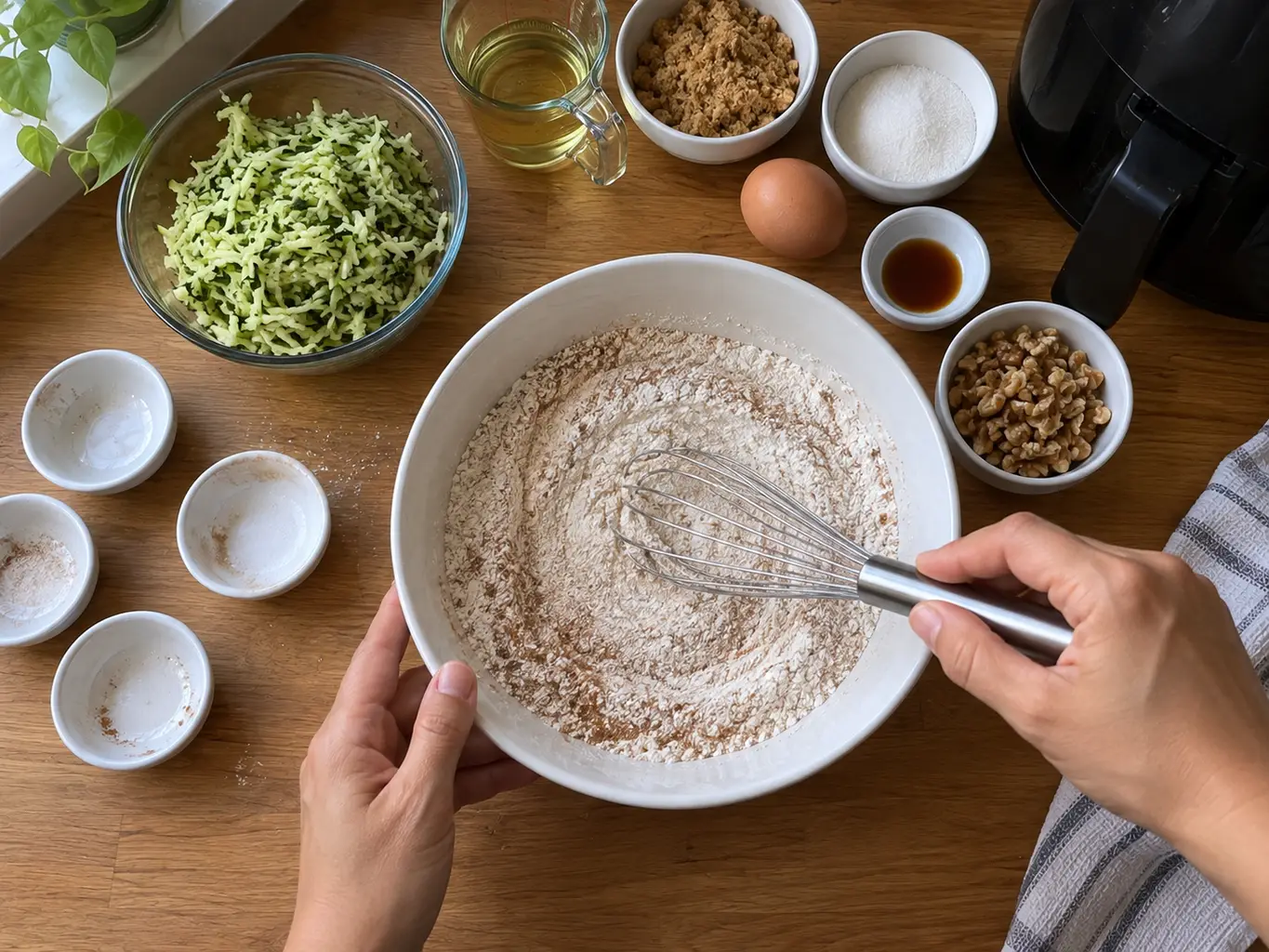
- Run the water ledger: grate one medium unpeeled zucchini coarse, wring it in a towel over a measuring cup until about 1/2 cup of liquid has come out, and fluff the shreds. You want 1.5 cups, squeezed.
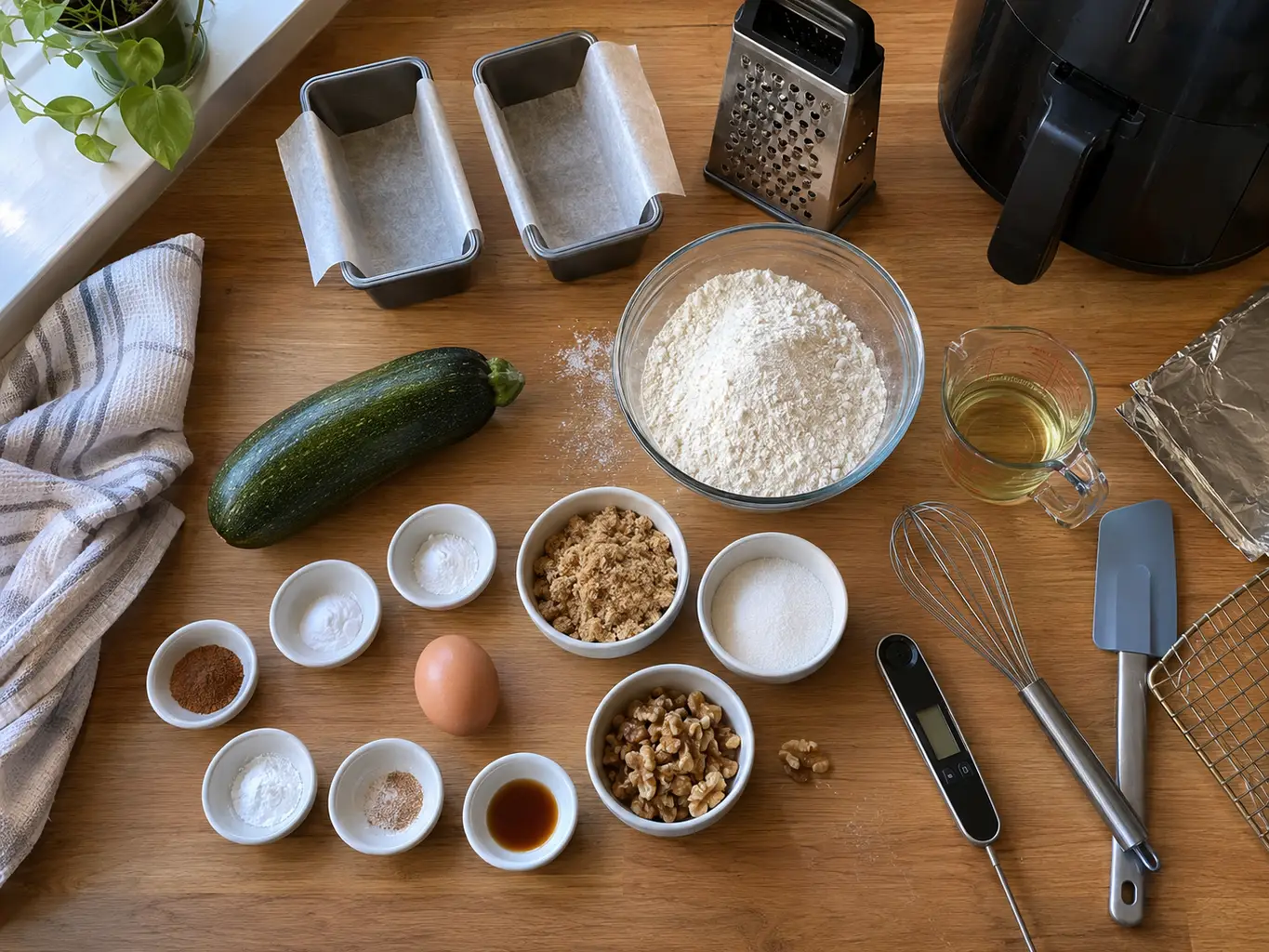
- Whisk the dry: 1.5 cups flour, 1 teaspoon cinnamon, 1/2 teaspoon each baking soda and baking powder, 1/2 teaspoon salt, 1/4 teaspoon nutmeg.
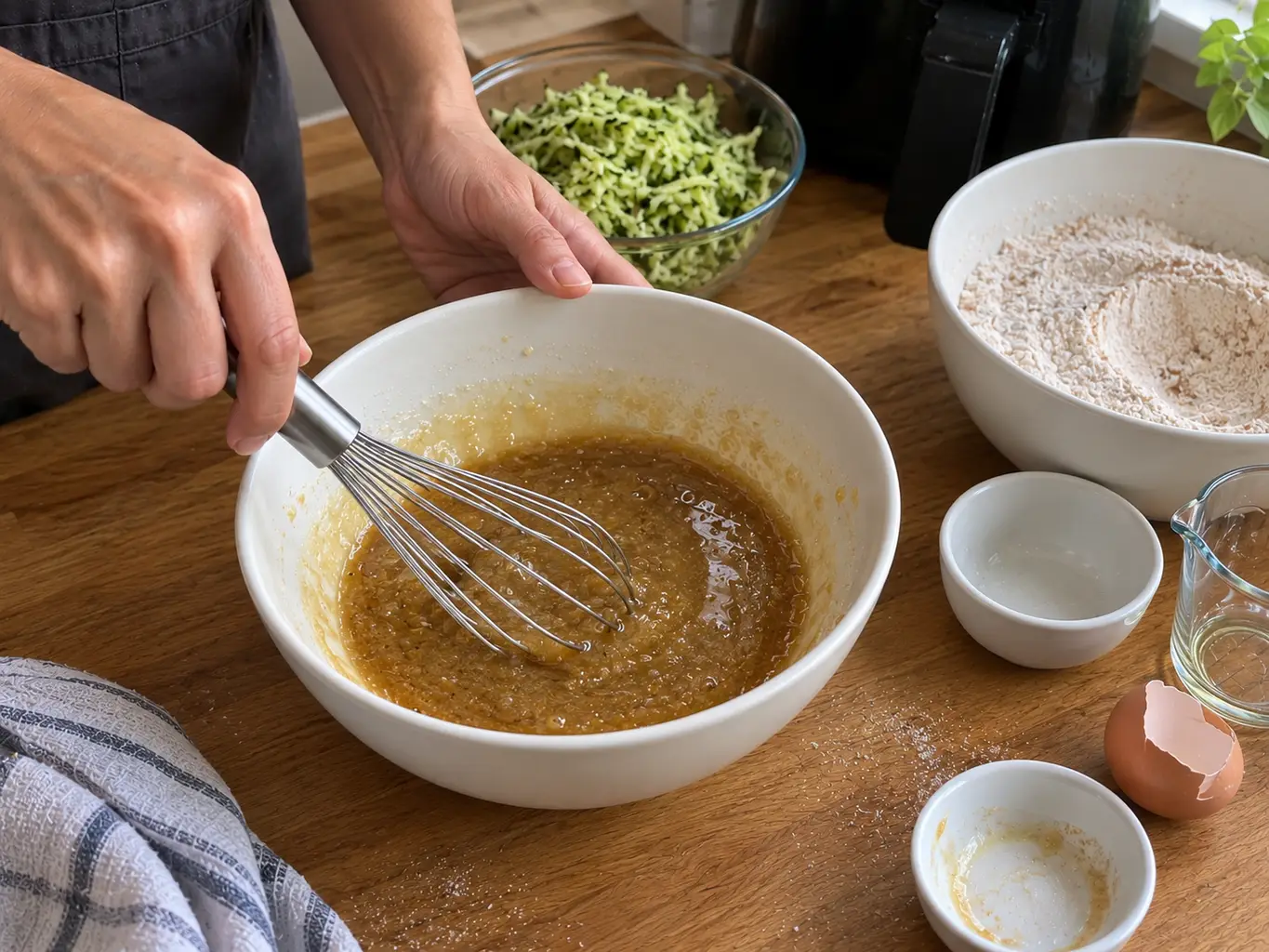
- Whisk the wet: 1 egg, 1/3 cup neutral oil, 1/2 cup brown sugar, 1/4 cup white sugar, 1 teaspoon vanilla, until glossy.
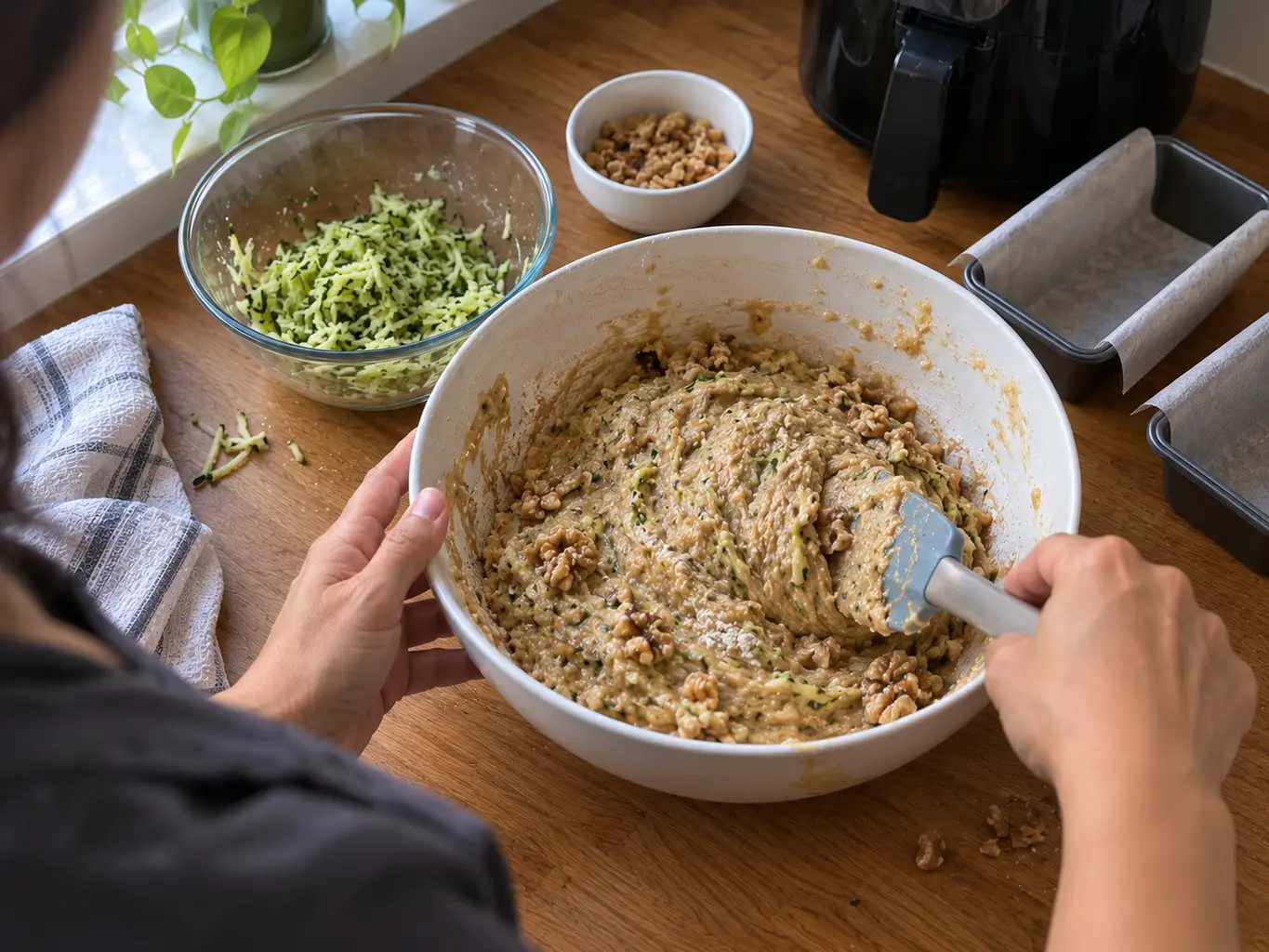
- Fold wet into dry just until no flour streaks remain, then fold in the zucchini and 1/2 cup toasted walnuts if using. Quick bread batter is stirred by a coward: lumps are fine, enthusiasm makes rubber tunnels.
- Divide between two greased, parchment-slinged mini loaf pans, filled no more than two-thirds. The parchment sling lifts the finished loaves out without a fight.
- Bake at 310°F, tented loosely with foil, for 25 minutes. No preheat; a quick bread in a cold machine rises more evenly, and the preheat guide keeps the roster of who warms up and who does not.
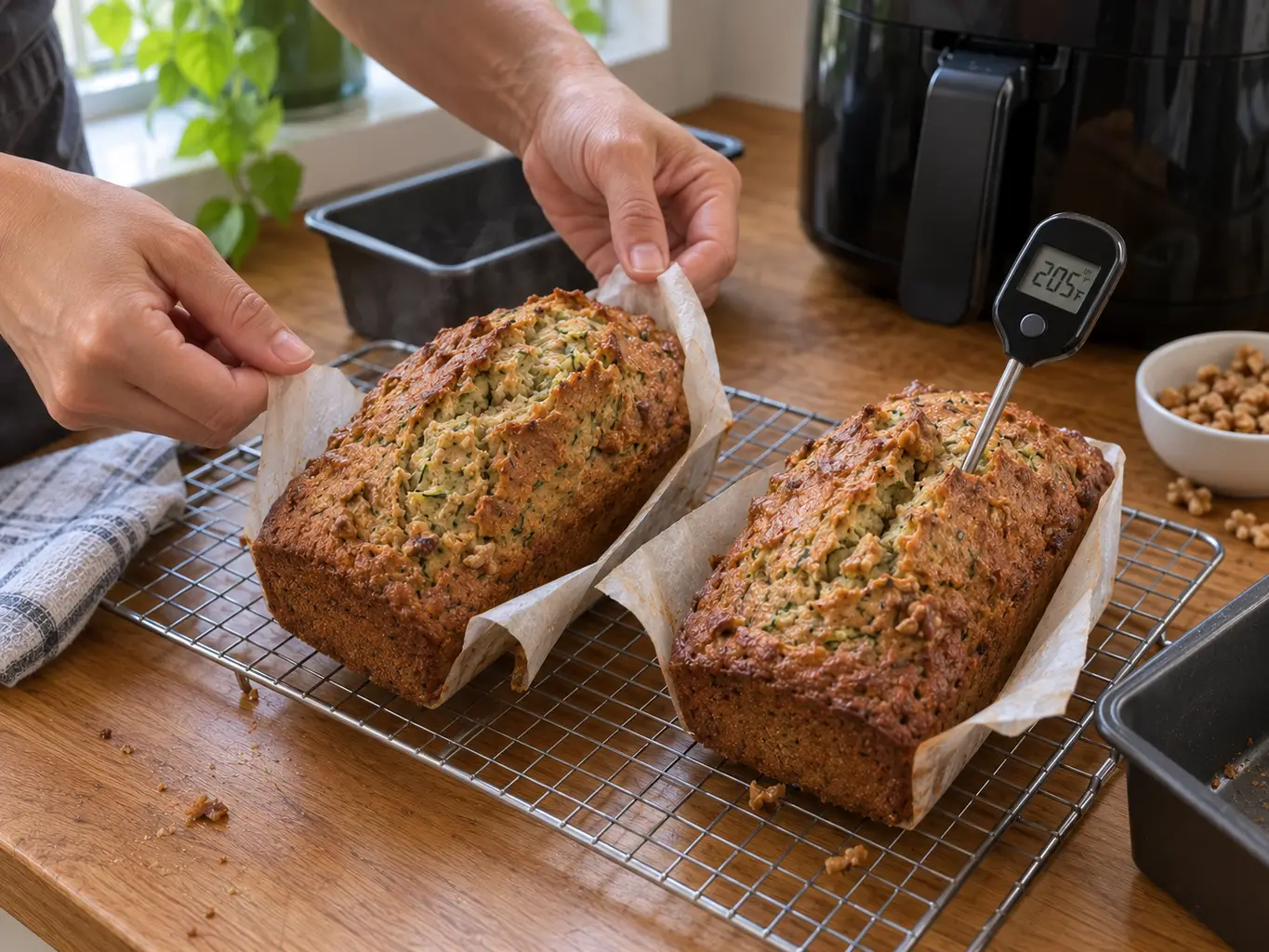
- Untent and bake 8 to 12 minutes more, until the crown is deep gold and cracked down the middle, and the center of each loaf reads 205°F.
- Cool in the pans exactly 10 minutes, then sling them onto a rack. Bottom-side airflow while cooling is the last defense of the crisp bottom. Slice after 30 minutes if you can stand it; the crumb is still setting.
Doneness: the toothpick lies here
Zucchini bread is the bread that defeats the toothpick. The crumb is so moist by design that a pick can come out clean from a loaf whose bottom center is still batter-adjacent, and it can come out smeared from a loaf that is perfectly done but just met a pocket of zucchini. Both errors are common enough that even competing recipes admit the test is unreliable, then tell you to use it anyway.
Use the number instead: 205°F at the center of the loaf, on an instant-read thermometer, the same 200 to 205 window every dense cake on this site bakes to. Probe from the top straight down to the loaf's heart, because the bottom center is the last place to finish, which is precisely where the soggy stripe waits for the impatient. And remember carryover: a loaf at 205°F keeps cooking gently in the pan during its 10 minute rest, which is part of why the rest is 10 minutes and not 40.
Troubleshooting
| What you got | Why | Fix |
|---|---|---|
| Gummy stripe along the bottom | Unsqueezed zucchini, an early pull, or a long sulk in the pan. | The ledger's 1/2 cup, the 205°F number, and the 10 minute pan exit. All three parents, handled. |
| Burnt top, wet middle | Untented long bake under a top element, or full-size loaf ambition. | Tent 25 minutes, and keep the format small. |
| Sunken center line | Underbaked structure or too much water; the crumb could not hold its own roof. | The same physics as every collapsed bake; the sunken middle guide runs the full inquest. |
| Dry, sawdusty loaf | Over-squeezed zucchini or an extra 10 minutes of caution. | Stop wringing at the ledger number; trust 205°F over fear. The dry bakes guide covers the rest. |
| Rubbery crumb with tunnels | Overmixed batter. | Fold until the flour disappears, then put the spatula down. |
| Pale, soft bottom | Silicone pan, or cooling in the pan. | Metal pans, and the rack. |
| One loaf browner than the other | A machine hot spot. | Swap pan positions when the tent comes off. |
| Foil tent flew off mid-bake | Crimped too casually against a fan. | Fold it under the pan rim at two corners; the burning guide covers what the exposed crown can take. |
Failures that follow you from recipe to recipe live in the troubleshooting guide.
Variations and the glut plan
- Chocolate zucchini bread: swap 1/4 cup of the flour for cocoa and fold in 1/2 cup chocolate chips. Same water ledger, same tent, and the toothpick becomes even more useless, so the thermometer earns double.
- Lemon walnut: a teaspoon of lemon zest in the wet, and the loaf leans breakfast instead of snack, which is the whole argument of the lemon bread. Serious lemon people already know where the lemon bars live.
- Zucchini muffins: the same batter in silicone cups, 14 to 17 minutes, no tent. The lunchbox format.
- Doubling for the glut: the recipe scaler resizes the batter honestly, but bake in shifts, two mini pans at a time; a crowded basket bakes nobody's loaf well.
- The glut plan itself: grate and squeeze the August surplus by the ledger, freeze it flat in 1.5 cup bags, and this recipe runs on garden zucchini in January. The bag thaws in an hour on the counter; re-wring the thaw water and proceed. Whatever the freezer cannot hold goes to zucchini fries, which is the other honorable exit from an August pile.
This loaf sits in the same quick bread family as the banana bread and pumpkin bread, and they share a fate: the fruit-and-vegetable breads exist because something on the counter was about to go over the edge. Banana bread rescues Tuesday's bananas; zucchini bread rescues August. Toasted slices of either, 2 minutes at 320°F cut-side up, with butter, is the correct breakfast.
Storage and freezing
- Room temperature: 3 days, wrapped once fully cool, and fully cool means the center is at room temperature, not merely touchable. Wrapping a warm loaf traps steam, and you know by now where steam goes.
- Fridge: skip it. The fridge staling curve turns moist crumb mealy; the freezer is the real second home.
- Freeze whole loaves 3 months, double-wrapped. The mini format shines again: thaw one, gift one, freeze one.
- Freeze slices for toast: frozen slices go straight into the machine, 3 minutes at 320°F, and August shows up in the middle of winter on demand.
Frequently asked questions
QHow long does zucchini bread take in an air fryer?
33 to 37 minutes total at 310°F for mini loaves: 25 minutes under a loose foil tent, then 8 to 12 minutes uncovered for the crown to color, done when the center reads 205°F. Muffins from the same batter run 14 to 17 minutes with no tent. That is roughly half the time of the oven version, without heating the kitchen in August.
QDo you squeeze zucchini before making bread?
Yes, and to a measurable amount, not a vague firmness. Wring the grated zucchini in a towel over a measuring cup until about 1/2 cup of liquid has come out of one medium zucchini, then stop. Squeezing less leaves free water that sinks and forms the gummy bottom stripe; squeezing to bone dry makes a dry loaf. The measuring cup turns the recipe's biggest guess into a number.
QWhy is my zucchini bread soggy at the bottom?
Three causes, often stacked: unsqueezed zucchini water migrating down and pooling where the machine's bottom heat is weakest, pulling the loaf before the bottom center actually finished, and leaving the hot loaf in its pan, where trapped steam soaks the bottom crust while it cools. Squeeze to the measured amount, bake to 205°F in the center, and move the loaf to a rack after 10 minutes in the pan.
QHow do you know when zucchini bread is done?
By temperature: 205°F on an instant-read thermometer pushed to the center of the loaf. The toothpick test is unreliable on zucchini bread specifically, because the deliberately moist crumb can read clean while the bottom center is still underdone, and can read wet from a pocket of zucchini in a finished loaf. The thermometer removes both errors for the cost of five seconds.
QCan you bake a regular loaf pan of zucchini bread in an air fryer?
Usually not, and you would not want to. A 9x5 pan physically misses most baskets, and a full-size zucchini loaf is so deep and wet that its center cannot set before the top overbakes even under foil. Two mini loaf pans or a 7 inch round pan bake the same batter better, and a pan size calculator check against your basket's true interior takes two minutes.
QDo you peel zucchini for zucchini bread?
No. The skin softens to nothing during the bake, carries most of the green flecks that make the bread look like itself, and peeling only adds work while removing character. Grate the whole zucchini on the coarse side of a box grater. The one edit worth making is for giant overgrown zucchini: halve them and spoon out the watery seed core before grating the firm walls.
QCan I use frozen grated zucchini?
Yes, and it is the best use of a garden glut. Thaw the bag fully, then wring the shreds exactly as you would fresh; freezing collapses the cells, so the water comes out even more easily. Grate, squeeze and freeze the August surplus flat in 1.5 cup portions, and the recipe runs on your own zucchini all winter with no change to times or temperatures.
QWhy did my zucchini bread sink in the middle?
Either the structure was underbaked when it was asked to stand, or there was more water aboard than the flour could hold up, and often both. Squeeze the zucchini to the measured 1/2 cup, bake to 205°F rather than by the clock, and fill pans no more than two-thirds so the crumb is not lifting more than it can carry. A sunken line down an otherwise done loaf is nearly always the water.
QHow do you store zucchini bread so it stays moist?
Wrapped at room temperature for 3 days, but only wrapped once fully cool, because wrapping a warm loaf traps steam and softens the crust you protected all bake. Skip the fridge, which turns moist crumb mealy. For longer, freeze whole mini loaves double-wrapped for 3 months, or freeze slices and toast them straight from frozen, 3 minutes at 320°F.
Never overbake again
Get our one-page times & temps cheat sheet, plus a new tested recipe each week.
No spam · unsubscribe anytime