

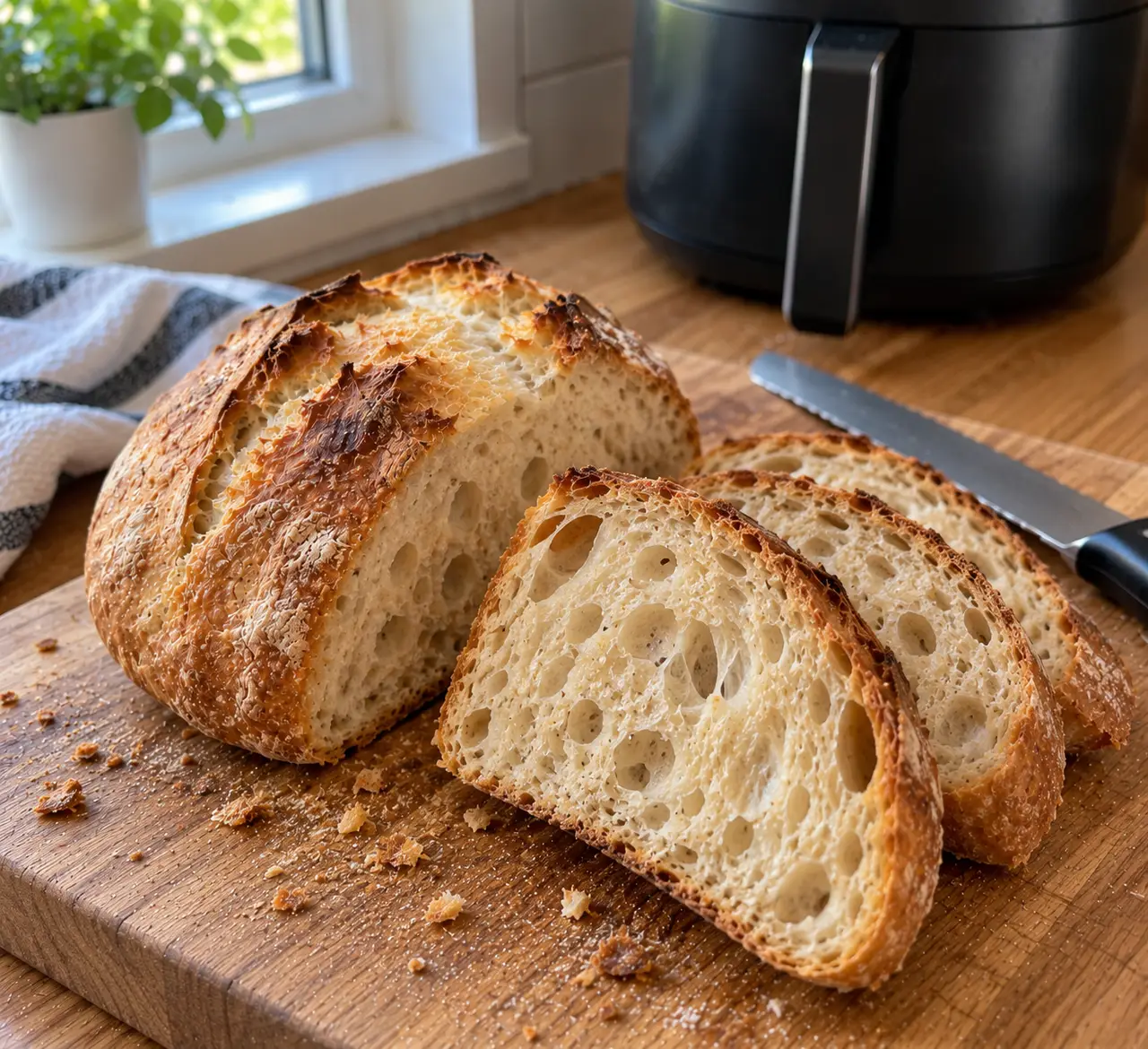
For years my no-knead dough had a landlord problem: the recipe lived in my kitchen, but the Dutch oven it demanded lived at my sister's house. The famous method, stir once, wait overnight, bake in a screaming-hot covered pot, produces the best bread-to-effort ratio in all of baking, and it gatekeeps that bread behind a piece of cast iron most kitchens do not own and most air fryer owners would have nowhere to put.
So I spent a stubborn month finding out what the pot was actually contributing, and the answer was almost insulting: a lid. The Dutch oven is a steam trap with good marketing. And a steam trap, it turns out, can be built in an air fryer basket out of a cake pan and a sheet of foil, which is why this loaf exists.
Quick answer: Stir flour, water, salt and a small pinch of yeast into a shaggy dough and let time do the kneading, 12 to 18 hours on the counter (or 2.5 hours with more yeast for same-day bread). Shape gently, rest 30 minutes, then bake in a preheated 7 inch pan at 380°F: 25 minutes under a tight foil dome, then 10 to 15 minutes uncovered until deep brown and 205°F inside. The dome traps the dough's own steam, which is the entire secret of the Dutch oven, and then the fan builds the crust the moment you take the dome away.
Time is the kneading
Kneading exists to organize flour's proteins into gluten, the stretchy net that holds bubbles. The no-knead insight, the one that made the 18-hour method famous, is that flour organizes itself if you give it enough hours in a wet dough: the proteins find each other while you sleep. Your entire job is to stir for thirty seconds and then not interfere.
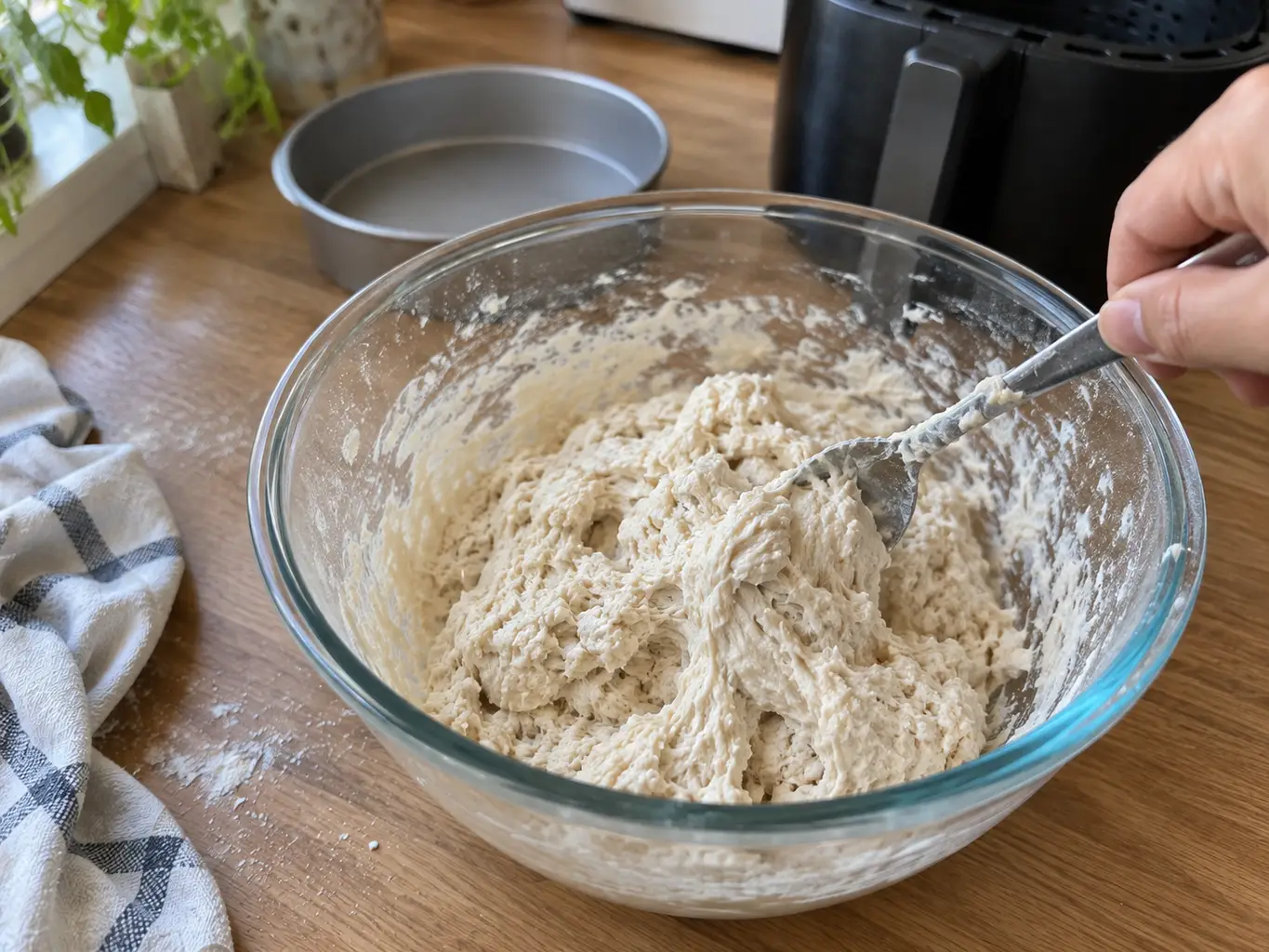
- The dough should look wrong. Shaggy, sticky, wet, no smooth ball, no window pane. Wetness is the point; a wet dough is a mobile dough, and mobility is what lets gluten assemble unassisted.
- The pinch of yeast is not a typo. A quarter teaspoon for a whole loaf, because 14 hours is a marathon and a full teaspoon would sprint, exhaust the flour's sugars, and leave flat flavor. Slow fermentation is where the loaf's faint tang and big open holes come from.
- No proof box needed for the long rise: room temperature is correct, and even a coolish kitchen just means the flavorful end of the window. The switched-off machine and a mug of boiled water, this site's usual proof box, belong to the same-day schedule below, not to the overnight one.
What the Dutch oven actually does
A raw loaf carries all the water a bakery steam-injector would otherwise provide. In a sealed pot, that moisture evaporates and has nowhere to go, so for the first stretch of the bake the loaf is wrapped in its own steam, and the steam does three things:
It keeps the skin soft
A dry skin sets in minutes and stops the loaf from growing. A steamed skin stays elastic, so the interior can expand to its full height, the burst bakers call oven spring.
It builds the shine and crackle
Steam gelatinizes the surface starch into a thin glossy layer that later dries into the crackly, blistered crust. No steam, no crackle; just a dull, leathery rind.
It delays the browning
A wet surface cannot brown, which sounds bad and is actually the sequencing: rise first, then color. Uncovering the pot is what flips the switch to Maillard browning.
Now the uncomfortable part: an air fryer is the opposite of a Dutch oven. It is a machine purpose-built to strip moisture off food with moving air. Bake this dough naked in a basket and the fan sets the skin in ninety seconds, the loaf stays squat, and the crust comes out thick and dull. The fan is your enemy for the first 25 minutes and your best friend after, so the build below simply keeps it out until its shift starts.
The foil dome build
- The floor: preheat a 7 inch metal cake pan, empty, 5 minutes at 400°F. A Dutch oven is preheated for exactly this reason; hot metal under the dough fires the bottom crust and kicks the first rise upward. Check that your pan actually fits your basket with the pan size calculator before the dough is committed.
- The transfer: the shaped loaf waits on a parchment square, and you lower it, parchment and all, into the hot pan by the corners. No sling, no burned knuckles, and the parchment stays for the whole bake. The liner rules live in the foil and parchment guide.
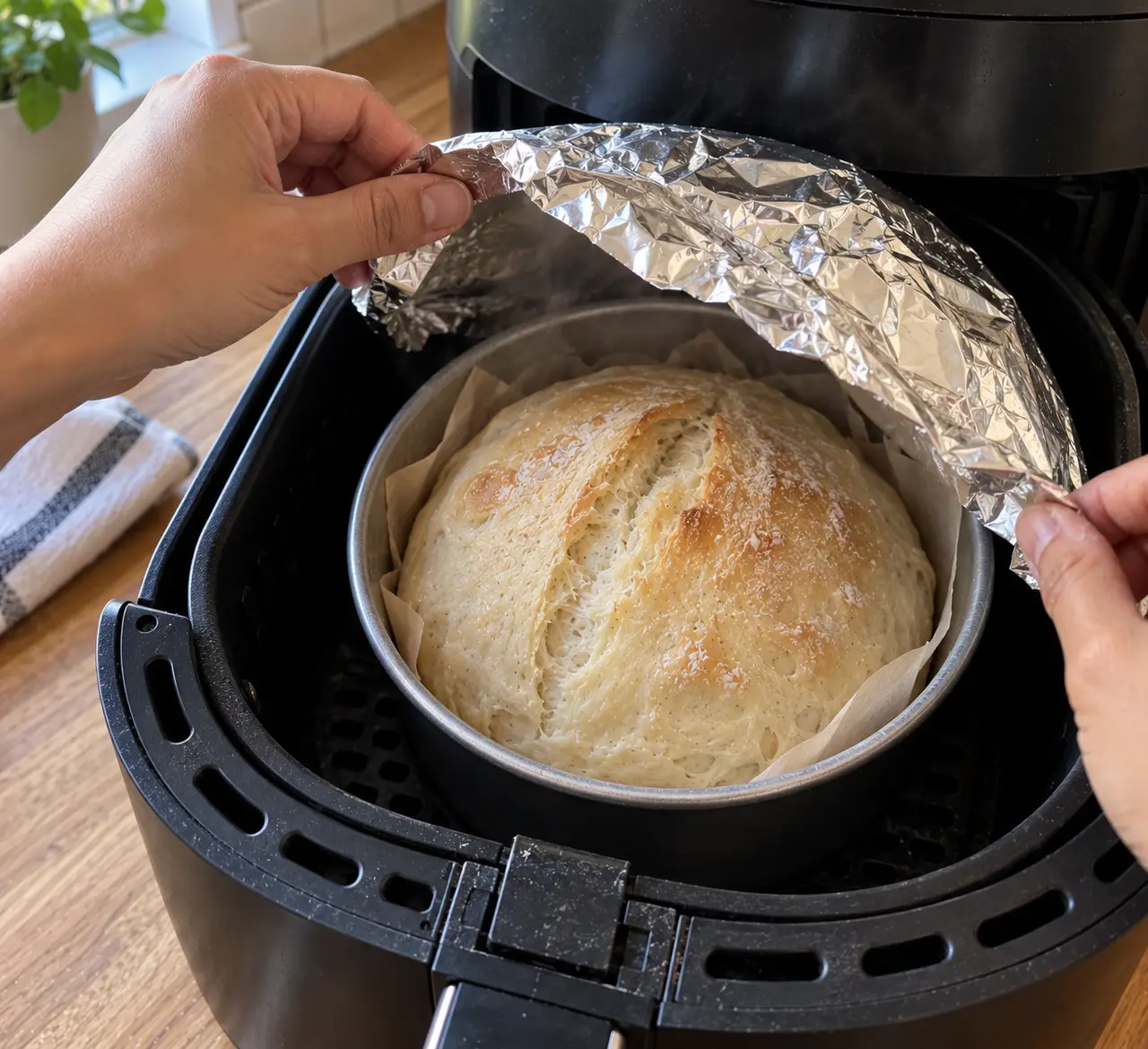
- The lid: a sheet of foil pressed tight over the pan rim, sealed all the way around, with a little headroom domed into it for the loaf to rise into. Tight matters; this is a pressure-free steam room, and a loose flap lets the fan reach in and end the experiment. The loaf's own water does the steaming; you add nothing.
- The reveal: after 25 minutes, peel the dome off. Inside is a fully risen, pale, glossy loaf. The fan now has 10 to 15 minutes to do the one thing it does better than any oven, which is convert pale and glossy into deep brown and crackled.
Temperature honesty: classic no-knead bakes at 450°F and up in the oven, and the air fryer calculator would convert that to about 425°F, which most baskets do not have. This is the same dial-ceiling problem naan and pizza dough hit, solved the same way: run the ceiling's neighborhood, 380°F under the dome where steam is doing the work anyway, and let the uncovered fan phase make up the browning that the missing degrees would have provided. Every number on the site lives in the air fryer baking chart.
Two schedules: overnight and same-day
| Overnight loaf | Same-day loaf | |
|---|---|---|
| Yeast | 1/4 teaspoon | 2 teaspoons |
| Water | Cool tap | Warm, bath temperature |
| First rise | 12 to 18 hours on the counter | 2 to 2.5 hours, or 90 minutes in the switched-off air fryer beside a mug of just-boiled water |
| Flavor | Faint tang, deep wheat, the loaf people mean by artisan | Clean and mild, entirely respectable |
| Crumb | Open, glossy, irregular holes | Even and slightly tighter |
| Use it when | You thought ahead by one evening | You did not, and dinner is at six |
Everything after the first rise, the shaping, the rest, the dome, the numbers, is identical for both. The overnight version costs 30 seconds of effort the night before and repays it in flavor; it should be your default and the same-day loaf your escape hatch.
How to make it
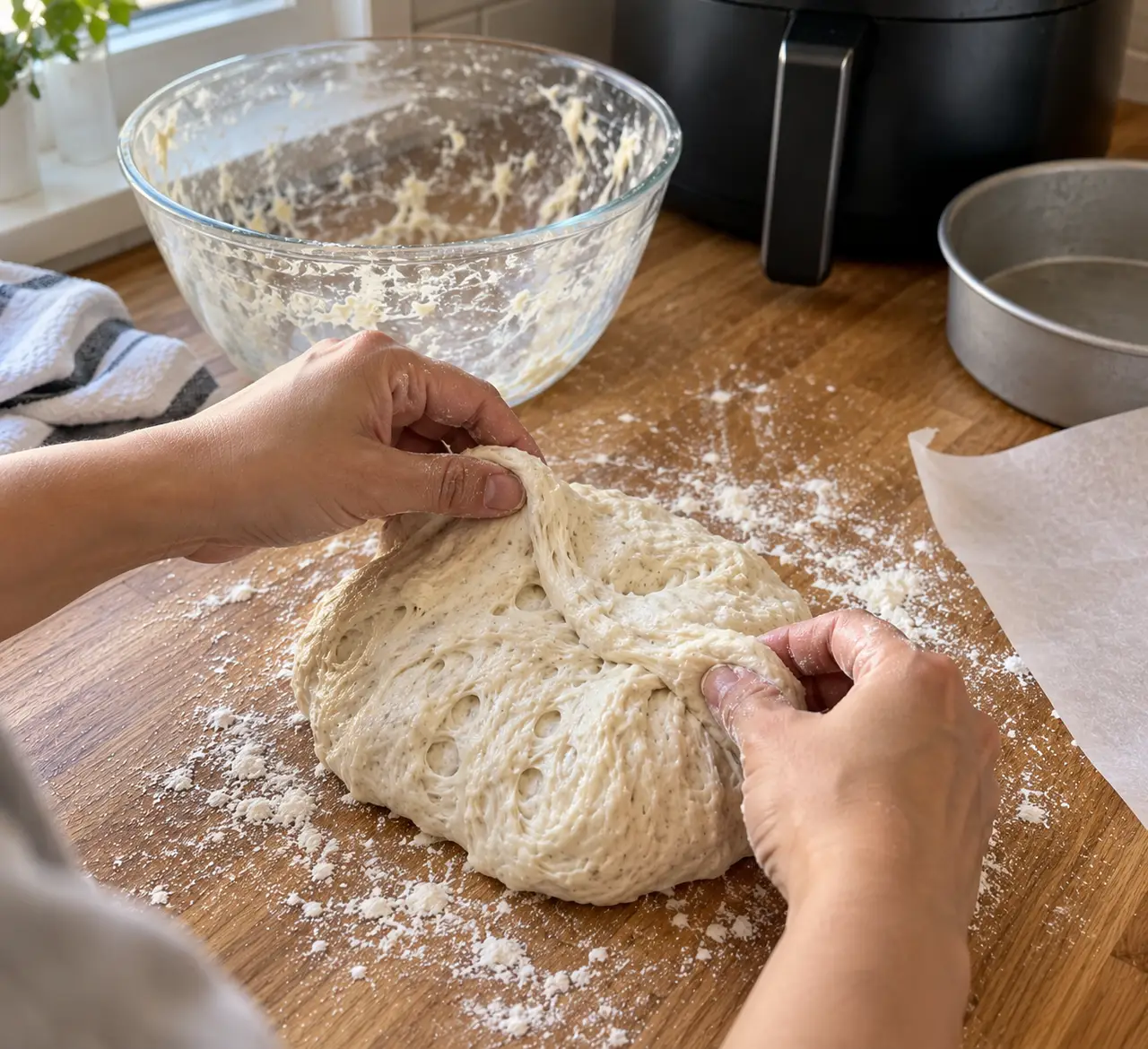
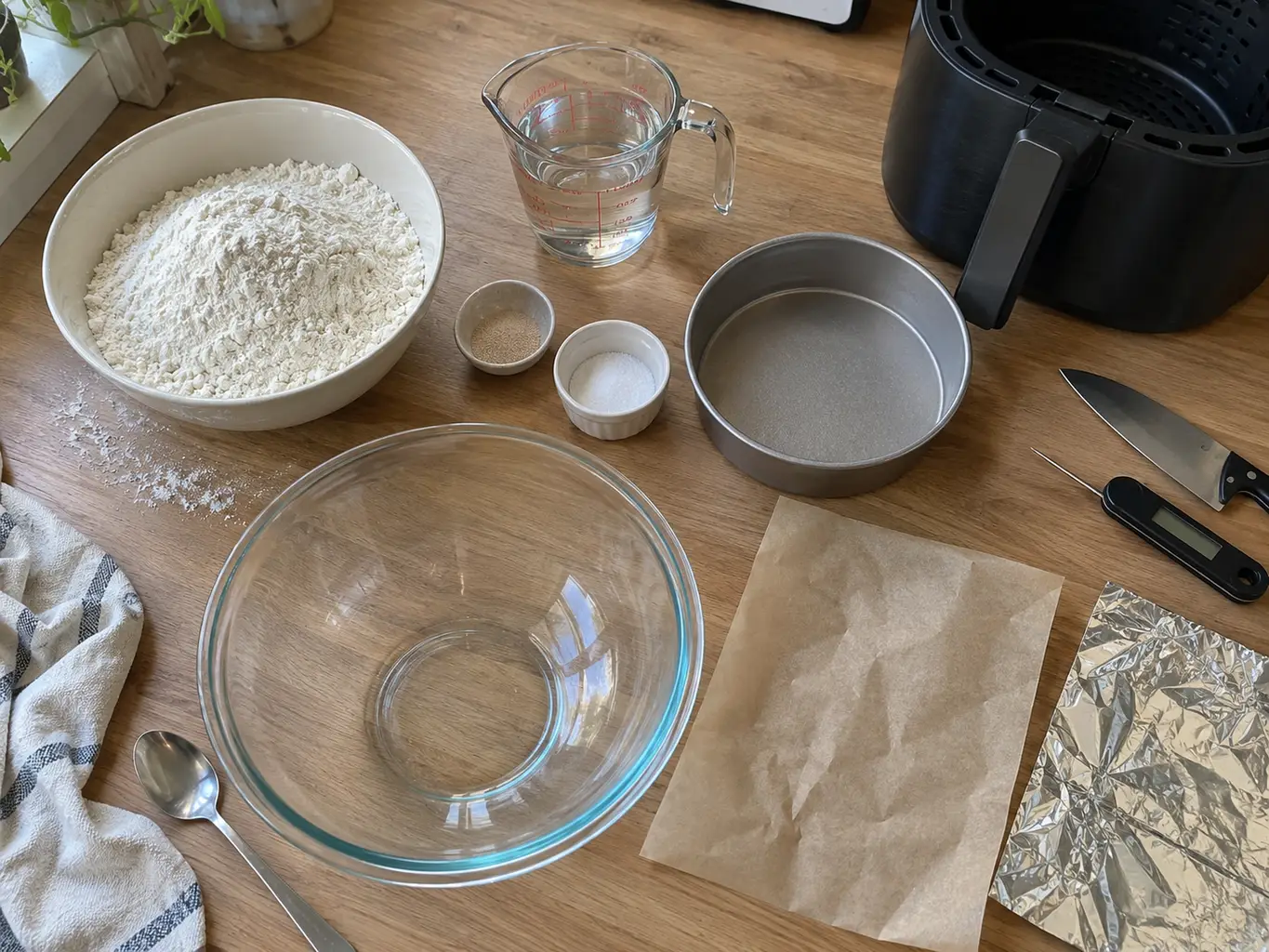
- Stir the dough: 3 cups flour, 1.5 teaspoons fine salt, and the yeast for your schedule, then 1 1/8 cups water. Stir with a spoon until no dry flour remains, about 30 seconds. It will look shaggy and unpromising. Cover the bowl.
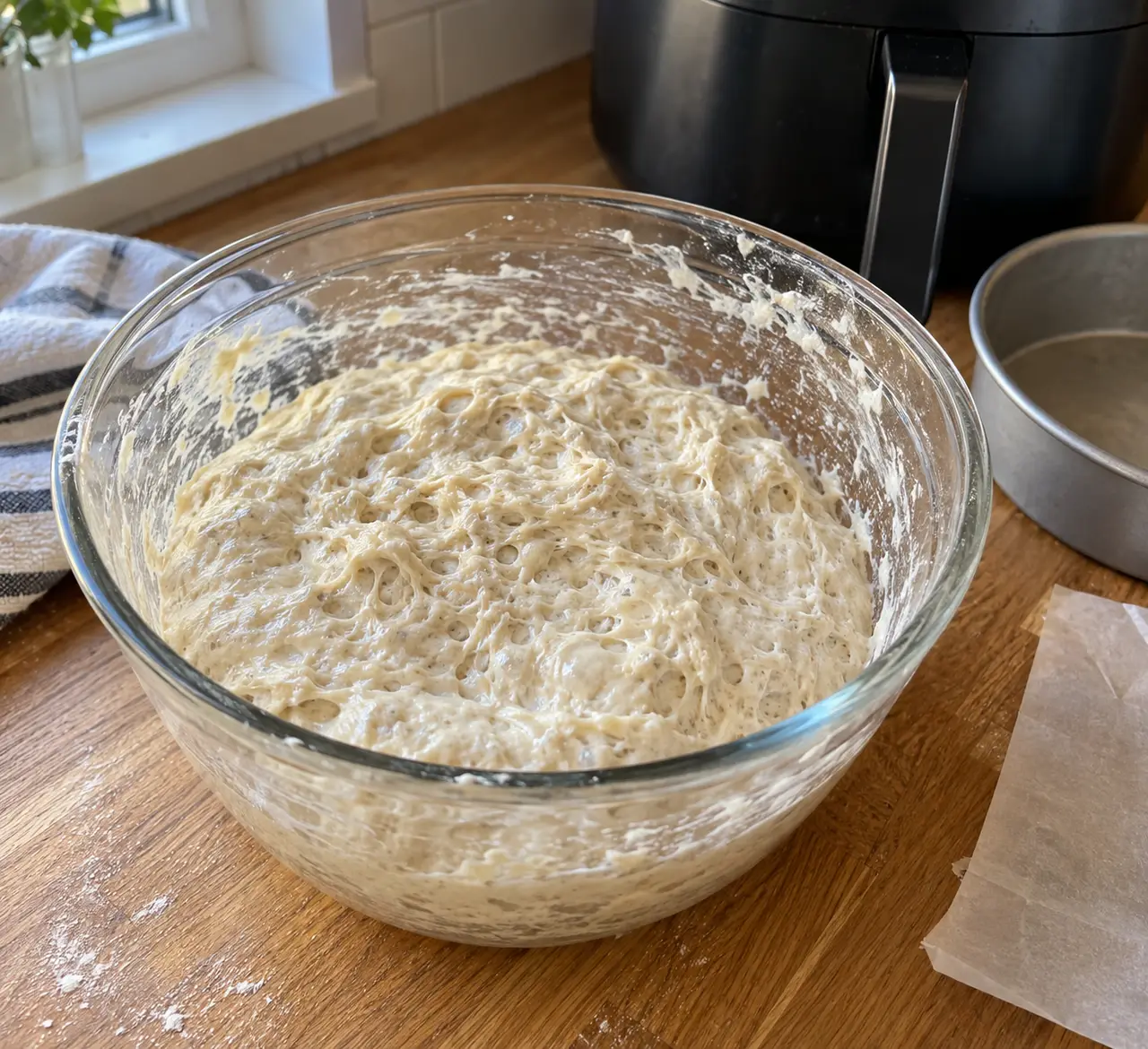
- First rise per your schedule, until doubled, bubbly on top, and smelling faintly of beer.
- Shape gently on a floured counter: scrape the dough out, fold its edges to the middle a few times like closing a box, and flip it seam-down onto a parchment square. Handle it like something sleeping that you do not want to wake; every degassing punch costs holes in the crumb.
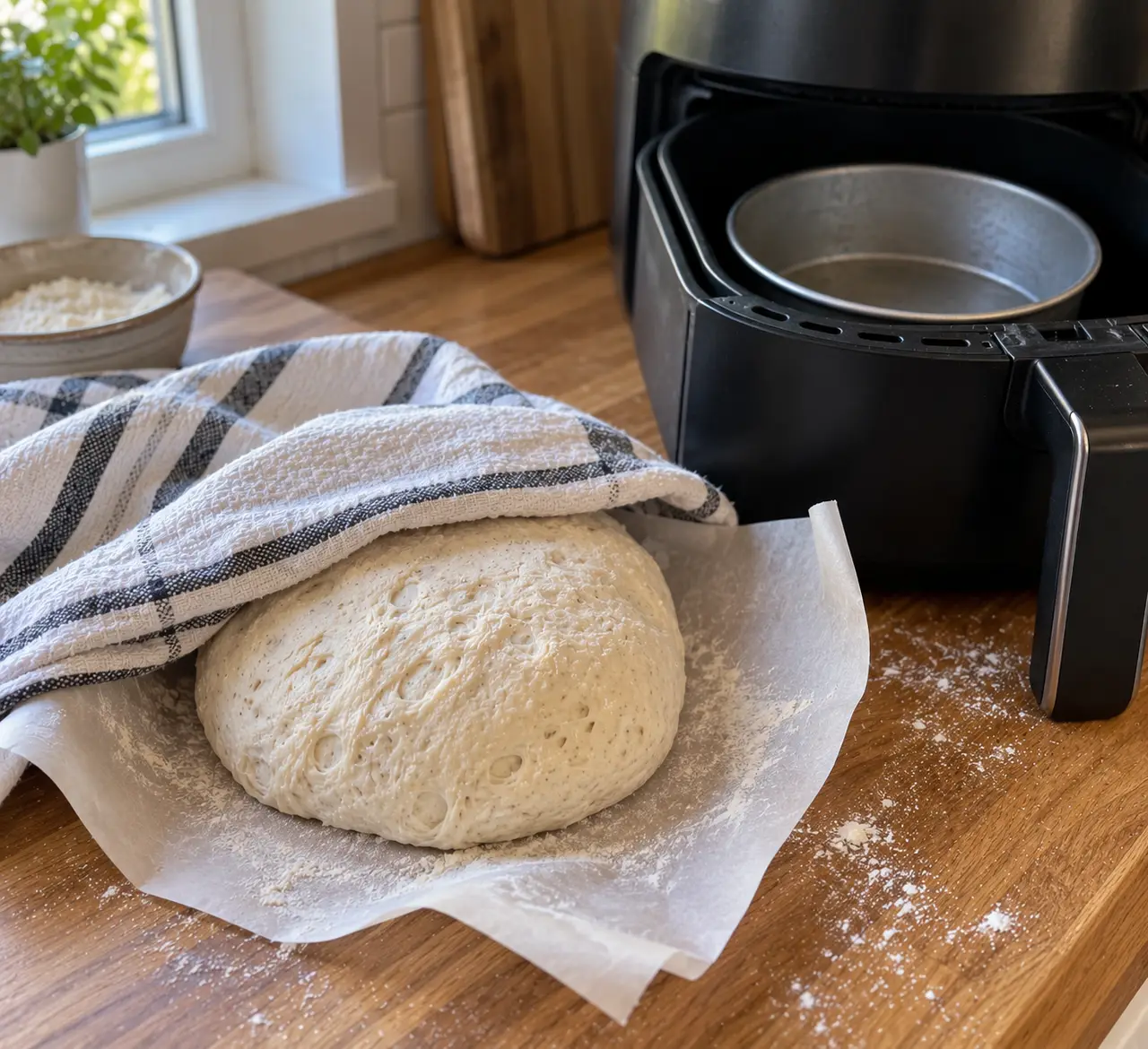
- Rest 30 minutes seam-down on the parchment under the towel while the pan preheats in its last 5 minutes.
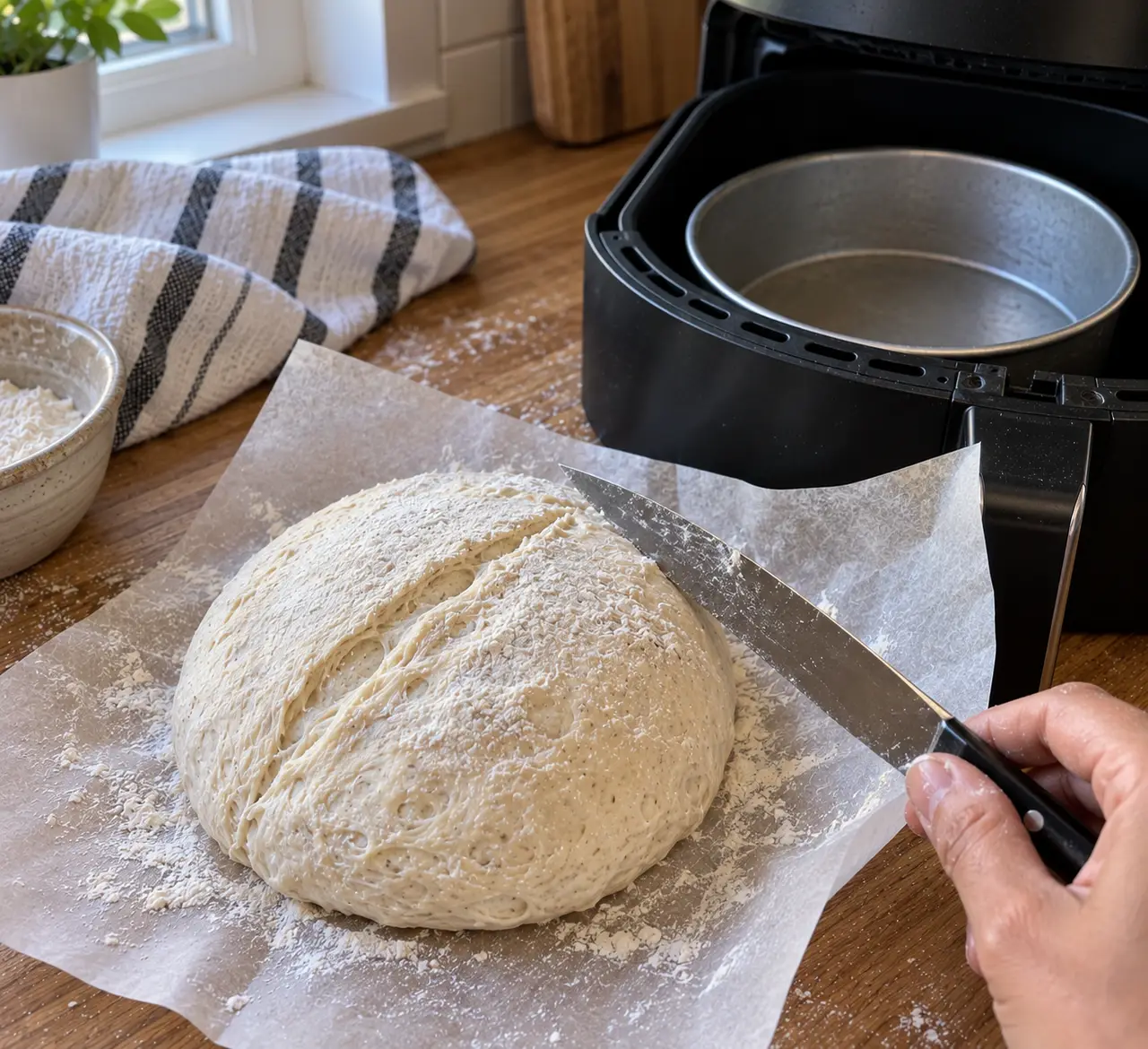
- Score it: one confident half-inch-deep slash across the top with your sharpest knife, wet the blade first. The cut is the door the loaf expands through; an unscored loaf blows out its own side instead.
- Lower the parchment into the hot pan, seal the foil dome on tight, and bake at 380°F for 25 minutes. Resist all curiosity; opening the dome early releases the steam you built the dome to keep.
- Uncover and bake 10 to 15 minutes more, until the crust is deep chestnut brown, further than pale-gold instinct wants to go. Pale crust is flavorless crust; the color is the taste.
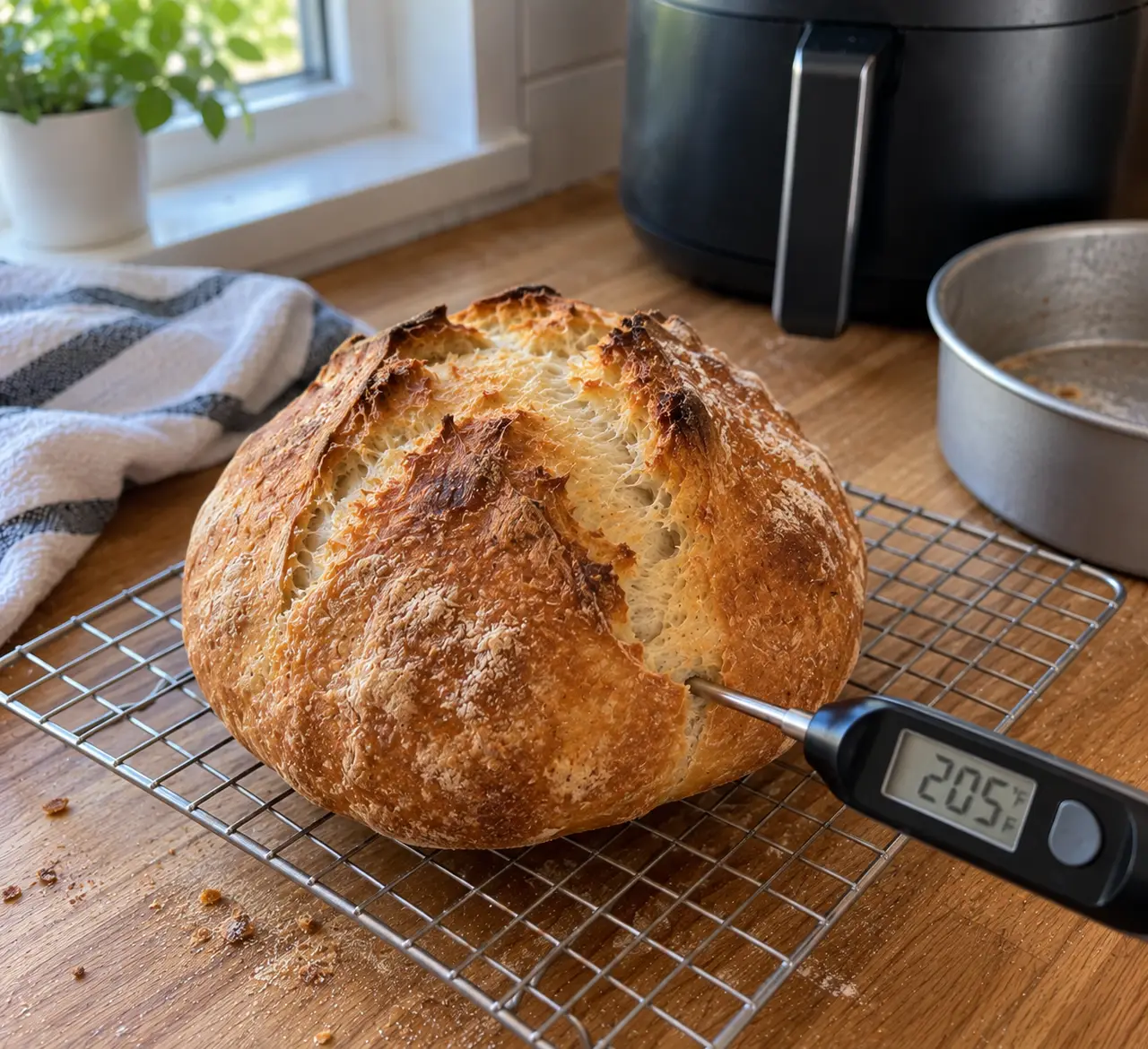
- Confirm 205°F in the center with an instant-read thermometer through the bottom, then move the loaf to a rack. The knuckle-knock hollow test is folklore with decent aim, but it cannot hear through a thick crust what the number knows for sure.
Scoring, and calling it done
The two moments people fumble are the knife and the finish line. Scoring is not decoration: a rising loaf must expand somewhere, and the slash is you choosing where, so make it decisive, half an inch deep, one motion. Shallow tentative scratches seal themselves shut in the steam, and the loaf tears wherever it pleases, usually along the pan edge like a split seam.
The finish line is a number, not a look and not a sound. Lean crusty breads finish higher than the soft loaves on this site: 205°F at the center, against 195°F for the dinner rolls, because an open wet crumb needs the extra degrees to set fully. Probe through the bottom crust so the crown stays unblemished, and remember the crust keeps darkening for a minute after the machine stops; carryover works on the outside too.
The cooling hour and the singing crust
Put the finished loaf on a rack, lean in, and listen: a proper crust crackles audibly for the first minutes as it cools and contracts, tiny ticks and pings that bakers call singing. It is the most satisfying sound this hobby produces, and it is also a quality report; a silent loaf is a soft-crusted loaf.
Then comes the discipline: one full hour before cutting. A just-baked crumb is still an active construction site, moisture redistributing, starches setting. Cut at ten minutes and the interior smears into gumminess and the knife exits wearing dough; cut at an hour and the crumb is glossy, set, and open. The bread is still faintly warm at the hour mark. That is the earliest honorable moment, and butter melts on it just fine.
Troubleshooting
| What you got | Why | Fix |
|---|---|---|
| Dull, thick, leathery crust | The dome leaked or came off early; the fan reached the wet skin. | Seal the foil tight to the rim all the way around, and give it the full 25 minutes. |
| Squat loaf, no spring | Cold pan, broken seal, or a shaped loaf left waiting too long. | Preheat the pan its full 5 minutes, dome tight, and bake within about 40 minutes of shaping. |
| Dense, tight crumb | Too much flour in the stir, or heavy hands at shaping. | The dough should be sticky-shaggy in the bowl, and shaping is folding, not punching. |
| Gummy interior | Cut too early, or pulled short of temperature. | 205°F, then the full hour on the rack. Both, not either. |
| Blowout on the side | Timid or missing score. | One confident half-inch slash with a wet blade. |
| Pale crust after full time | Under-browned, not underbaked; instinct pulled it at gold. | Keep going to chestnut. If your machine browns unevenly, give the pan a half turn at the uncovering; hot spots show up in this phase. |
| Flat beer smell, sour taste | Overnight rise went too long in a warm kitchen. | 18 hours is the ceiling at room temperature; hot summer kitchens should check at 12. |
| Burnt bottom | Pan preheated far beyond 5 minutes, or a second loaf into an already-hot machine. | Five minutes only, and knock 3 minutes off the domed phase for back-to-back loaves. The burning guide covers the rest. |
Recurring mysteries across recipes belong to the troubleshooting guide, and the preheat rules, this page being one of the few that truly preheats, live in the preheat guide.
Variations
- Rosemary and sea salt: a tablespoon of chopped fresh rosemary in the stir, flaky salt pressed along the score just before the dome goes on. It is the focaccia flavor set in a boule shape.
- Cheese crust: a handful of sharp cheddar cubes folded in at shaping. The cubes near the surface burst and fry into crisp cheese windows during the uncovered phase.
- Seeded: brush the shaped loaf with water and roll it in sesame and poppy seeds before the rest. The dome keeps them from becoming fan confetti, the same physics as the pizza toppings rule.
- Part whole wheat: swap in up to 1 cup whole wheat flour and add 2 tablespoons water. Past a third, the loaf trades height for earnestness.
- Cranberry walnut: a half cup each, folded in at shaping, and suddenly it is a holiday cheese-board loaf.
Role call, for the sake of the bread shelf: this is the site's crusty, tear-it-apart loaf. The soft sandwich loaf lives at the air fryer bread page, the pull-apart pan of softness belongs to the dinner rolls, the crisp sticks are the breadsticks, and yesterday's boule has two excellent afterlives: thick slices become garlic bread with better structure than any supermarket loaf, and the heels become the best croutons in this house's rotation.
Storing a crusty loaf
- Day one and two: cut side down on the board, naked. A plastic bag is where crackle goes to die; the exposed crust stays crisp and the cut face seals the crumb.
- Day three onward: now the bag, because by then keeping the crumb soft matters more than keeping the crust loud, and 3 minutes at 350°F resurrects the crackle on any slice whenever you want it back, which is the whole trick behind getting bakes crisp in an air fryer.
- Freeze: whole or halved, 3 months, double-wrapped. Refresh a thawed loaf at 350°F for 6 to 8 minutes and it returns to within a whisper of fresh, crust song included.
- The dough itself keeps: after the overnight rise, the covered bowl holds another day in the fridge, and cold dough is actually easier to shape. Bake day two for an even deeper tang.
Frequently asked questions
QCan you bake no-knead bread in an air fryer?
Yes, with one build: a preheated 7 inch metal pan as the floor and a tight foil dome as the lid, which together recreate the Dutch oven's sealed steam chamber inside the basket. Bake 25 minutes domed at 380°F, then 10 to 15 uncovered for color, to 205°F inside. Without the dome, the fan dries the skin in the first minutes and the loaf comes out squat with a dull, leathery crust.
QHow long does no-knead bread take in an air fryer?
The bake is 35 to 40 minutes at 380°F: 25 under the foil dome, 10 to 15 uncovered. The rise is where the real time lives: 12 to 18 hours on the counter for the overnight loaf with its quarter teaspoon of yeast, or 2 to 2.5 hours for the same-day version with 2 teaspoons. Then one non-negotiable hour of cooling before the knife, because a hot crumb cuts gummy.
QDo you really need a Dutch oven for no-knead bread?
No. The Dutch oven contributes exactly two things: a preheated floor and a sealed lid that traps the dough's own steam, which keeps the skin elastic for oven spring and gelatinizes the surface into the glossy, crackly crust. A hot cake pan supplies the floor and a tightly sealed sheet of foil supplies the lid, at a combined cost of roughly nothing. The pot was always just a steam trap with a handle.
QWhy is my air fryer bread crust not crusty?
Steam escaped, or steam never happened. A crackly crust requires the surface to stay moist and elastic through the rise phase, then dry fast under heat. If the foil dome leaked, came off early, or was never used, the fan dried the skin immediately and it set thick and dull instead. Seal the dome tight to the pan rim, keep it on the full 25 minutes, and then let the uncovered fan phase run to deep chestnut, not gold.
QWhat is the difference between the overnight and quick versions?
Yeast and flavor. The overnight loaf uses a quarter teaspoon of yeast and 12 to 18 slow hours, which build a faint sourdough-adjacent tang and a glossy, open crumb. The same-day loaf uses 2 teaspoons and rises in about 2.5 hours, tasting cleaner and milder with a slightly tighter crumb. The bake is identical. Make the overnight one when you remember tonight that you want bread tomorrow.
QWhy do you score bread before baking?
Because the loaf must expand somewhere in its first minutes, and the score is you choosing where. One confident slash, half an inch deep with a wet sharp blade, opens a controlled door that blooms into the classic split crown. Skip it, or scratch timidly, and the pressure finds its own exit, usually a ragged blowout along the side of the loaf where the crust set weakest.
QHow do I know when the loaf is done?
205°F on an instant-read thermometer pushed to the center through the bottom crust, higher than the 195°F of soft breads because a wet open crumb needs the extra degrees to set. The traditional hollow-knock test points the right direction but cannot hear through a thick crust reliably. Color is the other half of doneness: a crust pulled at pale gold is underdeveloped even when the inside is cooked, because on lean bread the color is the flavor.
QWhy is my no-knead bread dense?
Usually extra flour, sneaked in because the dough looked too sticky. It is supposed to look too sticky; wetness is what lets gluten organize without kneading. The other culprits are heavy-handed shaping that punched out the bubbles the long rise built, an under-risen bowl baked too soon, or a cold pan that never fired the spring. Fold gently, trust the shag, and preheat the floor.
QHow do you store crusty bread so it stays crusty?
For the first two days, cut side down on the cutting board with the crust exposed to the air; a plastic bag softens crackle within hours. From day three, bag it to protect the crumb and re-crisp slices at 350°F for 3 minutes as needed. The loaf freezes beautifully for 3 months double-wrapped, and 6 to 8 minutes at 350°F brings a thawed loaf back, crackle and all.
Never overbake again
Get our one-page times & temps cheat sheet, plus a new tested recipe each week.
No spam · unsubscribe anytime