

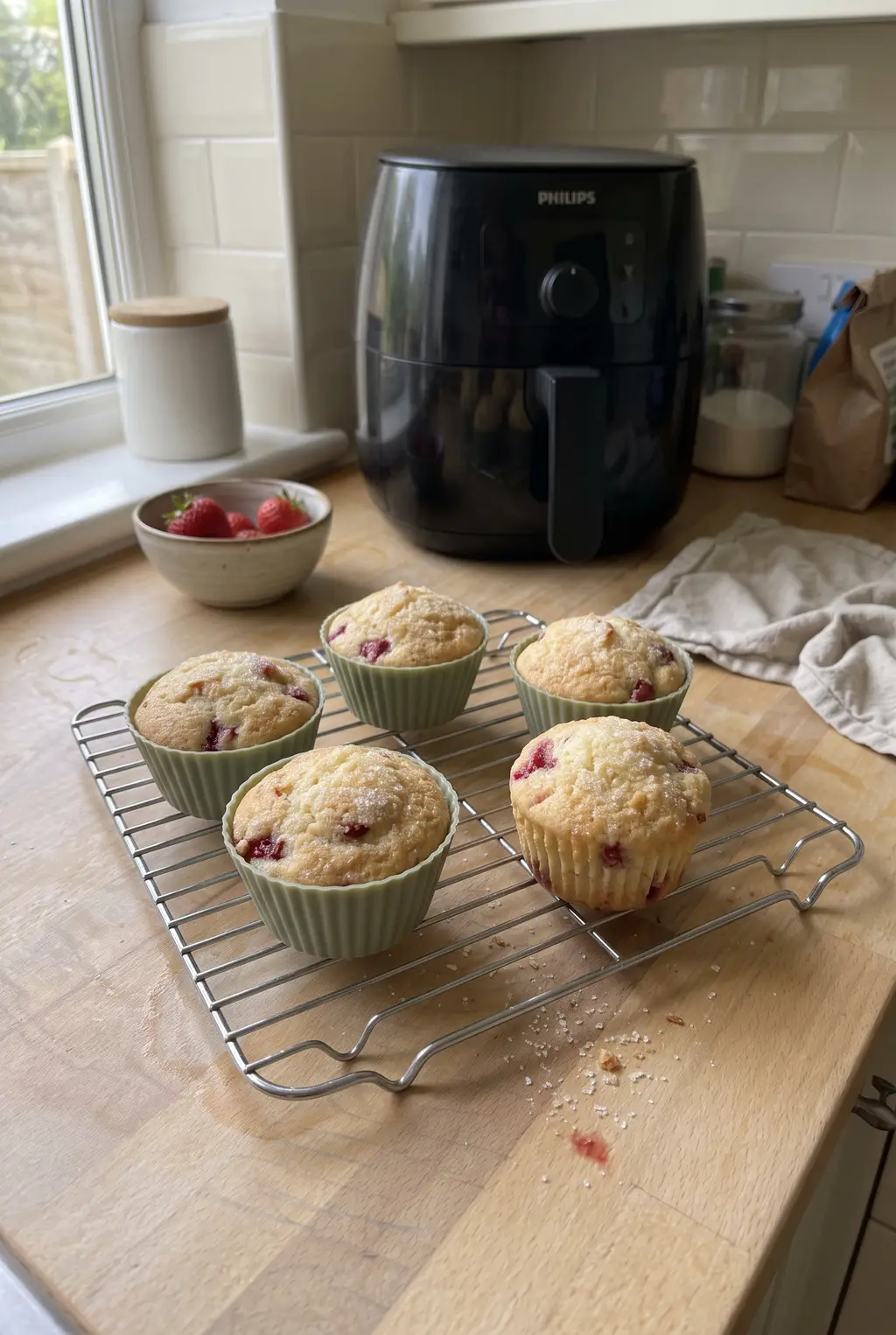
I baked my way through strawberry muffin disappointment in the usual order. First the soggy batch, wet caves around every berry, from chunks cut big and juicy. Then the pink batch, batter smeared rose from folding too long, pretty in a way that promised more flavor than it delivered. Then the saddest batch of all: structurally perfect muffins, evenly pink-flecked, that tasted like sweet bread with a rumor in it. That third failure is the one nobody warns you about, and it is the one this recipe was built to kill.
Because here is the strawberry's whole character sheet, stated plainly the way none of the thin recipes ranking for this keyword bother to: it is about 91 percent water, its cut flesh has no skin to hold that water in, and the compounds that make it taste like strawberry are volatile and dilute, half of them boiling away or washing out in the bake. A blueberry is a sealed pouch that cooks into a jam pocket on its own; that is why the blueberry muffins are the easy sibling. Strawberries need managing on three fronts at once, water, color, and flavor, and each front has a specific, cheap move. Three moves, one genuinely great muffin, and a method tuned for the basket this site bakes everything in.
Quick answer: Dice strawberries small, blot the dice dry on paper towels, and toss it in a spoonful of the dry mix; fold it in last, with the fewest strokes of the day. Frozen berries go in still frozen, never thawed. For flavor that survives the oven, whisk crushed freeze-dried strawberries into the dry ingredients, concentrated berry with zero added water. Bake in rigid silicone cups at 320F for 13 to 15 minutes to a 205F center, and finish the popped-out muffins 2 minutes naked in the basket for bronze sides.
The wettest berry in baking, and why the muffin pays for it
Water is the quiet villain of every quick bread, and the strawberry smuggles more of it than anything else you would reasonably fold into batter. Worse than the quantity is the packaging: a blueberry's water rides inside an intact skin until the heat sets the crumb around it, but a strawberry has to be cut to muffin size, and cut flesh starts leaking immediately, into the bowl, into the batter, and into the crumb around each piece, where it bakes into the gummy, wet-cave texture that reads as raw even when the muffin is fully cooked. Meanwhile the water that stays in the berry dilutes its own flavor, which is why a berry that tasted like June on the cutting board tastes like a suggestion after twenty minutes at temperature. Every fix in this recipe is some form of the same instruction: less water in, or more flavor per drop.
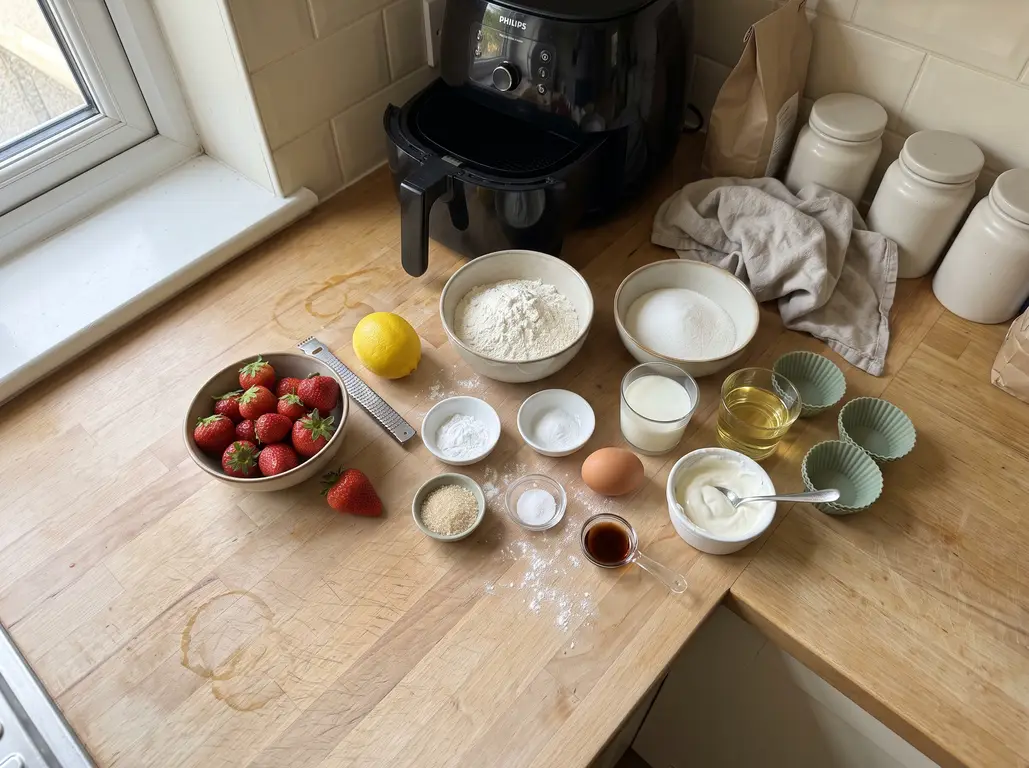
The three-front defense: dice, blot, toss, and fold last
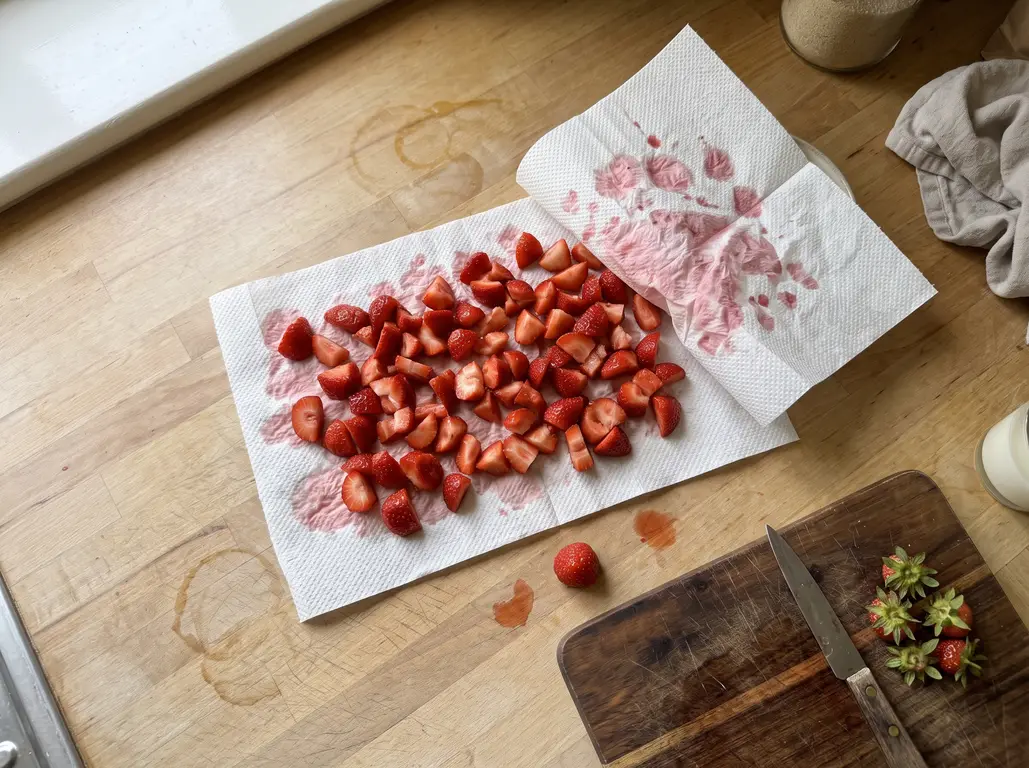
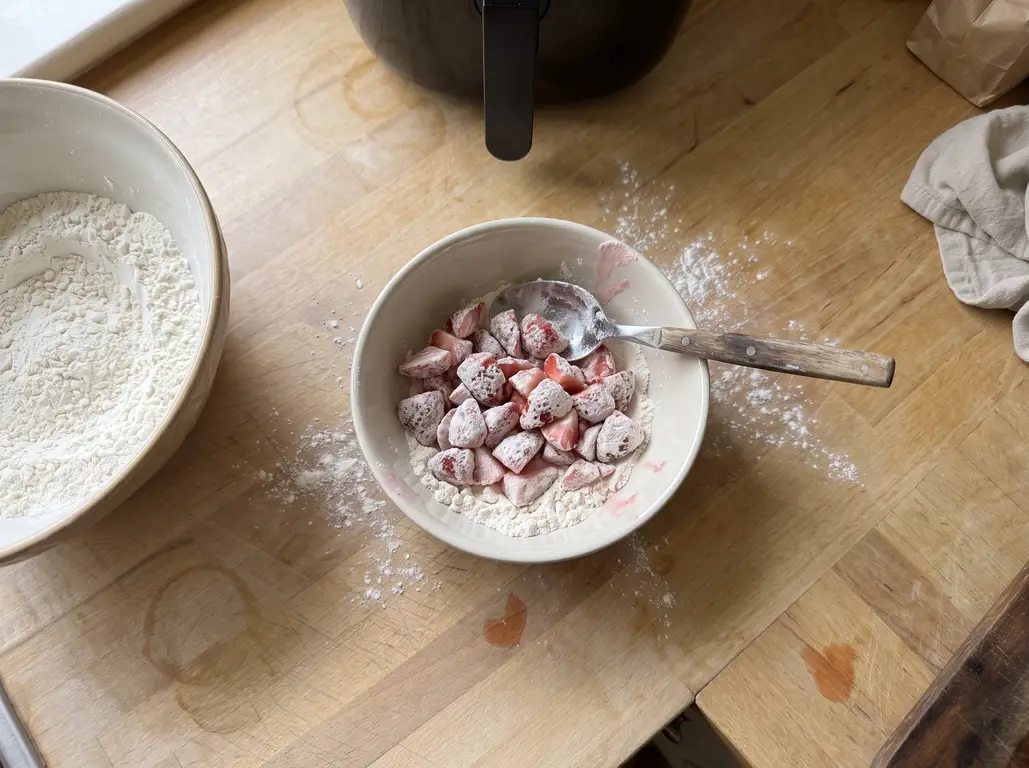
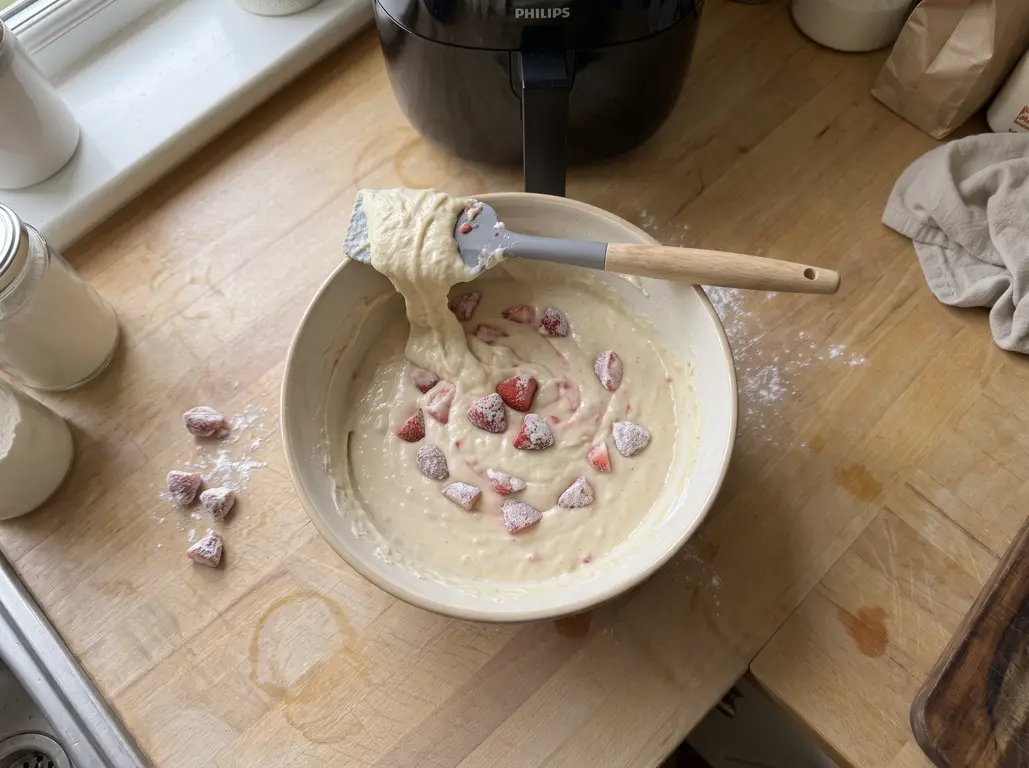
Front one is the knife: a small dice, between a quarter and half an inch, because small pieces shed less juice per pocket and distribute further, so no single neighborhood of crumb drowns. Front two is the towel: spread the dice on paper towels, lay one more sheet on top, and press gently for thirty seconds. That blot pulls off the surface juice that would otherwise go straight into the batter, the same water-comes-out-first thinking this site applies to every wet ingredient in the fall lineup. Front three is the toss and the fold: shake the blotted dice with a spoonful of the dry mix until every face is dusted, then fold it in absolutely last, after the batter is otherwise finished, with three or four wide strokes. The flour coat grips the batter and slows the bleed; the minimal fold is what keeps the bleed from becoming a dye job, because every extra stroke drags pink through the bowl. Do all three and the berries arrive at the bake dry-jacketed, suspended, and intact.
Fresh vs frozen, settled in one paragraph
Fresh berries in season beat frozen on flavor and always will; blot them and proceed. Out of season, frozen strawberries are genuinely fine with one non-negotiable rule that the internet keeps getting backwards: they go into the batter still frozen, straight from the bag, diced while icy if they went in whole. Thawed berries are the worst of every world, limp flesh in a puddle of exactly the juice you have been fighting, and no amount of draining recovers them. A frozen berry, by contrast, holds its water as ice through the mixing and releases it only after the crumb has begun to set around it, which is the closest thing to a blueberry's sealed-pouch behavior a strawberry will ever offer. Expect one to two extra minutes of bake time and slightly more pink at the seams, both cheap at the price. The same still-frozen rule runs the raspberry muffins, the other soft berry that punishes a thaw.
The freeze-dried fix: flavor with the water already removed
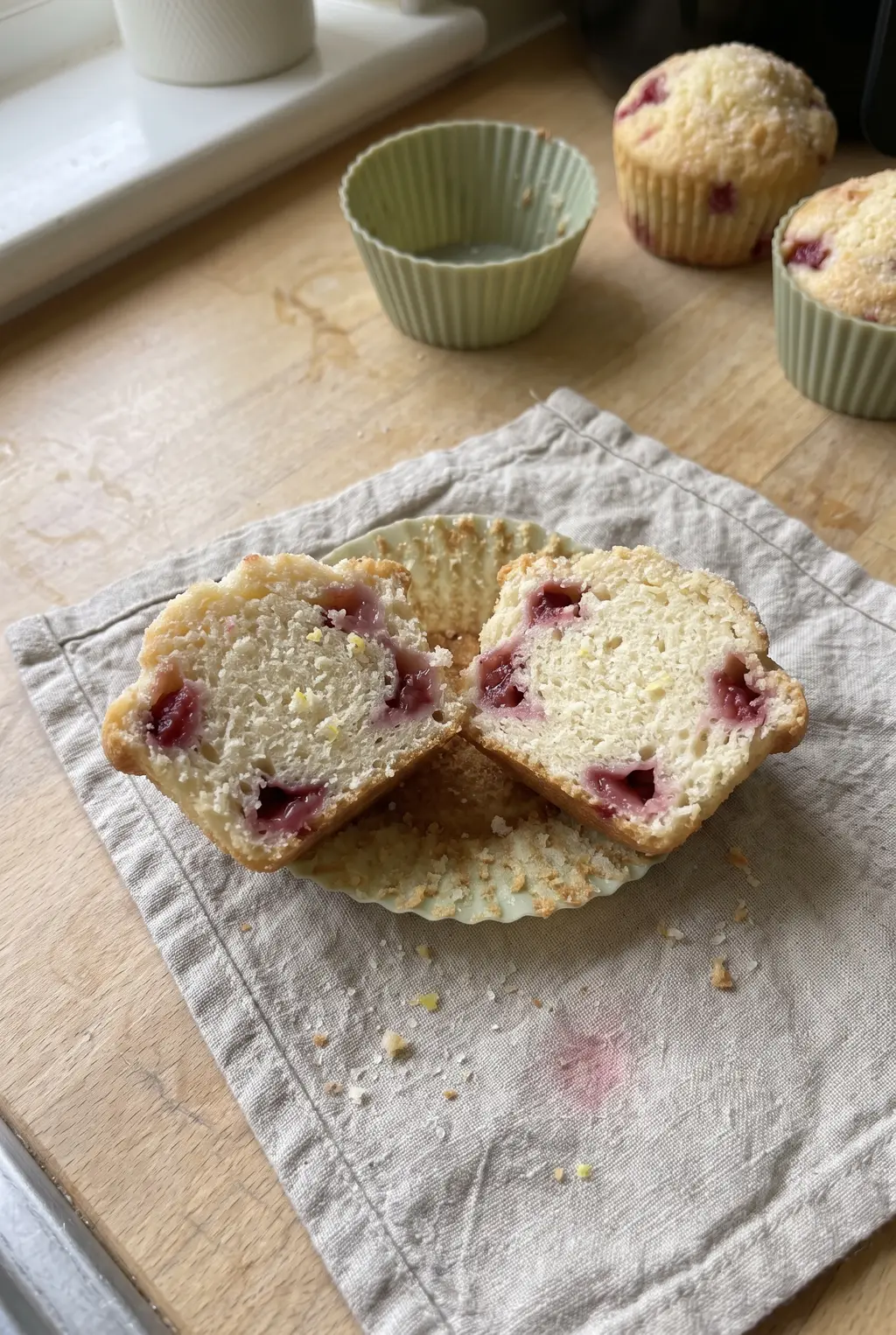
Now the move that separates this muffin from every version above it in the rankings. Freeze-dried strawberries, the crisp snack-aisle kind with one ingredient on the label, are real berries with roughly all of their water removed and none of their flavor compounds cooked off, because freeze-drying happens cold. Crush a handful to powder and coarse crumbs, a bag corner and a rolling pin is all it takes, and whisk a quarter cup into the dry ingredients. In the bake, those crumbs drink batter moisture instead of adding any, and they release concentrated berry flavor through the entire crumb, so the muffin itself tastes like strawberry instead of politely hosting some. It is the same logic as the site's other concentration moves, remove the water, keep the flavor, except the factory did the work. The powder is optional and the recipe stands without it; it is also the difference between good and the batch your household names. If your machine bakes on the dry side to begin with, the moisture-defense playbook in the dry bakes guide pairs well with everything on this page.
Cups, temperature, and the schedule
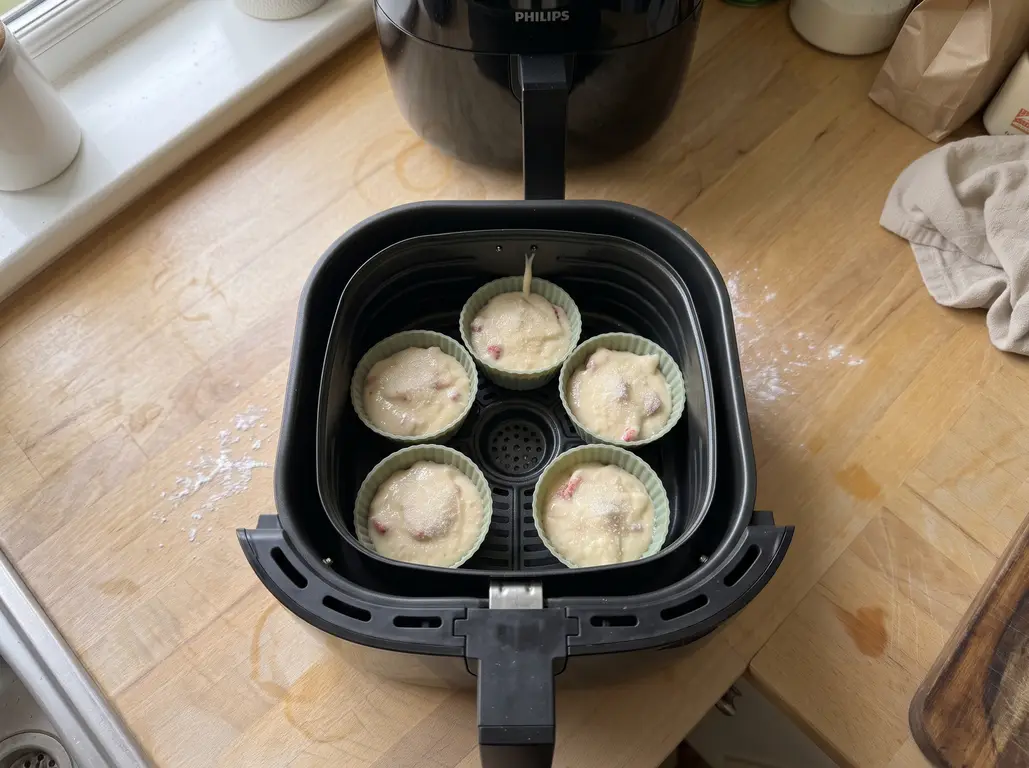
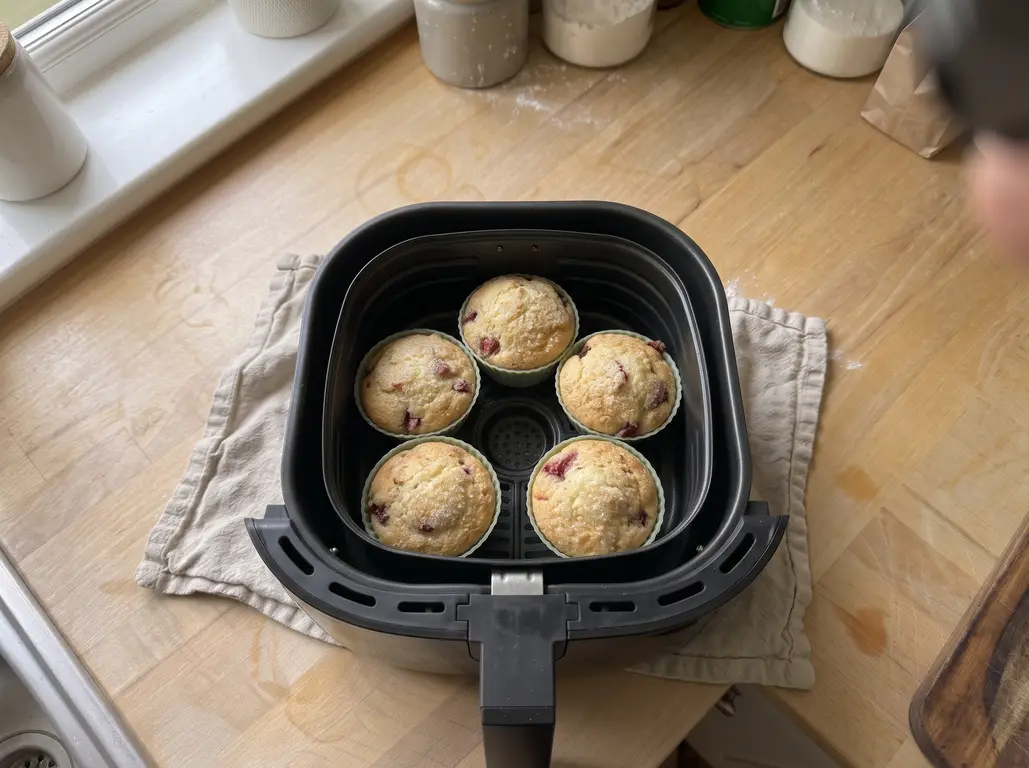
The hardware and numbers follow house muffin doctrine, stated here in brief. Rigid silicone cups, never floppy ones and never unsupported paper liners, per the silicone molds guide; four or five cups per batch with air between them. 320F, not the oven's 350F, because the element is close and crowns scorch before centers set, the same discount the air fryer calculator applies to any oven muffin recipe you bring over. Thirteen to fifteen minutes, rotating the cups a half turn at minute 8 if your machine has a known hot corner, and done means 205F on an instant-read probe in the middle muffin, never the toothpick alone, because berry pockets fake wet crumbs and browned crowns fake doneness, and the probe is immune to both lies. Carryover finishes the last degrees on the rack. Silicone's one cosmetic tax, pale sides, gets the house fix: tip the finished muffins out of their cups and run them naked in the basket for 2 minutes at 340F, and they come out bakery-bronze all around. Second batch runs a minute quick, and every other tested quick bread setting lives in the baking chart.
Variations, and the rest of the muffin shelf
Lemon zest is already in the base recipe because strawberry without acid is a singer without a microphone; double it if your berries are pale, the way the lemon poppy seed muffins lean on zest for lift. White chocolate chips work if you cut the sugar by two tablespoons. Mashed banana swapped for the sour cream gives you the strawberry banana muffin the internet keeps asking for, kin to the banana muffins next door. A clumped streusel per the house squeeze rule suits these as well as any muffin, though the coarse-sugar top in the recipe is faster and lets the pink flecks show. Beyond that, the shelf is deep: blueberry for the easy berry, raspberry for the other soft one, chocolate chip for the crowd, and the berry cobbler when you have more fruit than muffin ambition. For sizing, the mini versus jumbo guide and the recipe scaler do the math, and the small batch guide is for households where nine muffins is a week's supply, with this batter freezing portioned in its cups and baking from frozen with 3 extra minutes. The wider map of what the basket does and does not bake well is the can-and-cannot-bake rankings.
Frequently asked questions
QCan you make strawberry muffins in an air fryer?
Yes, in rigid silicone cups at 320F for 13 to 15 minutes, four or five per batch, pulled at 205F in the center. The machine handles the muffin easily; the strawberry is the actual challenge, because cut berries bleed water and color into batter. Dice them small, blot the dice on paper towels, toss it in a spoonful of the dry mix, and fold it in last with minimal strokes, and the berries bake into intact pockets instead of soggy caves.
QWhy are my strawberry muffins soggy in the middle?
The berries, nearly always. Strawberries are about 91 percent water with no skin to hold it once cut, so big juicy chunks shed liquid into the surrounding crumb, which bakes gummy and reads as raw. Cut a smaller dice, press it dry between paper towels before it meets the batter, and coat it in flour so the bleed slows. Verify doneness with a thermometer at 205F rather than a toothpick, since a berry pocket can smear a toothpick and fake wetness in a fully baked muffin.
QShould I use fresh or frozen strawberries in muffins?
Fresh in season for flavor, frozen the rest of the year, and the frozen rule is absolute: into the batter still frozen, never thawed. Thawed berries collapse into a puddle of the exact juice you are trying to keep out of the crumb. Frozen berries hold their water as ice until the batter has begun to set around them, which contains the mess. Expect a minute or two more bake time with frozen, and slightly more pink at the edges of each pocket, which is cosmetic.
QHow do you keep strawberries from bleeding into the batter?
Three habits, in order of impact: fold the berries in last, after the batter is completely mixed, using three or four wide strokes and no more, because every additional stroke drags juice through the bowl; toss the diced berries in a spoonful of flour first, which jackets each piece and slows the bleed; and blot fresh dice dry before the toss so there is less free juice available to smear. A little pink at the seam of each pocket is natural and reads as homemade rather than as a mistake.
QWhy don't my strawberry muffins taste like strawberry?
Because strawberry flavor is dilute and heat-fragile: the berry is mostly water, and its aroma compounds partly boil away during baking, leaving texture without taste. The fix is concentration. Whisk a quarter cup of crushed freeze-dried strawberries into the dry ingredients; they carry full berry flavor with the water already removed and release it through the whole crumb as they rehydrate in the batter. A teaspoon of lemon zest helps too, sharpening whatever berry flavor survives the bake.
QWhat temperature do you bake muffins in an air fryer?
320F for 13 to 15 minutes in standard silicone cups, a deliberate notch below the oven's 350F because the air fryer's heating element sits inches above the crowns and moving air delivers heat harder than still air at the same setting. At 320F the tops, walls, and centers finish together instead of the crown browning first and lying about the middle. The same 25 to 30 degree discount converts any oven muffin recipe to the basket, checked early the first time.
QCan I use strawberry jam instead of fresh strawberries?
Not as a substitute, but it works as an accent: drop a half teaspoon of thick jam onto the center of each filled cup and swirl once with a toothpick before baking. Jam swapped in for the diced berries makes the muffins overly sweet and strangely textured, since jam is sugar-bound water with no fresh structure. The best flavor stack is all three tiers: diced fresh or frozen berries for pockets, freeze-dried powder for the crumb, and the optional jam swirl for the top.
QHow do you store strawberry muffins?
These are the most perishable muffins on the shelf because the berry pockets stay moist, so plan for 2 days airtight at room temperature with a paper towel above and below, then move survivors to the freezer rather than the refrigerator, which dries the crumb while doing nothing for the berries. Frozen baked muffins keep 2 months and revive at 320F for 3 to 4 minutes. Batter portioned into silicone cups also freezes raw and bakes from frozen with about 3 extra minutes.
QWhy did my muffins come out pale on the sides?
Silicone insulates, so the cup walls shield the sides and bottoms from browning while the exposed crowns bronze in the direct overhead heat. The muffins are fully baked, just pale where the cup sat, and the fix costs 2 minutes: tip the finished muffins out of their cups and return them naked to the basket at 340F, where the direct air bronzes the walls and floor to match the crown. It is optional cosmetics, and it is also the difference between homemade-looking and bakery-looking.
Never overbake again
Get our one-page times & temps cheat sheet, plus a new tested recipe each week.
No spam · unsubscribe anytime