

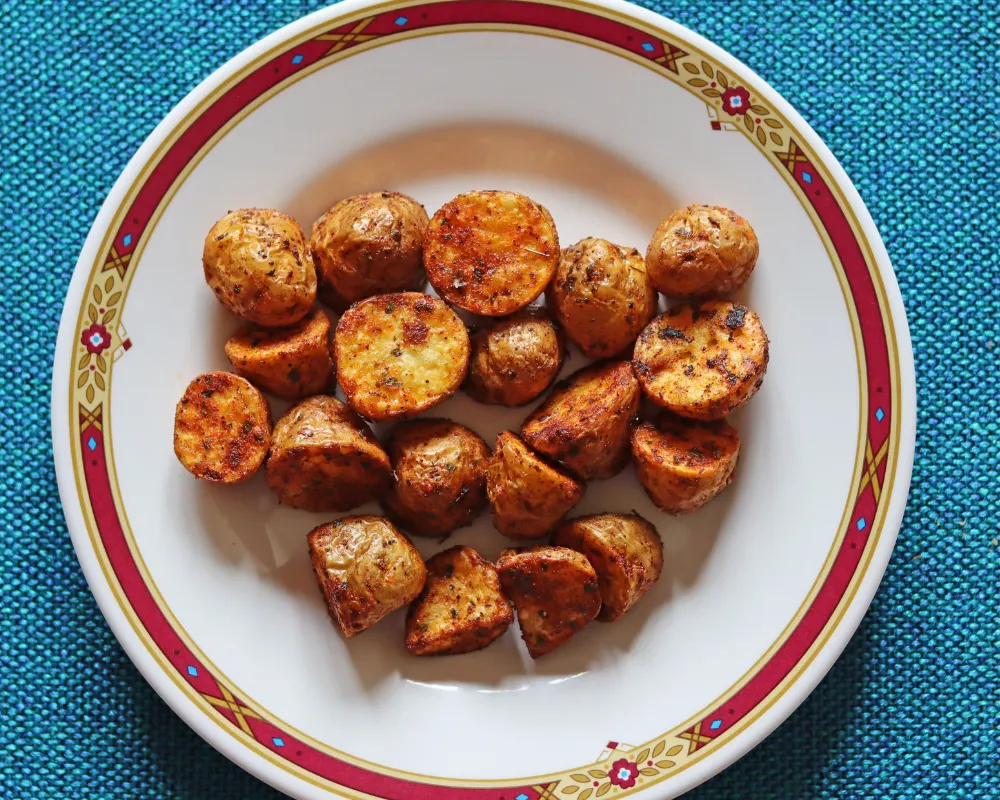
I made these the way the internet said to for about a year. Halve them, oil, salt, four hundred degrees, shake the basket at the ten minute mark. What I got every time was fine. Soft inside, skin a bit leathery, and a sort of patchy tan on the cut sides that was not really a crust.
Then one evening I forgot about them. No shake, no toss, just twenty minutes and a beep. Every single potato had a flat golden face on it, the kind you get from a cast iron pan, and I had been sabotaging them on purpose for a year.
Quick answer: Halve them, toss with oil and salt, and lay them cut side down in a single layer on a preheated basket. 400°F for 18 to 22 minutes. Do not shake, do not toss, do not turn them. Pull them at 205°F inside. If your machine has a hot spot, turn the whole basket around once at the halfway point without disturbing the potatoes.
Everybody says shake. Do not shake.
I looked at the recipes ranking for this and nearly all of them do the same two things in the same order. They tell you to cut the potatoes in half. Then, a few lines later, they tell you to shake the basket or toss the potatoes halfway through.
Those instructions are working against each other, and nobody seems to have noticed.
Shaking is genuinely correct for a lot of things in an air fryer. It is right for fries, for wings, for anything in loose pieces that need every side exposed to moving air. Our own glossary entry on shaking covers when it helps. It is exactly wrong for a halved potato, because a halved potato is not trying to brown on every side. It is trying to brown on one.
What the shake actually costs you. A cut face takes several minutes of uninterrupted contact with the hot basket floor to build any color. Every shake lifts every potato and puts it back down in a random orientation, so most of them land skin down and start again from nothing. Shake twice in a twenty minute cook and you have given the average potato maybe six or seven minutes of face contact spread across three separate attempts. That is why the color comes out patchy rather than even.
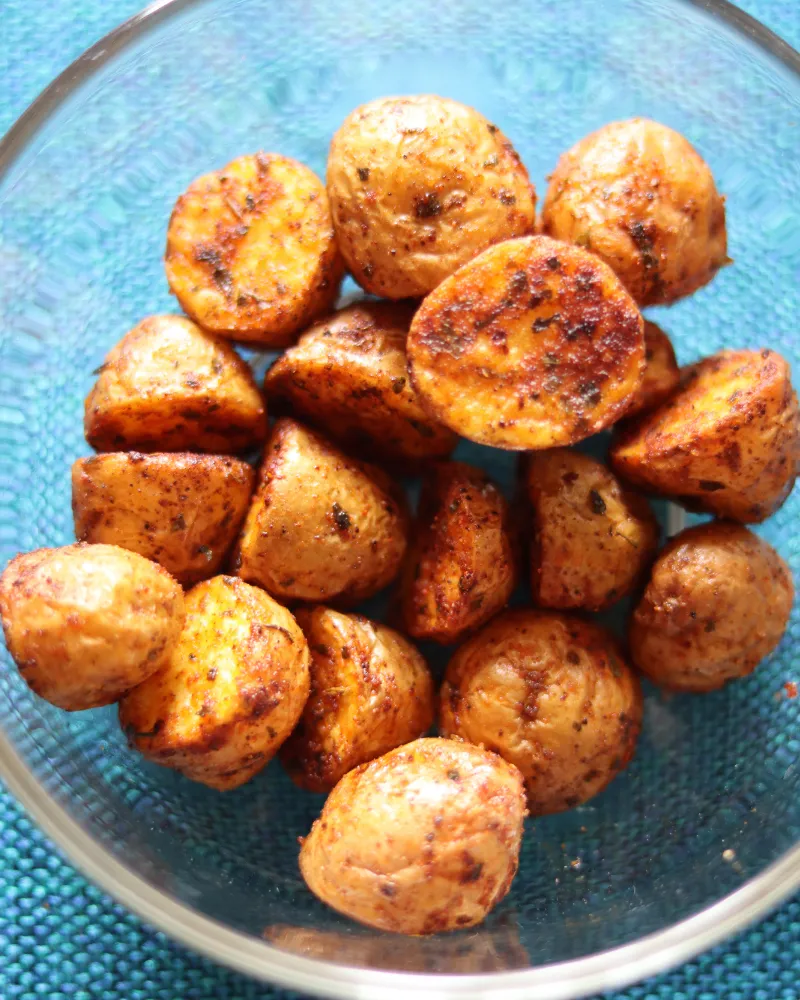
Leave them alone and each potato gets the full eighteen minutes on the same patch of floor. The difference is not subtle and it costs nothing.
The crust comes from the floor, not the air
This is the bit worth understanding, because once you have it the rest of the recipe explains itself.
An air fryer browns things two different ways and they are not equally good at it. Hot air moving over a surface is forced convection, and it is what makes an air fryer better than a still oven. But air is a poor carrier of heat compared with metal. Direct contact between food and a hot solid surface is conduction, and it moves heat into food far faster than any amount of moving air can.
Curved, waxy, and only meeting air
Potato skin is a barrier by design. It is water resistant, it is curved so nothing presses against it, and moving air is all it ever gets. It dries and toughens. It does not build a crust.
Flat, starchy, and pressed to hot metal
A cut surface is exposed starch with no skin in the way, and being flat it sits in real contact with the basket floor. That is a frying pan, not an oven.
One golden side, and that is the point
The Maillard reaction and a little starch browning happen properly on that face and nowhere else. Serve them cut side up.
Which leads to two things the recipes skip.
- Preheat, and mean it. Preheating matters more here than in almost anything else, because the whole method depends on the potato meeting a floor that is already hot. Put a cut face onto a cold crisper plate and it sits there sweating for three minutes before anything starts. Three minutes of preheat buys you all of that back, and whether you need to preheat an air fryer goes through where it earns its keep and where it does not. The glossary covers preheating and recovery time.
- Single layer, and not touching. Every potato needs its own patch of floor. Two potatoes leaning on each other are sharing one contact point and shading each other from the air as well. Two batches genuinely beat one crowded basket here, and the second one runs a couple of minutes faster because the machine is already up to temperature.
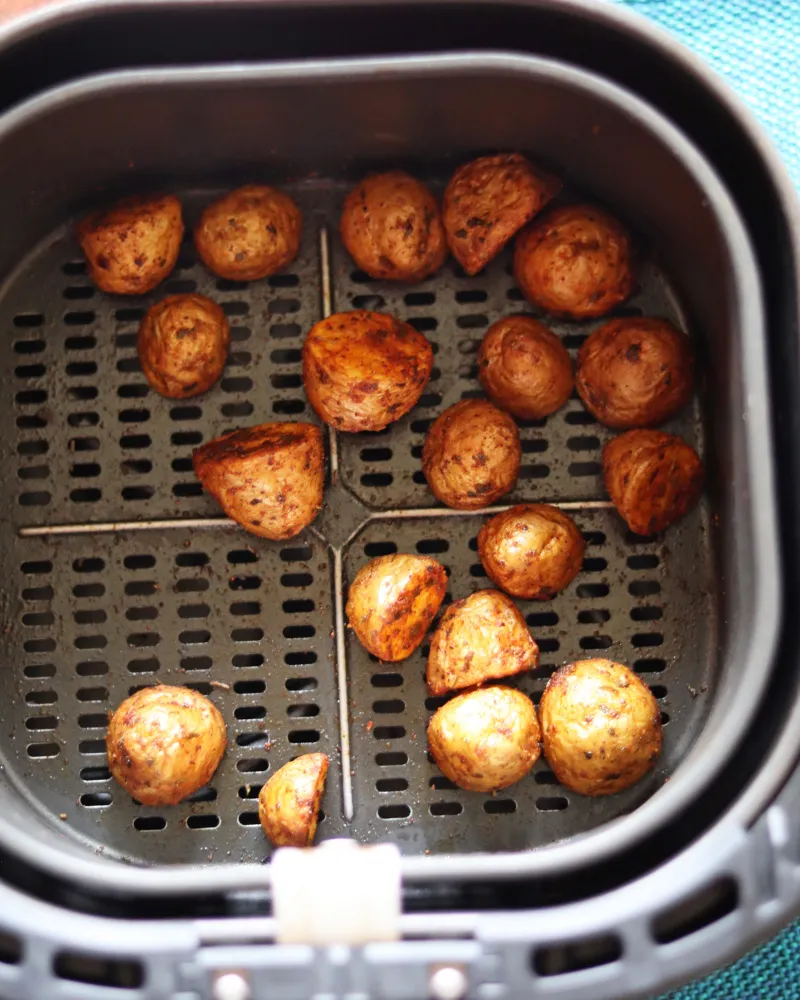
A perforated crisper plate has holes in it, so you lose some contact area to the gaps. It still works well and you should still use it, because the airflow underneath is what keeps the potatoes from steaming. If your machine came with a solid tray as well, the crisper plate is the better choice of the two for this, and the accessories guide covers which ones are worth replacing once the coating starts to go. The general version of the dry surface argument is in how to get things crispy in an air fryer, and it is worth reading once because it applies to nearly everything in a basket.
Why you should not soak these
Soaking cut potatoes in cold water is standard advice and it turns up in a lot of potato recipes for a good reason. It is the wrong move here, and the reason why is a useful thing to know.
Soaking rinses surface starch off. For french fries that is exactly what you want, because loose starch on the outside of a fry turns gummy and stops the shell from going properly brittle. The same logic drives the soak in our air fryer potato chips, where the goal is a thin dry shatter all the way through. Air fryer croutons chase the same texture from a completely different starting point.
A baby potato half is after the opposite thing. You want a browned face over a creamy middle, and that surface starch is precisely what browns. Rinse it away and you have removed the ingredient doing the work. Wash the potatoes, dry them properly, cut them, and put them straight into the oil.
Parboiling is a different question and the answer there is also no, but for a plainer reason: a baby potato is small enough to cook through in the same time the face takes to brown. Parboiling is for big chunks where the outside would burn before the middle was done. Here the two finish together, which is most of why this is such an easy side dish.
Baby is not a size
Here is the other reason bags of these come out uneven, and it has nothing to do with your air fryer.
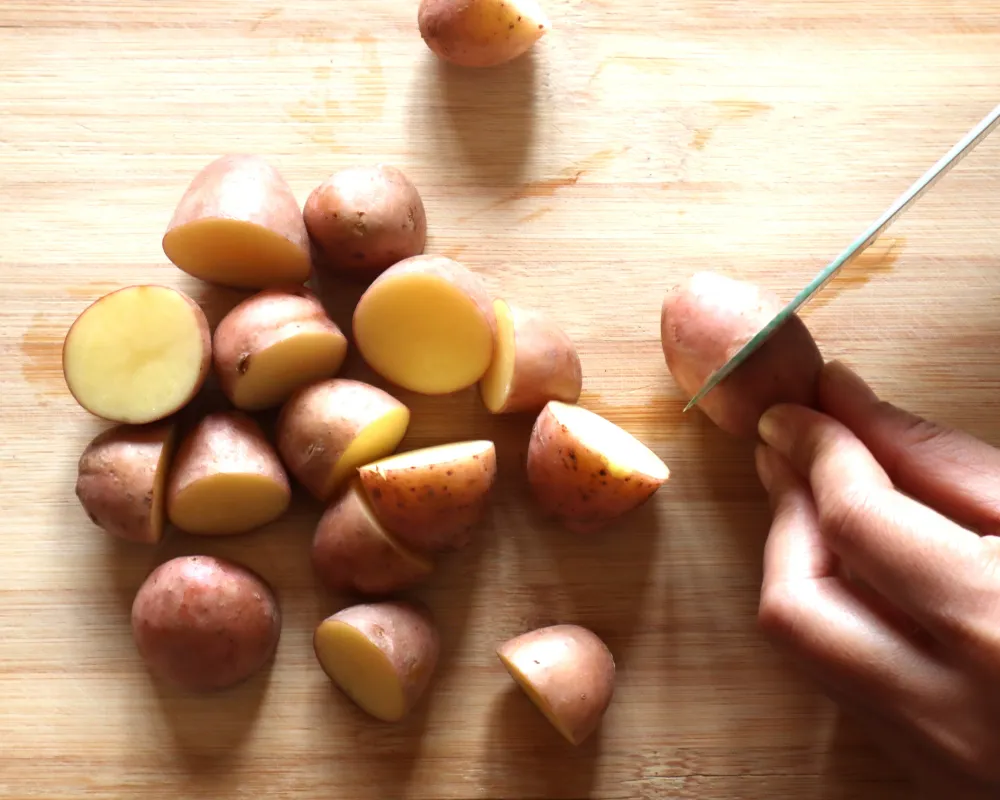
Baby potatoes are sold by name rather than by measurement. Open a bag and you will find some the size of a walnut and some closer to a golf ball, which is roughly a two to one range in diameter. That sounds harmless. It is not, because heat has to travel from the outside of a potato to the middle, and the time that takes goes roughly with the square of the distance.
| Potato | Whole | Halved | What happens if you mix them |
|---|---|---|---|
| 3/4 inch, small | 14 to 16 min | 15 to 17 min | Collapses and goes leathery while it waits for the big ones |
| 1 to 1 1/4 inch, typical | 20 to 24 min | 18 to 22 min | The recipe as written |
| 1 1/2 inch and up | 28 min and up | 22 to 26 min | Still dense in the middle when everything else is done |
Notice that halving barely changes the time for a small potato and saves six minutes or more on a big one. That is the square law again: cutting a potato in half does not halve the distance to the center of the whole thing, it halves the distance to the center of each piece, and the payoff grows with size.
So the fix is not a timer adjustment. Tip the bag out, pull out anything noticeably bigger than the rest, and quarter those instead of halving them. It takes about thirty seconds and it is the difference between a tray where everything is done at once and a tray where you are picking out the good ones.
Cutting them all to a similar thickness matters more than cutting them all to a similar shape. A quartered large potato and a halved medium one will finish together even though they look different.
They will never go fluffy inside, and that is fine
Worth setting expectations, because people sometimes describe the result as slightly underdone when it is nothing of the sort.
Baby potatoes are new potatoes, harvested young before the plant has finished packing starch into them. That makes them waxy: lower in starch, higher in moisture, with cell walls that hold together when cooked. A floury potato like a russet has cells that separate as the starch swells, which is what gives you that dry fluffy interior in a baked potato.
| Waxy, these | Floury, a russet | |
|---|---|---|
| Inside, cooked | Dense, moist, creamy, holds its shape | Dry, light, falls apart |
| Browns on its own? | Less readily. Lower starch at the surface | Yes, easily |
| So the cut face | Matters more, not less | Is a bonus rather than the point |
This is the part that surprised me. Because a waxy potato brings less starch to the party, the browning you do get depends more on making full use of the one surface that can deliver it. The lower the starch, the more the contact matters.
Red skinned, yellow and purple baby potatoes are all waxy and all behave the same way here. Yellow ones, the Yukon type, sit slightly closer to floury than the red ones do and brown a touch more readily, which is what I buy if the shop has both.
Ingredients
Serves four as a side, from a standard 1 1/2 pound bag.
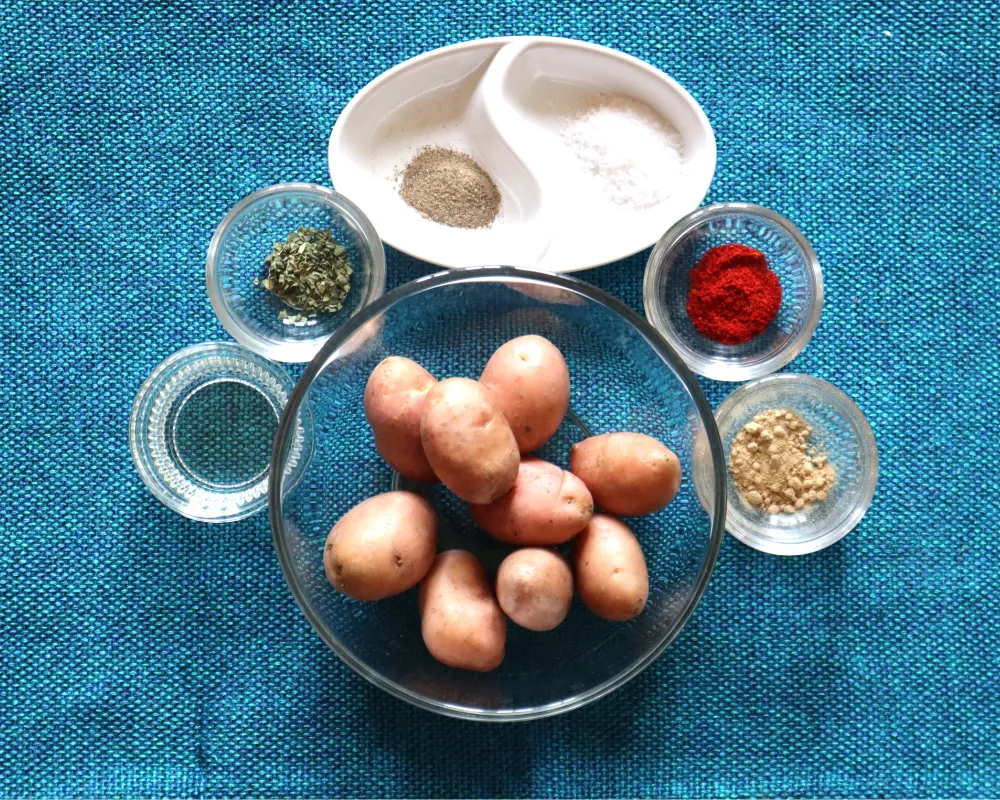
- 1 1/2 lb (680g) baby potatoes, scrubbed
- 1 1/2 tablespoons (22ml) olive or avocado oil
- 3/4 teaspoon salt
- 1/2 teaspoon garlic powder
- 1/2 teaspoon smoked paprika
- 1/4 teaspoon black pepper
- Optional, at the end: 1 tablespoon chopped fresh parsley, rosemary or chives
- Optional, at the end: a squeeze of lemon, or flaky salt
Two notes
- Do not be shy with the oil, but do not drown them either. A tablespoon and a half for a pound and a half is enough to coat every cut face in a thin film, and that film is what carries heat evenly across the surface instead of leaving dry patches. Much more than that pools on the basket floor and smokes, which is its own problem: why your air fryer smokes covers it.
- Check the oil can take 400°F. Avocado oil and refined olive oil are comfortable there. Extra virgin olive oil sits close to its smoke point and will smoke a little in some machines. It still tastes good, so use it if you like it, just expect a bit of haze.
How to make them
- Preheat to 400°F (200°C) for 3 minutes. Not optional here. The cut faces need to meet a hot floor, and this is the one step that decides whether they start browning at minute one or minute four.
- Scrub and dry the potatoes properly. Skin on. Wet potatoes steam before they brown, and the water has to leave before anything else can happen.
- Sort by size, then cut. Halve the ordinary ones. Quarter anything noticeably bigger. You are aiming for pieces of similar thickness rather than similar shape.
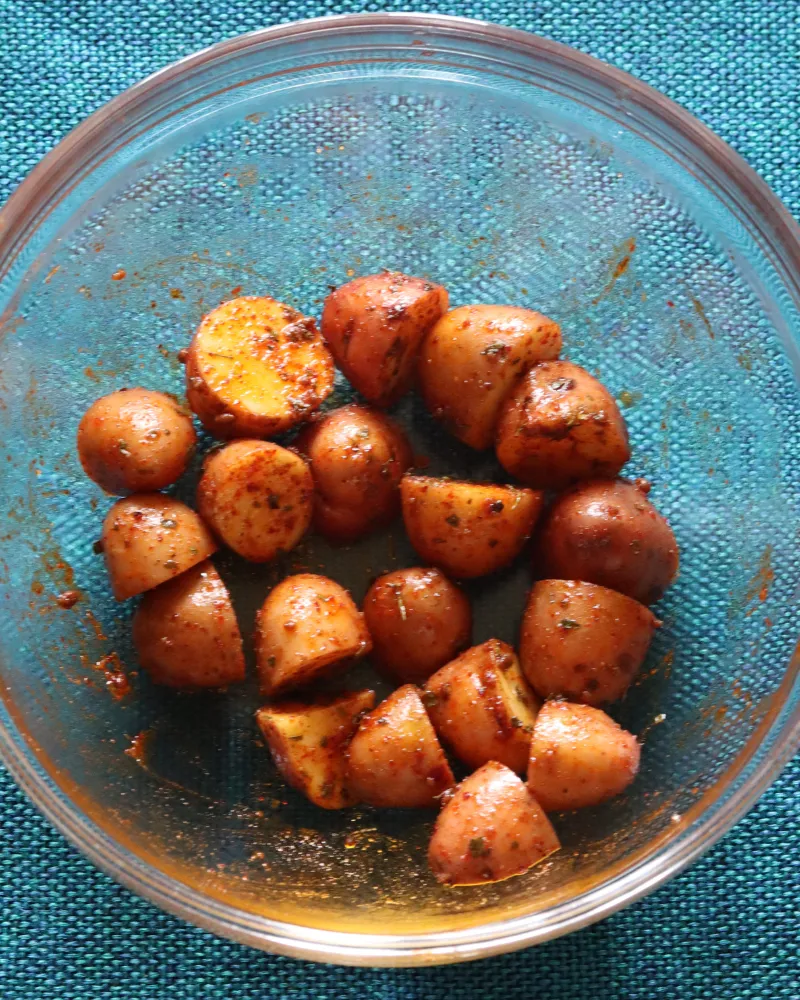
- Toss with the oil first, then the seasonings. Oil first gives the powders something to stick to. Straight onto dry potato they mostly end up in the bottom of the bowl.
- Lay them cut side down in a single layer, not touching. Each one needs its own patch of floor. Two batches beat one crowded basket, and the second batch runs about two minutes faster.
- Cook 18 to 22 minutes at 400°F, without shaking. Leave them completely alone. This is the whole recipe.
- If your machine has a hot spot, pull the basket out at 10 minutes, turn it 180 degrees and slide it back without disturbing the potatoes. Rotating the basket is not the same thing as shaking it.
- Check at 18 minutes. Lift one with tongs and look at the face. You want deep golden, not tan. A thermometer into the thickest piece should read 205°F.
- Herbs, lemon and flaky salt go on now, off the heat. Fresh herbs burn in a basket and lemon steams. Both are finishing touches, not seasonings.
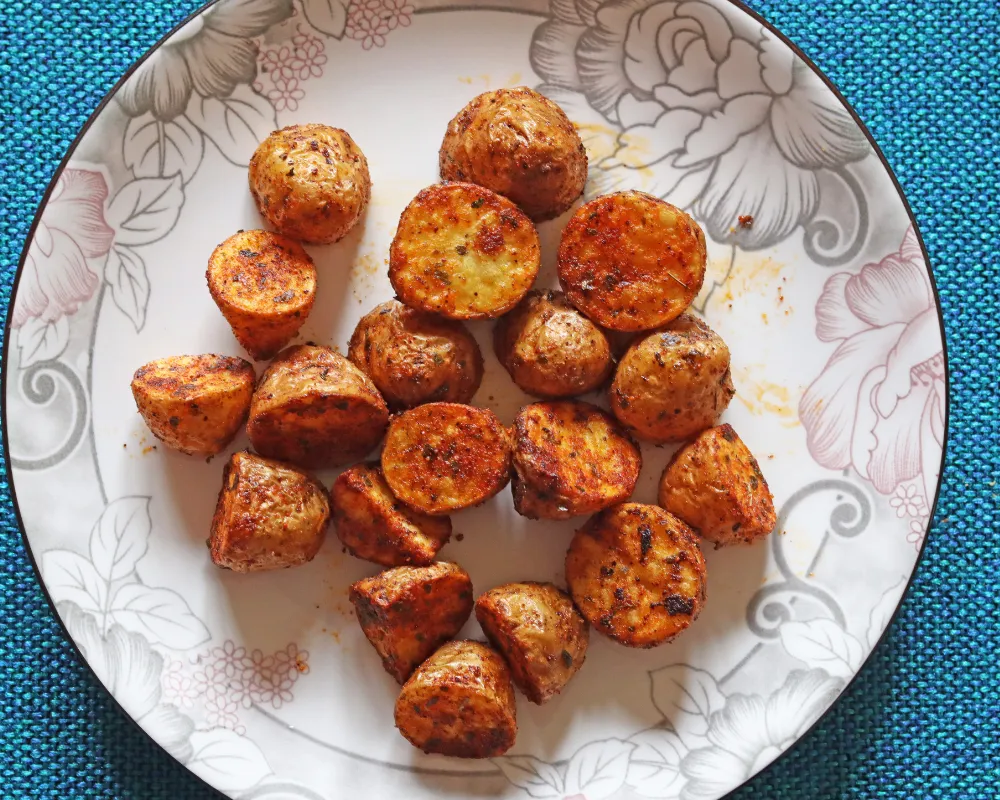
- Serve cut side up. You spent twenty minutes on that face. Do not put it on the plate face down.
Why 400°F and not higher. Some recipes push these to 425°F to force more color. It does not work as well as it sounds, because at that temperature the outside of the cut face browns before the middle of the potato has reached 205°F, and you end up choosing between a dark face and a dense center. 400°F happens to be the temperature where those two finish at about the same moment, which is the whole reason this is a twenty minute side dish and not a fussy one. If you are converting a roasting recipe from an oven, the air fryer calculator will do the temperature for you, then use the internal reading rather than its time.
205°F, and the fork test done properly
Every recipe for this finishes on fork tender, and fork tender is a real test. It is just vaguer than it needs to be, and vague is what produces the slightly dense, faintly waxy bite people describe as almost done.
A potato is properly cooked at around 205°F in the middle. That is where the starch has fully gelatinized and the cell walls have softened enough to give you a creamy texture rather than a firm one. It is higher than most people guess, and it is well past the point where a fork will already slide in without much protest.
| Reading | What you have |
|---|---|
| 195°F | A fork goes in. It still eats slightly firm and waxy in the middle. |
| 200°F | Good. Most people would call this done. |
| 205°F | Creamy the whole way through. This is the one. |
| Past 212°F | Starting to dry and collapse, especially on the small ones. |
Probe the thickest piece you can find, from the side, into the middle. If you would rather not own a thermometer, the honest fork version is this: the fork should go in with almost no resistance and the potato should not lift off the fork when you raise it. If it clings to the fork, it needs another two minutes. An instant-read thermometer settles it in three seconds and is useful for everything else on this site too. Internal targets for the rest are in the air fryer baking chart.
What goes on when
Not everything survives twenty minutes at 400°F, and the things that do not are usually the things people are disappointed by.
| Goes on before | Goes on after |
|---|---|
| Salt. It draws a little water to the surface early, which then leaves, and dry surfaces brown. | Fresh herbs. Parsley, chives, dill and rosemary all scorch and turn bitter in a basket. |
| Garlic powder, onion powder, paprika. Dried and stable at this temperature. | Fresh garlic. Burns in about eight minutes. Use the powder in, and fresh minced garlic tossed through at the end if you want the bite. |
| Dried oregano, thyme, Italian seasoning. Fine, they are already dry. | Lemon juice or vinegar. Water on a hot surface stops browning dead. Acid is a finishing note. |
| Black pepper. Slightly muted by the heat, so use a little more than feels right. | Parmesan and flaky salt. Cheese burns before it browns at 400°F. On at the end, on hot potatoes, so it melts. |
Fresh rosemary is the one people argue about. Whole sprigs tossed in at the start do survive better than chopped leaves, because there is more of them and less surface, but they still darken. I put a sprig in for the last five minutes and take it out before serving, which perfumes the oil without burning anything.
What I serve these with
They go with almost anything, which is most of why they get made so often here. Air fryer frozen Brussels sprouts cook at a similar temperature if you want two vegetables out of one machine, and air fryer corn on the cob is the summer version of the same idea. For something with more going on, air fryer aloo gobi uses potatoes the other way round, spiced and softened rather than browned.
For the main next to them, air fryer chicken sausage and frozen salmon straight from the freezer are the two I fall back on most. Both want the basket to themselves, so run those first and let them rest under foil while the potatoes go in. Air fryer asparagus is quick enough to slot in after the potatoes come out, if you want a green thing on the table.
If potatoes in a basket are your thing generally, the rest of the family here works on the same handful of principles. Air fryer potato chips are the thin dry version, hash browns and accordion potatoes both chase surface area on purpose, tater tots are the from-frozen shortcut, and air fryer potato peels turn the offcuts into something worth eating. Sweet potatoes behave differently enough to need their own numbers, which are in the sweet potato fries page.
Fixing what goes wrong
| What you got | Why | Fix |
|---|---|---|
| Patchy tan faces, no real crust | You shook the basket, so no face got more than a few unbroken minutes on the floor. | Cut side down and do not touch them. This is the whole page. |
| Pale and slightly steamed | Crowded basket, or the potatoes went in wet, or a cold start. | Single layer with gaps, dry them properly, preheat 3 minutes. |
| Some perfect, some raw | Mixed sizes in the bag, which is normal and nobody warns you. | Sort them. Quarter the big ones, halve the rest. |
| Tough leathery skin | Skin only ever meets moving air, so it dries rather than browns. | Normal. The cut face is where the texture comes from. Serve them face up. |
| Firm, slightly waxy middles | Pulled at fork tender, which is around 195°F, rather than at 205°F. | Two or three more minutes. Check the thickest piece. |
| Burnt garlic, bitter herbs | Fresh aromatics went in at the start. | Powders in, fresh things after. See the table above. |
| Smoking machine | Too much oil pooling on the basket floor, or an oil with a low smoke point. | A tablespoon and a half is plenty. More on smoking here. |
| Stuck to the basket | Not enough oil on the cut face, or you tried to move them too early. | Coat every face, and leave them until they release on their own. They will. Do not line the basket with parchment to avoid it, since that removes the hot floor entirely. |
| Small ones collapsed | They finished ten minutes before the big ones and kept cooking. | Sort by size before cutting, not after. |
If burning or uneven results are a pattern across different foods rather than just this one, how to prevent burning in an air fryer covers the usual causes and the troubleshooting guide has the rest. Machine format matters here too, since an oven-style unit gives you a much bigger flat surface and therefore more potatoes in one layer: basket versus oven-style goes through it.
Storage and reheating
- Best in the first ten minutes, like most crisp things. The face softens as steam from inside the potato works its way out.
- Do not cover them while hot. A lid on a bowl of hot potatoes is a steam trap and the crust goes first. Leave them uncovered on a wide plate if there is a gap before dinner.
- Refrigerated: 4 to 5 days in an airtight container, once completely cool.
- Reheating: 4 to 5 minutes at 380°F, cut side down again. This works genuinely well and it is one of the clearest cases where an air fryer beats a microwave, which only steams them soft.
- Freezing: possible but not good. Waxy potatoes go grainy after freezing, which is a texture problem you cannot reheat your way out of.
- Leftovers are excellent smashed. Press a cold one flat with the base of a glass, oil it, and give it 8 minutes at 400°F. You get far more surface area, which is the same principle as this page taken further.
Twenty minutes of air fryer time for a side dish is very cheap next to heating a full oven, and if you want the real figure for your electricity rate the running cost calculator will work it out. Cooking for more than four means more batches rather than a fuller basket, and the recipe scaler handles the seasoning quantities. If you have never measured what your basket actually holds in a single layer, the pan size calculator gives you the floor dimensions to work from. All four air fryer tools are in one place, the guides index collects the technique pages behind all of this, how to bake in an air fryer covers the method end to end if a basket is new to you, and if the oil has baked onto the basket after a few rounds of these, the bakeware cleaning guide deals with it properly. The full recipe index has everything else.
Frequently asked questions
QShould I shake the basket when cooking baby potatoes?
No, and this is the one instruction almost every recipe gets wrong. Shaking is right for fries and wings and anything in loose pieces that wants every side exposed to moving air. A halved potato is not trying to brown on every side, it is trying to brown on one: the flat cut face pressed against the hot basket floor. A cut face needs several unbroken minutes of contact to build color, and every shake lifts the potatoes and puts them back down in random orientations, so most land skin down and start again. That is why shaken potatoes come out patchy rather than evenly golden. Lay them cut side down and leave them completely alone.
QWhat temperature and how long for baby potatoes in an air fryer?
400F for 18 to 22 minutes, halved and laid cut side down in a single layer, pulled at 205F inside. Whole baby potatoes take 20 to 24 minutes and give you far less crust, since there is no flat surface to brown. Going hotter than 400F does not help: at 425F the cut face darkens before the middle reaches 205F, so you end up choosing between a dark face and a dense center. 400F is roughly where those two finish at the same moment, which is what makes this a twenty minute side dish rather than a fussy one.
QShould I cut baby potatoes in half or leave them whole?
Halve them, and it is not mainly about cooking time. A whole baby potato has nothing but curved skin on the outside, and skin is a water resistant barrier that only ever meets moving air, so it dries and toughens rather than browning. Cutting exposes a flat starchy face that sits in direct contact with the hot basket floor, and direct contact with hot metal moves heat into food far faster than air does. That contact is where the golden crust comes from. Halving also saves real time on the bigger potatoes, though on the smallest ones it barely changes the clock at all.
QWhy are my air fryer potatoes not crispy?
Four usual causes, in the order I would check them. You shook the basket, so no cut face got sustained contact with the floor. The basket was crowded, so the potatoes shaded each other and steamed instead of browning. They went in wet, and the surface water has to leave before browning can start. Or you skipped the preheat, so the faces spent the first few minutes on a cold plate. All four come back to the same thing: browning needs a dry surface in contact with something hot, held there long enough to work.
QDo I need to soak or parboil baby potatoes first?
No to both, and the soaking question is worth explaining because the standard advice points the other way. Soaking cut potatoes rinses surface starch off, which is genuinely right for french fries and for thin potato chips, where loose starch turns gummy and stops the shell going brittle. A baby potato half wants the opposite: a browned face over a creamy middle, and that surface starch is exactly what browns. Rinse it off and you have removed the ingredient doing the work. Parboiling is unnecessary for a different reason, which is that a potato this small cooks through in the same time the face takes to brown.
QHow do I know when baby potatoes are done?
205F in the middle of the thickest piece. That is higher than most people expect and well past the point where a fork already slides in easily, which is why fork tender so often produces a slightly firm, faintly waxy bite. At 205F the starch has fully gelatinized and the cell walls have softened into something creamy. If you would rather not use a thermometer, the honest fork version is that the fork should meet almost no resistance and the potato should not cling to the fork when you lift it. If it hangs on, give it two more minutes.
QWhy do some of my potatoes come out raw while others are perfect?
Because baby potatoes are sold by name rather than by size, and a single bag typically runs from about three quarters of an inch to an inch and a half. Heat has to travel from the outside of a potato to the middle and the time that takes goes roughly with the square of the distance, so a potato twice the diameter takes around four times as long to heat through. Nobody warns you about this. Tip the bag out before you start, pull out anything noticeably bigger than the rest, and quarter those while halving the others. Aim for similar thickness rather than similar shape.
QWhy are my baby potatoes not fluffy inside like a baked potato?
They never will be, and nothing is wrong. Baby potatoes are new potatoes, harvested young before the plant has packed much starch into them, which makes them waxy: lower in starch, higher in moisture, with cell walls that hold together when cooked. A floury potato like a russet has cells that separate as the starch swells, and that separation is what makes a baked potato dry and light. A waxy potato stays dense and creamy instead. It is a different texture rather than an undercooked one, and it is the reason these hold their shape in salads.
QWhen should I add garlic and fresh herbs?
Powders before, fresh things after. Garlic powder, onion powder, paprika and dried herbs are already dry and stable at 400F, so they go on with the oil at the start. Fresh minced garlic burns in about eight minutes at that temperature and turns bitter, and fresh parsley, chives and dill scorch outright. Toss those through once the potatoes are out of the basket. Lemon juice and vinegar also belong at the end, because adding water to a hot surface stops browning dead. Whole rosemary sprigs are the exception worth knowing: drop one in for the last five minutes and take it out before serving.
QCan I cook baby potatoes in an air fryer without oil?
You can, and they will cook through perfectly well, but you will not get the crust. Oil does two things here that nothing else does: it fills the microscopic gaps between the potato and the basket floor so heat conducts across the whole face rather than at a few contact points, and it carries heat evenly across the surface so the browning is uniform rather than blotchy. A tablespoon and a half over a pound and a half is a small amount of fat spread across four servings. If you want to use less, a fine mist from a refillable oil mister on the cut faces only will get you most of the way.
QHow many baby potatoes fit in an air fryer at once?
However many fit in one layer with gaps between them, which for a typical 5 to 6 quart basket is about a pound to a pound and a quarter, halved. Every potato needs its own patch of floor, because the contact with that floor is what browns it, and two potatoes leaning together are sharing one contact point while shading each other from the air. Two unhurried batches genuinely beat one crowded basket, and the second batch runs about two minutes faster because the machine is already hot. An oven-style unit with a full tray takes considerably more in one go.
QHow do I reheat leftover air fryer potatoes?
Four to five minutes at 380F, laid cut side down again, and it works better than you would expect. This is one of the clearest cases where an air fryer beats a microwave, which only puts steam back into them and leaves them soft. Do not cover them while they are hot either time, since a lid on hot potatoes is a steam trap and the crust is the first thing to go. Better still, press a cold leftover flat with the base of a glass, oil it and give it eight minutes at 400F. Smashing creates far more surface area, which is this whole page taken one step further.
Never overbake again
Get our one-page times & temps cheat sheet, plus a new tested recipe each week.
No spam · unsubscribe anytime