

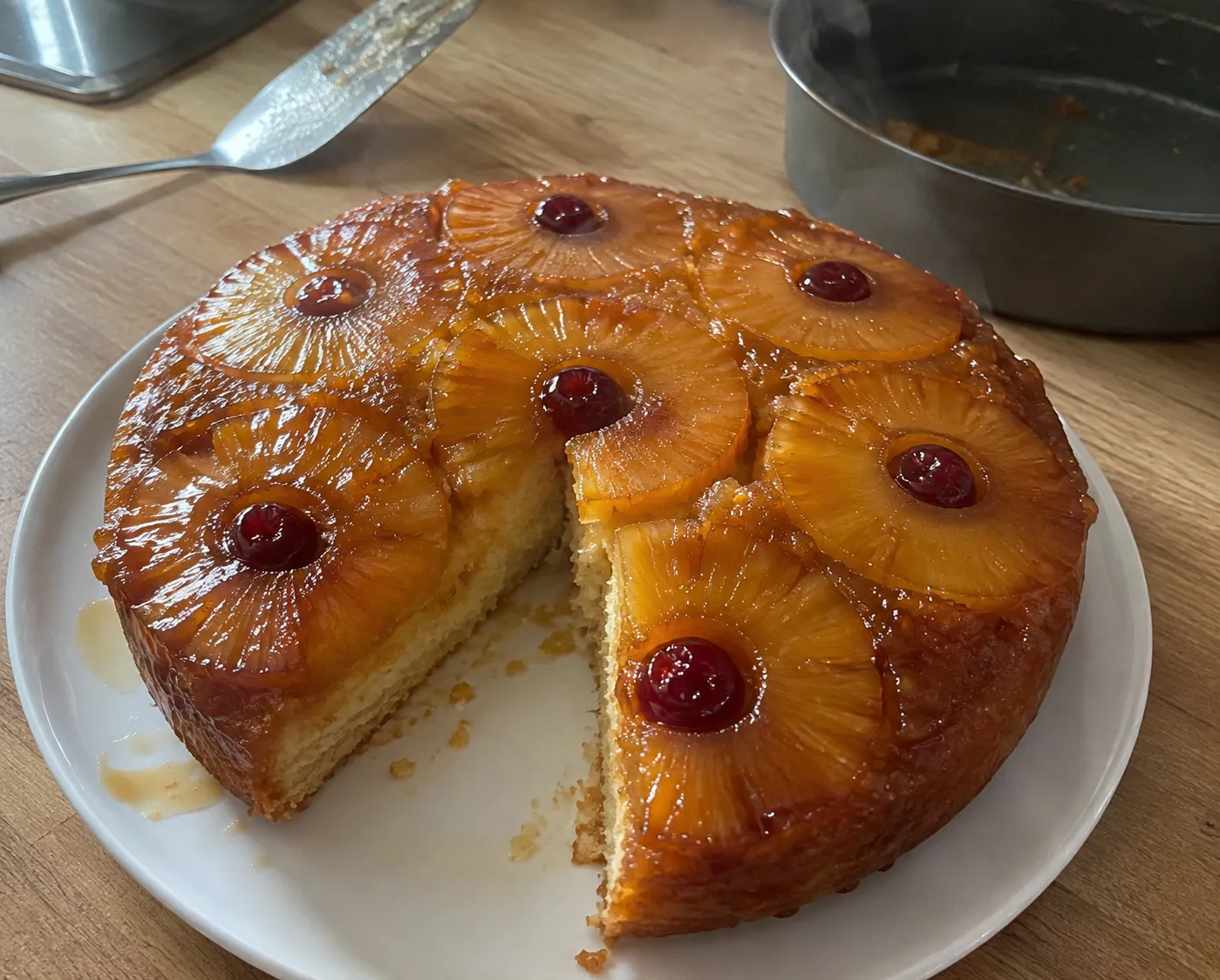
The first one I turned out slid. Not dramatically, it just sagged sideways off the plate, and the syrup ran out from under the pineapple and pooled around the base like the cake was melting. The rings themselves were pale yellow. Pretty, but pale.
The second one I left in the pan longer to firm up, and it welded itself in. Two rings stayed behind, stuck to the bottom, and I served a cake with holes in it.
Both of those come down to the same thing, which is that the layer everybody calls caramel almost never gets hot enough to become caramel, and in an air fryer it gets even less of a chance than usual.
Quick answer: Melt the butter and brown sugar in the pan and give it 4 minutes in the air fryer on its own, before any fruit or batter goes near it. That is the only moment it is exposed. Blot the pineapple rings dry, hard, between paper towels. Bake at 320°F for 24 to 28 minutes and pull at 200°F. Cool exactly 10 minutes, then flip. Do not line the base of the pan with parchment.
An upside down cake is upside down relative to the heat
Start here, because it explains why this recipe behaves differently in a basket than it does in an oven, and none of the pages ranking for this mention it.
In an oven, heat arrives from all directions. There are elements above and below, the whole cavity is hot, and the metal shelf your pan sits on has been soaking up heat for twenty minutes. The sugar layer at the bottom of the pan gets a genuine share of that.
A basket air fryer has one heating element and it is above the food. Underneath the pan there is a perforated crisper plate with moving air, which is warm but carries no radiant heat at all. So the geometry of this particular cake is exactly backwards.
The side you are going to hide
Bare cake batter, directly under the element, taking every bit of radiant heat in the machine. It browns hard, and then you turn it over and nobody ever sees it.
The side you are going to show
The sugar, the butter and the pineapple. It gets conducted heat through the pan base and nothing else. It is the least heated thing in there.
You cannot see any of it
The one surface that decides whether the cake is any good is face down in a pan for the entire bake. You find out at the flip.
This is worth knowing before you start blaming your machine. A pale topping out of a basket is not a fault, it is the expected result of putting the sugar in the coldest, darkest corner of the appliance and then heating the opposite face.
An oven-style unit with a shelf changes this a little, because the element sits further away and some models have a lower element as well. It is still not an oven. Basket versus oven-style goes through the differences, and this cake is one of the clearer cases where the format matters.
Your caramel is not caramel, and that is true in an oven too
Here is the part that surprised me, and once you know it the fix is obvious.
Sucrose caramelizes at around 320°F. Brown sugar starts browning sooner than that, from about 250°F, because the molasses in it contains reducing sugars that darken at lower temperatures. Either way, you need to get well past boiling.
Now look at where that sugar actually sits. It is in a thin layer at the bottom of the pan, in direct contact with pineapple rings that are mostly water, under a batter that is also mostly water. And a wet surface cannot climb past 212°F while there is still water touching it, because the evaporation carries the heat away as fast as it arrives. The glossary covers this under the 212 degree ceiling, and it is the same mechanism that keeps the crust of a pie from burning once the filling goes in, which we go through on the air fryer apple pie page.
So what is actually happening down there? The butter and brown sugar melt into a syrup and stay a syrup. The color and most of the flavor come from the molasses that was already in the brown sugar, plus a little Maillard browning from the milk solids in the butter and the pineapple's own sugars against the hot pan. It is a good syrup. It is not caramel, and no amount of extra time in the basket will turn it into caramel, because the water will not let it.
That is true in an oven as well, incidentally. The difference is that an oven at least drives the pan base hard from below, so the very bottom film of syrup in contact with hot metal does get some real browning. In a basket even that is missing.
Which means the question is not how to give the sugar more time. It is how to give it heat at a moment when there is no water sitting on top of it.
Caramelize it while it is still naked
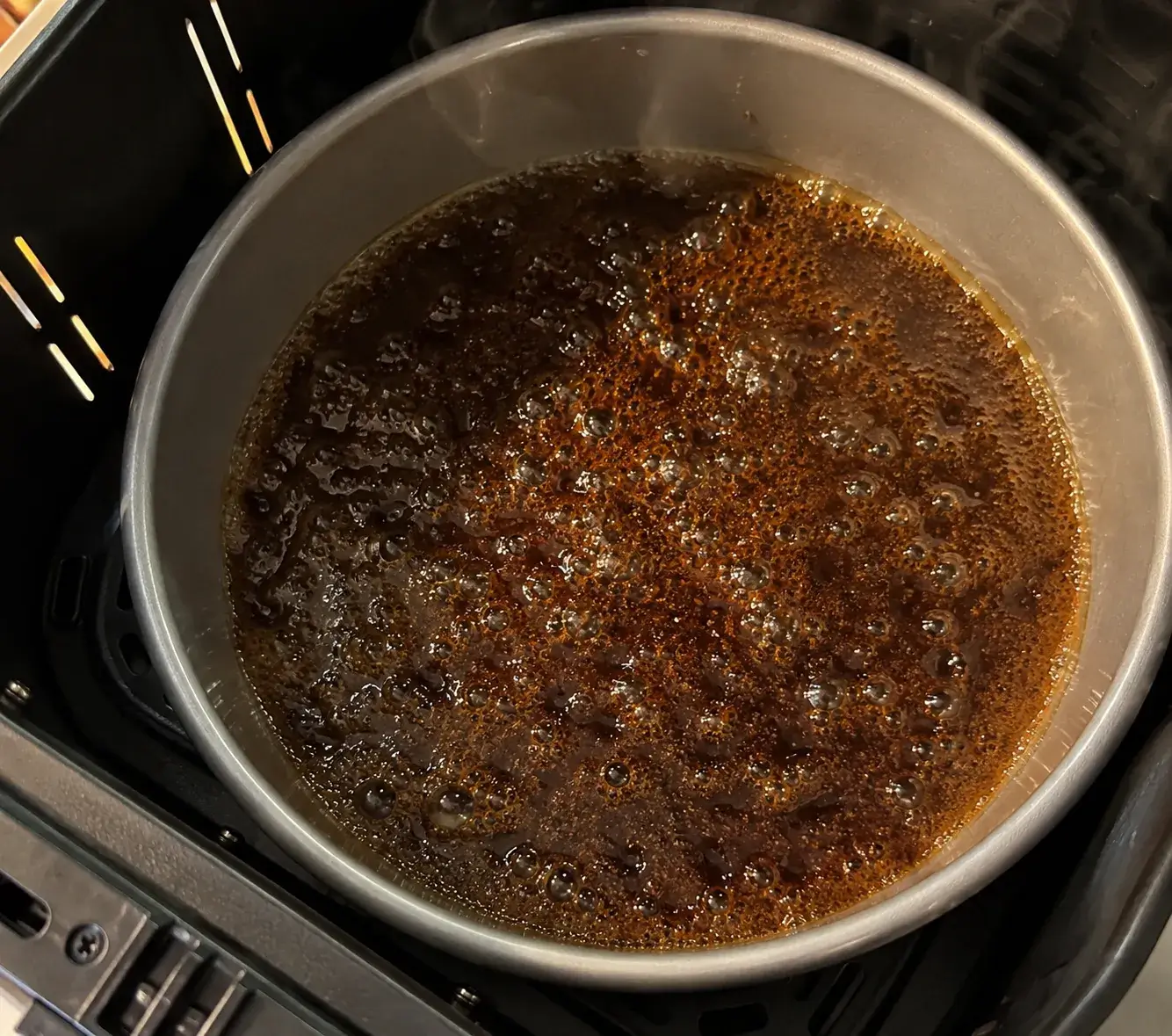
There is exactly one window in this recipe when the sugar layer is uncovered: after you put it in the pan and before the pineapple goes on. It lasts as long as you want it to, and almost nobody uses it.
Give the butter and brown sugar four minutes in the preheated air fryer on their own. Nothing on top. With no water in the way, the syrup can climb past 212°F, and at 320°F air temperature it will get into the range where the sugar genuinely starts to caramelize rather than just melt.
| Approach | What the sugar layer reaches | What you get |
|---|---|---|
| Scattered dry, batter straight on top | Never much above 212°F | A thin sweet syrup. Pale rings. This is what most recipes produce |
| Butter melted first, sugar sprinkled on | Same. The batter still goes on immediately | Slightly better distribution, same ceiling |
| 4 minutes alone in the basket | Well past boiling, into browning territory | Actual caramel notes, a darker syrup, and rings with color |
This is the same structural move as cooking the filling before it goes into a pie, or dusting apple chips with color at the end rather than the start. Do the step that needs high heat at the moment nothing is protecting the food from it. Our air fryer coffee cake plays the same trick in reverse, holding its streusel back until minute 16 so the element cannot scorch it.
Watch it, and take it seriously. Check at 3 minutes. You want the syrup bubbling and a shade darker at the edges, smelling like toffee. Sugar goes from correct to acrid in well under a minute once it dries out, and molten sugar burns are genuinely nasty, so use tongs and oven gloves and do not put your face over the basket. If it smokes, it has gone. If you have burnt sugar welded to a pan afterwards, the bakeware cleaning guide covers getting it off without wrecking the finish.
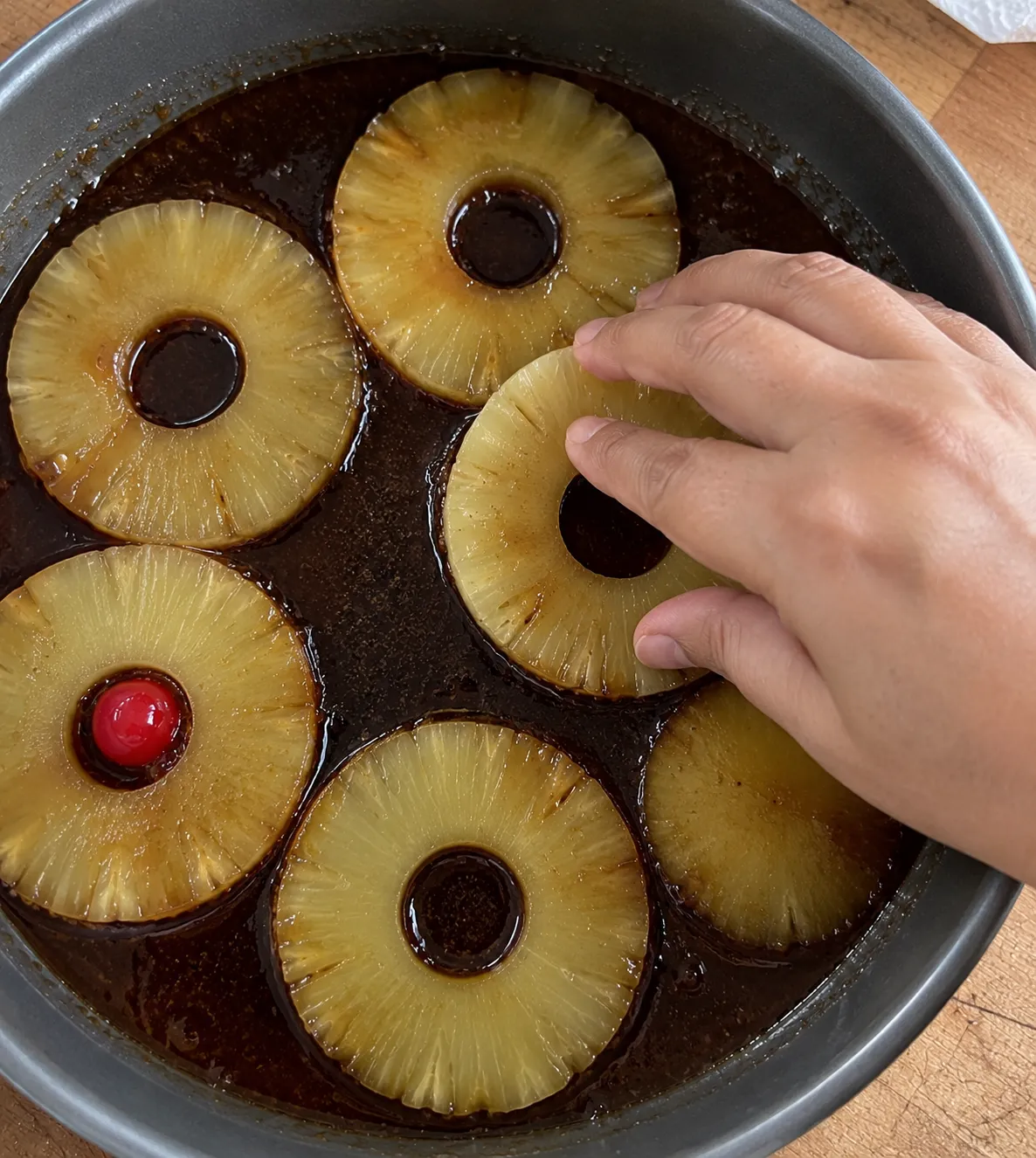
Then the pineapple goes straight onto the hot syrup, which is a bonus: the rings hit something at 250°F or so and start browning on contact rather than slowly warming up in a cold pan.
The juice is why the topping runs off
Canned pineapple rings come out of the tin carrying a lot of liquid, both on the surface and held in the fruit. Draining the tin is not the same as drying the rings, and the difference decides whether your topping stays on the cake when you turn it over.
Every tablespoon of juice that goes into the pan does two things, both bad. It dilutes the sugar syrup, so what should set into a thick glossy layer stays thin and runny. And it is more water sitting on the sugar, holding it at 212°F, which is the problem the whole page is about.
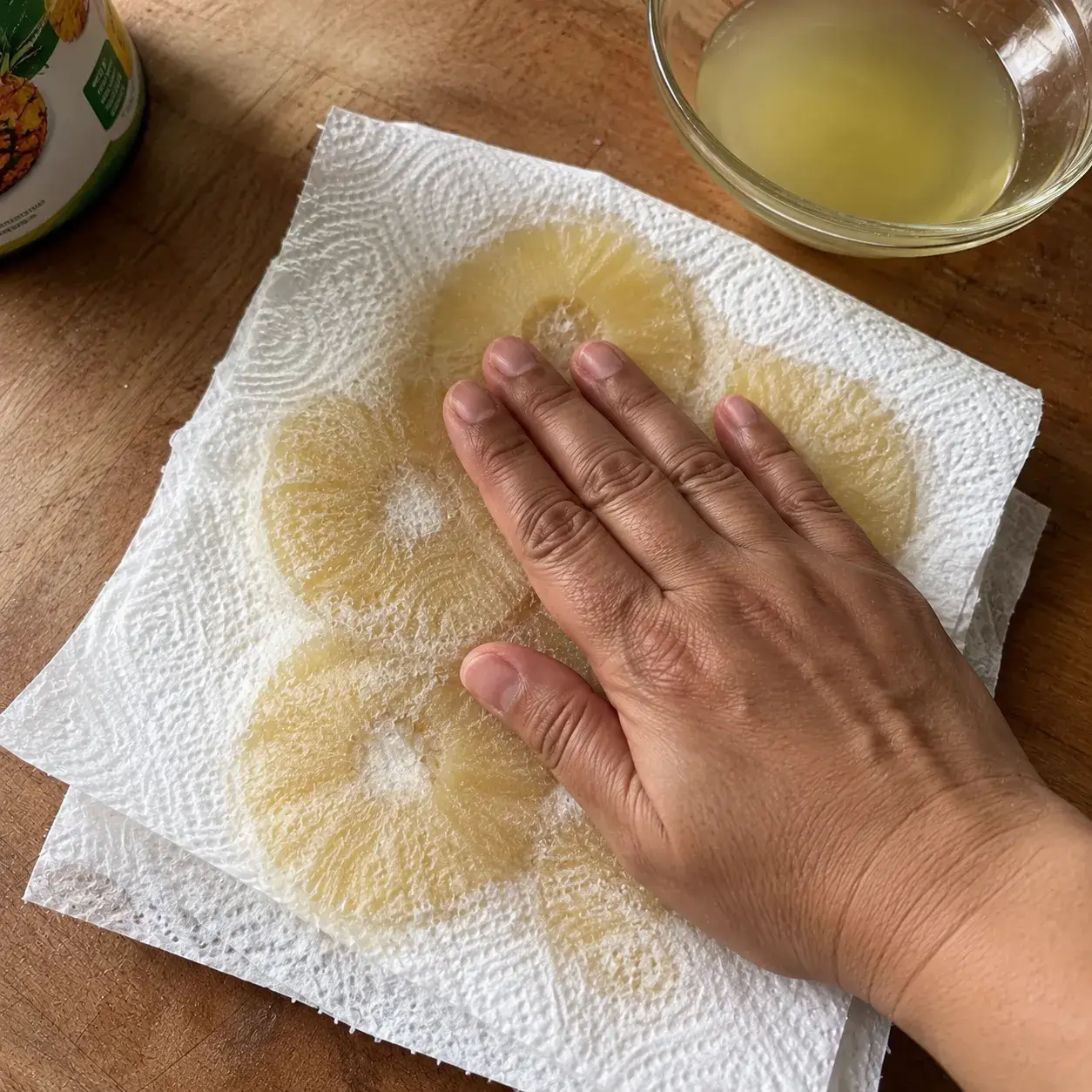
Blot them properly. Lay the rings on a double layer of paper towel, put another double layer on top, and press down firmly with your palm. Then do it again with dry towels. You are aiming for rings that feel tacky rather than wet. It takes a minute and it is the difference between a topping that sits on the cake and one that runs down the sides.
Keep the juice, though. Three tablespoons of it go into the batter, where it belongs. Pineapple juice is one of the few fruit juices that carries real flavor rather than just sourness and water, so it earns its place in the crumb even though it has no business in the topping.
Fresh pineapple works and tastes better, with one warning. Fresh pineapple contains bromelain, an enzyme that breaks down protein, and in a batter that means it can attack the egg and the gluten and give you a slack, gummy crumb. Heat destroys it, so if you are using fresh, cook the rings for a couple of minutes first or use canned for the batter juice. Canned pineapple has already been heat treated, which is why it is the safer default here.
Do not line the base of the pan
This is the one piece of advice on this page that runs against normal practice, so it is worth explaining.
Lining a cake pan with a parchment circle is usually correct and we say so on most of the cake pages here. For an upside down cake in a basket, it is a mistake, for two reasons.
- It blocks conduction to the one layer that needs it. The sugar is already the least heated thing in the machine. Putting a sheet of paper between it and the hot metal makes that worse. Conduction through the pan base is the only heat that layer gets.
- It comes off with the topping. When you flip, the parchment lifts away stuck to the syrup, and it takes rings with it. You end up peeling paper off the top of your finished cake and rearranging fruit.
Grease the pan properly instead, sides and base, with soft butter and a brush. The sugar syrup is doing most of the non-stick work anyway once it sets, and the flip timing below is what actually stops it welding on. Foil and parchment in an air fryer covers where they do belong, and the safety rule about never leaving a loose sheet in a basket.
Flipping blind, and the ten minute window
You do not get to see how it went until you commit, which is what makes this cake stressful the first few times. The good news is that the flip is not luck. It is a window, and it is fairly narrow.
Under about 7 minutes
The syrup is still thin and hot, and the crumb next to the pan has not firmed up. It slides, and the topping runs out from under the fruit.
10 minutes
Syrup thick enough to cling to the fruit, cake set enough to hold together, and everything still warm enough to release.
Past about 20 minutes
The syrup cools toward a solid and glues the rings to the pan. This is how you get a cake with holes in it and fruit left behind.
So ten minutes, and it is a real number rather than a tradition. Sugar syrup viscosity changes fast as it cools, which is the whole of it. Our air fryer bundt cake has the same ten minute window for the same reason, since a bundt is also held in by sugar against hot metal, and every fluted ridge is another place for it to stick.
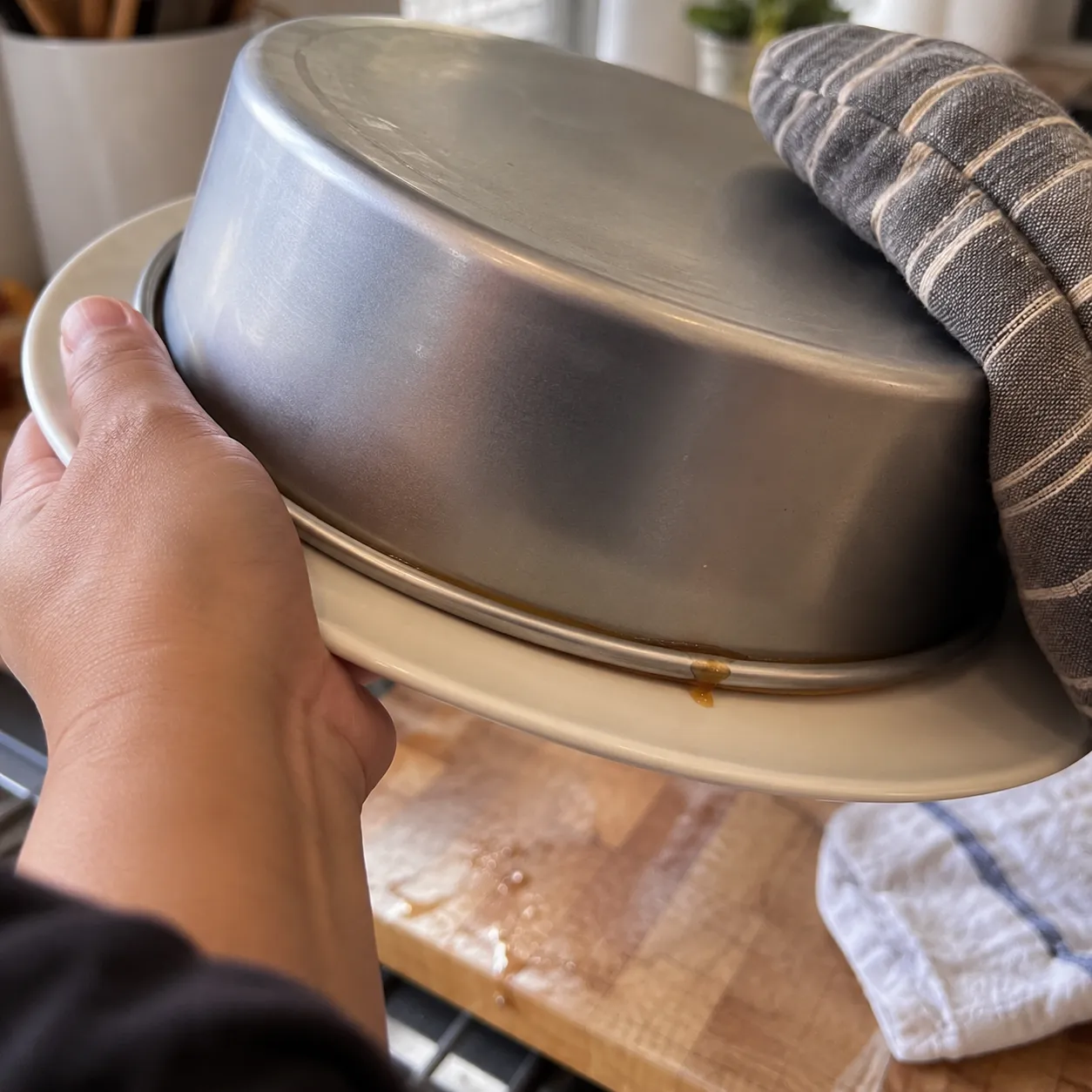
How to actually do the flip. Run a thin knife around the sides only, not underneath. Put your serving plate face down on top of the pan, hold both together with a hand on the plate and a gloved hand under the pan, and turn the whole thing over in one movement rather than tipping it. Then leave the pan sitting on top of the cake for another minute before you lift it, so anything still clinging has a moment to let go under its own weight.
If a ring does stay behind, do not panic. Lift it off with a spoon and put it back where it belongs, then spoon any syrup left in the pan over the top. Nobody will know.
Ingredients
One 6-inch cake, six slices. A 6-inch round pan fits a typical 5 quart basket with airflow around it. If you have never measured yours, the pan size calculator gives you the largest round pan that fits, and the recipe scaler converts the quantities if you go up a size.
For the topping
- 3 tablespoons (42g) unsalted butter
- 1/3 cup (67g) dark brown sugar, packed
- Pinch of salt
- 4 to 5 canned pineapple rings, blotted very dry
- Optional: 4 to 5 maraschino cherries, also blotted
For the cake
- 1 cup (125g) all-purpose flour
- 2/3 cup (133g) granulated sugar
- 1 teaspoon baking powder
- 1/4 teaspoon salt
- 1/4 cup (57g) unsalted butter, softened
- 1 large egg plus 1 yolk, room temperature
- 1/4 cup (60g) full-fat sour cream, room temperature
- 3 tablespoons (45ml) pineapple juice from the can
- 1 teaspoon vanilla extract
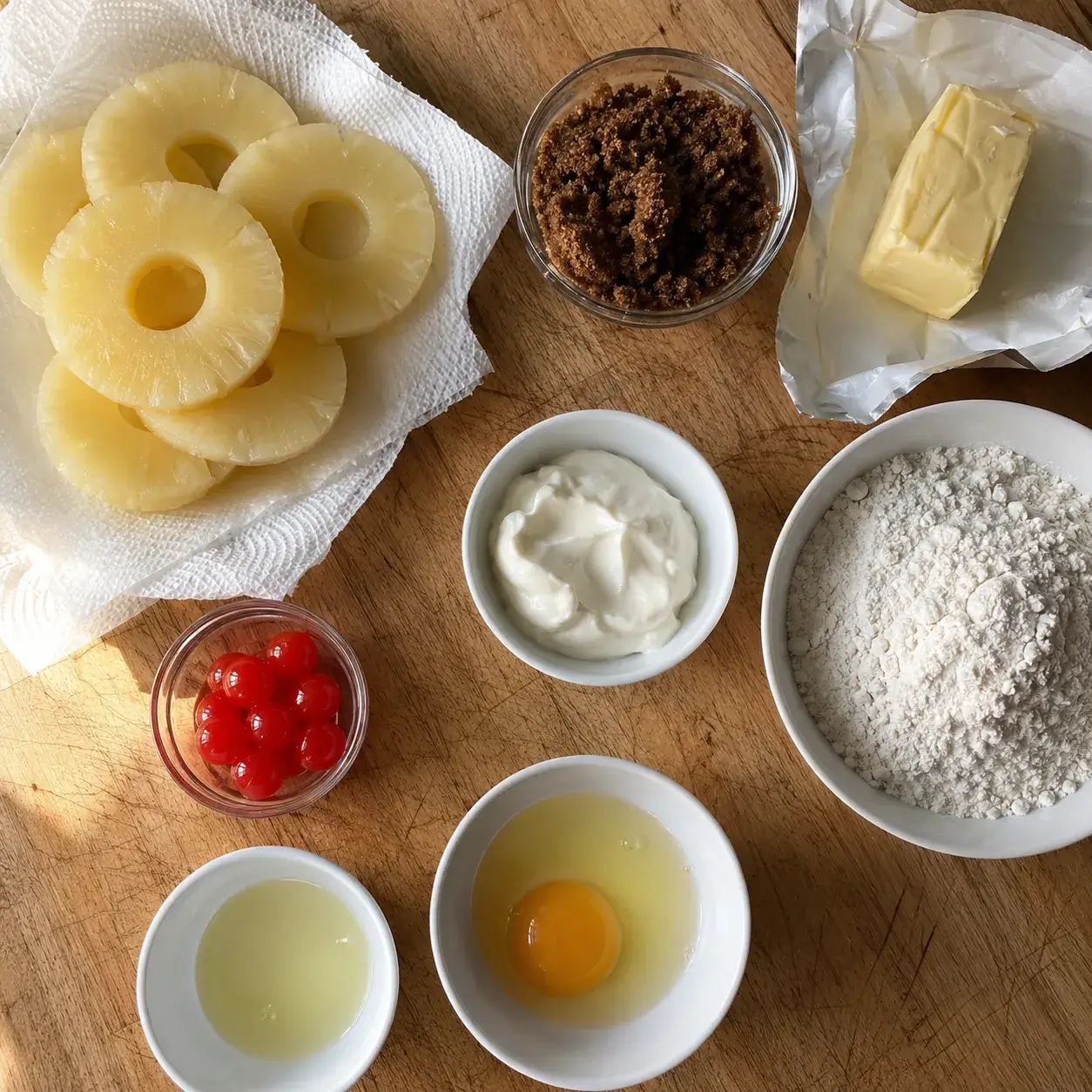
Three notes
- Dark brown sugar, not light. The color and most of the flavor in this topping come from molasses rather than from caramelization, so the sugar with more molasses in it is doing more of the work. Dark brown is a noticeable upgrade here in a way it is not in most recipes.
- Canned rings, not fresh, unless you cook the fresh first. Covered above. Bromelain in raw pineapple attacks protein and can leave the crumb slack and gummy.
- The extra yolk. This cake gets turned upside down and has to hold a wet, heavy fruit layer on top of it without slumping. The yolk adds fat and emulsifier and a little more structure, the same reasoning as the extra yolk in our air fryer vanilla cake. If you want the densest possible crumb under a topping, our air fryer pound cake takes that argument to its conclusion.
How to make it
- Blot the pineapple first, before anything else, so it has time to dry further while you work. Double paper towel underneath, double on top, press firmly, then repeat with dry towels. Save the juice.
- Preheat to 320°F (160°C) for 3 minutes. Whether you need to preheat covers why it matters more on short bakes.
- Grease the pan, base and sides, with soft butter. No parchment on the base, for the reasons above.
- Melt the topping butter into the pan, then stir in the dark brown sugar and the pinch of salt until it is an even layer.
- Give it 4 minutes in the air fryer on its own. Check at 3. You want it bubbling, a shade darker, smelling like toffee. Not smoking. Take it out with tongs.
- Lay the pineapple rings straight onto the hot syrup in a single layer, cherries in the ring holes if you are using them. Press them down gently.
- Whisk the flour, baking powder and salt together and set aside.
- Cream the butter and granulated sugar for about 3 minutes, until pale and fluffy rather than grainy. See creaming.
- Beat in the egg and the yolk one at a time, then mix in the sour cream, pineapple juice and vanilla.
- Add the dry ingredients on low and stop the moment the last streak of flour goes.
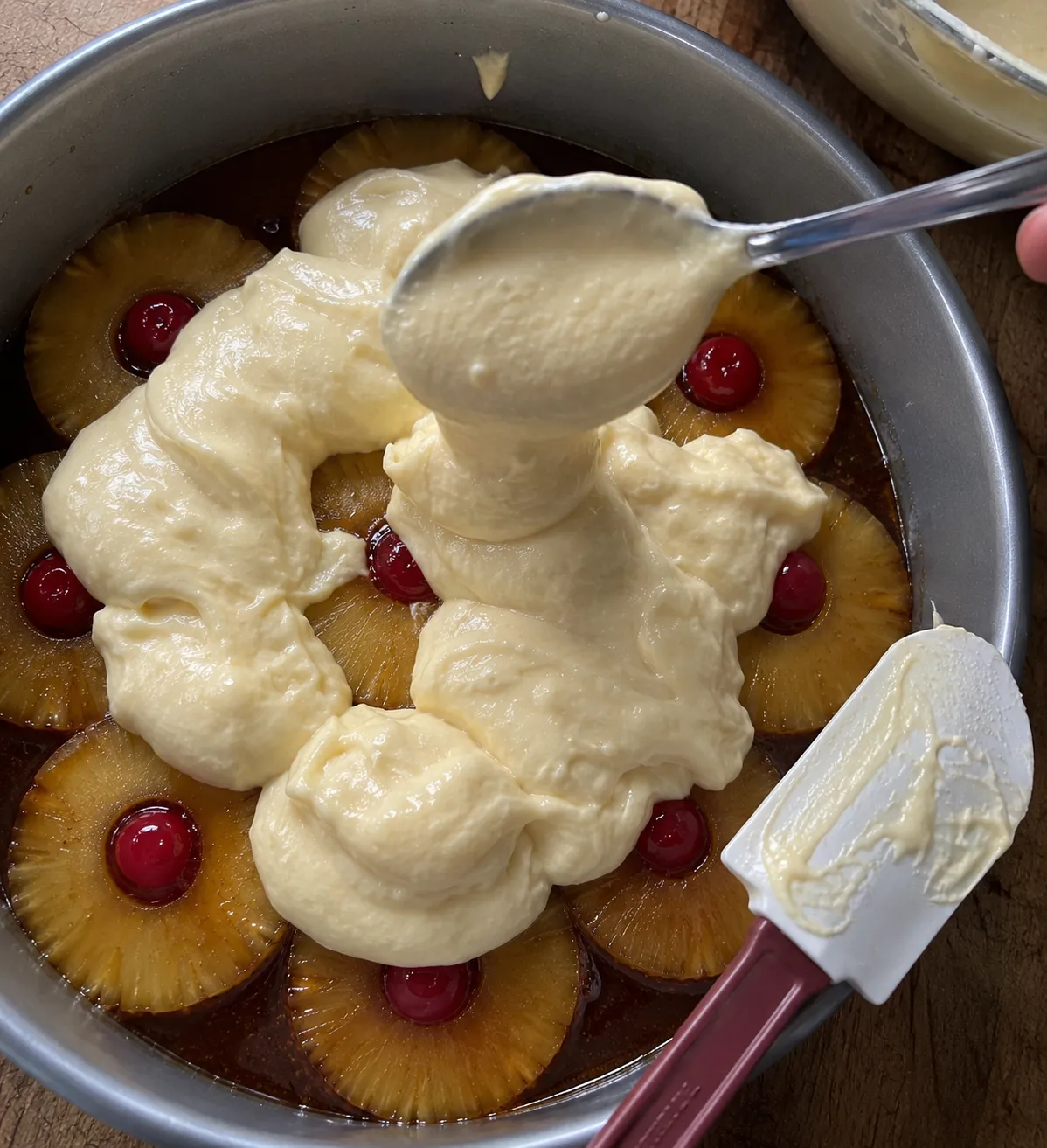
- Spoon the batter over the fruit rather than pouring it, and spread it gently to the edges. Pouring in one place shifts the rings out of position and you will not know until the flip. The pan should be about two thirds full. See fill level.
- Bake 24 to 28 minutes at 320°F. Leave it alone for the first 18. If your machine has a hot spot, turn the pan 180 degrees at 18 minutes.
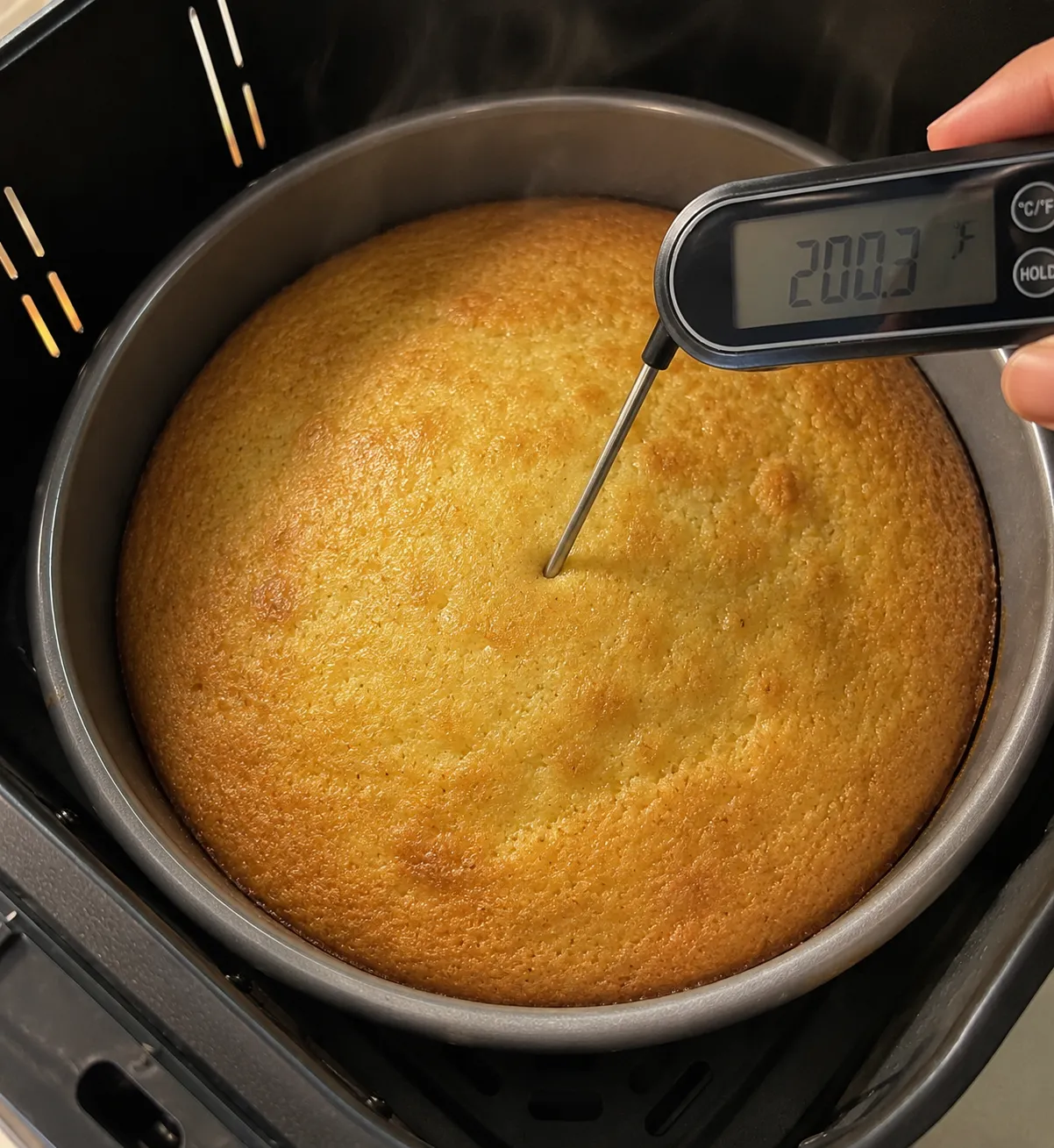
- Check at 24 minutes. You want 200°F in the middle. Probe wherever you like, which is the next section.
- Cool exactly 10 minutes, then run a knife around the sides only and turn it out onto a plate in one movement. Leave the pan resting on top for a minute before lifting it away.
- Spoon any syrup left in the pan over the top and serve warm.
Why 320°F and not higher. Several recipes for this run hot, and one popular one calls for 200°C, which is about 392°F. In a basket that is far too high for a cake with a wet fruit layer in it. The bare batter surface is directly under the element, so at 392°F it darkens hard while the middle is still catching up, and turning the cake over does not undo a burnt face, it just hides a bitter one. 320°F is where the top and the middle finish at roughly the same moment. If you are converting somebody else's oven recipe, run it through the air fryer calculator for the temperature, then take the internal reading rather than trusting its clock.
200°F, and the one cake you can probe anywhere
A butter cake is done at 200 to 205°F in the middle, and here I aim at the lower end, because this cake carries a wet fruit layer that keeps giving up moisture into the crumb as it sits. Pull it at 200°F and it will be perfect by the time you serve it.
There is one genuinely nice thing about this recipe, and it is worth pointing out because it removes the usual fussiness. The surface you are probing is about to become the bottom of the cake. Every other cake on this site involves going in at an angle from the edge so the hole ends up somewhere a glaze will hide. Here you can put the thermometer straight down through the middle of the top and nobody will ever see it.
| Reading | What you have |
|---|---|
| Under 190°F | Not set. Another 3 minutes. |
| 195°F | Nearly. Two more minutes. |
| 200°F | Done. Out, and start the ten minute clock. |
| Past 208°F | Dry, and the topping has had longer than it needed as well. |
The toothpick test is awkward on this one for a different reason than usual: push it in too far and it goes through into the wet fruit layer, comes out smeared, and tells you the cake is raw when it is finished. Stop about two thirds of the way down, or just use a thermometer. An instant-read settles it in three seconds, and targets for everything else are in the air fryer baking chart.
Fixing what goes wrong
| What you got | Why | Fix |
|---|---|---|
| Pale rings, thin syrup | The sugar never got past boiling, because it was under wet fruit and batter the whole time. | 4 minutes in the basket on its own before anything goes on it. |
| Topping ran off when I flipped it | Pineapple juice diluted the syrup, or you flipped too early. | Blot the rings properly. Ten minutes, not five. |
| Rings stayed stuck in the pan | Left too long, so the syrup cooled toward solid and glued them down. | Ten minutes. Past twenty and you are fighting set sugar. |
| Parchment came off stuck to the fruit | You lined the base. | Grease only. The syrup is the release layer. |
| Dark bitter face on the bottom of the cake | Temperature too high. That surface is right under the element. | 320°F, and tent with foil pressed over the rim if it colors early. |
| Toothpick said raw, cake was done | It went through into the fruit layer and came out wet. | Stop two thirds down, or use a thermometer. |
| Rings shifted out of position | Batter poured in one spot pushed them around. | Spoon it over evenly, then spread gently. |
| Slack, gummy crumb | Fresh raw pineapple. Bromelain attacks the protein in the batter. | Canned, or cook fresh rings a couple of minutes first. |
| Soggy layer under the fruit | Too much liquid went in with the rings. | Blot harder. Rings should feel tacky, not wet. |
| Sank in the middle | Pulled before the structure set, or opened it early. | 200°F, nothing before 18 minutes. See why cakes sink. |
If problems repeat across different bakes rather than just this one, the air fryer baking troubleshooting guide covers the usual causes, how to prevent burning deals with the top-browning side, and avoiding dry bakes covers the other direction.
Variations
- Pineapple chunks instead of rings. Easier to fit into a 6-inch pan and they pack more fruit in. Blot them just as hard. You lose the classic look, which may or may not matter to you.
- Peach or apricot. Canned halves, cut side down, work beautifully and behave the same way. Stone fruit brings more juice than pineapple does, so blot even harder.
- Apple. Slices cooked down for five minutes first, the way our air fryer apple cake handles them, since raw apple carries a lot of water into a small cake.
- Rum or bourbon. A tablespoon into the topping syrup after its four minutes, off the heat. It will steam furiously. Worth it.
- Coconut. Two tablespoons of desiccated coconut scattered over the syrup before the rings go on. It toasts in the syrup and ends up on top.
- From a box mix. A yellow cake mix works and the topping method is unchanged, since it is set by the sugar rather than the batter. A standard box makes about twice what a 6-inch pan wants, so hold some back. Our boxed cake mix guide has the times by format.
- Individual ramekins. Four 6 oz ramekins, one ring each, 320°F for 12 to 15 minutes, and the sugar still gets its 4 minutes alone first. Easier to turn out and the ratio of topping to cake is better, and the basket position argument in our air fryer cupcakes applies once you are running several small vessels at once.
For other fruit desserts out of a basket, air fryer baked apples are the simplest thing on this site, air fryer apple pie uses the same cook-the-fruit-first logic in a different form, and air fryer lava cake is the ten minute answer when you have not planned ahead. Air fryer carrot cake and air fryer cheesecake both use the same 6-inch pan if you want more out of it.
That pan is the busiest piece of equipment on this site, in fact. Air fryer lemon cake is the other fruit-forward one and runs at the same 320°F for the same 24 to 28 minutes, air fryer chocolate cake and air fryer red velvet cake are the two to know if you are baking for an occasion, and every cake we have tested in a basket is collected in one place.
Storage
- Best warm, on the day. This is a cake that is genuinely better in the first hour, because the syrup is still glossy and moving.
- Room temperature: 2 days, loosely covered. Not airtight while there is any warmth in it, or the topping sweats and goes watery.
- Refrigerated: 4 days. The syrup sets firm and the fruit weeps a little, so it is a different cake cold. Bring slices back to room temperature or warm them.
- Reheating a slice: 2 to 3 minutes at 320°F, fruit side up. The syrup loosens again and it is close to new.
- Freezing: works for a month, wrapped well, though the fruit softens noticeably on thawing. Freeze it whole rather than in slices.
- Store it fruit side up. Sitting it back on the topping presses the syrup into the crumb and you lose the layer.
Half an hour of air fryer time for a cake this size is very cheap against heating a full oven, and the running cost calculator will give you the figure for your own electricity rate. All four air fryer baking tools are in one place, how to bake in an air fryer covers the method end to end if a basket is new to you, and the accessories guide covers pans that actually fit. The full recipe index has everything else.
Frequently asked questions
QWhy is my pineapple upside down cake topping pale and not caramelized?
Because it never got hot enough, and it structurally cannot while the cake is baking. Sugar caramelizes around 320F, but the sugar layer sits under pineapple rings and batter that are mostly water, and a wet surface cannot climb past 212F while there is still water touching it. So the butter and brown sugar melt into a syrup and stay a syrup. In a basket it is worse than in an oven, because all the radiant heat comes from the element above and lands on the bare batter, while the sugar at the bottom only gets conducted heat through the pan. The fix is to give the butter and sugar 4 minutes in the air fryer on their own, before any fruit or batter covers them.
QWhat temperature and how long for pineapple upside down cake in an air fryer?
320F for 24 to 28 minutes in a 6-inch round pan, pulled at 200F internal, plus 4 minutes at the start for the sugar layer on its own. Published recipes for this run from 320F for 25 minutes up to 200C, which is about 392F, for 40 minutes. That higher end is much too hot for a basket: the bare batter surface sits directly under the element, so it darkens hard while the middle is still catching up, and turning the cake over hides a bitter face rather than fixing it. Individual ramekins take 12 to 15 minutes at the same temperature.
QWhy did my topping run off when I flipped the cake?
Either the pineapple went in wet or you flipped too early, and usually both. Draining the tin is not the same as drying the rings: they carry a lot of liquid, and every tablespoon of it dilutes the sugar syrup so it stays thin instead of setting into a thick glossy layer. Blot them between doubled paper towels, pressing firmly, then repeat with dry towels until they feel tacky rather than wet. Then cool the baked cake for a full 10 minutes before turning it out, because the syrup thickens as it cools and at five minutes it is still liquid enough to run.
QHow long should I cool it before flipping?
Ten minutes, and it is a narrow window rather than a rough guide. Before about seven minutes the syrup is still thin and the crumb next to the pan has not firmed up, so the cake slides and the topping runs out from under the fruit. Past about twenty minutes the syrup has cooled toward a solid and glued the rings to the pan, which is how you end up serving a cake with holes in it. Ten minutes is where the syrup is thick enough to cling to the fruit and everything is still warm enough to release cleanly.
QShould I line the pan with parchment paper?
Not the base, which is the opposite of the usual advice and worth explaining. A parchment circle does two bad things in this particular cake. It puts an insulating layer between the hot pan and the sugar, which is already the least heated thing in the machine, and conduction through the pan base is the only heat that layer gets. And when you flip, the parchment lifts away stuck to the syrup and takes pineapple rings with it, so you end up peeling paper off your finished cake. Grease the pan properly with soft butter instead. The sugar syrup does the non-stick work once it sets.
QCan I use fresh pineapple instead of canned?
Yes, and it tastes better, with one real warning. Fresh pineapple contains bromelain, an enzyme that breaks down protein, and in a cake batter that means it can attack the egg and leave you with a slack, gummy crumb. Heat destroys the enzyme, so cook fresh rings for a couple of minutes before they go into the pan, or use canned juice in the batter even if the rings are fresh. Canned pineapple has already been heat treated during canning, which is why it is the safer default and why almost every recipe for this quietly assumes it.
QHow do I know when it is done without cutting into it?
200F in the middle. This is the one cake on the site where you can put the thermometer straight down through the middle of the top without worrying about the hole, because that surface is about to become the bottom. The toothpick test is awkward here for a different reason than usual: pushed in too far it goes through into the wet fruit layer, comes out smeared, and tells you the cake is raw when it is actually finished. If you are using a toothpick, stop about two thirds of the way down and judge it on what comes off the middle of the stick.
QWhy is the bottom of my cake dark and bitter?
Because it was the top while it baked, and in a basket the top is inches from the heating element. That bare batter surface takes every bit of radiant heat in the machine for the whole bake, and flipping the cake hides it rather than fixing it. Drop to 320F if you were running hotter, and if it still colors early, tent it with a sheet of foil pressed down firmly over the rim of the pan. Press it rather than draping it, because the fan moves air fast enough to lift a loose sheet into the element, which is a real hazard and not a theoretical one.
QDo I need to pre-cook the brown sugar and butter?
You do not have to, and the cake will still be nice without it, but it is the single biggest difference between a pale sweet syrup and something with real caramel flavor. Four minutes in the preheated basket with nothing on top is the only moment in the whole recipe when that sugar is uncovered and free to climb past boiling. Check it at three minutes. You want it bubbling and a shade darker with a toffee smell, not smoking. Sugar goes from correct to acrid in well under a minute once it dries, so watch it and use tongs, because molten sugar burns badly.
QShould I use light or dark brown sugar?
Dark, and it matters more here than in most recipes. Since the sugar layer spends most of the bake capped at boiling by the water around it, very little actual caramelization happens, and most of the color and flavor you taste comes from the molasses that was already in the sugar. Dark brown sugar simply has more molasses in it than light does, so it brings more of what this topping depends on. If you only have light brown sugar, a teaspoon of molasses stirred into it gets you most of the way there.
QCan I make this in individual ramekins?
Yes, and it is the easier version in several ways. Four 6 oz ramekins, one pineapple ring in each, 320F for 12 to 15 minutes, still pulling at 200F. The sugar and butter still get their 4 minutes alone in the ramekins first. Small ones turn out far more reliably than a whole cake because there is less weight bearing down on the topping, the ratio of syrup to crumb is better, and if one of them sticks you have only lost one portion. Cool them 8 minutes rather than 10, since a small ramekin loses heat faster.
QCan I use a box cake mix for this?
Yes, and nothing about the topping method changes, because the timing there is set by the sugar rather than by the batter. Use a yellow or vanilla mix at 320F rather than the 350F on the box, and remember that a standard 15.25 oz box makes roughly twice as much batter as a 6-inch pan wants. Hold the extra back and bake it as cupcakes rather than filling the pan higher, because a cake that rises to the rim in a basket is rising into the element. Everything else on this page, including the four minute sugar step and the ten minute flip, is unchanged.
Never overbake again
Get our one-page times & temps cheat sheet, plus a new tested recipe each week.
No spam · unsubscribe anytime